R E S E A R C H
Open Access
Average bit error probability for the
l-MRC
detector under Rayleigh fading
Mitchell Omar Calderon Inga and Gustavo Fraidenraich
*Abstract
In this paper, an exact expression for the average bit error probability was obtained for thel-MRC detector, proposed in Sendonaris et al. (IEEE Trans Commun 51: 1927-1938, IEEE Trans. Commun 51: 1939-1948), under Rayleigh fading channel. In addition, a very accurate approximation was obtained to calculate the average bit error probability for any power allocation scheme. Our expressions allow to investigate the possible gains and situations where cooperation can be beneficial.
Keywords:User cooperation, Virtual MIMO, Bit error probability, Rayleigh fading
I. Introduction
Diversity techniques have been widely accepted as one of effective ways of combat multipath fading in wireless communications [1], in particular spatial diversity is spe-cially effective at mitigating these multipath situation. However, in many wireless applications, the use of mul-tiple antennas is not practical due to size and cost lim-itations of the terminals. One possible way to have diversity without increasing the number of antennas is through the use of cooperative diversity.
Cooperative diversity has root in classical information theory work on relay channels [2], [3]. Cooperative net-works achieve diversity gain by allowing the users to cooperate, and thus, each wireless user is assumed to transmit data as well as act as a cooperative agent for another user [4], [5]. The first implementation strategy for cooperation was introduced in [1], [6], where the achievable rate region, outage probability, and coverage area were analyzed.
In this pioneering work, assuming a suboptimal recei-ver called l-MRC, the bit error probability was com-puted assuming a fixed channel. This kind of receiver combines the signal from the first period of transmis-sion with the signal transmitted jointly by the both users in the second period of transmission. The variable
l Î[0,1] establishes the degree of confidence in the bits estimated by the partner. For situations where the inter-user channel presents favorable conditions, the variable
lshould be close to unity; on the other hand, for very severe channels conditions, the parameterlshould tend to zero. Unfortunately, the bit error probability was computed only for a fixed channel and remained open for the situation where all the fading coefficients are Rayleigh distributed.
In this paper, an exact and approximate expression is computed for the average bit error probability assuming a Rayleigh fading for the inter-user channel and for the direct channel between users and base station (BS).
II. System Model
This section summarizes the system model that was employed in [1], [6].
A. System Model
The channel model used in [6] can be mathematically expressed as
Y0(t) =K10X1(t) +K20X2(t) +Z0(t) (1)
Y1(t) =K21X2(t) +Z1(t) (2)
Y2(t) =K12X1(t) +Z2(t) (3)
whereY0(t), Y1(t), and Y2(t) are the baseband models
of the received signal at the BS, user 1, and user 2, respectively, during one symbol period. Also,Xi(t) is the
signal transmitted by useri under power constraintPi,
for i = 1, 2, and Zi(t) are white zero-mean Gaussian
noise random processes with spectral height Ni/2for i
* Correspondence: [email protected]
Department of Communications, University of Campinas, Campinas, Brazil
= 0, 1, 2, and the fading coefficientsKijare Rayleigh dis-can track perfectly the variations inK10andK20, user 1
can trackK21and user 2 can trackK12.
The system proposed in [6] is based on a conventional code division multiple access (CDMA) system and divides the transmission into two parts: the first without cooperation and the second with cooperation. For a given coherence time of L symbols and cooperation time of 2Lc symbols, the transmitted signals can be
expressed as shown in (5), whereLn =L-2Lc,b(ji)is user j’sith bit,bˆj(i)is the partner’s estimate of userj’sith bit, and cj(t) is user j’s spreading code. The parametersaij
represent the power allocation scheme, and they must maintain an average power constraint that can be expressed as
transmits its own bits to the BS. The remaining 2Lc
per-iods are dedicated to cooperation: odd perper-iods for trans-mitting its bits to both the partner and the BS; even periods for transmitting a linear combination of its own bit and the partner’s bit estimate.
B. Error Calculations
1) Error Rate for Cooperative Periods: During the 2Lc
cooperative periods, we have a distinction between
“odd” and “even” periods. During the “odds” periods, each user sends only their own bit, which is received and detected by the partner as well as by the BS.
The partner’s hard estimate of b1 is given by
ˆ
, resulting in a probability of bit error equals to
Pe12 =Q
where Q (·) is the Gaussian error integral, Nc is the
CDMA spreading gain, σ2
2 =N2/(2Tc), Tc is the chip
period, andN2/2is the spectral height ofZ2(t).
The BS forms a soft decision statistic by calculating
yodd=
1
Nc
cT1Y0odd (7)
whereYodd
0 =K10X1+K20X2+Z0odd.
During the“even” periods, each user send a
coopera-tive signal to BS according to
Yeven
0 =K10X1+K20X2+Z0even, and the BS extracts a soft
decision statistic by calculating
yeven=
1
Nc
cT1Y0even (8)
The combined statistics at BS for user 1 is therefore given by
yodd=K10a12b1+nodd
yeven=K10a13b1+K20a23bˆ1+neven
(9)
where noddandneven are statistically independent and
both distributed according to a Gaussian distribution N(0,σ02/Nc).
The optimal detector shown in [1] is rather complex and does not have a closed-form expression for the resulting bit error probability. Thus, they consider the following suboptimum detector
ˆ
b1= sign([K10a12λ(K10a13+ K20a23)]y) (10)
where y = [yoddyeven]T √
Nc/σ0andl Î [0,1]. They call
this suboptimum detector as thel-MRC. The probabil-ity of bit error for this detector is given by
Pe1= (1−Pe12)Q
III. Rayleigh fading calculations
The expression presented in (11) is only valid for a fixed (time-invariant) channel, that is, the fading coefficients Kij are fixed. The aim of this paper is to obtain an
expression for the bit error probability when the fading coefficients vary according to a Rayleigh distribution.
A. Bit Error Probability
¯
whereg12 is the average signal-to-noise ratio, defined
as
From (11), we can define two random variables U1
andU2, respectively, as
vT
sinceK10andK20are Rayleigh distributed, the support
of (14) will be always greater than zero. On the other hand, since we have negative values in the numerator of (15), its support will be all the real line. Taking this into account, we can rewrite (11) as
Pe1=
To obtain the error probability, we must average Pe1,
over the probability density function (PDF) ofU1 and
U2[7]. Thus, we have to evaluate the integral
Pef =
In order to calculate Pef, we have to know the
distri-bution of U1 andU2, thus to facilitate the calculations,
we assume an equal power allocation situation, where a12 =a13 =a23=a. With this assumption the random
variablesU1 andU2will be simplified to
U1=
write the cumulative distribution function (CDF) and the PDF ofU1, respectively, as
Fu1(u1) =∫
Note that this region is very similar to a rotated ellipse but not exactly an ellipse.
Since K10 andK20 are independent Rayleigh
distribu-tion with parametersa10and a20, respectively, we have
Fu1(u1)=
now it is possible to derive the PDF ofU1 easily as
fu1(u1)=
and unfortunately, it is not possible to evaluate (28) in a closed-form solution.
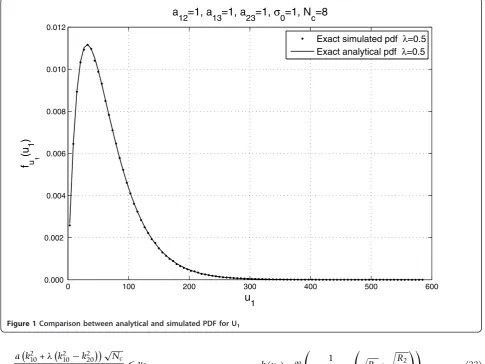
In order to validate the above formulation, Figure 1 shows the analytical and simulated PDF ofU1. Note the
excellent agreement between them showing the correct-ness of our formulation.
Following similar rationale, we now find the CDF and PDF ofU2. Note that in this case, the region of
ak2
leading to the following CDF and PDF, respectively, as
Fu2(u2)=
andR2are described in the Appendix.
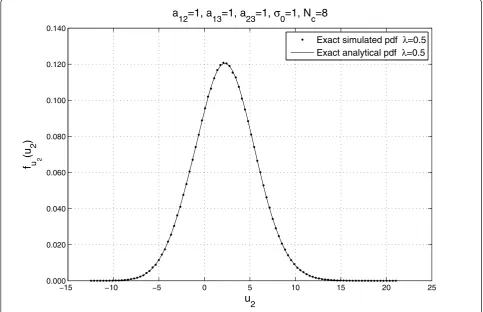
In the same way as in the first case, (31) cannot be obtained in a closed-form solution. Figure 2 compares the analytical and simulated PDF ofU2 in order to
vali-date our formulation.
Once that the PDFs ofU1 and U2were exactly
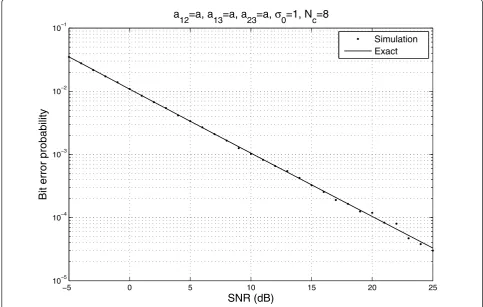
com-puted, it is possible to obtain the average bit error prob-ability by simply substituting (28) and (31) into (17). Figure 3 shows the simulation result of the bit error probability and the result of our theoretical expression given in (17), where we can observe that both curves are
almost coincident. In this figure,SNR = P σ2
0
. According
to Section II-B, we consider three symbols periods, each period with an average power of P. Also, for simplicity,
0 100 200 300 400 500 600
we consider that EK2 10
, EK2
20
and EK2 12
are identical.
Although (17) presents the exact solution to the aver-age bit error probability, in some cases, the complexity to compute this expression can be prohibitive. For this reason, we found a very accurate approximation for the bit error probability presented in the sequel.
B. Approximate Bit error Probability
The main problem in order to obtain a simpler expres-sion for the bit error probability is to simplify the PDFs of U1 and U2 given, respectively, in (14) and (15). In
order to obtain an approximation, the expressions (14) and (15) can be reduced when l= 1,s0 = 1 anda12=
a13=a23 = 1. Therefore, the new random variables are
given by
U1=Nc
K102 +(K10+K20)2
(35)
U2=
√
Nc
2K2 10−K202
K102 +(K10+K20)2
(36)
Considering Du1as the region of the planeK10×K20
where Nc
k210+(k10+k20)2
≤u1, it can be seen that
Du1corresponds to the area of an ellipse whose center
is in the origin (0, 0). Unfortunately, the evaluation of the integral (20) is rather complex for the domain Du1.
For this reason, we consider a simplified version ofDu1,
as being the area of a circle expressed ask2
10+k220 ≤u1.
This simplification can be applied since a circle corre-sponds to a particular case of the general ellipse. Hence
Fu1
u1
=
√
u1
k20=− √
u1 √
u1−k220
k10=− √
u1−k220
fk10k20(k10,k20)dk10dk20(37)
This gives
fu1
u1
=
√
u1
k20=−√u1
1
2
u1−k220
fk10k20
u1−k220,k20
+
fk10k20
−u1−k220,k20
dk20
(38)
−15 −10 −5 0 5 10 15 20 25
0.000 0.020 0.040 0.060 0.080 0.100 0.120 0.140
u
2
f
u 2(u
2)
a
12
=1, a
13=1, a
23=1,
σ
0=1, N
c=8
Exact simulated pdf λ=0.5
Exact analytical pdf λ=0.5
Since K10 andK20 are independent Rayleigh
distribu-ted with parameters a1anda2, respectively, the PDF of
U’1 given in (38) will result in a chi-square probability
distribution with four degrees of freedom [8]. Therefore, our approximation ofU1will be given by
fu1(u1)≈
4u1
γ2 1
e−2u1/γ1 (39)
whereg1is the mean ofU1 given in (14)
γ1=E[U1] (40)
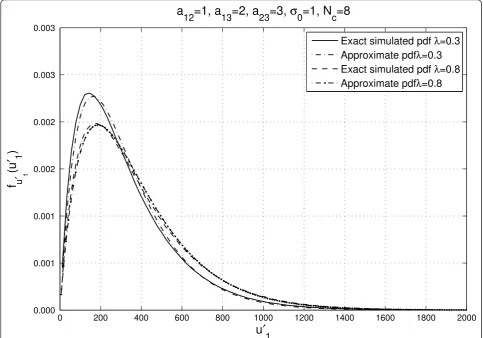
Figure 4 shows the comparison between our approxi-mate PDF given in (39) and the computer simulation for the PDF ofU1 given in (14) for two different values
of lkeeping the same values for a12 = 1,a13 = 2, and
a23 = 3. We observe that the curves are very close for
both values ofl. Although only these two cases are pre-sented here, many other cases were compared and the approximation still remains very good.
A similar rationale can be applied in order to find a good approximation forU2. The region of theK10×K20
plane whereU2≤u2is similar to (29). Note that the range ofU2 varies from−∞ ≤u2 ≤ ∞, discarding all
the distributions with positive support. In order to observe the behavior of the PDF ofU2, a large number
of simulations were performed, and the Gaussian distri-bution proves to fit extremely well in all the cases. Therefore, assuming a Gaussian distribution, the follow-ing can be written
Pef≈ 1 4
1 +
γ
12 2 +γ12
1− √γ
1(γ1+ 6)
(γ1+ 4)3/2
+1 2
1−
γ
12 2 +γ12
Q
γ
2 √
1 +v2
(41)
fu2(u2)≈
1
√
2πν2e
−(u2−γ2) 2
2ν2 (42)
where
γ2=E[U2] (43)
ν2= var (U
2) (44)
Figure 5 shows the comparison between the approxi-mate PDF given in (42) and the computer simulation for the PDF ofU2 given in (15), for two different values
of l. Note that the approximation is less accurate for small values of l, but this inaccuracy does not have a significant influence in the bit error probability. In all
−5 0 5 10 15 20 25
10−5 10−4 10−3 10−2 10−1
SNR (dB)
Bit error probability
a
12
=a, a
13=a, a
23=a,
σ
0=1, N
c=8
Simulation Exact
the cases, the approximation fits very well the exact PDF ofU2.
Using (39) and (42) into (17), it is possible to obtain a very accurate approximate bit error probability. Fortu-nately, both integrals can be found in a closed-form solution as
∞
0
Q√u1
4u1
γ2 1
e−2u1/γ1du1
=1 2
1−
√γ
1(γ1+ 6)
(γ1+ 4)3/2
(45)
and
∞
−∞ Q(u2)
1
√
2πν2e
−(u2−γ2)2 2ν2 du
2=Q
γ2 √
1 +ν2
(46)
All these calculations lead to the approximate bit error probability for the l-MRC detector as shown in (41), whereg12is given in (13),g1 is given in (40), g2is given
in (43), andν2is given in (44).
Assuming an equal power allocation scheme (a12=
a13=a23=a), Figure 6 shows the comparison between
the theoretical bit error probability presented in (17)
using the exact PDFs (28) and (31) and our approxima-tion given in (41). We can observe that both curves are almost the same, validating our approximation.
Our results are quite exact for a different power allo-cation scheme as well. This can be seen in Figure 7, where a comparison between the exact simulated bit error probability and our approximation given in (41) was performed. In this figure, the following parameters were useda10=a20= 1 anda12= 0.8.
The final approximate expression allows us to deter-mine the optimal value for lin each case. As stated in [1], when the BS believes that the inter-user channel is
“perfect”, thenl= 1 and the optimal detector turns out to be the maximal ratio combining [7]. As the inter-user channel becomes more unreliable, i.e., as Pe12increases,
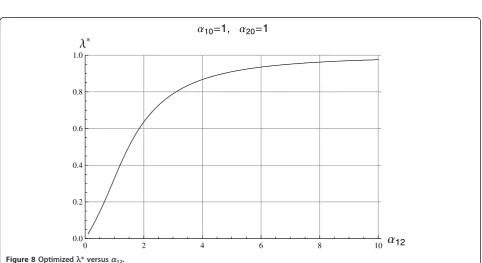
the value of the best l decreases toward to zero. In order to demonstrate this behavior, Figure 8 shows the optimized l* versus the inter-user channel parameter
a12. This curve was obtained using computational opti-mization techniques that minimizes our approximate bit error probability (41) with respect tolfor each value of the inter-user channel parameter, a12. The direct
0 200 400 600 800 1000 1200 1400 1600 1800 2000
0.000 0.001 0.001 0.002 0.002 0.003 0.003
u
′
1
f
u′ 1(u
′
1)
a
12
=1, a
13=2, a
23=3,
σ
0=1, N
c=8
Exact simulated pdf λ=0.3 Approximate pdfλ=0.3 Exact simulated pdf λ=0.8 Approximate pdfλ=0.8
−30 −20 −10 0 10 20 30 0.00
0.02 0.04 0.06 0.08 0.10 0.12 0.14 0.16 0.18 0.20
u′2
f u′ 2
(u
′ 2
)
a12=1, a13=2, a23=3, σ0=1, Nc=8
Exact simulated pdf λ=0.01
Approximate pdfλ=0.01
Exact simulated pdf λ=0.9
Approximate pdfλ=0.9
Figure 5Comparison between the simulated PDF of (15) and our approximation given in (42).
−5 0 5 10 15 20 25 30
10−5 10−4 10−3 10−2 10−1
SNR (dB)
Bit error probability
a
12=a, a13=a, a23=a, σ0=1, Nc=8
Exact Approximation
−5
0
5
10
15
20
25
10
−410
−310
−210
−1SNR (dB)
Bit error probability
a
12
=0.7a, a
13=1.3a, a
23=a,
σ
0=1,
α
10=
α
20=1,
α
12=0.8, N
c=8
Simulation
Approximation
Figure 7Comparison between exact and approximate bit error probability for a non equal power scheme allocationl= 0.5.
0 2 4 6 8 10
Α
12 0.00.2 0.4 0.6 0.8 1.0
Λ
Α
101,
Α
201
channel parameters a10=a20 = 1 were kept constant,
and the equal power allocation scheme (a12=a13=a23
= 1) was adopted.
IV. Conclusions
In this paper, an exact and approximate expression for the average bit error probability under Rayleigh fading for thel-MRC presented in [1] was obtained.
The exact expression was obtained under the condi-tion of an equal power allocacondi-tion scheme. The expres-sion was validated through simulations showing a perfect agreement between exact and simulated curves.
In order to reduce the complexity of the exact expres-sion, a very accurate approximation was presented as well. The approximate expression is valid for any values ofl,a12,a13, anda23. The expression has been validated
by simulation for a variety of values showing a small dif-ference between the exact and approximate curves.
Both expression can be very important in many situa-tions where the performance of a cooperative system employing CDMA should be evaluated.
V. Competing Interests
The authors declare that they have no competing interests.
Appendix
R1= 2M1+M2+
M3
M2
R2= 24k20λ2μ22A2λ1
3
R1
+ 8M1−2M2−
2M3
M2
M1= 2A22λ λ1k220+λ2u22
M2= 3
E+ 2G+A2k20λλ1u22
√
27F
M3= 16A42λ2λ21k420−
4A22λ
2λ3+ 5λ2+ 2λ−1u22k220+λ22u42
E=−λ32u62+ 6(A2K20)2λλ5u42−
24(A2K20)4λ2λ21λ3u22
F=−16(A2k20)6λ2λ21λ4+ 8(A2k20)4λλ7u22−
(A2k20)2λ6u42+λ32u62
G= 32(A2k20)6λ3λ31
λ1=λ+ 1
λ2=
λ2+ 1
λ3=
2λ2+ 3λ−1 λ4=
5λ2+ 2λ+ 1 λ5=
2λ5+ 5λ4−5λ3−14λ2−7λ−1 λ6=
13λ6+ 28λ5−34λ3−12λ2−8λ+ 1
λ7=
7λ5+ 22λ4+ 17λ3+ 3λ2−1
Received: 11 February 2011 Accepted: 10 November 2011 Published: 10 November 2011
References
1. A Sendonaris, E Erkip, B Aazhang, User cooperation diversity Part II: Implementation aspects and perfomance analysis. IEEE Trans Commun.
51(11), 1939–1948 (2003). doi:10.1109/TCOMM.2003.819238
2. EC van der Meulen, Three-terminal communication channels. Adv Appl Probab.3(1), 120–154 (1971). doi:10.2307/1426331
3. TM Cover, A El Gamal, Capacity theorem for the relay channel. IEEE Trans Inform Theory.25(5), 572–584 (1979). doi:10.1109/TIT.1979.1056084 4. A Nosratinia, TE Hunter, A Hedayat, Cooperative communication in wireless
networks. IEEE Commun Mag.42(10), 74–80 (2004). doi:10.1109/ MCOM.2004.1341264
5. JN Laneman, DNC Tse, GW Wornell, Cooperative diversity in wireless networks: Efficient protocols and outage behavior. IEEE Trans Inform Theory.
50(12), 3062–3080 (2004). doi:10.1109/TIT.2004.838089
6. A Sendonaris, E Erkip, B Aazhang, User cooperation diversity Part I: System description. IEEE Trans Commun.51(11), 1927–1938 (2003). doi:10.1109/ TCOMM.2003.818096
7. JG Proakis, Digital Communications, 4th ed. (McGraw-Hill, New York, 2001) 8. S A Papoulis, Unnikrishna Pillai, Probability, Random Variables and
Stochastic Processes 2001, 4th ed. (McGraw-Hill, 2002)
doi:10.1186/1687-1499-2011-166
Cite this article as:Inga and Fraidenraich:Average bit error probability
for thel-MRC detector under Rayleigh fading.EURASIP Journal on
Wireless Communications
and Networking20112011:166.
Submit your manuscript to a
journal and benefi t from:
7Convenient online submission
7Rigorous peer review
7Immediate publication on acceptance
7Open access: articles freely available online
7High visibility within the fi eld
7Retaining the copyright to your article