R E S E A R C H
Open Access
Low complexity antenna selection for V-BLAST
systems with OSIC detection
Youngtaek Bae and Jungwoo Lee
*Abstract
Multiple-input multiple-output (MIMO) systems have an advantage of spectral efficiency compared to single-input single-output systems, which means that the MIMO systems have significantly higher data throughput. The V-BLAST (Vertical Bell Laboratories Layered Space Time) scheme is a popular transceiver structure which has relatively good performance. In the V-BLAST scheme, ordered successive interference cancellation (OSIC) technique was proposed as a possible efficient detection method in terms of performance and complexity. However, MIMO systems suffer from high complexity and implementation cost. As a practical solution, a technique called antenna selection has been introduced. Since the existing literature considered only the capacity-based selection, we develop an optimal selection method for V-BLAST scheme using OSIC detection with respect to error rate performance in this article. Its complexity is shown to be proportional to the fourth power of the number of transmit antennas. To reduce the complexity without significant performance degradation compared to the optimal selection method, a near-optimal selection method is also proposed. Simulation results show that the proposed selection method is very close to the performance of optimal selection.
Keywords:MIMO systems, antenna selection, V-BLAST, QR decomposition, OSIC detection, low complexity
Introduction
The spatial multiplexing systems with multiple transmit/ receive antennas, referred to as input multiple-output (MIMO), have been developed to provide high data rate with limited bandwidth, i.e., high spectral effi-ciency. MIMO techniques can also be used to increase the diversity order for reliable transmission in a fading channel [1], [2]. One of the implementation issues of MIMO sys-tems is the increased hardware complexity and cost. A popular approach being employed to address the issue is the technique called the antenna selection. It has been shown that antenna selection maintains the same diversity order as the full antenna system, which makes antenna selection even more attractive (see [3], [4], and references therein).
In antenna selection, a critical issue is developing the selection method. In [5], those authors proposed selection methods based on minimum error rate for spatial multi-plexing systems with linear and maximum likelihood (ML) receivers. Similar results based on the second-order
statistic of the channel are also described in [6]. Selection method when using the space-time coding was provided in [7]. In [8], an optimal selection method for maximizing the capacity was proposed, and incremental or decremen-tal selection methods as a greedy search algorithm were suggested to reduce the selection complexity in [9]. For ML detection, the performance analysis of antenna selec-tion was already studied in [10] by giving upper bounds on the pairwise error probability. However, the selection method for a nonlinear receiver such as successive inter-ference cancellation (SIC) has not been investigated thor-oughly. Even though antenna selection for V-BLAST (Vertical Bell Laboratories Layered Space Time) scheme was analyzed in [11], this article considered only the capa-city as a performance metric as in the existing literature. In terms of error rate performance, few articles have con-sidered antenna selection for the V-BLAST scheme using ordered successive interference cancellation (OSIC) detec-tion since the detecdetec-tion order makes the analysis more complicated.
In this article, we focus on the antenna selection for V-BLAST scheme using OSIC detection with respect to error rate performance. Basically, SIC has two operations:
* Correspondence: [email protected]
School of Electrical Engineering and Computer Sciences, Seoul National University, Seoul 151-744, Korea
nulling and cancellation. Common methods for the nul-ling step are the minimum mean square error (MMSE) and zero-forcing (ZF). In addition, it is well known that the detection order is critical to the overall performance. The optimal detection order is obtained by choosing a stream with the largest signal-to-noise and interference ratio (SINR) at each stage of the detection process as shown in [12].
Considering the optimal detection order, we derive an alternative expression for SINR using QR decomposition of which the derivation is similar to [13]. The optimal antenna selection method will be derived using this expression. However, obtaining the optimal detection order needs so many pseudo-inverse matrix operations as the number of transmit antennas. Therefore, the selection operation itself becomes very complex. In order to reduce the selection complexity, we will propose a new detection order with which we select the antenna subset. This new detection order can be obtained by only one pseudo-inverse matrix operation, and thus it can be very effective in the MIMO systems with a large number of antennas. We will show that the reduction in the selection complex-ity of the new detection order does not degrade the overall performance significantly by analysis and simulations.
The rest of this article is organized as follows. Section II describes the system and the channel model. In Section III, we review the OSIC detection used in the conven-tional V-BLAST scheme and derive an alternative expres-sion for SINR. In Section IV, we derive the optimal antenna selection method, and propose new near-optimal selection method. In Section V, we discuss the complex-ity of both methods. Section VI shows the simulation results. Finally, we provide our conclusion in Section VII.
System and channel model
MIMO wireless systems withTtransmit andRreceiver
antennas are considered in this study. The number of
available radio frequency chains areNandM,
respec-tively. According to the selection criterion,Nout ofT
andMout ofRtransmit and receive antennas,
respec-tively, are selected. The channel has flat fading which is slowly time varying. We assume that the receiver can track the channel state information (CSI) perfectly, but the transmitter does not know CSI. Therefore, antenna selection should be carried out on the receiver side by using current CSI. The selected antenna indices are then fed back to the transmitter. We also assume that this feedback path has negligible error and delay.
After antenna selection is applied, the discrete time for the MIMO system model can be described as
y=
SNR
N Hx+n (1)
where SNR is the expected signal-to-noise ratio at
each receiver antenna, yrepresents the M × 1 received
symbol vector, His the M×Nselected channel matrix,
x is theN × 1 transmitted symbol vector, andnis the
complex additive white Gaussian noise with variance 1/2
per each dimension. Each entry of theR ×T original
channel matrix is an i.i.d. circular symmetric complex Gaussian fading coefficient with zero mean and unit var-iance. The transmitted symbol is normalized such that
E[xxH] =I
N, where IN is an N × N identity matrix.
Throughout this article, (·)Hand (·)⊤denote the complex conjugate transpose and the transpose of a matrix, respectively. A (Moore-Penrose) pseudo-inverse of a matrix is represented by (·)†, and (·)istands for the ith
column of a matrix.
OSIC detection algorithm
A. ZF-based nulling
The OSIC with ZF as the nulling step had been described in [12]. In order to derive an alternative expression for SINR at each detection stage, we sum-marize the overall process of ZF-OSIC detection algo-rithm as follows
whereHki denotes the matrix obtained by zeroingk1 to kicolumns of HandHk0 =H. Assuming the previous detected symbol is correct and using the fact that wki vector is orthogonal to columns which is not yet detected and canceled, the post-detection SINR for the
ρki=
We assume that the detection order is known in advance for the time being. This seems unreasonable at first, but from the procedure in [12], we can see that the detection order depends on only the channel matrix. In other words, the detection order is not affected by cance-lation steps of the transmitted symbols. Therefore, if the current channel can be estimated at the receiver via training or pilot signals, then we can obtain the detection order for the antenna selection. Because antenna selec-tion achieves larger gain in a slow-fading channel than in a fast-fading channel, the processing to obtain the detec-tion order does not have to occur frequently. Thus, we can also use the detection order of the training signals.
Let the optimal detection order p = [k1, k2, ..., kN].
Using this order, we can make the permutation matrix Pas follows:
P(ki,N−i+ 1) = 1 for 0≤i≤N (3)
where the size ofPmatrix isN×N, andkiis the
inte-ger number between 1 andN which is theith element
of p vector. To rearrange the columns of the channel
according to the detection order, we multiply the chan-nel matrix by thePmatrix. It can easily be checked that this operation rearranges the columns of the channel matrix from the right to the left according to the detec-tion order. The permutated channel matrix can be denoted by a QR decomposition.
HP=QR (4)
whereQ is an M ×N matrix such thatQH Q =IN,
andRis anN×Nupper triangular matrix. Now, using
the definition of pseudo-inverse matrix H†= (HH H)
-1HH
andP-1=PH, we can getH†=PR-1QH. Therefore, the following relation is obtained:
H†(H†)H= (HHH)−1=PR−1(HH)−1PH (5)
Owing to the special structure of the P matrix, the
diagonal element of denominator of (2), i.e., the norm of
kith row can be described as follows: all i, an alternative expression for the post-detection SINR of thekith stream is
ρki=
SNR
N |RN−i+1,N−i+1|
2. (7)
That is, the SINR of each detection stage is propor-tional to the squared absolute value of diagonal elements of theRmatrix. This result can be explained intuitively as follows. The pure permutation operation of the chan-nel matrix does not affect the system performance. The
detection order inHPis from the rightmost column to
the leftmost column. In this case, the nulling vectorwkiis the same as the conjugate of the (N-i+ 1)th column of Qmatrix, i.e.,wki= (Q)∗N−i+1. Therefore, the SINR at the first detection stage is proportional to the last diagonal
element RN,NofR, the SINR at the second detection
stage toRN-1,N-1, and so forth.
B. MMSE-based nulling
In the case of the MMSE-based nulling, pseudo-inverse matrix operation should be changed as follows:
G1=
√
α(HHH+αIN)−1HH (8)
whereα= N
SNR. The ZF nulling completely eliminates
the interference among transmitted streams at the expense of noise enhancement. On the other hand, the MMSE-based nulling pursues the balance of noise enhancement and estimation error. Here, we let the
[HH √αI Now, we can notice that theA†has the pseudo-inverse form similar to the ZF equalizer,H†. From this point of view, we can also express the alternative expression for SINR of MMSE-OSIC. In the same manner, we make the
permutation matrixPunder the assumption that we know
the optimal detection order in advance. By considering the detection order, we make a modified augmented matrix:
where Ris the N ×N upper triangular matrix with
real diagonal elements, and it is noted that theM ×N
upper matrixQumay not be a unitary matrix. From the
above equation,HP=QuR.
The post-detection SINR of MMSE V-BLAST for the
Using the definition of pseudo-inverse, the following equality is established for the augmented matrixA:
A†(A†)H= (HHH+αIN)−1. (12)
By combining (10), (11), and (12) according to the simi-lar argument of ZF-OSIC, thekith post-detection SINR is
ρki=
The kith SINR of MMSE-VBALST has the similar
form as (7) except for the QR decomposition applied to the augmented matrix and the bias term of-1.
Selection criteria
Let us now develop the antenna selection method using the alternative expression for SINR discussed in the pre-ceding section.
A. Optimal selection methods
The error rate performance of a spatial multiplexing MIMO system is mostly affected by the stream with the smallest SINR. Therefore, it is optimal to choose the antenna subset maximizing the minimum value of diago-nal elements of theRmatrix for OSIC. The optimal selec-tion criterion (SCopt) with respect to symbol error rate is
SCopt= max
s⊂S mini Ri,i(s) (14)
whereS is the set of all possible antenna combination,
and sis the element set which consists of the selected
antennas, 1≤i≤N.
B. Proposed selection method
The optimal method needs to compute a pseudo-inverse matrix operation at each iteration step to determine the detection order (p). In general, a pseudo-inverse of a matrix can be computed through singular value decom-position (SVD). As an alternative detection order, we propose to determine the detection order by a single pseudo-inverse as follows:
That is, the detection order is determined by the row
norms of G1 in the increasing order. To have some
intuition, let us consider the ZF-OSIC algorithm again and assume||gT
stream is detected and canceled, then we have
where δi represents the variation vector from G1.
From this relation andH†H=IN, we can induce
follow-ing property fori= 2, 3, ...,N:
δi⊥{h2,. . .,hN}
gi∈span{h2,. . .,hN}.
(17)
That is,δiis orthogonal togi. Therefore each squared
row norm of
However, we do not know the norm of variation vec-tors in advance. Therefore, it is possible to have
||gi||2+||δ
i||2<||g2||2+||δ2||2for some i >2. From this point on, the new detection order begins to deviate from the optimal order. If the variation vector has a small norm, then the new detection order will be nearly the same as the optimal detection order. Thus, we pro-pose to use this new detection order for selecting the
antenna subset. The Pmatrix can be produced through
only one pseudo-inverse of the channel matrixH.
Since (17) is not satisfied for MMSE-OSIC, additional term begins to affect on the row norm as
gi+δi2=gi
2
+δi2+ 2giδHi . (19)
Therefore, when the selection using new detection order is used for MMSE-OSIC, it is obvious that the performance gap from optimal selection case will be lar-ger than in the ZF-OSIC case, which will be shown in simulation results. Of course, this analysis does not
show the effect on the diagonal elements of the R
matrix directly. However, we can conjecture that the variation vector has small norm for a random complex matrix. Therefore, the new detection order will be almost the same as the optimal order at least for the first few indices. Here, we notice that the first order is always the same for the optimal and the suboptimal order, but the tractable analysis on the overall effect of the detection order may be difficult as the number of transmit and receiver antenna increases.
Complexity comparison
of a flop which is a floating point operation. The com-plexity is measured by the number of flops, denoted as
F. For anM×NmatrixHÎℂM×N, a Classical
Gram-Schmidt (CGS) algorithms for QR decomposition needs
FCGS= 8M2N−2M N flop operations [14]. The flop
count for SVD of a real valuedM×Nmatrix is given by
4M2N+8MN2 +9N3in Golub-Reinsch algorithm [15].
The multiplication and the addition between two com-plex scalar values require six flops and two flops, respec-tively. Further, most operations in SVD are matrix multiplications, which in turn consist of several vector dot products. Each dot product of two real vectors with
length Nhas the flop count of 2N, whereas the flop
count for two complex vectors is 8N. That is, the SVD
complexity of a complex matrix is four times higher than that of a real matrix approximately due to some addi-tional scalar multiplications and additions. This is more accurate than [14] where the flop count of a complex SVD is approximated by six times that of a real SVD by treating every operation as complex multiplication. Thus,
the flop count for SVD of a complex valued M × N
matrix isFSVD≈16M2N+ 32MN2+ 36N3.
To get the optimal detection order, we need N
pseudo-inverse operations for the matrices where the
size decreases from M ×N to M × 1. Therefore, the
total flop count for optimal order can be calculated by
FOpt−Order≈ N
k
16M2k+ 32Mk2+ 36k3
= 8M2N(N+ 1) +16
3MN(N+ 1)(2N+ 1) + 9N2(N+ 1)2.
(20)
Therefore, the total flop count of optimal selection is
FTot−Opt≈FOpt−Order+FCGS (21)
≈O((max[8K2, (323)K])·N4) (22)
where we setK=M/Nas the ratio of the number of
receiver antenna to that of transmit antenna, which is larger than one for a V-BLAST system. While the new detection order needs only one pseudo-inverse matrix operation, the total flop count of the proposed selection method is
FTot−Sub≈FSVD+FCGS (23)
≈O((max[24K2, 32K, 36])·N3). (24)
Approximately, the proposed algorithm has 1/Ntimes
the complexity of the optimal selection method in flops
for the case of K ≈ 1. Thus, the larger the number of
transmit antennaN, the more the complexity reduction
that we get for the proposed selection method.
Simulation results
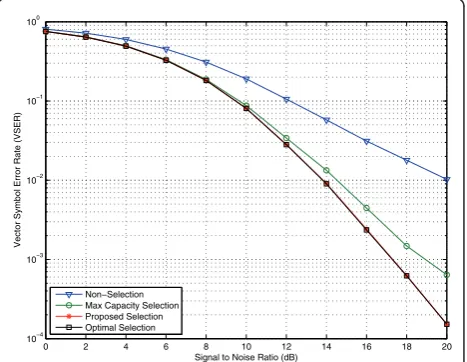
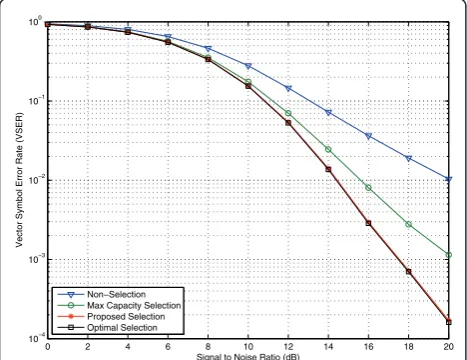
Monte Carlo simulations are performed for a wireless system with multiple antennas to evaluate the perfor-mance of the proposed selection criterion. For the sake of simplicity, we consider only transmit antenna selec-tion. However, this simplification does not change the relative performance tendency for each criterion. Perfor-mance is measured based on vector symbol error ratio (VSER), which is obtained by averaging over 10,000 ran-domly generated channels according to i.i.d. distribution. We used QPSK modulation in all the simulations, and one frame consists of 100 vector symbols. In all the fig-ures, two other methods are also compared. One is the well-known maximum capacity-based selection where a
general capacity formula log2det(IN+
SNR N H
HH) is
used. Implementing an algorithm to compute the deter-minant has the complexity order ofO(N3). Compared to (24), the maximum capacity method has the same com-plexity order assuming thatKis fixed, but the proposed method has better performance than the maximum capacity method in terms of VSER. The other is the non-selection case which means a system with fixed Tx and Rx antennas. For a fair comparison, the channel matrix of the non-selection case the size of which is the same as the selected channel matrix is generated accord-ing to i.i.d. circular symmetric complex Gaussian fadaccord-ing with zero mean and unit variance. It is noted that this case has no diversity advantage.
Figures 1 and 2 show the performance comparison of selection methods from a 3 × 4 system to a 3 × 3
system for ZF-OSIC and MMSE-OSIC where M ×N
denotes the size of channel matrix. It is shown that the optimal and the proposed methods have almost
0 2 4 6 8 10 12 14 16 18 20
10−4 10−3 10−2 10−1 100
Signal to Noise Ratio (dB)
Vector Symbol Error Rate (VSER)
Non−Selection Max Capacity Selection Proposed Selection Optimal Selection
Figure 1ZF-OSIC: VSER curves for antenna selection from (3 ×
4) to (3 × 3) where (M×N) means channel matrix size
the same performance. At 10-3 VSER, the proposed algorithm gains about 1 dB compared to the maxi-mum capacity-based selection method. That is, simple capacity-based selection does not work well in the MIMO system with nonlinear receiver using OSIC detection in terms of error rate performance. The antenna selection scheme using our proposed selec-tion method has also the advantage of increased diversity.
In Figures 3 and 4, the performance of MIMO systems with larger number of antennas are compared. Almost the same relative performance tendency is obtained. The performance of the ZF-OSIC receiver shows still near-optimal performance in the case of the proposed
method. On the other hand, the proposed method has small performance loss compared to the optimal case in MMSE-OSIC detection as shown in Figure 4. When the number of antennas increases, it is expected that the performance gap will grow larger, but the complexity reduction will be more significant.
Conclusion
In this article, we have presented an alternative expres-sion for SINR at each nulling and cancelation step using QR decomposition of a channel matrix. By means of this expression, we derive the optimal antenna selection method in a spatial multiplexing MIMO system using OSIC detection. To reduce the complexity of the tion process itself, we propose a low complexity selec-tion method using a new detecselec-tion order. The proposed order can be obtained by a single computation of pseudo-inverse of the channel matrix. Therefore, the selection complexity is reduced by a factor of about 1/N compared with the optimal selection complexity. Based on the simulations, we have shown that the proposed method has near-optimal performance for the MIMO systems with a small number of antennas. In the sys-tems with a large number of antennas, we can achieve even higher complexity reduction without significant performance loss. The proposed selection method depends only on the current CSI, and thus, it can be applied to the systems with any quadrature amplitude modulation.
Abbreviations
CGS: Classical Gram-Schmidt; CSI: channel state information; MIMO: multiple-input multiple-output; MMSE: minimum mean square error; OSIC: ordered successive interference cancellation; SINR: signal-to-noise and interference
0 2 4 6 8 10 12 14 16 18 20
10−5 10−4 10−3 10−2 10−1 100
Signal to Noise Ratio (dB)
Vector Symbol Error Rate (VSER)
Non−Selection Max Capacity Selection Proposed Selection Optimal Selection
Figure 2MMSE-OSIC: VSER curves for antenna selection from
(3 × 4) to (3 × 3) where (M×N) means channel matrix size
(Uncoded, QPSK).
0 2 4 6 8 10 12 14 16 18 20
10−4 10−3 10−2 10−1 100
Signal to Noise Ratio (dB)
Vector Symbol Error Rate (VSER)
Non−Selection Max Capacity Selection Proposed Selection Optimal Selection
Figure 3ZF-OSIC: VSER curves for antenna selection from (5 ×
6) to (5 × 5) where (M×N) means channel matrix size
(Uncoded, QPSK).
0 2 4 6 8 10 12 14 16 18 20
10−5 10−4 10−3 10−2 10−1 100
Signal to Noise Ratio (dB)
Vector Symbol Error Rate (VSER)
Non−Selection Max Capacity Selection Proposed Selection Optimal Selection
Figure 4MMSE-OSIC: VSER curves for antenna selection from
(5 × 6) to (5 × 5) where (M×N) means channel matrix size
ratio; SVD: singular value decomposition; V-BLAST: Vertical Bell Laboratories Layered Space Time; VSER: vector symbol error ratio; ZF: zero-forcing. Acknowledgements
This research was supported in part by the Basic Science Research Program (2010-0013397) and the Mid-career Research Program (2010-0027155) through the NRF funded by the MEST, Seoul R&BD Program (JP091007, 0423-20090051), the INMAC, and BK21.
Competing interests
The authors declare that they have no competing interests.
Received: 13 October 2010 Accepted: 6 June 2011 Published: 6 June 2011
References
1. GJ Foschini, MJ Gans, On limits of wireless communications in a fading environment when using multiple antennas. Wirel Pers Commun.
6(3):311–335 (1998). doi:10.1023/A:1008889222784
2. IE Telatar, Capacity of multi-antenna Gaussian channels. Eur Trans Telecommun.10(6):586–595 (1999)
3. AF Molisch, MZ Win, MIMO systems with antenna selection. IEEE Microwave.5(1):46–56 (2004). doi:10.1109/MMW.2004.1284943
4. S Sanayei, A Nosratinia, Antenna selection in MIMO systems. IEEE Commun Mag.42(10):68–73 (2004). doi:10.1109/MCOM.2004.1341263
5. R Heath, A Paulraj, Antenna selection for spatial multiplexing systems based on minimum error rate. Proc. IEEE International Conference on
Communications Systems (ICC’01), Helsinki, June 11-14.7, 2276–2280 (2002) 6. D Gore, R Heath, A Paulraj, Statistical antenna selection for spatial
multiplexing systems. Proc. IEEE International Conference on
Communications Systems (ICC’02), New York, April 28-May 2.1, 450–454 (2002)
7. D Gore, A Paulraj, MIMO antenna subset selection with space-time coding. IEEE Trans. Signal Process.50(10):2580–2588 (2002). doi:10.1109/ TSP.2002.803337
8. RS Blum, JH Winters, On optimum MIMO with antenna selection. IEEE Commun Lett.6(8):322–324 (2002). doi:10.1109/LCOMM.2002.802050 9. A Gorokhov, D Gore, A Paulraj, Receive antenna selection for MIMO
flat-fading channels: theory and algorithm. IEEE Trans Inf Theory.
49(10):2687–2696 (2003). doi:10.1109/TIT.2003.817458
10. I Bahceci, TM Duman, Y Altunbasak, Antenna selection for multiple-antenna transmission systems: performance analysis and code construction. IEEE Trans Inf Theory.49(10):2669–2681 (2003). doi:10.1109/TIT.2003.817455 11. D Lu, DKC So, Performance based receive antenna selection for V-BLAST
systems. IEEE Trans Wirel Commun.8(1):214–225 (2009)
12. GD Golden, CJ Foschini, RA Valenzuela, PW Wolniansky, Detection algorithm and initial laboratory results using VBLAST space-time communication architecture. Electron Lett.35(1):14–16 (1999). doi:10.1049/el:19990058 13. B Hassibi, A fast square-root implementation for BLAST. Proceedings of the
Thirty-Fourth Asilomar Conference on Signals, Systems and Computers, October 29-November 1. 1255–1259 (2000)
14. Z Shen, R Chen, JG Andrews, RW Heath, BL Evans, Low complexity user selection algorithms for multiuser MIMO systems with block diagonalization. IEEE Trans Signal Process.35(1):3658–3663 (2006)
15. GH Golub, CFV Loan,Matrix Computations, 3rd edn. (Johns Hopkins University Press, Baltimore, MD, 1983)
doi:10.1186/1687-1499-2011-6
Cite this article as:Bae and Lee:Low complexity antenna selection for V-BLAST systems with OSIC detection.EURASIP Journal on Wireless Communications and Networking20112011:6.
Submit your manuscript to a
journal and benefi t from:
7Convenient online submission
7Rigorous peer review
7Immediate publication on acceptance
7Open access: articles freely available online
7High visibility within the fi eld
7Retaining the copyright to your article