R E S E A R C H
Open Access
Multi-objective robust resource allocation
for secure communication in full-duplex MIMO
systems
Min Zhu
1,2and Dengyin Zhang
1*Abstract
In this paper, we study robust resource allocation for the multi-user full-duplex (FD) multiple-input multiple-output (MIMO) communication systems. Particularly, we aim at minimizing uplink (UL) transmit power and downlink (DL) transmit power simultaneously while guaranteeing the quality of service (QoS) requirements regarding secure UL and DL communication, under the consideration of the imperfect channel state information (CSI) of the wiretap channels and the inter-user interference channels. In view of the conflicting of two objectives, we propose a multi-objective optimization (MOO) framework to achieve the trade-off between them. The formulated MOO problem is non-convex and intractable. By employing the weighted Tchebycheff, the Taylor series expansion, and the S-procedure
approaches, we convert the MOO problem into the convex one and propose an iterative algorithm to solve it optimally. Simulation results not only demonstrate an interesting trade-off between the considered conflicting objectives but also show the efficiency of our proposed robust resource allocation designs.
Keywords: Robust secrecy beamforming, Wireless information and power transfer, Multi-input single-output (MISO), Physical layer security
1 Introduction
Owing to the exponential growth of demand in ubiq-uitous high data rate and secure wireless communica-tion, the next generation communication systems suffer from severe limitation in radio resources such as energy and bandwidth. A promising technique for reducing the energy consumption and improving the bandwidth effi-ciency is multiple-input multiple-output (MIMO) which guarantees the efficient radio resource allocation by pro-viding the extra degree of freedom. Moreover, as a practical realization, the multi-user MIMO (MU-MIMO) wireless communication systems which possess multiple receivers and shift the computational complexity from the receivers to the multi-antenna base station (BS) have drawn much attention of the researchers [1–5]. How-ever, though the employment of the MU-MIMO wireless communication systems facilitate the efficiency for radio
*Correspondence: [email protected]
1Internet of Things, Nanjing University of Posts and Telecommunications, Nanjing 210003, China
Full list of author information is available at the end of the article
resource allocation, the spectral resource is still underuti-lized since the uplink (UL) and downlink (DL) transmis-sion phases must be operated orthogonally in either time or frequency under the regime of half-duplex (HD) BS.
Recently, full-duplex (FD) wireless communication sys-tems attract significant attention from both the academia and industry due to the ability in supporting the concur-rent transmission and reception over the same frequency, which, thus, double the spectral efficiency compared with the HD communication systems [5–8]. However, owing to the strong loopback self-interference (SI), the implemen-tation of FD communication encounters big challenges in the past decades. The protocols and resource alloca-tion schemes need to be redesigned to fit with the context of FD communications. In [5], the authors studied the dynamic resource allocation and scheduling for the FD and hybrid relaying MIMO orthogonal frequency division multiple access (MIMO-OFDMA) systems. The authors in [6] studied the low-complexity scheme for the end-to-end performance in MIMO FD relay systems under the consideration of outage. A close to optimal beamformer
design is proposed in [7] to maximize the spectral effi-ciency of FD small cell wireless systems. In [8], to restrain the SI and promote the spectral efficiency, both the mas-sive MIMO antenna array and the multi-pair FD relays are introduced. Nevertheless, resource allocation scheme design for the systems with simultaneous UL and DL wire-less communications have not been discussed in above literatures yet. Moreover, the UL and DL transmit power minimization are two conflicting design objectives. Thus, the frameworks adopted for the single-objective optimiza-tion in [5–8] may not be applicable in this scenario.
Simultaneous UL and DL wireless communication in FD systems have been studied in many literatures, recently. In [9], the authors investigated the robust power efficient problems under the premise of secure communication for the UL and DL users with FD BS. A multi-objective optimization framework was proposed to balance differ-ent design indexes. The similar system was considered in [10], where, in addition, the dual use of the radio fre-quency (RF) signals for simultaneous wireless information and power transfer (SWIPT) are incorporated. In [11], the multi-objective resource allocation problem is studied for multi-user multiple-input single-output (MISO) sec-ondary communication system with SWIPT. By exploiting both the primal and dual solutions of the semidefinite relaxation (SDR) problem, the global optimal solution of the original problem is constructed. However, the prob-lems investigated in above literatures are mainly focused on the MISO systems. The more complex systems, MIMO systems, are still remains little research, especially for the FD systems with simultaneous UL and DL transmission.
Motivated by the aforementioned observations, in this paper, we study the UL and DL transmission power min-imization problem for the multi-user full-duplex (FD) multiple-input multiple-output (MIMO) communication systems. From the perspective of practice, the problem formulation takes into account the imperfectness of the CSI of the wiretap channels and the interference channels between UL user and DL users. Based on the MOO frame-work, the considered non-convex optimization problem is resolved by employing the weighted Tchebycheff, the Taylor series expansion, and the extended S-procedure approaches. Finally, from the derived approximate opti-mal solutions, the robust resource allocation schemes which balance UL and DL power consumption are pro-posed.
Notation: The lower-case, boldface lower-case, and boldface upper-case letters are used to denote scalars, vectors, and matrices, respectively; Tr(X),|X|(det(X)),XH,(X)−1, and XF denote trace, determinant, Hermitian transpose, inverse, and Frobenius norm;Irepresents the identity matrix;Cn×mdenotes the space ofn×mcomplex matrices;x ∼ CN(μ,)means that the random vectorxfollows a circularly symmetric
complex Gaussian (CSCG) distribution with meanμand
covariance ; X ≥ 0(X>0) means that X is positive semidefinite (definite); Hn+ representsn × n Hermitian positive semidefinite matrices; Rn means n-dimensional real vectors;vec(X)denotes the vectorization of matrix of Xby stacking its columns;X⊗Ydenotes the Kronecker product of XandY. Diag(X)returns a diagonal matrix containing the diagonal elements of matrixXin its main diagonal.
2 System model
We consider a multi-user FD MIMO communication sys-tem which is comprised of an FD radio base station (BS),
an UL user, K DL users, and Meavesdroppers. The BS
is assumed to be equipped withNB > 1 antennas while
the kth DL user and mth eavesdropper are equipped
with ND > 1 and NE > 1 antennas, respectively. To facilitate efficient UL information transfer, which may be wiretapped by the eavesdroppers, we also presume that the UL user is equipped with multiple,NU > 1, anten-nas. Considering the existence of the eavesdroppers in our system, for guaranteeing the secure communication of both UL and DL channels, an efficient resource alloca-tion scheme by joint design of UL/DL transmit covariance matrices has to be employed. The potential applications of our considered system could be the cognitive radio networks with full-duplex primary transmitter who simul-taneous receives the confidential messages sent by the secondary transmitter and transmits confidential signals to the desired primary users via the same spectrum.
Remark 1Note that for simplicity, in this paper, we con-sider the multi-user full-duplex MIMO communication system with only one uplink user. The more general multi-ple uplink users setup will be left as our future work. The single uplink user setup is widely assumed in the litera-tures for mathematical tractability and optimization[12]. Moreover, it is also of practical interest in many scenar-ios due to its low implementation complexity. For example, for the single uplink user setup, there is no multiple access interference, while for the multiple uplink users setup, the complicated multiple access interference management is required to suppress the co-channel interference among the uplink users[9, 10].
For the UL communication, the UL user transmits sig-nal vector u(t) ∈ CNU, which is modeled as a complex Gaussian random vector with u(t) ∼ CN(0,), where
Thus, the transmitted signal at the FD BS possesses the the confidential signal intend for thekth DL user, which follows a complex Gaussian distribution CN(0,Wk),
Wk 0 AN covariance. Under the assumption that all the commu-nication links are undergoing quasi-static frequency-flat fading. The received signals at the BS, thekth DL user, and themth eavesdropper are modeled as
yUL(t)=GHu(t)+HSI ces between the FD BS and the UL user, the DL user k, and the eavesdropperm, respectively; Fk ∈ CNU×ND andEm ∈ CNU×NE are the channel matrices between the UL user and DL userk, and the eavesdropperm, resp.; HSI ∈ CNB×NB is the self-interference (SI) channel of the FD BS;nUL ∼ CN 0,INB
are standard additive white complex Gaussian noises at BS,kth DL user, andmth eavesdropper, resp.
3 Problem formulation
Our purpose is to design the (UL and DL) transmit and AN covariances,{Wk}Kk=1andVsuch that the minimum tolerable secure communication requirements for UL and DL channels can be ensured with the transmit power con-sumption as small as possible. Assuming perfect CSI at the FD BS, given,{Wk}Kk=1andV, the channel capacity (bit/s/Hz) between the UL user and the FD BS is given by
CUL=log
of the SI elimination induced noise ([13], Eq. (4)), the main purpose of such a modelization is to isolate the resource allocation algorithm design from the specific implementa-tion of self-interference mitigaimplementa-tion; 0< ρ ≤1, a constant, denotes the noisiness of the SI elimination at the FD BS. The eavesdroppers overheard the uplink communication channel, and the mutual information between UL user and themth eavesdropper is given by
CUL-Em =log
GivenCULandCUL-Em , the achievable secrecy rate of the UL channel can be given by [14]
RUL-S=
For the DL transmission, similar to the UL case, the achievable rate between FD BS and thekth DL user can be given by
RDL-Sk =
CkDL−max m∈MC
DL-E m,k
+
, k∈K. (10)
In regard to the CSI of our focused FD MIMO com-munication system, the slowly time-varying channels are considered. For the UL channel, by performing hand-shaking between FD BS and UL user, the UL CSI can be reliably estimated at the FD BS through measuring the pilots from UL user in the handshaking signals via channel reciprocity at the beginning of each scheduling slot. Then, during the transmission, the UL user inserts the pilot signals termly into the data packets such that the FD BS is able to refine the CSI estimate of the UL user frequently. For the DL channels, similar to the UL channel, the handshaking is also executed between FD BS and thekth DL user to promote the DL channel esti-mation at the beginning of each scheduling slot. Then, by sending the acknowledgement packets periodically to inform the FD BS of successful reception of data pack-ets during the transmission, the CSI of the FD BS to the kth DL user link can be perfectly known (with negligi-ble estimation error) during whole transmission period. Consequently, here, we assume perfect CSI of both the UL and DL channels, G and{Hk}Kk=1. However, for the wiretap and co-channel interference channels, since there is no interaction between two different communication nodes during the transmission, their CSI at the FD BS is imperfect. To capture the effect of the imperfect CSI, a deterministic model [16, 17] is introduced to model the resulting CSI uncertainty, while the Gaussian estimation error model [18] will be left as future work. In particular, the CSI between the FD BS and themth eavesdropper, i.e., Lm,m ∈ M, the CSI between the UL user and themth eavesdropper, i.e.,Em,m ∈ M, the CSI between the UL user and thekth DL user, i.e.,Fk,k∈K, are given as
Lm= ¯Lm+Lm,LmF≤εL,m, m∈M,
Em= ¯Em+Em,EmF ≤εE,m, m∈M,
Fk = ¯Fk+Fk,FkF≤εF,k, k∈K,
(11)
resp., whereLm,Em, andFkare the actual channel states at the FD BS and UL user, resp., whileL¯m,E¯m, andF¯kare the channel estimation values, andLm,Em, andFmare the channel estimation errors which are bounded in the deterministic regions LmF, EmF, and FmF, resp., forεL,m>0,εE,m>0, andεF,k>0.
Two optimization problems, UL and DL transmit power minimization, are considered in our resource allocation algorithm designs. Based on the analysis of the secrecy rates and CSI in above paragraphs, the first consid-ered optimization problem minimizing the UL transmit
power under the constraints of system secrecy rates is formulated as
(P1) min
WkKk=10,V0,
0
Tr()
s.t. C1 : logI+Q−1GHG− max
Lm∈BL,m Em∈BE,m
logI+m−1EHmEm
RUL-S
≥ ¯RUL-S,∀m,
C2 : max
Fk∈BF,klog
I+−1
k HHkWkHk−E max m∈BE,m Lm∈BL,m
logI+−1 m,kLHmWkLm
RDL-Sk
≥ ¯RDL-Sk ,∀m,k,
C3 :Tr()≤PmaxUL, C4 : K
k=1 Tr Wk
+Tr(V)≤PmaxDL,
C5 :Wk0,V0,0,∀k,
(12)
where
Q=ρDiag
HSI
K
k=1 Wk+V
HHSI
+I,
m=LHm
K
k=1 Wk+V
Lm+I,
k=HHk
⎛
⎝K
i=k
Wi+V
⎞
⎠Hk+FHkFk+Iand
m,k=LHm
⎛
⎝K
i=k
Wi+V
⎞
⎠Lm+EHmEm+I;
BL,m=Lm|Lm= ¯Lm+Lm,LmF≤εL,m,∀m,
BE,m=
Em|Em= ¯Em+Em,EmF≤εE,m
,∀m and
BF,k=Fk|Fk= ¯Fk+Fk,FkF≤εF,k,∀k;
¯
RUL-S > 0 and R¯DL-Sk > 0 in C1 and C2, resp., specify the minimum required secrecy rate of the UL andkth DL channel, resp.;PULmax>0 in C3 gives the maximum allow-able UL transmit power of the UL user whilePmaxDL > 0 in C4 gives the maximum allowable DL transmit power of the FD BS; C5 implies the positive semi-definiteness of the optimization variables.
On the other hand, for the efficient resource allocation from the perspective of whole system, the DL transmit power minimization under same constraints as in prob-lem (P1) can be given as
(P2) min
{Wk}Kk=10,V0, 0
K
k=1
Tr(Wk)+Tr(V)
s.t. C1−C5.
(13)
(QoS) regarding secrecy communications for different users with the least possible power consumption. How-ever, as mentioned above, each objective concerns only one aspect of the system and the two designed objectives even conflict with each other. For instance, large trans-mit power of the UL user provides high communication quality of the UL channel, and ensures reliable commu-nication security to some extent. But, this will lead to severe co-channel interference to the DL users, degrade the communication performances of the DL channels. To circumvent it, the FD BS increases the DL transmit power to offset the adverse impact caused by co-channel interfer-ence and enhance the DL signal reception. Yet, higher FD BS transmission power results in strong SI which in turn impairing the reception of the signals intended for the FD BS. Hence, a non-trivial trade-off design for balancing two conflicting objectives arises in our considered multi-user FD MIMO communication system.
In this paper, we resort to the MOO mathematical framework to study the trade-off between the UL and DL transmission power via the concept of Pareto optimality [11], which can be given as
MOO problem: min {Wk}Kk=10,V0,
0
Tr(),
K k=1
Tr Wk+Tr(V)
s.t. C1−C5.
(14)
In order to facilitate solving, the weighted Tchebycheff method [19] is employed to convert the problem (14) into a weighted form MOO problem. We define such a problem as problem (P3), which is given by
(P3) min
{Wk}Kk=10,V0, 0
max j=1,2
λj
Oj(W,V,)−O∗j
s.t. C1−C5,
(15)
where O1(W,V,) = Tr(), O2(W,V,) =
K
k=1
Tr(Wk) + Tr(V), O∗j represents the optimal
objec-tive value with respect to (w.r.t) problems (P1) and (P2),
0 < λj < 1, a constant with 2
j=1λj =
1, is the weight
imposed on the jth objective. Different pre-specified weightsλj2j=1are assigned to each of the objectives to show the preferences of the system operator. The opti-mal solutions of the MOO problem (P3) (by varying the weights) consist of the Pareto frontier or the Pareto opti-mal set, each point in the frontier denotes one preferential design of the system operator.
In fact, the MOO problem (P3) is a generalization of the single-objective optimization problems (P1) and (P2). In
other words, problem (P3) is equivalent to problem (Pj) whenλj =1 andλi = 0,i =j. As a consequence, in the following section, we mainly focus on the methodology for solving the MOO problem (P3).
4 Robust resource allocation algorithm design to MOOP
It is obvious that problem (P3) is non-convex owe to the non-convex objective and constraints C1 and C2. Through the introduction of a new variableτ, the objec-tive can be transformed into a convex one, and the transformed problem of (P3) is given by
(P3) min
{Wk}Kk=10,V0, 0,τ≥0
τ
s.t.C1−C5, C6 :λj
Oj(W,V,)−O∗j
≤τ,∀j.
(16)
Next, we focus on dealing with the non-convex con-straints C1 and C2. It is noteworthy that the terms on the left side of the inequalities of both con-straints C1 and C2 are constructed in the form of the difference between two convex expressions. More-over, the uncertainties of CSI also lead to the semi-infiniteness of the constraints C1 and C2, which further enhances the complexity of the non-convex constraints. Hence, reformulation is needed to transform them into the convex constraints with finite numbers. To this end, we first endeavor to dispose of constraint C1 while the processing of C2 can be performed in a similar way.
As regards constraint C1, introducing two additional auxiliary variablesα1andα2, it can be recast as
C1 :
⎧ ⎪ ⎪ ⎨ ⎪ ⎪ ⎩
C1.1 : lnI+Q−1GHG≥α1,
C1.2 : max
Lm∈BL,m
Em∈BE,m
lnI+−1EHmEm≤α2,∀m, C1.3 :α1−α2≥ ¯RUL-Sln 2.
(17) From (17), we note that the non-convexity caused by the difference of two logarithmic functions is settled. How-ever, the newly formed constraints C1.1 and C1.2 are still appeared in non-convex forms. By adopting the first-order Taylor approximation, constraints C1.1 and C1.2 can be rewritten as
lnI+Q−1GHG =ln|| −ln|Q| ln|| −ln|Q0| −
Tr
Q−01ρDiag
HSI
K
k=1
Wk+V− K
k=1
Wk0−V0
HHSI
≥α1,
max ble points of the first-order Taylor approximation of the original problem (P3). For easy identification, we rename the transformed constraints in (18) and (19) asC1.1 and C1.2, respectively. The optimal solution can be obtained through iteration that updatingWk0,V0, and0from the
includes all the matrix variables associated with it. The implication ˜f(X) ≥ c ⇒ f(X) ≥ c holds, wheref˜(X)
denotes the first-order Taylor approximation of f(X) at any initial feasible pointX0and c > 0denotes any real constant, sincef˜(X) ≤ f(X)satisfies at anyX 0and the equation holds if and only ifX=X0[20]. If f(X)is a concave function, then the implication will bef˜(X)≤c⇒ f(X) ≤c. In other words, for the convex function−ln|Q| and the concave functionln|m|in(18)and(19), respec-tive, after performing the first-order Taylor approximation on them, we can conclude that if constraints C1.1and C1.2 satisfied, then the constraints C1.1 and C1.2 in(17)must be satisfied too.
Now, we find that the constraintC1.1 is convex w.r.t. the optimization variables {Wk}Kk=1 and V, while con-straintC1.2 still remains non-convex due to the channel uncertainty sets. Focusing on constraintC1.2, introducing additional slack variablesα3,α4,α5, andα6, we have
Considering that most of the constraints in (20) still remain non-convex. Firstly, we make a reformulation about C1.2.1 as in the following proposition.
Proposition 1 The inequality constraint C1.2.1 can be equivalently expressed as ln|m0| ≤ lnα3,∀Lm ∈
Proof The equivalence transformation of the constraint C1.2.1 is easy to understand. Here, we devote ourselves to the proof of the implication (21). Before the start of the proof, consider such a lemma which will be used to assist the convex transformation of constraint C1.2.1.
Lemma 1(Golub and Loan[21]) It holds true that
det(I+A)≥1+Tr(A)
for anyA≥0, the equation holds if and only if Rank(A)= 1holds.
Based on Lemma 1, we have
|m0| =
we consider this lemma is to replace the determi-nant operations with the trace operations. Then, with the trace operations, we can overcome the semi-infiniteness caused by the channel uncertainties conve-niently. Another effective method in dealing with the determinant operation has ever been proposed in [22], in which the Taylor series expansion was adopted and the global optimal solution was obtained at the con-vergence of the iterative algorithm. Replacing (22) into the constraint C1.2.1, we have the following relaxation for C1.2.1:
The proof of Proposition 1 is thus finished.
After this, we endeavor in overcoming the semi-infiniteness of constraint C1.2.1. To this end, the S-procedure [23] is usually employed to convert it into a finite number of linear matrix inequality (LMI). Learning that Tr AHBCD= vec(A)H DT⊗Bvec(C), based on Proposition 1, the constraint C1.2.1 can be equivalently rewritten as
ties ofLmandEmare taken into account separately, here, we first deal withLmwith the aid of S-procedure, and (24) is equivalently re-expressed as
the semi-infiniteness caused by the imperfectness of channel Em via utilizing the extended S-procedure [24] which is summarized in the following lemma.
Lemma 2The relation
Is valid, if and only if
⎡
⎣BAH D−BδI FCH
CH F G+δE
⎤
⎦≥0, ∃δ≥0. (27) According to Lemma 2, by introducing a new variable δE,m ≥ 0, (25) can be further reformulated as a single convex constraint given by
where. Similarly, make full use of the S-procedure, the constraints C1.2.2, C1.2.3, and C1.2.4 can also be equiva-lently transformed as
far, the convex transformation of constraint C1 is finished and summarized asC01.
0
C2 : Next, for constraint C2.1 and C2.2, adopting one-order Taylor approximation, we have
C2.1 : lnI+−1
are given above. Then, let us deal with the non-convexity caused by the channel uncertainties. By introducing aux-iliary variablesβ3,β4, andβ5, the constraint C2.1 in (34) can be recast as
C2.1 :
Performing the S-procedure w.r.t the uncertainty setBF,k, and C2.1.1, C2.1.2 and C2.1.3 are equivalently trans-formed into is converted to the convex form w.r.t its variables, which is depicted as follows:
Similar to (36), constraint C2.2 can be recast as
C2.2 :
have the following convex reformulationC02 composed of several sub-constraints
2
C2 :
⎧ ⎪ ⎨ ⎪ ⎩
C2.1.1,C2.1.2,C2.1.3,C2.1.4,
C2.2.1,C2.2.2, C2.3.
(43)
Then, replacing constraints C1 and C2 byC01 and C02, respectively, problem (P3) can be transformed into the following convex problem with finite number of con-straints:
'P3: min
W≥0,V≥0,≥0,
τ≥0,α,β,{δk}Kk=1, {δm}Mm=1
τ
s.t. C01,C02,C3−C6,
(44)
where α = {α1,α2,α3,α4,α5,α6}, β = {β1,β2,β3,β4, β5,β6}, δk = {δF,k,δF,k,δF,k}, andδm = {δL,m,δL,m,δL,m,
δ
L,m,δE,m,δE,m,δE,m}. It is worthy to note that problem
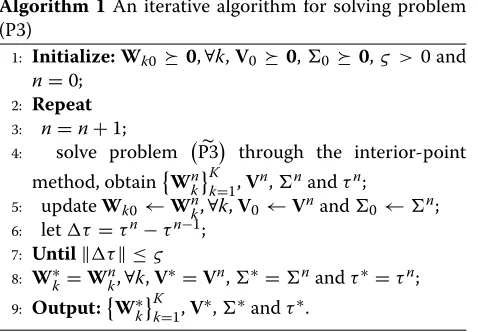
'P3can be solved efficiently by adopting the off-the-shelf convex optimization tools, such as SeDuMi (or CVX) [25]. Hence, the specific trade-off design scheme is obtained by choosing preferable weighted valueλj. On the other hand, the approximate optimal solution for each single-objective optimization problem is also obtained by solving the spe-cial case of problem 'P3. Finally, an iterative algorithm is derived on the basis of the above procedures and the details are summarized in Algorithm 1.
Feasibility assurance about the initial point
{Wk0}Kk=1,V0,0
: The common way that preset
{Wk0}Kk=1,V0,0
is to initialize each one in it as zeros or the diagonal matrix with full transmission power uniformly distributed on each element. However, due to the fact that the initialization satisfy constraints C3, C4, and C5 in (12) may not be feasible to constraints C1 and C2, which will possibly result in a poor convergence per-formance of our proposed algorithm and better objective values compared to the optimal of the original problem. Therefore, to circumvent such a defect, the feasibility assurance procedure need to be injected in obtaining the feasible initial point. Particularly, we consider the following problem extracted from(P1)in (12)
max {Wk}Kk=1,V,
min k+1
RUL−S− ¯RUL−S,RDL−S
k − ¯RDLk −S
s.t. C3,C4,C5.
(45)
Given the initial point, problem (45) can be solved effec-tively through the methods mentioned above. Then, the resulting optimal pointW∗k0Kk=1,V∗0,∗0
which leads to non-negative objective value of problem (45) can be selected as the feasible initial point.
Algorithm 1An iterative algorithm for solving problem (P3)
1: Initialize: Wk0 0,∀k,V0 0,0 0,ς > 0 and n=0;
2: Repeat
3: n=n+1;
4: solve problem 'P3 through the interior-point
method, obtainWnkKk=1,Vn,nandτn;
5: updateWk0←Wnk,∀k,V0←Vnand0←n; 6: letτ =τn−τn−1;
7: Untilτ ≤ς
8: W∗k =Wnk,∀k,V∗=Vn,∗=nandτ∗=τn;
9: Output:W∗kKk=1,V∗,∗andτ∗.
5 Simulation results
In this section, simulation results are presented to assess the performance of our proposed multi-objective robust resource allocation scheme. The simulation settings for our simulation are as follows. It is assumed that there are K =3 DL users,M=2 eavesdroppers,NE =2,NU =3, ND =2, andς = 10−6. The small scale fading of the UL channel, DL channels, CCI channels, and eavesdropping channels are modeled as independent and identically dis-tributed Rayleigh fading. All the users and eavesdroppers are assumed to be located randomly and uniformly in the range between the distance of 10 and 100 m away from the transmitter. The SI channel is modeled as the Rician fading channel with Rician factor 5 dB. In regards to the channel uncertainties, we define the channel estimate error ratios as:αL,m= 3 εL,m
E44L¯m442F
,αE,m = 3 εE,m E44E¯m442F
,∀m,
and αF,m = 3 εF,m E44F¯m442F
,∀k. All simulation results were
achieved by an average of 1000 channel realizations. In our simulation, the feasibility of the given parameters can be ensured in this way. Taking problem P1 in (12) as an exam-ple, the secrecy ratesR¯UL−Sin constraint C1 andR¯DL−S
k in
constraint C2 will be given first. Then, after many chan-nel realizations, the value ofPDLmax can be determined by checking the feasibility of problem P1 without constraint C3. At the same time, the maximum allowable transmit powerPmaxUL can also be determined by the obtained max-imum objective value of problem P1. The infeasible case will be picked and assigned to null once the cvx status is not “Solved” or cvx optval is “Inf.’. The infeasible case should not be occurred frequently among the 1000 chan-nel realizations. If it happens, we need to increase the value of the maximum allowable transmit power until it occurs rarely.
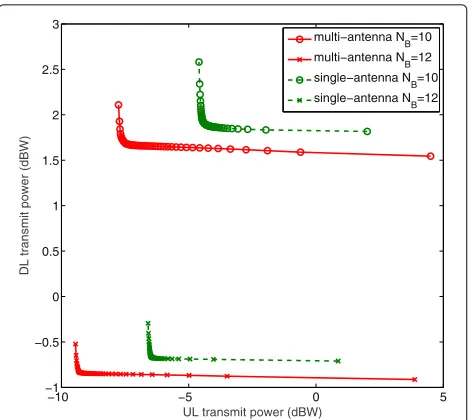
Figure 1 depicts the trade-off between UL and DL trans-mit powers withPUL
−10 −5 0 5 −1
−0.5 0 0.5 1 1.5 2 2.5 3
UL transmit power (dBW)
DL transmit power (dBW)
multi−antenna NB=10 multi−antenna NB=12 single−antenna NB=10 single−antenna N
B=12
Fig. 1Trade-off region between UL and DL transmit powers for different number of transmit and receive antennas
¯
RUL-S=1.5 bps/Hz andR¯DL-S=2.5 bps/Hz, respectively. The channel estimate error ratios are set asαL,m=αE,m=
αF,k = 0.05,∀m,k. The boundary points of the trade-off region are obtained by solving problem (P3) under differ-ent weight values 0 ≤ λj ≤ 1,j = 1, 2 with fixed step size 0.02.
For the purpose of a comprehensive performance com-parison, four scenarios where each of the users and
eaves-droppers is equipped with multi-antenna andNB = 10,
where each of the users and eavesdroppers is equipped with multi-antenna andNB=12, where each of the users and eavesdroppers is equipped with single antenna and
NB = 10 and where each of the users and
eavesdrop-pers is equipped with single antenna and NB = 12 are
considered in Fig. 1. From this figure, we can see that, under the case the same antenna equipped at the transmit-ter, an obvious savings in transmit power for UL user and DL transmitter can be achieved when the UL, DL users, and eavesdroppers have multiple antennas compared with the single-antenna cases. Particularly, the requirement of UL transmit power declined more significant than the DL transmit power. This is due to the fact that the change of the antenna number results in a direct influence on UL user while it is indirect on the transmitter. The direct and apparent impact which leads to obvious power sav-ing on the transmitter can be achieved with the increase of the numberNBwhile the antennas of the other nodes keep unchanged. An interesting phenomenon what we can learn from this figure is that, from the first and the last curves listed in the legend, the multi-antenna case with
NB = 10 consumes much more DL transmit power but
less UL transmit power than the single-antenna case with
NB =12. It further reveals the advantage of more anten-nas allocated for the communication nodes, especially for the users.
Figure 2 shows the convergence performance of our proposed algorithm. The initial values of {Wk0}Kk=1, V0 and 0 are all set to be 0, the channel uncertainties and minimum required secrecy rates are the same as in Fig. 1, multi-antenna case is considered with NB = 10. The black curves marked with x represent the DL trans-mit power (corresponding to problem P2) while the blue curves marked with circle represent UL transmit power (corresponding to problem P1). Ten random channel real-izations are depicted in Fig. 2. From this figure, we can see that our proposed algorithm converges to a stable value after a finite number of iteration. This is due to the fact that the problem defined in 'P3is convex, the optimal transmit covariance matrix W∗k,V∗, and∗are obtained by solving problem 'P3for the givenWk0,V0, and0. At each iteration,Wk0,V0, and0will be updated from the optimal W∗k, V∗, and ∗ of the previous iter-ation. Hence, Wk0, V0, and 0 are always the feasible solution of the next iteration, and the optimal solution W∗k, V∗, and ∗ obtained for the given Wk0, V0, and 0 will consume less than or equal to the transmission power of the previous iteration. Then, the required trans-mission power will monotonically non-increasing at each iteration. Moreover, since the transmission power is lower bounded below for a required secrecy rate, this algorithm will converge to a solution. Moreover, the convergence step of two problems appears to be consistent.
Figure 3 shows the average power consumption of UL user and DL transmitter versus the channel estimate error ratios. The antennas of the DL transmitter is set to be NB = 10. Three cases, non-robust, our proposed robust
1 2 3 4 5 6 7 8 9 10 11 12 13 14 15 16 17 18 19 20 0
0.5 1 1.5 2 2.5 3
Iteration number
Transmit power (dBW)
0 0.01 0.02 0.03 0.04 0.05 0.06 0.07 0.08 0.09 −8
−6 −4 −2 0 2 4
Channel estimate error ratios
Transmit power(dBW)
DL non−robust DL robust (proposed) DL perfect UL non−robust UL robust (proposed) UL perfect
Fig. 3Average power consumption versus the channel estimate error ratios
and the perfect CSI known at the DL transmitter, are depicted in Fig. 3. The information of channelsLm, Em,
and Fk known at the base station are actually
imper-fect. Physically, the non-robust case is that the researchers mistakenly believe that the CSIs known by the base sta-tion are perfect and do not take any addista-tional acsta-tions to against the disadvantage caused by channel uncertain-ties. To reflect the actual situation, for the non-robust case, the channel estimate errors (each of them comes from the channel estimate error ratio multiplied by chan-nel estimation) are added in the estimated chanchan-nels. The optimization problem for the robust case is non-convex due to the difference between two logarithmic functions in constraints C1 and C2, which can be tackled by using the similar methods adopted in Section 3. From this figure, we can see that, to meet the QoS requirement of secrecy rates of UL and DL users, the transmitter power of both UL user and DL transmitter increases with the channel uncertainties for the non-robust and robust cases. For the perfect CSI case, the consumed power remains unchanged and lower than the other two cases. In regard to our proposed robust scheme, a significant power saving is fulfilled compared with the non-robust scheme.
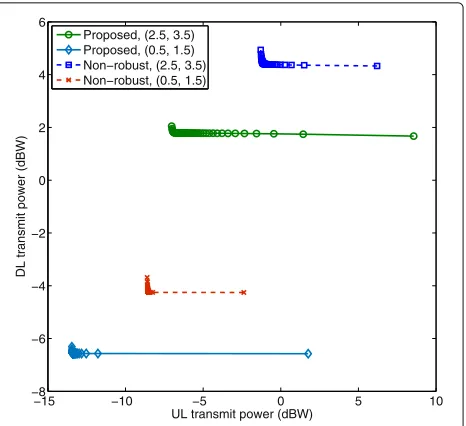
Figure 4 shows the trade-off between UL and DL transmit power for our proposed robust and the exist-ing non-robust schemes. (0.5, 1.5) and (2.5, 3.5) denote the required secrecy rate pairs while (0.5, 1.5) denotes
¯
RUL−S = 0.5 bps/Hz andR¯DL−S = 1.5 bps/Hz, (2.5, 3.5) denotesR¯UL−S = 2.5 bps/Hz andR¯DL−S = 3.5 bps/Hz. The number of the antennas of the base station isNB=12. The maximum allowable transmit power, the channel esti-mate error ratios and the step size are the same as that
−15 −10 −5 0 5 10
−8 −6 −4 −2 0 2 4 6
UL transmit power (dBW)
DL transmit power (dBW)
Proposed, (2.5, 3.5) Proposed, (0.5, 1.5) Non−robust, (2.5, 3.5) Non−robust, (0.5, 1.5)
Fig. 4Trade-off region between UL and DL transmit powers for different schemes
given in Fig. 1. From this figure, we can see that the trans-mit power of the UL user and the base station increase sig-nificantly with the required secrecy rates. Our proposed scheme consumes less power at the transmitters than the non-robust scheme under the same required secrecy rate pair. Moreover, by comparing the curve “Proposed, (2.5, 3.5)” in Fig. 4 with the curve “multi-antennaNB= 10” in Fig. 1, we find that both of them achieve nearly the same UL and DL transmit power trade-off region. This means that the higher secrecy rate can be obtained by increas-ing the degrees of freedom with more transmit antennas instead of the transmit power.
Figure 5 shows the number of the infeasible case occurred versus the UL transmit power for five different DL transmit power, givenR¯UL-S=1.5 bps/Hz andR¯DL-S= 2.5 bps/Hz. From this figure, we can see that the proba-bility of the infeasible case does not exceed one percent at the low transmit power region, which is absolutely a small probability event and can be accepted. Moreover, the fre-quency of this event decreases with transmit power and eventually tends to zero at the high transmit power region.
6 Conclusions
−150 −12 −9 −6 −3 0 3 6 9 1
2 3 4 5 6 7 8 9 10
UL transmit power (dBW)
Number of the infeasible cases
−8 dBW −4 dBW 0 dBW 4 dBW 8 dBW
Fig. 5The infeasible case occurs among 1000 channel realizations for different transmit power
with the Taylor series expansion and the S-procedure approaches were proposed in handing the formulated non-convex optimization problem optimally. Simulation results not only demonstrated an interesting trade-off between the considered conflicting objectives, but also showed the efficiency of our proposed robust resource allocation designs.
Acknowledgements
The work was partially supported by Swedish Research Links [No.348-2008-6212], the National Natural Science Foundation of China [61571241], Industry-university-research prospective joint project of Jiangsu Province [BY2014014], and Major projects of Jiangsu Province university natural science research [15KJA510002].
Authors’ contributions
Both authors contributed extensively to the work presented in this paper. MZ designed the proposed algorithm, performed the experiments, and wrote and revised the paper. DZ supervised the design of the algorithm and the performance evaluation, and revised the paper. Both authors read and approved the final manuscript.
Competing interests
The authors declare that they have no competing interests.
Publisher’s Note
Springer Nature remains neutral with regard to jurisdictional claims in published maps and institutional affiliations.
Author details
1Internet of Things, Nanjing University of Posts and Telecommunications,
Nanjing 210003, China.2Information Technical Department, Wenzhou Vocational Technical College, Wenzhou 325000, China.
Received: 1 January 2017 Accepted: 24 October 2017
References
1. P Yeoh, M Elkashlan, N Yang, D da Costa, T Duong, Unified analysis of transmit antenna selection in MIMO multirelay networks. IEEE Trans. Veh. Technol.62(2), 933–939 (2013)
2. J Park, B Clerckx, Joint wireless information and energy transfer in a two-user MIMO interference channel. IEEE Trans. Wirel. Commun.12(8), 4210–4221 (2013)
3. X Chen, Z Zhang, H-H Chen, H Zhang, Enhancing wireless information and power transfer by exploiting multi-antenna techniques. IEEE Commun. Magazine.53(4), 133–141 (2015)
4. A Khisti, GW Wornell, Secure transmission with multiple antennas—Part II: the MIMOME wiretap Cchannel. IEEE Trans. Inf. Theory.56(11), 5515–5532 (2010)
5. DWK Ng, ES Lo, R Schober, Dynamic resource allocation in MIMO-OFDMA systems with full-duplex and hybrid relaying. IEEE Trans. Commun.60(5), 1291–1304 (2012)
6. H Suraweera, I Krikidis, G Zheng, C Yuen, P Smith, Low-complexity end-to-end performance optimization in MIMO full-duplex relay systems. IEEE Trans. Wirel. Commun.13(2), 913–927 (2014)
7. D Nguyen, L-N Tran, P Pirinen, M Latva-aho, On the spectral efficiency of full-duplex small cell wireless systems. IEEE Trans. Wirel. Commun.13(9), 4896–4910 (2014)
8. HQ Ngo, H Suraweera, M Matthaiou, E Larsson, Multipair full-duplex relaying with massive arrays and linear processing. IEEE J. Select. Areas Commun.32(9), 1721–1737 (2014)
9. Y Sun, DWK Ng, J Zhu, R Schober, Multi-objective optimization for robust power efficient and secure full-duplex wireless communication systems. IEEE Trans. Wirel. Commun.15(8), 5511–5526 (2016)
10. S Leng, DWK Ng, N Zlatanov, R Schober, in2016 IEEE International Conference on Communications (ICC), Kuala Lumpur. Multi-objective resource allocation in full-duplex SWIPT systems, (2016), pp. 1–7. http://ieeexplore.ieee.org/document/7510760/
11. DWK Ng, ES Lo, R Schober, Multi-objective resource allocation for secure communication in cognitive radio networks with wireless information and power transfer. IEEE Trans. Veh. Technol.65(5), 3166–3184 (2016) 12. Y Zeng, R Zhang, Full-duplex wireless-powered relay with self-energy
recycling. IEEE Wirel. Commun. Lett.4(2), 201–204 (2015) 13. B Day, A Margetts, D Bliss, P Schniter, Full-duplex MIMO relaying:
achievable rates under limited dynamic range. IEEE J. Select. Areas Commun.30(8), 1541–1553 (2012)
14. Y Liang, G Kramer, HV Poor, S Shamai, in2008 IEEE 19th International Symposium on Personal, Indoor and Mobile Radio Communications, Cannes. Recent results on compound wire-tap channels, (2008), pp. 1–5. http:// ieeexplore.ieee.org/document/4699909/
15. Z Chu, K Cumanan, Z Ding, M Johnston, SY Le Goff, Secrecy rate optimizations for a MIMO secrecy channel with a cooperative jammer. IEEE Trans. Veh. Technol.64(5), 1833–1847 (2015)
16. W Wu, B Wang, Robust secrecy beamforming for wireless information and power transfer in multiuser MISO communication system. EURASIP J. Wirel. Commun. Netw.2015(161) (2015)
17. Z Chu, Z Zhu, M Johnston, SY Le Goff, Simultaneous wireless information power transfer for MISO secrecy channel. IEEE Trans. Veh. Technol.65(9), 6913–6925 (2016)
18. Z Chu, K Cumanan, Z Ding, M Johnston, S Le Goff, Robust outage secrecy rate optimizations for a MIMO secrecy channel. IEEE Wirel. Commun. Lett. 4(1), 86–89 (2015)
19. RT Marler, JS Arora, Survey of multi-objective optimization methods for engineering. Struct. Multidiscip. Optim.26, 369–395 (2004)
20. W Wu, B Wang, Efficient Transmission solutions for MIMO wiretap channels with SWIPT. IEEE Commun. Lett.19(9), 1548–1551 (2015) 21. GH Golub, CF van Loan,Matrix computation, 2nd edn. (John Hopkins
University Press, 1989)
22. K Cumanan, Z Ding, B Sharif, GY Tian, KK Leung, Secrecy rate optimizations for a MIMO secrecy channel with a multiple-antenna eavesdropper. IEEE Trans. Veh. Technol.63(4), 1678–1690 (2014) 23. S Boyd, L Vandenberghe,Convex optimization. (Cambridge University
Press, 2004)
24. Z-Q Luo, JF Sturm, S Zhang, Multivariate nonnegative quadratic mappings. SIAM J. Optimiz.14, 1140–1162 (2004)