A Multi Model Based Bio Metric Analysis Using Gaussian Distribution
P Appala Naidu & CH GVN Prasad
1Research Scholar Rayalaseema University, Kurnool, AP, India 2Dept. of CSE SICET, JNTU-H Hyderabad, India
[email protected] ; [email protected]
Abstract—Most of the bio metric analysis in the industry till now
is using unimodel verification. major Systems has to deal with added demands such as coverage of vast data base and demographic variety, varied use in different environment, and demanding quality requirements. As the unimodel with limited features cannot fulfill all the need it better to add the other features also which are available at those places. A multimodal biometric system combines features from multiple biometric traits, sensors, algorithms, and other components to make a identification conclusion along with enhancement of accuracy, the fusion of biometrics can also come over the problems like spoofing, limited population etc..there is huge research work is going on the these multimodal but there is huge gap in solving the problems like incompleteness of the features to compare. Therefore, here we developed a hybrid multimodal biometric authentication approach fusing palm print and fingerprint traits at score-level. here in the multi model authentication, Generalized Gaussian distribution is used on the features of both the prints which are further used for the verification and validation. here we have taken criminal mapping application with huge data base. The model performance is measured using the FAR and MDR
Keywords—Multimodel Bio metric; Gaussian Distribution; Criminal Mapping,
I. INTRODUCTION
To verify a human identity using the characteristics of behavior or anatomical like palm print, fingerprint vein pattern, face and iris biometric technology is used. Multi model bioimetric verification and validation is used by combining more then one feature of the client to get more accurate verification and validation. The aim of multimodal biometrics is to reduce one (or) more of the following
o False Accept Rate [FAR]. o Missed Detection Rate[MDR].
by taking the data from multiple censors and combining the features from multiple sources of the human verification and validation is done and it is done at different levels:
1. Sensor level where the data is acquired from multiple sensor as raw data and they initially processed and integrated to generate features which can be integrated. here we can implement sensor level fusion as well as data level fusion[1]. the second is Feature level, in this after the feature set is pooled from the data by combining the features a feature vector is developed which is further given to next level called
Match score level which is gets the verification and validation of the given features with the test of features by giving the score to mapped features and combined scores are scaled in multi model bio metric mapping[2]. and in the rank level fusion is used to give ranking while mapping to reduce overburden these are rank fused to give new rank to make decision. and in the decision level here fusion is approved out at this stage when only the decisions output by the entity biometric mappers are available. Here, a separate validation choice is computed for each biometric characteristic which is then pooled to consequence in a last vote. diverse strategies are offered to merge the distinct decisions of individual modality to a final authentication decision
II. FEATURE EXTRACTION
Here we developed the model for mapping the criminal features[17] which are available at the crime spot with the database of criminals. a few of the largest part valuable evidence at the offence prospect are finger & palm prints. Stamps are evidences which conclude and be capable of in any of the corresponding 3 possible investigations
1. The crime accused has made the print 2. Criminal may not be obtained.
3.Insufficient details from the print which are to be evaluated
Here the value of finger stamp is deeply improved by the likelihood of recognizing a criminal[19]. When offenders commit a crime, clues are inevitable as long as they put on gloves or several other forms of guard. Finger stamps are attained by friction ridges, where they store lubricant and perspiration on the contacted object and the impression is generated where the criminal holds the object. The prints so obtained may be contaminated with dirt, blood or grease.
1.Finger print developing methodologies
generating a print and these models are called chemical based fingerprint visualization techniques.
Other methods available for the identification of the finger print include, latest fingerprints, where brushing the fingerprint dust over a hidden print creates the print noticeable. The choice of the powder that is to be used depends on the exterior on which the stamp is recognized and partly on what way it is to be conserved. The powders available are white, colored, black, aluminum, fluorescent, copper and magnetic tape.
These powder are dipped using a brush & are sprinkled on the area where the fingerprints are to be extracted, the fingerprints obtained are photographed.
To recognize the extracted finger prints, we developed Model based approach based on GGMM.
a.
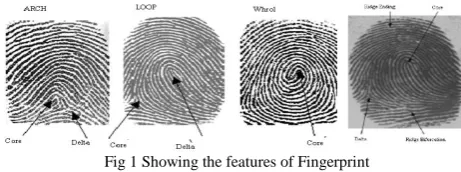
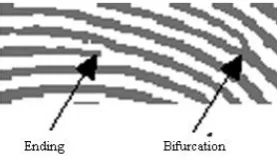
Identification patterns in fingerprints:Every fingerprint contains the features along with the details of the fingertip, the fingerprint features are categorized into three major types, are the loop, the whorl, and the arch. Every finger will be having at least one of these feature. The lines which enter and leave on the same side of the finger stamp are called as loops. Arches are lines that, starts one side rises and ends in other sides. Whorls will not exit by making circles. The minor or smaller features (or minutiae) having the location of ridge finishing (the patterns which flow on the FP are called ridges) and of “ridge bifurcations (the point where ridges split in two)”. Minutia refers to various ways in which the ridges can be discontinuous. In each finger there are nearly fifty to two hundred attributes. Finger stamp cross checking is done mostly based on 3 major attributes is called pattern verification as in-depth mapping are based on minutia . Other attribute are used for validation, but minutiae and patterns are the important ones. A fingerprint image can be captured voluntarily and/or consciously (with the person’s consent and/or knowledge), or involuntarily or unconsciously. The latter generally occurs at the crime spot where the extracted fingerprints are investigated. People leave fingerprint impressions on almost every surface they touch via the oil that coats the ridges of their print. The residue that is left behind is known as a latent fingerprint..Enrollment and acquisition may be done utilizing off-line or by using a live sensor. By sprinkling ink on fingertip and taking the impression on any paper we can take offline fingertip (or fingerprint card).
This is the oldest and best-known acquisition technique, which is still used by law enforcement and other government agencies worldwide. Before the age of digitalization, these fingerprint cards were copied and sent to a centralized national verification office, where all cards were
Fig 1 Showing the features of Fingerprint
stored and where matching took place. Such a process is quite hard, requires labs and consumes time. As per the FBI, a fingerprint checks under this system would take usually three months to complete. The off-line mode has been advanced during the last decade via digitization. The fingerprint cards are now scanned digitally, allowing the image data to be stored in databases and to be transferred via communication networks. This process is, of course, much faster compared to the physical fingerprint cards. Live fingerprints acquired by using sensors sensing the finger’s tip directly. A fingerprint scan helps to dig huge information, but the scanners available mainly aim in getting the information which can be essential for matching. The performance of the recognition is directly based on effective scanning of the fingerprint. Basing on the acquired fingerprint, the minutia details can be identified. The major concern in fingerprint recognition is poor input quality.
b. Extraction of Fingerprint Attributes
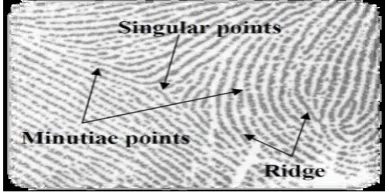
Fig 2 showing the Finger Print features
lakes or ponds (blank rooms among two impermanent differing ridges); spurs (a mark project from a ridge); bridges (minute ridges combining two longer nearby ridges); and crossovers (the crossing of the ridges). As there are man types of minutiae can be calculated, normally a only a coarse classification is adopted to combat with different difficulties. The core is center of archies. It is regularly attributed by a ridge end and many exactly curved ridges. The lower right and left points are called as deltas. Pores marks the ridges, where they are appeared as study intervals. Primarily little works was done to consider the distribution and location of the pores as a purpose for the authentication. But top resolution is necessary to get pores constantly. Once a top resolution image is taken, there are many procedures necessary to convert its distinctive features into a dense model. This procedure, known as attribute mining, is at the core of finger stamp technique. After altering the image to normal. If the picture is grayscale, discarding of areas lighter than a respective threshold are, and which are darker are converted black. The ridges will be changed from eight to five pixels in to single pixel, for precise placement of bifurcations and endings. With this implemented image, Minutiae localization starts.
Fig 3 Showing the Ending and Bifurcation
At this position, even a very accurate picture will have deformation and phony minutiae that required to be screened out. It is necessary to investigate the picture and remove one of double nearby minutiae, because minutiae are especially rarely adjoining. irregularities caused by marks, dirt or sweat emerge as false minutiae, and procedures locate any patterns or points that are not important, such as a island’s spur (mostly false) or a ridge coming across to more than one others (probably a scar or dirt) from perpendicular. A huge proportion of potential minutiae are eliminated in this process. The place at where a ridge stops and the starting point of bifurcation is the huge minutiae of rudimentary, and is utilized in most of the applications. There is deviation in how
accurately to situate a minutia place: whether to park it straightly on the ending of the ridge, a single pixel away to the ending, or single pixel among the ridge ending. Once the place has been located, its place is commonly specified by the long from the center point, with the center point serving as the (0,0) on an two dimensional (X,Y-axis). Few finger stamp equipments utilize the far bottom and left boundaries of the picture as the lines, correcting for wrong placement by placing and nearby from the (center point) core. With respect to obtaining the minutia, information, every finger stamp which is gathered, should be improved using histogram normalization, usage of morphological application and binarization, such as thickening, thinning, close and open. To narrow down the print of finger stamp we use thinning, to fine tune the edges of finger stamp we use the thickening , so that the finger prints are legible, erosion and dilation are used to fill the cracks and holes. The morphological techniques, thinning and thickening, erosion and dilation are used to process the finger print.
c
.Fingerprint Image EnhancementFingerprint picture enhancement is to create the picture clearer for simple further processes. Since the finger stamp pictures acquired from input streams are not guaranteed with good quality, those improvement methods, for growing the contrast among furrows and ridges for connecting the phony broken places of ridges due to inadequate ink, are very practical for keep a advanced accuracy to finger stamp recognition.Histogram equalization procedure is utilized to preprocess the finger stamp.
d.Equalization of Histogram:
Equalization of Histogram is a method which improves the quality of finger stamp image, so that perceptional data is increased. In general the histogram of the original fingerprint image takes a bimodal type [Figure 4], after performing histogram equalization the range of the input fingerprint image expands to the range from 0 to 255 and there by enhanced fingerprint impression is obtained.
The figure [Figure 4.] along the right side displays the output after the histogram equalization is performed.
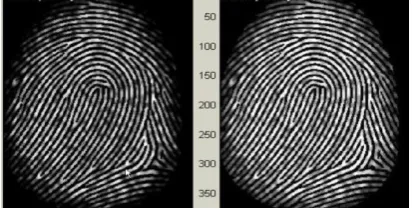
The same effect, can be viewed with respect to the fingerprint and is shown in figure 5.
Fig 5 Showing the effect of Histogram Enhancement - Original Image (Left). Enhanced image (Right)
e. Binarization of Fingerprint
Binarization of Fingerprint is a course that is used to convert the 8-bit Gray finger stamp to a 1-bit figure where 0-value showing the ridges and single-0-value is utilized to represent furrows. After histogram improvement, ridges finger print ridges are shown with black shade while furrows are signify with white color. A locally adaptive method of binarization is utilized to change the input fingerprint into Boolean values. The process that takes place is converting a pixel to 1 if the assessment is bigger than the average intensity assessment of the existing block (16x16) to which the pictorial element belongs.
The steps involved for extracting the binary values of the given input fingerprint, include thinning process and to identify the ridges, skeleton is used. Thinning is a process of converting the input binary information of the fingerprint to a size of a single pixel width.
If the fingerprint ridges which are obtained after binarization are thick, then it is necessary to thin the ridges so that each is one pixel thick and the single-pixel width. Ridges help in the detection of ridge ending and bifurcations. The thinning process aims in the reduction of the ridges width together with the retention of connectivity and minimizing the number of pixels obtained while processing
Algorithm for Thinning
Step 1: fingerprint image template Scanning row after row from top and left to bottom and right and verify whether the pictorial element assessment is 1 or not.
Step 2: identify the 4 connectivity for each individual fingerprint pixel.
Step 3: If the addition is greater than that of two, consider it as a fault pixel.
Step 4: delete the erroneous pixel.
Step 5: Repeat the above steps 1 – 4 until the complete fingerprint is scanned and removing the erroneous pixels.
Here the two Morphological Smoothing applications called
‘OPEN’ (by erosion) and ‘CLOSE’ (by dilation) are considered. The ‘OPEN’ by erosion operation will enlarge the finger stamp by pictures by removing peak initiated by backgrounds outlier. To remove small cavities or holes the
‘CLOSE’ operation helps. Every opening operation must be followed by closing in order to remove or process both bright and dark pixels to make image smoother.
2.Palm Print processing
In the palm print bio metric validation[5] . Palms of hands epidermal ridges, thought to provide a friction surface to assist with gripping an object on surface. Palm print identification systems measure and compare ridges, lines and Minutiae found on the palm. Palm print[7] recording and identification for law enforcement purposes has been in existence almost as long as palm prints systems are reported to comprise 30% of all crime scene marks.The biometric palm print recognition system is the most permissible. The Palm print is an physiological or is an external characteristic of human being which is found to be unique and distinct from among every individual. The palm print has maximum region of interest; which makes researcher to study and carry experiments over palm print image such as palm print features- ridge, minutia and principal lines etc.
a. Methods for Recognition
There are three groups of marks which are used in palm print identification:
the palm. Geometric features are a coarse measurement and are relatively easily duplicated. In themselves they are not sufficiently distinct;
identify the length, position, depth and size of the various lines and wrinkles on a palm. While wrinkles are highly distinctive and are not easily duplicated, principal lines may not be sufficiently distinctive to be a reliable identifier in themselves; and
Fig 6 Palm print features
The palmprint recognition system includes preprocessing followed by ROI extraction. After ROI extraction, features are extracted using the feature extraction algorithms. The palmprint is then accepted or rejected on the basis of matching the extracted features. preprocessing commonly focuses on five steps 1.Binarizing the palm images 2.Boundary tracking 3.Identification of key points 4.Establishing a coordination system and 5.Extracting the central part.
b. Feature extraction and matching :
The aim of this section is to recognize a correct person to authenticate and to prevent multiple people from using the same identity. In identification, the system recognizes an individual by searching the templates of all users in the database for matching. Research on feature extraction and matching algorithms are classified as follows: line based, subspace based, statistical based and coding based. These calculated values are distinct for each and every individual. So a palm matching can be done on the basis of individual basic statistical palm properties. And can be used to identify an individual. The testing image that ‟s basic statistical property such as area, bounding box and centric of palm line image and values is being calculated as we input the testing image. The corresponding one to one matching has to be done by comparing it with our already trained samples. The basic statistical properties are found to be distinct and unique for each and every palm print image sample.
The corresponding matching sample of testing palm sample will be got matched depending upon the similar statistical values of the Palm image. Hence the Biometric identification of individual can be done on the basis of its palm statistical properties such area, bounding box and centric of palm print image
Fig 7experimentally calculated statistical property values of the respective palm print image
II.Generalized Gaussian Mixture Model (GGMM
)
a.“GENERALIZED GAUSSIAN DISTRIBUTION”
This segment briefly analyses the “probability distribution” of GGMM and its attributes utilized in the criminal identification algorithm. Let the crime information values (intensities) in the total crime data are obtained Randomly, assuming that it follows a “Generalized Gaussian Mixture Distribution”[20]. The total crime information can be considered as the group of “K” crime data regions, then the crime data values intensities in each crime data section go after a Gaussian distribution with generalization. The “Probability density function”[23] is
( )
(,)
1 (| ,,)
1
2(1 )(,)
P i i
Z
AP
fz P e
AP P
(1)
Where 12 1 2
( ) 0, ( , )
3 ( ) P AP P
.
(2)
The argument
is the average, the methodA P
( , )
is an measuring feature which permits that the Var(Z) =
2, and ‘P’ is the argument of shape. When P=1, the relevant Gaussian communicates to a Exponential or Laplacian Distribution, When P=2, the relevant Generalized Gaussian communicate to a distribution based on Gaussian.b. Using Expectation Maximization Algorithm Estimation of the Model Parameters
We have to find the parameter
i,
iand
i for i=1,2,---K, maximizing the likelihood function (or) Log likelihood function. Here the shape parameter ‘P’ is estimated by the procedure given by J.Armando Dominguez et al (2003) and also we assume that shape parameter is same for all crime data regions of a crime data under consideration. For obtaining the estimates of these arguments we use in the Expectation Maximization algorithm. The first step of Expectation Maximization algorithm requires the estimation of the primaryapproximates for both arguments
iand
i and theweights
i,
from the given crime data( ) 1
( ) 1
1 () ( 1) 1
1 () 1 ( , ) ( , ) l P l P N i
s k k s
l s
k
N
i
k k s
s
z t z
f z
-- (3)
However, for not using the numerical methods, we can also
adopting an premise that the structure of μ should be a weighted mean of the vectors from data with the index weights generated by data vector’s power of the job probability, informed in division by equilibrium of the model and in part by expediency guides to
μk
(l+1)=
∑
s=1N
ti(zs, θ
(l))γ(N , P)
zs
∑
s=1
N
ti(zs, θ
(l)
)γ(N ,P)
(4)
as
γ
(
N , P
)
is a function, as it should be equivalent toagreement for P=2, and must be equivalent to
1
P
−
1
forP≠1, in the case of N=2, we have also observed that γ must be an increasing function of P. Practically, the majority of data’s assignment properties are either close to 1 or close to 0, where the investigative dissimilarity of the each density of probability, penalize yet little disarticulation from the curve of equal of likelihood of any couple of clusters incredible heavily.
In our method, we obtained the updated
μ
k(l+1)
from solving the equation (no-27) by numerical methods on MathCAD
Assuming that each σi is independent, we have
σ
i(l+1)
=
[
∑
i=1
N
ti(zs,θ(l))
(
Γ(3/P)PΓ(1/P)
)
∣zi−μi(l)∣1
P
∑
i=1
N
ti(zs, θ(l))
]
1
P
III. MODEL BASED APPROACH
In this approach, we considered the fingerprints and palmprints available at the crime spot related to the crime and mapping them with finger prints and palmprints of the criminal using the Generalized Gaussian Mixture Model (GGMM) which is discussed
Multi model Recognition Algorithm based on GGMM
Step 1: Extract the finger prints obtained at the crime spot Step 2: Normalize the finger prints, into fixed sizes of 100*100 Step 3:Thickening & thinning algorithm
Step 4: extracting features from palm like area, bounding box and centric of palm line image and values.
Step 5: Obtaining the probability density function for the both features in the crime database, suspect table and store the PDF Step 6: calculate the PDF from the both fingerprint and palm.
Step 7: Match these PDF with that of PDF in Criminal data base, check for the most likely match exists notify the details, else go to step -7
Step 8: Note the finger prints belong to person in CD/ST Step 9: If the Patterns does not match then the profile belong to unknown/ new criminal
IV. Experimentation
In order to experiment our data we have considered three types of datasets with size above 7000 different crime issues for case of crime table, around thousand different criminal records, for the second type of database called criminal records data base and nearly 50 entries for the Suspect for Suspect Table
The Finger Prints and palm prints of criminal are maintained in the data base with four different orientations and all are of fixed size. Whenever a crime incident takes place, the type crime is identified then in order to identify a criminal, the criminal data base is first subjected to K-means clustering is used for the classification of crime (Murder, Rape, Roit, Kidnap) and type of weapon used at the crime spot.
The relevance of Finger print and Palm prints is compared against the Probability Density Function for most likelihood match the results obtaining the formula used for the above calculation are notified in table 1.The metrics like Missed Detection Rate, False Acceptance Rate are utilized for the analysis. After the test the results gained are displayed in the below table
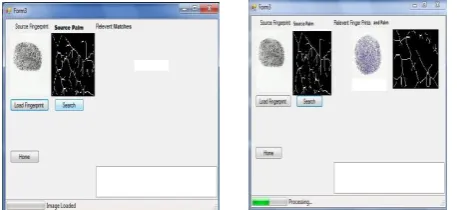
The fingerprint, obtained at the crime spot is extracted and is checked with that of the other Finger print and Palm prints available in database as shown in figure 7.
The PDF of the given finger is compared with that of the other Finger print and Palm prints PDF for a likelihood match and is shown in figure 8. From the picture 9 it can be observed with lucidity that the input finger matches with that of fingerprints in the data storage and if the PDF matches then the criminals are identified.
Fig 8-9 Showing the comparing the Finger print and Palm print with that of Criminal Database
Fig 10 Showing the result obtained from Criminal Database
From the above table the details of criminal given criminal identified are given below
Fig 11 Showing the filtered table after performing the mapping
The model is evaluated using the metrics FAR and MDF by changing the number of the finger stamps in the data storage and the results obtained are tabulated in the table 1 Test Sample size ( No of Finger print and Palm prints) Metrics used for Evaluation
Test Sample size ( No of Finger print and Palm prints)
Metrics used for Evaluation
FAR MDR
1000 5 8
2000 8 10
3000 13 15
4000 16 18
5000 18 21
6000 22 24
7000 24 26
Table 1 Showing the FAR and MDR results obtained with different data sizes
Graph 1 Showing the FAR and MDR lines of finger print matching using the GGMM
In case if the Finger print and Palm print does not match with any of the Finger print and Palm prints considered in the database, then the suspect table is considered by considering the Finger print and Palm prints of the relatives and close aids , servant maids cooks etc for the identification purpose, if the recognition does not exit, the criminal is deemed to be a new criminal
Suspect table
If Finger print and Palm print is matched with any of the Finger print and Palm print in the above table the identification is achieved in case the if Finger print and Palm print is not matched neither to criminal database or suspect table then it is considered as new entry and added to the database
V. Evaluation of two approaches
2)Finger print and Palm print matching based on GGMM
Test Sample size ( No of Finger print and Palm prints) Metrics evaluated using GGMM model Metrics evaluated using Minutia based recognition
Test Sample size
( No of Finger print
and Palm prints)
Metrics evaluated using GGMM model
Metrics evaluated using Minutia based
recognition
FAR MDR FAR MDR
1000 5 8 5 8
2000 2 1 4 5
3000 3 2 2 5
4000 4 1 1 3
5000 1 3 2 2
6000 4 24 3 2
7000 4 2 5 3
TABLE 2 Showing the FAR and MDR of the minutia based
fingerprint matching and the FAR and MDR of the Finger print and Palm print matching based on the Generalized Gaussian Mixture Model .
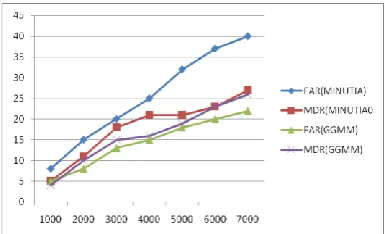
From the above shown table, it can be observed that, as the count of samples are improving, the model based on GGMM is yielding good results and can be observed from the data table, that the false acceptance rate is also less and the MDR in case of GGMM is less, indicating the efficiency of the model
Graph 2 Showing the FAR and MDR of the, minutia based fingerprint matching and the Generalized Gaussian Mixture Model based
The graph 2, clearly notifies that the developed model outperforms the model based on minutia, and is very effective for large sample sizes which can be very much useful for the crime investigation
VI. Conclusion
Multi model is always better option comparatively with the unimodel. but still there is lag in implementation with realistic problem in extracting and evaluating the features from the real life scenarios. an generalized Gaussian distribution model is used to solve these limitations while evaluating the features and comparing them in the verification and validations and it shown better results comparatively when we implemented using minutia
References
1.K.Geetha, V.Radhakrishnan,” Multimodal biometric system: A feature level fusion approach”, International journal of computer applications Vol.71, No.4, 2013.
2. P.S.Sanjekar, J.B.Patil,”An overview of multimodal biometrics”, Signal and image processing: An International journal (SIPIJ) Vol.4, No.1, 2013.
3. Muhammed Imran Razzak, Rubiyah Yuosf and Marzuki Khalid, “Multimodal face and finger veins biometric authentication”, Scientific Research and Essays, Vol.5, No.17, pp. 2529-2534, 2010. 4. Mohammed soltane, Noureddine Doghmane,”Face and speech based multimodal biometric authentication”, International journal of advance science and technology, Vol 21, No.8, pp 41-46, 2010. 5. Dhanashree vaidhya, sheetal pawar, “Feature level fusion of palmprint and palm vein for personal authentication based on Entrophy technique”,International Journal on Electronics and communication Technology, Vol.5, Issue spl-1, 2014.
6. A.Rattani, D.R.Kishu, M.Bicego,” Feature level fusion of face and fingerprint Biometrics”, Biometrics: Theory, applications and systems, First
IEEE International conference, 2007.
7. S.F.Bahgat, S.Ghoniemy, M.Alotabi,” Proposed Multimodal palm-veins- face biometric Authentication”, International journal of advancedcomputer science and applications, vol-4, No.6, 2013. 8. Feifei cui, Gongping yang, “Score level fusion of fingerprint and finger vein Recognition”, Journal of Computer Information’s systems: 16,5723-5731, 2011.
9. Krishneswari K, Arumugam S,” Multimodal Biometrics using feature fusion”, Journal of computer science 8(3):431-435, 2012. 10. Nazmeen bibi boodoo, R.K.Subramanian, “Robust multi-biometric recognition using face and ear images”, IJCSIS-International journal ofcomputer science and information security, Vol.6, No.2, 2009.
11. Nageshkumar, Mahesh.PK, Shanmuka swami M.N, “A Efficient Multimodal biometric fusion using palmprint and a face image”, International
Journal of computer science, Vol.2, Issue 3, 2009.
12. Krzyszof, Jonas Richard, Plamen Prodanov, Andrzejn Drygajlo, “Reliability- Based decision fusion in multimodal biometric verification systems”, EURASIP Journal on advances in signal processing, Article ID 86572, 9 Pages, 2007.
13. Mohamad Abdolahi, Majid Mohamadi, Mehdi Jafari,” Multimodal biometric system fusion using fingerprint and iris with fuzzy logic”,
14. Lin Hong, Anil Jain, “Integrating faces and fingerprints for personal identification for personal identification”, IEEE Transactions on pattern analysis and machine intelligence, Vol.20, No.12, 2008.
15. Gayathri umakant bokade, ashok M.sapkal, “Feature level fusion of palm and face for secure recognition”, International Journal of Computer and Electrical Engineering, Vol.4, No.2, 2012.
16. Mitul D. Dhameliya, Jitendra P.Chaudri,” A multimodal biometric recognition system based on fusion of palmprint and fingerprint”, International journal of engineering trends, Vol.4, Issue
5, 2013.Manish Gupta, Chandra B and M. P. Gupta1(2006),” Crime
Data Mining for Indian Police Information System”, 2006. 17. Manish Gupta1, B. Chandr and M. P. Gupta(2006),” Ranking Police Administration Units on the Basis of Crime Prevention Measures using Data Envelopment Analysis and Clustering” Institute for Systems Studies and Analyses, Metcalfe House, Delhi, India. 18. Mayuri Shakamuri(2006) ,"data mining for digital forensics " ,
Digital Forensics - CS489 Sep 15, 2006
19. Memon, Q.A Mehboob S(2003).“Crime investigation and analysis using neural nets” Publication Year: 2003 , Page(s): 346 20. Metallinou A(2008) “Audio-Visual Emotion Recognition using Gaussian Mixture Models for Face and Voice”,Multimedia, 2008. ISM 2008. Tenth IEEE International Symposium on 15th -17th
December 2008
21. Michael M. Ordonez, Kara M. Worrest, Mimi S. Krauss, Lauren N.Tietje, Reid Bailey,Michael C Smith(2007) have presented a paper entitled ”Mental Health Resources and the Criminal Justice System: Assesment and Plan for Integration in Charlottesville, Virginia” 2007.
22. O. Bernard, J. D’hooge, and D. Friboulet, "Statistical modelling of the radio-frequency signal in echocardiographic images based on Generalized Gaussian distribution," in Proc. ISBI, 2006, accepted 23. R. Krupinski, J. Purczynski, "Approximation fast estimator for the shape parameter of generalized Gaussian distribution," Signal Processing, 86, pp. 205-211, 2005.
24. S.G. Mallat, "A theory of multiresolution signal decomposition: the wavelet representation," IEEE Trans. Pattern Anal. Machine Intell., 11, pp. 674-693, 1989.
25. A. Consortini and F. Rigal, "Fractional moments and their usefulness in atmospheric laser scintillation," Pure and Applied Optics, vol.7, pp. 1013-1032, 1998.