© 2018, IRJET | Impact Factor value: 6.171 | ISO 9001:2008 Certified Journal | Page 2644
Artificial Interaction Pattern Identification using Eabc Algorithm
K. Thangadurai
1, Dr. S. Sharavanan
2, R. Vijai
31, 3 Assistant Professor, Department of Computer Science and Engineering, Annapoorana Engineering College, Salem 2 Vice Principal, Annapoorana Engineering College, Salem
---***---Abstract:
In human-human communication the faceconveys a lot of information. People are identified by their face and it also has a strong eject on rest impressions. We can recognize gender, estimate age, or deduce some cultural characteristics. Analyzing faces in human-computer communication is also becoming increasingly important. Ancient face representation is a key to any further analysis. In this same way Enhanced Artificial Bee Colony optimization algorithm (EABC) observed as a neuro developing disability that can affect social collaboration, language or behavioral skills of a person. Most persons show symptoms of withdrawal from social interaction and a lack of emotional empathy towards others. This behavior is usually attributed to their inability in understanding or expressing emotions. Among the essential social deficiencies in the EABC are challenges appropriately recognizing and responding to nonverbal cues and communication. Nature of the person is represented through behavior and mining technique helps to analyze the opinion a person exhibits. Discovering semantic knowledge is significant for understanding and interpreting how people interact in a meeting discussion. Different human interactions, such as proposing an idea, giving comments, and acknowledgements, indicate user intention toward a topic or role in a discussions. To identify the problem of detecting more number of interaction patterns made in the meeting to gain semantic knowledge of meetings by using EABC. Human interaction flow is represented by Tree structure. And to identify the human intention by using inherits the concepts of STA (Stemming). Student’s informal conversations on social media (e.g. Twitter, Face book) shed light into their educational experiences opinions, feelings, and concerns about the learning process. Data from such un instrumented environments can provide valuable knowledge to inform student learning. Analyzing such data, however, can be challenging. The complexity of students’ experiences reflected from social media content requires human interpretation. However, the growing scale of data demands automatic data analysis techniques.
Key Words - Industrial Control Systems (ICSs),
Programmable Logic Controllers (PLCs), Supervisory Control and Data Acquisition (SCADA), Intrusion Detection System (IDS), Local Area Network (LAN), Expected Chance of Successful Attack (ECSA).
I. INTRODUCTION
Image processing is any form of signal processing for which the input is an image, such as a photograph or video frame; the output of image processing may be either an image or a set of characteristics or parameters related to the image. Most image-processing techniques involve treating the image as a two-dimensional signal and applying standard signal-processing techniques to it. The common steps in image processing are image scanning, storing, enhancing and interpretation.
It aims in detecting more number of interesting patterns with minimum execution time. So, in this work ABC algorithm is enhanced using Partial Least Square (PLS) mechanism in order to extract frequent interaction among patterns. In order to have powerful algorithm, we have used PLS mechanism in population initialization, so that solutions are generated uniformly within the search space. This helps to generate at least some points in the neighborhood of global solution.
Human interaction flow in a discussion session is represented as a tree. Human cooperation is identified by whether the gathering was decently composed or not.
II. RELATED WORK
Emotion Detection Using Sub-Image Based Features Through Human Facial Expressions ShowsThe human face is an important human body part which plays an extraordinary role in the human to human or human to machine communications. As such, it is important to design robust emotion detection system for real world applications like human decision making and effective human computer interaction. Facial expression provides non-verbal communication for human computer interactions. This study identifies the problem of loss of data in the feature extraction scheme based on limited number of positions of facial muscles[1].
sub-© 2018, IRJET | Impact Factor value: 6.171 | ISO 9001:2008 Certified Journal | Page 2645 image based features enhance the classification rates.
The proposed features are able to give better results to classify facial expressions accurately from the color images[2].
Facial Expressions Based In Emotions For Virtual Agents saysFacial expressions and emotions are two major processes underlying human behavior. They allow humans to manage their internal resources on relevant elements in the environment as well as to evaluate the emotional significance of such elements. In fields such as human-computer interaction and artificial intelligence, computational models of either expressions or emotions have been developed to be included in cognitive agent architectures. However, modeling the interaction between expressions and emotions has been barely studied. We propose a computational model for the interaction of facial expressions and emotional behavior. This model is designed to provide intelligent agents with adequate mechanisms to attend and react to emotions in the environment. The simulations performed demonstrate that the proposed model helps to provide virtual agents with more realistic behavior[3].
Coginitive Model Based Emotion Recognition From Facial Expressions For Live Human Computer Interaction saysThe goal of this paper is to design a model with the capability of classifying the uncertainty, contradiction and the cognitive nature of the emotions. For achieving this, 3D cognitive model is designed. This model enhances our vision of classification of emotions produced by reinforcing stimuli. In this model the dimensions represent the positive reinforces, negative reinforces and the emotion content present. The positive reinforce increases the probability of emission of a response on which it is contingent, whereas the negative reinforce increases the probability of emission of a response that causes reinforce to be omitted. This model increases the number of emotions which can be classified. Presently this model can classify 22 emotions subject to the presence of a facial expression database. It has the flexibility to increase upon the number of emotions. The real time processing for identification, aids in applying emotions to real time audio player. An environment, that is all pervasive or ubiquitous, that would sense one's mental state and play the appropriate musical track to maintain the positive emotional state or ease from a negative emotional state[4].
Skin Detection Using Color, Texture And Space Information thispaper proposes an improved skin detection method that integrates color, texture and space information. After color filters, texture filter is
constructed based on texture features extracted form Gabor wavelet transform. Texture filter will further filters non-skin pixels meanwhile it may also filter some skin pixels. It showed that there exists good separability between the skin and non-skin color distributions. Then skin pixel detector is used to cluster the skin pixel as compact as possible and to eliminate the influence of varying illuminations to the best extent. Experimental results show that the proposed method can achieve better performance than that of skin probability map (SPM)[5].
Gender Recognition From Face Images With Local Wld DescriptorThis paper investigates Weber’s local descriptor (WLD) for gender recognition. it act as a texture descriptor that performs better than other similar descriptors. A large majority of gender classification approaches are based on extracting features from face images. the feature extraction phase has been carried out by using either appearance based method or geometric methods[6].
This novel technique is used to enhance the gender classification rate using the textural properties of the faces. this descriptor represent an image as a histogram of differential excitations and gradient orientations has several interesting properties like robustness to noise, illumination changes, elegant detection of edges and powerful image representation. The computation of WLD descriptor involves three steps (i.e.) finding differential excitations, gradient orientations and building the histogram. Despite its simplicity, the proposed system can produce good results as complicated systems.WLD feature histogram dimensionality increases, which increase time complexity. This can be reduced by feature selection technique[7][8].
III. MODULES:
1. Login
2. Data collection 3. Data clustering 4. Data classification 5. Suggestion and feedback
MODULES DESCRIPTION
1. Login:
© 2018, IRJET | Impact Factor value: 6.171 | ISO 9001:2008 Certified Journal | Page 2646 2. Data collection:
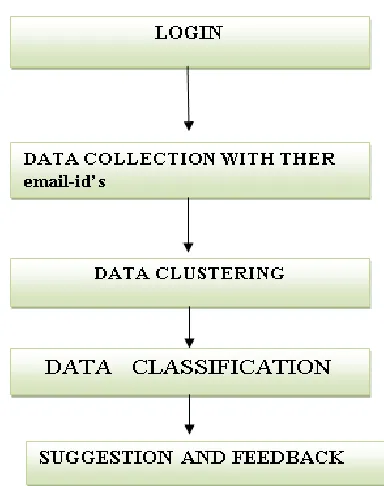
Collects all the information from the different students posted their comments in social website twitter. In this we also collects students email-id’s to send the suggestions to their individual id’s.
3. Data clustering.
In this module, the raw data is clustered by using BIRCH clustering algorithm.This algorithm starts with single cluster. Every point in a database is a cluster. Then it groups closest points into separate clusters, and continues until only one cluster remains. The computation of clusters calculated with help of distance matrix. The BIRCH algorithm generates cluster feature tree while scanning the dataset. Each entry in the CF tree represents the cluster of objects and is characterized by triple(N,LS,SS).
4. Data classification:
After clustering the data in different clusters based on the content, we use Naïve bayes classification algorithm. One popular way to implement multi-label classifier is toTransform the multi-label classification problem into multiple single-label classification problems. One simple transformation method is called one-versus-all or binary relevance. The basic concept is to assume independence among categories, and train a binary classifier for each category. All kinds of binary classifier can be transformed to multi-label classifier using the one-versus-all heuristic.
5. Suggestions and feedback:
After classification, finally we send the suggestions against their problems to their individual email-id’s so that we provide privacy to the students and also get feedback from the students in which how helpful our suggestions to them.
IV. GROUP CONSTRUCTION
User must sign up before login to give his\her details, the servers performing all the authentication and authorization processes for involved entities (users and resources). Based on the signup details user must use both username and password to login. User’s information is stored in database side to maintain separate server. User without login they can’t access any information for any sort of service every login information must protect by the data server as well as
authentication. This process is maintained by grid service
Sobel Operator:
The Sobel operator performs a 2-D spatial gradient measurement on an image and so emphasizes regions of high spatial frequency that correspond to edges. Typically it is used to find the approximate absolute gradient magnitude at each point in an input grayscale image.
[image:3.612.344.536.257.500.2]System Data Flow Diagram:
Fig. 1: Flow Diagram
Mathematically, the operator uses two 3×3 kernels which are convolved with the original image to calculate approximations of the derivatives - one for horizontal changes, and one for vertical. If we define A as the source image, and Gx and Gy are two images which at each point contain the horizontal and vertical derivative approximations, the computations are as follows:
© 2018, IRJET | Impact Factor value: 6.171 | ISO 9001:2008 Certified Journal | Page 2647 The x-coordinate is here defined as increasing in the
"right"-direction, and the y-coordinate is defined as increasing in the "down"-direction. At each point in the image, the resulting gradient approximations can be combined to give the gradient magnitude, using:
Using this information, we can also calculate the gradient's direction:
where, for example, Θ is 0 for a vertical edge which is darker on the left side.
The result of the Sobel operator is a 2-dimensional map of the gradient at each point. It can be processed and viewed as though it is itself an image, with the areas of high gradient (the likely edges) visible as white lines. The following images illustrate this, by showing the computation of the Sobel operator on a simple image.
Final Feature Set:
[image:4.612.324.565.361.551.2]The number of features was determined empirically, optimizing for accuracy. The final feature set included the top 85features (see Table II for the feature types selected) for each emotion class. The feature sets for anger and sadness are primarily composed of MFBs. The feature sets of happiness and neutrality are composed primarily of a mixture of cheek and mouth features.
Fig. 2: Comparison of Edge detection Algorithm Original
Fig. 3: Sobel
The high representation of audio features in the angry and sad feature sets and the low representation in the happy and neutral feature sets reinforce previous findings that anger and sadness are well captured using audio data while happiness is poorly captured using audio data alone .
Fig. 4: Comparison
V. CONCLUSION
Innovative technology promises alternative paradigm in increasing intervention accessibility. Emerging technology such as EABC has the potential to offer useful technology-enabled therapeutic system.To identify the
human intention in meeting. It
[image:4.612.83.252.519.661.2]© 2018, IRJET | Impact Factor value: 6.171 | ISO 9001:2008 Certified Journal | Page 2648 FUTURE WORK
Accuracy of the session classifier may be improved by different methods. Benefits of this paper is Decreasing assessment efforts, Promoting intervention, Ultimately skill generalization, Improving emotion recognition abilities. The developed EABC achieved high accuracy detection and by utilizing a set of features with low control by an attacker this EABC becomes more robust.
REFERENCES
[1.] M. Thomas, C. Kambhamettu “Face Recognition using a Color Subspace LDA approach" IEEE Transaction on Video/Image Modeling,1977.
[2.] JOHN G. DAUGMAN, “Complete Discrete 2-D Gabor Transforms by Neural Networks for Image Analysis and Compression”, IEEE Transactions on ACOUSTICS, SPEECH, AND SIGNAL PROCESSING,July 1988.
[3.] Zhou Wang, Alan Conrad Bovik, Hamid Rahim Sheikh and Eero P. Simoncelli, “Image Quality Assessment: From Error Visibility To Structural Similarity”, IEEE Transactions on IMAGE PROCESSING,April 2004.
[4.] Jun Wang, Lijun Yin, Xiaozhou Wei and Yi Sun 3D Facial Expression Recognition Based on Primitive Surface Feature Distribution, on 3D face recognition,2005.
[5.] AiHakamata, Fuji Renand Seiji Tsuchiya,“Human Emotion Model Based On Discourse Sentence For Expression Generation Of Conversation Agent”,Journal March 2010.