Data Sharing For Auditing Efficiency in Cloud
Computing
Raya Srinivasarao
1& SK Anjaneyulu Babu
21
PG Scholar, Dept of MCA,QIS College Of Engineering And Technology, Prakasam, AP.
2Assistant Professor, Dept of MCA, QIS College Of Engineering And Technology, Prakasam ,AP.
Abstract- the load rebalancing problem in cloud
computing. The main objective of the paper is to Enhance distributed load rebalancing algorithm to cope with the load imbalance factor, movement cost, and algorithmic overhead. The load rebalance algorithm is compared against a centralized approach in a production system and the performance of the proposal implemented in the Hadoop distributed file system for cloud computing applications. the cloud applications process large amount of data to provide the desired results. Data
volumes to be processed by cloud applications are
growing much faster than computing power. This growth demands on new strategies for processing and analysing the information. The project explores the use of Hadoop Map Reduce framework to
execute scientific workflows in the cloud. Cloud
computing provides massive clusters for efficient large computation and data analysis. In such file systems, a file is partitioned into a number of file chunks allocated in distinct nodes so that Map Reduce tasks can performed in parallel over the nodes to make resource utilization effective and to improve the response time of the job. In large failure
prone cloud environments files and nodes are
dynamically created, replaced and added in the system due to which some of the nodes are over
loaded while some others areunder loaded. It leads
to load imbalance in distributed file system. To overcome this load imbalance problem, a fully
distributed Load rebalancing algorithm has been
implemented, which is dynamic in nature does not consider the previous state or behaviour of the system (global knowledge) and it only depends on the present behaviour of the system and estimation of load, comparison of load, stability of different system, performance of system, interaction n
between the nodes, nature of load to be transferred, selection of nodes and network traffic. The current Hadoop implementation assumes that computing
nodes in a cluster are homogeneous in nature.
I. Introduction
every computing task helps to achieve resource utilization ratio and high user satisfaction. Minimizing resource consumption, avoiding bottlenecks, implementing fail-over, enabling scalability, reducing network inconsistencies and solving network traffic are the main goals of load computing. Whole cloud gets fail while analyzing existing system clouds performance bottleneck due to failure of central node. Functional difficulties and technical difficulties are caused because of those failures. Cloud computing allocate resources dynamically, which connects and add thousands of nodes together. The main goal is to allocate files to these nodes, for avoiding heavy nodes that files are uniformly distributed to these nodes. Load balancing provides maximization of network bandwidth, reduction of network traffic and network inconsistencies. We can add, delete and update nodes dynamically for heterogeneity of the nodes. Heterogeneity of the nodes will increase the scalability and system performance. In Distributed File System the main functionalities of nodes is to serve computing and storage functions. Cloud computing is a relatively new way of referring to the use of shared computing resources, and it is an alternative to having local servers handle applications. Cloud computing groups together large numbers of computer servers and other resources and typically offers their combined capacity on an on-demand, pay-per-cycle basis without sophisticated deployment and management of resources. The end users of a cloud computing network usually have no idea where the servers are physically located, they just spin up their application and start working. This flexibility is the key advantage to cloud computing, and what distinguishes it from other forms of grid or utility computing and software as a service (SaaS). The ability to launch new instances of an application with minimal labor and expense allows application providers to scale up and down rapidly, recover from a failure, bring up development or test instances, and roll out new versions to the customer base. Distributed file systems are key building blocks for cloud computing applications based on the Map Reduce J. Deanet all [1] programming paradigm. Map Reduce programs are designed to compute large volumes of data in a parallel fashion. This requires dividing the workload across a large
number of machines. Hadoop provides a systematic way to implement this programming paradigm. The computation
takes a set of input key/value pairs and produces a set of output key/value pairs. The computation involves two basic operations: Map and Reduce. The Map operation, written by the user, takes an input pair and produces a set of intermediate key/value pairs. The Map Reduce library groups together all intermediate values associated with the same intermediate Key #1 and passes them to the Reduce function. The Reduce function, also written by the user, accepts an intermediate Key #1 and a set of values for that key. It merges together these values to form a possibly smaller set of values. Typically just an output value of 0 or 1 is produced per Reduce invocation. The intermediate values are supplied to the user's Reduce function via an iterator (an object that allows a programmer to traverse through all the elements of a collection regardless of its specific implementation. The proposed fully distributed load rebalancing algorithm can be integrated with the Hadoop [3] Single-Node Cluster or Multi-Node Cluster to enhance the performance of the NameNode in balancing the loads of storage nodes present in
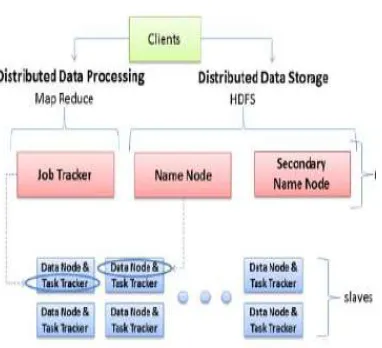
physical server playing multiple roles, such as both Job Tracker and Name Node.
II. Related work
Data Balancing on Cloud
an associated implementation for processing and generating large data sets. Users specify a map function that processes a key/value pair to generate a set of intermediate key/value pairs, and a reduce function that merges all intermediate values associated with the same intermediate key. Many real world tasks are expressible in this model. The map and reduce primitives present in Lisp and many other functional languages. We realized that most of our computations involved applying a map operation to each logical ―record‖ in our input in order to compute a set of intermediate key/value pairs, and then applying a reduce operation to all the values that shared the same key, in order to combine the derived data appropriately. The functional model with user specified map and reduce operations allows us to parallelize large computations easily and to use re-execution as the primary mechanism for fault tolerance. Programs written in this functional style are automatically parallelized and executed on a large cluster of commodity machines. The run-time system takes care of the details of partitioning the input data, scheduling the program’s execution across a set of machines, handling machine failures, and managing the required inter-machine communication. This allows programmers without any experience with parallel and distributed systems to easily utilize the resources of a large distributed system. Distributed file systems are key building blocks for cloud computing applications based on the MapReduce programming paradigm. In such file systems, nodes simultaneously serve computing and storage functions; a file is partitioned into a number of chunks allocated in distinct nodes so that MapReduce tasks can be performed in parallel over the nodes. The implementation of MapReduce runs on a large cluster of commodity machines and is highly scalable: a typical MapReduce computation processes many terabytes of data on thousands of machines. Programmers find the system easy to use: hundreds of MapReduce programs have been implemented and upwards of
Fig: single node cluster
The load rebalancing problem in distributed file systems specialized for large scale, dynamic and data-intensive clouds. Our objective is to allocate the chunks of files as uniformly as possible among the nodes such that no node manages an excessive number of chunks.
III. Balancing for DHT-Based Systems DHT based P2P systems offer a distributed hash table (DHT) abstraction for object storage and retrieval. Many solutions have been proposed to tackle the load balancing issue in DHT-based P2P systems. However, all these solutions either ignore the heterogeneity nature of the system, or reassign loads among nodes without considering proximity relationships, or both. To tackle this issue an efficient, proximity-aware load balancing scheme by using the concept of virtual servers. The goal is to ensure fair load distribution over nodes proportional to their capacities, but also to minimize the load-balancing cost (e.g., bandwidth consumption due to load movement) by transferring virtual servers between heavily loaded nodes and lightly loaded nodes in a proximity-aware fashion. To achieve the latter goal by using proximity information to guide virtual server reassignments. There are two main advantages of a proximity-aware load balancing scheme. First, from the system perspective, a load balancing scheme bearing network proximity in
mind can reduce the bandwidth consumption (e.g., bisection backbone bandwidth) dedicated to load
IV.Peer-to-Peer Lookup for Internet Applications ADistributed System-to-System applications that can store in data items. The cloud Protocal can solve the this problem using decentralized Networking systems. Cloud can support Single operation : given a key, it can assign a map to key . Data association will be mapped with all the part of the application data . Chord simplifies the design of System-to-System and applications based on it by pointing different problems. Those are as follows :
Load balance: Cloud act as decentralized
distribution system to spread over the networks so it can get all the keys of the cloud and it’s applications .
Decentralization: Cloud is fully distributed ., No
node is more important than any other key nodes . This improves robustness and makes Chord appropriate for loosely-organized System -to- System applications.
Scalability: even very large system are flexble in
the cloud computing ., so it can communicate with each other components . No parameter tuning is required to achieve this scaling.
Availability: Cloud automatically adjust it’s internal tables and data components. Because map reducing algoritham will take a relation between node to node and it’s formation . so that data will be associated with each other and it’s keys .so data will be avialble with all formats for the customers..
about every other node. A Chord node needs only a small amount of ―routing‖ information about other nodes. Because this information is distributed, a node resolves the hash function by communicating with other nodes. In an N-node network, each node maintains information about only O(logN) other nodes, and a lookup requires O(logN) messages. The consistent hash function assigns each node and key an m bit identifier using SHA-1 [10] as a base hash function. A node’s identifier is chosen by hashing the node’s IP address, while a key identifier is produced by hashing the key. We will use the term ―key‖ to refer to both the original key and its image under the hash function, as the meaning will be clear from context. Similarly, the term ―node‖ will refer to both the node and its identifier under the hash function. The identifier length m must be large enough to make the probability of two nodes or keys hashing to the same identifier negligible. Consistent hashing assigns keys to nodes as follows. Identifiers are ordered on an identifier circle modulo 2m. Key k is assigned to the first node whose identifier is equal to or follows (the identifier of ) k in the identifier space. This node is called the successor node of key k, denoted by successor(k). If identifiers are represented as a circle of numbers from 0 to 2m- 1, then successor(k) is the first node clockwise from k. In this paper the Chord uses consistent hashing to assign keys to Chord nodes. Consistent hashing tends to balance load, since each node receives roughly the same number of keys, and requires relatively little movement of keys when nodes join and leave the system. Chord will be a valuable component for peer-to-peer, large-scale distributed applications and also adapts efficiently as nodes join and leave the system, and can answer queries even if the system is continuously changing. Chord acts as a distributed hash function, spreading keys evenly over the nodes; this provides a degree of natural load balance.
V. Global Load Balancing in Peer-to-Peer Systems
A new framework, called Histogram-based Global Load Balancing (HiGLOB) to facilitate global load balancing in structured P2P systems. Each node P in HiGLOB has two key components. The first component is a histogram manager that maintains a histogram that reflects a global view of the
VI. Conclusion
In this paper the load rebalancing problem in large-scal, dynamic and distributed file systems in clouds has been presented. This is our first paper in which only the overview of load rebalancing algorithm have been done and we will provide a load balanced cloud, then only the resources can be well utilized and provisioned, maximizing the performance of MapReduce-based applications. The load-balancing algorithm to deal with the load rebalancing problem in large-scale, dynamic, and distributed file systems in clouds has been presented in this paper. The proposal strives to balance the loads of data nodes and task nodes efficiently. Then only can able to distribute the file chunks as uniformly as possible. The proposed algorithm operates in a distributed manner in which nodes perform their load-balancing tasks independently without synchronization or global knowledge regarding the system. In a loadbalanced cloud, the resources can be well utilized and provisioned, maximizing the performance of MapReduce-based applications. The algorithm also outperforms the competing distributed algorithm in terms of load imbalance factor, movement cost, and algorithmic overhead. References
[1] 1 J. Dean and S. Ghemawat, ―MapReduce: Simplified Data Processing on Large Clusters,‖ in Proc. 6th Symp. Operating System Design and Implementation (OSDI’04), Dec. 2004, pp. 137–150.
[2] 2 G. DeCandia, D. Hastorun, M. Jampani, G.
Kakulapati, A. Lakshman, A. Pilchin, S.
Sivasubramanian, P. Vosshall, and W. Vogels, ―Dynamo: Amazon’s Highly Available Key-value Store,‖ in Proc. 21st ACM Symp.
[3] 3 Hadoop Distributed File System,
―RebalancingBlocks,‖ http://develop
er.yahoo.com/hadoop/tutorial/module2.html#rebalancing.
[4] HDFSFederation, http://h adoop.apach
e.org/commo n/docs/r0 .23.0/hadoop-yarn/hadoop-yarn-site/Federation.html.
[5] D. Karger and M. Ruhl, ―Simple Efficient Load Balancing Algorithms for Peer-to-Peer Systems,‖ in Proc. 16th ACM Symp. Parallel Algorithms and Architectures (SPAA’04), June 2004, pp. 36–43.
[6] M. Raab and A. Steger, ―Balls into Bins—A Simple and Tight Analysis,‖LNCS 1518, pp. 159– 170, Oct. 1998.
[7] M. Jelasity, A. Montresor, and O. Babaoglu, ―Gossip-Based Aggregationin Large Dynamic Networks,‖ ACM Trans. Comput. Syst., vol. 23, no. 3,pp. 219–252, Aug. 2005.
[8] M. Jelasity, S. Voulgaris, R. Guerraoui, A.-M. Kermarrec, and M. V. Steen,―Gossip-Based Peer Sampling,‖ ACM Trans. Comput. Syst., vol. 25, no. 3,Aug. 2007.
[9] H. Sagan, Space-Filling Curves, 1st ed. Springer,1994.
[10] C. Guo, G. Lu, D. Li, H. Wu, X. Zhang, Y. Shi, C. Tian, Y. Zhang, andS. Lu, ―BCube: A High Performance, Server-Centric Network Architecturefor Modular Data Centers,‖ in Proc. ACM SIGCOMM’09, Aug. 2009, pp.63–74.
[11] H. Abu-Libdeh, P. Costa, A. Rowstron, G. O’Shea, and A. Donnelly,―Symbiotic Routing in Future Data Centers,‖ in Proc. ACM SIGCOMM’10,
Aug. 2010, pp. 51–62.
[12] S. Surana, B. Godfrey, K. Lakshminarayanan, R. Karp, and I. Stoica,―Load Balancing in Dynamic Structured P2P Systems,‖ PerformanceEvaluation, vol. 63, no. 6, pp. 217–240, Mar. 2006.
Authors Profile:
SK Anjaneyulu Babu
Asst Professor, M.C.A
Qis College Of Engineering & Technology Vengamukkalapalem,Ongole,Prakasam ,AP.
Raya Srinivasarao,M.C.A
Qis College Of Engineering & Technology