International Journal of Research (IJR)
e-ISSN: 2348-6848, p- ISSN: 2348-795X Volume 2, Issue 07, July 2015Available at http://internationaljournalofresearch.org
Facial expression recognition using Support vector
machine based on perceptual color & spaces Log
Gabor Filter
Praveen Kumar
1& D. Vijay Kumar
21M.Tech, Dept of ECE, Vijaya Engineering College, Telangana, India.
Email: [email protected]
2Associate Professor, HOD, Dept Of ECE, Vijaya Engineering college, Telangana,India,
Email: [email protected]
Abstract
Facial expression analysis is the important area of Human Robot Interaction (HRI) because facial expressions represent human emotions. Most existing researches in facial expression analysis mainly focused on recognizing extreme facial expressions. In existing work they introduced a tensor perceptual color framework (TPCF) for facial expression recognition (FER), which is based on information contained in color facial images. Humans can perform expression recognition with a remarkable robustness without conscious effort even under a variety of adverse conditions such as partially unmarked faces, different appearances and poor illumination. To avoid this proposed face recognition system consists of a novel illumination-insensitive pre-processing method for eliminating the illumination. First, in the pre-processing stage, a face image is transformed into an illumination-insensitive image, called an “integral normalized gradient image,” by normalizing and integrating the smoothed gradients of a facial image. The features are classified by using Support Vector clustering (SVC) classifier to avoid the complexity. The objective of this paper is to apply Support Vector Machines to the problem of classifying emotion on images of human faces.
Keywords: Facial expression recognition; Log Gabor Filter; Support vector machine; perceptual color spaces
1. Introduction
A goal of the human-computer-interaction (HCl) systems is to enhance the communication between the computer and user by making it user friendly and user's needs. In [1] proposes the important of the automatic facial expression recognition (FER)
International Journal of Research (IJR)
e-ISSN: 2348-6848, p- ISSN: 2348-795X Volume 2, Issue 07, July 2015Available at http://internationaljournalofresearch.org
emotions (i.e., anger, disgust, fear, happiness, sadness and surprise) [2].
The research study by Megrabian [3]has indicated that 7% of the communication information is transformed by linguistic language, 55% by facial expression and 38% by paralanguage in human face-to-face communication. It shows that facial expression provides a large amount of information in human communication. Many approaches have been proposed for the FER in the past several decades [1],[4]. Current state-of-art techniques mainly focused on the gray-scale image features [1], rarely it consider the color image feature [5]-[7]. Color feature mat provides more robust classification results. Research reveals that the color information enhance the face recognition and image retrieval performance [8]-[11]. In [8] it was first reported in that taking color information enhance the reorganization rate as compared with the same scheme using only the luminance information. Liu and Liu in [10] proposed a new color space for face recognition. In [11] Young,Man and Plataniotis demonstrated that the facial color cues express the improved face recognition performance using the low-resolution face image.
The RGB color tensor has enhanced the FER performance but it does not consider the different illumination was reported in [7].
Recent research shows the improved performance by embedding the color components. The capability of the color information in the RGB color space in terms of the recognition performance depends upon the type and angle of the light source, often making recognition impossible.
Thus the RGB may not be always be the most desirable space for processing color information. In [12] this issue can be addresses using perceptually uniform color system. In this paper a novel tensor perceptual color framework (TPCF) for FER is introduced which provides the information about the color facial images and investigates performance contained in the color facial images and investigates performance in perceptual color space under slight variation in the illumination.
This paper is organized as follows Section II provides the brief detail about the components of the FER systems used for this investigation. Section III defines and examines the tensor-based representation of color facial images in different color space and explains the proposed TPCF technique. Section IV presents the experimental result and Section V presents final conclusion.
2. Related Work
International Journal of Research (IJR)
e-ISSN: 2348-6848, p- ISSN: 2348-795X Volume 2, Issue 07, July 2015Available at http://internationaljournalofresearch.org
Many iris segmentation approaches has been explored till now. Approaches like Principal Component Analysis [1], Linear Discriminant Analysis [2], Independent Component Analysis [3] constitute a major part in the facial expression recognition techniques. These methods are 1-dimensional in nature. Therefore 2- dimensional Principal Component Analysis [4] is introduced. Since these techniques are applicable only in gray scale images, Global Eigen Approach [5] and Sub pattern Extended 2-dimensional Principal Component Analysis [6](E2DPCA) can be extended by traditional approaches to color space. Multilinear Image Analysis [7] introduced tensor concept which allows more than one factor variation in contradiction to PCA. Color Subspace Linear Discriminant Analysis [8] also uses tensor concept but in color space which improves the accuracy. Forachieving greater performance, another technique called Gabor Filer Bank [9] is used which outperforms all the other methods. Local Gabor Binary Pattern [10] has improved recognition rate than the gabor filter bank technique. Many studies have revealed that the overall performance is enhanced by color component embedding. But if RGB color space is used, accuracy depends on the angle and light source which reduces the recognition performance. Therefore RGB color space is not always suitable for color information processing. Perceptually uniform color
systems can address this problem. Therefore a novel tensor perceptual framework [11] for facial expression recognition is introduced in this paper for better performance. This is done on perceptual color space and SVM classifier is used for better performance.
2.2 Proposed System:
The principal approaches (i.e., imagebased and model based) to FER using static images are explained in [1]. Image-based extract feature form the image without extensive knowledge about the object of interest, which are fast and simple. The model based methods attempt to recover the volumetric geometry of the scene, which are slow and complex [1]. Geometric features present the shape and location of facial components (including mouth, eyebrows, eyes and nose). The facial feature points or facial components are obtained from the feature vector that represents the face geometry.
International Journal of Research (IJR)
e-ISSN: 2348-6848, p- ISSN: 2348-795X Volume 2, Issue 07, July 2015Available at http://internationaljournalofresearch.org
The appearance feature can be taken from either the whole face or specific regions in a face image. This paper focused on the static color image and a holistic technique of the image-based method is used for feature extraction. Image based FER systems consist of several components or modules, including face detection and normalization, feature extraction, classification and feature selection. The system level diagram of FER system shown in Figure 1 The following section will describe briefly about YCbCr, CIELab, and CLELuv [13].
3. Implementation
A. Face Detection and Normalization:
In this module is to obtain face images, which have normalized intensity, are uniform in shape and size and depict only the face region. Face area of an image is detected using the ViolaJones method based on the Haar-like features and the AdaBoost learning algorithm [14]. The Viola and Jones method is an object detection algorithm provides competitive object detection in the realtime. Features used by Viola and Jones are derived from pixels selected from rectangle area imposed over the picture and exhibit high sensitivity to the vertical and horizontal lines. After face detection the image is scaled into some size (e.g., pixels). Color values in the face image are then normalized with respect to RGB values of the image.
Color normalization is used to reduce the lighting effect because the normalization process is actually a brightness elimination
process. Input image of pixels represented in the RGB color space,
the normalized values,
are defined by
Where
International Journal of Research (IJR)
e-ISSN: 2348-6848, p- ISSN: 2348-795X Volume 2, Issue 07, July 2015Available at http://internationaljournalofresearch.org
Fig 2:Facial expression images: (a) the
original color components (b) the
normalized color components.
B. Feature Extraction:
Feature extraction have been studied and compared in terms of their performance, including principal components analysis, independent components analysis, linear discriminates analysis (LDA), the Gabor filter bank, etc. In [1] presents the Gabor filter has better performance than the rest. The Gabor filters model the receptive field profiles of cortical simple cells quite good [1], [15]. Gabor filter have two major drawbacks i.e., the maximum bandwidth of Gabor filter themaximum bandwidth is limited to approximately one octave, and the Gabor filter are not optimal to achieve broad spectral information with the maximum spatial localization [16].
The Gabor filter are band pass filters, which may suffers from lost of the low and the high-frequency information is reported in [17]. To overcome the bandwidth limitation of the traditional Gabor filter, Field proposed Log-Gabor filter [17]. Response of the Log-Log-Gabor filter, is Gaussian when viewed on a logarithmic frequency scale instead of a linear. It allows more information to be capture in the highfrequency area with desirable high pass characteristics. A bank of 24 Log-Gabor filter is employed to extract the facial features.
Polar form of 2-D Log-Gabor filters in frequency domain is given by
Where is frequency response function of the 2-D Log-Gabor filter, f and denotes the frequency 2-D Log-Gabor filters, f and ∅
denotes the frequency and the phase/angle of the filter. f0is the filter center frequency and
∅0the filter's direction. The constant 𝜎fdefines
the radial bandwidth B in octaves and the constant 𝜎𝜃angular bandwidth in radians.
In this paper describes here, the ratio is
kept constant for varying B is set to one octave and the angular bandwidth is set to one octave and the angular bandwidth is set to
International Journal of Research (IJR)
e-ISSN: 2348-6848, p- ISSN: 2348-795X Volume 2, Issue 07, July 2015Available at http://internationaljournalofresearch.org
arrays, X, are changed into the spectral vectors X and multiplied by the log-Gabor transfer functions 𝐻1 𝐻2 . . 𝐻24 producing 24 spectral representations for each image [17]. Spectra are then transformed block to the spatial domain via the 2-D inverse FFT. In this process results are obtained in the large numbers which are not suitable to build the robust learning models for classifications.
C. Feature Selection:
Feature selection module have a distinctive features of image and it help us to improve the performance of the learning models by removing the most relevant and redundant features from the feature space. Optimum features are selected using minimum redundancy maximum relevance algorithm based on mutual information (IM). In [18] presents a mutual information quotient (MIQ) method for feature selection and adopted to select the optimum features. As per the MIQ features selection if a feature vector has expression randomly or uniformly distributed in different classes and its MI with these classes is zero. If a feature vector is different from the other features for different classes, it will have large MI. Let F denotes the feature space; C denotes a set of classes
and denotes the vector of N observation for that feature.
Where is an instance of the discrete
random variable . The MI between features
and is given by
Where, is the joint probability
distribution function (PDF) of and
and are the marginal PDFs of
and for
and is the input dimensionality, which equals the number of features in the dataset. The Mi between the
and C can be represent by entropies [19].
Where
Where H(C) is the entropy of C, is
International Journal of Research (IJR)
e-ISSN: 2348-6848, p- ISSN: 2348-795X Volume 2, Issue 07, July 2015Available at http://internationaljournalofresearch.org
of the form where and is selected based on solution of following problems:
Where is the complement features subset of S, is the number of features in subset S and is the MI between the candidate features and the selected feature and intra-class features is maximized. MI between the selected feature and inter-class features is minimized. These features are used for emotion classification.
4. Experimental Results
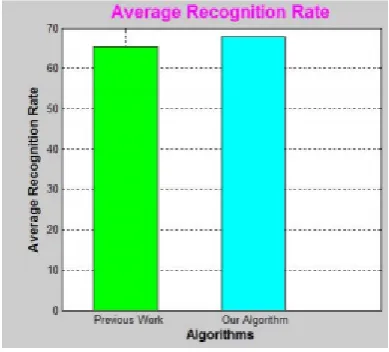
The training database is consisted of 50 images. While the test database contains 5 images that are randomly chosen for every expression. The main parameters which are used to evaluate the facial expression recognition system are: Accuracy, Average Recognition rate and matching time. The average recognition rate is 67.79. The accuracy of proposed work is 98.79. Fig. 3 reveals the comparison graph of proposed work.
Fig 3: Comparison graph of Accuracy of previous work and our proposed work.
Fig 4:Comparison graph of Average Recognition rate of previous work and our proposed work.
5. Conclusion
International Journal of Research (IJR)
e-ISSN: 2348-6848, p- ISSN: 2348-795X Volume 2, Issue 07, July 2015Available at http://internationaljournalofresearch.org
an approach for face detection using Viola-Jones method which minimizes computation time while achieving high detection accuracy. It also proposed a SVC method to classify the features. It also exhibit high accuracy. The contribution of this paper is a simple and efficient classifier built from computationally efficient features using AdaBoost for face detection.
6. References
[1] B. Fasel and J. Luettin, “Automatic facial
expression analysis: A
survey,”PatternRecognit., vol. 36, no. 1, pp.
259– 275, 2003.
[2] P. Ekman, E. T. Rolls, D. I. Perrett, and H.
D. Ellis, “Facial expressions of emotion: An old controversy and new findings discussion,”
Phil. Trans. Royal Soc. London Ser. B, Biol. Sci., vol. 335, no. 1273, pp. 63–69, 1992.
[3] A. Mehrabian, Nonverbal Communication. London, U.K.: Aldine, 2007.
[4] M. Pantic and I. Patras, “Dynamics of
facial expression: Recognition of facial actions and their temporal Segments from face profile
image sequences,” IEEE Trans. Syst., Man,
Cybern. B, vol. 36, no. 2, pp. 433 – 449, Apr. 2006.
[5] J. Wang, L. Yin, X. Wei, and Y. Sun, “3-D facial expression recognition based on
primitive surface feature Distribution,” in
Proc. IEEE Conf. Comput. Vis. Pattern Recognit., Jun. 2006, pp. 1399–1406. [6] Y. Lijun, C. Xiaochen, S. Yi, T. Worm, and M. Reale, “A high-resolution 3-D dynamic facial
expression database,” in Proc. 3rd Int. Conf.
Face Gesture Recognit., Amsterdam, The Netherlands, Sep. 2008, pp. 1–6.
[7] S. M. Lajevardi and Z. M. Hussain,
“Emotion recognition from color facial images
based on multilinear image analysis and
Log-Gaborfilters,” in Proc. 25th Int. Conf. Imag.
Vis. Comput., Queenstown, New Zealand, Dec. 2010, pp. 10–14.
[8] S. M. Lajevardi and Z. M. Hussain,
“Emotion recognition from color facial images
based on multilinear image analysis and
Log-Gabor filters,” in Proc. 25th Int. Conf. Image.
Vis. Comput., New Zealand, Dec. 2010, pp. 10–14
[9] T. S. Lee, “Image representation using 2-D
Gabor wavelets,” IEEE Trans. Pattern Anal.
Mach. Intell., vol. 18, no. 10, pp. 959–971, Oct.1996
[10]X. Xie and K.-M. Lam, “An efficient
illumination normalization method for face
recognition,” Pattern Recognition.Lett., vol.
27, no. 6, pp. 609–617,2006
[11]Y. Lijun, C. Xiaochen, S. Yi, T. Worm,
and M. Reale, “A high-resolution 3-D dynamic facial expression database,” in Proc.
International Journal of Research (IJR)
e-ISSN: 2348-6848, p- ISSN: 2348-795X Volume 2, Issue 07, July 2015Available at http://internationaljournalofresearch.org
Amsterdam, The Netherlands, Sep. 2008, pp. 1–6
[12]Z. Liu and C. Liu, “A hybrid color and
frequency features method for face
recognition,” IEEE Trans. Image Process., vol.
17, no. 10, pp. 1975–1980, Oct. 2008
Authors Profiles
D. PRAVEEN
KUMAR pursuing his M.Tech, from Vijaya Engineering College, Telangana, India. Email:
praveendaida1209@g mail.com