Wide Range Voltage to Frequency Converter
using PSoC3 Microcontroller
Manju Mohan1, Bini D2
PG Student [VLSI & Embedded Systems], Department of ECE, Musaliar College of Engineering & Technology.,
Pathanamthitta, Kerala, India1
PG Student [VLSI & Embedded Systems], Department of ECE, B S Abdur Rahman University, Chennai, Tamilnadu,
India2
ABSTRACT: This design describes a wide range voltage to frequency converter in a single PSoC chip, which can measure wide range of voltage between 50mV-5000mV and found suitability in sensor applications. This design is implemented in a PSoC3 device IC CY8C3866. The design implements analog and digital user modules: an IDAC, COMPARATOR, PWM, COUNTER, UART and LCD. The comparator gets the analog input from measurement signal or from sensors and the digitized output is sent to serial port through UART module. User friendly menu driven program written in LABVIEW acquires the serial data from PSoC chip and the acquired measurement data is displayed on the PC menu screen as well as saved in a user specified file path. The user interacts only with the graphical screen designed for the project. The software used is PSoC creator 2.2 and LabVIEW.
KEYWORDS: LABVIEW, PSoC, Transfer Characteristics, Virtual Instrument, V to F Converter.
I. INTRODUCTION
A Voltage to Frequency Converter is a device which can accept an analog voltage or current signal as input and converts it into an equivalent digital signal. The frequency of the digital signal is linearly proportional to the measured input voltage or current signal. It is advantageous to transmit a digital signal rather than an analog signal for long distance communications due to high noise immunity. This paper describes a wide range voltage to frequency converter design implementation in a single Programmable System on Chip (PSoC), which can measure wide range of voltage between 50-5000mV and found suitability in sensor applications. This design is implemented in a PSoC3 device IC CY8C3866. The unique design feature in PSoC design is the implementation of analog and digital user modules in a single chip, example in this design are: an IDAC, COMPARATOR, PWM, COUNTER, UART and LCD modules implemented within PSoC chip. The comparator gets the analog input from measurement signal or from sensors and the digitized output, converted using IDAC, PWM and COUNTER modules, and is sent to serial port through UART module. User friendly menu driven program written in LABVIEW acquires the serial data from PSoC chip and the acquired measurement data is displayed on the PC menu screen as well as saved in a user specified file path. The user interacts only with the graphical screen designed for the project. The software design toll used for the programmable hardware is PSoC creator 2.2.
II. RELATED WORK
Voltage-to-frequency (V/F) is widely used in applications such as industrial electronics, frequency-shift keying modulators, Phase-locked systems, analog-to digital converters, and isolation amplifiers. Voltage-To-Frequency Converters are low cost circuits for analog-to-digital conversion that generates a pulse train at a frequency precisely proportional to applied input voltage.
relatively expensive compared to modern low-cost analog integrated circuits. At present as an intelligent system design PIC, 8051 or in general any microcontroller is usually applied for voltage to frequency converter, but it requires many external components for the application. In this paper, PSoC3 microcontroller is used for wider V to F conversion which allows the designer to build the V/F converter using a PSoC microcontroller with its internal user modules and an external capacitor for charging. The PSoC Creator tool is given a useful device function with virtually no additional cost or extra components.
III.PROGRAMMABLE SYSTEM ON CHIP
A Programmable System on Chip (PSoC) is software configured, mixed-signal array with a built-in MCU core. PSoC facilitates an advanced method of signal acquisition, processing and control with exceptional accuracy, high bandwidth and superior flexibility. Its analog capability spans the range from thermocouples (DC voltages) to ultrasonic signals. The digital, analog and mixed signal blocks are all built on the same chip. In fig 1, CY8C38 device family block diagram is shown. PSOC 3 (CY8C38xxxx, CY8C36xxx, CY8C34xxx, CY8C32xxx) families are fully scalable 8-bit PSoC platform devices that have these characteristics: An 8-bit single cycle pipelined 8051 processor, running up to 67 MHz, with a nested vectored interrupt controller(NVIC) and a high-performance DMA controller. The single cycle 8051 CPU runs ten times faster than a standard 8051 processor. Digital system includes configurable Universal Digital Blocks (UDBs) and specific function peripherals, such as USB, CAN and I2C. PSoC has three separate memory spaces: paged SRAM for data, Flash memory for instructions and fixed data and I/o Registers for controlling and accessing the configurable logic blocks and functions. The device is created using SONOS technology.
A.
PSoC Designer
PSOC designer is the first generation software IDE to design, debug and program the PSoC 1 devices. It introduces unique features including a library of pre-characterized analog and digital peripherals in a drag-and-drop design environment which could then be customized to specific design needs by leveraging dynamically generated API libraries of code.
B.
PSoC Creator
PSoC Creator is the second generation IDE to design debug and program the PSoC 3 and PSoC 5 devices. The development IDE is combined with an easy to use graphical design editor to form a powerful hardware/software co-design environment. PSoC Creator consists of two basic building blocks. The program that allows the user to select, configure and connect existing circuits on the chip and the components which are the equivalent of peripherals on MCUs. The configurable blocks in a PSoC are the biggest difference from other microcontrollers. PSoC devices include up to 16 digital and 12 analog blocks, depending on the device.
IV. DESIGNING IN PSoC CREATOR
To create a new project, click “Create New Project” on the Start Page. On the New Project dialog, select an empty design and complete the requested project information. We can select a Starter Design to create a new project with components and code already placed. Components are to be selected and dragged from the Component Catalogue onto the schematic design. Various component parameters are configured to modify the behaviour as needed. A Pins component, Clock component and other components are added to complete the design. Various components are connected using the Wire tool. Once completed, use the Build command to generate source code. Components used in the design of Voltage-Frequency Converter are:
IDAC
Comparator
PWM
Counter
UART
LCD Display
Features of IDAC: The IDAC8 component is an 8-bit current output DAC (Digital to Analog Converter). The
output can source or sink current in three ranges. The IDAC8 can be controlled by hardware, software or by a combination of both hardware and software.
Three ranges: 2040 ìA, 255 ìA and 31.875 ìA
Current sink or source selectable
Software- or clock-driven output strobe
Data source may be CPU, DMA or Digital components
Features of Comparator: The comparator (comp) component provides a hardware solution to compare two
analog input voltages. The output can be sampled in software or digitally routed to another component. Three speed levels are provided to allow optimizing for speed or power consumption. A reference or external voltage can be connected to either input. We can also invert the output of the comparator using the Polarity parameter.
User controlled offset calibration
Multiple speed modes
Low-power mode
Output routable to digital logic blocks or pins
Selectable output polarity
Configurable operation mode during Sleep
Features of PWM: The PWM component provides compare outputs to generate single or continuous timing
and control signals in hardware. The PWM provides an easy method of generating complex real-time events accurately with minimal CPU intervention. PWM features may be combined with other analog and digital components to create custom peripherals.
8-bit or 16-bit resolution
Multiple pulse width output modes
Configurable trigger
Configurable capture
Configurable hardware/software enable
Features of Counter: The Counter component provides a method to count events. It can implement a basic counter function and offers advanced features such as capture, compare output and count direction control. For PSoC 3 and PSoC 5 devices component can be implemented using FF blocks or UDB. PSoC 4 devices support only UDB implementation. A UDB implementation typically has more features than an FF implementation. If the design is simple, consider using FF to conserve UDB resources for other purposes.
Fixed-Function (FF) implementation for PSoC 3 and PSoC 5 devices
8-, 16-, 24-, or 32-bit counter
Up, down or up-down configurations
Optional compare output and capture input
Enable and reset inputs for synchronizing with other components
Features of UART: The UART provides asynchronous communications commonly referred to as RS232 or
versions provide the same basic functionality. They differ only in the amount of resources used. To assist with processing of the UART receive and transmit data, independent size configurable buffers are provided.
9-bit address mode with hardware address detection
Baud rates from 110 to 921600 bps or arbitrary up to 4 Mbps
RX and TX buffers = 4 to 65535
Detection of Framing, Parity and Overrun errors
Full duplex, Half Duplex, TX only and RX only optimized hardware
Features of LCD: The Character LCD component contains a set of library routines that enable simple use of
one, two or four-line LCD modules that follow the Hitachi 44780 standard 4-bit interface. The component provides APIs to implement horizontal and vertical bar graphs.
Implements the industry-standard Hitachi HD44780 LCD display driver chip protocol
Requires only seven I/O pins on one I/O port
Contains built-in character editor to create user-defined custom characters
V. LABVIEW
Laboratory Virtual Instrumentation Engineering Workbench is a platform and development environment for a visual programming language from National Instruments. The graphical language is named “G” Language which is a unique tool implementing the data-flow programming model. In this project, LabVIEW has been used for giving a graphical user interface and also for communicating with PSoC through the Serial Port of the computer. LabVIEW provides a set of functions in the Function palette which is used for establishing a Serial Communication buffer and closing the Serial Communication operation. With LabVIEW, visualizing the program flow becomes easier and hence leads to faster and more efficient coding. LabVIEW provides excellent debugging tools and huge support through official forums. LabVIEW programs are called virtual instruments (VIs). Vis contains three main components-the Front panel, the block diagram and the Icon & Connector pane. The front panel is the user interface of the VI. The controls and functions contain sub palettes of objects to create a VI.
VI. EXPERIMENTAL SETUP
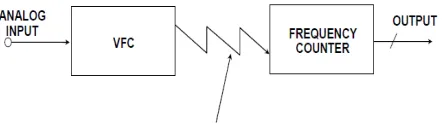
The basis for voltage-to-frequency converter uses the principle of linear charging and discharging of capacitance. The circuit consists of a charging capacitor, programmable current source, a comparator, PWM and counter.
Fig. 2 Block Diagram V-F Converters
The current set by IDAC module charges the external capacitor linearly until the threshold voltage is reached. The output frequency is dependent on capacitance value and the changing current. For the measurement, a Pulse Width Modulator (PWM) of a fixed period is enabling a 16-bit counter. The output of comparator clocks the counter and the count value is read and sent to Universal Asynchronous Receive transmit (UART) for transmitting to PC.
VII.PSoC IMPLEMENTATION FOR V TO F CONVERTER
continues and we get an oscillator whose frequency is inversely proportional to Vin. The period of the output waveform is directly proportional to the input voltage. The frequency output of the circuit can be found from the formula:
disch
t I CV F
1
where, F is the output frequency, C is the capacitance, V is the input voltage, I is the IDAC current and tdisch is the
period of the Comparator’s Synch clock. The frequency measurement is the number of rising edges that occur within one second. The project uses a PWM to generate the time window. The signal whose frequency is to be found is given to the count input of the counter. The count value in the counter within the time window gives a measure of the input signal frequency. The calculated frequency is displayed on the LCD Display and the UART provides asynchronous communications to PC via RS 232.
Fig. 3 Design/Configure for Measurement Using V/F Converter
VIII. LABVIEW IMPLEMENTATION FOR VOLTAGE TO FREQUENCY CONVERTER
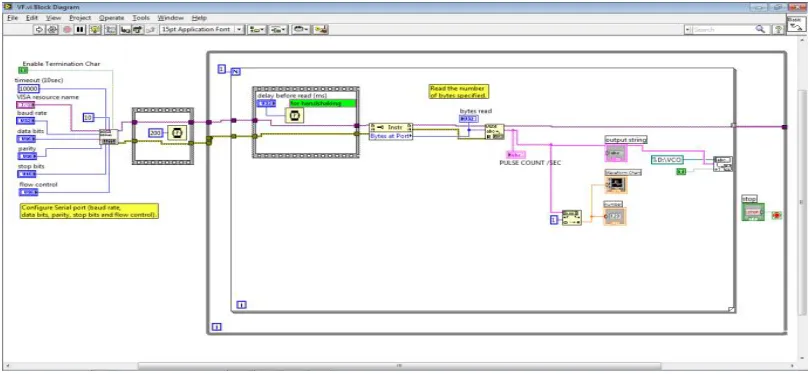
In this design, LabVIEW has been used for giving a graphical user interface and also for communicating with PSoC through the serial port of the computer. The measured data is displayed in the menu screen as well as saved in a user specified file path.
Fig 4 shows the block diagram in LabVIEW. The block diagram mainly consists of a VISA Configure serial port (initializes the serial port to the required settings given), VISA Read (Reads the specified number of bytes from the device or interface specified by VISA resource name and returns the data in read buffer) and a waveform chart(generates a waveform with voltage along X-axis and counts along Y-axis).
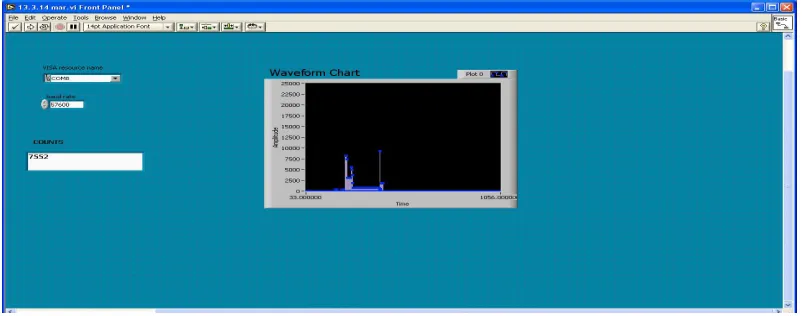
Fig. 5 LabVIEW Front Panel
Fig 5 shows the front panel in LabVIEW. The user enters the inputs through the interface or front panel which is also the screen on which the outputs are displayed.
XI. RESULTS
Voltage to Frequency converters generates a digital output proportional to the measured input voltage or current signal. Table 1 shows the measurements of counts corresponding to the input voltage given.
TABLE 1 Measurements of Counts Volts (mV) Counts (Hz)
100 35602 150 19416 200 14790 250 11496
300 8764
400 4452
450 4215
500 4100
550 3918
600 3786
650 3577
700 3226
750 3056
800 2946
850 2801
900 2698
1000 2526 1500 1708 2000 1340 2500 1150 3000 1050
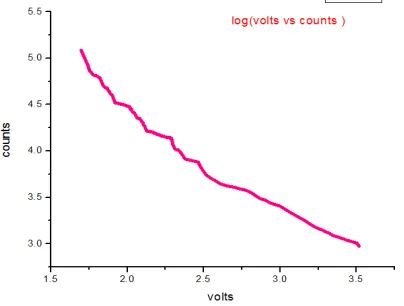
Fig 6 shows the transfer characteristic as a function of the input voltage. The frequency has been measured for various input voltages. The slope decreases with increasing input voltage.
Fig. 6 Transfer Characteristics of Volts Vs Counts
X.CONCLUSION
A wide range Voltage to Frequency Converter has been designed and implemented using the PSoC components and configurations. The results are quite accurate and the device is operable in any operating environment. The main advantage of this design over others is that it uses just one chip for the entire operation. The repeatability during tests has been verified. There is a scope for developing the design to be able to measure the voltages in the range of nano volts.
REFERENCES
1. Ivan Leni Cek, Damir Ili’C, and Roman Malari’C, “Determination of High-Resolution Digital Voltmeter Input Parameters”, IEEE Transactions on Instrumentation and Measurement, Vol. 57, No.8, pp. 1685-1688, 2008.
2. Todd D.Batzel, Mihai Comaanescu, “Instantaneous Voltage Measurement in PWM Voltage Source Inverters”, Electrical Machines and Power Electronics, pp. 168-173, 2007.
3. Nidhin.M.S, “Accurate Measurement Using Psoc 3 and Psoc 5 LP Delta-Sigma ADC’s”, Application Note AN84783, Document No. 001-84783.
4. Voltage Controlled Oscillator in PSoC 3/ PSoC 5, Application Note, http://www.cypress.com/?docID=33522.
5. Ganesh Raaja, Pushek Madan “Calibrating amplifiers and ADCs in SoC’s” Transpower Electronics, doc_id 528282, May, 2012. 6. PSoC Creator, version 2.2, www.cypress.com/?id=2494.
7. PSoC Programmable System on Chip, Technical Reference Manual, Document No. 001. 8. LABVIEW Basics I: Introduction Course Manual, Part Number: 320628M-01, 2004. 9. Mala Shiralkar, “LABVIEW Graphical Programming Course”, National Instruments, 2007.
10. Analog Blocks, Cypress Semiconductors, Rev.E., 2012, Pg.No. 2, 3 &4 Overview”, http://www.scribd.com/doc/68094111/CUA101 Semiconductor Corporation, 2009.
11. Ross Fosler, “Getting started with PSoC3”, Application Note-AN54181, Cypress Semiconductor Corporation.
12. Frequency Measurement with Counter in PSoC 3/ PSoC 5, http://www.cypress.com/?app=forum&id=2233& rID=57191. 13. Microchip AN795 "Voltage to Frequency / Frequency to Voltage Converter" June 2008 p. 4: "13-bit A/D converter".
14. Carr, Joseph J. (1996) Elements of electronic instrumentation and measurement, Prentice Hall, p. 402, ISBN 0133416860.
15. Walt Kester and James Bryant, “Voltage-to-Frequency Converters” Analog Devices MT-028 Tutorial 2009, apparently adapted from Kestre, Walter Allan (2005) Data Conversion Handbook, Newnes, p.274, ISBN 0750678410.