c e-ISSN: 2348-6848, p- ISSN: 2348-795X Volume 3, Issue 01, January 2016
International Journal of Research (IJR)
Available at http://internationaljournalofresearch.orgA Study to Investigate the Power Quality Issues for Using
DVR to Mitigate Voltage Sag
1
Ms. Manjari Gaur
M.Tech Scholar, Swami Keshwanand Institute of Technology, Jaipur
2
Mr. Bharat Modi
Assistant Professor, Swami Keshwanand Institute of Technology, Jaipur
1[email protected]
;
2[email protected]
ABSTRACT: Power Quality is an important problem of recent days. Many utilities from around the world is finding very difficult to meet the energy demands leading to the load shedding and other power quality problems. From decades, power quality has always been an important issue. Much research has been done to monitor and improve the quality of power. Many measures have been implemented and even we have gone so far in improving as well as maintaining the quality of power. Dynamic Voltage Restorer (DVR) is of great importance in present power system because of consistent problems related to the power distribution including the voltage sag and voltage swell.
Keywords: DVR; Voltage Sag; Power Quality
I. INTRODUCTION
An electrical power system is composed of three
major blocks: Generation, Transmission and
Distribution. For a reliable system, power generation should be produced adequate enough to meet the demands of the various types of customers, the transmission lines must be capable to transport the generated power to long distances without any problem and the distribution system must be able to distribute the electrical power to customers. The distribution system is directly connected to the customers and therefore the power quality is important mainly for the distribution system. In the past, for the improvement of power quality and reliability, various FACTS devices like IPFC: Interline power flow controller, STATCOM: static synchronous series compensator, UPFC: Unified
power flow controller, SSSC: Static Synchronous Series compensator, were introduced. These devices were designed for transmission system. Since now a day’s more importance is being given to the distribution system for power quality improvement, modified devices are being used known as custom power devices. The major custom power devices used are DSTATCOM: Distribution static synchronous
compensator, UPQC: Unified power quality
conditioner, DVR: Dynamic Voltage Restorer, AF: Active filter.
Electrical energy is commercialized. To increase the price per kilowatt of power, the quality has to be finest. Thus power quality has been an interest so that maximum profit can be achieved from the share markets. Dynamic voltage restorer is a power electronic based device. It protects sensitive loads from the various types of disturbances of the power supply. The basic principle of DVR is to restore the voltage sag to a pre-sag value by injecting a desired value of voltage. DVR can be implemented both at low voltage level as well as medium voltage level thus providing a facility to protect higher level sensitive loads too from voltage deflections.
In this work, the study of Dynamic voltage restorer for the mitigation of voltage sag has been done. Dynamic Voltage Restorer (DVR) is of great importance in present power system because of consistent problems related to the power distribution including the voltage sag and voltage swell. Due to modernization in today’s world, a large number of sophisticated electrical as well as electronic
c e-ISSN: 2348-6848, p- ISSN: 2348-795X Volume 3, Issue 01, January 2016
International Journal of Research (IJR)
Available at http://internationaljournalofresearch.orgprogrammable logic controllers, microprocessors, electrical drives etc. are being used these days. The power quality problems like voltage sag and swells, harmonic distortion are born which can cause serious problems to industries and the commercial electrical consumers. Due to these voltage sag and swell problems, there is failure in production plants, malfunctioning of sensitive loads etc. Thus there is a requirement of a device which can be used to overcome such problems. DVR is one of such devices that is used for the compensation of voltage sag so that sensitive equipments can work properly. The study of this device is of importance because to overcome the newer problems, the device should be updated with such problems and techniques. Also for the advancement of DVR, it is important to study the
advantages and disadvantages so that the
disadvantages can be overcome and its features can be further enhanced. This work provides a detailed study of DVR, its application at two voltage levels, the low voltage level and medium voltage level. A simulation has been done with line fault in a power system and DVR has been implemented for compensating the voltage sag due to the fault. The output graph for the voltage with DVR and voltage without DVR has been studied. The DVR implemented in this work is Space vector pulse width modulated Voltage source inverter based.
II. POWER QUALITY
Introduction: Power Quality is an important problem
of recent days. Many utilities from around the world is finding very difficult to meet the energy demands leading to the load shedding and other power quality problems. Due to modernization, a large number of sophisticated electrical as well as electronic
equipment such as computers and laptops,
programmable logic controllers, microprocessors, electrical drives etc. are being used. The power quality problems like voltage sag and swells, harmonic distortion are born which can cause serious problems to industries and the commercial electrical consumers. Due to these voltage sag and swell problems, there is failure in production plants,
malfunctioning of sensitive loads etc. Modern Power system is a complex network, hundreds of power generating stations and thousands of load centers are interconnected with the help of long lines of power transmission and distribution networks. Today, consumer’s main concern is the quality and reliability of supplied power at the various load centers. With the help of advance technologies, the modern industries are trying to extract and develop the new technology to achieve their predefined industrial goals. Every industry wants to optimize their production at the same time minimizing the cost of production so that a maximum profit can be achieved. Such production process requires a guarantee of stable and un-interrupted power supply. The main reason for the demand of a high quality power is
these modern manufacturing processes and
equipment. They require high efficiency with high quality of power for the operation of these machines. Most of the components of such machines are sophisticated and sensitive. Industries can go through a major financial loss if they go through shut down due to unavailability of required quality power[2]. Voltage dips in the supply is mainly caused by the faults in the grid as well as the fault clearing time taken by the devices used for protection. This fault clearing time mainly decides the voltage dip duration time. There can be various origins for such faults: (i) Faults in Transmission system. (ii) Due to starting of large motors.(iii) Various Fuses.(iv) Faults in remote distribution system.(v) Faults in Local distribution system. (vi) Short term Interruptions.
c e-ISSN: 2348-6848, p- ISSN: 2348-795X Volume 3, Issue 01, January 2016
International Journal of Research (IJR)
Available at http://internationaljournalofresearch.org2.2 Power Quality Problems.
Transient is not a steady state problem since it is an unwanted decay along time. Transient is a part of a change in the variable which disappears due to transition from one steady state to another. Transient is also called surge.There are two categories of Transients:(a) Impulsive, (b) Oscillatory
Voltage sag: The power quality engineers call "sag" as an event that occurs when the line voltage is reduced to less than 80% of the normal voltage for a few cycles. Such a disturbance can cause to upset or shutdown of the control circuits. Voltage sag mainly causes malfunction and many complaints of equipment and rarely causes any damage to the equipment. Sags fault in a feeder that has its source in, causes a large current to be drawn in the feeder thereby a voltage drop occurs in that bus which supplies power to other feeders. Sag is the major causes for the malfunctioning of equipment. Upsets mainly affects the Information Technology equipment and simple power devices which are basically controlled by magnetic motor starter. Voltage sag causes a reduction in the rms voltage up to a value between 0.1 to 0.9 p.u. and generally lasts for a duration of 0.5 cycles to 1 minute. A sag mostly lasts for a duration from 3 cycles to 30 cycles and depends on the fault clearing time.
Voltage swell: Swell is a brief increase of line voltage. It causes rise in rms voltage in between 1.1 and 1.8 p.u. for a time duration of about 0.5 cycles to 1 minute. The Sine wave of the AC voltage is essentially undistorted, but the amplitude increases to a few cycles or a few seconds. Swells which lasts for a few cycles does not cause much damage, only most sensitive electronic equipment may experience some disturbance. But swells which lasts for more than a few cycles causes considerable damage. It can trip out the protective circuits in some of the systems. A single line to ground fault results in voltage swell. Energizing of large capacitor banks can also result in swell.
Fig 2.2 Voltage Sag & Swell.
Interruption: Interruption is caused due to a decrease in the load current or supply voltage to less than 0.1 p.u. for some time period which may not be more than one minute. A system fault, any equipment failures or malfunctioning of any control equipment can cause interruption. Interruption is measured by their duration. The operating time of protective devices determines the duration of interruption due to faults and the duration of interruption due to malfunctioning of equipment is mostly irregular.
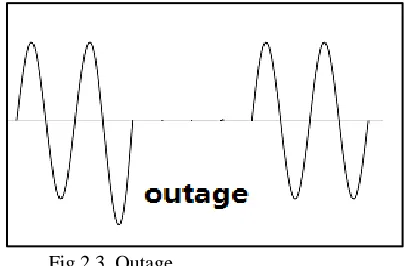
Sustained Interruptions: When the supply voltage becomes zero for a time period which is always greater than 1 minute, it is called sustained interruption. Such an interruption of voltage which lasts for more than a minute is mostly unending and it usually requires a human in order to restore the supply. A Long term interruption may be called "outage".
Fig 2.3 Outage
Waveform Distortion: A steady state deviation from power frequency ideal sine wave is called Waveform Distortion.There are five different types of waveform distortion:(a) Harmonics (b) DC offset (c) Harmonics Distortion (d) Noise (e) Notching
Voltage Imbalance: Voltage imbalance is mainly caused due to single phase loads running over a three phase circuit. Symmetrical components define the voltage imbalance. The ratio of zero sequence or negative sequence component to the positive sequence component is defined as the measure of unbalance.
c e-ISSN: 2348-6848, p- ISSN: 2348-795X Volume 3, Issue 01, January 2016
International Journal of Research (IJR)
Available at http://internationaljournalofresearch.orgthe improvement of power qualityis emphasized on distribution system also. For the improvement of power quality and reliability, some FACTS devices like STATCOM: Static Synchronous Compensator, SSSC: Static Synchronous Series Compensator, IPFC: Interline Power Flow Controller, and UPFC: Unified Power Flow Controller were used. These FACTS devices were basically for the transmission system only. But now a days, these devices are modified so that they can be used in distribution system and as a result the power quality can be further improved. Such modified devices are called Custom Power Devices. The Custom power devices which are basically used for the improvement of power quality in the distribution system are DSTATCOM: Distribution STATic synchronous COMpensator,APF: Active Power Filter, DVR: Dynamic Voltage Restorer, BESS: Battery Energy Storage System, DSC: Distribution Series Capacitors, SVC: Static Var Compensator, UPS: Uninterrupted Power Supplies, SMES: Super conducting Magnetic Energy System[2].
Custom Power Devices: To improve power quality, N.G. Hingorani was the first who proposed FACTS controllers and named them as Custom Power Devices[4]. These are basically based on VSC and there are 3 types described as below.(a) Series connected Dynamic Voltage Restorer (DVR) (b) Shunt connected Distribution STATCOM (DSTATCOM) (c) Combined shunt and series Unified Power Quality Conditioner (UPQC)
The DVR is almost similar to SSSC and the UPQC can be compared to UPFC. After being such similar, there is still a difference between them, the control technique used for improving the power quality is different which includes harmonic current and voltage injection to separate the source from load. A DVR works as an isolator to prevent harmonics in the source voltage that is reaching the load to as to balance the voltage and provide voltage regulation. A DSTATCOM eliminates the harmonics from source current and balances them to provide reactive power compensation in order to improve the power factor as well as regulate load bus voltage.
From among these custom power devices, DVR is considered as the most effective and most efficient custom power device due to its smaller size, lower cost, and its fast response in case of any disturbances.
Among the custom power devices, three of them can be compared:
DVR: Dynamic Voltage Restorer. It is used to correct the voltage dips and to restore the load voltage in such cases. It is always connected in series. DVR is considered as an effective and efficient device due to its low cost, smaller size, and fast response towards the voltage problems. Figure 2.4.
UPS: Universal Power Supply is a static converter using double conversion system. It takes energy from the supply in AC form, converts it to DC so that it can store that energy. In case of any disturbances, it supplies the stored energy using DC/AC converter to the load. Figure 2.5.
SSTS: Solid state Transfer Switch is used to change to change a faulted feeder to a working and healthy feeder by switching between two supply lines. Figure 2.6.
Fig.2.1 DVR connected in series.
Fig.2.2 UPS (Double Conversion)
Fig.2.3 Solid State Transfer Switch
c e-ISSN: 2348-6848, p- ISSN: 2348-795X Volume 3, Issue 01, January 2016
International Journal of Research (IJR)
Available at http://internationaljournalofresearch.orgcost per kVA, total annual cost as well as benefit/cost ratio. The SSTS have been found to have the highest benefit/cost ratio in case there is a secondary independent feeder and if there is no independent feeder, DVR will be the most cost effective solution.
III. CONCLUSION
DVR is a fast and effective solution for such problems of voltage sag or voltage dip. The controller used here implements fast forward technique utilizing the error signal. Error signal is the difference between the actual load voltage and the reference voltage. This error signal triggers the switches of inverter using space vector pulse width modulation technique. A simulation study was performed for a power system with two parallel feeders one of which consists of fault and DVR implemented in series for compensating the voltage sag. The output graph generated from the simulated presents the voltage sag problem without DVR and the compensated voltage after the DVR has been implemented. The effectiveness of DVR was studied with the help of experiment model and output results. The work also presents the study of application of the DVR at different voltage levels, Low voltage level and Medium voltage level. The advantages, disadvantages and features of the DVR have also been studied which can be referred for the future development of the DVR.
REFERENCES
[1] John Godsk Nielsen, “Design and control of a
DVR”, Doctoral Dissertation, Aalborg University, Denmark, 2002.
[2] M.V. KasuniPerera, “Control of a Dynamic
Voltage Restorer to compensate single phase voltage sags”, Master of Science, Stockholm, Sweden 2007.
[3] S.Deepa, Dr.S.Rajapandian, “Implementation of
Dynamic Voltage Restorer for voltage sag
mitigation”, International journal of engineering science and technology, Vol.2(10),2010, 5825-5830
[4] N.G. Hingorani, “Introducing Custom Power”,
IEEE spectrum, Vol.32, 1995, 4148.
[5] D. Daniel Sabin, AmbraSannino, “A summary of
the Draft IEEE P1409 Custom Power Application Guide”, IEEE, Vol. 3, pp.931-936, 2003
[6] P. T. Nguyen, Tapan K. Saha, “Dynamic Voltage
Restorer against Balanced and Unbalanced Voltage Sags: Modelling and Simulation”, IEEE, 0-7803-8465-2, 2004.
[7] D. MahindaVilathgamuwa, H. M. Wijekoon, S.
S. Choi, "Interline Dynamic Voltage Restorer: A Novel and Economical Approach for Multiline Power Quality Compensation" IEEE, 0093-9994, 2004.
[8] John Godsk Nielsen, Michael Newman, "Control
and Testing of a Dynamic Voltage Restorer at Medium Voltage Level", IEEE, 0885-8993, Vol. 19, No.3, May 2004.
[9] Bingsen Wang, GiriVenkataramanan, "Dynamic
Voltage Restorer Utilizing a Matrix Converter and Flywheel Energy Storage", IEEE, Vol. 45, No. 1, 0093-9994, Jan/Feb 2009.
[10]P. Ananthababu, B. Trinadha, K. Ram Charan,
"Performance of Dynamic Voltage Restorer against Voltage sags and swells using Space Vector PWM Technique", International Conference on Advances in
Computing, Control, and Telecommunication
Technologies, IEEE, 987-0-7695-3915-7, 2009
[11]Rosali Omar, N.A. Rahim, "Voltage
Disturbances Mitigation in Low Voltage Distribution System Using New Configuration of Dynamic Voltage Restorer", World Applied Sciences Journal, IEEE, 1818-4952, 2010.
[12]H. P. Tiwari, Sunil Kumar Gupta, International