Low Latency Low Complexity Compare and Decode
Architecture for LTE Turbo Codes
Aaquib Javed, Vijay L. Agrawal
P.G. student, Electronics and Telecommunication Department, HVPM’s College of Engineering and Technology Amravati, India
Professor, Electronics and Telecommunication Department, HVPM’s College of Engineering and Technology Amravati, India
ABSTRACT:
Another building design to matching those information secured for an error-correcting
code will be exhibited in this short to decrease inactivity What's more multifaceted nature. In light of the
way that the codeword of an ecc will be typically quell to An precise manifestation comprising of the
crude information and the equality majority of the data produced Toward encoding, the suggested
building design parallelizes those correlation of the information Also that of the equality majority of the
data. Will further lessen those inactivity Furthermore complexity, to addition, another butterfly-formed
weight gatherer will be suggested for those productive calculation of the turbo separation. Grounded on
the BWA, the recommended building design looks at if those approaching information matches the saved
information whether a sure amount about wrong odds would remedied. The recommended building design
diminishes those inactivity and the fittings unpredictability by, compared for the practically later
execution. The suggested construction modeling lessens those inactivity and the fittings multifaceted
nature Eventually Tom's perusing
∼33% Furthermore 10%, respectively, compared with those practically
late usage.
Keywords: Reduce the latency, less complexity, High-speed access, Communication Decoding
system.
1. INTRODUCTION
Information correlation will be generally utilized
within registering frameworks on perform a number
operations for example, the tag matching over a reserve
memory and the virtual-to-physical address interpretation
to An interpretation gaze a side cushion (TLB). Those
information correlation normally resides in the
discriminating way of the parts that need aid concocted on
expand those framework performance, e. G. , caches
What's more TLBs, whose outputs determine the stream of
the succeeding operations over An pipeline. Those circuit,
therefore, must a chance to be outlined with need Likewise
low inactivity as possible, alternately the parts will a
chance to be disentitled from serving Likewise accelerators
and the generally execution of the entire framework might
a chance to be extremely deteriorated.
As recent computers employ error-correcting codes
(ECCs) to protect data and improve reliability, complicated
decoding procedure, which must precede the data
comparison, elongates the critical path and exacerbates the
complexity overhead. Despite the need for sophisticated
designs as described, the works that cope with the problem
are not widely known in the literature since it has been
usually treated within industries for their products.
Recently, however, trigered the attraction of more and
more attentions from the academic field. The most recent
solution for the matching problem is the direct compare
method, which encodes the incoming data and then
compares it with the retrieved data that has been encoded
as well. Therefore, the method eliminates the complex
decoding from the critical path. In performing the
retrieved data is exactly the same as the incoming data.
Instead, it checks if the retrieved data resides in the error
correctable range of the codeword corresponding to the
incoming data.
As the checking necessitates an additional circuit to
compute the Turbo distance i.e. the numbers of different
bits between the two code words, the saturate adder (SA)
as a basic building block for calculating the Turbo
distance. However, a practical ECC
codeword is usually represented in a systematic form in which
the data and parity parts are completely separated from each
other. In addition, as the SA always forces its output not to be
greater than the number of detectable errors by more than one,
it contributes to the increase of the entire circuit complexity.
2. LITERATURE REVIEW
The decode-and-compare architecture, the n-bit
retrieved codeword should first be decoded to extract the
original k-bit tag. The extracted k-bit tag is then compared
with the k-bit tag field of an incoming address to determine
whether the tags are matched or not. As the retrieved
codeword should go through the decoder before being
compared with the incoming tag, the critical path is too long
to be employed in a practical cache system designed for
high-speed access. Since the decoder is one of the most
complicated processing elements, in addition, the complexity
overhead is not negligible. The following section will point
out the evolution of the proposed project’s work and research
till date:
I Performance evaluation of turbo codes using hard decision viterbi algorithm in vhdl
Susrutha Babu Sukhavasi, Suparshya Babu
Sukhavasi, Dr.Habibulla Khan, IEEE Chiranjeevi
Pilla/ International Journal of Engineering Research
and Applications (IJERA) ISSN: 2248-9622 Vol. 2,
Issue 3, May-Jun 2012
We first briefly describe the algorithms of convolution
encoder and hard decision Viterbi decoder. The focus of this
work is towards developing an application specific design
methodology for low power solutions. The methodology starts
from high level models which can be used for hardware
solution and proceeds towards high performance hardware
solutions. The methodology starts from algorithmic level,
concentrating on the functional correctness rather than on
implementation architecture. The effect on performance due to
variation in parameters like frame length, number of
iterations, type of encoding scheme. Turbo codes are used for
error protection, especially in wireless systems.
II Reed-Solomon Turbo Product Codes for Optical Communications: From Code Optimization to Decoder Design
Institut TELECOM, TELECOM Bretagne, CNRS
Lab-STICC, Technopˆole Brest-Iroise, CS 83818,
29238 Brest Cedex 3, France Correspondence should
be addressed to Rapha¨el Le Bidan Received 31
October 2007; Accepted 22 April 2008
The field of channel coding has undergone major advances
for the last twenty years. With the invention of turbo codes
followed by the rediscovery of low-density parity check
(LDPC) codes, it is now possible to approach the fundamental
limit of channel capacity within a few tenths of a decibel over
several channel models of practical interest. Although this has
been a major step forward, there is still a need for
improvement in forward-error correction (FEC), notably in
terms of code flexibility, throughput, and cost.
III Turbo and Turbo-Like Codes: Principles and Applications in Telecommunication
K. Gracie is with the Communications Research
Centre (CRC) Ottawa, ON K2H 8S2, Canada. M.-H.
Hamon is with France Telecom Research and
France Manuscript received August 24, 2006; revised
December 20, 2006.
For decades, the de facto standard for forward error
correction was a convolution code decoded with the
Viterbi algorithm, often concatenated with another
code (e.g., a Reed–Solomon code). But since the
introduction of turbo codes in 1993, much more
powerful codes referred to collectively as turbo and
turbo-like codes have eclipsed classical methods.
These powerful error-correcting techniques achieve
excellent error-rate performance that can closely
approach Shannon’s channel capacity limit. The lure
of these large coding gains has resulted in their
incorporation into a widening array of
telecommunications standards and systems.
IV Cascaded feed forward architectures for parallel viterbi decoding
G. Fettweis and H. Meyr, “Cascaded feedforward architectures for parallel Viterbi decoding,” in Proc.
IEEE Int. Sym. Circuits Syst., May 1990, pp. 978–
981.
The Viterbi-Algorithm (VA) is a common application of
dynamic programming. Since it contains a nonlinear feedback
loop (ACS-feedback, ACS: add-compare-select), this loop is
the bottleneck in high data rate implementations. In this paper
we show that asymptotically the ACS-feedback no longer has
to be processed recursively, i.e. there is no feedback, resulting
in negligible performance loss. This can be exploited to derive
purely feed forward architectures for Viterbi decoding, such
that a modular cascadable implementation results. By
designing one cascadable module, any speedup can be
achieved simply by adding modules to the implementation. It
is shown that optimization criteria, e.g. minimum latency or
maximum hardware efficiency, are met by very different
architectures.
3. PROBLEM DEFINITION
In the decode-and-compare architecture, the n-bit retrieved
codeword should first be decoded to extract the original k-bit
tag. The extracted k-bit tag is then compared with the k-bit tag
field of an incoming address to determine whether the tags are
matched or not. As the retrieved codeword should go through
the decoder before being compared with the incoming tag, the
critical path is too long to be employed in a practical cache
system designed for high-speed access. Since the decoder is
one of the most complicated processing elements, in addition,
the complexity overhead is not negligible.
Note that decoding is usually more complex and
takes more time than encoding as it encompasses a series of
error detection or syndrome calculation, and error correction.
The critical path is too long
Most complicated processing elements
More complexity4. RESEARCH METHODOLOGY
In the SA (saturate adder)-based architecture, the
comparison of two code words is invoked after the incoming
tag is encoded. Therefore, the critical path consists of a series
of the encoding and the n-bit comparison. However, it did not
consider the fact that, in practice, the ECC codeword is of a
systematic form in which the data and parity parts are
completely separated. As the data part of a systematic
codeword is exactly the same as the incoming tag field, it is
immediately available for comparison while the parity part
becomes available only after the encoding is completed.
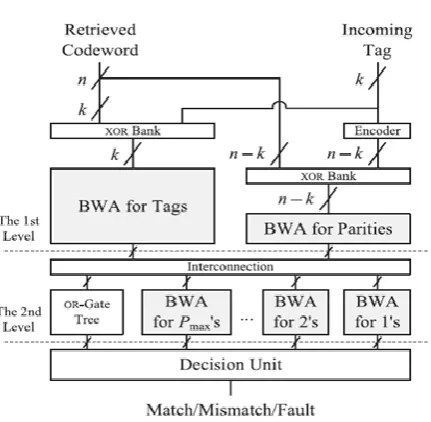
The proposed architecture grounded on the data path
design is shown in Fig. 1. It contains multiple
butterfly-formed weight accumulators (BWAs) proposed to improve the
latency and complexity of the Turbo distance computation.
The basic function of the BWA is to count the number of 1’s
SYSTEM BLOCK DIAGRAM:
Fig. 1Proposed architecture optimized for systematic code words
5. IMPLICATION
For a set of four codes including the (31, 25) code
quoted, We measured the metrics at the gate-level first and
then implemented the circuits in a 0.13-μm CMOS technology
to provide more realistic results by deliberating some practical
factors, e.g., gate sizing and wiring delays. The latency is
measured from the time when the incoming address is
completely encoded. As the critical path starts from the arrival
of the incoming address to a cache memory, the encoding
delay must be, however, included in the latency computation.
performing post layout simulations and equivalent gate counts
are measured by counting a two-input NAND as one.
The latencies of the SA-based architecture and the
proposed one are dominated by SAs and HAs, respectively.
As the bit-width doubles, at least one more stage of SAs or
HAs needs to be added. Since the critical path of a HA
consists of only one gate while that of a SA has several gates,
the proposed architecture achieves lower latency than its
SA-based counterpart, especially for long codewords.
The realization of this project will solve most of the
difficulties discussed above and in the problem definition
section. This project will have following results:
o Reduce the latency
o Less complexity
o High-speed access
o
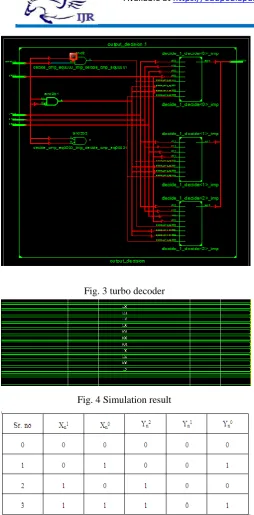
Communication Decoding systemsFig. 2 turbo distances
Fig. 3 turbo decoder
Fig. 4 Simulation result
Table 5.1 a sequence of transmitted signals for the
(a) Turbo encoder (b) Turbo encoder
6. REFERENCES
[1] Susrutha Babu Sukhavasi, Suparshya Babu Sukhavasi,
Dr.Habibulla Khan,” Performance evaluation of turbo codes
using hard decision viterbi algorithm in vhdl ,”IEEE
Chiranjeevi Pilla/ International Journal of Engineering
Research and Applications (IJERA) ISSN: 2248-9622 Vol. 2,
Issue 3, May-Jun 2012
[2] Raphael Le Bidan, Camille Leroux, Christophe Jego,
Patrick Adde, and Ramesh Pyndiah,”Reed-Solomon Turbo
Product Codes for Optical Communications: From Code
Optimization to Decoder Design,” Institute TELECOM,
TELECOM Bretagne, CNRS Lab-STICC, Technopˆole
Brest-Iroise, CS 83818, 29238 Brest Cedex 3, France
Correspondence should be addressed to Rapha¨el Le Bidan
Received 31 October 2007; Accepted 22 April 2008
[3] K. Gracie is with the Communications Research Centre
(CRC) Ottawa,”Turbo and Turbo-Like Codes: Principles and
Applications in Telecommunication,” ON K2H 8S2, Canada.
M.-H. Hamon is with France Telecom Research and
Development, 35512 Cesson- Se´vigne´ Cedex, France
Manuscript received August 24, 2006; revised December 20,
2006.
[4] Byeong Yong Kong, Jihyuck Jo, Hyewon Jeong, Mina Hwang, “Low-Complexity Low-Latency Architecture for Matching of Data Encoded With Hard Systematic Error-Correcting Codes,” Manuscript received January 14, 2013; revised May 22, 2013; accepted July 25, 2013. Date of publication August 21, 2013; date of current version June 23, 2014.IEEE TRANSACTIONS ON VERY LARGE SCALE INTEGRATION (VLSI) SYSTEMS, VOL. 22, NO. 7, JULY 2014
[5] G. Fettweis and H. Meyr, “Cascaded feedforward architectures for parallel Viterbi decoding,” in Proc. IEEE Int.