Available online: https://edupediapublications.org/journals/index.php/IJR/ P a g e | 285
Life Cycle Assessment Using Revit Software and
Tally Application
Ahmed Abdulameer Arab Al-Taie, Iraq
M.E/M.Tech, (Construction Engineering and Management) Department of Civil Engineering
Osmania University [email protected]
Abstract
The purpose of this paper to determine an effective means for analysis materials and find alternative materials to help in decision making. Lifecycle assessment, maintenance and replacement. The building of the College of Administration and Economics in Iraq at Waset is considered as a case study to realize the actual uses and benefits of Building Information Modeling (BIM). A 3D model is developed in Revit Architecture software, the study is carried out to know the impact of materials on the environment by means of Mass, Acidification Potential, Eutrophication Potential, Global Warming Potential, Ozone Depletion Potential, Smog Formation Potential, Primary Energy Demand, Non- renewable Energy Demand, Renewable Energy Demand to understand impact materials on environment and studied the effect of construction materials on the environment, the function of building information model and corresponding data control in different stages of Life Cycle Assessment .
Keywords: Building Information Modeling 6D, Life Cycle Assessment LCA , Environmental Impact.
INTRODUCTION
Available online: https://edupediapublications.org/journals/index.php/IJR/ P a g e | 286
important to note that BIM is not just software it is a process and software. BIM means not only using three-dimensional intelligent models but also making signification changes in the workflow and project delivery processes. BIM represents a new paradigm within Architecture Engineering and Construction (AEC).One that encourages integration of the roles of all stakeholders on a project. It has the potential to promote greater efficiency and harmony among players who, in the past, saw themselves as adversaries. BIM also supports the concept of integrated of integrated project delivery, which is a novel project delivery approach to integrate people, system and business structures and practices into a collaborative process to reduce waste and optimize efficiency through all phases of the project life cycle.[1]
Buildings provide countless benefits to society; nonetheless, they can have substantial environmental and human health impacts. The building sector is the largest energy consumer in the United States and worldwide (U.S. EIA 2012a). Civil works and building construction consume 60% of the global raw materials extracted from the lithosphere. In Europe, the mineral extractions per capita intended for buildings accumulate up to 4.8 t per inhabitant per year, which is 64 times the average weight of a person, highlighting the need to work toward dematerialization in building (Zabalza Bribián et al. 2011).
There is growing interest in integrating life cycle assessment (LCA) into
Available online: https://edupediapublications.org/journals/index.php/IJR/ P a g e | 287
arise throughout the design and construction and assist in their decisions by providing scientific and objective justifications (Erlandsson and Borg 2003; van der Lugt et al. 2006). Those questions include the possibility of comparing different alternatives or products during different building phases (i.e., design, construction and operation), especially the design phase. One additional challenge for designers is the selection of commercially available tools. The common tool is Impact Estimator for Buildings tally is application in Revit software.
Life-Cycle Assessment
There are many methods available for assessing the environmental impacts of materials and components within the building sector. While adequate to an extent for a particular purpose, they have disadvantages. LCA is a methodology for evaluating the environmental loads of processes and products during their whole life-cycle [1]. The assessment includes the entire life-cycle of a product, process, or system encompassing the extraction and processing of raw materials; manufacturing, transportation and distribution; use, reuse, maintenance, recycling and final disposal [2]. LCA has become a widely used methodology, because of its integrated way of treating the framework, impact assessment and data quality [3]. LCA methodology is based on ISO 14040 and consists of four distinct analytical steps: defining the goal and scope, creating the life-cycle inventory, assessing the impact and finally interpreting the results [4]. Employed
to its full, LCA examines environmental inputs and outputs related to a product or service life-cycle from cradle to grave, i.e., from raw material extraction, through manufacture, usage phase, reprocessing where needed, to final disposal. ISO 14040 defines LCA as: ―A technique for assessing the environmental aspects and potential impacts associated with a product, by: compiling an inventory of relevant inputs and outputs of a product system; evaluating the potential environmental impacts; and interpreting the results of the inventory analysis and impact assessment phases. LCA is often employed as an analytical decision support tool. [5]. Historically it has found popular use comparing established ways of making and processing materials, for example comparing recycling with incineration as a waste management option [6]. LCA is increasingly being seen as a tool for the delivery of more eco-efficient life-cycles.
LITERATURE REVIEW
Available online: https://edupediapublications.org/journals/index.php/IJR/ P a g e | 288
sustainability assessments. The motivation comes from the inability of existing building assessment tools in providing quick and reliable design decision support. The basic system architecture of the model has been described in detail. This system could help developers and designers to make more informed decisions. It is hoped that by providing quick and easy sustainability assessment at the design stage and by facilitating the establishment of a database and performance standards, in the future buildings will become much more sustainable [8].
Sahar Soltani (2016), The contributions of Building Information Modeling to Sustainable Construction. The aim of this paper is to review different ways through which BIM can interact with sustainable design, explore the gaps in its theoretical and practical scopes and highlight the important implications for related practitioners and researchers. It has shed light on the interaction of BIM and construction sustainability Based on this review, it is found that despite the abundance of the research in both areas of BIM and construction sustainability,the interaction of these two concepts has not well explored. In particular, among the three dimensions of sustainability, social dimension and the way BIM may have influences on it, have received less attention through using construction sustainability tools, methods and techniques, a greener design can be applied during various building phases. In this connection, it is argued that the analytical and
integrated models applied by Building Information Modeling (BIM) may also facilitate this process to be performed more efficiently. BIM and construction sustainability are quite different initiatives, but both have received much attention in recent years in the architecture, engineering.[9]
Methodology and Results
This paper describes a whole-building LCA performed for college building using LCA tools: , Tally The analysis accounts for the full cradle-to-grave life cycle, including material manufacturing, operation/use, maintenance and replacement, and eventual end of life. It includes the materials and energy used across all life cycle stages of the college building. The following sections describe the case-study building and then explains in detail the procedures performed in each LCA step The benefit of Building Information Modeling (BIM) in construction project of College of Administration and Economics as a case study. . The visualization is generally the simplest use of Building Information Modeling. The produced 3D model is then integrated to 6D Life Cycle Assessment LCA.
Life Cycle Assessment Tally Application:
Available online: https://edupediapublications.org/journals/index.php/IJR/ P a g e | 289
BIM elements and construction materials from the Tally database. The result is Life Cycle Assessment on demand, and an impact layer of decision – making information within
the same time frame, pace and environment that building designs are generated.
The process:
Define items Describe each item
Define Components and Quantity College Building Full Summary 6D
The present study is carried out for various Life Cycle Stages itemized by CSI Division, itemized by Revit Category, CSI Division itemized by Tally Entry, CSI Division itemized by Material, Revit Category itemized by Family, Revit Category itemized by Tally Entry, Revit Category itemized by Material. and are shown in above figure. The Tally software provides a summary of all materials present in selected study
materials are listed in alphabetical order along with a list of all Revit families and Tally entries in which they occur and any notes and system boundaries accompanying their database entries. The mass given here refers to full life – cycle mass of material, including manufacturing and replacement.
Available online: https://edupediapublications.org/journals/index.php/IJR/ P a g e | 290
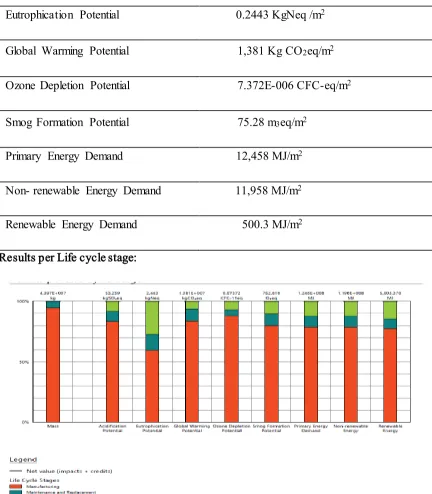
Potential, Global Warming Potential, Ozone Depletion Potential, Smog Formation Potential, Primary Energy Demand, Non- renewable Energy
Demand, Renewable Energy Demand. To understand impact materials on environment. As shown in Table 5.13
Table 1: Environmental Impacts per Full Building Life (60 Years).
Acidification Potential 5.326 kgSO2eq/m2
Eutrophication Potential 0.2443 KgNeq /m2
Global Warming Potential 1,381 Kg CO2eq/m2
Ozone Depletion Potential 7.372E-006 CFC-eq/m2
Smog Formation Potential 75.28 m3eq/m2
Primary Energy Demand 12,458 MJ/m2
Non- renewable Energy Demand 11,958 MJ/m2
Renewable Energy Demand 500.3 MJ/m2
Available online: https://edupediapublications.org/journals/index.php/IJR/ P a g e | 298
Conclusion
From the present study it is observed that with the help of Revit software quantities of materials can also be prepared while developing the 3D model this would help in reducing the time taken to quantify the materials and the components required. The impact of construction materials on the environment has been estimated using Tally software where by an effective management the impact of these materials in the ecosystem could be reduced.
Available online: https://edupediapublications.org/journals/index.php/IJR/ P a g e | 299
Potential, Global Warming Potential, Ozone Depletion Potential, Smog Formation Potential, Primary Energy Demand, Non – renewable Energy Demand, Renewable Energy Demand in the design phase, which are essential in the development of 6D (BIM) model are very much useful to green building concept.
References
1. ShekharJadhav, Ghadge A.N. Application of Building Information Modeling in
Construction Projects – A Critical Review, International Journal of Engineering Research, Volume No.5, pp.: 26-31, (2016). 2. Sonnemann, G.; Castells, F.;
Schuhmacher, M. Integrated Life-Cycle and Risk Assessment for Industrial Processes; Lewis
Publishers: Boca Raton, FL, USA, 2003
3. Consoli, F.; Allen, D.; Boustead, I.; Fava, J.; Franklin, W.; Jensen, A.; Oude, N.; Parrish, R.; Perriman, R.; Postlethwaite, D.; Quay, B.;
Seguin, J.; Vigon, B. Guide Lines for Life-Cycle Assessment: A ‘Code of Practice’; Society of Environmental Toxicology and Chemistry SETAC: Pensacola, FL, USA, 1993
4. Klöpffer, W. The role of SETAC in the development of LCA. Int. J. Life Cycle Assess. 2006, 11(Supplement 1), 116-122. 5. ISO 14040 Environmental
Management Life Cycle Assessment Principles and Framework; International
Standards Organization: Brussels, Belgium, 2006
6. Fava, J.A.; Consoli, F.; Dension, R.; Dickson, K.; Mohin, T.; Vigon, B. A Conceptual Framework for Life-Cycle Impact Assessment; Society of Environmental Toxicology and Chemistry SETAC: Sandestin, FL, USA, 1993.
7. elmes, D.G. Towards
Sustainability: Direction for Life Cycle Assessment. PhD thesis. Heriot Watt University: Edinburgh, UK, 2005.
8. Ping Yung and Xiangyu wang, A6D CAD Model for the Automatic Assessment ofBuilding Sustainability, International Journal of Advanced Robotic Systems, volume No. 5, pp. 1-10, (2014) . 9. Sahar Soltani, The contributions of
Building Information Modeling to SustainableConstruction. World Journal of Engineering and Technology, Volume No.4, pp.: 193- 199, (2016).
10.United States Environmental protection agency,
ORD/NRMRL/Sustainabletechnolo gy division systems analysis branch, (2012)SOP No. S10637-OP-1-0, pp. 24
11.Mastering Revit Architecture 2008 1st Edition, by Tatjana
Dzambazova and Greg Demchak 12.Auto desk, Revit
BuildingInformation Modeling (2007), http://6D modeling,
Available online: https://edupediapublications.org/journals/index.php/IJR/ P a g e | 300
13.Sonnemann, G.; Castells, F.; Schuhmacher, M. Integrated Life-Cycle and Risk Assessment for Industrial Processes; Lewis
Publishers: Boca Raton, FL, USA, 2003
14.Consoli, F.; Allen, D.; Boustead, I.; Fava, J.; Franklin, W.; Jensen, A.; Oude, N.; Parrish, R.; Perriman, R.; Postlethwaite, D.; Quay, B.;
Seguin, J.; Vigon, B. Guide Lines for Life-Cycle Assessment: A ‘Code of Practice’; Society of Environmental Toxicology and Chemistry SETAC: Pensacola, FL, USA, 1993
15.Klöpffer, W. The role of SETAC in the development of LCA. Int. J. Life Cycle Assess. 2006, 11(Supplement 1), 116-122. 16.ISO 14040 Environmental
Management Life Cycle Assessment Principles and Framework; International
Standards Organization: Brussels, Belgium, 2006
17.Fava, J.A.; Consoli, F.; Dension, R.; Dickson, K.; Mohin, T.; Vigon, B. A Conceptual Framework for Life-Cycle Impact Assessment; Society of Environmental Toxicology and Chemistry SETAC: Sandestin, FL, USA, 1993.
18.elmes, D.G. Towards