VDigital signal processing Using filter truncated multipliers
By VLSI design
Jaya Raju .Dara
1& K Kameswar Reddy
21
M-Tech Dept of ECE, Geethanjali Engineering College NANNUR-V, KURNOOL-DIST 2
Assistant Professor Dept ECE, Geethanjali Engineering College NANNUR-V, KURNOOL
DIST Mail Id:- [email protected]
Abstract:- Low-cost finite impulse replication (FIR) designs are presented utilizing the concept
of multipliers with the optimization of bit width and hardware resources without sacrificing the
frequency replication and output signal precision. Non-uniform coefficient quantization with
opportune filter order is proposed to minimize total area and cost. Multiple constant
multiplication/accumulation in a direct FIR structure is implemented utilizing an amended
version of Booth multipliers. In this proposed method a booth multiplier is implemented. In
Booth multiplier to multiply the signed numbers is an integrated advantage. Comparisons with
antecedent FIR design approaches show that the proposed designs achieve the best area and
power results.
KEYWORDS: VDigital signal processing (DSP), faithful rounding, finite impulse response
(FIR) filter, truncated multipliers, VLSI design
1. INTRODUCTION
Digital signal processing technology and its
advancements have dramatically impacted
our modern society everywhere. Without
DSP, we would not have digital audio and
verbalization, Digital telephone, Automobile
industry, Electronic communications,
Medical imaging equipment, Multimedia
applications. The signals are conventionally
processed in digital representation. , so
verbalization processing can be regarded as
a special case of digital signal processing the
digital filter is the most consequential
system in verbalization processing. It is
utilized to reduce the noise in an information
bearing signal. Predicated on the impulse
replication filters are relegated as two.
Illimitable impulse replication (IIR).
FIR filter is designed utilizing finite number
of impulse replication. IIR filter does not
provide the stable output, So that here we
have to design an efficient transposed FIR
filter which engenders stable output.
The involution of the fir filter is dominated
by the multiplication of the input samples
with filter coefficients. Filters employ an
immensely colossal number of multipliers
that lead to exorbitant area and power
consumption. But the filter coefficients are
constant for a given filter, so that
multiplications are implemented by a
network of adders and sub tractors. Where
the number of adders and subtractions are
minimized by a constant multiplication
scheme. In the transposed fir filter, the
recent most input sample at any given clock
period is multiplied with all the filter
coefficients. A set of intermediate results are
engendered in this case, and shared across
all the multiplications in order to minimize
the total number of integrations and
subtractions utilizing multiple constant
multiplication techniques. Each such
intermediate results in an MCM process
corresponds to one of the mundane
sub-expressions of the set of constants to be
multiplied. The prevalent sub expression
elimination for MCM reveals that the
number of operators used to compose the
adder tree networks is very consequential.
The number of operators on an adder tree is
resolute by the number of input terms the
coefficient uses from the network. For an N
input adder tree, N-1 operators are required.
Identify the resource minimization quandary
in the scheduling of adder tree operations for
the FIR MCM block. The area and power
consumption of the filters MCM blocks can
be calculated and apply the MIP predicated
algorithm for exact bit level resource
optimization.
2. RELETED WORK
The number of additaments used to
implement the coefficient multiplications. It
determines the intricacy of digital filters.
Many approaches have been proposed in
literature for reducing the number of adders
in the multipliers of digital filters. Utilizing
coefficient partitioning method to implement
low intricacy digital filters with minimum
number of full adders. While the
optimization criterion in conventional low
intricacy filter implementation method is the
number of adders, the focus of this method
is to minimize the number of full adders
required for each adder. The coefficient
the pseudo floating point coefficient coding
scheme and applied to optimize the
mundane sub expression elimination
methods. The full adder reduction achieved
utilizing this method is substantially higher
for higher order filters. The number of
adders and critical paths in a multiplier
block of a multiple constant multiplication
predicated implementation of a finite
impulse replication filter can be minimized
through mundane sub expression eliminate
techniques. A two bit mundane sub
expression can be located recursively in a
non-canonic sign digit representation of the
filter coefficients. To amend the elimination
of a CS from the multiplier block of an FIR
filter. It can be realized with fewer adders
and logical depths as compared to the
subsisting methods. This algorithm shows
average logical operator with a comparative
logic depth requisite. The two
reconfigurable FIR filter architectures,
namely Constant shift method (CSE) and
Programmable sub expression elimination
(PSE). Among these approaches, techniques
the best hardware reduction since it deals
with the multiplication of one variable (input
signal) with several constants
(coefficients).The CSE techniques fixate on
eliminating redundant computations in
multiplier blocks by employing the most
mundane sub expressions consisting of
two-nonzero bits. The PSM approach is
predicated on the prevalent sub expression
elimination algorithm utilized. Unlike the
CSM method where constant shifts are
utilized, the PSM employs programmable
shifters. The advantage of PSM over CSM is
that the former architecture always
ascertains the minimum number of
integrations and thus minimum power
consumption. The latency of the adder tree
increases by utilizing this approaches. An
incipient algorithm for digit serial FIR filter
utilizing CAD implement proposed in [2].
Little attention has been given to the
digit-serial MCM design that offers alternative
low involution MCM operations at the cost
of an incremented delay. Designing
digit-serial MCM operation with optimal area at
the gate level by considering the
implementation costs of digit-serial
integration, subtraction, and shift operation.
Since there are still instances with which the
exact CSE algorithm cannot cope, the
number of adders and logical operators still
increases the latency and reduces the
throughput of the multiple constant
multiplication. The resource minimization
operations for the FIR multiple constant
multiplication block and utilized the
commixed integer programming predicated
algorithm for exact bit level resource
optimization. The puissance and area
reduced in this approaches. After the
quandary identification of all these
implementations to surmount that only we
have to implement an efficient FIR filter and
proposed the high speed carry cull adder in
the scheduling of adder tree MCM block for
verbalization processing applications.
3. IMPLEMENTATION
Greedy Adder-Tree Scheduling
The coefficient of each CS terms is utilized
for the treeheight minimization algorithm to
engender an optimum height adder-tree. The
minimization algorithm for tree height is
utilized iteratively which collapses the dyad
consisting of {Ti , Tj} with delays having
most diminutive values. The most
diminutive delays are calculated utilizing
INTEGRATE/SUB to compose an incipient
term with delay max(Di , Dj)+1 until a
single term is reduced. The minimum delay
value can be calculated by either a positive
sign or a negative sign. When the positive
sign is utilized then it determines the
additament operation or when the negative
sign is utilized then it determines the
subtraction operation. With the avail of
these designations, it can able to identify
when the algorithm collapses a dyad of
terms in the adder-tree. This is predicated on
two rules. (1) If two input edges are of same
sign then INTEGRATE is utilized otherwise
it will be SUB. (2) The denotement of the
output edge is always same as that of the left
input edge. With the avail of these two rules
the summation engendered from the final
term may carry a negative sign. For an FIR
filter, results from multiple adder-trees are
accumulated by a structural adder-register
line. So the negation can be eliminated by
superseding the structural adder with a
Fig.1 Composition of the MCM and Sub
expression, (b) Term network and
adder-trees for each Coefficient.
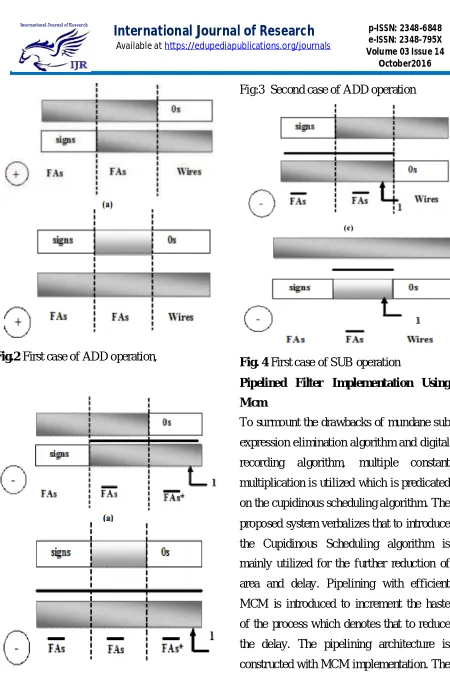
Cost Model
In order to reduce the hardware cost of the
adder-tree the implementation of ripple
carry is predicated on the cost of the
INTEGRATE/SUB operations, which is
most area efficient and will be picked up by
the hardware compiler whenever the timing
sanctions. The cost is calculated discretely
by three bit segments. The cost calculation
commences from the least paramount bit
(LSB), 1st segment covers the bit positions
not including the first bit of the shifted
operand, 3rd segment covers the bits
corresponding to the denotement extension
bits of the denotement elongated operand
and 2nd segment takes the rest of the bit
positions. INTEGRATE operation is
predicated on two cases are shown in . In
both cases, the 2nd and 3rd segments are
implemented by one Full Adder (FA) per
bit, while the 1st segment cost is nothing but
the wiring. SUB operation is predicated on
four cases are shown in . In first two cases
the shift operation takes place with the
minuend. The first segment is implemented
by full adders with the inverters in the
minuend bits. The 1st segments for the last
two cases are the wires, the 2nd segment for
all the cases is implemented by a dyad of
full adders and invertors and the 3rd
segment when the designation extension bits
emanate from the subtrahend, investors are
Fig.2 First case of ADD operation,
Fig:3 Second case of ADD operation
Fig. 4 First case of SUB operation
Pipelined Filter Implementation Using
Mcm
To surmount the drawbacks of mundane sub
expression elimination algorithm and digital
recording algorithm, multiple constant
multiplication is utilized which is predicated
on the cupidinous scheduling algorithm. The
proposed system verbalizes that to introduce
the Cupidinous Scheduling algorithm is
mainly utilized for the further reduction of
area and delay. Pipelining with efficient
MCM is introduced to increment the haste
of the process which denotes that to reduce
the delay. The pipelining architecture is
Multiple Constant Multiplication is one of
the hardware efficient techniques which
greatly reduces the number of shifts and
integrate operation. The pipelining
architecture with MCM implementation with
Nth order is illustrated in . In an N-level
pipelined system, the number of delay
elements in any path from input to output is
(N-1) more preponderant than that in same
path in the pristine sequential circuit. While
pipelining reduces the critical path, it leads
to a penalty in terms of an incrementation in
latency. Latency is the difference in the
availability of the first output data in the
pipelined system and sequential system. For
example if latency is 1 clock cycle then the
kth output is available in (k+1) th clock
cycle in a 1- stage pipelined system. The
two main drawbacks of the pipelining are
increase in the number of latches and in
system latency
Fig:- 5 Second case of SUB operation
EXPERIMENTAL RESULTS
Fig:-6 Firfiter
Fig:-7 Simulater Results
4. CONCLUSION
In this, the resource minimization
formalization for designing digit-serial
MCM operation with optimal area at the
gate level by considering the
implementation costs of digit-serial
additament, subtraction, and shift operations
was introduced. Since there are still
instances with which the exact prevalent
sub-expression algorithm cannot cope. But
acquisitive scheduling algorithm that finds
the best partial products in each iteration
which yield the optimal gate level area in
digit-serial MCM design was proposed. The
experimental results denote that the sundry
pipelined FIR filter, Parallel processing FIR
filter implementation of Multiple Constant
Multiplication. By utilizing MCM
implementation with Acquisitive scheduling
algorithm, we are achieved 30.55% area
reduction and 4.5% delay reduction
compared to subsisting algorithms. The
future work will enhance to develop the
Multiple Constant Multiplication (MCM)
design by introducing the Commixed Integer
Programming (MIP) algorithm. This
algorithm is utilized to
5. REFERENCES
[1] Yu Pan and Pramod Kumar Meher,
Senior Member, IEEE, ―Bit-Level
Optimization of Adder-Trees for Multiple
Constant Multiplications for Efficient FIR
Filter Implementation‖, IEEE Transactions
on Circuits and Systems—I: Regular Papers,
Vol. 61, No. 2, February 2014.
[2] D. R. Bull and D. H. Horrocks,
―Primitive operator digital filter, IEE
Proceedings-G, vol. 138, no. 3, pp. 401–412,
Jun. 1991.
[3] A. G. Dempster and M. D. Macleod,
―Use of minimumadder multiplier blocks
in FIR digital filters, IEEE Trans. Circuits
Syst. II, Analod Digit. Signal Process, vol.
42, no. 9, pp. 569–577, 1995.
[4] S. D. S. M. Mehendale and G.
Venkatesh, ―Synthesis of multiplier-less
FIR filters with minimum number of
additions, in Proc. IEEE ICCAD, 1995.
[5] I. C. Park and H. J. Kang, ―Digital filter
synthesis based on minimal signed digit
representation, in Proc. Design Autom.
Conf. (DAC), 2001.
[6] Y. Voronenko and M. Püschel,
―Multiplier less multiple constant
multiplication,‖ ACM Trans. Algorithms,
vol. 3, no. 2, 2007.
[7] P. K. Meher and Y. Pan, ―Mcm-based
implementation of block fir filters for
high-speed and low-power applications, in Proc.
2011 IEEE/IFIP 19th Int. Conf., Oct. 2011,
pp. 118–121.
[8] L. Aksoy, C. Lazzari, E. Costa, P. Flores,
and J. Monteiro, ―Design of digit-serial
FIR filters: Algorithms, architectures, and a
CAD tool, IEEE Trans. Very Large Scale
Integration (VLSI) Syst., vol. 21, no. 3, pp.
498–511, Mar. 2013.
[9] M. B. Gately, M. B. Yeary, and C. Y.
Tang, ―Multiple real-constant
multiplication with improved cost model
and greedy and optimal searches in Proc.
IEEE ISCAS, May 2012, pp. 588–591.
[10] M. Kumm, P. Zipf, M. Faust, and C.-H.
Chang, ―Pipelined adder graph
optimization for high speed multiple
constant multiplication, in Proc. IEEE