Speech Recognition for Physically
Challengeable Using Sonogram Techniques
S.Saravana, M.Uma Maheswari
Assistant Professor, Dept. of ETC, Bharath University, BIST, Chennai, Tamil Nadu, India
Dept. of ECE, Sree Sastha Institute of Engineering and Technology, Chennai, Tamil Nadu, India
ABSTRACT: The main objective of this project is to identify the tamil vowels (a,aaa,e,eee,u,uuu) or words speak by different aged persons. It can be done using Haar wavelet, by various decomposition levels the mean and standard deviation is obtained by simulating the various vowels in .wav file. The mean and standard deviation values are plotted as graph by using microsoft excel and the tamil vowels or words are identified by using that values.
The simulation results obtained for the following age groups in various decomposition levels.
The age group between 11 to 12.
The age group between 23 to 24.
The age group between 50 to 60.
I. ANALYSIS OF TAMIL VOWELS USING MATLAB
MATLAB is a numerical computing environment programming language. The sound can be visualized and analyzed in several ways with the help of this tool. The basic document we work with is sound files of 3 male and 3 female speakers with letters ‘a’,’aaa’,’e’,’eee’,’u’,’uuu’ fo different age people.The standard speech analysis of the letter ‘a’ such as Waveform and statistical value such as mean and standard deviation are analyzed and the samples are shown in following figures.
Stimulated Waveforms for the Age 11-12
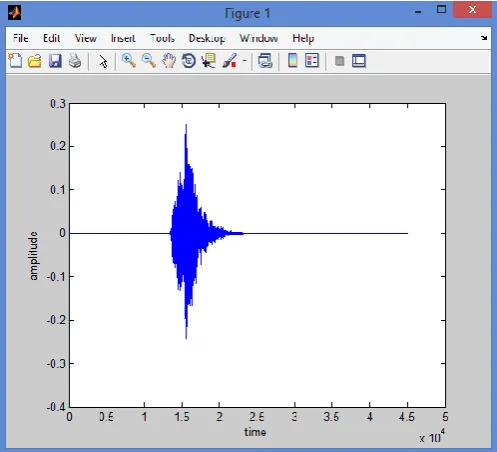
The figures show ‘a’ letter simulationfigures of male person, the input signal is given as .wav file and the wave is read to produce input waveform
The input waveform of letter ‘a’
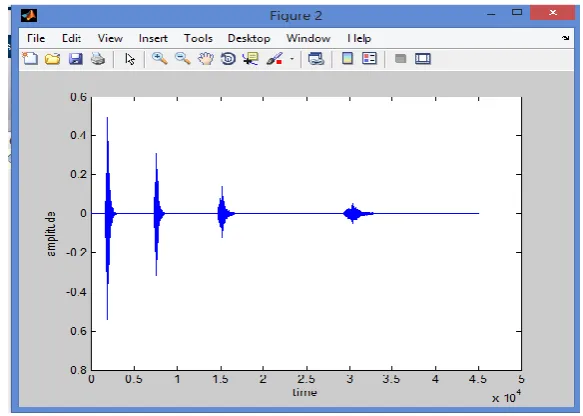
The first decomposition level of the input waveform
Fig. 2 First Decomposition Waveform for Letter ‘a’ of Age Person (11-12)
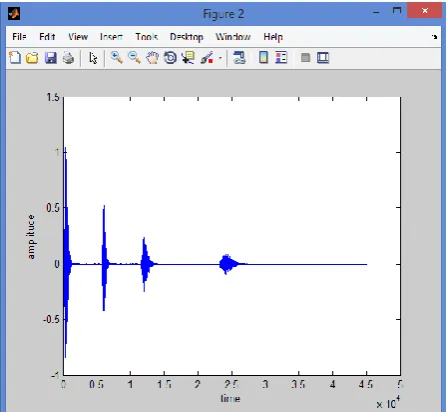
The fifth decomposition level of the input waveform
Fig. 4 Fifth Decomposition Waveform for Letter ‘a’ of Age Person (11-12)
Stimulated Waveforms for the Age 50-60
The figures show ‘a’ letter simulation figures of male person, the input signal is given as .wav file and the wave is read to produce input waveform
The input waveform of letter ‘a’
The first decomposition level of the input waveform
Fig. 6 First Decomposition Waveform for Letter ‘a’ of Age Person (50-60)
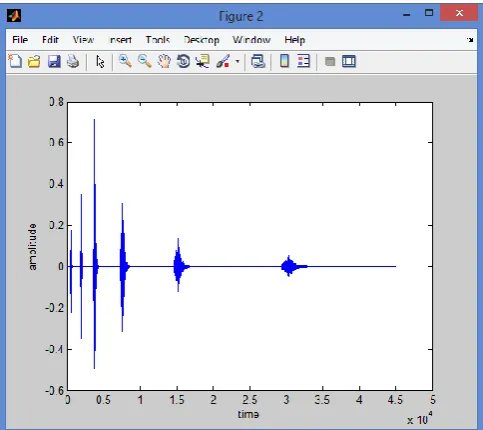
The third decomposition level of the input waveform
Fig. 7 Third Decomposition Waveform for Letter ‘a’ of Age Person (50-60)
Fig. 8 Fifth Decomposition Waveform for Letter ‘a’ of Age Person (50-60)
II. MEAN AND STANDARD DEVIATION GRAPHS FOR DIFFERENT LETTERS
The analyzed mean and standard deviation is tabulated for tamil vowels ‘a’, ‘aaa’, ‘e’, ‘eee’, ‘u’, ‘uuu’ for different decomposition level and the graph is plotted by using Microsoft excel.The mean and standard deviation is same for different decomposition level of the same letter.
Mean and Standard Deviation Graphs for Different Aged Persons MALE (11-12)
Person 1 Person 2 Person 3
Fig. 9 Mean and Standard Deviation Graph for the Male Person of (11-12)
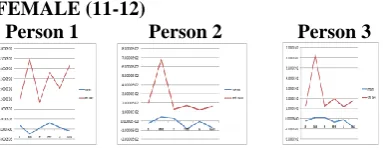
FEMALE (11-12)
Person 1 Person 2 Person 3
MALE (23-24)
Person 1 Person 2 Person 3
Fig. 11 Mean and Standard Deviation Graph for the Male Persons of (23-24) FEMALE (23-24)
Person 1 Person 2 Person 3
Fig. 12 Mean and Standard Deviation Graph for the Female Persons of (23-24)
MALE (50-60)
Person 1 Person 2 Person 3
Fig. 13 Mean and Standard Deviation Graph for the Male Persons of (50-60)
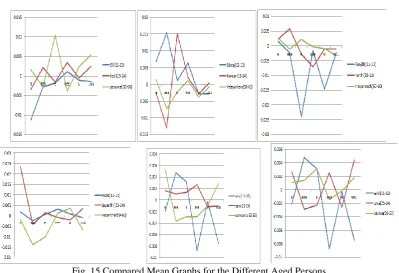
III. COMPARISION MEAN GRAPHS FOR ALL AGE GROUP PERSON
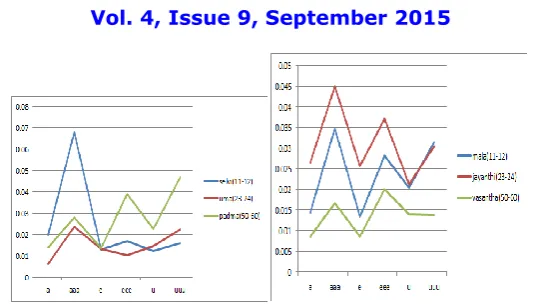
Fig. 16 Compared Standard Deviation Graphs for Different Aged Persons
The fig 16 show the Standard Deviation graph for different aged persons between 11 to 12, 23 to 24 and 50 to 60.
IV. CONCLUSION
The decomposition of speech signals through Haar wavelet is very efficient compared to other wavelet techniques such as Daubechies, Coiflet, Symlet, Meyer . In this work the normal speech is analyzed for the age group of 11-12, 23-24 and 50-60 for some Tamil vowels such as ‘a’,’aaa’,’e’,’eee’,’u’,’uuu’. By analyzing the speech signals the parameter’s mean and standard deviation of the various Tamil vowels are calculated by using MATLAB Then the parameters are tabulated and plotted.
From the graph the mean and standard deviation values are between some specific ranges based on the age groups. Further these values will be used for identifying the various vowels of Non-Audible Murmuring(NAM) and recognitionzation of words will be done for the same. In Future, the normal person’s speech is to be implemented using Stellar is hardware and various parameters such as mean and standard deviation are compared with (NAM) speech signals and without the knowledge of English also it it can be used in web browsing of converting speech to text in Tamil.
REFERENCES
1. Dharun V.S. , Karnan M. (2012), ‘Voice and Speech Recognition for Tamil Words and Numerals,’in International Journal of Modern Engineering Research (IJMER) Vol.2, Issue.5, pp-3406-3414 ISSN: 2249-6645
2. Anbuselvi S., Rebecca J., "A comparative study on the biodegradation of coir waste by three different species of Marine cyanobacteria", Journal of Applied Sciences Research, ISSN : 1815-932x, 5(12) (2009) pp.2369-2374.
3. Huiping Zhu, Bin Wu, Peng Ren (2013), ‘Medical Image Fusion Based on Wavelet Multi-Scale Decomposition’ Journal of Signal and Information Processing, 4, 218-221
4. Bharatwaj R.S., Vijaya K., Rajaram P., "A descriptive study of knowledge, attitude and practice with regard to voluntary blood donation among medical undergraduate students in Pondicherry, India", Journal of Clinical and Diagnostic Research, ISSN : 0973 - 709X, 6(S4) (2012) pp.602-6
5. Philips N. , Sonnadara D.U.J. and Jayananda M.K (2005),’Text To Speech Conversion - Tamil Language,’ in Proceedings of the Technical Sessions, 21, 1-8 Institute of Physics – Sri Lanka
6. Raj M.S., Saravanan T., Srinivasan V., "A modified direct torque control of induction motor using space vector modulation technique", Middle - East Journal of Scientific Research, ISSN : 1990-9233, 20(11) (2014) pp.1572-1574
7. Dr.Saraswathi.S, Asma Siddhiqaa.M, Kalaimagal.K, Kalaiyarasi.M (2010), ‘BiLingual Information Retrieval System for English and Tamil,’ in Journal of computing, volume :2, issue :4, ISSN 2151‐9617
8. Rajasulochana P., Krishnamoorthy P., Dhamotharan R., "An Investigation on the evaluation of heavy metals in Kappaphycus alvarezii", Journal of Chemical and Pharmaceutical Research, ISSN : 0975 – 7384, 4(6) (2012) pp. 3224-3228.
9. Selvarajan and Thekkumpurath Geetha (2007), ‘ Morpheme Based Language Model for Tamil Speech Recognition System,’ in the International Arab Journal of Information Technology, vol.4, no.3
10. Jasmine M.I.F., Yezdani A.A., Tajir F., Venu R.M., "Analysis of stress in bone and microimplants during en-masse retraction of maxillary and mandibular anterior teeth with different insertion angulations: A 3-dimensional finite element analysis study", American Journal of Orthodontics and Dentofacial Orthopedics, ISSN : 0889-5406, 141(1) (2012) pp. 71-80
11. Srinivasan A., Srinivasa Rao K. , Kannan K. and Narasimhan D. (2009), ‘Speech Recognition of the letter ‘zha’(H) in Tamil Language using HMM,’ in A.Srinivasan et al /International Journal of Engineering Science and Technology Vol.1(2), 67-72
13. B Karthik, TVU Kirankumar, MS Raj, E BharathKumaran,Simulation and Implementation of Speech Compression Algorithm in VLSI, Middle-East Journal of Scientific Research 20 (9), PP 1091-1092, 2013.
14. A.Geetha, Face Recognition Using OPENCL, International Journal of Advanced Research in Electrical, Electronics and Instrumentation Engineering , ISSN (Print) : 2320 – 3765, pp- 7148-7151, Vol. 3, Issue 2, Febuary 2014.
15. A.Geetha, Universal Asynchronous Receiver / Transmitter (UART) Design for Hand Held Mobile Devices, International Journal of Advanced Research in Electrical, Electronics and Instrumentation Engineering, ISSN: 2231-5381, pp 25-26, Volume 3 Issue 1 No1 – January 2012. 16. D.Sridhar raja, Comparison of UWB Band pass filter and EBG embedded UWB Band pass filter, International Journal of Advanced Research
in Electrical, Electronics and Instrumentation Engineering, ISSN 2278 – 8875,pp 253-257 ,Vol. 1, Issue 4, October 2012
17. D.Sridhar raja, Performances of Asymmetric Electromagnetic Band Gap Structure in UWB Band pass notch filter, International Journal of Advanced Research in Electrical, Electronics and Instrumentation Engineering, ISSN (Online): 2278 – 8875,pp 5492-5496, Vol. 2, Issue 11, November 2013