MATLAB Simulation of a High Step-Up
DC-DC Converter for a Micro Grid Application
GadeVenkat Raghavendra Reddy1, A. Hari Prasad2, Dr.Goli Ravikumar 3
1
Department of E.E.E, VasireddyVenkatadri Institute of Technology, Nambur, India 2
Department of E.E.E, VasireddyVenkatadri Institute of Technology, Nambur, India 3
Department of E.E.E, VasireddyVenkatadri Institute of Technology, Nambur, India
ABSTRACT: A high step-up dc–dc converter for a distributed generation system is proposed in this paper. The concept is composed of two capacitors, two diodes, and one coupled inductor. Two capacitors are charged in parallel, and are discharged in series by the coupled inductor. Thus, high step-up voltage gain can be achieved with an appropriate duty ratio. The voltage stresses on the main switch and output diode are reduced by a passive clamp circuit. Therefore, low resistance RDS (ON) for the main switch can be adopted to reduce conduction loss. In addition, the reverse recovery problem of the diode is alleviated. The operating principle and steady-state analysis of the voltage gain are also discussed in detail.
Finally, a MATLAB/Simulink based model is developed with 24v input voltage to obtain 400v output voltage and 400w output power from the proposed converter is simulated in this project.
KEYWORDS: step-up dc–dc converter, distributed generation system, high step-up voltage gain.
1. INTRODUCTION
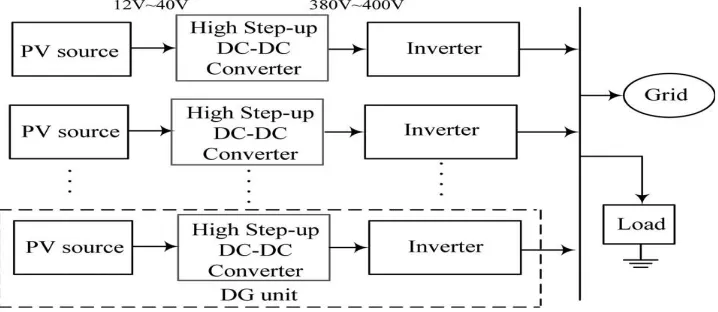
The distributed generation (DG) systems based on the renewable energy sources have rapidly developed in recent years. These DG systems are powered by micro sources such as fuel cells, photovoltaic (PV) systems, and batteries. Fig. 1.1 shows a PV distributed system in which the solar source is low dc input voltage.
PV sources can also connect in series to obtain sufficient dc voltage for generating ac utility voltage; however, it is difficult to realize a series connection of the PV source without incurring a shadow effect. High step-up dc–dc converters are generally used as the frontend converters to step from low voltage (12–40 V) to high voltage (380–400 V). High step-up dc–dc converters are required to have a large conversion ratio, high efficiency, and small volume.
Distributed energy resource (DER) systems are small-scale power generation technologies (typically in the range of 3 kW to 10,000 kW) used to provide an alternative to or an enhancement of the traditional electric power system. The usual problems with distributed generators are their high costs.
II. PROPOSED CONVERTER
This Proposed Converter has a high efficiency, high step-up voltage gain, and clamp-mode converter. The proposed converter adds two pairs of additional capacitors and diodes to achieve high step-up voltage gain. The coupled inductor is used as both a forward and flyback type; thus, the two capacitors can be charged in parallel and discharged in series via the coupled inductor. The transit current does not flow through the main switch compared with earlier studies. Thus, the proposed converter has low conduction loss. Additionally, this converter allows significant weight and volume reduction compared with other converters. Another benefit is that the voltage stresses on the main switch and output diode are reduced. However, the leakage inductor of the coupled inductor may cause high power loss and voltage spike. Thus, a passive clamping circuit is needed to recycle the leakage-inductor energy of the coupled inductor and to clamp the voltage across the main switch. The reverse-recovery problems in the diodes are alleviated, and thus, high efficiency can be achieved.
Figure.1. Circuit Configuration of the proposed converter
2.1 Operation
This converter consists of dc input voltage Vin , power switch S, coupled inductors Np and Ns , one clamp diode D1, clamp capacitor C1 , two blocking capacitors C2 and C3 , two blocking
diodes D2 and D3 , output diode Do , and output capacitor Co . The coupled inductor is modeled as the magnetizing inductor Lm and leakage inductor Lk .
To simplify the circuit analysis, the following conditions are assumed.
1) Capacitors C2 , C3 , and Co are large enough that Vc2, Vc3 , and Vo are considered to be constant in one switching period.
2) The power MOSFET and diodes are treated as ideal, but the parasitic capacitor of the power switch is considered. 3) The coupling coefficient of coupled inductor k is equal to Lm/(Lm+Lk ) and the turns ratio of coupled inductor n is equal to Ns /Np.
2.2Continuous-Conduction Mode (CCM) Operation
In CCM operation, there are six operating modes in one switching period of the proposed converter. The operating modes are described as follows.
Mode I [t0 , t1 ]: During this time interval, S is turned on. Diodes D1, D2, and D3 are turned off and Do is turned on. The current-flow path is shown in Fig.2. The primary-side current of the coupled inductor iLk is increased linearly. The magnetizing inductor Lm stores its energy from dc source Vin. Due to the leakage inductor Lk , the secondary-side current of the coupled inductor is is decreased linearly. The voltage across the secondary side winding of the coupled
inductor VL 2 , and blocking voltages Vc2 and Vc3 are connected in series to charge the output capacitor Co and to provide the energy to the load R. When the current is becomes zero, dc source Vin begins to charge capacitors C2 and
Figure.2. Current flowing path of proposed converter CCM Mode I operation.
Mode II [t1 , t2 ]: During this time interval, S is still turned on. Diodes D1 and Do are turned off, and D2 and D3 are turned on. The current-flow path is shown in Fig. 3. The magnetizing inductor Lm is stored energy from dc source Vin . Some of the energy from dc source Vin transfers to the secondary side of the coupled inductor to charge the capacitors
C2 and C3. Voltages Vc2 and Vc3 are approximately equal to nVin . Output capacitor Co provides the energy to load R. This operating mode ends when switch S is turned off at t = t2 .
Figure.3. Current flowing path of proposed converter CCM Mode II operation.
Mode III [t2 , t3 ]: During this time interval, S is turned off. Diodes D1 and Do are turned off, and D2 and D3 are turned on. The current-flow path is shown in Fig. 4. The energies of leakage inductor Lk and magnetizing inductor Lm
are released to the parasitic capacitor Cds of switch S. The capacitors C2 and C3 are still charged by the dc source Vin via the coupled inductor. The output capacitor Co provides energy to load R. When the capacitor voltage Vin+Vds is equal to Vc1 at t = t3, diode D1 conducts and this operating mode ends.
Figure.4. Current flowing path of proposed converter CCM Mode III operation.
Figure.5. Current flowing path of proposed converter CCM Mode IV operation
Mode V [t4 , t5 ]: During this time interval, S is turned off. Diodes D1 and Do are turned on, and D2 and D3 are turned off. The current-flow path is shown in Fig.6. The energies of leakage inductor Lk and magnetizing inductor Lm are released to the clamp capacitor C1 . The primary and secondary windings of the coupled inductor, dc sources Vin , and capacitors C2 and C3 are in series to transfer their energies to the output capacitor Co and load R. This operating mode ends when capacitor C1 starts to discharge at t = t5 .
Figure.6. Current flowing path of proposed converter CCM Mode V operation
Mode VI [t5 , t6 ]: During this time interval, S is still turned off. Diodes D1 and Do are turned on, and D2 and D3 are turned off. The current-flow path is shown in Fig.7. The primary-side and secondary-side windings of the coupled inductor, dc sources Vin , and capacitors, C1 , C2 , and C3 , transfer their energies to the output capacitor Co and load
R. This mode ends at t = t6 when S is turned on at the beginning of the next switching period.
Figure.8.Some typical key waveforms of the proposed converter at CCM operation.
2.4 Dis-Continuous Conduction Mode (DCM) Operation
In order to simplify the analysis for DCM operation, leakage inductor Lk of the coupled inductor is neglected. There are three modes in DCM operation. The operating modes are described as follows.
Mode I [t0 , t1 ]: During this time interval, S is turned on. The current-flow path is shown in Fig.9.The part energy of dc source Vin transfers to magnetizing inductor Lm. Thus, iLm is increased linearly. The dc source Vin also transfers another part energy to charge capacitors C2 and C3 via the coupled inductor. The energy of the output capacitor Co is discharged to load R. This mode ends when S is turned off at t = t1 .
Figure.9. Current flowing path of proposed converter DCM Mode I operation
Figure.10. Current flowing path of proposed converter DCM Mode II operation
Mode III [t2 , t3 ]: During this time interval, S remains turned off. The current-flow path is shown in Fig.11. Since the energy stored in Lm is depleted, the energy stored in Co is discharged to load R. This mode ends when S is turned on at
t = t3.
Figure.11. Current flowing path of proposed converter DCM Mode III operation
III. STEADY STATE ANALYSIS
3.1.CCM Operation
At modes IV and V, the energy of the leakage inductor Lk is released to the clamped capacitor C1. According to previous work, the duty cycle of the released energy can be expressed as
where Ts is the switching period, Dc 1 is the duty ratio of the switch, and tc 1 is the time of modes IV and V. By applying the voltage-second balance principle on Lm, the voltage across the capacitor C1 can be represented by
Since the time durations of modes I, III, and IV are significantly short, only modes II, V, and VI are considered in CCM operation for the steady-state analysis. In the time period of mode II, the following equations can be written based on Fig. 3.
Thus, the voltage across capacitors C2 and C3 can be written as
During the time duration of modes V and VI, the following equation can be formulated based on Fig.7
Thus, the voltage across the magnetizing inductor Lm can be derived as
Using the volt-second balance principle on Lm, the following equation is given:
Substituting (2), (3), (5), and (7) into (8), the voltage gain is obtained as
The ideal voltage gain is written as
According to the description of the operating modes, the voltage stresses on the active switch S and diodes D1 , D2 ,
D3 , and Do are given as
3.2. DCM Operation
In DCM operation, three modes are discussed. The key waveform is shown in Fig. 5. During the time of mode I, the switch S is turned on. Thus, the following equations can be formulated based on Fig.9
The peak value of the magnetizing inductor current is given as
Furthermore, the voltage across capacitors C2 and C3 can be written as
In the time interval of mode II, the following equations can be expressed based on Fig.10
During the time of mode III, the following equation can be derived from Fig.2.11
Applying the voltage-second balance principle on Np , Ns of the coupled inductor, the following equations are given as
Substituting (14), (15), (17), (18), (19), and (20) into (21) and (22), the voltage gain is obtained as follows:
According to (24), the duty cycle DL can be derived as
IV. SIMULINK MODELS AND RESULTS
The MATLAB/Simulink model of the proposed converter under full load condition (Po=400W) is shown in Fig.4.1. The output voltage 400v obtained is shown in Fig.4.2. The proposed converter is operated in CCM under full-load
cindition.Thecorresponding diode voltage and current waveforms are shown in Fig’s.4.3-4.11.Fig.4.3 Output voltage
Fi
gure.13 MATLAB/Simulink Model of the Proposed Converter under Full-Load condition
Po=400W.
Figure.14. Output voltage waveform for proposed converter in CCM operation
Figure.16. Output current waveform for proposed converter in CCM operation at Ilk.
Figur.17Output current waveform for proposed converter in CCM operation at IS.
Figure.18.Output voltage waveform for proposed converter in CCM operation at Vds.
Figure.19Output current waveform for proposed converter in CCM operation at Id2.
Figure.20Output current waveform for proposed converter in CCM operation at Id3.
Figure.21. Output voltage waveform for proposed converter in CCM operation at Vds.
Figure.22.Output current waveform for proposed converter in CCM operation at Id0.
Mode of Operation Input Voltage(Vin) Output Voltage(Vo)
CCM Operation 24 400
DCM Operation 24 500
Table.1.Comparison Table of the proposed converter
V. CONCLUSION
A step-up dc–dc converter is designed and Simulated in this project. By using the capacitor charged in parallel and discharged in a series by the coupled inductor, a high step-up voltage gain is achieved. The steady-state analysis of voltage gain is discussed in detail. Simulation results confirm that high step-up voltage gain is achieved. Moreover, the proposed converter has simple structure. It is suitable for renewable energy systems in microgrid applications.
REFERENCES
1. Y. Li and Y. W. Li, “Decoupled power control for an inverter based low voltage microgrid in autonomous operation,” in Proc. IEEE Int. Power Electron. Motion Control Conf. (IPEMC), 2009, pp. 2490–2496.
2. Y. Li, D. M. Vilathgamuwa, and P. H. Loh, “Design, analysis, and real-time testing of a controller for Multibus microgrid system,” IEEE Trans. Power Electron., vol. 19, no. 5, pp. 1195–1204, Jul. 2004.
3. C. L. Chen, Y. W, J. S. Lai, Y. S. Lee, and D. Martin, “Design of parallel inverters for smooth mode transfer microgrid applications,” IEEE Trans. Power Electron., vol. 25, no. 1, pp. 6–15, Jan. 2010.
4. Timbus, M. Liserre, R. Teodorescu, P. Rodriguez, and F. Blaabjerg, “Evaluation of current controllers for distributed power generation systems,” IEEE Trans. Power Electron., vol. 24, no. 3, pp. 654–664, Mar. 2009.
5. Y. A.-R. I. Mohamed and E. F. El Saadany, “Hybrid variable-structure control with evolutionary optimum-tuning algorithm for fast grid-voltage regulation using inverter-based distributed generation,” IEEE Trans. Power Electron, vol. 23, no. 3, pp. 1334–1341, May 2008. 6. Y. A.-R. I. Mohamed and E. F. El Saadany, “Adaptive decentralized droop controller to preserve power sharing stability of paralleled inverters
in distributed generation microgrids,” IEEE Trans. Power Electron., vol. 23, no. 6, pp. 2806–2816, Nov. 2008.
7. Y. W. Li and C. -N. Kao, “An accurate power control strategy for power electronics- interfaced distributed generation units operating in a low voltage multibus microgrid,” IEEE Trans. Power Electron., vol. 24, no. 12, pp. 2977–2988, Dec. 2009.
8. H. Karimi, A. Yazdani, and R. Iravani, “Negative-sequence current injection for fast islanding detection of a distributed resource unit,” IEEE Trans. Power Electron., vol. 23, no. 1, pp. 298–307, Jan. 2008.
9. T. Shimizu, K.Wada, andN.Nakamura, “Flyback-type single-phase utility interactive inverter with power pulsation decoupling on the dc input for an ac photovoltaic module system,” IEEE Trans. Power Electron, vol. 21, no. 5, pp. 1264–1272, Sep. 2006.