Volume 2009, Article ID 598063,14pages doi:10.1155/2009/598063
Research Article
An Optimization Theoretic Framework for Video Transmission
with Minimal Total Distortion over Wireless Networks
Pejman Goudarzi, Mohammad Hesam Tadayon, and Mahmoud Mousavinejad
Multimedia Group, IT Faculty, Iran Telecom Research Center (ITRC), P.O. Box 14155-3961, Tehran 14399 55471, Iran
Correspondence should be addressed to Pejman Goudarzi,[email protected]
Received 17 February 2008; Revised 4 October 2008; Accepted 10 January 2009 Recommended by Kameswara Namuduri
Optimization theoretic-based rate allocation strategies can be used for the aim of allocating some optimal rates to the competing users in wireless ad hoc networks. By considering different objective functions (such as congestion level, total packet loss, etc.), the researchers propose some optimization framework by which the problem can be solved. Due to the rapid increase in the development of different video applications in such environments and the existence of difficulties in satisfying the prespecified QoS limits, increasing the perceived video quality can be considered as an important and challenging issue. The quality of the received video stream is inversely proportional to the amount of distortion which is being imposed on the video stream by the network packet loss and the video encoder. The main contribution of the current paper is to introduce an optimization theoretic framework in which by optimal rate allocation to some competing video sources, the aggregate distortion associated with all of the sources can be minimized. The numerical results verify the claims.
Copyright © 2009 Pejman Goudarzi et al. This is an open access article distributed under the Creative Commons Attribution License, which permits unrestricted use, distribution, and reproduction in any medium, provided the original work is properly cited.
1. Introduction
Convex optimization theory is an important tool for many rate allocation algorithms in wireline or wireless networks. Wireless ad hoc networks are computer networks in which the communication links are wireless. The network is ad hoc because each node is willing to forward data for other nodes, and so the determination of which nodes forward data is made dynamically based on the network connectivity. This is in contrast to wired network technologies in which some designated nodes, usually with custom hardware (variously known as routers, switches, hubs, and firewalls), perform the task of switching and forwarding the data. Ad hoc networks are also in contrast to managed wireless networks, in which a special node known as an access point manages communication among other nodes. Ad hoc networks can form a network without the aid of any pre-established infrastructure [1].
The requirements of a specific set of QoS parame-ters (delay, jitter, packet loss, etc.) must be guaranteed for each time application. However, for most real-time applications of wireless ad hoc networks, intrinsic
time-varying topological changes provide challenging issues in guaranteeing these stringent QoS requirements.
Multipath routing can provide both diversity and mul-tiplexing gain between source and destination. However, multihop and multipath routing can also increase the total packet loss between the source and destination, especially if there is congestion in the paths or if the bit error rate of the paths is high due to the bad wireless link conditions (existence of high noise or interference levels). Therefore, supporting multimedia data with stringent maximum loss requirement over multihop ad hoc networks with multipath routing can be considered as an important and challenging research area.
Sending multimedia traffic over wireless ad hoc networks is a challenging issue, and many active research areas exist that all try to propose a solution to the problem from different points of view.
Some researchers such as those in [3, 4] try to use adaptive link layer techniques for throughput optimization. The authors in [4] propose a mathematical framework in which they vary adaptively the constellation size of an MQAM modulator in order to maximize the single user throughput.
In [5, 6] a congestion-minimized stream routing approach is adopted. In [6] the authors analyze the benefits of an optimal multipath routing strategy which seeks to minimize the congestion, on the video streaming, in a bandwidth limited ad hoc wireless network. They also predict the performance in terms of rate and distortion, using a model which captures the impact of quantization and packet loss on the overall video quality.
Some researchers such as Agarwal [7], Adlakha [8], and Zhu [9] follow some congestion-aware and delay-constrained rate allocation strategies. Agarwal and Gold-smith [7] introduce a mathematical constrained convex opti-mization framework by which they can jointly perform both rate allocation and routing in a delay-constrained wireless ad hoc environment. Adlakha et al. extend the conventional-layered resource allocation approaches by introducing a novel cross-layer optimization strategy in order to more efficiently perform the resource allocation across the pro-tocol stack and among multiple users. They showed that their proposed method can support simultaneous multiple delay-critical application sessions such as multiuser video streaming [8].
For multipath video streaming over ad hoc wireless networks, received video quality is influenced by both the encoder performance and the delayed packet arrivals due to limited bandwidth. Hence, Zhu et al. propose a rate allocation scheme to optimize the expected received video quality based on simple models of encoder rate-distortion performance and network rate-congestion trade-offs [9]. As the quality of wireless link varies, video transmission rate needs to be adapted accordingly.
In [6], Setton et al. analyzed the benefits of optimal mul-tipath routing on video streaming in a bandwidth-limited ad hoc network. They show that in such environments the optimal routing solutions which seek to minimize the congestion are attractive as they make use of the resources efficiently. For low-latency video streaming, they propose to limit the number of routes to overcome the limitations of
such solutions. To predict the performance in terms of rate and distortion, they develop a model which captures the impact of quantization and packet loss on the overall video quality.
In [10], measurements of packet transmission delays at the MAC layer are used to select the optimal bit rate for video, subsequently enforced by a transcoder. The benefit of cross-layer signaling in rate allocation has also been demonstrated in [11], where adaptive rate control at the MAC layer is applied in conjunction with adaptive rate control during live video encoding. The authors in [12] propose a media-aware multiuser rate allocation algorithm in multihop wireless mesh networks that can adjust the video rate adaptively based on both video content and network congestion and show the benefits of their work with respect to the well-known TCP friendly rate control (TFRC) [13].
In the current work, a similar approach such as [7] is being adopted by which a constrained optimization framework is introduced for optimal rate allocation to the real-time video applications. In [6], the authors do a similar optimization but they take the average congestion of the overall network as the QoS criterion and minimize it to find the optimal solution for rate allocation on the available paths using simulations. In [14], the authors propose a distributed rate allocation algorithm which minimizes the total distortion of all video streams. Based on the subgradient method, their proposed scheme only requires link price updates at each relay node based on local observations and rate adaptations at each source node derived from rate-distortion (RD) models of the video. They show by simulation that their proposed scheme can achieve the same optimal rate allocation as that obtained from exhaustive search.
The presented work in this paper differs from that of [14] in that, in our work, we have assumed that each video source may use multipath routing for partitioning and transmission of the total video traffic. On the other hand, we have included the effect of the packet loss in the perceived video distortion. Our work differs from [6, 7] in that we have used the total distortion as an objective Quality of Experience (QoE) measure in place of the QoS criterion used in [6, 7]. In order to compute the total distortion, we have assumed that multiple video sources use the same wireless ad hoc medium for transmission, and their associated distortions are additive [6]. On the other hand, the presented work differs from [7] in considering more than one (and possibly interfering) multipath-routed video sources which compete for the available bandwidth in a bandwidth-limited wireless ad hoc network.
The paper’s objective is to develop an optimal rate allo-cation framework bases on which the overall distortion of all the video sources is minimized. We also have used a penalty function approach for finding an iterative solution algorithm for the proposed constrained optimization problem such as those introduced in [15,16].
The rest of the paper is organized as follows. InSection 2
devoted to the numerical analysis, and finally in Section 5
some concluding remarks are presented.
2. Video Distortion Model
For smooth playback of a live video, transmitted packets must meet maximum allowed delay constraint. Therefore, the packets with a greater delay are useless so that they are supposed as packet loss. On the other hand, the total distortion of decoded video is the superposition of the distortion caused by video encoder (Denc) and the distortion caused by packet loss or late arrivals during the transmission (Dtrans) [6].
According to [17], considering Mean Squared Error (MSE) criterion and assuming that Denc and Dtrans are uncorrelated, the overall distortion can be written as follows:
Ddec=Denc+Dtrans. (1)
The empirical Rate-Distortion (R-D) model in [17] is used to representDenc:
Denc=D0+R θ
+R0, (2)
whereR is the rate of encoded video, and the parameters
D0, θ > 0, and R0 are calculated empirically from R-D curves. Again, based on [17], we assume a linear relationship between the total packet error rate (PER) andDtrans:
Dtrans=ξ·pT, (3)
wherepTis the PER, and the scaling factorξ >0 depends on
the encoding structure. Assuming that the video encoder uses the maximum allocated channel capacity, the rate of encoded video can be computed as follows [6]:
R=
n
j=1
xj, (4)
wherenis the number of paths in a multipath-routed source-destination pair, andxjis the rate allocated to the jth path.
The above assumption is achievable by using adaptive source rate control algorithms such as those mentioned in [18–20].
3. Proposed Optimization Framework
Consider the multihop wireless ad hoc network depicted in
Figure 1. Assume that there existN video sources, and the existing multipath routing protocol (e.g., DSDV) introduces
nkdisjoint multihop paths between each source-destination
pair (Sk,Dk) periodically (1 ≤ k ≤ N). Each path is
associated with a traffic flow, and these multiplexed flows are aggregated in the destination node to produce the initial source-generated traffic stream. The number nk is selected
based on the assumption of availability of the current paths throughput information for the video source nodeSk and
the sufficiency of the aggregate-estimated throughput for the traffic’s minimum bandwidth requirements.
Path 1
PathN S
D
Figure1: A typical multihop wireless ad hoc network.
Path 1
Path 2
Path 1 Path 2 S1
S2
D1
D2 C
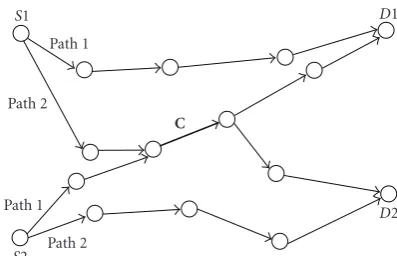
Figure2: Two competing multipath-routed video sources.
Each path jrelated to the sourcekcontainsMjkwireless
links from source to destination for 1≤k≤N and 1≤ j≤
nk. We assume that the total capacity of the wireless link
between the nodesyandzis denoted byCand is derived as
follows [6]:
C=W
2 log
1 +γSNR
, (5)
where SNRis the Signal to Noise Ratio between the nodesy
andzand can be written as follows:
SNR=Δ
d−αyz
WN. (6)
In the above calculations it is assumed that by a properly designed MAC protocol, there exist no collisions so that the inter node interference (INI) can be neglected. dyz is the
different paths [1]. We have used the Independent Basic Service Set (IBSS) setup (DCF mode) for implementing the MAC layer of the 802.11 WLAN standard which enforces the WLAN network in the ad hoc mode. It is assumed that BPSK DSSS is used in the physical layer. As the Bit Error Rate (BER) performance of the BPSK spread spectrum system in an AWGN environment is identical to that of conventional coherent BPSK system [21], it is sufficient to calculate the latter performance for evaluating the BER of the proposed system.
We also assume that the transmitted data is fragmented in equal length packets of lengthL bits enabled with FEC error correction capability up toMbits, and this leads to the coding gainγ.
In the current paper, our objective is to minimize the total distortion associated with multiple video sources. Thus, a mathematical formulation must be presented to express the distortion of each video source in terms of its allocated rate. According to (3), this distortion is a function of the PER associated with each video source. In the following paragraphs, the packet error rate computation method is presented.
The bit error rate (BER) of the linkiin the jth path of thekth video source can be represented for a simple strong LOS propagation model with BPSK signaling as follows [1]:
bi jk =Q
ηi jk
√r
i jk
1≤i≤Mjk,
1≤ j≤nk,
1≤k≤N,
(7)
where
ηi jk=hi jk·
Ti jk ∀k,j,i∈Rjk,
Q(y)=Δ √1 2π
∞
ye −x2/2
dx, (8)
wherehi jkis a physical constant,Rjkis the (nonempty) set of
wireless links associated with the jth flow of thekth video source, andTi jk andri jk are the transmitted power and the
total transmission rate associated with theith link in thejth flow of thekth source, respectively. As it is said before, we assume thatTi jk is fixed during transmission and therefore
does not depend on the transmission data rateri jk.
Assume that Rjk can be partitioned in two disjoint
subsets. One subset is associated with those wireless links that are common between more than one video sources which we denote byRcjk (it is assumed that this subset is not empty for at least one j), and the other set contains noncommon wireless links which we denote byRnc
jk. So, we can write
Rjk=Rcjk∪Rncjk ∀j,k. (9)
We represent the set cardinality operator by| · |, so we have|Rjk| =Mjk. We also assume that|Rncjk| = Ojk, and
thus we have|Rc
jk| =Mjk−Ojk.
Theri jkconsists of two components: one is the traffic rate
allocated to the jth flow of thekth source which is denoted byxjk, and the other part is associated with the time-varying
ith link’s cross (background) trafficai jk. Thus we have
ri jk=xjk+ai jk ∀k,j,i∈Rjk. (10)
So, the available capacity (throughput) is denoted byei jkand
is equal toei jk=Ci jk−ai jk, whereCi jkis the capacity of the
linkiin the jth path of thekth video source.
In some cases (as is depicted in Figure 2), two or more multipath video sources may compete for acommon wireless link (inFigure 2this link is shown by bold line). Therefore, the available capacity of the common link must be shared between the competing flows in an optimal manner.
Assume that for each common linki∈Rc
jkthere exists
an associated setSijkwhich represents the set of all ordered pairs (path, source) that use the common linkiin the path
j of the sourcek (e.g., in Figure 2, the path 1 of source 2 shares the common linkC with the path 2 of source 1). So the ingress and egress nodes associated with this common link are common between more than one flow.
For common links we assume that background traffic is composed only of those flows which are inSijk, that is, we can write
ai jk=
(u,v)∈Si jk
xuv ∀k,j,i∈Rcjk. (11)
With the assumption of independent links’ bit error rate, the total bit error rate along the jth path of thekth source can be calculated as follows:
Bjk=1−
Mjk
i=1
1−bi jk
∀j,k. (12)
The total PER of the jth path of thekth video source is composed of the congestion-related and noncongestion-related (wireless link) losses which we denote bypQj,kandpRj,k,
respectively.
If the FEC-induced error correction capability of a packet with lengthLbits isMbits (M >1) and with the assumption of independent bit errors (lack of burst errors), the wireless link-related PER along thejth path (flow) of thekth source can be calculated as follows:
pRjk=1− M
m=0
L m
Bm
jk
1−Bjk
L−m ∀
j,k. (13)
Now we are in a position that must compute the congestion-related part of the PER.
First, assume that the end-to-end queueing delay of the
jth path of thekth source can be represented with a random variable with the probability density function (pdf)βjk(t).
By adopting the same approach as in [7], it can be assumed that congestion-related packet loss occurs when the end-to-end queuing delay of the jth path of thekth source exceeds a predetermined threshold Δjk. In mathematical
terms the mentioned fact can be represented as follows:
pQjk=
∞
Δjk
βjk(t)dt ∀j,k. (14)
In the sequel, the distributionβjk(t) has been calculated
based on some specific assumptions.
assumption of M/M/1 queueing model, the service time of each queue is an exponentially distributed random variable [22]. We also assume that this service times are independent. On the other hand, the end-to-end delay of each path j
belonging to the video source k is equal to the sum of these independent random variables. Ignoring the source and destination nodes (hops), the total number of nodes inRjk and the number of noncommon nodes inRncjk and
common nodes in Rcjk would be Mjk −1, Ojk −2, and
Mjk−Ojk+ 1, respectively, for eachj,k.
3.1. Definition. If traffic flows from nodea to nodeb, the nodesaandbare called theingressandegressnodes for the linkab, respectively.
Based on [23], for the nodes inRjk, the delay
distribu-tion (pdf) can be represented byexponentialdistribution as follows:
fi jk(t)=e −t/αi jk
αi jk ∀k,j,i∈Rjk, (15)
where we can write for noncommon nodes associated with
Rnc
jk[8]:
αi jk=
1
ei jk−xjk ∀j,k,i∈R nc
jk. (16)
Based on the value ofei jk and for ingress/egress nodes
associated with common links inRcjk, we can write [8]
αi jk=
Ci jk−
(u,v)∈Si jk
xuv−xjk
−1
∀k,j,i∈Rc
jk. (17)
Thus the probabilistic distribution function of the end-to-end delay (βjk(t)) is the convolution of all thesepdf’s [22].
On the other hand, we can write
βjk(t)=
Mjk−1
f1jk(t)∗ · · · ∗ fn jk(t) ∀j,k, (18)
where n = Mjk −1 is the number of nodes in Rjk, ∗
is the convolutionoperator, and f1jk· · ·fn jk are the pdf’s
associated with all of the nodes which reside inRjk.
The total PER related to thejth flow of thekth source can be simply shown to be equal to
pjk =1−
1−pRjk
1−pQjk
∀j,k. (19)
The total PER of the source-destination pairkwith the assumption of independent path packet losses can be written as follows:
pkT =1− nk
j=1
1−pjk
∀k. (20)
We also define the total allocated rate to the sourcekto beRk, and we have
Rk=
nk
j=1
xjk ∀k. (21)
As described in (1)–(4), we can formulate the distortion of each video sourcek(Dk) as follows [6]:
Dk=Dk0+R θk
k+Rk0
+ξk·pTk ∀k. (22)
Based on the above facts, the formulation of the proposed total distortion minimization problem can be done as follows:
minDT=Δ
N
k=1
Dk (23)
subject to
nk
j=1
xjk≥xk,min ∀k (24)
0≤xjk≤min
i (ei jk) ∀j,k,i∈Rjk, (25)
in whichxk,minis the minimum required bandwidth for the
kth video source.
We must now remind our previous assumption that the parameter nk is assumed to be large enough such that the
constraint (24) is met for allk.
Suppose that the optimal solution vector of the system (23)–(25) is defined as follows:
χ∗=Δx∗11x∗21· · ·x∗n11· · ·x
∗
1N · · ·xn∗NN
. (26)
Since the constraint set is convex, in order to make the constrained optimization problem (23)–(25) has a unique and optimal solution vectorχ∗, it is necessary and sufficient that the following Lagrangian equation to have positive second derivatives with respect to all of thexjkvariables [16]:
Ψ(χ)=Δ DT−
N
k=1
λk
nk
j=1
xjk−xk,min
− N
k=1
nk
j=1
λjk
minejk, min i
ei jk
−xjk
,
(27)
whereλjkandλkare the Lagrange multipliers.
Theorem 1. Consider a typical multihop wireless ad hoc
network. Assume that the following assumption holds:
0≤Bjk< 1
L ∀j,k. (28)
Then, there exists someMsuch that the following holds:
∂2pR
jk
∂rm jk∂rn jk >0 ∀k,j,m,n∈Rjk. (29)
Proof. From (13) we have
∂pRjk
∂rm jk = −
∂Bjk
where
Similarly we can write
∂2pR
where we have for eachj,kthe following:
ψjk=
Also we can write
∂2pR
We also introduce
Φi
By considering (38) and (42) for satisfying the inequality (29), it is sufficient that the following functional be positive for someM:
By consideringM=2 we can write
ϕjk = −L
Thus, based on assumption (28) we can write
TBjk
Hence, it can be concluded that
Now, we propose another theorem based on which the existence and uniqueness of the solution vector of the system (23)–(25) that can be proved.
Theorem 2. Assume that there exists one and only one
congested linkifor each path j of the video sourcek, for all
j,k. Then, based on the assumption (28)inTheorem 1 and the following assumption, there exists a unique and optimal solution vector for the optimization problem(23)–(25):
xjk < ei jk− 2 Δjk ∀j
,k,i. (51)
Proof. First it must be shown that the Lagrangian (27) has positive second derivatives with respect to all of the xjk
variables. From (27) we can write the following:
∂Ψ
∂xjk =
∂DT
∂xjk −λk−λjk ∀j,k. (52)
Also we have
∂2Ψ
If we assume that the congestion-related and wireless-link losses are small enough, the equation (19) can be simplified as follows:
pjk ≈pRjk+pQjk ∀j,k, (56)
We also have
∂2p
In general, from congestion point of view, we can partition the wireless links inRjkto two other disjoint sets.
One set is related to the congested links associated with common nodes in Rcjk which we denote by Rjk, and the
other is associated with noncongested ones, that is,Rjk\Rjk.
For congested links we can write simply
∂ai jk
∂xjk = −
1=⇒ ∂ri jk
∂xjk =
0 ∀j,k,i∈Rjk. (60)
But, for noncongested links we have
∂ai jk
∂xjk =
0=⇒∂ri jk
∂xjk =
1 ∀j,k,i∈Rjk\Rjk. (61)
From chain rule, we can write
∂pRjk
Now, we show that under assumption (51) and the fact thatΔjk<1 we can write
kand the ingress nodeiassociated with this congested link, works, and near the capacity region, from (16) and (17) we have
αi jk−→ ∞. (69)
Equivalently, we can say that the delay distribution function (67) of each path j of the source k can be approximated by the convolution of a dominant exponential delay distribution associated with this congested node and some other negligible delay distributions which behave like weighted dirac delta functions as compared with the dominant distribution as follows:
βjk(t)≈e −t/αi jk
αi jk ∀k,j. (70)
Thus we have
∂2β
Based on integral limits in (65), the theorem assumption (51), and the relation (70), we have
Note that the first term of (55) is positive. Now, based on (74) it is easy to show that the second term of (55) is also positive. For proving the positiveness of the third term, we must show that
∂2p
It is trivial that if pathuof the sourcevis disjoint from pathjof the sourcek, we have
∂2p
uv
∂x2jk
=0. (77)
So, from now on, we assume that pathuof the sourcev
is common with pathjof the sourcekin some links.
Similar to the results inTheorem 1forM=2, we have
Thus we can write
∂2p
uv
∂x2jk
≥0 ∀j,k,u,v. (91)
Now, from (91) we can conclude that the third term in (55) must be positive, and finally based on (55), (74), and mization problem (23) has a unique and optimal solution vectorχ∗[16].
Theorem 3. AssumeMjk−1>1and consider the general form
ofTheorem 2in which there exists the possibility of multiple congested links in path j of the video source k. Based on the assumption(28)inTheorem 1and the following assumption, there exists a unique and optimal solution vector for the optimization problem(23)–(25):
Proof. It is clear that the delay distribution function of each node has exponential form. Equation (67) can be rewritten forn=Mjk−1>2 as follows:
From preliminary calculus and the definition of fi jk(·) in
(15), the equation (95) can be simplified as follows:
q(y)
0 y
Figure3: Typical penalty function.
By taking derivatives and considering the fact thatt ≥
Δjk, for proving the positiveness of (103), it is sufficient that
∂2σ
jk
∂x2jk
+ 2t∂σjk ∂xjk
+t2σjk>0 ∀j,k. (104)
Sinceσjk≥0, it is sufficient that
t >
−∂σjk/∂xjk+
∂σjk/∂xjk
2
−σjk
∂2σjk/∂x2
jk
σjk ∀j
,k, (105)
which is valid when assumption (93) is true and alsot≥Δjk.
The rest of the proof is the same as that ofTheorem 2.
3.2. Corollary A. In the special case of equal delay distribu-tion funcdistribu-tion for all of the nodes in path j of the source
k, it can be easily shown that the assumption (93) can be simplified as follows:
xjk< ejk−
Mjk−1 +
Mjk−1
Δjk ∀j
,k. (106)
It can be verified that the assumption (51) is a special case of the condition (106) forMjk=2.
3.3. Corollary B. It can also be easily verified that, in the special case of equal delay distribution function for all of the nodes in path jof the sourcek, the distribution (97) reduces to the well-knowngammaform [23] as follows:
βjk(t)=Γt
Mjk−1;αjk
Δ
= tMjk−2e−t/αjk
Mjk−2
!αMjkjk−1
. (107)
Many iterative methods have been proposed which lead to the optimal solution of constrained optimization problem (23)–(25) with the additional assumptions in (28) and (51) or (93) [16]. From these methods we have selected the penalty function approach. A typical convex penalty function is depicted inFigure 3.
For solving the previous constrained optimization prob-lem, it is adequate to solve the following unconstrained one [16]:
V(χ)=ΔDT+
k
xkmin−
jxjk
0 q
(y)d y. (108)
Theorem 4. Assume that(28)and(51)or(93)are true and
consider the following update rule:
d
dtxjk= −δjk ∂
∂xjkV(χ) ∀j,k, (109)
whereδjk >0is a small positive constant. Then, the function
V(·)is a Lyapunov function for the mentioned system(109)to which all the trajectories converge.
Proof. First, we must show thatV(·) is convex. From (92) and the convexity of functionq(·), we have
∂2V
∂x2jk
=∂2DT
∂x2jk
+q
xkmin−
j
xjk
>0 ∀j,k. (110)
From (108)-(109) and the chain-rule, we can write
˙
V(χ)=Δ dV
dt =
k
j
∂V ∂xjk ·
dxjk
dt
= −
k
j
δjk
∂V ∂xjk
2
≤0.
(111)
Thus,V(·) is a Lyapunov function for the continuous-time system (109), and the vector χ∗ is an equilibrium point of the system (23)–(25) to which all of the trajectories converge.
As we can see from assumptions (28) and (51), for guaranteeing the uniqueness of the solution vector in optimization problem (23)–(25), it is necessary that thexjk
variables remain in the constraint set ζ. So, we must solve a projected version of unconstrained optimization (108) [16]. The iterative gradient descent solution for solving the unconstrained problem (108) is as follows:
xjk[n+ 1]=
xjk[n]−δjk ∂V
∂xjk
xjk=xjk[n]
xjk[n]∈ζ
∀j,k,
(112)
whereδjkis some positive and sufficiently small constant that
guarantees the convergence [15].
The stability of the discrete-time iteration (112) can be proved in the same way as that proposed in [15].
0 1 2 3 4 5 6 7 8 9 10×
104
Al
lo
cate
d
rate
(b
p
s)
0 10 20 30 40 50 60 70 80 90 100 Iteration
Path 1 of source 1
(a) Path 11
0 0.5 1 1.5 2 2.5 3 3.5 4 4.5 5 ×10⁴
Al
lo
cate
d
rate
(b
p
s)
0 20 40 60 80 100
Iteration Path 2 of source 1
(b) Path 21
0 0.5 1 1.5 2 2.5 3 3.5 4 4.5 5 ×10⁴
Al
lo
cate
d
rate
(b
p
s)
0 20 40 60 80 100
Iteration Path 1 of source 2
(c) Path 12
0 2 4 6 8 10 12×
104
Al
lo
cate
d
rate
(b
p
s)
0 20 40 60 80 100
Iteration Path 2 of source 2
(d) Path 22
Figure4: Rate allocation to different paths of the two sources.
reached at all by the proposed iterative algorithm in (112). Hence, some modifications must be applied in the proposed method. In general, if it can be assumed that the estimation error in the link capacities is such that the resulting uncertain constraint setζin (112) can be a subset of a given uncertainty setU, then it can be shown that by adopting therobust convex optimizationtheory [24,25], an optimal solution can still be found.
4. Numerical Analysis
Consider a sample scenario which is depicted in Figure 2. This scenario is consisted of two competing video sources
S1 and S2, and each video source is routed through two disjoint paths. Path 2 of the source 1 and path 1 of the source 2 are common in one wireless link. 16 nodes are randomly distributed in a 10 m×10 m area in this scenario. We have selected a simplified LOS propagation model for
mobile nodes, and the nodes mobility has been neglected by the assumption of a static network topology. Some typicalηi j
andCi jkparameters are listed in Tables1and2, respectively,
(note that, e.g., Path 21 in Table 2 denotes path 2 of the source 1). Although these parameters are chosen arbitrarily and may not be necessarily practical one selection of other values cannot change the optimality of the results because the proposed optimization framework leads to optimal resource allocation with minimal total distortion to the competing video sources independent of the selection ofηi j andCi jk
parameters.M = 2,N =2,L =1000, andx1,min = x2,min are selected to be 128 Kbps. Path 1 of the source 1 and path 2 of the source 2’s cross traffics are selected to be CBR sources with rates 20 Kbps and 50 Kbps, respectively, and other links’ cross traffics are being neglected. We assume that the paths 1 and 2 of source 1 are consisted of 4 and 5 wireless links, respectively. Also assume that the paths 1 and 2 of source 2 are consisted of 5 and 4 wireless links, respectively. Δjk
0.2 0.4 0.6 0.8 1 1.2 1.4 1.6 1.8×
105
(bps)
0 20 40 60 80 100
Iteration Aggregate rate of source 1 Average rate
Figure5: Aggregate rate of source 1.
0.2 0.4 0.6 0.8 1 1.2 1.4 1.6 1.8×
105
(bps)
0 20 40 60 80 100
Iteration Aggregate rate of source 2 Average rate
Figure6: Aggregate rate of source 2.
Table1: Values of the parametersηi j.
ηi j Link 1 Link 2 Link 3 Link 4 Link 5
Path 1 1 2 1.5 3
Path 2 1 1 2 3 1.7
Path 3 4 2 1 1 2.1
Path 4 1.2 1.3 2 3.1
because this value is typical for most practical video delivery applications.δjkin iteration (112) is assumed to be 0.07.
The allocated rate to each path of the two video sources is shown in the Figure 4, and the aggregate-allocated rate
10−5 10−4 10−3 10−2 10−1 100 101
0 20 40 60 80 100
Iteration Distortion of source 1
Figure7: Distortion of source 1.
10−4.6
10−4.7
0 20 40 60 80 100
Iteration Distortion of source 2
Figure8: Distortion of source 2.
Table2: Values of the link capacities (Kbps).
Ci jk Link 1 Link 2 Link 3 Link 4 Link 5
Path 11 120 110 120 120
Path 21 60 60 50 60 60
Path 12 70 70 50 70 70
Path 22 110 110 100 110
to source-destination pairs is depicted in Figures5 and 6. Note that, in Figures 5 and 6, the average aggregate rate of video sources 1 and 2 is above the threshold xmin = 128 Kbps (1283 Kbps and 129 Kbps, resp.). As it can be deduced from Figures5and6, the aggregate-allocated rate to the video sources makes some fluctuations around the target ratexmin=128 Kbps. This is the direct consequence of
10−5 10−4 10−3 10−2 10−1 100 101
0 20 40 60 80 100
Iteration Total distortion
Proposed method Equal-share
Figure9: Total distortion comparison.
in fast fluctuation of the background traffic patterns for each video source. As the result of these fluctuations, the constraint set ζ in the problem (112) changes rapidly, and the iterative rate allocation algorithm (112) is not able to track the resulting fast variations in the constraint set; so it cannot converge to the optimal solution. One possible approach for faster convergence is the intelligent selection of the parameterδjk in (112) (e.g., incorporating the fuzzy
logic [26] or genetic algorithm [27] in the selection process) based on the capacity estimation methods such as those in [28,29].
In Figures 7 and 8, the distortion of the two sources (D1,D2) is being depicted, and as the source 1 suffers from more packet loss, its distortion performance is worse than that of source 2. Finally in Figure 9 the total distortion (DT) of the proposed method is compared with an equal
share scenario. In equal share scenario, equal rate allocation pattern exists for the two source, that is, path 1 of the source 1 and path 2 of the source 2 each achieves 103 Kbps, and path 2 of source 1 and path 1 of source 2 each achieves the remaining 128 Kbps−103 Kbps=25 Kbps. As it can be easily checked, the total distortion of the proposed method is much less than that of the nonoptimal equal-share regime because the philosophy behind the resource allocation process in the equal-share scenario is far apart from that of the proposed distortion-minimal algorithm.
5. Conclusions
In the current work, an optimization framework is intro-duced by which the rate allocation to each path of a multipath wireless ad hoc network can be performed in such a way that the total distortion of multiple video sources resulting from the network congestion and wireless environment can be minimized.
Main application of such algorithms is in rate allocation to those subsets of real-time traffics which require a min-imum level of total distortion. As we have used a simple LOS propagation model for the mobile nodes and ignored the mobility, a more powerful algorithm which can support more general multipath fading propagation models and the mobility can be considered for future research.
Acknowledgment
This work was supported by Iran Telecommunication Research Center (ITRC).
References
[1] O. K. Tonguz and G. Ferrari, Ad Hoc Wireless Networks: A Communication-Theoretic Perspective, John Wiley & Sons, New York, NY, USA, 2006.
[2] E. Royer and C.-K. Toh, “A review of current routing protocols for ad hoc mobile wireless networks,” IEEE on Personal Communications, vol. 6, no. 2, pp. 46–55, 1999.
[3] W. T. Webb and R. Steele, “Variable rate QAM for mobile radio,”IEEE Transactions on Communications, vol. 43, no. 7, pp. 2223–2230, 1995.
[4] T. Yoo and A. Goldsmith, “Throughput optimization using adaptive techniques,” Tech. Rep., Wireless Systems Lab, Stan-ford University, StanStan-ford, Calif, USA, 2004.
[5] E. Setton and B. Girod, “Congestion-distortion optimized scheduling of video over a bottleneck link,” in Proceedings of the 6th IEEE Workshop on Multimedia Signal Processing (MMSP ’04), pp. 179–182, Siena, Italy, September-October 2004.
[6] E. Setton, X. Zhu, and B. Girod, “Congestion-optimized multi-path streaming of video over ad hoc wireless networks,” inProceedings of IEEE International Conference on Multimedia and Expo (ICME ’04), vol. 3, pp. 1619–1622, Taipei, Taiwan, June 2004.
[7] R. Agarwal and A. Goldsmith, “Joint rate allocation and rout-ing for multi-hop wireless networks with delay-constrained data,” Tech. Rep., Wireless Systems Lab, Stanford University, Stanford, Calif, USA, 2004.
[8] S. Adlakha, X. Zhu, B. Girod, and A. J. Goldsmith, “Joint capacity, flow and rate allocation for multiuser video stream-ing over wireless ad-hoc networks,” inProceedings of the IEEE International Conference on Communications (ICC ’07), pp. 1747–1753, Glasgow, Scotland, June 2007.
[9] X. Zhu, S. Han, and B. Girod, “Congestion-aware rate allocation for multipath video streaming over ad hoc wireless networks,” inProceedings of the International Conference on Image Processing (ICIP ’04), vol. 4, pp. 2547–2550, Singapore, October 2004.
[10] P. van Beek and M. U. Demircin, “Delay-constrained rate adaptation for robust video transmission over home net-works,” in Proceedings of IEEE International Conference on Image Processing (ICIP ’05), vol. 2, pp. 173–176, Genova, Italy, September 2005.
[11] I. Haratcherev, J. Taal, K. Langendoen, R. Lagendijk, and H. Sips, “Optimized video streaming over 802.11 by cross-layer signaling,”IEEE Communications Magazine, vol. 44, no. 1, pp. 115–121, 2006.
on Operator-Assisted (Wireless-Mesh) Community Networks (OpComm ’06), pp. 1–8, Berlin, Germany, September 2006. [13] M. Handley, S. Floyd, J. Padhye, and J. Widmer, “TCP friendly
rate control (TFRC): protocol specification,” Tech. Rep. RFC 3448, University of Mannheim, Mannheim, Germany, 2003. [14] X. Zhu and B. Girod, “Distributed rate allocation for
multi-stream video transmission over ad hoc networks,” in Pro-ceedings of IEEE International Conference on Image Processing (ICIP ’05), vol. 2, pp. 157–160, Genova, Italy, September 2005. [15] F. P. Kelly, A. K. Maulloo, and D. K. H. Tan, “Rate control for communication networks: shadow prices, proportional fairness and stability,” Journal of the Operational Research Society, vol. 49, no. 3, pp. 237–252, 1998.
[16] D. P. Bertsekas and J. N. Tsitsiklis, Parallel and Distributed Computation, Prentice-Hall, Old Tappan, NJ, USA, 1989. [17] K. Stuhlm¨uller, N. F¨arber, M. Link, and B. Girod, “Analysis
of video transmission over lossy channels,”IEEE Journal on Selected Areas in Communications, vol. 18, no. 6, pp. 1012– 1032, 2000.
[18] R. Chandramouli, K. P. Subbalakshmi, and N. Ranganathan, “Stochastic channel-adaptive rate control for wireless video transmission,”Pattern Recognition Letters, vol. 25, no. 7, pp. 793–806, 2004.
[19] P. Feng, Z. Li, K. Lim, D. Wu, R. Yu, and G. Feng, “An adaptive rate control algorithm for video coding over personal digital assistants (pda),” in Proceedings of the IEEE International Conference on Multimedia and Expo (ICME ’03), vol. 2, pp. 573–576, Baltimore, Md, USA, July 2003.
[20] R. Chandramouli, S. Kumar, and N. Ranganathan, “Joint optimization of quantization and on-line channel estimation for low bit-rate video transmission,” inProceedings of the IEEE International Conference on Image Processing (ICIP ’98), vol. 1, pp. 649–653, Chicago, Ill, USA, October 1998.
[21] K. Feher, Wireless Digital Communication: Modulation and Spread Spectrum Applications, Prentice-Hall, Old Tappan, NJ, USA, 1995.
[22] A. Papoulis and S. U. Pillai,Probability, Random Variables and Stochastic Processes, McGraw-Hill, New York, NY, USA, 2002. [23] D. Bertsekas and R. Gallager, Data Networks, Prentice-Hall,
Old Tappan, NJ, USA, 1987.
[24] A. Ben-Tal and A. Nemirovski, “Robust convex optimization,”
Mathematics of Operations Research, vol. 23, no. 4, pp. 769– 805, 1998.
[25] K. Zhou and J. C. Doyle,Essentails of Robust Control, Prentice-Hall, Old Tappan, NJ, USA, 1997.
[26] P. Goudarzi and F. Sheikholeslam, “A fast fuzzy-based (Ω,α )-fair rate allocation algorithm,” inProceedings of the 19th IEEE International Parallel and Distributed Processing Symposium (IPDPS ’05), p. 25b, Denver, Colo, USA, April 2005.
[27] P. Goudarzi and R. Hassanzadeh, “A GA-based fuzzy rate allocation algorithm,” inProceedings of the IEEE International Conference on Communications (ICC ’06), vol. 1, pp. 1–5, Istanbul, Turkey, June 2006.
[28] L. Ning, G. Yan, and G. Li, “Fast capacity estimation algorithms for manets using directional antennas,”Journal of Electronics, vol. 24, no. 5, pp. 710–716, 2007.