Security Schedule Speculation of User-Uploaded
Data in Content Sharing Sites
Krosuri Madhuri
#1, Dr K S M V Kumar
#2# P.G. Scholar in CSE, # Professor & Principal, Department of CSE
Priyadarshini Institute of Technology & Sciences for Women, Tenali, Andhra Pradesh, India
Abstract: Social Network is efficient security and service for content sharing sites (CSS). It is efficient service users communication new attack ground for data hackers they can easily unused the data in the media. Some users over CSS affect user’s security on their personal data. An Adaptive Privacy Policy Prediction (A3P) model helps users to compose security model for their data. We put forward this model consisting Adaptive Privacy Policy Prediction (A3P) framework to help users create security model for their data. To provide security for the data automated annotation of images is create the meta data information about the images by using the new model is called Semantic annotated Markova Semantic Indexing (SMSI) for take the data The proposed model automatically annotates the data using hidden Markov model and features extracted is using color histogram and scale invariant feature transform data sharing. We further propose many functions to uses in system recommended functions and provide security models. For user-specified functions We change secret small functions in which security is modify by hiding secret functions/algorithms.
Index Terms: Social networks · Privacy · Game theory · Clarke-Tax, content sharing sites, Meta data, Online social networks,
Photo tags. Semantic Markova Semantic Indexing, hidden Markov model.
1. INTRODUCTION
Figure 1: Diagram for content-based image retrieval system
The security strategy of client transferred picture is given in view of the client transferred picture substance and metadata..
2. RELATED WORK
Content-based retrieval [2] is ultimately dependent on the features used for the annotation of data and its efficiency is dependent and robust properties. The Polar Fourier Transform (PFT) is same to the Discrete Fourier Transform in two dimensions uses transform parameters radius and angle rather than the Cartesian co-ordinates [6]. Local radial symmetry is to identify regions of interest within a scene. A facial feature detector and as a generic region of interest detector the new transform is seen to offer equal performance to contemporary model. Equal performance in the images tested while offering significant savings in both the computation required and the complexity of the implementation. Security and privacy in Social networks is generally in Web 2.0 are emerging as important and crucial research topics [7]. SNs have been studied by scholars from different disciplines: sociologists, HCI, computer scientists, economists. Many studies have been conducted to investigate users security attitudes and possible risks
which users face when poorly security their personal data [19] in SNs. Gross et al. [2] provided an interesting analysis of users’ security attitudes across SNs. Interestingly [17] have highlighted that on-line friendships is result in a higher level of disclosure due to lack of real-world contact. [17] There is many benefits in social capital as a result of sharing information in a SN that may limit the desirability of extensive privacy controls on content.
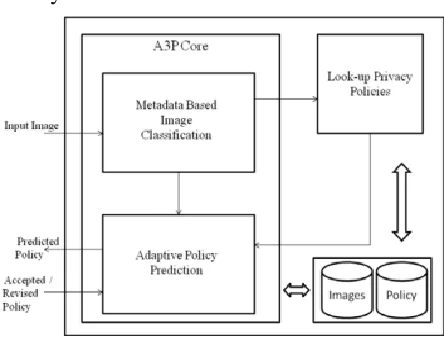
Figure2: Adaptive Privacy Policy Prediction (A3P) system Architecture
A3P Framework
The users control access to their shared content is necessary. Toward addressing this propose an Adaptive Privacy Policy Prediction (A3P) system to help users to compose security settings for their images. In this framework a two level framework is introduced is called as Adaptive Privacy Policy Prediction (A3P) system which aims to provide users a hassle security settings by automatically generating personalized privacy policies.
a. A3P Architecture
blocks: A3P Core. 1. Metadata based Image classification. 2. Adaptive policy prediction. 3. Look-Up Privacy Policies 4. Database If similar type of image exist then it looks for all the policies and lets user choose the policies.
b. A3P Algorithm
Access control in the shared location is one of the essential one. Access control mechanism (ACM) is one of the security conserve one. ACM permit users to oversee access to data controlled in own spaces users have no control over data be inherent in outside their spaces [15, 16]. In large-sample scenery the protection suite model favored by BIC if possible communicate to the competitor model which is a posteriori most probable the model which is provides most plausible by the data at hand.
c. Algorithm:
In Bayesian applications is comparisons many models is over and over again based on Bayes factors. The model which is a posteriori most likely is determined by
whether the Bayes factor is less than or greater than one [17].
3. PROPOSED ALGORITHM
The proposed model is introduced Semantic annotated Markova Semantic Indexing (SMSI), many semantic retrieval of images is done based on Hidden Markov model based annotated images. Annotation based image retrieval phase give user query and then finds similar terms for the query with the help of Word Net. Also discover the similarity many the query and images in annotated image database. Then find similarity many matching images. The system carries two major approaches.
Automatic image annotation
Annotation based image retrieval Automatic image annotation phase is use of a manually annotated training set taken to generate an annotated image database. Annotation based image retrieval phase gets a user query Also find the similarity many the query and images in annotated image database.
Figure 3 System Architecture
1. Color Histogram Feature
RGB, LUV, and HSV. Once the color space is specified color feature can be extracted from images. Then the histogram values are computed for gray level variations. According to histogram values, images are extracted from the database.
2. Textures Feature Extraction In this section, Texture feature is extracted by using SIFT (Scale-invariant feature transform) descriptor [10]. Scale-invariant feature transform (or SIFT) is an algorithm in computer vision to find and describe texture features in images
3. .SIFT Descriptors
SIFT is analysis involves detecting salient locations in an image and extracting descriptors that are distinctive yet invariant to changes in viewpoint illumination. The standard SIFT interest point detector and the standard SIFT histogram-of-gradients descriptor is used. These 128 dimension descriptors can be thought of roughly as summarizing the edge information in an image patch centered at an interest point. This global descriptor is a frequency count of the quantized local descriptors.
4. Database updation with HMM annotated images
Hidden Markov Model is provides [8] Estimating the parameters of the model from annotated image+ caption pairs. and Computing the like lipoid of a caption-word stating present in an image Let a collection of image+ caption pairs is provided and consider the problem of developing a stochastic generative model that jointly describes every pair.
5. Modeling Social Context
We observe the users with similar background tend to have similar security
concerns in previous research studies and also confirmed in our collected data. The social context modeling algorithm consists of two main steps. The first step is to identify and formalize potentially important factors that may be informative of one’s security settings. The second step is to group users based on the identified factors. First we model each user’s social context as a list of attributes: {sc1, sc2, ..., scn} where sci denote a social context attribute and n is the total number of distinct attributes in the social networking site.
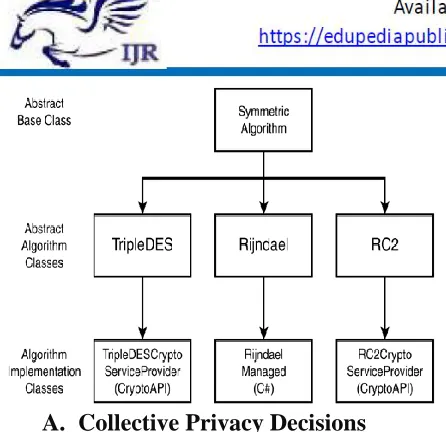
RIJNDAEL’S ALGORITHM
A. Collective Privacy Decisions
The most intuitive model is aggregate users decisions is to let owners iteratively disclose their preferred settings and explicitly agree in possible viewers each owner proposes to include. This method is hardly applicable in that it requires all the owners to agree on a single set of security policies which may sometimes be an endless task. Since SN users typically access the network independently this model is pretty simplistic and fails to leverage the individuals’ preferences within the co-owners group. In addition to the identified drawbacks main and ranking based model such as the ones described is proved to be unfair in that astute individuals may manipulate outcomes to their advantage [20].
Fig. 5 Example of combined co-owner graph
B. IMPROVING PRIVACY TOOLS
As our final point of analysis we examine the potential for assisting users in managing
their security. Specifically we focus on friend lists, a mechanism for users to group their friends that is same to the Circles feature of Google+. We explore every friend lists could be automatically populated using community detection algorithms [16] over the social network. To verify the extent to users in friend lists form closely connected communities we examine the normalized conductance [11] of the existing friend lists whose value ranges from -1 to 1, with strongly positive values indicating significant community structure. We analyzed the conductance values for our 233 friend lists and we found a significant positive bias. Over 48% of the friends lists have values larger than 0.2, suggesting that a large fraction of friend lists could be automatically inferred from the social network.
C. Social-graph visualization
Figure 6: Visualization of social circle [7]
4. EXPERIMENTAL EVALUATION
The comparison between existing and the proposed system (see figure 3.0). In the proposed system is access of the pages is limited and compared to existing system. This based type of model is generates access-control policies from photo administration tags. Every photo is integrated with an access grid for mapping the photo with the participant’s friends. The contestant is select a suitable partiality and access the information. Photo tags is categorized as directorial or forthcoming based on the user needs
Figure 7: Difference between Existing and Proposed
5. CONCLUSION
Social network is an upgrading media for data sharing through internet. We have studied and approached towards adaptive
privacy policy prediction users for maintaining the security of their uploaded images by automatically recommending security policies. The present work proposes Semantic annotated Markova Semantic Indexing (SMSI) a semantic image retrieval is done and its result is improved by incorporating an automatic annotation system. Automatic annotation of images in database is using a proposed Hidden Markov model extracted features (color and texture) where all states represent the concepts. Semantic same image retrieval can be done with the use of Natural language processing tool namely Word Net where conceptual similarity between natural language terms were done. Comparative result users better result for proposed system rather than existing retrieval system of framework.
6. FURTHER WORK
We plan is implement our analysis concerning the systems modify is elaborating on colluding users. Currently users can choose to undo the auction and update the security preferences. In this paper different methods is studied which make privacy setting easier for user. User social environment and characteristics and image content and its metadata is useful to predict security policy for user. Using all this content and above methods privacy recommendation is easier.
REFERENCES
semantics: Interactions between content andcommunity,” Proc. IEEE, vol. 100, no. 9, pp. 2737–2758, Sep. 2012.
[3] S. Ahern, D. Eckles, N. Good, S. King, M. Naaman,and R. Nair. Over-Exposed? Privacy Patterns and Considerations in Online and Mobile Photo Sharing.CHI, 2007.
[4] Sangeetha. J ,Kavitha. R, “An Improved Privacy Policy Inference over the Socially Shared Images with AutomatedAnnotation Process”
[5]. Peter F. Klemperer, Yuan Liang, Michelle L. Mazurek, “Tag, You Can See It! Using Tags for Access Control in Photo Sharing”, Conference on Human Factors in Computing Systems, May 2012.
[6] R. Ravichandran, M. Benisch, P. Kelley, and N. Sadeh, “Capturing social networking privacy preferences,” in Proc. Symp. Usable Privacy Security, 2009.
[7] K. A. Raftopoulos, K. S. Ntalianis, D. D. Sourlas, and S. D. Kollias, Mining user queries with markov chains: Application to online image retrieval," Knowledge and Data Engineering, IEEE Transactions on, Vol. 25, 2013.
[8] A. Ghoshal, P. Ircing, and S. Khudanpur, Hidden markov Models for automatic annotation and content-based retrieval of images and video," in Proceedings of the 28th annual international ACM SIGIR conference on Research and development in information retrieval. ACM, 2005.
[9] D. M. Blei, A. Y. Ng, and M. I. Jordan, Latent dirichlet allocation, The Journal of machine Learning Research, Vol. 3, 2003. [10] F. Yu and H. H.-S.Ip, “Automatic semantic annotation of images using spatial hidden markov model," in Multimedia and
Expo, 2006 IEEE International Conference on IEEE, 2006
[11] R. Datta, D. Joshi, J. Li, and J. Wang, “Image retrieval: Ideas, influences, and trends of the new age” IEEE Transaction on Cloud Computing, Vol. 2, NO. 4, OCTOBER-DECEMBER 2014.
[12] P.R. Hill, C.N. Canagarajah and D.R. Bull, “Rotationally Invariant Texture Based Features” IEEE Computer Society 1089- 7801/15/$31.00 c 2015 IEEE.
[13] Kaitai Liang, Joseph K. Liu, Rongxing Lu, Duncan S. Wong, “Privacy Concerns for Photo Sharing in Online Social Networks” IEEE Computer Society 1089- 7801/15/$31.00 c 2015 IEEE
[14] R. Datta, D. Joshi, J. Li, and J. Wang. Image retrieval: Ideas, influences, and trends of the new age. ACM Computing Surveys (CSUR), 40(2):5, 2008.
[15] J. Deng, A. C. Berg, K. Li, and L. Fei-Fei. What does classifying more than 10,000 image categories tell us? In 11th European conference on Computer vision: Part V, ECCV’10, pages 71–84, Berlin, Heidelberg, 2010. Springer-Verlag.
[16] A. K. Fabeah Adu-Oppong, Casey Gardiner and P. Tsang. Social circles: Tackling privacy in social networks. In Symposium On Usable Privacy and Security, 2008.
[19] C. A. Yeung, L. Kagal, N. Gibbins, and N. Shadbolt, “Providing access control to online photo albums based on tags and linked data,” in Proc. Soc. Semantic Web: Where Web 2.0 Meets Web 3.0 at the AAAI Symp., 2009, pp. 9–14.
[20]A. Mazzia, K. LeFevre, and A. E.,, “The PViz comprehension tool for social network privacy settings,” in Proc. Symp. Usable Privacy Security, 2012
AUTHOR DETAILS
Krosuri Madhuri born in Thummapudi,
Duggirala, Guntur Dt, AP. I received MCA from K.Chandhrakala P.G College,
Nelapadu, Tenali, Guntur dt, AP, ANU Guntur in the year 2011. Presently she is
pursuing M.TECH in CSE from
Priyadarshini Institute of Technology & Science for Women, Chinthalapudi,
Duggirala Md, Guntur Dt, and
Andhrapradesh, India.
Dr. K S M V KUMAR is presently a Professor of Computer Science & Engineering, Principal (PRIYADARSHINI
INSTITUTE OF
TECHNOLOGY AND SCIENCE ,
TENALI) and Executive Council Member, Advanced Computer Machinery (ACM) India Chapter .He served and held several Academic and Administrative positions including VICE principal , Dean Academics and Administration HOD for CSE Head of the Department, He did his 10th standard from Z.P.H.S. Parimella, Intermediate from Dr,G.G.Degree college ,T.P gudem ,Andhra Pradesh in 1989, B.E.(ECE) from Nagarjuna University College of Engineering, Guntur in 1997,
M.Tech from Jawaharlal Nehru
Technological University(JNTUH), Hyderabad in 2002 and Ph.D from
Jawaharlal Nehru Technological