Available online: https://edupediapublications.org/journals/index.php/IJR/ P a g e | 1211
Flooded and Limitised Analysis of Misleading Feedbacks of Cloud
Servicing Environment
Munganda Venkata Lakshmi 1, B Surya Narayana Murthy2
1PG Scholar, Dept of CSE, Sri Sunflower College of Engineering and Technology, Lankapalli, Krishna Dist, AP.
2 Associate Professor, Dept of CSE, Sri Sunflower College of Engineering and Technology, Lankapalli, Krishna Dist, AP.
Abstract: Cloud Framework Supporting Automate Rank supported Trust management benefit of cloud describes the design and implementation of cloud framework, The framework users automate rank about executive trust system which hand over service with events to produce. Trust is one of the most concerned oriented changes and improve of cloud computing. Number of solutions is proposed and managing trust feedbacks in cloud environments. A key modeluses exceptional consideration is security of trust and trust management is a key some portion of cloud security. The creator’s cross-check what trust is isconnected in appropriated registering trust management service is managed by the availability context system model describe the additional functionalities provided to cloud framework by increasing security trustworthy assessment for data owner and cloud consumer. Extending the SLA period of every owner and consumer based on their request the studies held from a collection of a real world users trust feedbacks are been verified established on cloud services. This increases the transparency many user consumer and cloud on TaaS. The achievability and advantages of our methodology is tried by a model and test studies utilizing a collection of true trust feedbacks on cloud services. The feasibility and benefits of our approach have been validated by a prototype and experimental studies using a collection of realworld trust feedbacks on cloud services.
Index Terms: Reputation, Credibility, Credentials, Security, Privacy, Availability,
1. INTRODUCTION
To extremely dynamic and nontransparent nature of cloud administrations manufacture and trust administration in cloud situations a significant challenge with regards to analysts at Berkeley security and trust is reviewed one in all the most noteworthy ten obstructions for the reception of distributed computing. [1] For ServiceLevel Agreements (SLAs) is lacking to find out trust between cloud customers and providers
Available online: https://edupediapublications.org/journals/index.php/IJR/ P a g e | 1212
problem in the unpredictable number of users and the highly dynamic nature of the cloud environment [3]. Approaches in require understanding of users’ interests and capabilities through similarity measurements or operational availability measurements are inappropriate in cloud environments. TMS should is modify and highly scalable to be functional in cloud environments [4]. High accessibility is a vital prerequisite to the trust administration. System proposes a few conveyed hubs to oversee criticisms given by utilizations redistributed. Load balancing is used to share the workloadmany lines each keeping up an interest accessibility level. The quantity of TMS hubs is resolved through an operational quality metric. Replication procedures are uses to minimize the effect of inoperable TMS occurrence. The quantity of reproductions for every hub is resolved through a replication find metric that present [5].
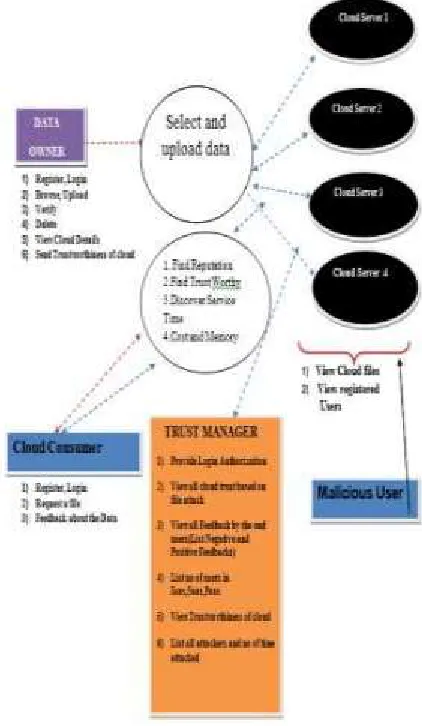
Figure 1. Trust Management Service
2. RELATED WORK
Available online: https://edupediapublications.org/journals/index.php/IJR/ P a g e | 1213
owner [8].C. Dellarocas2003 -It provides a holistic view of ranking fraud as well as proposes a ranking fraud detection method for mobile Apps. Specifically we first propose to correctly locate the ranking fraud by mining the active periods which is called leading sessions of mobile Apps. These leading sessions is leveraged for detecting the local anomaly instead of global anomaly of App rankings. Furthermore we investigate three types of evidencesone is ranking based evidences second one is rating based evidences and third one is review based evidences by modeling Apps’ ranking rating and review behaviors through statistical hypotheses tests. Addicting we propose an optimization based aggregation model to integrate all the evidences for fraud detection [9]. Trust is one of the most concerned obstacles for the adoption and growth of cloud computing. In this project the system proposed a Cloud Armor reputation-based trust management framework that provides a set of functionalities to deliver Trust as a Service (TaaS). “Trust as a Service” (TaaS) framework to improve ways on trust management in cloud environments. The model is validated by the prototype system and experimental results. It is not unusual that a cloud service experiences malicious behaviors from its users [10].
3. PROPOSED APPROACH
The Cloud Armor framework is based on the service oriented architecture (SOA), which delivers trust as a service. SOA and Web services are most important enabling technologies for cloud computing in the sense the resources are exposed in clouds as services [11]. In particular the trust management service spans many distributed nodes is expose interfaces so that users give their feedbacks or inquire the trust results
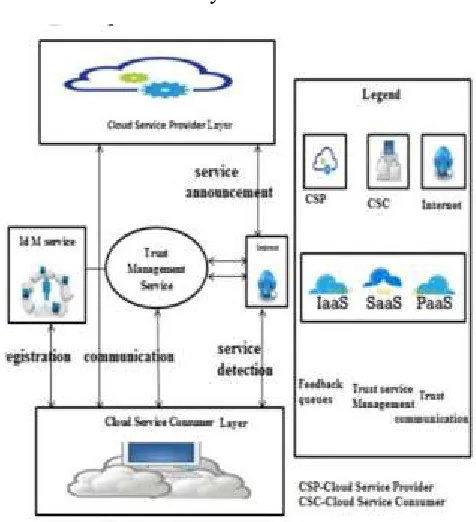
Cloud Service Provider Layer the Trust Management Service Layer and the Cloud Service Consumer Layer.
Figure 2: System Architecture
User feedback of cloud service is a decent source to take the total trustworthiness of cloud services the novel method is introduced that gives a help in detecting reputation attacks. The credibility model is introduced. Identifies misleading trust feedbacks from collusion attacks but also find Sybil attacks matter these attacks happens short period of time [12]. We also develop an availability model is t maintains the trust management service in desired level
4. METHETHODOLOGIES A. Detection of service
Available online: https://edupediapublications.org/journals/index.php/IJR/ P a g e | 1214
services and different services in internet, ii) Trust and Service interactions the users give their feedback result the trust results of a particular cloud service [13].
B. Trust Communication
In a typical interaction of the reputation based TMS a user either gives feedback regarding the trustworthiness of a particular cloud service the trust assessment of the service users feedback. The trust model of a cloud service is actually a collection of invocation history records represented by a tuple H= (C, S, F, T f), where C is the user’s primary identity, S is the cloud service’s identity, and F is a set of Quality of Service (QOS) feedbacks [14].
C. Service Announcement and Communication
This layer consists of different cloud service is offer one or many cloud servicesIaaS (Infrastructure as a Service), PaaS (Platform as a Service), and SaaS (Soft-ware as a Service), publicly in the Web. These cloud services is accessible in web portals and indexed on web search engines such as Google, Yahoo, and Badu Interactions for this layer arecloud service interaction with users and TMS [15].
D. Feedback Collusion Detection:
Trust Management Service is the one which use all the details stored in the IDM for check the user credibility. Users have a limit to send the feedback for a service. There is a threshold value. If the cross limitis identify trying to increase/decrease the service rate. Suppose they cross the limit, The trust management service separate them from the users list. This process is called as feedback collusion detection [16].
E. High Availability
High availability is an important requirement to the trust management service. We propose to spread several distributed nodes to manage feedbacks given by users in a decentralized way. Load balancing schema is exploited to destitution the workloadto maintaining a desired availability level. The number of TMS nodes is finding the operational power metric. Replication method is exploited to minimize the impact of crashing TMS instances. The number of replicas node is determined in replication determination metric. This metric exploits particle filtering techniques to precisely predict the availability of each node [17].
5. CONCLUSIONS
Available online: https://edupediapublications.org/journals/index.php/IJR/ P a g e | 1215
6. REFERENCES
[1] S. M. Khan and K. W. Hamlen, “Hatman: Intra-Cloud Trust Management for Hadoop,” in Proc. CLOUD’12, 2012.
[2] FR TRUST: A Fuzzy Reputation Based Model for Trust Management in Semantic P2P Grids ,SaeedJavanmardia, Mohammad Shojafar2,*, Shahdad Shariatmadari3 and Sima S. Ahrabi4.
[3] S. Pearson, “Privacy, Security and Trust in Cloud Computing,” in Privacy and Security for Cloud Computing, ser. Computer Communications and Networks, 2013, pp. 3–42.
[4] J. Huang and D. M. Nicol, “Trust Mechanisms for Cloud Computing,” Journal of Cloud Computing, vol. 2, no. 1, pp. 1–14, 2013.
[5] K. Hwang and D. Li, “Trusted Cloud Computing with Secure Resources and Data Coloring,” IEEE Internet Computing, vol. 14, no. 5, pp. 14–22, 2010.
[6] S. Pearson, “Privacy, Security and Trust in Cloud Computing,” in Privacy and security for Cloud Computing Part of the series Computer communication and network pp 3-42 Date: 27 June 2012 Cloud and Security Lab, HP Labs, Bristol, UK.
[7] J. Huang and D. M. Nicol, “Trust Mechanisms for Cloud Computing,”Journal of Cloud Computing, vol. 2, no. 1, pp. 1–14, 2013.
[8] K. Hwang and D. Li, “Trusted Cloud Computing with Secure Resources and Data Coloring,” IEEE Internet Computing, vol. 14, no. 5, pp. 14–22, 2010.
[9] C. Dellarocas, “The digitization of word of mouth: Promise and challenges of online
feedback mechanisms,” Manage. Sci., vol. 49, no. 10, pp. 1407– 1424, 2003.
[10] Jingwei Huang and David M Nicol, Trust mechanisms for cloud computing, April 2013.
[11]I. Brandic, S. Dustdar, T. Anstett, D. Schumm, F. Leymann, and R. Konrad, “Compliant cloud computing (C3): Architecture and language support for user-driven compliance management in clouds,” in Proc. 3rd Int. Conf. Cloud Comput., 2010, pp. 244–251.
[12]W. Conner, A. Iyengar, T. Mikalsen, I. Rouvellou, and K. Nahrstedt, “A trust management framework for service-oriented environments,” in Proc. 18th Int. Conf. World Wide Web, 2009, pp. 891–900.
[13] Siani Pearson and AzzedineBenameur, Privacy, Security and Trust Issues Arising from Cloud Computing , 2010
[14] S. M. Khan and K. W. Hamlen, “Hatman: Intra-Cloud Trust Management for Hadoop,” in Proc. CLOUD’12, 2012.
[15] S. Pearson, “Privacy, Security and Trust in Cloud Computing,” in Privacy and Security for Cloud Computing, ser. Computer Communications and Networks, 2013, pp. 3–42.
[16] M. Armbrust, A. Fox, R. Griffith, A. Joseph, R. Katz, A. Konwinski, G. Lee, D. Patterson, A. Rabkin, I. Stoica, and M. Zaharia, “A View of Cloud Computing,” Communications of the ACM, vol. 53, no. 4, pp. 50–58, 2010.