New Cryptography Based Compression Method using
Blowfish and Neural Network
Rupinder Kaur ;
Er.Rajat Tiwari
1 Student M.Tech Department of ECE; 2Assistant professor , Department of ECE Chandigarh University Gharuan, Mohali, Punjab, INDIA 140413
email: [email protected] ; email: [email protected]
Abstract- One of many major challenges associated with resource sharing with data communication network is actually their safety measures. That is premised with the belief that as soon as there's connection among personal computers sharing some resources, the problem associated with data security becomes important. The actual large progress within the networking technologies qualified prospects perhaps the most common culture intended for interchanging in the electronic digital photos really drastically. Hence it is a lot more prone associated with duplicating associated with electronic digital image and also redistributed by cyber-terrorist. Which means photos must be protected although transmitting it, vulnerable data such as credit cards, consumer banking purchases and also social safety numbers need to be protected. So to solve this problem, proposed work will be implemented on the usage of blowfish algorithm with neural network for image encryption as well as image compression in MATLAB environment
Index Terms-Image Encryption, Compression, Neural Network, Blowfish.
I. INTRODUCTION
Cryptography is actually participating in a major purpose throughout data protection throughout applications managing inside a network environment. The idea enables individuals to ply their trade in an electronic form without having problems associated with deceit and also lies besides guaranteeing this sincerity in the information and also authenticity in the sender [3].
They have be a little more important to our day-to-day lifestyle simply because 1000s of folks have interaction in an electronic form every day; through e-mail, e-commerce, ATM equipment, cell phones, and so forth. This particular geometric increase associated with data carried in an electronic form has produced elevated reliability with cryptography and also authentication by consumers [4]. Although secured connection has been around since then, the key supervision issue has averted that coming from popular software. The actual
may communicate safely with one another even when that they never communicated before.
A. Image Encryption
Image encryption plans have been progressively contemplated to take care of the demand for continuous secure image transmission over the Internet and through wireless systems. Encryption is the procedure of changing the data for its security [1]. With the tremendous development of PC systems and the most recent advances in computerized innovations, an immense measure of advanced information is being traded over different sorts of systems. It is frequently genuine that a substantial piece of this data is either classified or private. The security of images has turn out to be more imperative because of the quick advancement of the web on the planet today. The security of images has pulled in more consideration as of late, and a wide range of image encryption techniques have been proposed to upgrade the security of these images. Image encryption procedures attempt to change over a image to another that is difficult to get it. Then again, image decrypts the first image from the encoded one. Encryption is the procedure of encoding plain instant message into cipher text message though turn around procedure of changing cipher content to plain content is called as decryption [2].
B. Compression
the relative data redundancy R of the representation with b bits is
R = 1-1/C
In this paper cryptography uses to enhance the security in compression technique using Blowfish algorithm. It takes too less time to encrypt the file with Cryptography Mechanism [6].
III.PROPOSED METHOD
In this research there is combination of Blowfish encryption Algorithm to provide the Security of our data from unauthorized users and with the advantage of fast mechanism to encrypt the File in addition with neural network compression [7]. This Mechanism is more secure, robust and fast than AES and RSA mechanism. So there is implementation of this mechanism with compression to achieve better results from previous Research.
IV. METHODOLOGY
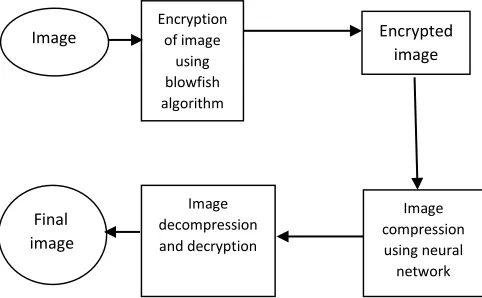
Below figure describes the steps to achieve proposed results using blowfish and neural network.
Figure.1 Methodology of proposed work
B. Input Image
At First window is browsed and image file is picked up and therefore loaded in the database where compression and encryption two different mechanism takes place in single way [8,9].
Figure 2. Input image C. Encryption using Blowfish
Then implementation of basic encryption algorithm takes place which would encrypt the image file.
Figure1. Encrypted Image
Above figure describes the encrypted image using Blowfish algorithm.
D. Training using Neural Network
The Back Propagation neural network is artificial neural network based on error back propagation algorithm [10]. The Back Propagation (BP) neural network model consists of an input layer, more or less hidden layers as well as an output layer. Each connection connecting neurons has a distinctive weighting value.
In training the network, the nodes in the BP neural network obtain input information from exterior sources, and then go by to hidden layer which is an interior information processing layer and is answerable for the information conversion, and then the nodes in the output layer supply the required output information.
After that, the back-propagation of error is transported by distinct the actual output with wanted output. Each weight is revised and back propagated layer by layer from output layer to hidden layer and input layer.
This process will be continued until the output error of network is reduced to an acceptable level or the predetermined time of learning is achieved. The processing results of information are exported by output layers to the outside [11].
The process of BPNN training has been described below:
[training_rows_total,cols]=size(new_image); training_rows=round(training_rows_total*70/100);
Encryption of image
using blowfish algorithm
Image decompression and decryption
Encrypted image
Image compression using neural network Image
training_data(1:training_rows,:)=new_image(1:training_rows ,:);
for i=1:training_rows Target(i)=i;
end
net=newff(training_data',Target,10); net.trainParam.epochs=50;
net=train(net,training_data',Target);
This leads to initialization of the neural network and the compression process is performed.
E. Compression
Figure 3. Compressed Image
Above figure describes the compressed image using Blowfish algorithm and neural network.
F. Decompression
.
Figure 4. De- Compressed Image
Above figure describes the de-compressed image using Blowfish algorithm and neural network.
G. Decryption
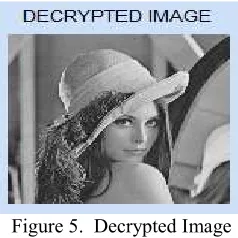
Figure 5. Decrypted Image
Above figure describes the decrypted image using Blowfish algorithm and neural network.
V. RESULTS AND IMPLEMENTATION
The Research is carried on different size of image files with purposed algorithm which include Blowfish and neural network [12].
A. Performance parameter and calculation: 1) PSNR :The results are taken in matlab programming. The PSNR and MSE values are calculated using equation (1) and (2) The Peak Signal-to-Noise Ratio (PSNR) is defined as:
2) MSE
The mean-squared error (MSE) between two images I1 (m,n) and I2(m,n) is
Where M and N are the number of rows and columns in the input images, respectively.
3) CR
Image compression ratio is the division of uncompressed size file to compressed file size.
CR = Uncomprssed image size Compressed image size
Table I
Comparison with AES-SS work
LEENA AES-SS 27.90 0.415
BF-NN 27.7 0.647
BOAT AES-SS 25.29 0.437
BF-NN 27.92 0.632
BABOON AES-SS 18.73 0.439
BF-NN 27.81 0.523
BARBARA AES-SS 21.69 0.445
BF-NN 28.0 0.590
GODHILL AES-SS 25.80 0.429
BF-NN 28.0 0.541
MAN AES-SS 25.29 0.437
BF-NN 27.97 0.589
PEPPERS AES-SS 26.02 0.427
BF-NN 27.92 0.562
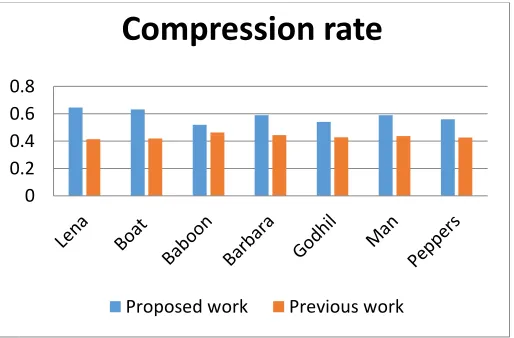
Above table and below figure describes the evaluated values of PSNR, MSE, CR and Bits per Pixel for proposed algorithm for compression process, de-compression process and Decryption process.
B. Performance parameters and comparison
Figure 5. Comparison of compression ratio
Figure 6. Comparison of PSNR values
VI CONCLUSION AND FUTURE SCOPE
In many practical scenarios such as cloud computing, the parties who process the encrypted data are often untrusted, and hence have no access to the secret key. This has led to the challenging problem of how to achieve superior efficiency of processing the encrypted data with zero knowledge of the secret. As one of the most common operations on multimedia data, multimedia compression over encrypted domain has received increasing attention since the last decade
In this paper, we have presented an image compression and encryption method based on blowfish and neural network machine learning algorithm. The whole simulation has been taken place in MATLAB 7.10 with good performance results.
ACKNOWLEDGEMENT
The authors would like to thank the Assistance Prof. Rajat Tiwari for their helpful comments and suggestions.
REFERENCES
1. Xianghong and L. Yang. "An Image Compressing Algorithm Based on Classified Blocks with BP Neural Networks," Proc. of the international conference on computer science and software engineering, IEEE Computer Society, Wuhan, Hubei, vol. 4, Dec 2008, pp.819-822, ISBN: 978-0-7695-3336-0, DOI: 10.1109/CSSE.2008.1357.
2. Fatima B. Ibrahim. "Image Compression using
Multilayer Feed Forward Artificial Neural Network and DCT," Journal of Applied Sciences Research, 0
0.2 0.4 0.6 0.8
Compression rate
Proposed work Previous work
0 10 20 30
PSNR comparison
vol.6, no.10, 2010, pp. 1554-1560, INSInet Publication.
3. O. N. A.AL-Allaf. "Improving the Performance of Backpropagation Neural Network Algorithm for
Image Compression/Decompression System,"
Journal of Computer Science, DOI:
10.3844/jcssp.2010.1347.1354, vol.6, Issue.11,
2010, pp. 1347-1354,
4. M. Johnson, P. Ishwar, V. Prabhakaran, D.
Schonberg, and K. Ramchandran, “On compressing encrypted data,” IEEE Trans. Signal Process., vol. 52, no. 10, pp. 2992–3006, Oct. 2004.
5. D. Schonberg, S. C. Draper, and K. Ramchandran, “On blind compression of encrypted correlated data approaching the source entropy rate,” in Proc. 43rd Annu. Allerton Conf. Commun., Control, Comput., 2005, pp. 1–10.
6. D. Schonberg, S. Draper, and K. Ramchandran, “On
compression of encrypted images,” in Proc. IEEE Int. Conf. Image Process., Oct. 2006, pp. 269–272.
7. A.A. Kumar and A. Makur, “Distributed source
coding based encryption and lossless compression of gray scale and color images,” in Proc. 10th Workshop
MMSP, Oct. 2008, pp. 760–764.
8. W. Liu, W. Zeng, L. Dong, and Q. Yao, “Efficient
compression of encrypted grayscale images,” IEEE Trans. Image Process., vol. 19, no. 4, pp. 1097–1102, Apr. 2010.
9. D. Klinc, C. Hazay, A. Jagmohan, H. Krawczyk, and
T. Rabin, “On compression of data encrypted with block ciphers,” IEEE Trans. Inf. Theory, vol. 58, no. 11, pp. 6989–7001, Nov. 2012.
10. A. A. Kumar and A. Makur, “Lossy compression of
encrypted image by compressive sensing technique,” in Proc. IEEE Region 10th Conf., Jan. 2009, pp. 1–6.
11. X. Zhang, Y. Ren, G. Feng, and Z. Qian,
“Compressing encrypted image using compressive sensing,” in Proc. 7th IEEE Int. Conf. IIH-MSP, Oct. 2011, pp. 222–2225.
12. X. Zhang, G. Feng, Y. Ren, and Z. Qian, “Scalable