Volume 2006, Article ID 27694, Pages1–11 DOI 10.1155/WCN/2006/27694
Energy-Efficient Channel Estimation in MIMO Systems
Sarod Yatawatta,1Athina P. Petropulu,1and Charles J. Graff2
1Electrical and Computer Engineering Department, Drexel University, Philadelphia, PA 19104, USA 2US Army RDECOM CERDEC STCD, Fort Monmouth, NJ 07703, USA
Received 14 February 2005; Revised 10 June 2005; Accepted 5 December 2005
Recommended for Publication by Stefan Kaiser
The emergence of MIMO communications systems as practical high-data-rate wireless communications systems has created sev-eral technical challenges to be met. On the one hand, there is potential for enhancing system performance in terms of capacity and diversity. On the other hand, the presence of multiple transceivers at both ends has created additional cost in terms of hardware and energy consumption. For coherent detection as well as to do optimization such as water filling and beamforming, it is essential that the MIMO channel is known. However, due to the presence of multiple transceivers at both the transmitter and receiver, the channel estimation problem is more complicated and costly compared to a SISO system. Several solutions have been proposed to minimize the computational cost, and hence the energy spent in channel estimation of MIMO systems. We present a novel method of minimizing the overall energy consumption. Unlike existing methods, we consider the energy spent during the chan-nel estimation phase which includes transmission of training symbols, storage of those symbols at the receiver, and also chanchan-nel estimation at the receiver. We develop a model that is independent of the hardware or software used for channel estimation, and use a divide-and-conquer strategy to minimize the overall energy consumption.
Copyright © 2006 Sarod Yatawatta et al. This is an open access article distributed under the Creative Commons Attribution License, which permits unrestricted use, distribution, and reproduction in any medium, provided the original work is properly cited.
1. INTRODUCTION
The use of multiple-input multiple-output (MIMO) chan-nels formed using multiple transmit/receive antennas has been demonstrated to have great potential for achieving high data rates [1]. Of concern, however, is the increased complex-ity associated with multiple transmit/receive antenna sys-tems. First, increased hardware cost is required to imple-ment multiple RF chains and adaptive equalizers. Second, increased complexity and energy is required to estimate large-size MIMO channels.
Energy conservation in MIMO systems has been consid-ered in different perspectives. In [2], for instance, hardware-level optimization is done to minimize energy. On the other hand, in [3,4], energy consumption is minimized at the re-ceiver by using low-rank equalization. In [5], reducing the order of MIMO systems by selection of antennae is given as a viable option to minimize energy consumption both at the receiver and transmitter, without degrading the system per-formance. In [6], the transmission and circuit energy con-sumption per bit of information transmitted is analyzed. The authors claim in [6] that single-input single-output (SISO)
(1×1) systems gives best performance over MIMO (2×2) systems for short-range transmission.
In this paper, we focus on MIMO channel estimation subject to delay and error constraints. We propose an an-tenna selection scheme for channel estimation that can min-imize energy consumed both at the transmitter and the re-ceiver. Note that antenna selection for data transmission [5] requires at least partial knowledge of the full channel matrix. Hence, the proposed scheme can be applied before the an-tenna selection is done for data transmission.
The rest of the paper is organized as follows. First, we study the channel estimation error and the cost of compu-tation of the MIMO system under consideration. Next, we describe the generalized energy reduction scheme. After this, we focus on minimizing energy at the transmitter and the receiver separately. Next, we consider joint transmitter and receiver energy minimization. To illustrate our method, we consider a MIMO system with flat-fading channels of arbi-trary size and give comparisons of energy and error variation for different channel estimation schemes obtained by varying the number of active transmit/receive antennas under a fixed delay and error constraint.
2. CHANNEL ESTIMATION IN MIMO FLAT-FADING ENVIRONMENTS USING TRAINING
Before we proceed to formulate our problem, we need to have a valid model of channel estimation. The basic equation of the flat-fading MIMO system in concern is given in (1):
yi N×1
= H N×M
xi M×1
+vi N×1
, i=1, 2,. . ., (1)
where we consider a MIMO system withMtransmitters and N receivers. The received data vector is yi, the transmitted data vector isxi, while the noise vector isviat theith time interval. The channel matrix isHof sizeN×M. Let the noise variance beσ2and let the signal power level beP. By
trans-mittingJdata blocks, we form the augmented matrix equa-tion (2):
Y N×J
= H N×M
X M×J
+V N×J
, (2)
where
Y=y1,. . .,yJ, X=x1,. . .,xJ, V=v1,. . .,vJ (3)
and we form the least squares estimation of the channel as [7]
H=YX†. (4)
The matrix pseudoinverseX†is formed as
X†=XH XXH−1. (5)
2.1. Channel estimation error
The channel estimation error is obtained from (2) and (4) as
ξ=H−H=VX† (6)
and the average squared error (χ) is
χ= 1
NMtrace ξξ
H= 1
NMtrace X
†X†HVHV. (7)
×10−3
3.5
3
2.5
2
1.5
1
MSE
2 4 6 8 10 12 14 16 18 20
NorM
Variation withMatN=4 Variation withNatM=4
J=30
J=50
J=70
Figure1: MSE variation withN,M, andJ. We see that the MSE is independent ofN, has a linear variation withM, and is inversely proportional toJ.
We can find a lower bound toχas follows [7]. We assume the noise to be additive white and Gaussian. Then, taking expec-tation ofχ, we get the mean-squared error
MSE=E{χ} ≥ 1
NMtrace X
†X†HEVHV
≥ 1
NMtrace X
†X†HNσ2I
≥σ2
Mtrace XX H−1.
(8)
From [7], we see that
trace XXH−1≥ M2
trace XXH (9) and under optimal training, withXXH=JPI, we get
MSE≥ σ2
PJ, (10)
which is the result derived in [7].
the error as
MSE=cσ2M
JP, (11)
whereσ2 is the noise power,P is the signal power, andcis
a real, positive constant of proportionality. We should note that (11) is purely a heuristic formula that seems to model the behavior seen in Figure 1very well. Note also that it is possible for us to calculate the error more precisely in terms ofXbecause the training is known. However, sinceXis also a function ofM, it is not possible to formulate the error in explicit form and our analysis becomes more complicated. Thus, we limit our analysis to (11) in the remainder of this paper.
2.2. Channel estimation cost
It should be kept in mind that the variables in (1) are com-plex numbers in general. However, we prefer to study the number of computations required to obtain (4) in terms of real floating-point operations.
Before proceeding in our analysis, we make some gener-alized assumptions.
(i) We assume the computations are done in a sequential manner. However, in real systems, most computations are done in a blockwise manner [8,9]. Moreover, more than one floating-point operation can be performed simultaneously. However, the analysis of such schemes is beyond the scope of this paper.
(ii) The cost of multiplication is higher than the cost of addition. However, how much higher this is depen-dent on exact hardware implementation. For instance, in [10,11], it is given as 4 to 1. Moreover, the cost of di-vision is higher than multiplication. In order to make our analysis simpler, we consider cost of additions and multiplications separately and we take the cost of di-vision to be equal to two multiplications (reciprocal operation and multiplication).
We should stress that for a given hardware model, a more detailed and more accurate set of assumptions can be made.
We use the following basic rules, coupled with our as-sumptions, as in [12]. Let us denoteνmandνaas the energy cost for one real floating-point multiplication and addition, respectively.
(i) One complex addition requires two real additions, so the cost is 2νa.
(ii) One complex multiplication, that is, (α1+ jβ1)(α2+
jβ2), where (α1+jβ1) and (α2+jβ2) are the complex
numbers with real and imaginary parts, costs three real multiplications and five real additions 3νm+ 5νd. This is done asα1α2−β1β2+j((α1+β1)(α2+β2)−α1α2−
β1β2). The naive multiplication method requires one
more multiplication, 4νm+ 4νa.
(iii) One division with complex numerator and real de-nominator is equivalent to the cost of two real mul-tiplications, 2νm.
(iv) One division with complex numerator and denomina-tor (α1+jβ1)/(α2+jβ2) requires 7 real multiplications
and 6 real additions, that is, (α1+jβ1)(α2−jβ2)/(α2+
β2).
Next, let us consider the calculation of (5) in detail. The steps involved in this are as follows.
(1) Calculation ofXXH. The resulting matrix is of size M×M. Each element of this matrix is an inner product of two vectors of size 1×J. This inner product requiresJcomplex multiplications andJ−1 complex additions. Hence, the total computation isM2Jcomplex multiplications andM2(J−1)
complex additions. We can cut this almost by half by noticing thatXXH is Hermitian. Finally, we haveM(M+ 1)J/2 com-plex multiplications andM(M+ 1)(J−1)/2 complex addi-tions. (Note that we can reduce this even more by noticing that the main diagonal is real. However, we ignore this fact for simplicity in our analysis.)
(2) Calculation ofXH(XXH)−1. In terms of complexity
as well as numerical stability, it is not advisable to compute X†via explicitly computing the matrix inverse (XXH)−1[13].
Instead, we do this by solving a system of linear equations as follows:
X†=XH XXH−1, (12) X†T = XXHT−1 XHT, (13) X†T= LLH−1 XHT, (14) LLH X†T = XHT, (15) whereLLHis the Cholesky decomposition ofA=(XXH)T. (X†)Tare the unknowns that need to be found by solving the linear system. Each column of (15) can be written as
LLHx
i=xi, i=1, 2,. . .,J. (16) We need to solve a system as given in (16),Jtimes to obtain the matrixX†. First, forward elimination is used to solve for ziin (17):
Lzi=xi, i=1, 2,. . .,J. (17) Next, back substitution is used to solve forxiin (18):
LHx
i=zi, i=1, 2,. . .,J. (18) Since we have described the basic steps to be followed, let us consider the complexity of each operation.
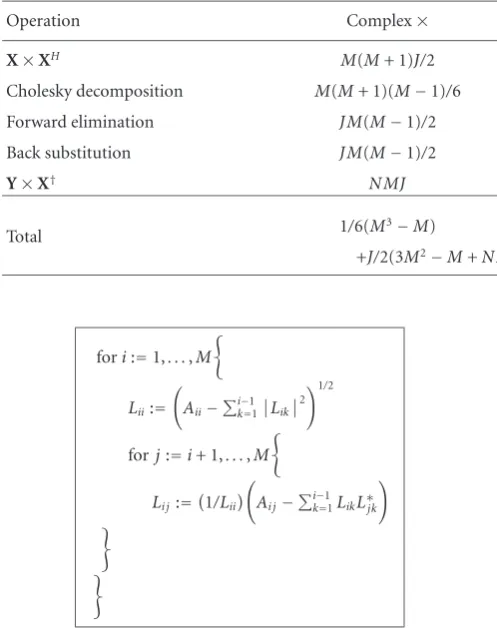
(i) The Cholesky decomposition can be given in pseu-docode as [14] inAlgorithm 1.
FromAlgorithm 1, we see that for each j, there arei−1 complex multiplications and additions and 1 real division. Since for fixedi,jvaries fromi+ 1 toM, the number of itera-tions ofjisM−i. Moreover, in order to calculateLii, we need i−1 multiplications and additions and one square root op-eration. We consider the cost of square root to be equivalent to the cost of division.
Table1: Computational cost of channel estimation.
Operation Complex× Complex + Divisions
X×XH M(M+ 1)J/2 M(M+ 1)(J−1)/2 —
Cholesky decomposition M(M+ 1)(M−1)/6 M(M+ 1)(M−1)/6 M(M+ 1)/2
Forward elimination JM(M−1)/2 JM(M−1)/2 JM
Back substitution JM(M−1)/2 JM(M−1)/2 JM
Y×X† NMJ NM(J−1) —
Total 1/6(M3−M) 1/6(M3−3M2−4M−6NM) 1/2(M2+M)
+J/2(3M2−M+NM) +J/2(3M2−M+ 2NM) +2JM
fori:=1,. . .,M
Lii:=
Aii−ik−=11Lik2
1/2
forj:=i+ 1,. . .,M
Li j:= 1/Lii
Ai j−ik−=11LikL∗jk
Algorithm1: Pseudocode for Cholesky decomposition.
(i−1 + (i−1)(M−i)) complex additions, and (1 +M−i) divisions(square root). Accumulating this fromi=1,. . .,M, we getM(M+ 1)(M−1)/6 complex multiplications,M(M+ 1)(M−1)/6 complex additions, andM(M+ 1)/2 divisions.
(ii) The forward elimination involves the step
zj= 1 Lj j
xj−
j−1
k=1
Ljkzk
, j=1,. . .,M. (19)
For fixedj, this involvesj−1 complex multiplications, j−1 complex additions, and 1 division. This sums up to the final cost ofM(M−1)/2 multiplications,M(M−1)/2 additions andMdivisions.
The forward elimination has to be done for each column ofX†, that is,J times. Thus, the final cost isJM(M−1)/2 complex multiplications, JM(M−1)/2 complex additions, andJMdivisions.
(iii) The back substitution has the same complexity of forward elimination. Thus, we have the same final cost of JM(M−1)/2 complex multiplications,JM(M−1)/2 com-plex additions, andJMdivisions.
Using the above calculations, we can compute the total cost of formingX†. This is given isTable 1.
(3) Calculation of productYX†. Once again, we have a matrix product where each element of the resultant matrix
x0(t)
x1(t)
xM−1(t)
h00
h01
h10
h(N−1)0
y0(t)
y1(t)
yN−1(t)
. . . .
. .
Figure2: MIMO channel.
is an inner product of vectors whose dimensions are 1×J. Hence, we haveNMJcomplex multiplications andNM(J−1) complex additions.
A summary of our analysis is given in Table 1. From Table 1, we can derive the total number of real floating-point operations to beJ((9/2)M2+(5/2)M+3NM)+(1/2)M3+M2+
(1/2)Mmultiplications andJ((21/2)M2−(7/2)M+ 7NM) +
(7/6)M3−(13/6)M−M2−2NMadditions.
3. GENERAL METHODOLOGY
In this section, we describe the proposed method in a gen-eral sense. The fundamental property that we assume in our scheme is the modularity of hardware. For instance, when a complex hardware system is built, it is done in a modular way by assembling less complex blocks. Hence, a MIMO sys-tem can be considered as a collection of SISO syssys-tems, with respect to hardware. For instance, we assume that a 4-by-4 MIMO system can operate as a 2 by 2 system by turning off some modules.
The MIMO system in concern, withMtransmitters and N receivers, can be given as in Figure 2. We call the set of transmittersTand the set of receiversR. Their cardinalities, |T|and|R|, areM andN, respectively. The objective is to estimate the channelshi j, 0≤i≤N−1, 0≤ j ≤M−1, in an energy-efficient manner. The channel estimation requires the consumption of energy and time.
We make the following assumptions.
active only a subset of transmitters/receivers, the esti-mate will be the same as the estiesti-mate we would get for the same channel if all transmitters/receivers were ac-tive. However, we refine our method taking correlation into account at a later section.
(A2) The channels are frequency flat fading and during the training phase, the channels remain time invariant.
We propose the following divide-and-conquer strategy. Instead of estimating the full channel matrix at once (which we call thenaive method), we propose to estimate the full channel matrix inK steps. On the kth step (k ∈ [1,K]), we select the transmitters given by the setTk (⊆T) and the receivers given by the setRk (⊆ R) and estimate the chan-nels between those transmitters and receivers. LetPkbe the power level of each transmitter at thekth step, and letlk de-note the length of training data to be used in channel estima-tion. Moreover, let the noise power level at the receiver beσ2.
Hence, at thekth step, the average SNR at the receiver will be proportional toPk/σ2. We assume all transmitters have the same path loss, that is, each transmitter is approximately at the same distance from the receiver and the noise power level is the same on all paths.
We will focus on minimizing the total energy consump-tion, both at the receiver and transmitter. We define the fol-lowing functions. LetgTbe the energy spent by all the trans-mitters. At the receivers, the energy consumption can be bro-ken down into two components: the energy required to per-form data acquisition and storage, which we denote bygI, and the energy needed to perform channel estimation or computations, which we denote bygC. In our formulation, gT,gI, andgCare functions of the variablesK,Tk,Rk,lk,Pk, k=1,. . .,K. For notational convenience, this dependence is not shown in the sequel.
The total energy consumed can be given as
g=gT+gI+gC. (20)
Our objective is to minimizeg. Next we consider the con-straints involved.
(i)Avoiding trivial solutions. In order to estimate all the channels, we need
k=1,...,K
Tk⊗Rk=T⊗R, (21)
where⊗is the Cartesian product. In order to avoid trivial solutions, we need
Tk =φ, Rk =φ, k∈[1,K], (22)
whereφis the null set.
(ii)Satisfying a channel MSE constraint. For acceptable performance, the mean channel estimation error (MSE) at each stepkshould be below a minimum threshold,
k=k Tk,Rk,Pk,lk
≤, k∈[1,K]. (23)
The exact expression forkis dependent on the channel es-timation method. If we consider the power level at each step, it should be lower than the maximum allowed by the trans-mitterP:
Pk≤P, k∈[1,K]. (24)
(iii)Satisfying a transmission delay constraint. The train-ing length at step kshould be above a certain threshold lk for the channel estimation to work (i.e., to have full rankX) and the total data length would be below the maximum delay allowedL:
lk≤lk, k∈[1,K], K
k=1
lk≤L. (25)
Our objective is to findTk,Rk,Pk, andlkfork=1,. . .,K subject to the above constraints (21), (22), (23), (24), and (25) that minimizeggiven in (20). This is a typical set par-titioning problem, where the objective is to find the optimal partition of the setsTandR. In general, solving such prob-lems would have to consider every possible partition in order to find the optimal one. The complexity of such an approach would be exponential in the set size. However, we pursue simplified solutions in the following sections.
Before we proceed, let us consider the feasibility of the problem. We see that all the parameters are bounded. Hence, the feasibility region is bounded and in order to find feasible solutions, we should choose the limitsandLin a suitable manner. For instance, if we choose =0 orL=0, it is ob-vious that no solutions exist. Hence, by increasing either or both of these values, we can increase the feasibility region. In other words, we can trade offenergy with channel estimation error and delay.
3.1. Mutual coupling of antennas
In the preceding discussion under assumption (A1), we have assumed the antennas to be uncorrelated. However, in real life, this is far from the truth. In this section, we consider mutual coupling between antennas at the transmitter and the receiver and examine its effect on the channel estimate. First, we break down the effective channel matrix into components due to mutual coupling and fading, as given in (26):
H=FHG. (26)
arbitrary manner as
The dimensions of the submatrices are such that the product in (26) holds. In particular,F22is size|Tk| × |Tk|,H22is size
|Tk| × |Rk|, andG22is size|Rk| × |Rk|. The dimensions of the other matrices are irrelevant to this discussion.
Next, we can express the channel betweenTkandRkas
H22=
However, if we apply the divide-and-conquer scheme, with all transmitters and receivers except Tk andRk being turned off, the channel that we estimate in thekth step is
Hk=F22H22G22. (29)
Thus, we see that there is an error in the channel estimation due to mutual coupling. However, we can correct this error provided we know the mutual coupling matrices F andG perfectly and have full rank. This is not an unreasonable re-quirement becauseFandGare constant for a given antenna configuration.
The procedure to correct the error due to mutual cou-pling is as follows. At thekth step, after getting the estimate
Hk, we solve (29) to obtainH22.
The number of computations required to solve this lin-ear system of equations can be calculated as follows. We first solve the systemH22G22 = F−122Hk and next solve the sys-temH22=F−122HkG−122. This is similar to the analysis done in
Section 2.2. However, the matricesF22andG22are not
Her-mitian in general. So we need to use LU decomposition in this case. Let us consider the solution ofH22G22 = F−122Hk first. The LU decomposition ofLU=F22can be given as [14]
inAlgorithm 2.
The LU decomposition as given inAlgorithm 2requires T(T−1)(2T−1)/6 complex multiplications,T(T−1)(2T− 1)/6 complex additions, andT(T+ 1)/2 complex divisions, whereT = |Tk|. The cost of forward elimination and back substitution can be deduced fromSection 2.2. Note that the forward elimination requires no divisions because the main diagonal of the lower triangular matrix consists of 1. We have given the total number of computations required inTable 2, whereR= |R k|.
Algorithm2: Pseudocode for LU decomposition.
The cost ofH22=F−122HkG−122 can be calculated in a
simi-lar manner. We have given the result inTable 3.
In the above result, the division can include a complex divisor. Thus, the cost of complex division which is 7 real multiplications and 6 real additions has to be taken into ac-count. Finally, we get the total cost as (T3+2T2+4T+3RT2+
8RT+3R2T+4R+2R2+R3) real multiplications and (7/3T3−
1/2T2+25/6T+7RT2−2RT+7R2T+25/6R−1/2R2+7/3R3)
real additions, whereT= |Tk|andR= |Rk|. This is the ad-ditional cost due to mutual coupling of antennas that appear in the proposed divide-and-conquer method.
After stepsk=1,. . .,K, we would have formed the entire matrixH. Finally, we form the productFHG to obtain the actual channel matrix. The complexity of this operation is 3(N2M+NM2) real multiplications and (7N2M+ 7NM2−
4NM) real additions.
4. MINIMIZING ENERGY AT THE TRANSMITTER
We make the following assumptions.
(B1) We assume the receiver has no constraints on energy because we only minimize energy at the transmitter. This allows us to always makeRk=R. In other words, we use all receivers at all steps.
(B2) We assume the antennas to be uncorrelated, so that the channel estimate will not change with the selection of TkandRk. Moreover, we assume the only variable af-fecting the channel estimation error to be the sizes of TkandRkand not the individual elements in them. (B3) We assume retransmissions to be costly and hence
se-lect disjoint sets of transmitters, that is,Tkare disjoint. In other words, each transmitter only transmits at one stepk.
From (11), the channel estimation error at thekth step is
k=c1 σ 2
Pklk
Tk, (30)
whereσ2is the noise variance, andc
1is a real, positive
Table2: Computational cost ofH22G22=F−221Hk .
Operation Complex× Complex + Divisions
LU decomposition T(T−1)(2T−1)/6 T(T−1)(2T−1)/6 T(T+ 1)/2
Forward elimination RT(T−1)/2 RT(T−1)/2 —
Back substitution RT(T−1)/2 RT(T−1)/2 RT
Total 1/6(2T3−3T2+T) 1/6(2T3−3T2+T) 1/2(T2+T)
+RT(T−1) +RT(T−1) +RT
Table3: Computational cost ofH22=F22−1Hk G−221.
Operation Complex× Complex + Divisions
LU decomposition R(R−1)(2R−1)/6 R(R−1)(2R−1)/6 R(R+ 1)/2
Forward elimination RT(R−1)/2 RT(R−1)/2 —
Back substitution RT(R−1)/2 RT(R−1)/2 RT
Total 1/6(2R3−3R2+R) 1/6(2R3−3R2+R) 1/2(R2+R)
+RT(R−1) +RT(R−1) +RT
The energy expenditure at the transmitter occurs mainly due to transmission of training symbols. This energy is pro-portional to the transmitter power level, the duration (or length) of training, and the number of active transmitters. Thus, total energy spent by all the transmitters can be given as
gT= K
k=1
c2PklkTk, (31)
wherec2is a real, positive constant of proportionality. Due to
Rk=R, andTkbeing disjoint, we can simplify (21) further. We can leaveRkfrom the Cartesian product becauseRk=R. This reduces (21) to
k=1,...,K
Tk=T (32)
and since allTkare disjoint, we get K
k=1
Tk= |T| =M. (33)
Solving for|Tk|is a standard integer partition problem. For instance, ifM=4, the ways we can select the number of transmitters during theK steps are{4}(K =1),{3, 1}(K = 2),{2, 2}(K =2),{2, 1, 1}(K =3), and{1, 1, 1, 1}(K =4). Thus, there are 5 possible ways in this case. If the number of possible ways of selecting|Tk|isp(M) for|T| =M, we have [15]
p(M)≈ 1 4√3
eπ√(2/3)M M
. (34)
We first select a partitioning scheme and keeping it fixed, we solve the problem
min Pi,li,i∈[1,K]
K
k=1
c2PklkTk (35)
subject to (23), (24), and (25), whereTk,RkandKare con-stants. We find the minimum cost associated with the solu-tion. For small values ofM, that is,M ≤ 10, we can try all possible partitions to find the best one with the minimum cost.
Proposition 1. Under assumptions(A1)-(A2)and(B1)-(B3), the channel estimation scheme that minimizes transmitter en-ergy is to reduce the MIMO channel into a set of single-input multiple-output (SIMO) channels and transmit using one transmitter only at a time. Thus, each time a SIMO chan-nel is estimated. The minimum energy is
gT=c1c2σ 2
M (36) as opposed to the energy of the naive method
gT =c1c2σ 2
M2. (37) The proof is given inAppendix A.
5. MINIMIZING ENERGY AT THE RECEIVER
In contrast to the transmitter, the energy consumption at the receiver is due to data acquisition and computation. From Section 2.2, we see that the computational energy required is
gC,k=νm
whereνmandνaare constants. The energy required for data acquisition and storage is proportional to the amount of data received (and processed). This is proportional to the number of active receivers|Rk|and the length of traininglk. Hence, by conservation of energy, we have
gI,k=c4Rklk, (39)
wherec4is a real, positive constant of proportionality and the
total energy is
Our objective is to minimize gT subject to the constraints (23), (24), and (25).
Proposition 2. Under assumptions(A1)-(A2)and(B2), the channel estimation scheme that minimizes the energy con-sumption at the receiver is to estimate each SIMO channel indi-vidually by using one transmitter and all receivers at each step. The minimum energy is
gR=M νm l(7 + 3N) + 2+νa l(7 + 7N)−2−2N+c4Nl
(41)
as opposed to the energy of the naive method
gR=M
The proof is given inAppendix B.
5.1. Minimizing energy with correlated antennas
With mutual coupling between antennas, at each step, there will be an additional cost as given inSection 3.1of
gC,k=νm and the final cost needs to be modified as
gR=3νm N2M+NM2
In this case, the proposed optimal method inProposition 2has higher cost than the naive method because of the added computations as well as due to the appearance of higher power terms of|Rk|in the cost expression. Due to the same reasons, we cannot derive an optimal solution analytically in this case.
6. MINIMIZING ENERGY BOTH AT THE TRANSMITTER AND RECEIVER
From Propositions1and2, we can conclude that the opti-mal scheme of channel estimation for a MIMO system (with no mutual coupling) that minimizes both transmitter and receiver energy consumption is to reduce the system into a set of SIMO channels and estimate each SIMO channel in-dividually. In other words, instead of transmitting the train-ing symbols from all transmitters simultaneously, we have to transmit them in a sequential manner by activating only one transmitter at a time. In order to satisfy the delay require-ment, each transmitter will be active only for a fraction of the time it would have been active if all transmitters were trans-mitting simultaneously.
6.1. Numerical example
Table 4: Energy consumption for different channel estimation schemes for 50 random 8-by-8 channels.
Scheme Total energy
1 448c2P+ 448c4+ 28324νm+ 61540νa 2 56c2P+ 448c4+ 1752νm+ 3384νa 3 56c2P+ 56c4+ 3824νm+ 8032νa 4 112c2P+ 448c4+ 4012νm+ 8108νa
each transmitter (total 56) and again used the naive method. Finally, inscheme 4, we used 14 symbols per each transmitter but reduced the system into four 8×2 systems (total 112) to estimate the channel in 4 steps. In Figure 3, we see that scheme 1 has the lowest error but highest energy tion. Either scheme 2 or 3 has the lowest energy consump-tion. Scheme 3 has the lowest delay, but the channel cannot be estimated because the training matrix does not have full row rank. Thus we have omitted the results of scheme 3 from figures. Schemes 2 and 4 have intermediate performance in terms of error and energy. This is also illustrated inFigure 4, where we have considered the number of estimation steps to be performed (K) to be the independent variable. Thus, we see that a tradeoffcan be accomplished between error and energy.
Although in this example schemes 2 and 4 have higher channel estimation error, a better conclusion about perfor-mance can be drawn only after numerical evaluation of the performance in terms of the bit error rate. In order to inves-tigate this, we have simulated transmission of 4-QAM data through the same set of channels. An MMSE equalizer was used at the receiver, constructed from the channel estimate obtained as described in the previous paragraph. For each channel, 10 Monte Carlo simulations were performed. We have given the uncoded BER results inFigure 5and we see acceptable performance of the proposed scheme.
The constantsP,c1,c2,νm,νa,c4can be calculated given
the specific hardware, or can be experimentally measured. We should stress that although we have assumed them to be constants, for better results, some of them (such asc1) might
be taken as variables ofM,N, and SNR and can be incorpo-rated into the optimization.
6.2. Minimizing energy with correlated antennas
With mutual coupling, the total cost to be minimized be-comes
g=gT+gR, (45)
wheregTandgRare given in (31) and (44), respectively. Min-imization of each term in the summation of (45) individu-ally would lead us to two different answers. We know that the scheme proposed in Propositions 1and2 would minimize gT but would increasegR with respect to the naive solution. However, if the cost saving ingTis greater than the loss ingR, we still might reduce the overall cost. The derivation of an analytical solution for this problem is impossible due to the
100
10−1
10−2
10−3
10−4
10−5
MSE
0 5 10 15 20 25 30
SNR (dB) Scheme 1
Scheme 2 Scheme 4
Figure3: MSE variation with SNR for different channel estimation schemes for 50 random 8-by-8 channels.
10−2
10−3
10−4
MSE
1 2 3 4 5 6 7 8
Number of steps (K) Scheme 1
Scheme 4
Scheme 2
Figure4: MSE variation with the number of steps taken (K) by different schemes at SNR 20 dB.
fact that the associated costs are disparate in nature. How-ever, given the exact cost functions, numerical optimization is possible for a specific hardware setup. This will be tackled in future work.
7. CONCLUSIONS
100
Figure 5: BER variation SNR for different channel estimation schemes for 50 random 8-by-8 channels.
individually and performing channel estimation on each SIMO system. However, the energy reduction comes at an increase in estimation error. In our formulation, we have as-sumed a homogeneous, isotropic, uncorrelated set of trans-mitters and receivers. There is room in this area for future work on adapting this method to a MIMO channel formed by a disparate set of transmitters and receivers with diff er-ent power, computation, and storage capabilities and diff er-ent radiation patterns. Future work will consider application of the proposed scheme to actual hardware.
APPENDICES
A. PROOF OFPROPOSITION 1
If we assume the partitionTk,Rkis already given for allk, the problem at hand reduces to a typical nonlinear continu-ous optimization problem. In order to solve this, we first find the extremal points and see if they satisfy the Karush-Kuhn-Tucker (KKT) conditions [16].
The Lagrangian (ignoring the lower bounds forlk) is
L= whereis the maximum error limit we need. If we substi-tute this into (30), we get the error atkth stepk =, thus satisfying (23) as well.
IfTk=T,|Tk| =Mand from (25), we need and we see that by selectinglkaccording to (A.4), (25) is au-tomatically satisfied. Hence, we have a feasible solution. Next we check its optimality. Since (25) is satisfied and active, we haveλ3>0. From (A.2) we have which is again positive. Hence, the solution is optimal. By substitution ofP = Pkand (A.4) in (31), we get (A.8). The minimum transmitter energy given the partition ofTis
gT =c1c2σ
Thus, we have solved the nonlinear continuous optimiza-tion problem. The next step is to find the partioptimiza-tion that mini-mizes the cost. We see that the partition that minimini-mizes (A.8) consists of all ones, that is,{1, 1,. . ., 1}. In other words, in order to minimize transmission energy, we should estimate channels selecting each transmitter individually. Substituting |Tk| = 1 into (A.8), we get (36); and substitutingK = 1, |Tk| =Minto (A.5), we get (37).
B. PROOF OFPROPOSITION 2
Note that there is no transmitter power termPkin (40) and we can selectPk = P. Next we select the data length as in (A.4). Next we make the following observations.
(i) Suppose we partitionR such that|Rk| < |R|. This implies we have turned offsome receivers at some point and thus we need some transmitters to transmit more than once. Let the partition scheme where transmitters transmit more than one be given asTk, as opposed to the partition scheme Tkwhere they transmit only once. Then we have
K
(ii) If we keep all receivers active at each step,Rk=R, we can select a partition for transmitters such thatKk=1|Tk| = |T|. In this case, the partition scheme that minimizes the cost isT= {1, 1,. . .}because in this case
M
k=1
Tki
=M, i=1, 2,. . . . (B.2)
Thus, in this case, we need to use all the receivers and the only possible partition forRk isR. Hence, we can conclude that the channel estimation scheme that minimizes receiver energy consumption is to estimate each SIMO channel indi-vidually. Substituting|Tk| =1,K=M,|Rk| = |R|into (40) we get (41) and substitutingK=1,|Tk| =M, into (A.5) we get (42).
ACKNOWLEDGMENTS
The authors would like to thank the editor and reviewers for their careful review and helpful comments that enhanced the quality of this paper. This work has been supported by ONR under Grant ONR-N00014-03-1-0123, and the US Army Re-search Office under Contract DAAD19-02-D-0001. Prelimi-nary results of this work were presented at the IEEE ICASSP 2005.
REFERENCES
[1] G. J. Foschini and M. J. Gans, “On limits of wireless commu-nications in a fading environment when using multiple an-tennas,”Wireless Personal Communications, vol. 6, no. 3, pp. 311–335, 1998.
[2] S. Rajagopal, S. Bhashyam, J. R. Cavallaro, and B. Aazhang, “Efficient VLSI architectures for multiuser channel estimation in wireless base-station receivers,”The Journal of VLSI Signal Processing, vol. 31, no. 2, pp. 143–156, 2002.
[3] G. Dietl and W. Utschick, “On reduced-rank approaches to matrix Wiener filters in MIMO systems,” inProceedings of the 3rd IEEE International Symposium on Signal Processing and Information Technology (ISSPIT ’03), pp. 82–85, Darmstadt, Germany, December 2003.
[4] Y. Sun, M. L. Honig, and V. Tripathi, “Adaptive, iterative, reduced-rank equalization for MIMO channels,” in Proceed-ings of Military Communications Conference (MILCOM ’02), vol. 2, pp. 1029–1033, Anaheim, Calif, USA, October 2002. [5] A. F. Molisch and M. Z. Win, “MIMO systems with antenna
selection,”IEEE Microwave Magazine, vol. 5, no. 1, pp. 46–56, 2004.
[6] S. Cui, A. J. Goldsmith, and A. Bahai, “Energy-efficiency of MIMO and cooperative MIMO techniques in sensor net-works,” IEEE Journal on Selected Areas in Communications, vol. 22, no. 6, pp. 1089–1098, 2004.
[7] H. Viswanathan and J. Balakrishnan, “Space-time signaling for high data rates in EDGE,”IEEE Transactions on Vehicular Tech-nology, vol. 51, no. 6, pp. 1522–1533, 2002.
[8] R. C. Whaley and J. J. Dongarra, “Automatically tuned linear algebra software,” inProceedings of 10th Anniversary. Interna-tional Conference on High Performance Computing and Com-munications (SC ’98), p. 33, Orlando, Fla, USA, November 1998.
[9] R. C. Whaley, A. Petitet, and J. J. Dongarra, “Automated empir-ical optimization of software and the ATLAS project,” ATLAS project, 2000,http://netlib.org/atlas/.
[10] R. Henning and C. Chakrabarti, “A quality/energy tradeoff ap-proach for IDCT computation in MPEG-2 video decoding,” inProceedings of IEEE Workshop on Signal Processing Systems (SiPS ’00), pp. 90–99, Lafayette, La, USA, October 2000. [11] F. Catthoor, E. de Greef, and S. Suytack,Custom Memory
Man-agement Methodology: Exploration of Memory Organisation for Embedded Multimedia System Design, Kluwer Academic, Nor-well, Mass, USA, 1998.
[12] D. Waters, “Complexity analysis of MIMO detectors,” on line publication, 2003, http://users.ece.gatech.edu/∼deric/ Projects/MIMO/Complexity.pdf.
[13] G. H. Golub and C. F. Van Loan,Matrix Computations, Johns Hopkins University Press, Baltimore, Md, USA, 3rd edition, 1996.
[14] W. H. Press, B. P. Flannery, S. A. Teukolsky, and W. T. Vetter-ling,Numerical Recipes in C: The Art of Scientific Computing, Cambridge University Press, Cambridge, UK, 1992.
[15] G. H. Hardy and S. Ramanujan, “Asymptotic formulae in combinatory analysis,”Proceedings of the London Mathemat-ical Society, vol. 17, no. 2, pp. 75–115, 1918.
[16] J. Nocedal and S. J. Wright,Numerical Optimization, Springer, New York, NY, USA, 1999.
Sarod Yatawattaobtained his B.S. degree in electrical and elec-tronic engineering from the University of Peradeniya, Sri Lanka, in 2000. He obtained his Doctorate degree in electrical engineer-ing from Drexel University in 2004. Currently he is workengineer-ing for the LOFAR Project in The Netherlands, developing software for next-generation radio telescopes. His research interests include signal processing, scientific computing, and wireless communica-tions.
Athina P. Petropulureceived the Diploma in electrical engineer-ing from the National Technical University of Athens, Greece, in 1986, the M.S. degree in electrical and computer engineering in 1988, and the Ph.D. degree in electrical and computer engineering in 1991, both from Northeastern University, Boston, Mass. In 1992, she joined the Department of Electrical and Computer Engineer-ing at Drexel University where she is now a Professor. Her research interests span the area of statistical signal processing, wireless com-munications and networking, and ultrasound imaging. She is the recipient of the 1995 Presidential Faculty Fellow Award. She is the coauthor (with C.L. Nikias) of the textbook entitled Higher-Order Spectra Analysis: A Nonlinear Signal Processing Framework
(Prentice-Hall, Inc., Englewood Cliffs, NJ, 1993). She has served as an Associate Editor for the IEEE Transactions on Signal Processing, the IEEE Signal Processing Letters, the IEEE Signal Processing Mag-azine, and the EURASIP Journal on Wireless Communications and Networking. She is IEEE Signal Processing Society Vice-President-Conferences. She was the General Chair of the 2005 International Conference on Acoustics, Speech, and Signal Processing (ICASSP-05, Philadelphia, Pa).