Blind Image Deblurring Driven by Nonlinear
Processing in the Edge Domain
Stefania Colonnese
Dipartimento Infocom, Universit`a degli Studi di Roma “La Sapienza,” Via Eudossiana 18, 00184 Roma, Italy Email:[email protected]
Patrizio Campisi
Dipartimento Elettronica Applicata, Universit`a degli Studi “Roma Tre,” Via Della Vasca Navale 84, 00146 Roma, Italy Email:[email protected]
Gianpiero Panci
Dipartimento Infocom, Universit`a degli Studi di Roma “La Sapienza,” Via Eudossiana 18, 00184 Roma, Italy Email:[email protected]
Gaetano Scarano
Dipartimento Infocom, Universit`a degli Studi di Roma “La Sapienza,” Via Eudossiana 18, 00184 Roma, Italy Email:[email protected]
Received 2 September 2003; Revised 20 February 2004
This work addresses the problem of blind image deblurring, that is, of recovering an original image observed through one or more unknown linear channels and corrupted by additive noise. We resort to an iterative algorithm, belonging to the class of Bussgang algorithms, based on alternating a linear and a nonlinear image estimation stage. In detail, we investigate the design of a novel nonlinear processing acting on the Radon transform of the image edges. This choice is motivated by the fact that the Radon transform of the image edges well describes the structural image features and the effect of blur, thus simplifying the nonlinearity design. The effect of the nonlinear processing is to thin the blurred image edges and to drive the overall blind restoration algorithm to a sharp, focused image. The performance of the algorithm is assessed by experimental results pertaining to restoration of blurred natural images.
Keywords and phrases:blind image restoration, Bussgang deconvolution, nonlinear processing, Radon transform.
1. INTRODUCTION
Image deblurring has been widely studied in literature be-cause of its theoretical as well as practical importance in fields such as astronomical imaging [1], remote sensing [2], med-ical imaging [3], to cite only a few. Its goal consists in re-covering the original image from a single or multiple blurred observations.
In some application cases, the blur is assumed known, and well-known deconvolution methods, such as Wiener fil-tering, recursive Kalman filfil-tering, and constrained iterative deconvolution methods, are fruitfully employed for restora-tion.
However, in many practical situations, the blur is par-tially known [4] or unknown, because an exact knowledge of the mechanism of the image degradation process is not
avail-able. Therefore, the blurring action needs to be character-ized on the basis of the available blurred data, and blind im-age restoration techniques have to be devised for restoration. These techniques aim at the retrieval of the image of inter-est observed through a nonideal channel whose characteris-tics are unknown or partially known in the restoration phase. Many blind restoration algorithms have been proposed in the past, and an extended survey can be found in [5,6].
x[m,n]
Figure1: Blurred image generation model and restoration stage.
in the restoration phase, possible degradation due to motion, defocus, or noise. In remote sensing applications, by employ-ing sensor diversity, different versions of the same scene can be acquired at different times through the atmosphere that can be modeled as a time-variant channel.
Different approaches have been proposed in the recent past to face the image deblurring problem. In [7], it is shown that, under some mild assumptions, both the filters and the image can be exactly determined from noise-free observations as well as stably estimated from noisy obser-vations. Both in [7, 8], the channel estimation phase pre-cedes the restoration phase. Once the channel has been es-timated, image restoration is performed by subspace-based and likelihood-based algorithms [7], or by a bank of finite impulse response (FIR) filters optimized with respect to a de-terministic criterion [8].
Different approaches resort to suitable image representa-tion domains. To cite a few, in [9], a wavelet-based edge pre-serving regularization algorithm is presented, while in [10], the image restoration is accomplished using simulated an-nealing on a suitably restricted wavelet space. In [11], the au-thors make use of the Fourier phase for image restoration [12] applying appropriate constraints in the Radon domain. In [13,14], the authors resort to an iterative algorithm, belonging to the class of Bussgang algorithms, based on al-ternating a linear and a nonlinear image estimation stage. The nonlinear estimation phase plays a key role in the over-all algorithm since it attracts the estimate towards a final re-stored image possessing some desired structural or statisti-cal characteristics. The design of the nonlinear processing stage is aimed at superimposing the desired characteristics on the restored image. While for class of images with known probabilistic description, such as text images, the nonlinear-ity design can be conducted on the basis of a Bayesian cri-terion, for natural images, the image characterization and hence the nonlinearity design is much more difficult. In [14], the authors design the nonlinear processing in a transformed domain that allows a compact representation of the image edges—the edge domain.
In this paper, we investigate the design of the nonlinear processing stage using the Radon Transform (RT) [15] of the image edges. This choice is motivated by the fact that the RT of the image edges well describes the structural image fea-tures and the effect of blur, thus simplifying the nonlinearity design.
The herein discussed approach shares some common points with [16] since it exploits a compact multiscale rep-resentation of natural images.
The structure of the paper is as follows. InSection 2, the observation model is described. Following the recent litera-ture, a multichannel approach is pursued.Section 3recalls the basic outline of the Bussgang algorithm, which is de-scribed in detail in the appendix.Section 4is devoted to the description of the image edge extraction as well as to the discussion of the nonlinearity design in the edge domain. Section 5presents the results of the blind restoration algo-rithm andSection 6concludes the paper.
2. THE OBSERVATION MODEL
The single-input multiple-output (SIMO) observation mod-el of images is represented byMlinear observation filters in presence of additive noise. This model, depicted inFigure 1, is given by
y0[m,n]
Figure2: General form of the Bussgang deconvolution algorithm.
processes, that is,
The basic structure of one step of the iterative Bussgang al-gorithm for blind channel equalization [17,18,19], or blind image restoration [14,20], consists of a linear filtering of the measurements, followed by a nonlinear processing of the fil-ter output, and concluded by updating the filfil-ter coefficients using both the measurements and the output of the nonlin-ear processor. The scheme of the iterative multichannel Buss-gang blind deconvolution algorithm, as presented in [14], is depicted in Figure 2. The linear restoration stage is ac-complished using a bank of FIR restoration filters fi(k)[m,n],
ter coefficients are updated by solving a linear system ( nor-mal equations) whose coefficients’ matrix takes into account
the cross-correlation between the observationsyi[m,n],i= 0,. . .,M−1, and the nonlinear estimate of the original image
˜
x(k)[m,n]. A description of the algorithm is reported in the
appendix.
4. BUSSGANG NONLINEARITY DESIGN IN THE EDGE DOMAIN USING THE RADON TRANSFORM
The quality of the restored image obtained by means of the Bussgang algorithm strictly depends on how the adopted nonlinear processing is able to restore specific characteris-tics or properties of the original image. If the unknown im-age is well characterized using a probabilistic description, as for text images, the nonlinearity η(·) can be designed on the basis of a Bayesian criterion, as the “best” estimate of
x[m,n] given ˆx(k)[m,n]. Often, the minimum mean square
error (MMSE) criterion is adopted.
For natural images, we design the nonlinearityη(·) af-ter having represented the linear estimate1xˆ[m,n] in a
trans-formed domain in which both the blur effect and the original image structural characteristics are easily understood.
We consider the decomposition of the linear estimate ˆ
ˆ
Figure3: Multichannel nonlinear estimatorη(·).
discrete polar pixel coordinates. These filters belong to the class of the circular harmonic functions (CHFs), whose de-tailed analysis can be found in [21,22], and possess the in-teresting characteristic of being invertible by a suitable filter pairφ(0)[m,n],φ(1)[m,n].
For the values of the form factorsσ0andσ1of interest, the
corresponding transfer functions can be well approximated as follows:
the polar coordinates in the spatial radian frequency domain. The reconstruction filtersφ(0)[m,n] andφ(1)[m,n] satisfy
the invertibility conditionΨ(0)(ejω1,ejω2)·Φ(0)(ejω1,ejω2) + Ψ(1)(ejω1,ejω2)·Φ(1)(ejω1,ejω2)=1.
By indicating with (·) the complex conjugate operator, in the experiments, we have chosen
Φ(0)ejω1,ejω2= Ψ
to prevent amplification of spurious components occur-ring at those spatial frequencies, where Ψ(0)(ejω1,ejω2) and Ψ(1)(ejω1,ejω2) are small in magnitude. The optimality of
these reconstruction filters is discussed in [23].
The zero-order circular harmonic filter ψ(0)[m,n]
ex-tracts a lowpass version ˆx0[m,n] of the input image; the form
factor σ0 is chosen so to retain only very low spatial
fre-quencies, so obtaining a lowpass component exhibiting high spatial correlation. The first-order circular harmonic filter
ψ(1)[m,n] is a bandpass filter, with frequency selectivity set
by properly choosing the form factorσ1. The output of this
filter is a complex image ˆx1[m,n], which will be referred to
in the following as “edge image,” whose magnitude is related to the presence of edges and whose phase is proportional to their orientation.
Coarsely speaking, the edge image ˆx1[m,n] is composed
of curves, representing edges occurring in x[m,n], whose width is controlled by the form factor σ1, and of low
mag-nitude values representing the interior of uniform or tex-tured regions occurring in x[m,n]. Strong intensity curves in ˆx1[m,n] are well analyzed by the local application of the
bidimensional RT. This transform maps a straight line into a point in the transformed domain, and therefore it yields a compact and meaningful representation of the image’s edges. However, since most image’s edges are curves, the analysis must be performed locally by partitioning the image into regions small enough such that in each block, only straight lines may occur. Specifically, after having chosen the region dimensions, the value of the filter parameter σ1is set such
that the width of the observed curve is a small fraction of its length. In more detail, the evaluation of the edge image is performed by the CH filter of order one ψ(1)[m,n] that
can be seen as the cascade of a derivative filter followed by a Gaussian smoothing filter. The response to an abrupt edge of the original image is a line in ˆx1[m,n]. The line is centered
in correspondence to the edge, whose energy is concentrated in an interval of±σ−1
1 pixels and that slowly decays to zero
in an interval of±3σ−1
1 pixels. Therefore, by partitioning the
image into blocks of 8×8 pixels, the choice ofσ1≈1 yields
edge structures that are well readable in the partitions of the edge image.
Then each region is classified as either a “strong edge” region or as a “weak edge” and “textured” region. The pro-posed enhancement procedures for the different kinds of re-gions are described in detail inSection 4.2.
It is worth pointing out that our approach shares the lo-cal RT as common tool with a family of recently proposed image transforms—the curvelet transforms [16, 24, 25]— that represent a significant alternative to wavelet representa-tion of natural images. In fact, the curvelet transform yields a sparse representation of both smooth image and edges, either straight or curved.
4.1. Local Radon transform of the edge image: original
image and blur characterization
We discuss here this representation in more detail. For a continuous imageξ(t1,t2), the RT [15] is defined as
pξβ(s)
def
=
∞
−∞ξ
cosβ·s−sinβ·u, sinβ·s+ cosβ·udu,
− ∞< s <∞,β∈[0,π), (7)
that represents the summation ofξ(t1,t2) along a ray at
dis-tancesand angleβ.
It is well known [15] that it can be inverted by
ξt1,t2
= 1
4π2
π
0
∞
−∞P
ξ
β(jσ)ejσ(σcosβt1+σsinβt2)|σ|dσdβ, (8)
where Pβξ(jσ) = F{pξβ(s)}is the Fourier transform of the RT. Note thatF{·}represents the Fourier transform.
Some details about the discrete implementation of the RT follows.
If the imageξ(t1,t2) is frequency limited in a circle of
di-ameterDΩ, it can be reconstructed by the samples of its RT taken at spatial sampling interval∆s≤2π/DΩ,
pβξ[n]=pξβ(s)|s=n·∆s, n=0,±1,±2,. . . . (9)
Moreover, if the original image is approximately limited in the spatial domain, that is, it vanishes out of a circle of diam-eterDt, the sequencepβξ[n] has finite lengthN=1 +Dt/∆s. In a similar way, the RT can be sampled with respect to the angular parameter β consideringM different angles m∆β,
m=0,. . .,M−1, with sampling interval∆β, namely,
pξβm[n]=p ξ
βm(s)|s=n·∆s,βm=m·∆β. (10) The angular interval ∆βcan be chosen so as to assure that the distance between pointspξβ[n] andp
ξ
β+∆β[n] lying on ad-jacent diameters remains less than or equal to the chosen spa-tial sampling interval∆s, that is,
∆β·Dt
2 ≤∆s. (11)
The above condition is satisfied whenM≥(π/2)·N1.57· N.
As long as the edge image is concerned, each region is here modeled as obtained by ideal sampling of an original imagex1(t1,t2), approximately spatially bounded by a circle
of diameterDt, and bandwidth limited in a circle of diameter
DΩ. Under the hypothesis thatN−1≥Dt·DΩ/2π, andM≥ (π/2)·N, theM,Nsamples
px1
βm[n], m=0,. . .,M−1,n=0,. . .,N−1, (12)
of the RT px1
β (s) allow the reconstruction of the image
x1(t1,t2), and hence of any pixel of the selected region.
Figure4: First row: original edges. Second row: corresponding dis-crete Radon transform.
Figure5: First row: blurred edges. Second row: corresponding dis-crete Radon transforms.
InFigure 4, some examples of straight edges and their corresponding discrete RT are shown.
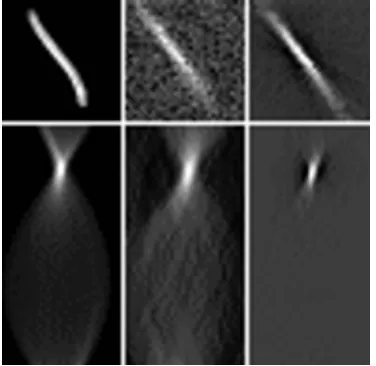
We now consider the case of blurred observations. In the edge image, the blur tends to flatten and attenuate the edge peaks, and to smooth the edge contours in directions de-pending on the blur itself. The effects of blur on the RT of the edge image regions are primarily two. The first effect is that, since the energy of each edge is spread in the spatial do-main, the maximum value of the RT is lowered. The second effect is that, since the edge width is typically thickened, it contributes to different tomographic projections, enhancing two triangular regions in the RT. This behavior is illustrated by the example inFigure 5, where a motion blur filter is ap-plied to an original edge.
4.2. Local Radon transform of the edge image: nonlinearity design
The design of the nonlinearity will be conducted after hav-ing characterized the blur effect at the output of a first-order CHF bank. By choosing the form factorσ0of the zero-order
CH filterψ(0)small enough, in the passband, the blur transfer
function is approximately constant, and thus the blur effect on the lowpass component is negligible.
As far as the first-order CH filter’s domain is concerned, the blur causes the edges in the spatial domain to be spread along directions depending on the impulse responses of the blurring filters. After having partitioned the edge image into small regions in order to perform a local RT as detailed in Section 4.1, each region has to be classified either as a strong edge area or a weak edge and textured area. Hence, the non-linearity has to be adapted to the degree of “edgeness” of each region in which the image has been partitioned. The deci-sion rule between the two areas is binary. Specifically, an area characterized as a “strong edge” region has an RT whose co-efficients assume significant values only on a subset of direc-tionsβm. Therefore, a region is classified as a “strong edge” area by comparing maxm
n(pξβm[n])2 with a fixed thresh-old. If the threshold is exceeded, the area is classified as a strong edge area; otherwise, this implies that either no di-rection is significant, which corresponds to weak edges, or every direction is equally significant, which corresponds to textured areas.
Strong edges
For significant image edges, characterized by relevant energy concentrated in one direction, the nonlinearity can exploit the spatial memory related to the edge structure. In this case, as above discussed, we use the RT of the edge image. We con-sider a limited area of the edge image ˆx1[m,n] intersected by
an edge, and its RTpxˆ1
βm[m,n], withm,nchosen as discussed inSection 4.1.
The nonlinearity we present aims at focusing the RT both with respect tomandn, and it is given by imum and the minimum value, respectively, of the RT for the direction βm under analysis, and maxβk,n(pβkxˆ1[n]) and minβk,n(pxβkˆ1[n]), withk = 0,. . .,M−1, the global maxi-mum and the global minimaxi-mum, respectively, in the Radon domain. Therefore, for each point belonging to the direc-tionβmand having indexn, the nonlinearity (13) weights the
Figure 6: First row, from left to right: original edge, blurred edge, and restored edge. Second row: corresponding discrete Radon transforms.
RT by two gain functions. Specifically, (14) assumes its max-imum value (equal to 1) for the directionβMax, where the
global maximum occurs and it decreases for the other direc-tions. In other words, (14) assigns a relative weight equal to 1 to the directionβMaxwhereas attenuates the other directions.
Moreover, for a given directionβm, (15) determines the rel-ative weight of the actual displacementnwith respect to the others by assigning a weight equal to 1 to the displacement where the maximum occurs and by attenuating the other lo-cations. The factorsκg andκf in (14) and (15) are defined as κg = κ0σw2(k) andκf = κ1σw2(k),σw2(k) being the
deconvo-lution noise variance and κ0 andκ1 two constants
empiri-cally chosen and set for our experiments equal to 2.5 and 0.5, respectively. The deconvolution noise varianceσ2
w(k)depends
on both the blur and on the observation noise, and it can be estimated as E{|w(k)[m,n]|2} ≈ E{|x˜(k)[m,n]−xˆ[m,n]|2}
when the algorithm begins to converge. The deconvolution noise variance gradually decreases at each iteration which guarantees a gradually decreasing action of the nonlinearity as the iterations proceed.
The edge enhancement in the Radon domain is then de-scribed by the combined action of (14) and (15), since the first estimates the edge direction and the second performs a thinning operation for that direction.
To depict the effect of the nonlinearity (13) on the edge domain, inFigure 6, the case of a straight edge is illustrated.
Figure7: First column: details of the F16 blurred image in the edge domain. Second column: corresponding restored details in the edge domain.
Figure8: First column: details of the Cameraman blurred image in the edge domain. Second column: corresponding restored details in the edge domain.
and the circle related to the closest block, for each pixel, only the inverse RT relative to its own block is considered. The restored details in the edge domain are shown in the second
Figure9: F16 image.
Figure10: Cameraman image.
columns. The edges are clearly enhanced and focused by the processing.
Weak edges and textured regions
If the image is flat or does not exhibit any directional struc-ture able to drive the nonlinearity, we use a spatially zero-memory nonlinearity, acting pointwise on the edge image. Since the edge image is almost zero in every pixel corre-sponding to the interior of uniform regions, where small val-ues are likely due to noise, the nonlinearity should attenu-ate low-magnitude values of ˆx1[m,n]. On the other hand,
high-magnitude values of ˆx1[m,n], possibly due the presence
of structures, should be enhanced. A pointwise nonlinearity performing the said operations is given in the following:
˜
x1[m,n]=
1 +1
α
·xˆ1[m,n]·gxˆ1[m,n],
g(·)=1 +γ·√1 +α·exp
−(·)2
2 ·
α
(1 + 1/α)
.
(16)
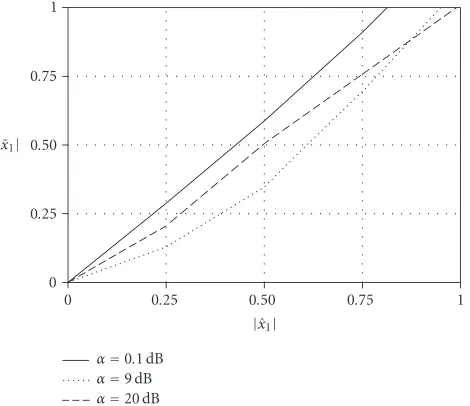
The magnitude of (16) is plotted inFigure 11for different values of the parameterα.
The low-gain zone near the origin is controlled by the pa-rameterγ; the parameterαcontrols the enhancement effect on the edges. Both parameters are set empirically. The non-linearity (16) has been presented in [14], where the analogy of this nonlinearity with the Bayesian estimator of spiky im-ages in Gaussian observation noise is discussed.
α=0.1 dB α=9 dB α=20 dB
0 0.25 0.50 0.75 1
|xˆ1| 0
0.25 0.50 0.75 1
|˜x1|
Figure11: Nonlinearity given by (16), employed for natural images deblurring and parameterized with respect to the parameterαfor
γ=0.5.
Figure12: Daughter image. From left to right: original image; linear estimation ˆx(1)[m,n]; nonlinear estimation ˜x(1)[m,n] after the first
iteration.
Figure13: Daughter image.
memory in the edge enhancement, is performed directly in the RT domain since the image edges are compactly repre-sented in this domain. When an edge structure is not de-tected, which may happen for example in textured or uni-form regions, the adopted nonlinearity reduces to a point-wise edge enhancement. It is worth pointing out that, as dif-fusely discussed in [16], the compact representation of an edge in the RT domain is related to the tuning between the
size of the local RT transform and the bandpass of the edge extracting filter.
After the nonlinear estimate ˜x1[m,n] has been computed,
the estimate ˜x[m,n] is obtained by reconstructing through the inverse filter bankφ(0)[m,n] andφ(1)[m,n], that is, (see
Figure 3)
˜
x[m,n]=φ(0)∗xˆ0
[m,n] +φ(1)∗x˜1
[m,n]. (17)
We remark that the nonlinear estimator modifies only the edge image magnitude, leaving the phase restoration to the linear estimation stage, performed by means of the filter bank
fi(k+1)[m,n],i=0,. . .,M−1. The action of the nonlinear-ity on a natural image is presented inFigure 12, where along with the original image, the linear estimation ˆx(1)[m,n], and
the nonlinear estimation ˜x(1)[m,n] obtained after the first
it-eration are shown.
5. EXPERIMENTAL RESULTS
Figure14: F16 image. First column: details of the original image. Second, third, and fourth columns: blurred observations of the original details. Fifth column: restored details (SNR=20 dB).
20 dB
Figure16: F16 image: mean square error versus the iterations num-ber.
using the blurring filters having the following impulse re-sponses:
In Figure 14, some details belonging to the original image shown inFigure 9are depicted. The corresponding blurred observations, affected by additive white Gaussian noise at SNR = 20 dB, obtained using the aforementioned blurring filters, are also shown along with the deblurred images. In Figure 15, the same images are reported for blurred images affected by additive white Gaussian noise at SNR=40 dB. In Figure 16, the MSE, defined as
MSEdef= 1
is plotted versus the iterations number at different SNR val-ues for the deblurred image.
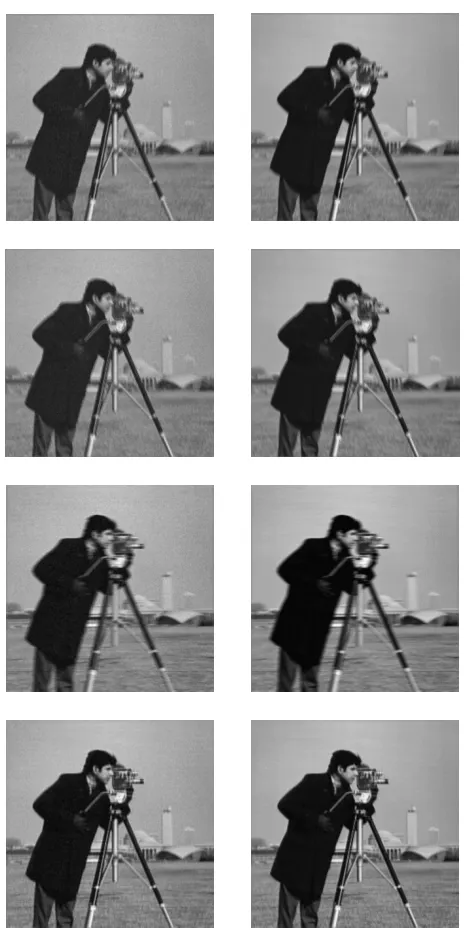
Figure17: Cameraman image. Left column, first, second, and third row: observations. Fourth row: restored image (SNR = 20 dB). Right column, first, second, and third rows: observations. Fourth row: restored image (SNR=40 dB).
Similar results are reported in Figure 17 for the image shown inFigure 10and the corresponding MSE is shown in Figure 18.
20 dB 40 dB
5 10 15 20
k 0.010
0.015 0.020 0.025 0.030 0.035 0.040 0.045
MSE
Figure18: Cameraman image: mean square error versus the itera-tions number.
Note that the algorithm converges in few iterations to-ward a local minimum and then may even diverge. In fact, as well known [17], the global convergence of the Bussgang algorithm cannot be guaranteed. The choice of the desired restoration result can be made by visual inspection of the re-stored images obtained during the iterations, which is, as also pointed out in [6], typical of blind restoration techniques.
It is worth noting that the deblurring algorithm gives im-ages of improved visual quality, thus significantly reducing the distance, in the mean square sense, from the original un-blurred image.
6. CONCLUSION
This work describes an algorithm for blind image restoration that iteratively performs a linear and a nonlinear processing. The nonlinear stage is based on a novel nonlinear process-ing technique that is based on a compact representation of the image edges by means of a local Radon transform. In or-der to focus the blurred image edges, and to drive the over-all blind restoration algorithm to a sharp, focused image, a suitable nonlinear processing is designed in the Radon trans-formed domain. The nonlinear processing is spatially vari-ant, depending on the detection of strong edges versus uni-form or textured regions.
The performance of the algorithm is assessed by a num-ber of experiments showing the overall quality of the restored images.
APPENDIX
MULTICHANNEL BUSSGANG ALGORITHM
The multichannel Bussgang blind deconvolution algorithm outlined in [14] is here briefly summarized.
Old estimator
Figure20: Daughter image: comparison between the mean square error of the old estimator [14] and of the proposed estimator (“RT Estimator”) versus the iterations number.
With reference toFigure 2, thekth iteration of the blind deconvolution algorithm is constituted by the following steps.
(1) Linear estimation step. The deconvolved image ˆ
Since the original image can be retrieved except for an amplitude scale factor, at each iteration, the Wiener fil-ter bank is normalized to yield a unitary energy out-put.
(2) Nonlinear estimation step. According to a suitable stochastic model of the imagex[m,n], the nonlinear MMSE estimate ˜x(k)[m,n] is computed through the
conditional a posteriori expectation:
˜
x(k)[m,n]=ηxˆ(k)def=
Ex[m,n]|xˆ(k). (A.2)
In general, the nonlinear estimatorη(·) exhibits non-zero spatial memory.
(3) Wiener filter coefficients update step. The Wiener filter bank fi(k)[m,n],i = 0,. . .,M−1, is recomputed by
tively. We must outline that in this step, only the cross-correlationsRx˜(k−1)yi[r,s] are computed sinceRyjyi[r,s]
are computed only once before starting the iterations. (4) Convergence test step. Convergence is tested by a
suit-able criterion.
The algorithm is initialized by a suitable initial guess
fi(0)[m,n],i=0,. . .,M−1, of the Wiener filter bank. As outlined in [17,18], the iterative algorithm reaches an equilibrium point, namely, fi(k−1)[m,n] = f
(k)
i [m,n], when the cross-correlations between the deconvolved image
ˆ
x(k)[m,n] and the measured imagesy
i[m,n],i=0,. . .,M−1, become proportional to the cross-correlations between the estimate ˜x(k)[m,n] and the observations, that is,
Rxˆ(k)yi[r,s]=const·Rx˜(k)yi[r,s]. (A.4)
Some of the authors have presented a discussion on the convergence of the algorithm in [26], where the analysis is conducted in an error energy reduction sense for the single-channel case. The condition for convergence given in [26] straightforwardly extends to the multichannel case since the variables involved in the analysis (original image, decon-volved image, and nonlinear estimate) do not change.
REFERENCES
[1] R. Molina, “On the hierarchical Bayesian approach to image restoration: applications to astronomical images,”IEEE Trans. on Pattern Analysis and Machine Intelligence, vol. 16, no. 11, pp. 1122–1128, 1994.
[2] J. P. Muller, Ed., Digital Image Processing in Remote Sensing, Taylor & Francis, Philadelphia, Pa, USA, 1988.
[3] T. Wilson and S. J. Hewlett, “Imaging strategies in three-dimensional confocal microscopy,” inProc. SPIE Biomedi-cal Image Processing, A. C. Bovik and W. E. Higgins, Eds., vol. 1245 ofProceedings of SPIE, pp. 35–45, San Jose, Calif, USA, February 1991.
[4] N. P. Galatsanos, V. Z. Mesarovi´c, R. Molina, and A. K. Kat-saggelos, “Hierarchical Bayesian image restoration from par-tially known blurs,” IEEE Trans. Image Processing, vol. 9, no. 10, pp. 1784–1797, 2000.
[5] A. K. Katsaggelos, Ed., Digital Image Restoration, Springer-Verlag, New York, NY, USA, 1991.
[7] G. Harikumar and Y. Bresler, “Perfect blind restoration of images blurred by multiple filters: theory and efficient algo-rithms,” IEEE Trans. Image Processing, vol. 8, no. 2, pp. 202– 219, 1999.
[8] G. B. Giannakis and R. W. Heath Jr., “Blind identification of multichannel FIR blurs and perfect image restoration,” IEEE Trans. Image Processing, vol. 9, no. 11, pp. 1877–1896, 2000. [9] M. Belge, M. E. Kilmer, and E. L. Miller, “Wavelet domain
im-age restoration with adaptive edge-preserving regularization,” IEEE Trans. Image Processing, vol. 9, no. 4, pp. 597–608, 2000. [10] M. C. Robini and I. E. Magnin, “Stochastic nonlinear image restoration using the wavelet transform,” IEEE Trans. Image Processing, vol. 12, no. 8, pp. 890–905, 2003.
[11] D. P. K. Lun, T. C. Hsung, and T. W. Shen, “Orthogonal dis-crete periodic Radon transform. Part II: applications,”Signal Processing, vol. 83, no. 5, pp. 957–971, 2003.
[12] R. G. Lane and R. H. T. Bates, “Relevance for blind deconvo-lution of recovering Fourier magnitude from phase,” Optics Communications, vol. 63, no. 1, pp. 11–14, 1987.
[13] P. Campisi, S. Colonnese, G. Panci, and G. Scarano, “Mul-tichannel Bussgang algorithm for blind restoration of natu-ral images,” inProc. IEEE International Conference on Image Processing (ICIP ’03), vol. 2, pp. 985–988, Barcelona, Spain, September 2003.
[14] G. Panci, P. Campisi, S. Colonnese, and G. Scarano, “Multi-channel blind image deconvolution using the Bussgang algo-rithm: spatial and multiresolution approaches,” IEEE Trans. Image Processing, vol. 12, no. 11, pp. 1324–1337, 2003. [15] S. R. Deans, The Radon Transform and Some of Its
Applica-tions, Krieger Publishing, Malabar, Fla, USA, 1993.
[16] J.-L. Starck, E. J. Candes, and D. L. Donoho, “The curvelet transform for image denoising,”IEEE Trans. Image Processing, vol. 11, no. 6, pp. 670–684, 2002.
[17] R. Godfrey and F. Rocca, “Zero memory nonlinear deconvo-lution,”Geophysical Prospecting, vol. 29, pp. 189–228, 1981. [18] S. Bellini, “Bussgang techniques for blind deconvolution and
equalization,” inBlind Deconvolution, S. Haykin, Ed., pp. 8– 59, Prentice-Hall, Englewood Cliffs, NJ, USA, 1994.
[19] G. Jacovitti, G. Panci, and G. Scarano, “Bussgang-zero cross-ing equalization: an integrated HOS-SOS approach,” IEEE Trans. Signal Processing, vol. 49, no. 11, pp. 2798–2812, 2001. [20] A. Neri, G. Scarano, and G. Jacovitti, “Bayesian iterative
method for blind deconvolution,” inProc. SPIE Adaptive Sig-nal Processing, vol. 1565 ofProceedings of SPIE, pp. 196–208, San Diego, Calif, USA, July 1991.
[21] G. Jacovitti and A. Neri, “Multiresolution circular harmonic decomposition,”IEEE Trans. Signal Processing, vol. 48, no. 11, pp. 3242–3247, 2000.
[22] G. Jacovitti and A. Neri, “Multiscale image features analysis with circular harmonic wavelets,” inProc. SPIE Wavelet Appli-cations in Signal and Image Processing III, vol. 2569 of Proceed-ings of SPIE, pp. 363–374, San Diego, Calif, USA, July 1995. [23] C. A. Berenstein and E. V. Patrick, “Exact deconvolution
for multiple convolution operators—an overview, plus per-formance characterizations for imaging sensors,”Proceedings of the IEEE, vol. 78, no. 4, pp. 723–734, 1990.
[24] J. L. Starck, “Image processing by the curvelet transform,” in Proc. Tyrrhenian International Workshop on Digital Commu-nications (IWDC ’02), Capri, Italy, September 2002.
[25] D. L. Donoho and M. R. Duncan, “Digital curvelet trans-form: strategy, implementation, and experiments,” inProc. SPIE Wavelet Applications VII, vol. 4056 ofProceedings of SPIE, pp. 12–30, Orlando, Fla, USA, April 2000.
[26] P. Campisi and G. Scarano, “A multiresolution approach for texture synthesis using the circular harmonic functions,”IEEE Trans. Image Processing, vol. 11, no. 1, pp. 37–51, 2002.
Stefania Colonnesewas born in Rome, Ita-ly. She received the “Laurea” degree in elec-tronic engineering from the Universit`a degli Studi di Roma “La Sapienza,” Italy, in 1993, and the Ph.D. degree in electronic engi-neering from the Universit`a degli Studi di Roma “Roma Tre” in 1997. In 1993, she joined the Fondazione Ugo Bordoni, Rome, first as a scholarship holder, and later as an Associate Researcher. During the
MPEG-4 standardization activity, she was involved in the MPEG-MPEG-4 N2 core experiment on automatic video segmentation. In 2001, she joined the Dipartimento di Scienza e Tecnica dell’Informazione e della Comunicazione (Infocom), Universit`a degli Studi di Roma “La Sapienza,” as an Assistant Professor. Her research interests lie in the areas of video communications, and image and signal processing.
Patrizio Campisireceived the “Laurea” de-gree in electronic engineering (summa cum laude) from the Universit`a degli Studi di Roma “La Sapienza,” Italy, and the Ph.D. degree in electronic engineering from the Universit`a degli Studi di Roma “Roma Tre,” Italy, in 1995 and 1999, respectively. He is an Assistant Professor in the Dipartimento di Elettronica Applicata, Universit`a degli Studi di Roma “Roma Tre,” where he has also been
a lecturer for the graduate course “Signal Theory” since 1998. From September 1997 until April 1998, he was a Visiting Research Asso-ciate with the Communication Laboratory, University of Toronto, Toronto, Canada, and from July 2000 until December 2000, he was a Postdoctoral Fellow with the same laboratory. From Octo-ber 1999 to OctoOcto-ber 2001, he held a Postdoctoral position at the Universit`a degli Studi di Roma “Roma Tre.” From March 2003 un-til June 2003, he was a Visiting Researcher at the Beckman Insti-tute, University of Illinois at Urbana-Champaign, Ill, USA. His re-search interests lie in the area of digital signal and image process-ing with applications to multimedia communications. Dr. Camp-isi has been a member of the Technical Committees of several IEEE conferences. He was the organizer of the special session on “Texture analysis and synthesis” for the IEEE International Sym-posium on Image and Signal Processing and Analysis 2003 (ISPA 2003).
Gianpiero Panci was born in Palestrina, Rome, Italy. He received the“Laurea” de-gree in telecommunications engineering in 1996 and the Ph.D. in communica-tion and informacommunica-tion theory in 2000, both from Universit`a “La Sapienza,” Italy. He worked in the area of signal process-ing for communication and radar systems, and in 1999, he was involved in the de-sign of the de-signum coded SAR
Gaetano Scaranowas born in Campobasso, Italy. He received the “Laurea” degree in electronic engineering from Universit`a degli Studi di Roma “La Sapienza,” Italy, in 1982. In 1982, he joined the Istituto di Acustica, Consiglio Nazionale delle Ricerche, Rome, Italy, as Associate Researcher. Since 1988, he has been teaching digital signal processing at Universit`a degli Studi di Perugia, Peru-gia, Italy, where in 1991 he became