R E S E A R C H
Open Access
Multiple extended target tracking algorithm based
on GM-PHD filter and spectral clustering
Jinlong Yang
*, Fengmei Liu, Hongwei Ge and Yunhao Yuan
Abstract
With the increase of the resolution of modern radars and other detection equipments, one target may produce more than one measurement. Such targets are referred to as extended targets. Recently, multiple extended target tracking (METT) has drawn a considerable attention. However, one crucial problem is how to partition the measurement sets accurately and rapidly. In this paper, an improved METT algorithm is proposed based on the Gaussian mixture probability hypothesis density (GM-PHD) filter and an effective partition method using spectral clustering technique. First, the density analysis technique is introduced to eliminate the disturbance of clutter, and then the spectral clustering technique based on neighbor propagation is used to partition the measurements. Finally, the GM-PHD filter is implemented to achieve the METT. Simulation results show that the proposed algorithm has a better performance, especially a better real-time performance, than the conventional distance partition and K-means++ methods.
Keywords:Extended target; Measurement partition; Probability hypothesis density; Spectral clustering
1 Introduction
In most target tracking cases, it is assumed that one tar-get generates at most one measurement per time step due to the low resolution sensor system, i.e., each target is tracked as a single point source, and its extension is as-sumed to be neglectable in comparison with sensor reso-lution [1-3]. However, with the increase of the resoreso-lution of modern radars and other detection equipments, the echo signal of a target may be distributed in a different range resolution cell, so the measurement is no longer equivalent to a point, i.e., a single target may produce multiple measurements. Such target is referred to as an extended target in [4-7]. Recently, extended target track-ing is a hot topic in the field of data fusion and has drawn a considerable attention, especially the multiple extended-target tracking (METT) [8-14].
In the conventional extended target tracking, the mea-surements are modeled as a spatial distribution model in [4], and two examples are used to prove the effective-ness of the approach: a point target with more measure-ment sources and an object with infinitely thin stick of lengthl. Poisson process with a spatially dependent rate
parameter is introduced in [5], assuming that each tar-get produces measurements with Poisson-distributed random number. It is considered that in this measure-ment model, the target is sufficiently far away from the sensor, and the measurements resemble a point cluster rather than a geometric structure [9-11]. Random matrix (RM) is proposed in [15], which has been used to track el-liptical target extension [12-14,16,17]. Different methods to estimate star-convex target extension and other gen-eral shapes are the random hypersurface model (RHM) and star-convex RHM by Baum and Hanebeck [6,7]. However, these methods can only effectively achieve the single extended target tracking, and they cannot track the multiple extended targets with unknown and vary-ing number.
Recently, the random finite set (RFS) method [18,19] for multi-target tracking has proven to be useful, which allows estimation of multiple targets in the presence of false measurements and detection uncertainty in a Bayesian filter framework [20-22]. Especially, Mahler has extended the probability hypothesis density (PHD) filter to the METT [8] and derived a complete updated formula, which can effectively achieve the METT. Gaussian mixture (GM) technique is introduced to yield a proximate solution in [9,10], and the proposed algorithm
* Correspondence:[email protected]
School of Internet of Things Engineering, Jiangnan University, Wuxi 214122, China
is referred to as extended target (ET)-GM-PHD filter. Cardinality PHD (CPHD) filter and random matrix technique are proposed to improve the performance of METT in [11,13]. However, the problem of how to ef-fectively partition the measurements of the extended multi-targets remains unresolved in these methods. The partition method based on distance is proposed in [10], which needs suitable thresholds to generate enough par-titions including the correct partition. So, the number of partitions grows rapidly as the target number in-creases, which implies that the distance partition con-sumes a large computational time, making the tracking algorithm intractable. The K-means++ method, the pre-dicted partition method, and the ML method are pro-posed in [12], but they also cannot effectively achieve the measurement partition.
As to the difficulty of METT in measurement parti-tion, a novel measurement partition algorithm is pro-posed based on spectral clustering technique under the ET-GM-PHD framework. First, the clutter can be effect-ively eliminated from the measurement set by the dens-ity analysis. Then, the spectral clustering technique is used to achieve the measurement partition quickly. Fi-nally, the ET-GM-PHD filter is implemented to obtain the states of the extended targets. Simulation results show that the proposed method has a better perform-ance in measurement set partition than the conven-tional methods.
The rest of the paper is organized as follows. Section 2 summarizes the measurement partition and the multiple extended target PHD filter. Section 3 presents the pro-posed measurement partition algorithm based on the Gaussian kernel density analysis and the spectral clus-tering and then implements the ET-GM-PHD filter. In Section 4, two examples are presented with simulation results to compare the performance of the proposed method with those of the conventional methods. Finally, the conclusions are given in Section 5.
2 Backgrounds
2.1 Measurement partition
In the METT, measurement partition is a matter of prime importance due to many measurements originat-ing from a soriginat-ingle target. The aim is to keep the mea-surements originating from a single target in the same class. However, the number of target is varying with time, and there is much clutter in the tracking scenario, which makes the measurements hard to be partitioned accurately.
Assume at time k, there are three measurements in
the measurement setZk¼ zð Þk1;z tition problem can be described as follows [10],
P1:W11¼ z
where Pi denotes the ith partition, and Wij denotes the jth subset in the ith partition, |Pi| denotes the subset
number in the ith partition, Wi j
denotes the measure-ment number of thejth subset in theith partition.
2.1.1 Distance partition theorem
Letd(⋅) be a distance measure between each pair of mea-surements, and dl≥0 be an arbitrary distance threshold.
Then, there is only one partition in which any pair of
mea-surementszð Þki andzð Þkj satisfyingd zð Þki;zð Þkj
≤dl are in the same cell [10,12].
It is noted that different distance thresholds may produce different partitions; therefore, many different thresholds are selected for producing enough partitions including the correct one in the distance partition algo-rithm, which makes this method time-consuming.
2.2 Multiple extended target PHD filter
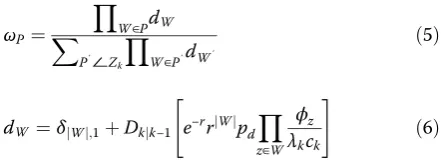
The standard PHD filter for single measurement target tracking has been described in [19]; however, it is not suitable for METT. Recently, Mahler has derived a cor-rect equation for extended target PHD filter based on the Poisson multi-target measurement model [8]. The predicted formula is the same as the standard PHD filter [19]. The updated formula for the METT can be de-scribed as [8]
Dkjkð Þ ¼x LZkð Þx Dkjk−1ð Þx ð2Þ
where Dk|k(x) denotes an intensity function of the state x, andLZkð Þx denotes the pseudo likelihood function. Zk
whereP∠Zk denotes a partition subset P of the
meas-urement set Zk, W denotes a subset of a partition P, and ∪W∈PW=Zk. ϕz(x) denotes the measurement
from an extended target x,r(x) is the measurement ex-pectation, and pD(x) denotes the detection probability
of the sensor. Clutter has a Poisson distribution, and its density can be described as κk(zk) =λkck(zk), λk
de-notes the mean number of clutter measurements, and ck(zk) is the space distribution of the clutter.
where δi,j denotes the Kronecker delta function and r=r(x).
The Gaussian mixture implement of the multiple ex-tended target PHD filter is presented in [10] and referred to as ET-GM-PHD filter.
3 The proposed algorithm
In order to solve the problem of the measurement parti-tion, a novel method is proposed in this section. The spectral clustering technique is introduced to partition the measurements of the multiple extended targets; then, the ET-GM-PHD framework is employed to esti-mate the target states. However, the spectral clustering method is sensitive to the clutter. To solve this problem, the clutter measurements are eliminated from the meas-urement sets by the Gaussian kernel density analysis technique.
3.1 Gaussian kernel density
Assumex1,x2,…,xn⊂Rdare independent and identically
distributed (i.i.d) random variables, whose probability distribution function is defined as f(x), then the kernel density estimator^f xð Þcan be obtained by [23,24]:
^
where K(⋅) denotes the kernel function, and h denotes the bandwidth (BW) parameter of the kernel. Moreover, the kernel function must satisfy the following properties:
K(−u) =K(u),Sup|K(u)| <∞, and
Z þ∞
−∞ K uð Þdu¼1.
Gen-erally, kernel functions include Gaussian function, Epa-nechnikov function, and biweight function. In this paper, assume that Zk ¼ zik
Nz;k
i¼1 denotes the measurement set
at timekand the Gaussian function is used as the kernel function. Then, the Gaussian kernel density function of the measurements can be described as
f zi
whereNz,kdenotes the number of measurements at time k, and Tdenotes the transpose operator. zi
k denotes the ith measurement of the measurement setZk.
In order to decrease the computational cost, only the neighbor measurements are considered for density com-putation. Therefore, we define the measurement density as
denotes the Euclidean distance
be-tweenzkj andzki.Cis the normalization constant. As can be seen from Equation 9, the more focused the mea-surements are, the bigger the measurement densities will be.
Figure 1 shows the measurement density of the ex-tended target and clutter measurements. As can be seen that if a suitable density threshold is selected, the clutter measurements can be removed effectively.
3.2 Density analysis and clutter elimination
In this section, the density threshold τ is selected by density histogram, and used to remove the clutter from the measurement sets. The density threshold can be ob-tained as follows.
(1) Assume that fmax and fmin denote the maximum
measurement density and the minimum measurement density, respectively. Divide [fmin fmax] into Nz equal
parts, where Nz denotes the number of the
measure-ments. The density interval can be described as [fmin fmin+d), [fmin+d fmin+ 2d),…, [fmax−d fmax],
whered= (fmax− fmin)/Nz.
(2) Calculate the measurement number of each density interval, find out the first density interval which does not include any measurement ranging from the max-imum density to the minmax-imum density, and then each density value in this interval can be selected as the dens-ity thresholdτ. In this paper, the maximum density value in this interval is selected.
3.2.1 Clutter removal If f zi
k >τ, then set zik as the measurement originating from the target; otherwise, set zik as the clutter measure-ment and remove it from the measuremeasure-ment set. Finally, the new measurement set without clutter can be ob-tained and described asGk ¼ zikf zik >τg
.
3.3 Spectral clustering based on neighbor propagation In recent years, spectral clustering has become one of the popular clustering approaches due to their high perform-ance in data clustering and simplicity in implementation [25]. Compared with traditional clustering techniques, there is no need to suppose the data distribution as spheral in spectral clustering method; thus, the nonspheral distributed clusters can be recognized by using the ei-genvectors of the normalized similarity matrix. As-sume at timek, the measurement set without clutter is Gk¼ zik
n
i¼1, the spectral clustering process based on
neighbor propagation is described as follows [25,26].
(1) Calculate the similarity matrixCof the new measurement setGk.
(a) Calculate each Euclidean distance between two measurements, i.e.
denotes the position of theith measurement,andn= |Gk| denotes the
measurement number inGk. Then the
similarity matrix can be denoted asC= [cij]n× parameter to control how fast the similarity attenuates with the distance between theith andjth measurements [26]. In this paper, we setσas an empirical parameter, and letσ= 1.5.
(b) The neighbor relation matrix is defined asT= [tij] n×n, which is a symmetrical matrix. In the initial stage, set each element value as zero, and ifbij
<ε, lettij= 1 andtji= 1, whereε¼ maxi¼1:n
minj¼1:n bij
denotes the distance threshold. (c) Calculate the mode matrixM according to the
rule of neighbor propagation and the neighbor relation matrixT. The rule of neighbor propagation can be described as, if gi
k;gjk
the measurement subset corresponding to the modeMimeets the neighbor relation. |M|
denotes the number of the modes.
(d) UpdateTandC. Iftij= 1,tji= 1, and tik= 0, set
tik= 1,tki= 1,cik= min(cij,cjk), andcki=cik.
Update the similarity of each mode, letc(m,n) = max(min(C(Mi,Mj))), wheremandndenote
the measurements ofMiandMj, respectively.
(2) Calculate the Laplacian matrixL,L=D−1/2CD−1/2, corresponding to theKlargest eigenvalues 1 =λ1≥λ2,…,≥λKof the matrixL.
(4) Form the matrixYfromVby renormalizing each row ofV, and the elementyijofYis defined as space, and use the K-means++ method to cluster the samples. Then the samples are divided intoK classes, whereKis an integer andK∈(KL,KU).KL
andKUdenote the minimum and the maximum
(a) (b)
-4000 -3000 -2000 -1000 0 1000 2000 3000 4000 -4000
class numbers, respectively. SetClass(K) as a clus-ter result ofGk.
(6) Repeat the step (5) to obtain the measurement partitionPk¼ ∪
K∈ðKL;KUÞ
Class Kð Þ.
3.3.1 Remark 1
Assume that NGis the number of measurements in Gk
and βdenotes the measurement rate conforming to the Poisson distribution. Then, the mean and the variance of the measurement rate are identical and equal to β. Therefore, 2βmeasurements are produced at most from an extended target, so we can setKL¼
⌈
N2βG⌉
. Moreover, |M| is bigger than the number of the targets, and is smaller than the measurement number, so we can set KU= |M|.
3.4 The ET-GM-PHD filter implementation
Implement the ET-GM-PHD filter according to the measurement partition Pk, and extract the target states.
Refer to [10] for the detailed process.
4 Simulations
In order to demonstrate the performance of the proposed algorithm, we implement the proposed measurement par-tition method, the distance parpar-tition, and the K-means++ method under the framework of ET-GM-PHD filter [10]. The two examples are implemented on Dell computer with Intel(R) Core(TM) CPU i5 3470, 3.2 GHz and 4GB RAM (Dell Inc., Round Rock, TX, USA).
Two different metrics are used for evaluating the algo-rithm performance. The first is the statistics of the target number estimates, and the second is the optimal subpat-tern assignment (OSPA) distance [27], which is recently developed and defined as
100 Monte Carlo runs are performed.
4.1 Example 1: crossing extended target tracking
Assume that Χk= [xk,yk,vx,k,vy,k]T denotes the extended
the measurement of thejth sensor. Each extended target follows a linear Gaussian dynamical model, and sensor has a linear Gaussian measurement model, i.e.,
fk k−1xkxk−1Þ¼N xk;Fxk−1;Qk
where N(⋅;m,P) denotes a Gaussian density with mean
mand covarianceP. F¼ I2 ΔtI2 02 I2
is the state
transi-tion matrix, and Qk−1¼σ2v
process noise covariance, where I2 and 02 denote the
2 × 2 identity and zero matrices, respectively. σv= 2 is
the standard deviation of the process noise, andΔt= 1s is the sample interval.Hk¼½I2 02denotes the
meas-urement matrix, Rk¼σ2εI2 is the covariance of the
measurement noise, and σε= 20 is the standard
devi-ation of the measurement noise. Let the probabilities of target survival and detection bePs= 0.99 andPD= 0.99,
Figure 2True tracks and the real measurements.
10 20 30 40 50 60 70 80 90 100
respectively. The clutter is modeled as a Poisson RFS with the meanλ=10 over the observation space.
The birth intensity is described as
Dbð Þ ¼x 0:1N x;mð Þb1;Pb
þ0:1N x;mð Þb2;Pb
þ 0:1N x;mð Þb3;Pb
þ0:1N x;mð Þb4;Pb
where mð Þb1 ¼½‐800‐800 0 0T, mð Þb2 ¼½‐800‐300 0 0T, mð Þb3 ¼½‐492 230 0 0T, mbð Þ4 ¼½‐654 409 0 0T, andPb= diag([100, 100.25, 25]).
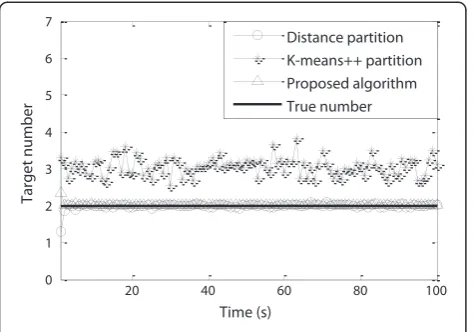
Figure 2 shows the real tracks of the extended targets with cluttered measurements in x- and y-coordinates. Figure 3 shows the number estimate of the extended tar-gets, and Figure 4 shows the OSPA distance. As can be seen, the proposed method has an accuracy similar to that of the distance partition method, but better than the means++ method, which is mainly because the K-means++ method is sensitive to the clutter and needs a good initial cluster center.
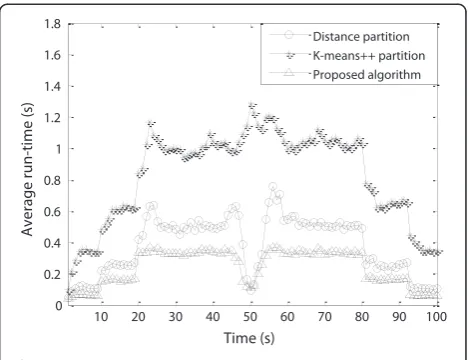
Figure 5 shows the partition number of the three dif-ferent methods, and Figure 6 shows the average run time of the three methods. It is clear that the proposed method has the smallest partition number and least computational cost, followed by the distance partition method, and the K-means++ method has the biggest partition number and highest computational cost. The reason is that the clutter measurements are removed from the measurements by the density analysis tech-nique, and the neighbor propagation technique is intro-duced to initially partition the measurements. However, for the K-means++ method, the way to set the k value is a problem, so the target number traversal technique is used. In this simulation, we also set K∈(KL,KU). Notice
that the partition number sharply decreases at time 50 s; the reason is that the targets make a cross with each other, and thus the measurements mix and cannot be separated.
10 20 30 40 50 60 70 80 90 100
0 0.2 0.4 0.6 0.8 1 1.2 1.4 1.6 1.8
Time (s)
Average run-time (s)
Distance partition K-means++ partition Proposed algorithm
Figure 6Average run time.
0 20 40 60 80 100
-1000 0 1000
X(m)
0 20 40 60 80 100
-1000 0 1000
Time (s)
Y(m)
Measurements True tracks
Figure 7True tracks and the real measurements.
0 20 40 60 80 100
0 20 40 60 80 100
Time (s)
OSPA distance (m)
Distance partition K-means++ partition Proposed algorithm
Figure 4OSPA distance statistic.
0 20 40 60 80 100
0 2 4 6 8 10 12 14 16 18
Time (s)
Partition number
Distance partition K-means++ partition Proposed algorithm
4.2 Example 2: close spaced extended targets tracking Assume that two close spaced extended targets make a parallel motion 100 m apart in this scenario, and the birth
intensity is described as Dbð Þ ¼x 0:1N x;mð Þb1;Pb
þ0:1
N x;mð Þb2;Pb
, where, mð Þb1 ¼½−800−600 0 0T , mð Þb2 ¼½−700−500 0 0T
, andPb=diag([100, 100.25, 25]). The
other parameters are the same as those of example 1. Figure 7 shows the real tracks of the extended targets with cluttered measurements in x- and y-coordinates. Figure 8 shows the number estimate of the extended tar-gets, and Figure 9 shows the OSPA distance. Figure 10 shows the partition number of the three different methods, and Figure 11 shows the average run time of the three methods.
It is clear that the proposed method has the smlest partition number and least computational cost al-though its accuracy is similar to that of the distance
partition and obviously better than that of the K-means++ method.
5 Conclusions
For the METT in clutter, this paper introduces the spectral clustering technique to partition measure-ments and track the multiple extended target states using the ET-GM-PHD filter. First, we analyze the measurement density and remove the clutter from the measurements. Then, the spectral clustering method based on the neighbor propagation technique replaces the distance partition in the ET-GM-PHD algorithm. The simulation results show that the proposed algo-rithm has a better performance than the conventional methods, especially that it decreases the computational cost. Thus, the proposed algorithm has a good pro-spect in the engineering practice.
0 20 40 60 80 100
2 4 6 8 10 12 14 16 18
Time (s)
Partition number
Distance partition K-means++ partition Proposed algorithm
Figure 10Partition number estimates.
20 40 60 80 100
0 0.05 0.1 0.15 0.2 0.25 0.3
Time (s)
Average run-time (s)
Distance partition K-means++ partition Proposed algorithm
Figure 11Average run time.
0 20 40 60 80 100
0 20 40 60 80
Time (s)
OSPA distance
Distance partition K-means++ partition Proposed algorithm
Figure 9OSPA distance statistic.
20 40 60 80 100
0 1 2 3 4 5 6 7
Time (s)
Target number
Distance partition K-means++ partition Proposed algorithm True number
Competing interests
The authors declare that they have no competing interests.
Acknowledgements
This paper is supported by the National Natural Science Foundation of China (No. 61305017, 61304264) and the Natural Science Foundation of Jiangsu Province (No. BK20130154).
Received: 5 February 2014 Accepted: 14 July 2014 Published: 25 July 2014
References
1. T Fortmann, Y Bar-Shalom, M Scheffe, Sonar tracking of multiple targets using joint probabilistic data association. IEEE J. Ocean. Eng.8(3), 173–183 (1983) 2. C Kreucher, K Kastella, AO Hero, Multitarget tracking using the joint multitarget
probability density. IEEE Trans. Aero. Electron. Syst.41(4), 1396–1414 (2005) 3. MR Morelande, CM Kreucher, K Kastella, A Bayesian approach to multiple
target detection and tracking. IEEE Trans. Signal Process.55(5), 1589–1604 (2007)
4. K Gilholm, S Godsill, S Maskell, D Salmond, Poisson models for extended target and group tracking, inProceedings of Signal and Data Processing of Small Targets, California, USA, 2005
5. K Gilholm, D Salmond, Spatial distribution model for tracking extended objects. IEE Proceedings Radar, Sonar and Navigation152(5), 364–371 (2005) 6. M Baum, UD Hanebeck, Random hypersurface models for extended object
tracking, inProceedings of the IEEE International Symposium on Signal Processing and Information Technology(Ajman, United Arab Emirates, 2009), pp. 178–183
7. M Baum, UD Hanebeck, Shape tracking of extended objects and group targets with star-convex RHMs, inProceedings of the 14th International Conference on Information Fusion(IEEE, Chicago Illinois, USA, 2011), pp. 1–8 8. R Mahler, PHD filters for nonstandard targets, I: extended targets, in
Proceedings of the 12th International Conference on Information Fusion (IEEE, Seattle, USA, 2009), pp. 915–921
9. K Granström, C Lundquist, U Orguner, A Gaussian mixture PHD filter for extended target tracking, inProceedings of the 13th International Conference on Information Fusion(IEEE, Edinburgh, U.K., 2010), pp. 1–8
10. K Granström, C Lundquist, O Orguner, Extended target tracking using a Gaussian-mixture PHD filter. IEEE Trans. Aero. Electron. Syst.
48(4), 3268–3286 (2012)
11. U Orguner, C Lundquist, K Granström, Extended target tracking with a cardinalized probability hypothesis density filter, inProceedings of the 14th International Conference on Information Fusion(IEEE, Chicago, USA, 2011), pp. 1–8
12. K Granström, U Orguner, A PHD filter for tracking multiple extended targets using random matrices. IEEE Trans. Signal. Process.60(11), 5657–5671 (2012) 13. C Lundquist, K Granström, U Orguner, An extended target CPHD filter and a gamma Gaussian inverse Wishart implementation. IEEE Journal of Selected Topics in Signal Processing7(3), 472–483 (2013)
14. A Swain, D Clark, The PHD filter for extended target tracking with estimable extent shape parameters of varying size, inProceedings of the 15th International Conference on Information Fusion(IEEE, Singapore, 2012), pp. 1111–1118
15. JW Koch, Bayesian approach to extended object and cluster tracking using random matrices. IEEE Trans. Aero. Electron. Syst.44(3), 1042–1059 (2008) 16. JW Koch, M Feldmann, Cluster tracking under kinematical constraints using
random matrices. Robot. Auton. Syst.57(3), 296–309 (2009)
17. M Feldmann, D Fränken, JW Koch, Tracking of extended objects and group targets using random matrices. IEEE Trans. Signal Process.59(4), 1409–1420 (2011)
18. R Mahler, Multi-target Bayes filtering via first-order multi-target moments. IEEE Trans. Aero. Electron. Syst.39(4), 1152–1178 (2003)
19. BN Vo, WK Ma, The Gaussian mixture probability hypothesis density filter. IEEE Trans. Signal Process.54(11), 4091–4104 (2006)
20. P Braca, S Marano, V Matta, P Willett, Multitarget-multisensor ML and PHD: some asymptotics, inProceedings of the 15th International Conference on Information Fusion(IEEE, Singapore, 2012), pp. 2347–2353
21. J Yang, H Ge, Adaptive probability hypothesis density filter based on variational Bayesian approximation for multi-target tracking. IET Radar, Sonar & Navigation7(9), 959–967 (2013)
22. P Braca, S Marano, V Matta, P Willett, Asymptotic efficiency of the PHD in multitarget/multisensor estimation. IEEE Journal of Selected Topics in Signal Processing7(3), 553–564 (2013)
23. ZI Botev, JF Grotowski, DP Kroese, Kernel density estimation via diffusion. Ann. Stat.38(5), 2916–2957 (2010)
24. D Comaniciu, P Meer, Mean shift: a robust approach toward feature space analysis. IEEE Trans. Pattern. Anal. Mach. Intell.24(5), 603–619 (2002) 25. X Li, L Guo, Constructing affinity matrix in spectral clustering based on
neighbor propagation. Neurocomputing97(15), 125–130 (2012) 26. J Cao, P Chen, Q Dai, WK Ling, Local information-based fast approximate
spectral clustering. Pattern Recogn. Lett.38, 63–69 (2014) 27. D Schuhmacher, BT Vo, BN Vo, A consistent metric for performance
evaluation of multi-object filters. IEEE Trans. Signal Process.56(8), 3447–3457 (2008)
doi:10.1186/1687-6180-2014-117
Cite this article as:Yanget al.:Multiple extended target tracking algorithm based on GM-PHD filter and spectral clustering.EURASIP Journal on Advances in Signal Processing20142014:117.
Submit your manuscript to a
journal and benefi t from:
7Convenient online submission
7Rigorous peer review
7Immediate publication on acceptance
7Open access: articles freely available online
7High visibility within the fi eld
7Retaining the copyright to your article