Electronic Thesis and Dissertation Repository
4-27-2015 12:00 AM
Exploration of Spatial and Temporal Changes in Trophic Status of
Exploration of Spatial and Temporal Changes in Trophic Status of
Lakes in the Northern Temporal Forest Biome Using Remote
Lakes in the Northern Temporal Forest Biome Using Remote
Sensing
Sensing
Aleksey Paltsev
The University of Western Ontario Supervisor
Dr. Irena I. Creed
The University of Western Ontario Graduate Program in Biology
A thesis submitted in partial fulfillment of the requirements for the degree in Master of Science © Aleksey Paltsev 2015
Follow this and additional works at: https://ir.lib.uwo.ca/etd
Part of the Biodiversity Commons, Biogeochemistry Commons, Environmental Monitoring Commons,
Forest Biology Commons, Fresh Water Studies Commons, Hydrology Commons, Other Earth Sciences Commons, Other Oceanography and Atmospheric Sciences and Meteorology Commons, Terrestrial and Aquatic Ecology Commons, and the Water Resource Management Commons
Recommended Citation Recommended Citation
Paltsev, Aleksey, "Exploration of Spatial and Temporal Changes in Trophic Status of Lakes in the Northern Temporal Forest Biome Using Remote Sensing" (2015). Electronic Thesis and Dissertation Repository. 2825.
https://ir.lib.uwo.ca/etd/2825
This Dissertation/Thesis is brought to you for free and open access by Scholarship@Western. It has been accepted for inclusion in Electronic Thesis and Dissertation Repository by an authorized administrator of
EXPLORATION OF SPATIAL AND TEMPORAL CHANGES IN TROPHIC STATUS OF LAKES IN THE
NORTHERN TEMPORAL FOREST BIOME USING REMOTE SENSING (Thesis format: Monograph)
by
Aleksey I. Paltsev
Graduate Program in Biology
A thesis submitted in partial fulfillment of the requirements for the degree of
Master of Science
The School of Graduate and Postdoctoral Studies The University of Western Ontario
London, Ontario, Canada
ii
Abstract
There is a critical need for detailed surveys of lakes covering large spatial
(>100 km2) and temporal scales (decades) to determine if there is an increase in the magnitude and frequency of phytoplankton blooms. Remote sensing was used to: (1)
develop a regression model that relates chlorophyll a (chl-a) as a proxy of lake
phytoplankton biomass to Landsat TM and ETM+ optical reflectance (r2=0.85,
p<0.001); and (2) apply this regression model to estimate chl-a in lakes within the
Temperate Forest Biome in Ontario over a 28-year period. A two-way Analysis of
Variance of remotely sensed chl-a of lakes revealed a spatial pattern of relatively low
chl-a in headwater lakes to higher chl-a in lower reaches of watersheds, and a
temporal pattern within a trend. These findings suggest that the recent increase in
community-driven reports of phytoplankton blooms is not indicative of an actual
increase in phytoplankton blooms in these lakes.
Keywords: temperate forest, lakes, trophic status, phytoplankton blooms,
iii
Co-Authorship Statement
Mr. Aleksey Paltsev will be the first author on any manuscript(s) submitted
from the contents of this thesis as he conducted satellite imagery data processing,
statistical analysis, and contributed to the design of the research approach. Dr. Irena F.
Creed will be a co-author on any manuscript(s) submitted from the contents of this
thesis as she contributed to the definition of the research problem, synthesis of ideas
and interpretation of the research results.
Financial support of the research activities for this project was provided by
Natural Sciences and Engineering Research Council of Canada (NSERC) Discovery
iv
Acknowledgments
First of all, I would like to thank my supervisor, Dr. Irena Creed, for all of her
guidance and encouragement throughout the entire 2.5 year research project. Dr.
Creed is an amazing scientist whose dedication to my professional development has
been invaluable and greatly appreciated.
I thank my advisory committee members, Dr. Katrina Moser, Dr. Hugh Henry
and Dr. Brian Branfireun, for allowing me the opportunity to accomplish this goal. Each member of my advisory committee contributed bright ideas that were
instrumental in making my thesis a success.
I thank Mr. David Aldred for his tremendous help in guiding me through
remote sensing techniques and developing automated scripts for satellite image
processing. I also thank Ms. Xue (Sherry) Qin for her incredible willingness to help as
well as for her support with satellite image processing and Ms. Jacqueline Serran for
her help with formatting text and numerous graphs in this thesis.
I would like to extend a special thanks to Dr. Eric Enanga who made my first
field trip in Canada unforgettable and from whom I learnt a lot on soil sampling. I
would also like to thank Dr. R. Sorichetti and Dr. G. Sass who became good friends of
v
Table of Contents
Abstract ... ii
Co-Authorship Statement...iii
Acknowledgments ... iv
Table of Contents... v
List of Tables ...vii
List of Figures...viii
Chapter 1 ... 1
1 Introduction ... 1
1.1 Problem Statement... 1
1.2 Theoretical framework for optical remote sensing of phytoplankton... 3
1.3 Analytical framework for optical remote sensing of phytoplankton ... 11
1.4 Hypothesis and Objectives ... 13
1.5 Thesis Organization... 13
Chapter 2 ... 15
2 Study Region... 15
Chapter 3 ... 18
3 Methods ... 18
3.1 Ground-based data... 18
3.2 Satellite-based data... 19
3.2.1 Rationale for choosing Landsat TM and ETM+ imagery ... 19
3.2.2 Landsat data acquisition ... 19
3.2.3 At-satellite radiance calibration... 20
3.2.4 Atmospheric correction ... 20
3.2.5 Lake identification ... 24
3.2.6 Lake selection for regression modeling ... 25
3.2.7 Regression modeling ... 26
3.2.8 Decomposition of variance ... 27
Chapter 4 ... 29
4 Results ... 29
4.1 Chl-a concentration in ground-based samples... 29
4.2 Regression model... 29
4.2.1 Results validation... 34
4.3 Spatial patterns in modelled chlorophyll a... 34
4.4 Temporal patterns in modelled chlorophyll a ... 37
4.5 Alterations in the trophic status of lakes... 37
4.6 Decomposition of total variation into space, time and space × time components ... 40
Chapter 5 ... 45
5 Discussion... 45
vi
Chapter 6 ... 51
6 Conclusions... 51
References ... 53
vii
List of Tables
Table 1.1: Overview of Landsat satellite sensors for phytoplankton monitoring (past
and currently operational) modified from Chander et al. (2009). RBV: Return Beam
Vidicon; MSS: Multispectral Scanner System; TM: Thematic Mapper; ETM+:
Enhanced Thematic Mapper; OLI: Operational Land Imager; pan: panchromatic; IR:
infrared; NIR: near infrared; SWIR: shortwave infrared; TIR: thermal infrared. ...7
Table 1.2: Overview of remote sensing studies using Landsat imagery for the
estimation of different parameters in inland waters only. B: Landsat band number;
LR: simple linear regression; MLR: multiple linear regression; Chl-a: chlorophyll-a;
SD: Secchi disk depth; TURB: turbidity; TSS: total suspended sediment; TSM:
total suspended matter; DOM: dissolved organic matter...9
Table 3.1: Correspondence between Landsat image capture dates and ground
measurement dates. ...21
Table 4.1: Descriptive statistics of in situ lake physical, chemical and biological data.
...30
Table 4.2: Pearson correlation coefficients between in situ DOC and various Landsat
viii
List of Figures
Figure 1.1: Evidence for the increased number of phytoplankton blooms in southern
Ontario (modified from Winter et al., 2011). ...2
Figure 2.1: Location of the study region in the Temperate Forest Biome of Ontario
and the location of sampled lakes. ...16
Figure 3.1: Flowchart of Landsat TM and ETM+ image processing steps, lake
identification and reflectance calculation. ...22
Figure 4.1: Pearson correlation coefficients (r) between CHLaobs (ln [µg
CHLaobs/L]) and various Landsat bands, band combinations and band ratios...31
Figure 4.2: Relationship of time window between in situ and satellite observations
and r2, and number of lakes...33
Figure 4.3: Scatter-plot of B3 reflectance regressed against CHLaobs (ln [µg
CHLaobs/L])...35
Figure 4.4: Comparison of CHLaobs (ln [µg CHLaobs/L]) and CHLamod (ln [µg
CHLamod/L])...36
Figure 4.5: Map of average CHLamod (µg/L) for 21,384 lakes in a 28-year record....38
Figure 4.6: Time series of median CHLamod (ln [µg CHLamod/L]) for 6,384 lakes in a
28-year record (1984-2011) with an additional axis for CHLamod (µg/L)...39
Figure 4.7: Comparison in distribution of trophic status of lakes (%) for two ten-year
periods (1985-1994 and 1995-2004)...41
Figure 4.8: Sources of natural variation of CHLamod (ln [µg CHLamod/L]). ...42
Figure 4.9: Number of years needed to establish the stability of variance in CHLamod
(ln [µg CHLamod/L])...43
Figure 4.10: Number of lakes needed to establish the stability of variance in CHLamod
ix
List of Abbreviations
chl-a: Chlorophyll a
CHLaobs: Observed (sampled in the field) chlorophyll-a
CHLamod: Modelled chlorophyll-a
DOC: Dissolved organic carbon
TM: Landsat Thematic Mapper sensor
ETM+: Landsat Enhanced Thematic Mapper sensor
OLI: Operational Land Imager sensor
B1: Band 1 (Landsat blue band)
B2: Band 2 (Landsat green band)
B3: Band 3 (Landsat red band)
B4: Band 4 (Landsat near infrared band)
ANOVA: Analysis of variance
RMSE: Root mean square error
DOS - Dark Object Subtraction method
Chapter 1
1 Introduction
1.1 Problem Statement
Lakes in the temperate forests of eastern North America appear to be
experiencing an increase in the frequency and duration of phytoplankton blooms.
These blooms are often comprised of phytoplankton species that have the capacity to
produce toxic secondary metabolites such as neurotoxins, hepatoxins and
gastro-toxins that can cause serious health problems for animals and humans (Havens, 2008).
This has been the focus of numerous recent public and government reports (Winter et
al., 2011), resulting in heightened public concern and public reporting of
phytoplankton blooms in Ontario (Figure 1.1).
Phytoplankton blooms have usually been associated with the process of
eutrophication where excess macronutrients such as phosphorus (P) and nitrogen (N)
enter water bodies (Paerl and Huisman, 2009). The leading cause of this excessive
nutrient concentration is mainly ascribed to anthropogenic influences through either
direct discharge of waste products and chemical fertilizers into surface waters (Glibert
et al., 2005) or widespread land use and land cover change (e.g. deforestation, prairie plowing, wetland drainage, etc.) (Foley et al., 2005). However, these explanations
provide little or no insight into phytoplankton bloom occurrence in nutrient poor
oligotrophic lakes located on relatively pristine landscapes a considerable distance
from urban zones and agricultural lands.
Canada’s Great Lakes-St. Lawrence forest region contains 18% of the world’s
freshwater resources. With relatively little anthropogenic influence in the northern
parts of this region, it is likely that other factors are contributing towards a rise in
phytoplankton biomass. For example, climate warming and associated hydrological
and biogeochemical changes may be contributing to increased phytoplankton biomass
in oligotrophic lakes (O’Neil et al.,2012). More intense precipitation events promote
washing of nutrients out from uplands to wetlands and lakes, increasing their nutrient
enrichment. On the other hand, the prolonged periods of droughts lead to the effect
when nutrients are captured within lakes, raising a possibility of blooms (Paul, 2008;
Figure 1.1: Evidence for the increased number of phytoplankton blooms in southern
may indicate perceived rather than real concerns. An increased number of reports
does not necessarily indicate an actual increase in phytoplankton blooms. Public
perception may be heightened by a greater number of news stories illustrated with photographs of dead fish and livestock. Therefore, there is a critical need for a detailed historical survey of lake phytoplankton biomass covering large regional
scales over extended periods (decades) that can help determine whether global factors
such as climate change do play an important role and whether public perceptions are
accurate.
Until recently it was unfeasible to conduct this kind of research because it
required both comprehensive historical records and laborious sampling campaigns in
frequently difficult-to-access locations. The era of remotely sensed imagery, however,
allows for characterization of lake phytoplankton over large spatial extents over the
past several decades.
1.2 Theoretical framework for optical remote sensing of
phytoplankton
Satellite remote sensing has proven to be an effective tool for ecological
research in inland water bodies, helping to understand past and current complex
ecological and biogeochemical processes occurring in them. In lake science, the
application of remote sensing is based on the inherent properties of water, its
dissolved components, and phytoplankton pigments to absorb or reflect solar radiation
at specific wavelengths within the electromagnetic spectrum (Richardson, 1996).
The ability of a surface to reflect radiation is measured by reflectance; i.e., the
ratio of the total amount of reflected radiation (light) to the total amount of radiation
(light) incident on the surface. Every dissolved component or pigment in water has its
own reflectance properties, making it possible to “trace” their presence and
concentration in the water column. Phytoplankton detection is possible through the
optical properties of one of the principal pigments of all phytoplankton, chlorophyll a
(chl-a). Some phytoplankton groups have specific pigments, such as phycocyanin in
cyanobacteria with an electromagnetic absorption peak at about 620 nm, meaning that
these groups can be distinguished from other phytoplankton by their reflectance
phytoplankton bloom development and toxin production (Downing et al., 2001),
remote sensing promises to be a useful technique for studying these blooms via
detection of phycocyanin concentration in water. However, this technique is
hampered by the inability of most satellite sensors to resolve the narrow bandwidths
of these specialized absorption peaks and is still under investigation (Vincent et al.,
2004).
Among several currently existing remote sensing systems, one of the most popular and widely availablesystems is the Landsat satellite series. It offers the longest continuous record of satellite-based observations of the Earth’s surface starting with the launch of the first satellite in the series (Multispectral Scanner or MSS) in the early 1970s (Fraser 1998). Landsat Thematic Mapper (TM) and Enhanced TM (ETM+) sensors were subsequently launched to provide finer spatial
resolution (30 m). Landsat TM and ETM+ images consist of seven spectral
bands (with one additional band for ETM+) (Table 1.1). Table 1.1 presents an overview of all past and currently operational Landsat satellite sensors.
Landsat TM and ETM+ have a long history of successful quantification of
phytoplankton chl-a (Carpenter and Carpenter, 1983; Lathrop et al., 1991; Gitelson,
1992; Fraser, 1998; Allee and Johnson, 1999; Svab et al., 2005; Cannizzaro and Carder, 2006; Karakaya et al., 2011; McCullough et al., 2012; Hicks et al., 2013;
Giardino et al., 2014). These studies relied mostly on: (1) the optical properties of
chl-a chchl-archl-acterized by low reflectchl-ance in the red wchl-avelengths chl-and high reflectchl-ance in the
near-infrared; and (2) simple linear or multiple linear regression models where
satellite measured reflectance was related statistically to near-simultaneous
ground-based measurements of chl-a.
The successful use of Landsat TM and ETM+ imagery depends on various
factors, including the methods used for: (1) ground-based data collection (e.g., depth
from which a sample was collected); (2) correction of raw Landsat images to remove
terrain and atmospheric effects; and (3) statistical analysis (e.g., the type of regression
analysis used) (Liu et al., 2003;Kallio, 2012). It has also been shown that estimates
produced by regression models can be highly dependant on chl-a concentration;
accuracy can significantly drop with decreasing chl-a concentration (El-Alem et al.,
from remotely sensed imagery (using Landsat in particular) revealed that the majority
of models were developed from a single lake (e.g., Ritchie et al., 1990;Mayo et al.,
1995; Budd and Warrington, 2004; Vincent et al., 2004; Tebbs et al., 2013; Rodríguez
et al., 2014), some from a few lakes (e.g., Dekker and Peters, 1993; Gitelson, 1993;
Baruah et al., 2001; Brezonik et al., 2005), and only a handful from a large number of
lakes (e.g., Chipman et al., 2004; Olmanson et al., 2013) (Table 1.2).Few studies
have attempted to estimate chl-a over a period of more than one year (e.g., Kloiber et
al., 2002; Sass et al., 2007; McCullough et al., 2012; Hicks et al., 2013) (Table 1.2).
The studies that aimed at the model developing from many lakes
transferedknowledge from a few representative lakes to many lakes in a region. They
used in situ measurements from a few representative lakes to calibrate relationships
between Landsat TM or ETM+ imagery and chl-a, then extended the scale of study
from one year to decades and/or from small to large regions. For example, Pulliainen
et al. (2001) predicted average chl-aconcentration for lakes in southern Finland using
regression models developed from ground-based chl-a measurements in just six lakes.
The authors found that average chl-a can be reliably estimated from satellite data
(AISA hyperspectral system) without having in situ measurements for every lake.
Sass et al. (2007) classified trophic status in 76 lakes in northern Alberta (Canada),
finding a relationship between Landsat TM Band 3 (red) reflectance and ground
observations from 18 lakes (r2 = 0.68, p < 0.0001). Further, they used the regression equation and the reflectance derived from archived TM data to build a time series of
chl-a concentration for 20 years, thereby confirming the possibility of using remote
sensing of the lakes with no in situ data for continuous temporal analysis. Allan et al.
(2011) characterized the spatial and temporal distribution of chl-a in numerous lakes spread over the large area of the Central Volcanic Plateau in New Zealand, finding a strong relationship between Landsat ETM+ Band 3 reflectance values and in situ data (r2 = 0.95, p < 0.001). The developed model was transferred to predict the
concentration of chl-a for two different seasons (spring and summer) of the same year.
The previously mentioned studies have one particular idea in common: their models
Table 1.1: Overview of Landsat satellite sensors for phytoplankton monitoring (past and currently operational) modified from Chander et al.
(2009). RBV: Return Beam Vidicon; MSS: Multispectral Scanner System; TM: Thematic Mapper; ETM+: Enhanced Thematic Mapper; OLI: Operational Land Imager; pan: panchromatic; IR: infrared; NIR: near infrared; SWIR: shortwave infrared; TIR: thermal infrared.
Resolution
Satellite Sensors Launch Date
Decommission
Date Spectral Bands (B) (nm) Pixel Size (m) Revisit Period (days) Altitude (km) Landsat 1 MSS and RBV July 23,
1972 January 7, 1978
80 (RBV)
79 (MSS) 18 920
Landsat 2 MSS and RBV January 22, 1975 February 25, 1982 RBV
B1 (green): 480-570 B2 (red): 580-680 B3 (NIR): 700-830
MSS
B4 (green): 500-600 B5 (red): 600-700 B6 (NIR): 700-800
B7 (SWIR): 800-1,100 80 (RBV) 79 (MSS) 18 920 Landsat 3 MSS and RBV March 5,
1978 March 31, 1983
RBV
B1 (pan): 505-750
MSS
B4 (green): 500-600 B5 (red): 600-700 B6 (NIR): 700-800
B7 (SWIR): 800-1,100 B8 (TIR):
10,400-12,600 40 (RBV) 79 (MSS) 240 (MSS thermal) 18 920
Landsat 4 MSS and TM
July 16,
1982 June 30, 2001 16 705
Landsat 5 MSS and TM
March 1, 1984
Completely deactivated: June 5, 2013
MSS
B4 (green): 500-600 B5 (red): 600-700
TM
B1 (blue): 450-520 B2 (green): 520-600
B3 (red): 630-690
82 (MSS) 30 (TM)
1,100 1,750 B6 (thermal IR):
10,400-12,500 B7 (SWIR-2):
2,080-2,350
Landsat 6 ETM+ October 5, 1993
Did not achieve
orbit 16 705
Landsat 7 ETM+ April 15,
1999 Operational
B1 (blue): 450-520 B2 (green): 520-600
B3 (red): 630-690 B4 (NIR): 760-900 B5 (SWIR-1): 1,550-1,750
B6 (TIR): 10,400-12,500 B7 (SWIR-2): 2,080-2,350
B8 (pan): 500-900
30 120 (thermal)
15 (pan)
16 705
EO-1 OLI November
21, 2000 Operational
B1 (coastal aerosol): 433-453 B2 (blue): 450-515 B3 (green): 525-600
B4 (red): 630-680 B5 (NIR): 845-885 B6 (SWIR-1): 1,560-1,660 B7 (SWIR-2): 2,100-2,300
B8 (pan): 500-680 B9 (cirrus): 1,360-1,390 B10 (TIR-1): 10,600-11,200 B11 (TIR-2): 11,500-12,500
30 100 (TIR)
15 (pan)
Table 1.2: Overview of remote sensing studies using Landsat imagery for the estimation of different parameters in inland waters only. B: Landsat band number; LR: simple linear regression; MLR: multiple linear regression; Chl-a: chlorophyll-a; SD: Secchi disk depth; TURB: turbidity; TSS: total suspended sediment; TSM: total suspended matter; DOM: dissolved organic matter.
Public
ation Location Sensor
# of modeled lakes # of years (period) Lake parameter Statistical technique Bands/band combinations/ band ratios r2 (chl-a only) Reference
2013 USA, Minnesota
TM, ETM+ 10500 20 (1985– 2005)
SD MLR B1/B3 n/a Olmanson et
al.(2013) 2013 New Zealand,
theWaikato region
ETM+ 34 9 (2000–
2009)
TSS, SD LR B4, B3, B1/B3 n/a Hicks et al., 2013
2012 USA, Maine TM, ETM+ 1511 20 (1990– 2010)
SD LR
(forward stepwise regression)
B1/B3 n/a McCullough
et al.(2012)
2011 New Zealand, Central Volcanic
Plateau
ETM+ n/a 1 (2001) Chl-a LR B3, B1/B3 0.95 Allan et al.
(2011)
2008 Southern Finland
ETM+ n/a 1 (2002) SD, TURB, DOM
LR B1/B3 n/a Kallio et al.
(2008) 2007 Canada,
Alberta, Boreal Plain
TM, ETM+ 76 20 (1984-2003)
Chl-a, SD, TURB
LR B3 0.68 Sass et al.
(2007)
2004 USA, Wisconsin
TM, ETM+ 8645 3 (1999– 2001)
SD MLR B1/B3, B1 n/a Chipman et al. (2004) 2003 USA, lower
peninsula of Michigan
ETM+ 93 1 (2001) SD LR B1/B3 n/a Nelson et al.
2003 USA, Minnesota
TM 94 1 (2001) SD MLR B1/B3, B1 n/a Sawaya et
al.
(2003) 2002 USA,
Minnesota, Twin Cities Metropolitan
Area
TM, MSS 64–170 25 (1973– 1998)
SD step-wise regression,
MLR
B1/B3, B1 n/a Kloiber et al.
(2002)
2002 The Netherlands,
Southern Frisian Lakes
TM n/a n/a TSM Analytical (B2 + B3)/2 n/a Dekker et al.
(2002)
2001 Southern Finland
TM 85 1 (1997) Chl-a, SD, TURB LR B1/B2, B1–B4)/ (B3– B1– B4)/(B3– B4), (B1– B4)/(B3– B4)
n/a Härmä et al.
(2001)
1998 USA, Nebraska Sand Hills,
Nebraska
TM 21 1 (1994) TURB LR B3 n/a Fraser
1.3 Analytical framework for optical remote sensing of
phytoplankton
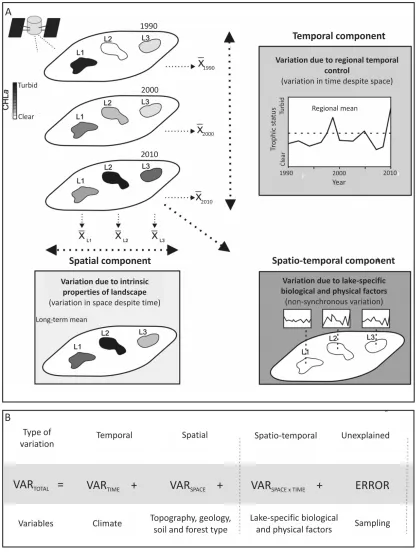
For this research the framework developed by Wiley et al. (1997) and later
applied by Sass et al. (2007) was adapted. Figure 1.2 shows schematic (A) and
statistical (B) models of three types of variation (space, time and space × time
interaction components) that contribute to overall variance in chl-a concentration.
Conceptually, the spatial component represents variation due to landscape attributes
of a study region including geology, topography, hydrology, forest and soil type (c.f.
Devito et al., 2005). Data on these attributes should be spatially extensive (Wiley et
al., 1997). For instance, they cannot represent concentration of chl-a for a single lake
but rather for many lakes in the region. The temporal component represents variation
due to differences between years including climatic oscillations and trends as well as
human development. Finally, the space × time interaction component represents
non-synchronous site (lake) specific variation in time. Processes leading to this type of
variation occur within lakes and can be biological (e.g., interactions between species
including competition and predation) or physical (e.g., morphometric properties of
lakes such as lake area, depth, size of littoral zone). The complexity of processes
involved in this type makes it difficult to define what exactly causes the variation.
Therefore, Sass et al. (2007) called it "variation due to unknown factors".
Statistically, all three components are integrated into the paradigm of standard
two-way analysis of variance (ANOVA). ANOVA has been widely used in ecological
research for evaluating spatial and temporal patterns with applications for
zooplankton (Lewis, 1978), fish and insect populations (Wiley et al., 1997), and chl-a
of eutrophic lakes (Sass et al., 2007). The spatial component represents averaged time
variation between sites, the temporal component represents averaged spatial variation
between years, while the space × time interaction component accounts for interaction
between time and space variations, namely variations that are site-specific (e.g. chl-a
that varies across the lakes of the same study region). Finally, the error term in the
ANOVA analysis may also be found in the space × time interaction component. This
error is associated with any measurement or remote sensing processing errors. It is
Figure 1.2: Schematic (A) and statistical (B) models of variation in the trophic status
time interaction component), but only if any replicates were collected during the
sampling period (Wiley et al., 1997).
1.4 Hypothesis and Objectives
The goal of the research is to characterize spatial and temporal variation in
lake chl-a as a proxy of phytoplankton biomass of lakes in the study region (the
northern edge of the Temperate Forest Biome) in Ontario.
The hypothesis is that concentration of chl-a in lakes in the Temperate Forest
Biome of Ontario is highly dependent on spatial and temporal differences in
topography and climatic patterns. The predictions are that: (1) the temporal
component of variation in chl-a is large, with an increase in chl-a over time related to
climate change; (2) the spatial component of variation in chl-a is similarly large, with
a systematic pattern of increase in chl-a from the upper to lower reaches of
watersheds; and (3) the space × time interaction component of variation is the
smallest.
To test this hypothesis, the following objectives were completed:
1. develop regression models that relate chl-a to optical reflectance;
2. apply these models to estimate chl-a concentration in lakes over several
decades;
3. decompose the total variation in chl-a into space, time, and space × time
interaction components to identify the main factors influencing chl-a
concentration.
The results of the study will help to identify which factors are associated with
reported phytoplankton blooms and allow researchers to target future monitoring
efforts on the potentially susceptible lakes in forested landscapes.
1.5 Thesis Organization
This thesis has been prepared in monograph format. The introduction (Chapter
1) provides an overview of the research problem and presents the theoretical and
analytical approaches to address the research problem. Chapter 2 outlines the study
region. The methods section (Chapters 3) describes methods used in the study.
influencing variation in chl-a. Chapter 6 summarises the major conclusions of the
work, discusses the anticipated significance of the study, and identifies future research
Chapter 2
2 Study Region
The study region is in the Great Lakes-St. Lawrence Forest region located at
the northern edge of the Temperate Forest Biome and confined by the administrative borders of the province of Ontario (Figure 2.1).
Climate is continental, with precipitation being influenced by lake effect from
the Great Lakes and local orographic effects in areas of high relief (Baldwin et al.,
2011). According to McKenney et al. (2011), mean annual precipitationin the study region for the period of 1981–2010 was 990 mm. Areas with maximum annual precipitation are located along topographic heights facing the Great Lakes, especially
in the Batchawana and Muskoka watersheds (1135 mm and 1150 mm respectively).
Average annual mean air temperature for 1981-2010 was +4.4 oC, varying between +7.0 oC in the south-east and 1.8 oC in the north (McKenney et al., 2011). The frost-free period greatly depends on the location; in more warm and humid south regions
this period normally extends from April to November while in the north it lasts from
May to September (Baldwin et al., 2011). Peaks in stream discharge occur during
snowmelt in March to April and again in September to November during autumn
storms (Mengistuet al., 2013).
Geology is the Precambrian rocks of the Canadian Shield. Bedrock geology is
primarily composed of silicate greenstone with small outcrops of more felsic igneous
rock (Ontario Geological Survey, 2003). In the south, these rocks are almost
completely covered with glaciofluvial outwash, whereas they come to the surface
throughout the Algoma Highlands and the north portion of the study region. The
outwash is 1-2 m in width and generally consists of two layers: sandy loam ablation
till and a compacted lower slit loam basal till (Ontario Geological Survey, 2003).
Topography varies from flats and depressions along the shores of lakes Superior and
Huron to hills and uplands (Algoma and Madawaska highlands, Batchawana
Mountains). Elevations range from 180 m to 650 m at the summit of Batchawana
Mountain with an average of 460 m (Baldwin et al., 2000). The most rugged
topography occurs in the Algoma Highlands where hills of mostly oblong forms with
Figure 2.1: Location of the study region in the Temperate Forest Biome of Ontario
Soils in the southern portion of the study region are thin and undifferentiated brunisols. Central and northern areas of the study region are represented by orthic ferro-humic podzols gradually thickening, differentiating, and increasing in organic content on topographic benches. Wetland areas are comprised of ferric humisols with highly humified organic deposits (Canada Soil Survey Committee, 1978).
The Great Lakes-St. Lawrence Forest region is the second largest forest region in Ontario and represents the transitional zone between deciduous and coniferous forests. Deciduous species are primarily comprised of sugar (Acer saccharum Marsh.) and red (Acer rubrum L.) maples, yellow birch (Betula alleghaniensis Britt.), and red
oak (Quercus rubra L.). Coniferous species are represented by white (Pinus strobes
L.) and red (Pinus resinosa Ait) pine, and easternwhite cedar (Thuja occidentalis L).
There is a long history of forest management activities that have resulted in a fairly
simple forest structure, with reduced species diversity and little variety in forest age
(Carleton, 2000). In addition, logging has also led to significant changes in nutrient composition of local soils (especially nitrogen [N] and dissolved organic carbon [DOC]) that could have had potential impact on the streams and lakes of the study
3 Methods
3.1 Ground-based data
Ground-based measurements were taken as a part of the field campaign
launched in 2008 and conducted by Sorichetti (2013b). The measurements of
chlorophylla andDOC were made in 31 oligotrophic lakes in the Algoma Highlands of Ontario from 2009 to 2011 (Figure 2.1).Lakes were selected on a basis of minimal
direct anthropogenic influence and public concern about the potential of
phytoplankton blooms in the lakes.The sampled lakes are relatively deep (ranging
between 0.8 m to 42.7 m; Sorichetti, 2013b), thermally stratified during the warm
summer months, and dimictic with major mixing events occurring during the spring
snowmelt and fall storms. Lakes were sampled at their centers throughout the ice-free
season (May – October). Surface water samples integrated to 1.0 m depth were
collected in 500 mL pre-rinsed polyethylene bottles near the centres of the lakes. The
samples were then put into in a cooler with ice until return to the field laboratory.
Each sample was filtered onto Whatman GF/F filters and analysed for chl-a
concentration according to EPA Method 445.0 (Arar and Collins, 1997). Chl-a was
extracted from filters using an acetone/ultra-pure water solvent (90:10 v/v) in 20 mL
scintillation vials and stored in the dark at -20 °C for 20 h. Samples were brought to
room temperature in the dark and measured using a Turner 10-AU field fluorometer
with a 680-nm emissions filter (Turner Designs, Sunnyvale, CA, U.S.A.).
Ground-based measurements of chl-a conducted by Sass et al. (2007) were
also used in this study. The measurements were taken in 22 eutrophic lakes in August
2001 in the Boreal Plain in northern Alberta. The lakes were relatively shallow with
an average depth of 1.3 m (Sass et al., 2008). Lakes were sampled at their centers in
mid-August coinciding with the summer peak in phytoplankton biomass. Grab
samples were taken from a depth of 0.20-0.40 m of the water column and transported
to a laboratory. Samples were filtered within 12 hours of collection, frozen, and later
analyzed for chl-a using a spectrophotometer at 750, 665 and 649 nm using EPA
(2007). Satellite reflectance values for the Alberta lakes were also provided by Sass et
al. (2007).
3.2 Satellite-based data
3.2.1 Rationale for choosing Landsat TM and ETM+ imagery
Archived Landsat TM and ETM+ satellite images were chosen as the source
of satellite-based data for this research for a number of reasons: (1) well-established
methods of image and associated metadata processing; (2) near-continuous coverage
of archived satellite imagery starting from 1982; (3) global coverage allowing for
analysis over large areas as well as in areas with limited or no physical access; and (4)
free distribution, an especially important consideration for historic surveys of large
areas with requirements of hundreds thousands of scenes.
3.2.2 Landsat data acquisition
Twelve Worldwide Reference System ground tracks (path and row
combinations 22/27, 21/28, 20/27, 20/28, 17/28, 17/29, 16/29, 18/28, 18/29, 21/27,
19/27, 19/28; UTM zones 16, 17 and 18) were identified for the study region. Landsat
TM (1984-2011) and ETM+ (1999-2003) scenes as well as associated metadata
corresponding to these tracks were retrieved from US Geological Survey archives for
the period of 1984-2011. ETM+ images for the period of 2003-2011 were not
acquired due to a system failure in the Landsat 7 sensor in 2003 that resulted in wide
strips of missing data within images. Only those images were selected that: (1)
contained less than 50% cloud or haze cover; and (2) were captured from late July to
early November. This period coincides with the peak phytoplankton biomass known
for the study region, extending into a prolonged autumn boundary. This boundary
may extend into ice cover periods, but it was set this way intentionally due to new
evidence that duration of phytoplankton blooms is increasing, covering a period up to
mid-November (Winter et al., 2011).
Although the 16-day revisit period of Landsat satellites offers the potential to
acquire two images for each ground track in most months, the presence of cloud cover
limited this number; in many months no usable images could be acquired. Particular
and ground observation within +/- 7 days was used to limit the search. Although this
window is the longest period in which reasonable results can be yielded (Kloiber et al,
2002; Nelson et al., 2003), it remained a challenge to find cloud-free Landsat images
falling within this window.
A total of 1,067 Landsat TM and 159 ETM+ images were retrieved. Five
images coinciding with the in situ measurements in 2009, 2010 and 2011 within +/- 6
days were acquired (Table 3.1). All images were corrected for terrain at delivery.
Landsat images were imported into ArcGIS 10.2 where they were cropped to remove
“dark” or zero value pixels on image margins. Only Bands 1-5 (out of 7) were
processed and used in this analysis.
3.2.3 At-satellite radiance calibration
Landsat images are stored in 8-bit Digital Numbers (DNs) for the purpose of
minimizing storage volume. This storage process involves scaling and offsetting the
physical at-satellite radiance values (the amount of energy sensed by the satellite
measured in W m-2 sr-1µm-1). The first step in image analysis is to convert DNs for each image Band 1-4 back to at-satellite radiance values (Lsat) using Equation 1:
[1]
where B and G are published post-launch image gain and bias provided in image
metadata (Chander et al., 2009). An automated script was developed for
implementation in ArcGIS 10.2 to execute at-satellite radiance calibration. Figure 3.1
shows a flowchart of Landsat processing.
3.2.4 Atmospheric correction
Estimating phytoplankton biomass or other water quality variables from
Landsat images depends on being able to relate Landsat pixel values to inherent
physical optical properties of the variables. Because these physical properties do not
vary in space or time, Landsat images acquired over a span of time and across
different ground tracks must be corrected to a common radiometric scale in order to
Table 3.1: Correspondence between Landsat image capture dates and ground
measurement dates.
Date of image
capture Sensor
Ground measurement date
May 22, 2009 TM May 17, 2009
June 12, 2009 TM June 13, 2009
June 23, 2009 TM June 24, 2009
June 17, 2010 TM June 16, 2010
August 16, 2010 TM August 16, 2010
Figure 3.1: Flowchart of Landsat TM and ETM+ image processing steps, lake
A major source of error is the modification of electromagnetic radiation
signals collected by satellites from scattering and absorption by gases and aerosols as
the signals travel through the atmosphere from the Earth’s surface. Atmospheric
interference can be particularly significant over water bodies, because interference
increases as reflected radiance from water decreases (Brezonik et al. 2005).
Atmospheric conditions vary in both space and time. The effects of atmospheric
conditions depend on the wavelength of energy reaching the given satellite sensor.
The main atmospheric effect is scattering which is additive to the remote sensed
signals, while the effect of absorption is multiplicative.
A number of methods have been developed to correct satellite images for
atmospheric effects (Chavez, 1996; Chen et al., 2005). Physical models are the most
complex and require detailed knowledge of atmospheric conditions such as Rayleigh
atmosphere, aerosols and ozone optical depth at the time of image acquisition. As
these parameters are rarely available – especially for historic and rural archived
imagery – physical models can typically only be used for field-calibrated studies
where in situ measurements can be made.
Relative methods use histogram matching and regression techniques to
normalize images to a single reference image by selecting pseudo-invariant ground
features (PIFs) that are assumed to have constant reflectance properties (Schott et al.,
1988; Furby et al., 2001). Relative methods are not applicable when generalization of
spectral features takes place across more than one Landsat frame as PIFs cannot be
identified across ground tracks (Mahiny et al., 2007).
Dark Object Subtraction methods (DOS) can be used across different scenes
and do not require in situ atmospheric measurements. These methods assume that
there are near-zero reflectance features ("dark features") within an image (e.g., clear
water bodies, dense forest, shadows) and that the signal recorded by the sensor is
solely a result of atmospheric scattering (path radiance) – this value is subtracted from
all pixels in an image (Shunlin et al, 2001). The Cosine of Sun Zenith Angle model
(COST) variation of DOS was adopted for this study (Chavez, 1996).
“Dark feature” DNs (DNmin) were identified by examining a histogram of DNs
in each image band. Only Bands 1-4 were processed and used in this analysis. The
Earth-Sun distance and solar zenith angle in addition to atmospheric effects by
converting physical at-satellite radiance values (Lsat) to unitless [0-1] surface
reflectance values (ρ) using Equation 2 (Chavez, 1996):
[2]
where:
a) d is the earth-sun distance in astronomical units (provided in lookup tables
according to image capture date);
b) Lp is dark object radiance ((Lp = DNmin – B / G) minus radiance contributed by
a percentage of surface reflectance (0.01 (1%) is an assumption of dark object
surface reflectance for Bands 1-3; 0.001 (0.1%) for Band 4; and 0 (0%) for
Band 5 (Lu et al., 2002; Mather and Tso, 2009; Clark et al., 2010));
c) Tv is atmospheric transmittance from target to sensor (assumed to be 1 by Lu et al., 2002);
d) Esun is an exoatmospheric solar constant (provided in lookup tables according
to satellite sensor);
e) ϴz is solar zenith angle in radians (published in image metadata); and
f) Tz is atmospheric transmittance in the illumination direction from sun to target
(given as ϴz for Bands 1-4).
An automated script was developed for implementation in ArcGIS 10.2 to
execute atmospheric correction for all images.
3.2.5 Lake identification
Pixels representing water bodies were identified according to an approach
suggested by Frazier et al. (2003). A threshold value between water and non-water
pixels for each image was identified by analysing histograms of raw Band 5
(shortwave infrared) DNs for each image (a band in which radiation is strongly
absorbed by water). This value was then used to reclassify the Band 5 images where
pixels were assigned as water below this threshold and values equal to and above the
Water pixels were then converted to polygons. Since the water pixels
accounted for not only lakes but also for other water features such as rivers and
streams, these polygons were manually removed, thereby leaving only lakes (the
“satellite lakes”) for further analysis.
Cloud/shadow masks were generated automatically from the raw Landsat DNs
by applying a stand-alone software package Fmask 3.2 (“Function of Mask”) that was
initially developed by Zhu and Woodcock (2012) as a Matlab code. Fmask uses the
physical properties of clouds (e.g., temperature, brightness) and the darkening effect
of cloud shadows in the near infrared band (Band 4) to separate cloud/shadow pixels
and clear sky pixels. Fmask can also be used to detect snow pixels – this function was
particularly important for analyzing images captured in late October – November.
Lake polygons intersecting any pixels classified as cloud, shadow or snow were
discarded.
3.2.6 Lake selection for regression modeling
Sass et al. (2007)cite the importance of lake selection criteria when dealing
with prediction of chl-a for small lakes because of potential errors appearing in pixels
near or along lake shorelines. The reflectance properties of shallow water and/or
abundant emergent or aquatic vegetation that appear at the edges of water features are
different than those of deeper water, producing pixels with mixed reflectances.
In order to avoid this problem, a minimum lake area of 4.5 ha (50 digital
pixels for images with 30 m resolution) was applied – lake polygons with a smaller
area were discarded. The remaining lake polygons were buffered inside to a distance
of 15 m (1/2 pixel distance), further reducing the potential effects of mixed pixels.
Mean reflectance values for each Landsat Band 1-4 were extracted within each
buffered lake polygon.
Twenty-six of 31 ground sampled lakes were matched with satellite lakes,
meaning that seven ground sampled lakes were either: (1) cloud covered at the time of
image capture; (2) smaller than 4.5 ha; or (3) image capture fell outside the +/-7 day
window of ground observation. Nine of the 26 ground sampled lakes had in situ chl-a
within a +/- 6 day time window of image capture.
3.2.7 Regression modeling
Ground-based measurements of chl-a were related to mean lake reflectance.
Pearson correlation was used to determine statistical relationships between natural log
transformed ground-based chl-a (hereafter referred to as CHLaobs) and reflectances
from Landsat bands (B), band combinations and band ratios. Band combinations and
band ratios were chosen on the basis of a review of studies (Dekker and Peters, 1993;
Chen et al., 1996; Vincent et al., 2004; Hellweger et al., 2004). Twenty-one different
bands, band combinations and band ratios were tested to determine the strongest
relationship of reflectance to chl-a by comparing with CHLaobs using the Pearson product-moment correlation coefficient (r). This correlation had already been
conducted on the CHLaobs from the Alberta lakes.
The Pearson correlation coefficient was also used to test potential relationships
between natural log transformed DOC sampled in the Ontario lakes and reflectance
values to determine whether DOC had any confounding effect on reflectance.
Sass et al. (2007) found that a maximum +/- 2 day time window between
ground measurement and image capture was optimal for their model. To determine
this window for the Ontario lakes, simple linear regressions between reflectance (in
the band, band combination or band ratio determined to have the strongest
relationship with CHLaobs) and CHLaobs for each time window interval step of one
day between +/ 1 to +/- 6 days. A maximum +/- 3 day time window left a total of 31
Ontario lake samples.
Ontario and Alberta ground sampled lakes were combined into a single dataset
for modeling. Cook's distance of CHLaobs was calculated in three iterations to identify and eliminate six outliers, leaving 47 samples for use in modeling. The resulting
dataset was randomly split into two datasets of 24 and 23 lakes covering
approximately the same ranges of chl-a and reflectance in the band, band combination
or band ratio determined to have the strongest relationship with CHLaobs. The first
A linear regression model was developed from the first dataset of 24 lakes
using CHLaobs as the dependent variable and the band, band combination or band ratio
determined to have the strongest relationship with CHLaobs as the independent
variable. The equation obtained from the regression model was applied to predict
chl-a (herechl-after referred to chl-as CHLchl-amod) for the lakes in the model validation dataset. A linear regression was conducted using CHLaobs from the validation dataset as the
dependent variable and CHLamod as the independent variableto determine the strength
of the model and to confirm that predicted values fit onto a 1:1 line with no intercept
with observed values. The model equation was then applied to all lakes in each
Landsat image and for the entire period of 1984-2011. These remaining images
included 793 cloud-free processed images from the end of July to mid-November with
the highest number of them captured in August and September (around 70%).
A total of 21,384 satellite lake observations were found to be located within
the study region over the 28-year period. These lakes were used for evaluating spatial
distribution of CHLamod within the study region as well as for analysing their trophic
status. However, many of these lakes lacked complete CHLamod data for some years
due to haze and clouds. In order to build temporal patterns where the development of
chl-a over a 28-year period could be identified, it was important to have a continuous
annual record of CHLamod for the same lakes. Therefore, lakes with missing data (i.e.
missing years) were excluded, leaving a final selection of 6,384lakes.
3.2.8 Decomposition of variance
Two-way analysis of variance (ANOVA) was used to evaluate spatial and
temporal patterns in CHLamod (Figure 1.2B). The variation in CHLamod was
decomposed into space, time and space × time interaction components, statistically
expressed as the sum of squares in space (SSspace), time (SStime), and space × time
(SSspace x timet). The ANOVA matrix consisted of 28 columns corresponding to the
number of years and 6,384 rows corresponded to the number of lake records. The
space factor accounted for evaluation of the difference between the 28-year average
CHLamod for a specific lake and the 28-year average of all lakes, whereas the time
factor accounted for the difference between the average CHLamod of all lakes for a
space and time factors (SStotal - SSspace - SStime).
ANOVAs were also conducted on subsets of the dataset to examine the
stability of variance in CHLamod with gradually increasing temporal and spatial extent
of sampling (i.e., the effect of number of years and number of lakes). Twenty subsets
were selected for testing both the number of years and the number of lakes. While
testing the effect of the number of years: (a) ANOVAs were performed for every year
from 1985 to 1997 and for every two years from 1998 to 2011; and (b) all 20 subsets
consisted of 6,384 lakes. While testing the effect of the number of lakes: (a) ANOVAs
were performed on subsets containing between 200 and 6384 lakes increasing in size
by increments of 200 between 200 and 2000 lakes and of 400 between 2001 and 6384
lakes; and (b) all 20 subsets consisted of 28 years. In the end, two final datasets were
created (number of years and number of lakes) with proportions of total variation in
CHLamod (in percentages).
The minimum number of years and lakes which was required to establish the
stability of variance in CHLamod was determined by identifying breakpoints for each
of three components (i.e., space, time and time x space interaction) with the use of
nonlinear piecewise regressions. Since the breakpoints for each component were
different, the one with maximum value (i.e., number of years or number of lakes) was
Chapter 4
4 Results
4.1 Chl-a concentration in ground-based samples
CHLaobs in 24 lakes selected for the regression model development ranged
from 0.50 to 78.79 µg/L with an average of 14.51 µg/L (Table 4.1). CHLaobs in the 23
lakes selected for the validation dataset ranged from 0.39 to 59.6 µg/L with an
average of 12.1 (µg/L). This indicates that both datasets represented the lakes of all
trophic states from oligotrophic to hypereutrophic (very nutrient rich; Carlson and
Simpson, 1996).
4.2 Regression model
Analysis of reflectance values showed that bands B2 (green) and B3 as well as
band combinations B3*B1 and B3*B2 were significantly correlated to CHLaobs in the
Ontario lakes with B3 showing the strongest correlation (r=0.91, p < 0.0001; Figure
4.1). Similar coefficients were found by Sass et al. (2007) for Alberta lakes (B3, PCC
= 0.82, p < 0.0001). Therefore, this band was chosen for the regression model
development. It was interesting to find that band ratio B3*B1 also had significant
correlation reaching a mark of 0.90 (p < 0.0001). There were no previous studies
found having any comparable results for this ratio for inland waters.
The possible contribution of DOC to the strength of the regression model was
considered. DOC absorbs moderately in the red wavelengths (B3) leading to potential
changes in the spectral reflectance properties (Gitelson et al., 1993, Svab et al., 2006).
However, there was no significant relationship found between this band and DOC (r=
0.38, p = 0.18, n = 14; Table 4.2).
A series of linear regression models were developed of CHLaobs from the
Ontario lakes and B3 by successively increasing the time window between the day of
image capture and sample day in one day increments from +/- 1 to +/- 6 days (Figure
4.2). As the time window increased, the strength of relationships decreased (r2
decreasing from 0.82 to 0.21 with increasing time windows). There was a significant
drop in the strength of relationships after +/-3 days (r2 decreasing from0.73 for
Table 4.1: Descriptive statistics of in situ lake physical, chemical and biological data.
n Mean Min Max Median
CHLaobs (µg/L)* 24 14.51 0.50 78.79 3.71
DOC (µg/L) 14 5148.68 2634.00 8477.90 4368.26
Validation CHLaobs
(µg/L) 23 12.1 0.39 59.60 5.59
bands and band ratios.
Landsat band/band
combination B1 B2 B3 B3*B1 B3*B2
Figure 4.2: Relationship of time window between in situ and satellite observations
strength of their models from one time step to another owing likely to a far larger
sample size (160 lakes in contrast to 35). Given the relative strength of the
relationship found using a time window of +/- 3 days, the decision was made to use
this time window to preserve a relatively large number of sample lakes (31).
Cook's distance identified six outliers in our dataset. Four of them came from
Ontario dataset from 2011, while two came from the Alberta dataset. The fact that all
the outliers from the Ontario dataset were from the same year suggests that this year
may have been exceptional in terms of climatic conditions.
A linear regression model performed using CHLaobs from the 24 lake model
development dataset explained 85% of variation in CHLamod (r2 = 0.85, p < 0.001, n =
24; Figure 4.3). 23 out of 24 lakes fell within the bounds of 95% prediction limits.
4.2.1 Results validation
The accuracy of model was assessed using the validation dataset of 23 lakes
(Table 4.1). The comparison revealed significant correlation between CHLaobs and
CHLamod with a root mean square error (RMSE) = 0.55 (r2 = 0.84 and p < 0.0001;
Figure 4.4). The slope of the regression was found to be only slightly greater than 1
(1.0079) and the intercept only slightly less than 0 (-0.0997). Therefore, it was
concluded that the predictive power of the model was good.
4.3 Spatial patterns in modelled chlorophyll a
Spatial patterns were assessed on the basis of a trophic status map of 21,384
lakes (Figure 4.5). The map was created by averaging the 28-year record of CHLamod
for each lake. This average concentration was used to classify the lakes into four main
trophic groups according to Carlson and Simpson (1996): oligotrophic, mesotrophic
(intermediate nutrient levels), eutrophic (nutrient rich) and hypereutrophic. The map
revealed two distinct patterns in average CHLamod.
First, lakes located in close proximity (within 100 km) to Lakes Superior and
Huron are mostly mesotrophic or eutrophic. Further, most of the highly productive
hypereutrophic lakes (CHLamod > 56 µg) of the study region are also found in close
proximity to the Great Lakes (especially to the northern shore of Lake Huron and Saul
Figure 4.3: Scatter-plot of B3 reflectance regressed against
Figure 4.4: Comparison of CHLaobs (ln [µg CHLaobs/L]) and
of the region. The distribution of mesotrophic and eutrophic lakes is apparently more
random.
Second, oligotrophic lakes are concentrated along the topographic divides
between watersheds. They form an almost continuous "oligotrophic belt" with the
only interruption in the south-eastern portion of the region.
4.4 Temporal patterns in modelled chlorophyll a
A 28-year time series of annual median CHLamod for 6,384lakes was created
for the analysis of temporal patterns (Figure 4.6).
The time series revealed a cyclic structured pattern in the median CHLamod
with a different range and intensity of fluctuation over the 28-year period. The range
of fluctuation seems to be higher between 1989 and 1999. The time series also
revealed three peaks in the median CHLamod in 1991, 2000 and 2010 with
approximately the same CHLamod (7.5 µg/L).
4.5 Alterations in the trophic status of lakes
The bar chart of comparison in the proportions of lakes trophic status for two
periods showed an increasing trend in the proportion of lakes with high level of
biological production (Figure 4.7). The proportion of oligotrophic lakes decreased
from 49.3% in 1994 to 41% in 2004; however, the proportion of mesotrophic lakes
significantly increased from 42.1% in 1994 to 48.1% in 2004. There was also an
increase in the proportion of eutrophic lakes from 7.4% in 1994 to 9.6% in 2004 as
well as a slight increase in the proportion of hypereutrophic lakes from 1.1% in 1994
to 1.3% in 2004. Provided that these two types of lakes (eutrophic and
hypereutrophic) are the ones with highest biological production, even a slight increase
in their proportion could have led to significant changes in the average CHLamod in the region. Overall, the chart showed that lakes of the study region became more
4.6 Decomposition of total variation into space, time and
space × time components
The analysis of proportions of total variation in CHLamod revealed that the
space × time interaction factor accounted for around 74.9% of total variation, while
space and time factors accounted for 16.1% and 8.9% accordingly (p<0.0001; Figure
4.8).
In evaluating the number of years that is necessary to establish the stability of
variance in CHLamod it was found that the sampling period should be not less than 12
years in order to obtain a stable variance structure (Figure 4.9). At this point the
space, time and space × time interaction component levelled off and did not change
significantly afterwards. It was also found that despite the fact that these factors
became stable at 12 years, there was a slight increasing trend of time factor with
increasing years of sampling. The space factor, in contrast, had a slight decreasing
trend after 12 years.
In evaluating the number of lakes (sample size) necessary to establish the
stability of variance in CHLamod, it was found that around 3,400 lakes are needed for
an area the size of the study region to obtain a stable variance structure (Figure 4.10).
The factors behave similarly on both plots, although not identically. The interaction
between time and space factors appears more complex in Figure 4.10 (evaluating the
number of samples) where they are located much closer to each other (between 10 and
20 % in proportion of total variation) and even intersect when the number of lakes
reaches 3,000. The third space × time interaction factor shows a very stable pattern on
Figure 4.9: Number of years needed to establish the stability of variance in
Figure 4.10: Number of lakes needed to establish the stability of variance in
Chapter 5
5 Discussion
5.1 Regression model analysis
The importance of the time window between satellite image capture and
sample date (Kloiber et al., 2002) was shown in this study (Figure 4.2). The fewer
days between these two events the stronger the correlation (as measured in r2)
between CHLaobs and satellite reflectance. Kloiber et al. (2002) showed that +/-1 day
was optimal for their model with a minimum sample size of 40. In this research,
however, with fewer ground observations and a sharp drop in correlation (at the point
of +/- 4 days), a time window of +/- 3 days was found to be optimal. There was also a
concern that using in situ observations from different years in the same model could
weaken the strength of correlation (Harma et al., 2001). Our results agreed with this.
Using a time window +/- 3 days and data from 2009 resulted in r2 = 0.80, whereas using the same window with added 2010 and 2011 data led to decline in the strength
with r2 = 0.73. The subsequent abrupt drop in correlation from +/- 3 days to +/- 4 days could have been caused by different factors (e.g., the presence of outliers) not related
to the year when data were sampled.
Since there were few studies conducted over a large number of lakes (i.e.,
hundreds or thousands; Table 1.2), it was a challenge to compare the overall results of
this model with others. However, in line with the studies conducted over moderate
number (tens) of lakes (Gitelson et al., 1993; Allee and Johnson, 1999; Allan et al.,
2011), this model showed strong correlation between reflectance values from Landsat
B3 and CHLaobs (r2 =0.85, p < 0.001). The coefficients obtained by comparing
CHLamod with the validation dataset (RMSE = 0.55, r2 = 0.84 and p < 0.0001)also
confirmed this. Therefore, it can be concluded that the Landsat TM and ETM+
imagery is reliable enough to be used for modelling detailed synoptic coverage of
chl-a.
5.2. Analysis of spatial and temporal patterns
Lake-specific variation (the space × time interaction component) accounted for
the majority of the variation in CHLamod (74.9%; Figures 4.8, 4.9 and 4.10). Such a
attributed to the ecology of particular phytoplankton species found in the lakes, e.g.
their ability to migrate in the water column and nutrient uptake characteristics. There
may be hundreds of different species of algae and cyanobacteria in a single lake that
compete with each other for nutrients and better access to light (Stoermer et al., 1985;
Huisman et al., 2004). Further, other biological factors such as predation may also
have a significant effect on phytoplankton populations (Hart and Robinson, 1990).
A similar percentage in variation was found by Wiley et al. (1997) for two
insect species (Glossosoma nigrior and Goera stylata; 77 and 44% accordingly).
However, in this research no particular species were studied. Moreover, Glossosoma
nigrior and Goera stylata are insects with well documented ecology, while it seems
rather difficult to incorporate ecological characteristics for all phytoplankton species
living in a lake (or several lakes) in the same paradigm. Since it is known that
different phytoplankton taxa tend to dominate an environment in a different part of
growing season (Wetzel, 2001), one of the feasible ways to understand the influence
of the biological factor on the space × time interaction component could be the ability
to discriminate this phytoplankton taxon remotely. For example, there are techniques
for distinguishing phycocyanin of cyanobacteria in large lakes from reflectance of
MERIS imagery (Simis et al., 2005; Kallio, 2012).
It is worth mentioning that lake-specific physical factors are of (if not the
same) importance. The size and form of lakes regulate sedimentation, diffusion and mixing which in turn regulate concentrations of nutrients and suspended particulate matter which affect primary production (Hakanson, 2005). Sorichetti et al. (2013a) found evidence that cyanobacteria thrive in iron poor environments. This is due to
their ability to migrate through the water column (Molot et al., 2014) and uptake
ferric iron that is unavailable to other phytoplankton species (Kranzler et al., 2013).
The main source of ferric iron in the temperate lakes is anoxic sediments. Anoxia in
turn is highly dependent on lake morphometry and depth in particular (Molot et al.,
2014). By definition the space × time interaction component also includes the error
term. Unfortunately, there were no replicates in this study that would enable
separation from the space × time interaction component. Therefore, it is impossible to





![Figure 4.1: Pearson correlation coefficients (r) between CHLaobs (ln [µg CHLaobs/L]) and various Landsat bands, band combinations and](https://thumb-us.123doks.com/thumbv2/123dok_us/7766240.1276932/40.595.140.742.96.424/figure-pearson-correlation-coefficients-chlaobs-chlaobs-landsat-combinations.webp)