122 | P a g e
LOAD FREQUENCY CONTROL OF HYBRID POWER
SYSTEM USING INTELLIGENT CONTROLLERS
Ramanpreet Kaur
1, Dr. Surya Prakash
2PG student (ME), EIED Department, Thapar University, Patiala
EIED Department, Thapar University Patiala (India)
Abstract
In this paper the model of hybrid power system is developed. It comprises two thermal power generation system with
Photovoltaic generation system (PV), wind turbine, fuel cell, aqua electrolyzer and battery storage system. To
maintain the preferred frequency and power exchange with the neighboring system in the hybrid power system is the
objective of Automatic Generation Control (AGC). The deviation in the frequency from the desired value is due to
the change in the load and any mismatch. This requires a quick and precise controller to keep the frequency at
desired value. This paper deals with the Artificial Intelligence technique called Fuzzy PI and Neuro- Fuzzy
approach. The advantage of Neuro-fuzzy approach is that it can deal with non-linearities in the meantime and it is
quicker than other conventional controllers. The output of intelligent controller is having better response and it is
faster than other controllers.
I. INTRODUCTION
123 | P a g e
multi-region control system containing GRCs [3]. Afterward, R. Oba et al. [4] have explored the impact of RESs, for example, PV in the three-area interconnected system to minimize the disturbances with the help of PID controller. An AGC scheme for hybrid system associated MW class PV power generating system is proposed in [5] while a control conspires for the photovoltaic-diesel single-stage independent power system is depicted in [6]. Artificial intelligence that accomplishes skill in taking care of the issues by achieving information about particular assignments is called learning based or intelligent system. AI was initially proposed by E. A. Feigenbaum et al. in the mid 1970s [7]. AI constitute intelligent strategy based techniques in which it deals with information or rule based system calculation, which utilizes the information and interface methodology to tackle issues that are sufficiently difficult for human. Fundamental points of interest of AI systems are: It is long-term and predictable
It can be effectively exchanged or corrected
Scientists have great attention about the adaptive neuro fuzzy interference system because it deals with nonlinearities and does not require exact numerical modeling of the system [8]. ANFIS controller has the potential to give an enhanced execution even to a system with wide parameter varieties [9]. The ANFIS controller has advantages of robust, basic, simple to be changed, usable for multi information. Utilization of ANFIS control rather than PI conventional controller can be a powerful app roach to explain the issue of variation in the system parameters
II. SYSTEM MODEL
123 | P a g e
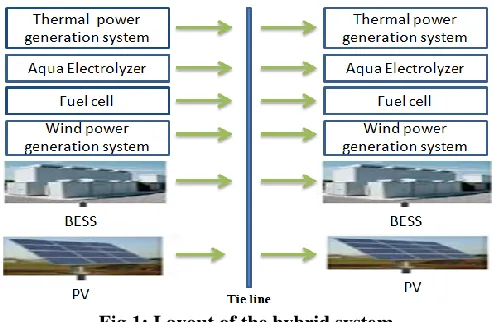
Fig 1: Layout of the hybrid system
Wind power turbine
Wind speed is responsible for the wind turbine power. It varies with time. The wind turbine mechanical power
output is varies with cube of the wind speed. The wind turbine power is given by
(1)
Where is the air density (kg/ ); the swept area of blade ( ); Power coefficient and is the wind speed.
Wind turbine system has various nonlinearities. The output power varies when the wind turbine is canceled out the frequency fluctuations by using the pitch controller. Restrictions of deviation in the output power decide the set point of pitch angle. The non linearity introduces in the system by the pitch system which adjust the pitch angle in accordance with the wind speed. The wind turbine transfer function is given by:
(2)Aqua Electrolyzer
For the hydrogen production some part of the wind turbine generator is used by the aqua electrolyzer which is fed to the fuel cell for power generation. The aqua electrolyzer transfer function is expressed as:
(3)
Fuel cell
124 | P a g e
(4)
Battery energy storage system
The BESS is providing extra power damping to the power system swings for improving the both dynamic and transient stability. The wind turbine power is continuously varying and small time power variations cause large problems in the operation of power system. There is solution for use of energy storage systems.
The BESS has good technical characteristics thus it can store huge amount of wind power. The BESS transfer function is expressed as:
(5)
Photovoltaic power generation system
The electric circuit of the PV consists of parallel resistor, diode, photocurrent and a series resistor as shown in figure 2. The PV array behavior is based on the PV module model with × modules is given by equation shown below:
(6) Where
Diode saturation current (A) = series resistance (
Array output current (A) n = diode ideal constant
PV module short circuit current (A) = PV module thermal potential (V) = PV array terminal voltage (V)
PV array has unique operating point and has linear voltage-current characteristics under the specific temperature conditions.
125 | P a g e
The PV transfer function is expressed as:(7)
III. AUTOMATIC CONTROLLER
The control signal is generated by the load frequency controller which maintains the frequency and tie line power. The control signal is
= -
=-
+
∆
)dt
.(8)
By taking derivative of the equation:
= -
= -
+
∆
(9)
The main advantage of using PI controller is that it minimizes the steady state error to zero. PI controller with preset gains has been considered at nominal working conditions, but over a large range of working conditions it fails to give the finest control performance. Fuzzy logic techniques has been projected for solving this problem in [10]-[13]
.
126 | P a g e
Fig 4: Block diagram of hybrid power system.
IV. FUZZY LOGIC CONTROLLER
In recent times, the fuzzy logic based control has widely received attentions in a range of power systems applications [14]. FLCs are knowledge-based controllers generally derived from a self-organizing control architecture or knowledge acquisition process. Fuzzy systems consist of membership functions describing the fuzzy sets and fuzzy IF-THEN rules. The Fuzzy Logic Controller comparison is considered on Mamdani inference model. The LFC problem is composed of the unexpected small load variation or a variation in input wind power which always perturb the operation of a power system. For this reason, the frequency deviation must be controlled.
4.1
Fuzzification
127 | P a g e
4.2
Knowledge Base
The main part of the fuzzy is a knowledge base carrying of fuzzy IF-THEN rules. The rule base has a set of fuzzy rules. The data base consists of membership function of fuzzy subsets. A fuzzy rule may have fuzzy variables and fuzzy subsets described by membership function.
Fig 5: Block diagram of fuzzy logic controller
4.3 De-Fuzzification
128 | P a g e
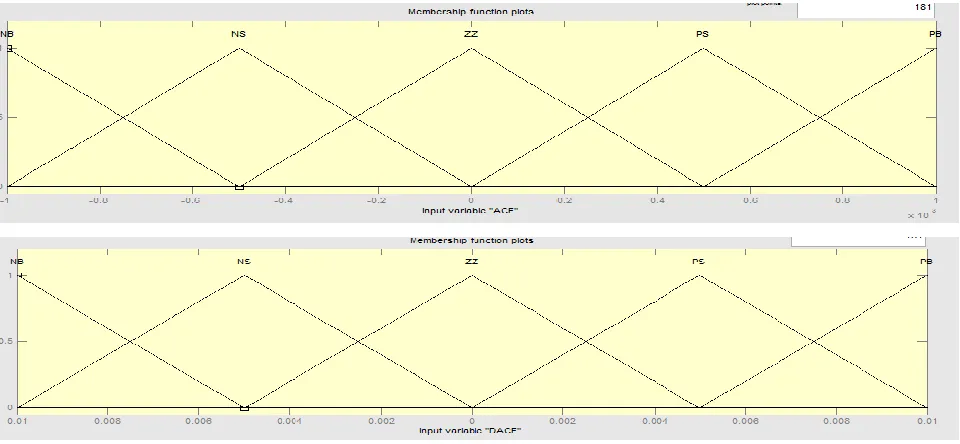
Fig 6: Membership functions of input and output variables
ACE/DACE
NB
NS
ZZ
PS
PB
NB
PB
PB
PB
PS
ZZ
NS
PB
PB
PS
ZZ
NS
ZZ
PB
PS
ZZ
NS
NB
PS
PS
ZZ
NS
NB
NB
PB
ZZ
NS
NB
NB
NB
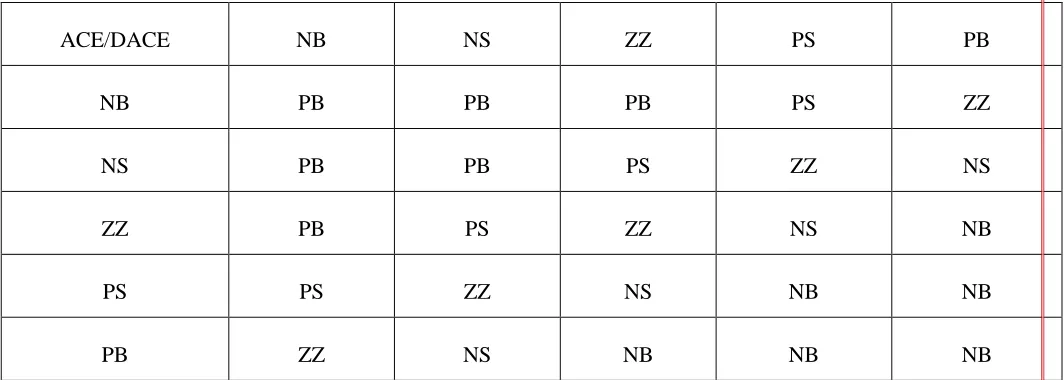
TABLE 1: Rule base for fuzzy logic controller (with five membership functions)
V. ADAPTIVE NEURO-FUZZY INFERENCE SYSTEM
ANFIS is a multi-layer versatile neural system based fuzzy inference system [15]. ANFIS algorithm is made up of fuzzy logic and neural systems with 5 layers to execute distinctive node functions to learn and tune parameters in a fuzzy interference system (FIS) structure utilizing hybrid learning mode. For the forward pass of learning, with constant premise parameters, estimation of least squared error approach is utilized to renew subsequent parameters and to pass the error to the backward pass. The resulting parameters are settled and the gradient descent strategy is used to update the subsequent parameters in the backward pass of learning. Subsequent and premise parameters will be recognized for membership function (MF) and FIS by repeating the forward and backward passes. Adaptive Neuro-Fuzzy Inference Systems are fuzzy Sugeno models put in the structure of adaptive frameworks to encourage learning and adjustment [15]. Such structure makes FLC more logical and less depending on expert information. Let us consider two-fuzzy rules to represent the ANFIS architecture based on a first order Sugeno model:
Rule 1: if (x is A1) and (y is B1) then (f1 = p1x + q1y + r1) Rule 2: if (x is A2) and (y is B2) then (f2 = p2x + q2y + r2)
where x and y are the inputs, Ai and Bi are the fuzzy sets, are the outputs within the fuzzy region given by the fuzzy rule pi, qi and ri are the design parameters which are obtained during the training process.
In five layers, the first and the fourth layers have adaptive nodes on the other hand, the second, third and fifth layers have fixed nodes. The adaptive nodes are linked with their respective parameters and get updated with next iteration but the fixed nodes are without any parameters. The two rules of ANFIS architecture is shown in Fig.
129 | P a g e
O i1 = μAi (x) , For i=1,2
(10)
O i1 = μBi-2 (y) , For i=3,4
(11)
x and y is the inputs to node I , A is a linguistic label (small, big, negative big) and μAi (x), μBi-2 (y) can be any fuzzy membership function.
Fig: 7 ANFIS architecture
Layer 2: Rule layer: A fixed node labeled M whose output is the product of all the incoming signals, the outputs of this layer can be represented as:
O i2 = wi = μAi (x) μBi (y) i=1,2
(10)
Layer 3: Normalization layer : A circle node labeled N is also a fixed node.
O i3 = _wi = wi / (w1 + w2) i=1,2
(6)
Layer 4: Defuzzification layer: An adaptive node with a node .The each node output is simply the product of a first order polynomial the normalized firing strength.
O i4 = _wi fi = wi (pix + qiy + ri) i=1,2
(7)
130 | P a g e
O i5 = Σ _wi fi = Σi=1 wi fi / (w1 + w2)
(8)
Fig 8: Block diagram of Neuro fuzzy controller
Steps to design the Neuro-Fuzzy Controller
1. Make the Simulink model with Fuzzy logic controller (Takagi-Sugeno model) and simulate the model for the two inputs with seven membership functions (error in frequency and rate of change in frequency error) and the rule base. 2. Gather the training data during simulation with FLC to propose the Neuro-Fuzzy controller.
3. The two data inputs, that is frequency change and rate of change of frequency error and output signal gives the training data.
4. Utilize "anfisedit" to make the Neuro-Fuzzy FIS file.
5. Load the data gathered in Step.1 and load the Neuro-Fuzzy FIS file. 6. Select the hybrid learning algorithm.
7. Train the gathered data with produced FIS up to a specific no. of Epochs. .
Fig-9: ANFIS structure for the designed Neuro- Fuzzy controller
131 | P a g e
VI. SIMULATION AND RESULTS
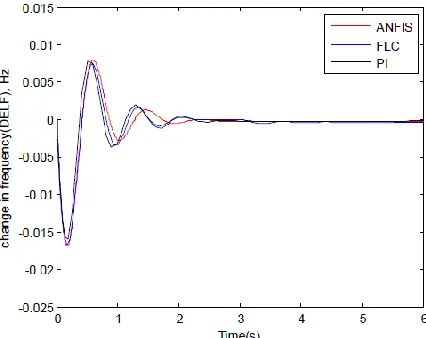
Simulation was performed by utilizing the proposed ANFIS based Neuro-Fuzzy controller , Fuzzy Logic controller ( Mamdani model) and the regular PI controller to the hybrid power system incorporating the renewable energy sources . All the execution criteria for example, settling time, overshoot and zero steady state error are considered to get limited for all the cases. Change in frequency with different load settings or step load variation to get the ideal execution of hybrid power sytem. The same framework parameters given in Table 2 were utilized for the above three controllers for the comparison. simulation is done for 1 % ,2%, 3%,4% and 5% step increment in the load power ( ΔPL=0.01 p.u. ,0.02 p.u.,0.03 p.u.,0.04 p.u. furthermore, 0.05 p.u.) at t = 0s . The overshoot and setting time of proposed ANFIS based Neuro-Fuzzy controller is lower than those of Fuzzy logic controller and regular PI controller.
Fig 10: ∆F in hybrid power system for load change 2%
132 | P a g e
VIII. CONCLUSION
The Neuro-Fuzzy controller is intended for Load frequency control of a hybrid power system to direct the frequency deviation and power deviations, by using Adaptive Neuro-Fuzzy Inference System (ANFIS). Comparison of results of the proposed paper shows that the system reaction of the Load Frequency Control with the use of ANFIS based Fuzzy controller has a very shorter settling time. The outcomes acquired by utilizing ANFIS based Neuro-Fuzzy controller proposed in this paper beat than those of regular PI controller and the fuzzy logic controller by the hybrid learning algorithm. It has been demonstrated that the proposed controller is successful and gives noteworthy change in system execution by combing the advantages of Fuzzy logic and neural systems. The proposed controller keeps the system more stable and reliable for sudden load changes and demonstrates its dominance.
REFERENCES
[1] L. Mengyan et al.,“Studies on the Tie-line Power Control with a Large Scale Wind Power,” International Conference on Electronics, Communications and Control, Ningbo, pp. 2302-2305, September 9- 11, 2011. [2] I. Ngamroo, “Robust SMES Controller Design based on Inverse Additive Perturbation for Stabilization of
Interconnected Power Systems with Wind Farms,” Energy Conversion and Management, Vol. 51, pp. 459-464, 2010.
[3] R. J. Abraham, D. Das and Amit Patra “Automatic Generation Control of an Interconnected Power System with Capacitive Energy Storage,” International Journal of Electrical and Electronics Engineering, Vol. 4, No. 5, pp. 351-357, 2010.
[4] R. Oba et al., “Suppression of Short Term Disturbances from Renewable Resources by Load Frequency Control Considering Different Characteristics of Power Plants,” IEEE Power Engineering Society General Meeting, Calgary, pp. 1-7, July 26-30, 2009.
Change in
load
( p.u.)
Frequency Change
NFC FLC PI
0.01 2.0108 2.0508 2.1824
0.02 1.7844 2.1158 2.1789
0.03 1.7441 3.0695 2.1824
0.04 1.7265 3.0560 2.1816
133 | P a g e
[5] M. Datta, T. Senjyu, A. Yona and T. Funabashi, “Control of MWclass PV Generation to Reduce Frequency andTie-line PowerFluctuations in Three Control Area Power System,” Proceedings of the 8th International Conference on Power Electronics, Korea, pp. 894-901, May/June 30-03, 2011.
[6] M. Rashed, A. Elmitwally and S. Kaddah, “New Control Approach for a PV-diesel Autonomous Power System,” Electrical Power Systems Research, pp. 1-8, 2007.
[7] E. A. Feigenbaum, B. G. Buchanan and J. Lederberg, “On generality and problem solving: A case study using the DENDRAL program,” Machine Intelligence 6, Edinburgh University Press, Edinburgh, pp. 165-190, 1971. [8] J. W. Dixon, J. M. Contardo, and L. A. Moran, ”A Fuzzy controlled active front-end rectifier with current
harmonic filtering characteristics and minimum sensing variable,” IEEE Transaction on Power Electronics, vol. 14, no. 4, pp. 724-729, July 1999.
[9] M. Rukonuzzaman, M. Nakaoka, “Fuzzy logic current controller for three-phase voltage source PWM-inverters”, Industry Application Conference, Vol. 2, pp. 1163 - 1169, 8-12 October 2000.
[10] B. Anand and A. Ebenezer Jeyakumar “Load Frequency Control with Fuzzy Logic Controller Considering Non-Linearities and Boiler Dynamics” ICGST-ACSE Journal, ISSN 1687-4811, Volume 8, Issue III, January 2009 [11] Ertug˘rul Cam, “Application of fuzzy logic for load frequency control of hydroelectrical power plants”, Energy
Conversion and Management 48 (2007) 1281–1288
[12]Ertugrul Cam ,Ilhan Kocaarslan, “Load frequency control in two area power systems using fuzzy logic controller”, Energy Conversion and Management 46 (2005) 233–243
[13]A. Soundarrajan, S. Sumathi, “Effect of Non-linearities in Fuzzy Based Load Frequency Control”, International Journal of Electronic Engineering Research Volume 1 Number 1 (2009) pp. 37–51.
[14] Ross T J , “Fuzzy logic with Engineering Applications”, second edition, John wiley&sons Ltd. (2004)