FPGA-Based Tracklet Approach to Level-1 Track Finding at CMS
for the HL-LHC
EdwardBartz2, JorgeChaves1, YuriGershtein2, EvaHalkiadakis2, MichaelHildreth3, Savvas Kyriacou2, KevinLannon3, AnthonyLefeld4, AndersRyd1, LouiseSkinnari1, Robert Stone2, CharlesStrohman1, ZhengchengTao1, BrianWiner4, PeterWittich1, and MargaretZientek1,a
1Cornell University, Ithaca, NY, USA
2Rutgers University, New Brunswick, NJ, USA 3University of Notre Dame, South Bend, IN, USA 4Ohio State University, Columbus, OH, USA
Abstract.During the High Luminosity LHC, the CMS detector will need charged particle tracking at the hardware trigger level to maintain a manageable trigger rate and achieve its physics goals. The tracklet approach is a track-finding algorithm based on a road-search algorithm that has been implemented on commercially available FPGA technology. The tracklet algorithm has achieved high performance in track-finding and completes tracking
within 3.4μs on a Xilinx Virtex-7 FPGA. An overview of the algorithm and its
imple-mentation on an FPGA is given, results are shown from a demonstrator test stand and system performance studies are presented.
1 Introduction
CERN’s LHC accelerator complex will undergo major upgrades, planned for 2025, to increase the
instantaneous luminosity up to around 7.5×1034cm−2s−1[1]. This era of the High Luminosity LHC
(HL-LHC) will yield an average number of overlapping proton-proton collisions per bunch crossing (pileup or PU) between 140 and 200. The LHC collides proton bunches every 25 ns. If every collision were kept, this would mean roughly 20 to 40 Tbps would need to be stored. However, only a small fraction of these collisions are of interest for further study. The CMS [2] physics program for the HL-LHC requires being able to intelligently select or trigger on collisions that could contain interesting physics scenarios. The trigger system reduces the 40 MHz collision rate to a manageable data storage rate of 400 Hz.
An integral part of reducing the rate is the hardware Level-1 (L1) trigger system. At the HL-LHC, the L1 trigger rates for objects such as single muons, electrons, or jets will exceed the current
front-end capabilities. Increasing the transverse momentum (pT) trigger thresholds for these objects limits
the physics potential of the HL-LHC and no longer sufficiently reduces the data rate. Integrating
charged particle tracking from the silicon tracker into the L1 trigger will improve lepton identification and momentum measurements and provide track isolation and vertex identification. These additional handles have the potential to reduce the L1 rates while maintaining reasonable trigger thresholds. One
Figure 1. The efficiency of a single muon trigger withpT >20 GeV as a function ofpT(left) and the trigger
rate as a function of the muon trigger threshold (right), shown for the stand-alone muon trigger (red) and when
including L1 tracking from the silicon tracker (black) for variousηranges [3].
example of this is shown in Figure 1, where efficiency (left) and rate (right) are plotted for a single
muon trigger. The red curves show the behavior of a stand-alone L1 muon trigger system, while the black curves show the performance of the same triggers when including L1 tracking. In particular, adding L1 tracking improves the momentum measurement which translates to a sharp turn-on curve at the trigger threshold and a reduced trigger rate [3]. The space available to store each event in the
buffer limits the time allowed for the trigger decision. The L1 trigger decision must occur within
12μs. In order to leave time for correlating tracks with other physics objects and the trigger decision,
the track reconstruction must be made in approximately 4μs.
The upgraded (“Phase 2”) CMS detector will include an all silicon tracker that is designed to in-tegrate tracking into the L1 trigger decision. The new tracker consists of a pixel detector, which is not used in L1 tracking, and an outer tracker that has a central barrel and two endcaps. The outer tracker
will have the unique feature of “pTmodules” that providepTdiscrimination at the level of the
front-end readout electronics. In the detector’s magnetic field, a charged particle’s bfront-end (and consequent hit
pattern) depends on itspT. Correlating hits between two closely spaced sensors thus provides a coarse
pTmeasurement. ApTmodule consists of two sensors, either instrumented with pixels or strips, that
are mounted 1–5 mm apart. Two different modules are used: pixel-strip (PS) modules in the inner
layers of the barrel and inner half of the endcaps, and strip-strip (2S) modules in the outer layers of the barrel and outer half of the endcaps. Further details on the layout and module design can be found in Ref. [3]. The pixelated sensor of the PS modules provides a precise measurement of the displacement
along the beam line (z-axis), which enables primary vertex reconstruction at the L1 level. Correlated
hits (“stubs") inpTmodules are required to be consistent with apT>2 GeV track originating from
the interaction point. Since most minimum bias events have lowpT tracks, this provides a factor of
≈10% data reduction already. The stubs are then sent to the L1 track finding system.
To summarize, the goals of the L1 tracking system are to reconstruct the trajectories of charged
particles that havepT>2 GeV and identify thez0of the track (zcoordinate where the track intercepts
thez-axis) with about 1 mm precision, similar to the average separation of vertices in events with
an average PU=140. Additionally, the L1 track finding must be completed within 4μs. There are
ap-proach using a custom ASIC [5]. The next sections will detail the tracklet algorithm, implementation on hardware, performance results, and some projections towards making a full system for completing L1 tracking at CMS at the HL-LHC.
2 Tracklet Algorithm
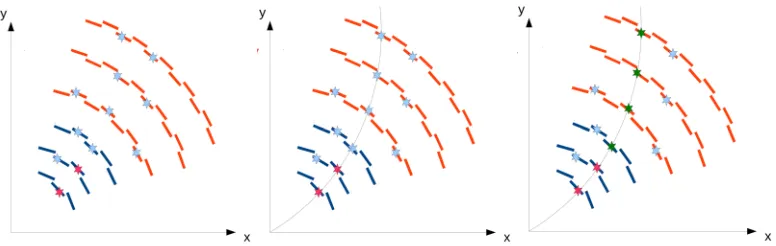
A sketch of the algorithm steps, which are detailed below, is shown in Figure 2. The tracklet approach starts by forming track seeds (tracklets) from pairs of stubs in adjacent barrel layers or endcap disks. The tracklet is an initial estimate of the tracklet parameters calculated from these two stubs using the
interaction point as a constraint. A candidate tracklet must be consistent with apT>2 GeV track that
originates within|z0| <15 cm. The seeding is performed for several combinations to provide good
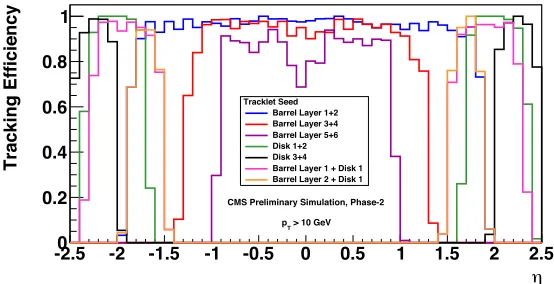
coverage of the entire pseudorapidity (η) range of the detector. The tracking efficiency for different
seeding combinations is shown for single muons in Figure 3, using an integer-based C++emulation of
the algorithm as it would be implemented on an FPGA. In the current implementation of the algorithm,
seeding includes pairs between layers 1+2, 3+4, and 5+6, and between disks 1+2 and 3+4.
The track parameters of the tracklets are then projected to other layers and disks to search for
con-sistent stubs. When the tracklets are projected to other layers/disks, the search for matching stubs
oc-curs in predetermined search windows, derived from residuals between projected tracklets and stubs. The projection of the tracklets occurs both inwards and outwards (i.e. to and from the interaction point). If a stub is found that is consistent with the original tracklet’s parameters, the matched stub
is included in the track candidate and the difference between the projected tracklet position and the
matched stub position is stored.
A linearizedχ2 fit is performed using all stubs in the track candidate - the stubs used to make
the original tracklet plus the matched stubs. The track fit uses pre-calculated derivatives and the
projection-stub differences. The linearizedχ2 fit corrects the initial tracklet parameters giving the
final track parameters: pT,η,z0, the azimuthal angle at the closest approach (φ0), and optionally
the impact parameter of the transverse plane (d0). Because seeding is performed for multiple seeding
combinations, a single track may be found several times. Duplicated tracks are removed by comparing the found tracks in pairs, comparing the number of independent and shared stubs.
η
-2.5 -2 -1.5 -1 -0.5 0 0.5 1 1.5 2 2.5
Tracking Efficiency
0 0.2 0.4 0.6 0.8 1
CMS Preliminary Simulation, Phase-2 > 10 GeV
T
p Tracklet Seed
Barrel Layer 1+2 Barrel Layer 3+4 Barrel Layer 5+6 Disk 1+2 Disk 3+4 Barrel Layer 1 + Disk 1 Barrel Layer 2 + Disk 1
Figure 3. Efficiency for finding a single muon track for several different seeding layer/disk combinations as a
function ofη. Here it is seen that the combination of the different seeding pairs provides coverage of the fullη
range of the detector [6].
3 Hardware System
To address the challenging amount of data and limited processing time available, the tracklet hardware configuration relies on massively parallelizing the data processing. The main parallelization is the
division of the detector into sectors in ther-φplane. The current project uses 28φsectors. This was
chosen so that tracks withpT>2 GeV span a maximum of two sectors. This limits the need for data
transfer between sectors to the nearest neighboring sector on each side. Tracklets that project to a neighboring sector are sent there for tracklet-stub matching. A dedicated processing board is used for
eachφsector. A small amount of data is duplicated every other layer to avoid gaps in the track-finding.
To allow for more time for data processing, the whole 28φ sector system is replicatedn times
using a round robin time multiplexing approach. Each independent time multiplexed system receives
a new event everyn×25 ns. The choice ofn is driven by a balance of cost, efficiency and needed
processing power. For the full system,n = 4−8 are considered reasonable choices. The current
implementation assumes a time multiplexing factor ofn=6, so a new event is received every 150 ns.
3.1 Hardware Implementation
The tracklet algorithm is implemented in the firmware as several processing steps (names in bold) [7]:
• Stub organization: (1) Sort input stubs by layer (Layer Router), and (2) into smaller units inzand
φcalled “virtual modules” (VM Router).
• Tracklet formation: (3) Select possible pairs of stubs (Tracklet Engine), and (4) calculate the
tracklet parameters (Tracklet Calculator).
• Projection organization: (5) Transmit projections that point to neighboring sectors (Projection
Transceiver), and (6) route the projections based on their virtual module (Projection Router).
• Stub matching: (7) Match projections to stubs (Match Engine), and (8) calculate the
tracklet-stub difference in positions (Match Calculator), and (9) transmit matches back to original sector
(Match Transceiver).
The largest combinatoric challenges occur at tracklet formation and match finding. With an aver-age PU=140, there are≈60 stubs per layer perφsector, this would yield≈3600 candidate tracklets per seeding combination [7]. By dividing eachφ sector into smaller virtual modules, the tracklet formation and match finding processes are further parallelized. Furthermore, only a small fraction of virtual module pairs are consistent withpT>2 GeV and|z0|<15 cm tracks. This reduces the number of stub combinations that need to be tried at each of these steps. Consequently, the number of tracklets perφsector is reduced to≈20 per seeding combination.
All of the processing steps above read from memories filled by the previous step and write the output to another set of memories. Currently all processing steps are synchronized to a single common 240 MHz clock. By construction, the system is fully pipelined and operates at a fixed latency. When a new event arrives (currently every 150 ns) the previous event moves to the next processing step. This necessarily implies that a given step can only perform a fixed number of operations. If the time limit is reached, processing on the remainder of the data for that step stops, meaning any remaining data must be truncated. The effect of truncation on the system is minimal, and more details on the performance with truncation are presented later.
3.2 Hardware Demonstrator
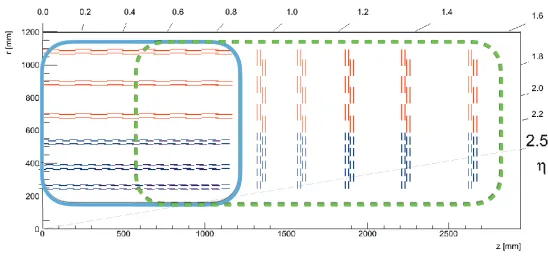
The full tracklet algorithm, including all processing and transmission steps, has been implemented in firmware. Two complete implementations - one for half the barrel (+z) and one for a quarter of the barrel plus the forward endcaps - were used to demonstrate the feasibility of this approach for the fullηrange of the detector. A sketch of the upgraded CMS tracker region covered by the each of the implementations is shown in Figure 4. Note, the layout of the upgraded tracker will actually have tilted modules in the inner barrel layers withη > 0.6. The porting of the tracklet algorithm to the updated geometry is almost complete.
Figure 4. Sketch of the+zportion of the detector in ther–zplane. PS modules are shown in blue while 2S
modules are shown in red. The box in blue shows the detector region covered by the half barrel implementation. A box in green shows the detector region covered by the other project that spans a quarter of the barrel, the transition region between the barrel and endcaps, and the endcaps.
Sector n-1 Sector n Sector n+1 100 Gbps 240 Gbps
100 Gbps
Track Sink 20 Gbps 160
Gbps
160 Gbps Stub Source
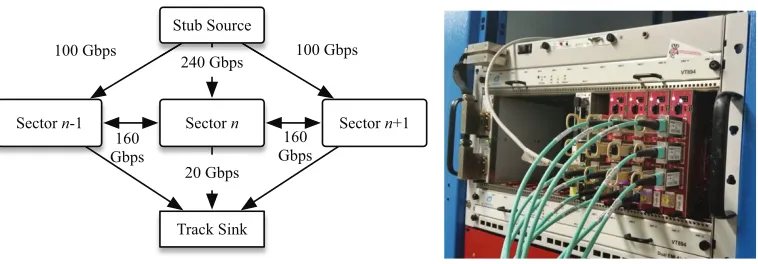
Figure 5.Schematic overview (left) and image (right) of the tracklet demonstrator system. The stub source and
track sink are on the same processing board. Estimated data transfer rates between the boards are also shown.
of its nearest neighbors. One additional processing board has the duplicate function of sending the stubs into theφsector boards and receiving the final track outputs. A schematic of the demonstrator is shown in Figure 5. The centralφsector processor is the actual system under test.
In the final system, each sector processor is foreseen to be an ATCA blade with a Virtex Ultra-scale+FPGA. The current demonstrator system instead is made of fourμTCA blades, called CTP7 boards [8]. Each CTP7 has a Xilinx Virtex-7 (XC7VX690T) FPGA [9] and a Xilinx Zynq-7000 SoC processor for configuration and outside communication. The CTP7 boards were developed for the current CMS L1 trigger [10]. An AMC13 [11] card provides synchronization between the boards with a central clock distribution. The inter-board communication uses 8b/10b encoding with 10 Gbps links. The demonstrator system is shown in Figure 5.
3.3 Demonstrator System Latency
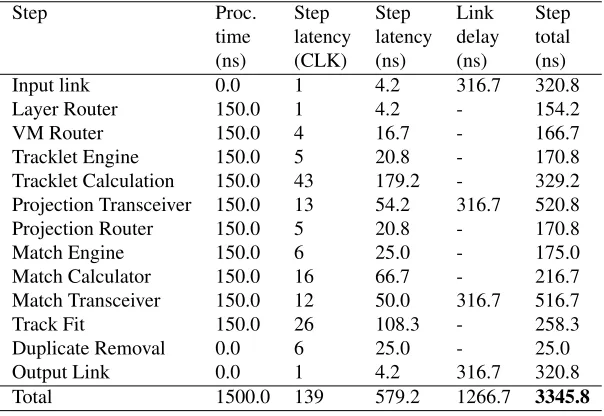
Each processing step outlined in Section 3.1 takes a fixed number of clock cycles to process its input data. Hence it is feasible to calculate a model of the latency for the complete system. Calculations are done assuming a 240 MHz clock and a time multiplexing factor of six, the current configuration of the project. The latency for each processing module to receive data and produce the first result varies between 1-50 clock cycles depending on the module. Each processing step continues to process data for the same event for 150 ns before switching to the next event.
For some of the steps, data has to be transmitted between boards. Tracklet projections and their corresponding matched stubs must be sent to the neighboring sector processors. In these cases, the latency due to inter-board communication and links is included in the latency model. The measured transmission latency is 316.7 ns (76 clock cycles). This latency includes all parts of the transmission: the transceiver TX and RX, channel bonding (the use of multiple serial links to send the data), data propagation through 15 m long optical fibers, and time needed to prepare and pass data from pro-cessing modules to transceivers. The latency also includes the data transmission latency for receiving stubs from and sending final tracks back to the data source/sink processing board.
Table 1.Demonstrator latency model. For each step, the processing time and latency is given. For steps involving data transfer, the link latency is given. The total model latency is 3345.8 ns.
Step Proc. Step Step Link Step
time latency latency delay total
(ns) (CLK) (ns) (ns) (ns)
Input link 0.0 1 4.2 316.7 320.8
Layer Router 150.0 1 4.2 - 154.2
VM Router 150.0 4 16.7 - 166.7
Tracklet Engine 150.0 5 20.8 - 170.8
Tracklet Calculation 150.0 43 179.2 - 329.2
Projection Transceiver 150.0 13 54.2 316.7 520.8
Projection Router 150.0 5 20.8 - 170.8
Match Engine 150.0 6 25.0 - 175.0
Match Calculator 150.0 16 66.7 - 216.7
Match Transceiver 150.0 12 50.0 316.7 516.7
Track Fit 150.0 26 108.3 - 258.3
Duplicate Removal 0.0 6 25.0 - 25.0
Output Link 0.0 1 4.2 316.7 320.8
Total 1500.0 139 579.2 1266.7 3345.8
track out latency is 3333 ns, which agrees within three clock cycles (0.4%) with the modeled latency.
This is already below the goal of 4μs for L1 tracks.
There are notable places where the latency can be improved. First, the layer router has become redundant as the incoming stubs are now foreseen to be sorted by layer. Removing this processing module will reduce the latency by 150 ns. The transmission protocol contributes a large amount to the latency of the system. By sending duplicated stubs from the neighboring sectors to the central sector, the need for inter-board communication in the projection transceiver and match transceiver steps is
removed. This could shave offas much as≈1μs from the total latency. Additional optimization in
transmission protocol and clock speed will provide speedup as well.
4 Tracklet System Performance
The demonstrator showed excellent agreement between the actual firmware results and the
integer-based C++emulation of the system. For single object events, the output tracks from the firmware
have 100% bitwise compatibility with the integer-based emulation. For busier events, for example top
quark pair (tt¯) events with an average PU=200, the emulation and firmware tracks agree to better than
99%. Because of this, the C++emulation can safely be assumed to emulate well the demonstrator
system.
The estimated performance of the tracklet algorithm is studied with the integer-based emulation
of the algorithm. The efficiency of reconstructing the input tracks with all of their correct stubs as a
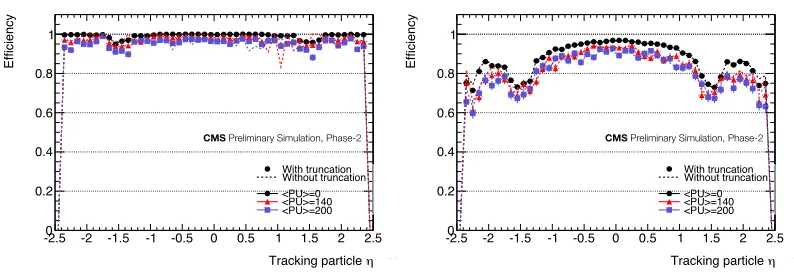
function ofηfor muon and electron events are shown in Figure 6. For all of these objects, efficiencies
are shown for several different average pileup conditions,<PU>=0, 140, and 200. The efficiency
is computed as implemented in the demonstrator, i.e. it includes the effects of truncating data.
Addi-tionally the integer-based emulation provides an estimate of the efficiency without truncation effects.
Efficiency with and without truncation effects are included in these plots. Here it is seen that for all
mini-Margaret Zientek Tracking particle η 1
-2.5 -2 -1.5 -1 -0.5 0 0.5 1 1.5 2 2.5
Efficiency
0 0.2 0.4 0.6 0.8 1
With truncation Without truncation <PU>=0 <PU>=140 <PU>=200
CMS Preliminary Simulation, Phase-2
Margaret Zientek Tracking particle η 1
-2.5 -2 -1.5 -1 -0.5 0 0.5 1 1.5 2 2.5
Efficiency
0 0.2 0.4 0.6 0.8 1
With truncation Without truncation <PU>=0 <PU>=140 <PU>=200
CMS Preliminary Simulation, Phase-2
Figure 6.Efficiency as a function ofηfor muons (left) and electrons (right). Results are shown for three different
average pileup scenarios: 0 (black), 140 (red), and 200 (blue). The efficiency is shown with (filled points) and
without (dashed lines) truncation included.
mal for two main reasons: (i) because of the large parallelization of the system, most of the modules
are sparsely populated, (ii) the different seeding combinations provide additional redundancy that can
recover tracks that may otherwise be lost.
For very busytt¯events there is a more drastic effect from truncation, as shown in Figure 7 (left).
Each of the jets in these events are generally very dense (inφ) and therefore are not well-split between
virtual modules. In the combinatoric heavy stages of the algorithm there is not enough time to process
all of the stubs, causing a drop in the efficiency. This can be fixed by better load-balancing. Changing
the partitioning of virtual modules so that they are thinner inφbut span the entirezof the detector
alleviates these issues. With this new scheme, when there is a dense jet in an event, the stubs are spread over more virtual modules, meaning more stubs can be processed within the given latency and
fewer stubs are lost due to truncation. The improvement in efficiency is shown in Figure 7 (right).
Although this change increases by about 20% the number of virtual modules perφsector, there is no
additional resource usage. The partitioning is thin enough to completely remove one of the lookup tables in the calculation, and reduces the number of memories needed downstream for storing the projections. This improved load-balancing scheme is currently being implemented.
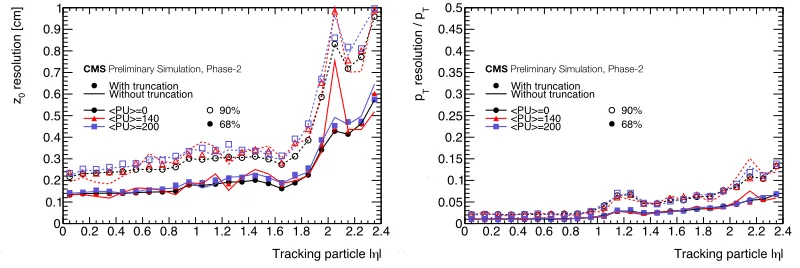
The tracklet algorithm achieves the resolution required of the L1 trigger system, specifically az0
resolution of 1-2 mm forη <1.9 and a relative pT resolution of less than 0.05 for almost the entire
ηrange as shown in Figure 8. The integer-based emulation achieves comparable resolution to that of
a floating-point simulation of the tracklet algorithm [6]. Some improvements can still be made. Too
fewηbins are used in the final track calculation lookup tables in the transition region between barrel
and endcaps (the region withη≈1.2). This can be corrected, and will improve the resolution in that
region. Additionally, the current version of the project uses too few bits for storing the stubzposition.
This can also be corrected and will improve overall the trackz0resolution shown here.
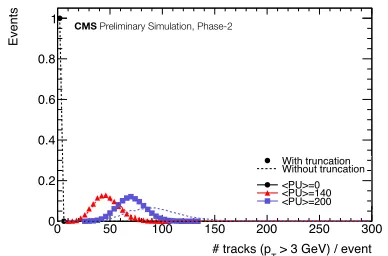
While achieving high efficiency and good resolution, the tracklet approach also achieves a
rela-tively low fake rate (the rate of incorrectly reconstructing a track). The total number of tracks found
for single muon events with different average pileup scenarios is shown in Figure 9. Here it can be
Margaret Zientek Tracking particle η 1
-2.5 -2 -1.5 -1 -0.5 0 0.5 1 1.5 2 2.5
Efficiency 0 0.2 0.4 0.6 0.8 1 With truncation Without truncation <PU>=0 <PU>=140 <PU>=200
CMS Preliminary Simulation, Phase-2
Margaret Zientek Tracking particle η 1
-2.5 -2 -1.5 -1 -0.5 0 0.5 1 1.5 2 2.5
Efficiency 0 0.2 0.4 0.6 0.8 1 With truncation Without truncation <PU>=0 <PU>=140 <PU>=200
CMS Preliminary Simulation, Phase-2
Figure 7. Efficiency as a function ofηfortt¯events with standard configuration (left) and after improved load
balancing (right). Results are shown for three different average pileup scenarios: 0 (black), 140 (red), and 200
(blue). The efficiency is shown with and without truncation included as points and dashed lines, respectively.
The asymmetry between positive-negativeηis introduced in the truncation and is currently under investigation.
Margaret Zientek Tracking particle |η| 1
0 0.2 0.4 0.6 0.8 1 1.2 1.4 1.6 1.8 2 2.2 2.4
resolution [cm]0
z 0 0.1 0.2 0.3 0.4 0.5 0.6 0.7 0.8 0.9 1 With truncation Without truncation <PU>=0 <PU>=140 <PU>=200 90% 68%
CMS Preliminary Simulation, Phase-2
Margaret Zientek Tracking particle |η| 1
0 0.2 0.4 0.6 0.8 1 1.2 1.4 1.6 1.8 2 2.2 2.4
resolution [cm]T
resolution / pT
p 0 0.05 0.1 0.15 0.2 0.25 0.3 0.35 0.4 0.45 0.5 With truncation Without truncation <PU>=0 <PU>=140 <PU>=200 90% 68%
CMS Preliminary Simulation, Phase-2
T
resolution / pT
p
Figure 8.Resolution ofz0(left) and relativepT(right) for the final tracks for muon events. Results are shown
for three different average pileup scenarios: 0 (black), 140 (red), and 200 (blue). The resolution is shown with
and without truncation included as points and dashed lines, respectively.
5 Projections for a Full L1 Tracking System
Extrapolations can be made for a full tracklet track-trigger system to be used at CMS in the HL-LHC.
Currently, almost an entire halfφsector (the+zregion of the detector) can be processed by a single
Virtex-7 FPGA. Based on the resources available in this chip and what is used, it is anticipated that
a fullφsector encompassing the fullzrange of the detector will be able to be processed by a single
future-generation FPGA. Actually the Virtex-7 FPGA has enough lookup table (LUT) resources to
store the precomputed portions of the algorithm for the fullφ sector. Similarly this FPGA has the
digital signal processing (DSP) resources needed to handle the relatively small number of calculations in the full algorithm. However, because the tracklet system relies largely on parallelization of the
processing, each φ sector needs a lot of memory (in FPGAs these are fixed size block RAMs or
Margaret Zientek # tracks (pT > 3 GeV) / event 1
0 50 100 150 200 250 300
Events
0 0.2 0.4 0.6 0.8 1
With truncation Without truncation <PU>=0 <PU>=140 <PU>=200
CMS Preliminary Simulation, Phase-2
Figure 9. Total number of tracks (with pT >3 GeV) found for muons with three different average pileup
scenarios: 0 (black), 140 (red), and 200 (blue). Results are shown with/without truncation included as filled
points/dashed lines.
that of the current Virtex-7 FPGA. However, a fullφsector processing needs fit comfortably within
the resource allotments of the Xilinx Virtex-Ultrascale+class of FPGAs, a few of which are shown
in Table 2. The project resource needs can also be met by a Kintex-Ultrascale (specifically KU115)
FPGA, if 16Gbps (instead of 25Gbps) links are sufficient for sending stubs from the detector to the
L1 tracking system.
Table 2.FPGA resource utilization for a fullφsector based on the usage as reported by Xilinx’s Vivado Design
Suite for the implementation of a halfφsector. The top line shows the needs for a fullφsector. The following
lines show the fraction of the resource needs in Virtex-7 (top line) and Virtex Ultrascale+(others) FPGAs.
LUT Logic LUT Memory BRAM DSP
Full sector 279733 151191 2721.5 1818
Virtex-7 690T 65% 87% 185% 51%
VU3P 32% 81% 85% 80%
VU5P 21% 53% 58% 52%
VU7P 16% 40% 42% 40%
VU9P 11% 27% 28% 27%
VU11P 10% 27% 29% 20%
VU13P 7% 20% 22% 15%
6 Conclusions
For the HL-LHC, CMS will require a new all-silicon tracker with trigger capabilities in order to achieve its physics goals. Tracking at the L1 trigger will provide greatly improved momentum
mea-surements, enabling rate reducing triggers without increasingpTthresholds. The tracklet approach is
one of the proposed methods for performing track finding for the L1 trigger. The method is based on a road-search algorithm that is implemented on commercially available FPGA technology. The tracklet algorithm has been implemented as a floating-point simulation, integer-based emulation, and in an
feasibility, a hardware demonstrator system based on Virtex-7 FPGAs was assembled and validated
the algorithm’s implementation. High performance, in terms of efficiency and resolution, is achieved.
The demonstrator gives a measured latency for L1 track finding of 3.333μs. With little extrapolation,
the system seems scalable to future FPGA technology.
Acknowledgements
I would like to thank the CMS collaboration and contributors to this project at Cornell University, Rutgers University, Ohio State University, and University of Notre Dame. I also wish to thank the Wisconsin University CMS group for their support of the CTP7 platform. This work was supported by the US National Science Foundation through the grant NSF-PHY-1307256.
References
[1] F. Zimmerman, PoSEPS-HEP2009, 140 (2009)
[2] CMS Collaboration, JINST3, S08004 (2008)
[3] CMS Collaboration, Tech. Rep. CERN-LHCC-2015-010. LHCC-P-008. CMS-TDR-15-02,
Geneva (2015),https://cds.cern.ch/record/2020886
[4] G. Hall, Nucl. Instr. Meth. A824, 292 (2016)
[5] G. Fedi, Eur. Phys. J. Conf.127, 7 (2016)
[6] L. Skinnari, EPJ Web Conf.127, 00017 (2016)
[7] J. Chaves, JINST9, C10038 (2014)
[8] A. Svetek et al., JINST11, C02011 (2016)
[9] Xilinx Incorporated,7 Series FPGAs Overview, http://www.xilinx.com/support/documentation/
data_sheets/ds180_7Series_Overview.pdf, last accessed on 2017-04-09
[10] The CMS Collaboration, Tech. Rep. CERN-LHCC-2013-011 (2013)
[11] Boston University, The AMC13 Project, http://bucms.bu.edu/twiki/bin/view/BUCMSPublic/
![Figure 1. The efficiency of a single muon trigger with pT > 20 GeV as a function of pT (left) and the triggerrate as a function of the muon trigger threshold (right), shown for the stand-alone muon trigger (red) and whenincluding L1 tracking from the silicon tracker (black) for various η ranges [3].](https://thumb-us.123doks.com/thumbv2/123dok_us/8134560.1355766/2.482.44.434.83.220/eciency-function-triggerrate-function-trigger-threshold-whenincluding-tracking.webp)