Investigating the difference between tourist age groups with
environment education indicators
1Pin-Fenn Chou*, 2Ying-Chun Wang
1
Department of Business Administration, Far East University, Tainan City, Taiwan, R.O.C.
2
Department of Airline and Transport Service Management, National Kaohsuing University of
Hospitality and Tourism, Kaohsiung City, Taiwan, R.O.C.
Abstract
People lifestyle was change with they
have a rest two days in every week, so
they began more tourism leisure
activities. To face many tourist areas,
how to educating tourists to protect the
environment, it is an important with visit
behavior. After all, there is a good
environment, then the tourism have
good quality.
keyword: environment education
Background
In recent years, the lifestyle was changes
in Taiwan. Due to the implementation of
a two-day vacation on one week, and the
increasingly sophisticated transportation
and communication facilities and related
other factors, that people percept the
importance for tourism and leisure
activities.
Touring, now, the tourists to
emphasize the importance for the natural
and human environment on their deeply
experience. Especially, related the issue
on the environmental protection, that is
an important to recognition in natural
ecology in the present.
Thus, the educational function on
the tourism, that let visitors can to
respect the ecological conservation,
environmental protection, and other
social responsibility on their visiting.
The aim of this study is to
understand whether difference exist
between the different tourists age groups
and percept of environmental education.
Literature Review
Technological advance has led to the
rapid development in society and
economic activities, so that let the
abundance of material life, so that
numbers of people consume and
meanwhile produce a lot of abandoned
items to pollution, diminishing resources,
thereby endangering the environment
continued development. One of the best
ways to solve the world's environmental
crisis is to develop environmental
education for people (Yang, 1998).
Environmental education is a
interaction process of education, the
environment, people, social, that can be
obtained from the knowledge, skills, and
values, to solve the current and future
environmental problems (Palmer, 1988).
Macro perspective, the
environmental education, which expand
to the life, production and ecological to
maintain their sustainable development.
From the ecological point of view, the
deep environmental education, then can
touches the ecological philosophy,
environmental ethics and take a
responsible to protect environmental
behavior (Wang, 2000).
that environment education is a process,
the subject included the course and
actives to teaching the students obtains
both of correct knowledge and build
positive attitude to be concern
environment, and use various skill to
practicing the behavior to protect
environment, and also to solve related
the environment problem.
Empirical Analysis and Result
The questionnaires were received, the
analysis step was followed. Respondents
were dived into three groups which
according to their ages, as shown in
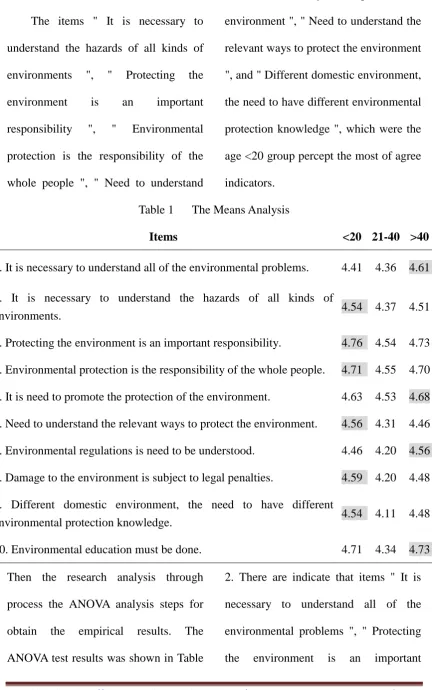
Table 1, there are: <20 years group,
21-40 years group, and >40 years group,
respectively.
Excepting the age 21-40 group was
not statement specially agree items, the
age >40 group percept the most agree
items were: " It is necessary to
understand all of the environmental
problems", " It is need to promote the
protection of the environment ", "
education must be done ".
The items " It is necessary to
understand the hazards of all kinds of
environments ", " Protecting the
environment is an important
responsibility ", " Environmental
protection is the responsibility of the
whole people ", " Need to understand
the relevant ways to protect the
environment ", " Need to understand the
relevant ways to protect the environment
", and " Different domestic environment,
the need to have different environmental
protection knowledge ", which were the
age <20 group percept the most of agree
indicators.
Table 1 The Means Analysis
Items <20 21-40 >40
1. It is necessary to understand all of the environmental problems. 4.41 4.36 4.61
2. It is necessary to understand the hazards of all kinds of
environments. 4.54 4.37 4.51
3. Protecting the environment is an important responsibility. 4.76 4.54 4.73
4. Environmental protection is the responsibility of the whole people. 4.71 4.55 4.70
5. It is need to promote the protection of the environment. 4.63 4.53 4.68
6. Need to understand the relevant ways to protect the environment. 4.56 4.31 4.46
7. Environmental regulations is need to be understood. 4.46 4.20 4.56
8. Damage to the environment is subject to legal penalties. 4.59 4.20 4.48
9. Different domestic environment, the need to have different
environmental protection knowledge. 4.54 4.11 4.48
10. Environmental education must be done. 4.71 4.34 4.73
Then the research analysis through
process the ANOVA analysis steps for
obtain the empirical results. The
ANOVA test results was shown in Table
2. There are indicate that items " It is
necessary to understand all of the
environmental problems ", " Protecting
responsibility ", " Environmental
regulations is need to be understood ",
and " Damage to the environment is
subject to legal penalties " were
presentation significantly difference at
p<0.05 among three different age groups
with their percept the related
environment education indicators.
In addition, the three different age
groups percept the related environment
education indicators" Different domestic
environment, the need to have different
environmental protection knowledge "
and " Environmental education must be
done " two items presentation
significantly difference at p<0.01 level.
Table 2 ANOVA Analysis
Items F test P value
1. It is necessary to understand all of the environmental problems. 2.589* 0.077
2. It is necessary to understand the hazards of all kinds of environments. 1.407 0.246
3. Protecting the environment is an important responsibility. 3.082* 0.047
4. Environmental protection is the responsibility of the whole people. 2.059 0.129
5. It is need to promote the protection of the environment. 1.274 0.281
6. Need to understand the relevant ways to protect the environment. 2.211 0.111
7. Environmental regulations is need to be understood. 6.455* 0.002
8. Damage to the environment is subject to legal penalties. 5.559* 0.004
9. Different domestic environment, the need to have different
environmental protection knowledge. 8.426** 0.000
10. Environmental education must be done. 9.668** 0.000
*, p<0.05; **, p<0.01
Conclusion
This study examine three age groups
whose percept the related environment
difference among indicators. " Different
domestic environment, the need to have
percept the most of agree indicator; "
Environmental education must be done "
was the age >40 group percept the most
of agree indicator.
That results implication that
government need to distinguish the
different ecosystem environment which
to implementation some protect strategy
in the environment education for
teaching the young group. Naturally, the
young they can agree the environmental
education must be done.
Reference
Hsiao, P. S. (2009). A Study on the
Relationship between Environmental
Education Knowledge and
Environmental Attitude. Graduate
Institute of Education, National
Changhua University of Education.
Lai, C. H. (2001). Consumer Behavior.
Taichung. Canghai Book Company.
Palmer, J.A.(1988). Environmental
education in the 21st century: Theory,
Practice, Progress and Promise. London:
Routledge。
Wang, P. J. (2010), The Study of the
Tourists'' Knowledge, Attitude, and
Behavior on Wetland Conservation-a
Case Study on Zengwun Estuary
Wetland's Tourists. Department of
Culture and Natural Resources, Nation
University of Tainan.
Yang, G. C. (1997) Towards Sustainable
Development of Environmental
Education. Journal of Environmental
Science and Technology Education, 12,