247 | P a g e
A Secure Distributed Code Discovery in Wireless Sensor
Networks
Sadineni Neelima
1, A.K.Chakravarthy
21,2 Assistant Professor, Department of Information Technology ,
Aditya Engineering College,Surampalem,Kakinada,(India)
ABSTRACT
A wireless sensor network (WSN) consists of little sensor nodes, that is capable of assembling information from
the surroundings and communicating to the controller via wireless transceivers. Limited battery energy is
employed to control the detector nodes and is extremely troublesome to exchange or recharge it, once the nodes
die. It is often difficult or not possible to exchange the batteries of the detector nodes. On the opposite hand, the
Base station or Sink is often rich in energy. Since the detector energy is that the most precious resource within
the WSN, effective utilization of the energy to improve the network period has been the main focus of abundant
of the analysis on the WSN. This can have an effect on the network performance. In most of existing protocols
authors considered only on the centralized data dissemination methods without more security and energy
consideration. We have a tendency to establish the safety vulnerabilities in previously planned protocols and
that we extend the secured and distributed information delivery system with energy concerns. It’s the first
distributed information discovery and dissemination protocol that permits network owners and approved users
to collect information items from detectors without base station and with network life time management. The
existing did rip [1] protocol is only concentrating on the security point. In this paper, we propose an enhanced
dissemination protocol, which is used to improve the quality of service issues. In the enhanced work, the
proposed solution is to enhance the energy efficiency in distributed wireless sensor.
I. INTRODUCTION
The communications within the Wireless Sensor Network (WSN) has the many-to one property, in this data
items from a large number of Sensor nodes tend to be targeted into one sinks. Since multi-hop routing is usually
required for distant Sensor nodes from the sinks to save huge amount of energy, the devices close to a sink are
often loaded with relaying an over-sized quantity of traffic from different nodes. Sensor nodes resources
affected in term of energy, processor and memory and dynamic behaviour of ad-hoc communication. The
Sensor nodes are commonly expected to work with batteries and they are usually deployed to not
easily-accessible or hostile surroundings, generally in large quantities. Routing is a crucial issue in information
gathering WSN, whereas on the opposite hand sleep/wake maintenance is that the main problems for event
detection networks. Even though, we cannot avoid the failure of nodes, so in our research work, further we
added the enhancement with the failure rectification techniques. Our ultimate aim of this project is to provide
248 | P a g e
dissemination algorithms propose fully centralized method where our method provides data collection scheme in
distributed method.
Fig:1.1 Wireless Sensor Network (WSN)
II. LITERATURE SURVEY
A Literature review is a body of text that aims to review the critical points of current knowledge including
substantive findings as well as theoretical and methodological contributions to a particular topic. A literature
review is a text of a scholarly paper, which includes the current knowledge including substantive findings, as
well as theoretical and methodological contributions to a particular topic. Literature reviews are secondary
sources, and do not report new or original experimental work. Most often associated with academic oriented
literature, such reviews are found in academic journals, while started to do this paper, referred the following
papers of integrity checking models in Wireless Sensor Networks and decided to do this project with the
existing system, and came to a conclusion that what can be done in the proposed system.
In[1] We present Trickle, an algorithm for propagating and maintaining code updates in wireless sensor
networks. Borrowing techniques from the epidemic/gossip, scalable multicast, and wireless broadcast literature,
Trickle uses a “polite gossip” policy, where motes periodically broadcast a code summary to local neighbours
but stay quiet if they have recently heard a summary identical to theirs. When a mote hears an older summary
than its own, it broadcasts an update. Instead of flooding a network with packets, the algorithm controls the send
rate so each mote hears a small trickle of packets, just enough to stay up to date. We show that with this simple
mechanism, Trickle can scale to thousand-fold changes in network density, propagate new code in the order of
seconds, and impose a maintenance cost on the order of a few sends an hour.
249 | P a g e
the nodes but here it is not happening. So to overcome this problem, Denial of service should be restricted, by
allowing base station to give privilege to the users up to some extent so that other users will not be entered to
transfer the information. In Wireless Sensor Networks, Code Dissemination is a process of Propagating new
code images or commands in the network. Since the WSN are mostly deployed in the military and hostile
environments secure code dissemination is needed. Mostly code dissemination protocols are based on two
approaches. First one is the centralized approach in which only the base station has the authority to initiate code
dissemination. Second one is the distributed
manner means allows multiple authorized network users too simultaneously and directly update code images on
different nodes without involving the base station. Motivated by this consideration, we develop a secure and
distributed code dissemination protocol named Di Code [2]. A salient feature of Di Code is its ability to resist
denial-of-service attacks which have severe consequences on network availability. Di Code in a network of
resource limited sensor nodes, which shows the efficiency of our protocol signature verification on the
propagation delay of code dissemination in multi hop networks, performance can be improved by using more
powerful sensor node. To verify the efficiency of the proposed approach in practice, we also implement the
proposed mechanism in a network of resource
constrained sensor nodes.
In[3]Ensuring that every sensor node has the same code version is challenging in dynamic,unreliable multi-hop
sensor networks. When nodes have different code versions, the network may not behave as intended, wasting
time and energy. We propose and evaluate DHV[5], an efficient code consistency maintenance protocol to
ensure that every node in a network will eventually have the same code. DHV is based on the simple
observation that if two code versions are different, their corresponding version numbers often differ in only a
few least significant bits of their binary representation. DHV allows nodes to carefully select and transmit only
necessary bit level information to detect a newer code version in the network.DHV can detect and identify
version differences in O (1) messages and latency compared to the logarithmic scale of current protocols.
Simulations and experiments on a real MicaZ test bed show that DHV reduces the number of messages by 50%,
converges in half the time, and reduces the number of bits transmitted by 40-60% compared to DIP, the
state-of-the-art protocol.
In[4] When a sender sends a packet to a receiver, receiver will keep the packet in a buffer. If a buffer is full then
the packet is discarded and hence causes a problem. To overcome a problem a technique is used called TESLA.
This technique is used by the sender. A packet is sent using a sender MAC value to the packet to the receiver
and receiver keep it in buffer. If the sender encloses the packet then receiver will authenticate it so that no loss is
there. In this way both sender and receiver get communicated. Multicast technology [4] application has been
widely utilized in broadband internet. Source authentication is one of the most needs for many multicast
applications transferring real-time information such as stream video and online news. Because multicast current
services provided to the group members are changed dynamically, data transferring by a group member is not
used by the recipient. In order to verify the identity of the sender who sent the packet and to make sure that the
data have not been tampered, an optimized source authentication scheme has been proposed to transfer the
250 | P a g e
packets authenticates the source with a limited number of electronic signatures. The proposed method can
reduce overhead compared to the method by adding a digital signature for every packet. In addition, by sending
the generated electronic signature to the first packet and the last packet, it prevents the loss of consecutive
packets, as well as a source authentication can be provided in real-time services.
In[5] A data discovery and dissemination protocol for wireless sensor networks (WSNs) is responsible for
updating configuration parameters of, and distributing management commands to, the sensor nodes. All existing
data discovery and dissemination protocols suffer from two drawbacks. First, they are based on the centralized
approach; only the base station can distribute data item. Such an approach is not suitable for emergent multi
owner multi-user WSNs. Second, those protocols were not designed with security in mind and hence adversaries
can easily launch attacks to harm the network. This paper proposes the first secure and distributed data
discovery and dissemination protocol named (Didrip).
We have identified the security vulnerabilities in the data discovery and dissemination when used in WSNs,
which have not been addressed in previous research. Also some data A Distributed and Secure Frame Exertion
For Data Detection in Wireless Sensor Network 11 discovery and dissemination protocols have been proposed,
but none of these approaches support distributed operation. Therefore in this paper, a secure and distributed data
discovery and dissemination protocol named Didrip has been proposed. Besides analyzing the security of
Didrip, this paper has also reported the evaluation results of Didrip in an experimental network of
resource-limited sensor nodes, which shows that Didrip is feasible in practice. We have also given a formal proof of the
authenticity and integrity of the disseminated data items in Didrip. Also, due to the open nature of wireless
channels, Messages can easily intercept.Thus, in the future work, we will consider how to ensure data
confidentiality in the design of secure and distributed data discovery and dissemination protocols.
III. SYSTEM ARCHITECTURE
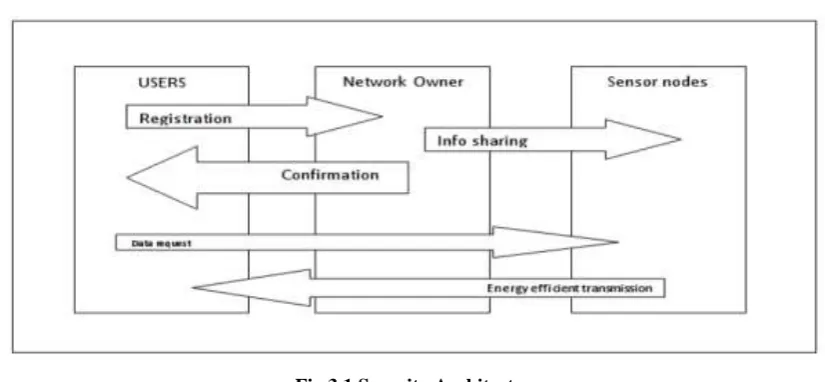
Fig 3.1 Security Architecture
User sends registration request to any interested networks include users address then user has to wait the
conformation message from the network owner. After successful registration user can perform Data request
251 | P a g e
Connected nodes.A WSN node contains several technical components. These include the radio, battery,
microcontroller, analog circuit, and sensor interface. When using WSN radio technology, you must make
important trade-offs. In battery-powered systems, higher radio data rates and more frequent radio use consume
more power. Often three years of battery life is a requirement, so many of the WSN systems today are based on
ZigBee due to its low-power consumption. The battery life and power management technology are constantly
evolving and the availability of IEEE 802.11 bandwidth, Wi-Fi is an interesting technology. The second
technology consideration for WSN systems is the battery. In addition to long life requirements, you must
consider the size and weight of batteries as well as international standards for shipping batteries and battery
availability. The low cost and wide availability of carbon zinc and alkaline batteries make them a common
choice. To extend battery life, a WSN node periodically wakes up and transmits data by powering on the radio
and then powering it back off to conserve energy. WSN radio technology must efficiently transmit a signal and
allow the system to go back to sleep with minimal power use.This means the processor involved must also be
able to wake power up, and return to sleep A Secure Distributed Code Discovery in Wireless Sensor Network
node efficiently. Microprocessor trends for WSNs include reducing power consumption while maintaining or
increasing processor speed. Much like your radio choice, the power consumption and processing speed trade-off
is a key concern when selecting a processor for WSNs. This makes the x86 architecture a difficult option for
battery-powered devices
252 | P a g e
Fig 3.2 . Algorithm
IV. RESULTS
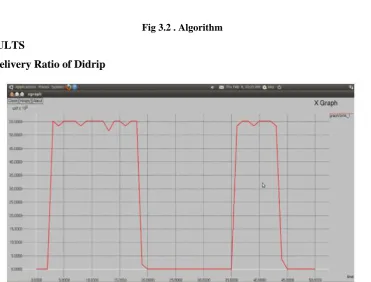
Packet Delivery Ratio of Didrip
Fig 4.1: Packet Delivery Ratio of Didrip
Here
X axis: time
Y axis: packet delivery ratio
Here DiDrip having very low delay in delivering packets when compared to existence one.
Packet Delivery Ratio of Edidrip
253 | P a g e
Here
X axis: Time
Y axis: packet delivery ratio
Here EdiDrip is having low delay in delivering packets when compared to DiDrip
.
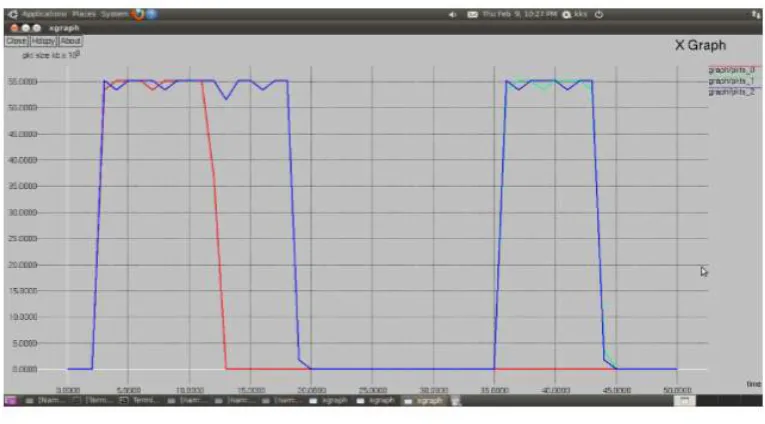
Comparison Between Both DiDrip and
EDiDripFig 4.3 Comparision Between Both DiDrip and EDiDrip
Here this graph shows that the comparison of all packets in which Enhanced DiDrip is having less delay.
V. CONCLUSION
In most of existing protocols author considered only on the centralized data dissemination methods without
more security and energy consideration. We have proposed the solution to establish the security protocol and
that we extended the secured and distributed information delivery system with energy concerns. It’s the first
distributed information discovery and dissemination protocol that permits network owners and approved users to
disperse information items into WSNs without hoping on the base station and with network life time
management. From the tested results, the research work providing good energy efficient security architecture to
wireless sensor network. In future, this can use autonomous sensor robotic network to improve the disaster
management system.
REFERENCES
[1] “Area Flexible (2)Elliptic curve cryptograpy coprocessor”, Adnan Abdul”aziz Gutub, CSE dept, King Fahd
University of Petroleum and Minerals, SA.
[2] D. He, C. Chen, S. Chan, and J. Bu, “DiCode: DoS-resistant and distributed code dissemination in wireless sensor networks,” IEEE Trans. Wireless Communication., vol. 11, no. 5, pp. 1946–1956, May 2012. [3] T.Dang, N. Bulusu, W. Feng, and S. Park, “DHV: Acode consistency maintenance protocol for multi-hop
254 | P a g e
[4] M. Zhao, M. Ma, and Y. Yang, “The Efficient data gathering with mobile collectors and space-division multiple access technique in wireless sensor networks,” IEEE Trans. Computer., vol. 60, no. 3, pp. 400– 417, Mar. 2011
[5] K. Lin and P. Levis, “Data discovery and dissemination with DIP,” in Proc. ACM/IEEE Int. Conf. Inf. Process. Sensor Netw. 2008, pp. 433–444.
[6] T.Dang, N. Bulusu, W. Feng, and S. Park, “DHV: Acode consistency maintenance protocol for multi-hop wireless sensor networks,” in Proc. 6th Eur. Conf.Wireless Sensor Netw., 2009, pp. 327–342.
[7] D. He, S. Chan, S. Tang, and M. Guizani, “Secure data discovery and dissemination based on hash tree for wireless sensor networks,” IEEE Trans. Wireless Communication, vol. 12, no. 9, pp. 4638– 4646, Sep. 2013.
[8] M. Rahman, N. Nasser, and T. Taleb, “Pairing-based secure timing synchronization for heterogeneous sensor networks,” in Proc. IEEE Global Telecommunication Conf., 2008, pp. 1–5.
[9] “designing energy routing protocol with power consumption optimization in manet”, shivashankar1, hosahalli narayanagowda suresh2, golla varaprasad3, and guruswamy jayanthi4, ieee transactions on emerging topics in computing, 2013.
[10] N. Ahmed, S.S. Kanhere, and S. Jha, “The Holes Problem in Wireless Sensor Networks: A Survey,” SIGMOBILE Mobile Computing Comm. Rev., vol. 9, no. 2, pp. 4-18, 2005.
[12] B. Wang, Coverage Control in Sensor Networks. Springer, 2010.