752 |
P a g e
Promoting ZED with RCF - A road map for Excellence
1
Dr. Sanjeevani Gogawale, SMART Incubation Centre Pune
2Sacchidanand S. Gogawale, VIT,Pune,
3Mrs. Manasi Ghamande, VIT Pune
ABSTRACT
RCF- Rashtriya Chemicals and Fertilizers Ltd., a dedicated set up with R & D and Production unit, with more
than 7500 employees and 5000 vendors, working for yield improvements for Farmers. ZED is a drive called
Zero effect and Zero-Defect 100 percent Indian Drive for make in India excellence road map. The author got an
opportunity to study and participate the drive of ZED awareness in Pune and Mumbai and based on
Interactions with their HR team , Purchase and vendors we could conclude the vendors are willing to have
self-motivation to go for such drive as the road map is more important and awareness spreading is a real value add
for them to be better. A pilot batch of 27 vendors were selected, from Pune, Sangali, Kupwad, Mumbai and
based on their interactions above relation was established for excellence mapping initiative . Before awareness,
the participants were reluctant to think one more certification, but after certification the response is let us bag
the best and be world class. This transformation is attributed to variables like organisers, Program structure,
participants and Faulty. The Feedback forms are analysed and conclusion based on three trainers feedback
comparison is derived. Although it is multi variant analysis keeping other variables constant, the analysis is
subjected to correlation between the participants and faculty, in RCF using correlation coefficient. Then
keeping faculty same, two organisers reviewed with new location and new participants is done with the same
method. The third training with different structure and same trainers is done using multivariant analysis. The
over all review show the faculty and participants are most positive association for success and structure and
organisers are having weak relation, so can not be concluded. However, feedback forms from participants with
clear awareness shows their keen interest in implementation hence in excellence Journey.
Key Words: ZED, RCF, SMART incubation, lean, MSME, DIC, QCI
I INTRODUCTION
ZED is being driven by QCI along with CII, FICCI, NPC, various industry Chambers, for MSME organisations.
The assessment system helps the organisation for betterment.
Currently the protocols most preferred by Industry for business and excellence mapping are audit based, the
assessment and rating method is used only for the global award criteria. The cost of assessment and professional
judgement is so high that MSME do not opt for such rating system. First rating system by DNV was ecstaticised
through QIMPRO team for IQRS and IERS but was not successful in India. In Singapore it picked up very well.
QIMPRO after their contract got with RKB award criteria for excellence mapping, still this is out of reach by
most of the MSME.
The initiative for handholding and guiding on the right track is being executed by QCI, where in the DIC is
753 |
P a g e
In spite of attractive refunds from 70 to 90% the MSME were not motivated. The online training modules werehardly being proven effective for registration.
The trained trainers are taking the spreading of awareness. The trainers are selected based on their basic
technical background and their more than 15 years’ experience. This protocol is so carefully designed that it will
have positive impact on MSME economy, yet it was not reaching to required target. So SMART incubation join
hands in the training drive.
II INTRODUCTION TO INNOVATION HUB & SMART INCUBATION CENTRE
–
Free entries with reference were given to anyone who wanted to be part of the innovation and incubation. A
dedicated gap analysis was done to map individual aspiration and current status review. The common topics for
development were identified, and specialised mentors and career development plans are also defined. The career
counselling, training and mentoring are the three methods used for this transformation and the grooming is
through SMART incubation and outcome has resulted in an innovation hub, a name of their choice. The mentors
are used to work with students from KG to PG including working professionals and PhD students, so relating at
any level of students is an added advantage.
III OBJECTIVE
The objective of this study is QCI has taken up the 22222 organisation getting Z certified challenge, to achieve
this they are training the trainers.
The technical training criteria are well established the behavioural rating analysis of trainers is aimed through
this exercise.
1. Scope and limitations: The trainers are selected for ZED protocol only and samples are selected from around
Pune, only in Maharashtra. This being a pilot study a pilot batch is considered.
2. Hypothesis: H1:Learning effectiveness for Technical session is related to application demonstration.
H2: Training effectiveness is based on the trainers’trainees’ relations.
3. Methodology: Data based on the surveys, interviews and finding of the selected pilot team of 5 trainings in
Nasik, Pune, Mumbai with NIC, RCF and QCI is considered. Participants reached are 4500. Each program 50
participants and 15 programs, 5 from each organiser with different faculty.
The trainer service providers are recognised national authorities, the samples selected in this case studies are
defined, including RCF that represent Relation to Farmer, Industry and has all types of vendors from Seed,
mechanical, electrical and all representations of MSME is feasible by selecting RCF trainings.
The NIC is also a leading organisation and the NEE and energy and banking link and already established
trainers network is a strength for selecting them for this research.
The Duration of the study is February 2017 till Date. The initial programs are QCI programs. Trainers are Mr.
Narendra Vishwarup, Dr. Sanjeevani and other SMART incubation members and non-members for comparison,
754 |
P a g e
The training module is frozen based on the structure proven by the pilot team in 2015 and is considered asreference material, controlled by QCI.
After the program the feedback forms are collected also the participants list signed by faculty is uploaded and
same is related to online registration rate of the participants. This clearly shows the simple interest o intention or
wrong rating is not feasible, as unless the participants get registered the program is not considered effective.
The area separation is essential as MSME rules and legal requirements and promotions across the state differ.In
Gujrat the state government give no consent to Electrical equipment, allowing self-control for manufacturers
having paining or surface treatment inhouse. Same is not valid in Maharashtra.
The Faculty training is also based on online test and mock demonstration of training, yet the grading and
feedback are more effective if linked to actual practice.
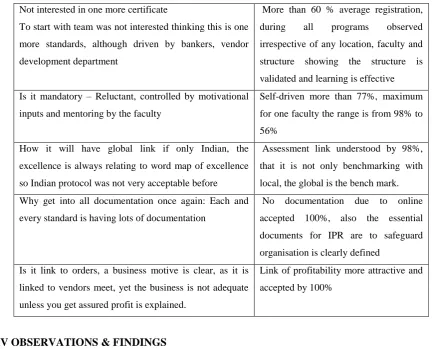
The table below shoes the various reasons why this was not picking up.
The second table give the changed demonstrated and observed from feedback review. The third table gives the
comparison before and after.
Not interested in one more certificate
To start with team was not interested thinking this is one
more standards, although driven by bankers, vendor
development department
More than 60 % average registration,
during all programs observed
irrespective of any location, faculty and
structure showing the structure is
validated and learning is effective
Is it mandatory – Reluctant, controlled by motivational
inputs and mentoring by the faculty
Self-driven more than 77%, maximum
for one faculty the range is from 98% to
56%
How it will have global link if only Indian, the
excellence is always relating to word map of excellence
so Indian protocol was not very acceptable before
Assessment link understood by 98%,
that it is not only benchmarking with
local, the global is the bench mark.
Why get into all documentation once again: Each and
every standard is having lots of documentation
No documentation due to online
accepted 100%, also the essential
documents for IPR are to safeguard
organisation is clearly defined
Is it link to orders, a business motive is clear, as it is
linked to vendors meet, yet the business is not adequate
unless you get assured profit is explained.
Link of profitability more attractive and
accepted by 100%
IV OBSERVATIONS & FINDINGS
Pre-mentoring analysis and finding of the team
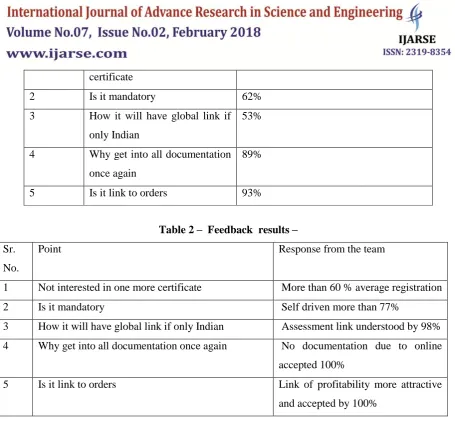
Table 1 – Pre-project situation
Sr. No.
Point
Response from the team
755 |
P a g e
certificate
2
Is it mandatory
62%
3
How it will have global link if
only Indian
53%
4
Why get into all documentation
once again
89%
5
Is it link to orders
93%
Table 2 – Feedback results –
Sr.
No.
Point
Response from the team
1
Not interested in one more certificate
More than 60 % average registration
2
Is it mandatory
Self driven more than 77%
3
How it will have global link if only Indian
Assessment link understood by 98%
4
Why get into all documentation once again
No documentation due to online
accepted 100%
5
Is it link to orders
Link of profitability more attractive
and accepted by 100%
The change in mind set and explanation how the protocol will positively impact the profitability motivated most
of the participants to get registered. Although we have allowed two participants from the same organisation the
more than 60% registration are a positively 100% registration, as one organisation may not go for two
registrations. Such variables are considered while doing the first pilot analysis, but when we realised it is free
and participants surely going for registrations wanted few more members to get aware, we have not considered
the same. We can not consider as this would mean redefining the questioner so we have considered as more than
60% registration as valid effectiveness of the course.
Feedback analysis
The training effectiveness
monitored by registration logs
BEFORE
nil
AFTER
60%
756 |
P a g e
Average
Feedback for Faculty >80%
Result
Strong relation and training is
effective
The faulty and participant relation gets reflected in faculty rating , all faculties are equally qualified and
competent, but the faculty with higher rating shows one is able to relate better, so better rating is given.
Data analysis for the rating for 20 questions feedback form is done for relating the two variable under
consideration to establish the relation of coefficient.
V DATA ANALYSIS AND INTERPRETATION
Data from the rating forms has marks from 1 to 5 and most of them were rated 5 for strong relation. 2 to 1 are
considered as weak relation.
The wrong representation possibility is evaluated based on the pmf 20Cx with x values from 1 to 20 is
negligible as it is linked to registrations done on the portal. Actual application of learning.
The relation 0.0000933, for Organisational variables and 0.0000714 for structure and same faculty
For Faculty is 0.68 with same structure and organisers and different team 0.838 with different organisers, same
structure
The data clearly shows the organisers impact marginally, structure impact very marginally,
While the faculty and participants relation is clearly established strongly with organisers and faculty itself.
VI SUGGESTIONS
The online awareness is not very effective although the same material is used by the trainer, so relating with
participants pays a major role. Some initiatives like vendors meet, QC meets, Safety meets where in such
interactions are feasible should be encouraged, to overcome the initial resistance of one more certification.
VII CONCLUSIONS
A dedicated mentor can initiate a change. A relation is evident in trainer and participants registration, so subject
knowledge and other course delivery, are having stronger relation than organisational resources. So, to make the
ZED drive more effective, RCF will have to select the trainers who can relate with the participants team. ZED if
understood and conceptually accepted will impact the ecosystem of Quality and make this country more Quality
and environment safe through the MSME network.
VIII ACKNOWLEDGEMENT
SMART incubation centre members, RCF, NIC, QCI and their vendors who have contributed openly during
their interactions, and given response to our surveys. We are thankful to them for the inputs, without their