1401 | P a g e
3D Convolutional Neural Network for Object Recognition
Rahul Dev Singh
1, Ajay Mittal
2, Rajesh K. Bhatia
11 PEC University of Technology, Chandigarh-160 012,( India)
2 UIET, Panjab University, Chandigarh-160 036, (India)
ABSTRACT
3D Object recognition is an important task in computer vision applications. After the success of convolutional neural networks for object recognition in 2D images, many researchers have designed convolution neural net-work (CNN) for 3D object recognition. The state of art methods provide favourable results. However, the avail-ability of large/dynamic 3D dataset and computational complexity of CNN are the biggest challenge in 3D CNN. In this paper, a model for object recognition problem using volumetric data representation has been pro-posed. The aim of this paper is to improve CNN architecture for volume based 3D objects. We implemented two separate CNN architectures and tested them on ModelNet datasets, which represent data in the form of CAD models. We compare our results with VoxNet, which is a state-of-art recognition method.
Keywords: 3D Image, Convolutional neural network, Deep learning, Voxel Grid
I. INTRODUCTION
Object Recognition is an important part of modern intelligent machines and systems. It is used in many applica-tions related to multiple fields such as character recognition for mail sorting service [1], traffic monitoring [2], surveillance for security purposes [3], self-driving vehicle [4], human behaviour analysis [5], and medical imag-ing [6]. Object recognition has been performed generally usimag-ing volumetric parts (i.e. generalized cylinders, geons and super-quadrics) [7], appearance based (i.e. edges, lines, corners) [8], pattern recognition (i.e. SIFT, HOG) [9], graph-based [10], and learning based methods [11]. Although the techniques mentioned above are still used in many applications, after the success of the award winning deep learning architecture alexnet [12], Convolutional Neural Networks (CNN) become ubiquitous. In recent years, deep learning has achieved out-standing results in 2D object recognition [13]. These results motivate researchers to apply deep learning me-thods for 3D object recognition, and some of them provide better results in comparison to state-of-art (SoA) ap-proaches.
1402 | P a g e
CNNs, but CNNs can also be applied directly to recognise the voxel of 3D volumetric representation of objects. In this paper, we present object recognition on 3D CAD based model.
The rest of paper is outlined as follows: Section II explains related work of voxel-based 3D object recognition. Dataset, method, and experiment results are presented respectively in Section III, IV, V. Finally, conclusions and future work are discussed in Section VI.
II. RELATED WORK
3D Shape Descriptors: Modern 3D object recognition models have its origin in the 1960s. The
earli-est recognition frameworks were created on geometry-based models [7]. However, most of the
recog-nition works rely on other handcrafted feature descriptors, such as Point Feature Histograms, 3D
Shape Context, or Spin Images. CNN for 3D recognition has first used for RGB-D images, where
depth is treated as an additional input channel [17]. The depth based approaches are conceptually very
similar to 2D based recognition methods. The depth is just used as the fourth channel in CNN, or 3D
synthetic models are used as input to CNN. However, using depth channel along with colour channels
produce 2.5D, and it does not provide full geometric information of objects. In recent years, the
re-searcher tried better shape descriptors based on multi-view [18], and volumetric information [19].
Convolutional Neural Networks: The CNNs have been designed for 2D data such as images and
au-dio signals. It is widely used in various computer vision tasks and data science. The reason behind the
acceptance of CNN in 2D image based tasks is due to the availability of large benchmark datasets,
and these large datasets help to generate better image descriptor in comparison to handcrafted
fea-tures, which provides better results. The similar approach for feature learning is used in this paper for
3D data instead of 2D data.
Convolutional Neural Networks on 3D data:
In recent years, with the availability of range based
and 3D CAD datasets, researchers have additional information of objects in the image in comparison
to the 2D image. 3D data is represented by motion [20], multi-view [18] and volume based methods in
deep networks. Motion based CNN architectures are used successfully in action recognition task. Wu
(a) (b) (c) (d)
et al. [19] developed first CNN architecture for volume based data, namely 3DShapeNets.
3DShapeNets used a Deep Belief Network to represent geometric 3D shapes as a probability
distribu-tion of binary variables on a 3D voxel grid. They use their method for shape compledistribu-tion from depth
maps, too. The ModelNet dataset was introduced along with their work. However, our work is
in-spired by VoxNet, which is designed by Maturana & Sherer [21]. The VoxNet is composed of a
sim-ple but effective CNN, accepting as input voxel grids similar to Wu et al. 3D ShapeNets and
Voxel-Net provide state-of-art results. The other remarkable works are the panoramic-view proposed by Shi
et al. [22], and the multi-view CNN proposed by Su et al. [18] that use multiple views of the same
ob-ject from different angles in CNN.
III. DATBASE
Several 3D datasets have become available in recent years. However, these datasets are not large as the ImageNet1 dataset that contains 2D images. There are many 3D datasets with reasonable size. Mostly 3D datasets are point-cloud based that obtained from range-scanners, such as the ModelNet2, Sydney Urban Objects3, SUN-3D4. The ModelNet dataset is used for training and testing of proposed CNN models. ModelNet dataset contains 127,915 CAD 3D images from 662 different object classes. ModelNet40, a subset of ModelNet, is a benchmark for 3D object recognition and used which further splits in 9,843 training and 2,468 test images. We also test our network on ModelNet10 in our experiments. ModelNet10 has ten object categories, and it is a subset of ModelNet40.
IV. METHOD
Object recognition in 3D CNN is done, by selecting most similar features from targeted classes. The object rec-ognition process can be divided into two parts, namely data representation of 3D objects and training of CNN on represented data. We used 3D volumetric data representation in proposed architecture. Most researchers used voxel or point cloud methods for volumetric data representation. We used voxel based data representation in our CNNs. The voxels are generated with the help of binary occupancy grid. The number of models provided by da-taset are less in comparison to the 2D dada-taset. To exploit network, we provide rotation of 30° along the gravity to the model. All the voxels are generated from provided mesh models in ModelNet dataset after rendering them to 12 different orientations. The proposed network is modified version of Voxnet. We used two different net-works for training purpose.
Network-1:
Network-1 consists three convolutional layers and two fully connected layers. The network is shown in figure-2. Most researchers used voxel size equal or less than 32×32×32. However, we believe that 32×32×32 pixel per object is very less for accurate prediction of an object. In 2D image tasks, experiments show that less than
1 http://www.image-net.org/
2 http://modelnet.cs.princeton.edu/
1404 | P a g e
227×227 reolution is not good for object recognition task in 2D images.
So to exploit the network, we use
three different sizes of voxels 32×32×32, 64×64×64, and 128×128×128 sizes. Many pixels in voxel
represent empty cells that generate a lot of unnecessary matrix multiplication (zero valued matrix)
cost. To reduce this cost, we use the kernel of 5×5×5 instead 3×3×3 that is frequently used in
volume-tric CNNs. The ReLU, and max-pooling (size of 2×2×2) layers are used after convolution (layer)
op-eration. The pooling layer is used to reduce the over-fitting of too many parameters. To avoid data
over fitting, due to orientation and similar views, we use dropout layer before first fully connected
layer with 0.5 probabilities.
Network-2:
Network-2 inspired by the network architecture of AlexNet. It consists five convolutional layers and
three fully connected layers. The network is shown in figure-3. Network-2 is also used multiple views
of the voxel. We train network with 30-degree rotation. This network has all the settings as used in
network-1 except pooling. To train network, we did not use pooling layers in the network-2. In our
view, pooling can create ambiguity in shape of an object. Network-2 helps us to understand that how
the depth of CNN affects the performance of recognition model.
Fig. 2.
The architecture of Network-1.
Conv/ReLU/Max-pool Conv/ReLU Conv/Relu/Max-poolFully Connected
Fully Connected
Conv Conv/ReLU Conv Conv/ReLU Conv/ReLU Fully Connected
Fully Connected Fully Connected
Type Filter
size/Dropout
rate
Stride Output size Number of
parameters
Convolution 5*5*5 1 32*28*28*28 4032
Max Pooling 2*2*2 - 32*14*14*14 -
Convolution 3*3*3 1 32*12*12*12 27,680
ReLU - - 32*12*12*12 -
Convolution 3*3*3 1 32*10*10*10 27,680
ReLU - - 32*10*10*10 -
Max Pooling 2*2*2 - 32*5*5*5 -
Dropout 0.5 - 32*5*5*5 -
Fully Con-nected
- - 128 5,12,128
Fully Con-nected
- - 40 5,160
Table 1: Details of Network-1
Type Filter
size/Dropout
rate
Stride Output size Number of
parameters
Convolution 5*5*5 1 32*28*28*28 4032
Convolution 3*3*3 1 32*26*26*26 27,680
ReLU - - 32*26*26*26 -
Convolution 3*3*3 1 32*24*24*24 27,680
Convolution 3*3*3 1 32*22*24*24 27,680
ReLU - - 32*22*24*24 -
Dropout 0.3 - 32*22*24*24 -
Convolution 3*3*3 1 32*22*22*22 27,680
ReLU - - 32*22*22*22 -
1406 | P a g e
80 82 84 86 88 90 92
32 64 128
A
cc
u
ra
cy
(
%
)
Voxel Size
VoxNet
Network-1
Network-2
Fully Con-nected
- - 256 27,26,144
Fully Con-nected
- - 128 32,896
Fully Con-nected
- - 40 5,160
Table 2: Details of Network-2
V. EXPERIMENTS
The ModelNet dataset is used for training and testing purpose in this network. All the 3D CAD images are con-verted in voxels using provided script by [19]. We test our networks for different size of voxels 32×32×32, 64×64×64, and 128×128×128. We implement both networks separately and compare their results. However, re-sults of both networks have very less difference. We compare rere-sults for the same size of voxels for Model-Net10 and ModelNet40 datasets. Results show that higher resolution voxels improved the accuracy of recogni-tion task. In comparison to VoxNet, our model gives better accuracy. However, VoxNet has less than 1 million parameters in its architecture while our network-2 has more than 2 million parameters. We train network-2 without pooling to test the effect of pooling on volumetric CNN. But results show that there is no significant ef-fect of pooling layer on results. One of the reasons for no efef-fect of pooling layer on performance is that the all the voxels used in training and testing has solid shape. There is not a single object model in the ModelNet
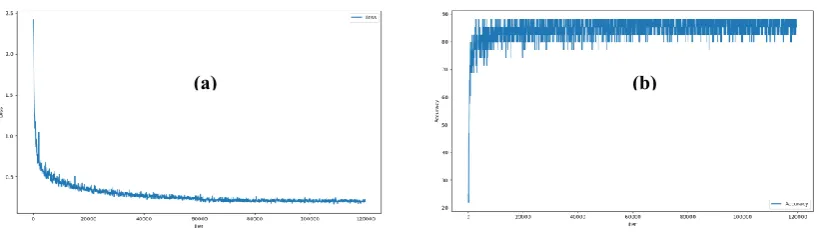
data-set, which has the hollow object. The results are shown in figure 4, and figure 5 shows the loss and accuracy
chart of network-1. All the experiments are done using NVidia Titan X Pascal GPU.
VI. CONCLUSION
The paper describes the recognition task on 3D data using voxel based 3D data representation. The
performance of CNN on different size of voxels has been analyzed. The analysis further motivated to
design new networks and test different sizes of the voxel to find a suitable size for CNN operations. It
can be concluded from the experimental results that size of a voxel has a direct impact on object
rec-ognition task. But on the other hand increasing the size of voxel creates a bottleneck in performance
in volumetric CNN architecture. To overcome this problem an optimized data structure regarding
time, as well as space, should be explored to handle the large size of voxels.
REFERENCES
[1] S. Basu, N. Das, R. Sarkar, M. Kundu, M. Nasipuri, and D. Kumar Basu, “A novel framework for automatic sorting of postal documents with multi-script address blocks,” Pattern Recognition, vol. 43, no. 10, pp. 3507–3521, Oct. 2010.
[2] S. R. E. Datondji, Y. Dupuis, P. Subirats, and P. Vasseur, “A Survey of Vision-Based Traffic Monitoring of Road Intersections,” IEEE Transactions on Intelligent Transportation Systems, vol. 17, no. 10, pp. 2681– 2698, Oct. 2016.
[3] M. J. Gómez, F. García, D. Martín, A. de la Escalera, and J. M. Armingol, “Intelligent surveillance of indoor environments based on computer vision and 3D point cloud fusion,” Expert Systems with Applications, vol. 42, no. 21, pp. 8156–8171, Nov. 2015.
[4] G. H. Lee, F. Faundorfer, and M. Pollefeys, “Motion Estimation for Self-Driving Cars with a Generalized Camera,” in 2013 IEEE Conference on Computer Vision and Pattern Recognition, 2013, pp. 2746–2753. [5] T. Ko, “A survey on behavior analysis in video surveillance for homeland security applications,” Applied
Imagery Pattern Recognition Workshop, 2008. AIPR ’08. 37th IEEE, pp. 1–8, 2008.
[6] A. P. James and B. V Dasarathy, “Medical image fusion: A survey of the state of the art,” Information Fusion, vol. 19, pp. 4–19, Sep. 2014.
[7] A. Andreopoulos and J. K. Tsotsos, “50 Years of object recognition: Directions forward,” Computer Vision and Image Understanding, vol. 117, no. 8, pp. 827–891, 2013.
[8] X. Gao, S. Member, Y. Su, X. Li, S. Member, and D. Tao, “A Review of Active Appearance Models,” vol.
Fig. 5: Plot of Network-1 model: (a) loss, and (b) accuracy on training modelnet40 dataset.
1408 | P a g e
40, no. 2, pp. 145–158, 2010.
[9] N. Dalal and W. Triggs, “Histograms of Oriented Gradients for Human Detection,” 2005 IEEE Computer Society Conference on Computer Vision and Pattern Recognition CVPR05, vol. 1, no. 3, pp. 886–893, 2004.
[10] A. S. Mian, M. Bennamoun, and R. Owens, “Three-dimensional model-based object recognition and segmentation in cluttered scenes,” IEEE Transactions on Pattern Analysis and Machine Intelligence, vol. 28, no. 10, pp. 1584–1601, 2006.
[11] R. Poppe, “Vision-based human motion analysis: An overview,” Computer Vision and Image Understanding, vol. 108, pp. 4–18, 2007.
[12] A. Krizhevsky, I. Sutskever, and G. E. Hinton, “ImageNet Classification with Deep Convolutional Neural Networks,” Advances In Neural Information Processing Systems, pp. 1097--1105, Feb. 2012.
[13] J. W. H. Tangelder and R. C. Veltkamp, “A survey of content based 3D shape retrieval methods,”
Multimedia Tools and Applications, vol. 39, no. 3, pp. 441–471, Sep. 2008.
[14] S. Gupta, P. Arbeláez, R. Girshick, and J. Malik, “Aligning 3D models to RGB-D images of cluttered scenes,” Proceedings of the IEEE Computer Society Conference on Computer Vision and Pattern Recognition, vol. 07–12–June, pp. 4731–4740, 2015.
[15] M. Schwarz, H. Schulz, and S. Behnke, “RGB-D Object Recognition and Pose Estimation based on Pre-trained Convolutional Neural Network Features,” IEEE International Conference on Robotics and Automation (ICRA’15), no. May, pp. 1329–1335, 2015.
[16] A. Aldoma, Z. C. Marton, F. Tombari, W. Wohlkinger, C. Potthast, B. Zeisl, R. Rusu, S. Gedikli, and M. Vincze, “Tutorial: Point cloud library: Three-dimensional object recognition and 6 DOF pose estimation,”
IEEE Robotics and Automation Magazine, vol. 19, no. 3, pp. 80–91, 2012.
[17] S. Gupta, P. Arbeláez, R. Girshick, and J. Malik, “Indoor Scene Understanding with RGB-D Images: Bottom-up Segmentation, Object Detection and Semantic Segmentation,” International Journal of Computer Vision, vol. 112, no. 2, pp. 133–149, Apr. 2015.
[18] H. Su, S. Maji, E. Kalogerakis, and E. Learned-Miller, “Multi-view Convolutional Neural Networks for 3D Shape Recognition,” in 2015 IEEE International Conference on Computer Vision (ICCV), 2015, pp. 945– 953.
[19] Zhirong Wu, S. Song, A. Khosla, Fisher Yu, Linguang Zhang, Xiaoou Tang, and J. Xiao, “3D ShapeNets: A deep representation for volumetric shapes,” in 2015 IEEE Conference on Computer Vision and Pattern Recognition (CVPR), 2015, pp. 1912–1920.
[20] S. Ji, M. Yang, K. Yu, and W. Xu, “3D convacolutional neural networks for human action recognition,”
IEEE transactions on pattern analysis and machine intelligence, vol. 35, no. 1, pp. 221–31, 2013.
[21] D. Maturana and S. Scherer, “VoxNet: A 3D Convolutional Neural Network for Real-Time Object Recognition,” Iros, pp. 922–928, 2015.