a
e-mail: [email protected]
Nuclear size isomers
Alexey Ogloblin1a, Andrey Danilov1, Alla Demyanova1, Sergey Goncharov2, Tatiana Belyaeva3, and Wladislaw Trzaska4
1NRC Kurchatov Institute, Moscow, Russia
2Lomonosov Moscow State University, Moscow, Russia 3Universidad Autonoma del Estado de Mexico, Mexico 4JYFL, Jyvaskyla University, Jyvaskyla, Finland
Abstract. Developing of methods of measuring the radii of nuclei in their highly excited states led to observation of those with dimensions enhanced and, probably, diminished in comparison with the corresponding ground states. Experimental data including very recent ones demonstrating that such “size isomers” belong to two groups: excited states having neutron halos (in 13C, 11Be and 9Be) and some specific cluster states (in 12C, 13C and 11B), are discussed.
1 Introduction
The radius of a nucleus belongs to one of the most fundamental and important its characteristics. Reflecting the properties both of nucleon – nucleon interaction and nuclear matter it plays a global role in nuclear physics. Even a moderate deviation of the radius from the standard values may be connected with a radical change of nuclear structure.
During a long time it was implicitly suggested that the excited states of nuclei have the same sizes as the corresponding ground states. Nevertheless, even in the late fifties there appeared some reasonable ideas that it is not the case [1]. Due to the absence of proper methods of measuring the radii of nuclear short-living excited states the experimental investigations capable shedding some light on this problem could not be performed.
Developing of such methods began a little more than ten years ago. As the result, two classes of nuclear excited states with abnormally large radii were observed: those having neutron halos and specific alpha-cluster structures. We united these states by the name “nuclear size isomers”.
2 Methods of determining the radii of
nuclei in their excited states
Until recently estimation of the radii values of nuclei in short-lived (Т < 10-12 sec) states decaying by emission of
nucleons or clusters was possible only in nuclear reactions by non-direct methods like fitting the form factors obtained, say, in the inelastic electron scattering to the data (e.g., [2,3]). Three direct though model-dependent methods have been proposed during the last decade.
2.1 Modified diffraction model (MDM)
MDM was proposed in Ref. [4]. Its use requires measuring the differential cross-sections of the inelastic and elastic scattering of, say, alpha-particles with the energy of several tens of MeV demonstrating well-developed oscillatory structure at small angles and considered to be the diffraction one. The main assumption of the MDM is that the RMS radius <R*> of the excited state can be determined by an increment to the RMS radius <R0.0> of the ground state. This increment is
equal to the difference of the diffraction radii of the excited and ground states correspondingly:
<R*> = <R0.0> + [R*(dif) – R0.0(dif)] (1)
2.2
Method of inelastic nuclear rainbow
scattering (INRS)
INRS was proposed in Refs. [5] and developed in [6]. The idea is based on the fact that the trajectory of the scattered particle in the nucleus with the larger radius is longer than that in the more compact state. Accordingly, the deflection angle (the Airy angle in the semi-classical approximation) should depend on the nuclear state dimensions. The larger is the radius of the excited state the larger is expected the shift of the Airy angle in the inelastic cross-section relatively that of the elastic scattering.
A simple INRS model [7] was developed on the basis of this idea. The analysis of the experimental data on the elastic alpha-scattering showed that the positions of the 1st Airy minima depends on the targets A-values as
Θ ~ A2/3 Æ ~ R2 (2)
C
Extrapolation of this pattern to the inelastic scattering allowed connecting the shifts of Airy minima with the radii of excited states. Application of the INRS to the inelastic scattering with the excitation of the Hoyle state [6] gave its radius value in excellent agreement with the results of the MDM analysis.
2.3
Method of asymptotic normalization
coefficients (ANC)
ANC was proposed in [8] and developed in [9]. After some updating we also began using of the ANC [10].
The idea of the ANC method consists in the fact that the spectroscopic factor can be substituted by the asymptotic normalization coefficient for some peripheral nuclear reactions like the (d,p) ones. The ANC is directly connected with the radius of the “orbit” of the transferred neutron in the final state. Thus, measuring the differential cross-section of the (d,p)-reaction one can determine some parameters of the state “core plus neutron” including its radius. This feature of the ANC method makes it especially adequate for studying neutron halos.
Contrary to MDM and INRS methods the ANC is well founded theoretically. Our recent studies allowed performing a critical test of all three models. The radius of the state (1/2+, 3.09 MeV of 13C) was obtained by their
application to the existing experimental cross-sections. The results are presented in Table 1 together with theoretical predictions including a simple model “12C
core + neutron wave function tail” (last row). The similarity of the results obtained by completely independent methods confirms their reliability for measuring the radii of the excited states.
Table 1. RMS radii of the 13С state 1/2+, Е* = 3.09 MeV
obtained by different methods.
Method RMS radius, fm
MDM 2.74 ± 0.06
MDM 2.92 ± 0.07
ANC 2.62 ± 0.20
ANC 2.72 ± 0.20
INRS 2.98±0.08
Theory 2.68
R(12C)+ħ(με)-1/2 2.7
3 Neutron halos in the excited states
Discovery of neutron halos [11] provided the first clear indication to the possibility of existence of nuclei with unusually large sizes. The very term “exotic nuclei” firstly appeared in connection with halos.
The point of view that halos are formed exclusively in the nuclei located close to the drip lines and only in their ground states dominated until recently. Besides, the structure of a typical halo was considered to be a core plus a weakly bound valence neutron.
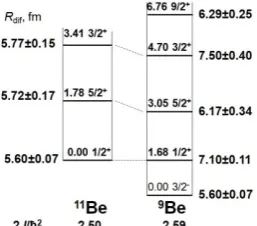
It is of special interest that 11Ве, whose ground state is 1/2+ and considered to be a standard of a one-neutron halo is a head of the rotational band (Fig.1). The MDM-analysis [12] of the single 11Ве + 12C scattering data [13] showed that the diffraction radii of all three members of 11Ве rotational band are quite similar. This means that the halo conserves in spite of the transfer from the discreet spectrum to continuum.
9Be has a positive parity rotational band based on its
first excited state (E* = 1.68 MeV, ½+) locating above the neutron emission threshold (Fig.1). The parameters of the band are very similar to those of the 11Ве one: both bands have the inversed sequence of levels and similar moments of inertia which are enhanced in comparison with the 9Be ground state band. The radii of the member states determined from the 9Be + α scattering [14] shown in Fig.1 are similar and larger than those of the ground state. This comparison indicates to the presence of halos in the excited states of both nuclei.
Figure 1. Energy levels of 11Be and 9Be belonging to the positive parity rotational bands. The moments of inertia are indicated in the bottom line. The diffraction radii of 11Be states from 11Be + 12C scattering and RMS radii of 9Be states obtained from 9Be + α scattering are shown for each band state.
Thus, we really deal with a new type of halos located in continuum, which are formed not by the tail of the wave function like those in discreet spectra. This finding together with the observation of halos in nuclei far from the neutron drip line (even in the stable nuclei) and in their excited states (size isomerism) considerably widen the existing conceptions of nuclear structure. Moreover, one may speak about some elimination of the difference between the normal and exotic nuclei.
4 Dilute cluster states in light nuclei
The famous Hoyle state 0+2 (7.65 МэВ) in 12С became the most important object for testing numerous theoretical models of alpha clustering. The values of the Hoyle state radius predicted by them scatter from the value close to the ground state (Rrms = 2.34 fm) up to the value twice as large [17].
Analysis of the inelastic scattering of 3He and 4He on 12C in a wide energy range both by MDM [4] and INRS
[6] gave the value of the Hoyle state radius 25% larger than that of the ground state. The best agreement with experiment showed AMD (R = 2.90 fm). The condensation model strongly overestimates the radius (R = 4.31 fm).
The Hoyle state occurred to be not a single size isomer in this nucleus. Naturally, one might expect the radius enhancement effect in the members of the rotational band based on the Hoyle state. The evidence of existing of such a band was obtained by observation of 2+, 9.6/9.84MeV [18, 19] and 4+, 13.3/13.75 MeV [17, 20] states whose radii [17, 21] occurred to be comparable with that of the Hoyle state.
The 3-, 9.64 MeV state also has an enhanced radius (Rrms = 2.88 ± 0.11 fm) [4]. There was a suggestion [22] that the state belongs to the negative parity branch of the ground state band. However, its enhanced radius does not fit to the smaller moment of inertia of the ground state band.
Figure 2.Rotational bands in 12C: solid squares – ground state band and open rhombs – the Hoyle state band. For clarity, point for state 4+, 13.75 MeV is moved to the right. Open circles denote the states 9.64 MeV (Iπ = 3¯) and 13.35 MeV (expected Iπ = 4¯).
Observation of exotic structure and an abnormally large radius of the Hoyle state initiated a series of suggestions that a similar situation may take place in the neighboring nuclei 13C and 11B, which differ from 12C by adding a neutron or removing a proton correspondingly. Study of the inelastic scattering on 13C and 11B provided convincing evidence that the 3/2-, 8.86 MeV excited state of 13C and the 1/2-,8.56 MeV one of 11B really can be considered as the analogs of the Hoyle state. In particular, their RMS radii obtained by the MDM analysis occurred to be similar to that of the Hoyle state [23]. Recent inelastic α-scattering experiments at 65 MeV [12, 24] confirmed this conclusion. Thus, an extra nucleon or hole added to the 3α cluster configuration does not destroy the latter and conserves its main original features.
The 11B spectrum occurred to be very rich for rotating states. The description of a very recent inelastic
α-scattering experiment at E(α) = 65 MeV and detailed analysis of the results are given in Ref. [24].
Figure 3. Rotational bands in 11B at the excitation energies E* > 6 MeV. For comparison, the Hoyle state band is shown. Enlarged circles, squares, hexahedrons and rhombs denote the states whose radii exceed those of the ground state by 0.7–1.0 fm.
Four identified rotational bands at the excitation energy higher 6 MeV are presented in Fig. 3. Some questions about the identity of some particular member states remain but general conclusion is that the predicted [25, 26] rotational bands really exist. All of them have quite large moments of inertia lying in the range 2Θ/ћ2 = 2 – 4 what is comparable or even larger than the cor-responding value of the Hoyle state band (2Θ/ћ2 = 2.7). The predicted bands are expected to have different cluster or quasimolecular structure. The diffraction radii obtained by the MDM analysis also are enhanced in comparison with those determined from the elastic scattering and well correlate with the radii calculated from the moments of inertia.
The radii measurements demonstrated the absence of “giant” excited states with the radii ~ 6 fm (the value approaching the radius of Uranium) and predicted by some theoretical models: 2+2 in 12C [27], 1/2+, 12.56 MeV in 11B [28].
5 “Supercompact” size isomer?
The 13C nucleus seems to be a unique one in the sense that a few completely different structures co-exist in its spectrum. Besides the normal shall model level there are two dilute states of different types: one of them contains a neutron halo (3.09 MeV) and the other one is the analog of the Hoyle state.
One cannot exclude that even more exotic structure may exist. The diffraction radius of the 9.90 MeV state obtained by the MDM analysis from the inelastic α-scattering experiment [29] at 65 and 90 MeV occurred to be less than that measured in the elastic scattering (2.0 fm versus 2.3 fm). This conclusion may be also drawn from comparison of the differential cross-sections with L = 2 transfer (Fig. 4).
It is seen that the minima and maxima in the case of the 9.90 MeV state is definitely shifted to the larger angles relatively two other curves. Such a shift is an indication of smaller radius of the 9.90 MeV state.
Figure 4. Differential cross-sections of the 13С + α inelastic scattering for L = 2 transitions at E(α) = 90 MeV. The vertical lines are drawn through the diffraction minima and maxima of the cross-sections leading to the excitation of the states 3.68 and 7.55 MeV. The arrows denote the shifted positions of the extremes of angular distributions relating to the formation of the state 9.90 MeV
6 “Ghost” of α-particle condensation
As we noted in Sec. 4 the model of alpha particle condensation provoked a high interest to the problem of dilute nuclear states. Theory declared two main features of the latter: 1) the abnormally large radii which naturally follow from the gas–like structure of the condensate states, and 2) high probability W(α) of the occupation of the lowest s – orbit by all alpha clusters. The W(α) value may be considered as the condensate fraction.
The measurements using MDM or INRS analysis showed that theory in general overestimates the sizes of the states expected to have the condensate structure (e.g., see Sec.4 for the Hoyle state).
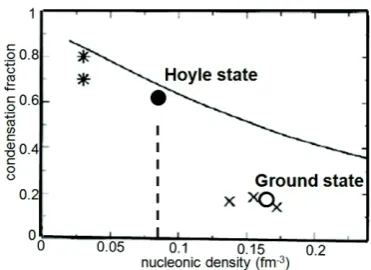
The only experiment, which allowed extracting the condensation fraction from the data was performed by our group [30] by measuring the 8Be–transfer in the 12C+α interaction in the backward hemisphere. The W(α)
values of different 12C states were obtained. For the Hoyle state it occurred to be 62%, which is more than 3 times larger than that in the 12C ground state. Both values are in good agreement with the theoretical prediction (W(α) ≈ 70% [27] for the Hoyle state).
This seeming contradiction between two sets of the data (radii and condensation fraction) is eliminated by the fact that the both quantities are correlated. Their mutual dependence is shown in Fig. 5 (taken from Ref. [31]) together with the experimental values of the radii and W(α) for the Hoyle and ground states of 12C taken from Refs. [4] and [30] correspondingly. As the dependence W(α) on the nucleon density is very weak both the experimental and predicted condensation fractions fit the theoretical curve quite satisfactory at different radii. Note, that the measured R- and W(α)- values were obtained in independent experiments.
This result means that the Hoyle state really bears some features of condensation but in very rudimentary form. The latter could be named a “ghost” of condensate.
Figure 5. Condensation fractions W(α) versus nucleonic density (from [31]). The stars are theoretical predictions for the Hoyle state, crosses for the ground state. The circles denote the experimental W(α) [30] at the radii of the Hoyle [4] and ground states
7 Conclusions
The development of methods of measuring the radii of nuclei in their short-lived excited states led to discovery of new classes of states, which were named “the size isomers”.
Up to now two groups of the size isomers were identified: the excited states with halos (9Be, 11Be, 13C) and some specific alpha cluster states (11B, 12C, 13C). All the observed states are diluted, however, some indica-tions to possible existence of more compact than the ground states was obtained as well (in 13C).
The phenomenon of size isomerism occurred to be not a rare one especially if one takes into account that rotational bands are based on some of such states. The structure of size isomers is related with some new features, e.g., rotating halos, halos in continuum, different types of quasimolecular configurations. Some rudimentary signs of alpha particle condensation (a “ghost“ of condensate) were observed (in the Hoyle state of 12C), however, one cannot speak about confirmation of this ambitious theory.
Acknowledgments
The work was supported in part by grants of Russian Science Foundation 14-12-00079, Russian Foundation for Basic Researches 14-02-00560 and 15-02-01503 and the mobility grant from the Academy of Finland.
References
1. A.I. Baz, Advances in Phys. 8, 359 (1959); JETP 36, 1762 (1959)
2. M. Kamimura, Nucl. Phys. A 351, 456 (1981) 3. M. Chernykh et al., Phys. Rev. Lett. 98, 032501
(2007)
4. A.N. Danilov et al., Phys. Rev. C 80, 054603 (2009) 5. S. Ohkubo and Y. Hirabayashi, Phys. Rev. C 70,
041602(R) (2004)
7. A.A. Ogloblin et al., AIP Conf. Proc. 1224, 100 (2010)
8. L.D. Blokhintsev et al., Sov. J. Part. & Nucl. 8, 485 (1977)
9. Z. H. Liu et al., Phys. Rev. C 64, 034312 (2001) 10. T.L. Belyaeva et al., Phys. Rev. C 90, 064610 (2014) 11. I. Tanihata et al., Phys. Lett. B 160, 380 (1985) 12. A.A. Ogloblin et al., Phys. Rev. C 84, 054601 (2011) 13. N. Fukuda et al., Phys. Rev. C 70, 054600 (2004) 14. A. S. Demyanova et al., EPJ Web of Conf. 66, 02027
(2014)
15. A. Tohsaki et al., Phys. Rev. Lett. 87, 192502 (2001) 16. Y. Kanada-En’yo, Phys. Rev. C 75, 024302 (2007) 17. A. Ogloblin et al., EPJ Web of Conf. 66, 02074
(2014)
18. M. Freer et al., Phys. Rev. C 80, 041303 (2009) 19. M. Itoh et al., Phys. Rev. C 84, 054308 (2011) 20. M. Freer et al., Phys. Rev. C 83, 034314 (2011) 21. A. A. Ogloblin et al., Eur. Phys. J. A 49, 1 (2013) 22. D.J. Martin-Lamberri et al., Phys. Rev. Lett. 113,
012502 (2014)
23. A.S. Demyanova et al., Int. J. Mod. Phys. E 20, 915 (2011)
24. A.N. Danilov, A.S. Demyanova et al., Phys. At. Nucl. 78, 777 (2015)
25. H. Yamaguchi et al., Phys. Rev. C 83, 034306 (2011)
26. T. Suhara and Y. Kanada-En’yo, Phys. Rev. C 85, 054320 (2012)
27. T. Yamada and P. Schuck, Eur. Phys. J. A 26, 185 (2005)
28. T. Yamada and Y. Funaki, Phys. Rev. C 82, 064315 (2010)