Finding Optimum Parallel Coprocessor Design
for Genus 2 Hyperelliptic Curve Cryptosystems
Guido Bertoni and Luca Breveglieri
Politecnico di Milano, Italy
{
bertoni,breveglieri
}
@elet.polimi.it
Thomas Wollinger and Christof Paar
Communication Security Group (COSY)
Ruhr-Universitaet Bochum, Germany
{
wollinger,cpaar
}
@crypto.rub.de
Abstract
Hardware accelerators are often used in cryptographic applications for speeding up the highly arithmetic-intensive public-key primitives, e.g. in high-end smart cards. One of these emerging and very promising public-public-key scheme is based on HyperElliptic Curve Cryptosystems (HECC). In the open literature only a few considerations deal with hardware implemen-tation issues of HECC.
Our contribution appears to be the first one to propose architectures for the latest findings in efficient group arithmetic on HEC. The group operation of HECC allows parallelization at different levels: bit-level parallelization (via different digit-sizes in multipliers) and arithmetic operation-level parallelization (via replicated multipliers). We investigate the trade-offs between both parallelization options and identify speed and time-area optimized configurations. We found that a coprocessor using a single multiplier (D= 8) instead of two or more is best suited. This coprocessor is able to compute group addition and doubling in479and334clock cycles, respectively. Providing more resources it is possible to achieve288and248clock cycles, respectively.
Keywords: hyperelliptic curve, hardware architecture, coprocessor, parallelism, genus2, embedded processor.
1
Introduction
All modern security protocols, such as IPSec, SSL and TLS use symmetric-key as well as public-key cryptographic algo-rithms. In order to be able to provide highly arithmetic-intensive public-key cryptographic primitives, hardware accelerators are often used. An example are high-end smart cards, where a cryptographic coprocessor takes over all the expensive (area and time) computations.
In practical applications the most used public-key algorithms are RSA and Elliptic Curve Cryptosystems (ECC). One emerging and very promising public-key scheme is the HyperElliptic Curve Cryptosystem (HECC). HECC has been analyzed and implemented only recently both in software [10, 11,15,17,20, 21, 23–25, 27, 33] and in more hardware-oriented platforms such as FPGAs [4, 31, 32].
The work at hand presents, for the first time, an architecture for a HECC coprocessor considering the most recent explicit formulae to compute group operations. All of the previous work implementing HECC in hardware used the original Cantor algorithm, which is outdated. Furthermore, we present and evaluate different design options for the HECC coprocessor. In order to do so, we wrote software capable of scheduling the necessary operations, resulting in an optimal architecture with respect to area and speed. Parallelizing at the bit and arithmetic operation level we found that: 1) no more than three multiplier units are useful; 2) architectures implementing one inversion and one multiplication unit are the best choice; 3) and providing sufficient resources group addition and doubling can be performed in288and248clock cycles, respectively. Moreover, we explored the overlapping of two group operations and we analyzed the usage of registers.
2
Previous Work
This section gives a short overview of the hardware implementations targeting HECC and of the previous research work to parallelize hardware ECC.
The first work discussing hardware architectures for the implementation of HECC appeared in [31, 32]. The authors describe efficient architectures to implement the necessary field operations and polynomial arithmetic in hardware. All of the presented architectures are speed and area optimized. In [31], they also estimated that for a hypothetical clock frequency of 20MHz, the scalar multiplication of HECC would take21.4ms using the window NAF method.
In [4] the authors presented the first complete hardware implementation of a hyperelliptic curve coprocessor. This imple-mentation targets a genus-2HEC overF2113. The target platform is a Xilinx II FPGA. Point addition and point doubling with
a clock frequency of45MHz take105µs and90µs, respectively. The scalar multiplication could be computed in10.1ms. Note that publications [4,31,32] adopt the Cantor algorithm to compute group operations. Today, there exist more efficient algorithms to compute group addition and group doubling, the so-called explicit formulae (for more details see Section 3.2). In [16] the authors proposed a parallelization of the explicit group operation of HECC. They developed a general method-ology for obtaining parallel algorithms. The methodmethod-ology guarantees that the obtained parallel version requires a minimum number of rounds. They show that for the inversion free arithmetic [12] using4,8 and12multipliers in parallel, scalar multiplication can be carried out in27,14and10parallel rounds, respectively. When using affine coordinates [11] and8 multipliers it can be performed in11rounds, including an inversion round.
Note that for an effective implementation it is impractical to use so many multipliers in parallel as stated in [16]. The work at hand attempts to consider not only the minimum number of rounds (speed), but also the necessary devices (area) as well as practical applications.
A similar work as that presented here for HECC can be found in [3] for ECC, where a study of the trade-off between the number of operators and different coordinate systems is presented. In [2] two scalar multiplications are scheduled in parallel on the same architecture: the two operations are executed in different coordinate systems to improve the use of the operators. Note that the group operations of elliptic curves are much less complex than those of the hyperelliptic ones. In ECC the silicon area of the possible architecture is easily bounded since the critical path can be computed by hand, while in the case of HECC it is much more complex.
3
Mathematical Background
In this section we introduce briefly the theory of HECC, restricting attention to the material relevant for this work only. The interested reader is referred to [1, 9] for more background on HECC.
3.1
Definition of HECC
LetFbe a finite field and letFbe the algebraic closure ofF. A hyperelliptic curveCof genusg≥1overFis the set of the solutions(x, y)∈F×Fto the following equation:
C:y2+h(x)y=f(x)
The polynomial h(x) ∈ F[x] is of degree at mostg andf(x) ∈ F[x]is a monic polynomial of degree2g+ 1. For odd characteristic it suffices to leth(x) = 0and to havef(x)squarefree. Such a curveCis said to be non-singular if there does not exist any pair(x, y)∈F×Fsatisfying the equation of the curveCand the two partial differential equations2y+h(x) = 0 andh0(x)y−f0(x) = 0.
The so-called divisorDis defined as follows:D=PmiPi, to be a formal weighted sum of pointsPiof the curveC(and the integersmiare the wights), with the additional condition thatDσ=
P
miPiσis equal toDfor all the automorphismsσ ofFoverF(see [1] for details).
3.2
Group Operations
The formulae given for the group operations (addition, doubling) of HEC by Cantor [6] can be rewritten in explicit form, thus resulting in more efficient arithmetic. The explicit formulae were first presented in [7]. Starting with this finding, a considerable effort of different research groups has been put into finding more efficient operations. The group operations of genus-2curves have been studied most intensively ( [7, 11–15, 17, 22, 29]), but also group operations on genus-3curves ( [10, 20, 21, 33]) and even genus-4curves ( [23]) have been considered.
In the work at hand, we target our HECC coprocessor for genus-2curves using underlying fields of characteristic two. We used the up-to-date fastest explicit formulae, as presented in [22], where the authors introduced a group doubling requiring a single field inversion,9field multiplications and6field squarings. Group addition can be computed with1field inversions, 21field multiplications and3field squarings.
3.3
Security of HECC
It is widely accepted that for most cryptographic applications based on EC or HEC, the necessary group is of order at least ≈2160. Thus, for HECC overF
q, we must have at leastg·log2|Fq| ≈ 160. In particular, we will need a field order|Fq| ≈280for genus-2curves. Even the very recent attack found by Th´eriault [30] shows no progress in attacks against genus-2 HEC.
4
Architecture of the HECC coprocessor
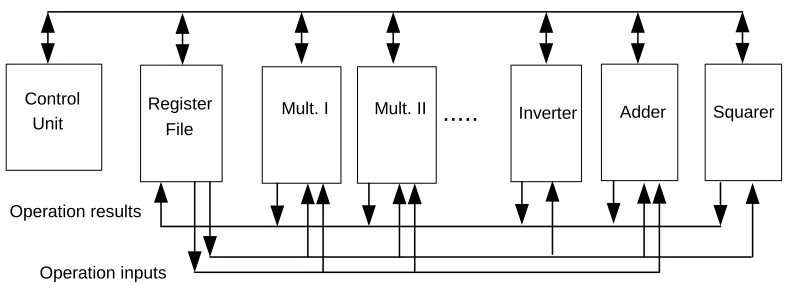
To implement the coprocessor we chose a standard architecture, see Figure 1. It contains a register file to store temporary results and outputs. The size of each register was chosen to be the dimension of the field, namely81bits. The register file has two output ports to feed the operators and one input port to receive the result. This guarantees feasibility and ease of implementation. At any given clock cycle only one field operation can start. If the operation is unary, such as inversion, one bus remains idle.
Operation results
Operation inputs
Control signals
Mult. I Control
Unit
Register File
Squarer Inverter Adder
Mult. II
...
Figure 1. Crypto-processor architecture.
The following list is a summary of how we implemented the field arithmetic:
• Addition: The addition of two elements requires the modulo2addition of the coefficients of the field elements.
• Squaring: The squaring of a field elementA=Pmi=0−1aixiis ruled by the following equation:A2≡Pm−1
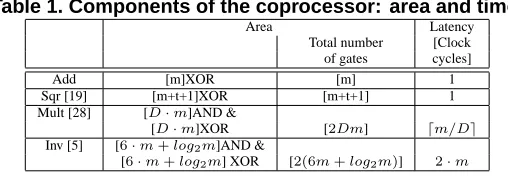
Table 1. Components of the coprocessor: area and time.
Area Latency
Total number [Clock of gates cycles]
Add [m]XOR [m] 1
Sqr [19] [m+t+1]XOR [m+t+1] 1
Mult [28] [D·m]AND &
[D·m]XOR [2Dm] dm/De
Inv [5] [6·m+log2m]AND &
[6·m+log2m] XOR [2(6m+log2m)] 2·m
• Multiplication: We decided to use digit multipliers, introduced in [28] for fields GF(2m). This kind of multiplier allows a trade-off between speed, area and power consumption. It works processing several multiplicand coefficients at the same time. The number of coefficients processed in parallel is the digit-sizeD. GivenD, we denote byd=dm/De the total number of digits in a polynomial of degreem−1. Hence,C≡ABmodF(x) =APdi=0−1BixDimodF(x).
• Inversion: The inversion is computed using the algorithm proposed in [5]. It is based on a modification of Euclid’s algorithm for computing the gcd of two polynomials. The asymptotic complexity is linear with the modulus both in time and area.
In Table 1 we give the area and latency for each arithmetic components we used. The given estimates assume2-input gates and optimum field polynomialsF(x) =xm+Pti=0fixi, wherem−t≥D.
5
Methodology
In this section we describe briefly our approach to find the best suited architecture for the HECC coprocessor.
1. Input: First we evaluated the most recent findings regarding the group operation of HECC. The given formulae were then prepared for the scheduler.
2. Scheduler: Our own software library, especially developed to schedule the HECC group operations, is the heart of our methodology. The scheduler is based on the method known as Operation Scheduling [8] and works accordingly to the As Soon As Possible (ASAP) policy. There is a list of operations that should be executed by the architecture. The scheduler takes one operation at a time and searches for the earliest time slot where the operation can be executed. It is constrained by the number of available resources and by the different times required to execute each operation.
The same methodology is used by compilers for scheduling machine instructions. It should be noted that this method-ology is heuristic and does not grant optimal results. To reach the optimal scheduling it is necessary to use other methods instead, see [8]. The scheduler has the following parameters:
• HECC formulae.
• Implementation method for addition, inversion, multiplication and squaring. • Number of multiplication units.
• Different digit-sizes for the multiplier. • Properties of the bus.
• Memory access time.
3. Testing: The results of the scheduler were tested by applying test vectors. In order to do so we implemented HECC group operations with the NTL library [26].
4. Analysis: The results were analyzed and, if needed, the input architecture was changed, in order to find a better structure for the coprocessor.
will consider both the hardware requirements and the time constraints of the cryptographic application. Hence, we are going to use the area-time product and the optimal implementation will reach the highest throughput consuming the smallest area.
We designed an architecture for the HECC coprocessor using different design criteria. We varied the number of multipliers (one, two, three and four), as well as their digit-sizeD(D = 2,4,8,16). Hence, we changed different architecture options, the processing power of the whole coprocessor and of each individual multiplier. Increasing the processing power yields a speed up of the group operation, but also causes a growth in area. Thus, there must exist an optimum architecture, where the area-time product is minimal.
Our goal is to implement a simple controller computing group operations with a fixed execution order. Hence, we look at a static schedule. The alternative would be to implement a finite state machine executing the schedule directly, controlling the availability of resources and deciding which operation should be executed. This solution is feasible but we consider it as too complex and expensive compared to a simple controller executing the operations in a fixed order.
Recent research in hyperelliptic curve cryptosystems provides a large number of explicit formulae to choose from for computing group operations. We chose the up-to-date fastest ones, as are given in [22].
6
Results
In this section the results of the scheduling methodology are presented. To extract the sequence of finite field operations necessary to compute group operations and to measure the timing, we chose a set of keys and scheduled addition and doubling. If one implements scalar multiplication using the double-and-add algorithm, the following consecutive group operations should be scheduled: addition after doubling, doubling after doubling and doubling after addition (it is impossible to have addition after addition due to the structure of the double-and-add algorithm).
We examined all the cases in order to find out whether we could schedule the second group operation in such a way as to gain speed and achieve a higher hardware utilization. Our results show that addition is always scheduled in the same way. As for doubling, there are two different ways to execute it, depending on the previous operation. When doubling is executed after another doubling, we can gain speed; thus we decided to integrate two options for computing doubling. One option covers the situation where the previous operation is an addition, and the other where it is a doubling. We have to allow negligible extra hardware for the controller to decide which option to choose.
6.1
Time Requirements of the Group Operations
After these considerations we can introduce some results. Table 2 shows the clock cycles necessary for performing a group addition in the different system configurations. Table 3 shows the latency of doubling. In this case, two different latency figures are given for each system. As stated before, the time necessary to perform doubling depends on the operation executed soon before. The leftmost figure in each cell of Table 3 is the number of clock cycles necessary to compute doubling after doubling. The rightmost instead is the time latency of doubling after addition.
One can see that by increasing the digit-size and the number of multipliers, the time necessary to execute a group operation decreases. For group addition our results show that the performance does not increase in some cases, even when augmenting the resources of the system. For example, focusing on the speed of addition, using three rather than four digit-size multipliers withD= 8(Table 2, third row) does not make any performance difference. The same behavior can be observed for2,3and 4multipliers with digit-size16.
Focusing on doubling, there is almost no performance gain in moving from3 to4 multipliers, no matter of what kind (Table 3, rightmost two columns). In addition, there is no performance gain in providing2,3or4multipliers of digit-size8 or16. Taking only performance into account, one concludes from Tables 2 and 3 that the design option using one inverter, two multipliers (D= 16), one adder and one squarer is preferable. The architecture can perform group doubling and addition in289and248clock cycles, respectively. As stated in Section 5, the ASAP scheduling policy does not grant an optimum solution; this is evident in the case of3 or4 multipliers withD = 16. The scheduling of doubling after addition is worse than the case with two multipliers.
6.2
Parallel Computation of Group Operations
Table 2. Clock cycles per group addition.
Digit-size Number of multipliers
1 2 3 4
2 1259 739 664 635
4 739 479 444 435
8 479 349 335 335
16 356 289 288 288
Table 3. Clock cycles per group doubling.
Digit-size Number of multipliers
1 2 3 4
2 724 / 846 486 / 560 458 / 490 458 / 484 4 464 / 526 346 / 380 338 / 350 338 / 344 8 334 / 366 278 / 286 278 / 279 278 / 279 16 274 / 284 248 / 247 248 / 250 248 / 250
coefficient) is computed, it can be used by the next group operation. We measure the overlapping of two group operations as the difference of the time when the last field operation of the former group operation ends execution minus the time when the first of the latter starts.
Table 4 shows the overlapping between for doubling after addition. Overlapping decreases as the speed and the number of multipliers increase. Similar behaviors have been observed in the other cases (doubling after doubling and doubling after addition).
6.3
Register Allocation
Schedulers fall into two broad families: unconstrained or resource limited. We choose to upper bound the number of resources as for busses and arithmetic units, while that of registers is unbounded. Once the operations are scheduled, we count the number of live registers and compute the register allocation. This option is the simplest solution and gives good results. In fact, each register stores a field element of81bits. Simulations demonstrate that changing the other parameters of the system has a low impact on the number of required registers. The system needs 18and20registers in the best and worst case, respectively.
If a designer wants to lower the number of required registers, he can trade the number of registers for additional latency. In order to do so, he should avoid overlapping and start a group operation only when the previous has finished. We noted that a single group operation uses from8to10registers, while the maximum register number is reached when two group operations overlap.
6.4
Evaluation of Different Architecture Options
In this section we report the results and compare the different architectures in terms of latency and area. In order to do so, we listed the use of the different multipliers as a percentage of the total time of one group operation. Thus, the figures shown in Table 5 and 6 are computed as follows: #multgroup·tmul, where#mul is the number of multiplications executed by one multiplier unit during one group operation,tmul is the time needed for one multiplication andtgroupis the total execution time of the group operation.
In an ideal scenario all the multipliers should be used uniformly. However, one can see that the fourth multiplier, and in
Table 4. Overlapping in clock cycles of doubling after addition.
Digit-size Number of multipliers
1 2 3 4
2 333 172 169 140
4 173 92 89 80
8 93 48 48 48
Table 5. Use of the multiplier as a percentage of the total time of group addition.
Digit-size Number of multipliers
1 2 3 4
2 68.3 % - -
-61.0 % 55.4 % - -55.5 % 43.2 % 30.8 % -51.6 % 45.1 % 25.8 % 12.9 %
4 59.6 % - -
-48.2 % 43.8 % - -42.5 % 33.1 % 23.6 % -38.6 % 33.7 % 19.3 % 9.6 %
8 48.2 % - -
-34.6 % 31.5 % - -32.8 % 22.9 % 13.1 % -32.8 % 19.7 % 13.1 % 3.2 %
16 35.3 % - -
-22.8 % 20.7 % - -22.9 % 16.6 % 4.1 % -22.9 % 16.6 % 4.1 % 0 %
Table 6. Use of the multiplier as a percentage of the total time of group doubling.
Digit-size Number of multipliers
1 2 3 4
2 50.9 % - -
-42.1 % 33.7 % - -35.8 % 35.8 % 8.9 % -35.8 % 35.8 % 8.9 % 0 %
4 40.7 % - -
-30.3 % 24.2 % - -24.8 % 24.8 % 6.2 % -24.8 % 24.8 % 6.2 % 0 %
8 29.6 % - -
-19.7 % 15.8 % - -15.8 % 15.8 % 3.9 % -15.8 % 15.8 % 3.9 % 0 %
16 19.7 % - -
-12 % 9.6 % -
-12 % 9.6 % 0 % -12 % 9.6 % 0 % 0 %
some cases also the third multiplier, are used very unfrequently (see Table 6, the column corresponding to the4thmultiplier). Hence, for most applications it will be unreasonable to provide this extra hardware unit.
In Table 8 we show a comparison to find the optimal architecture. The optimal implementation will achieve the highest throughput consuming the smallest area (contrary to some traditional cryptographic implementations, where only best per-formance was evaluated). The analysis uses the normalized area-time product (with respect to the lowest area-time product). Table 8 shows that the architecture using one inversion, one multiplication (D= 8), one addition and one squaring achieves the best area-time product.
To evaluate the latency of a complete scalar multiplicationkD, reported in Table 7, we examined it in an average case, where the integerkof160bits has half of its bits equal to1and the rest equal to0. This means that80and160additions and doublings were performed, respectively. Half of the160doublings are computed after another doubling and half after an addition.
We supposed that the all different configurations of the system work always at the same frequency. This a a worst-case assumption. In fact, usually the multiplier unit dominates frequency, and a smaller digit-size will yield to higher clock frequency and thus speed-up the system.
Table 7. Latency estimation in clock cycles.
Digit-size Number of multipliers
1 2 3 4
2 165987 113948 100345 99836 4 106527 80228 74625 74136 8 76797 63524 61844 61844 16 62969 56216 56139 56139
Table 8. Area-time product.
Digit-size Number of multipliers
1 2 3 4
2 1.3552 1.1148 1.1442 1.3000 4 1.0422 1.0447 1.2133 1.4454 8 1 1.2385 1.6063 2.0067 16 1.2277 1.8241 2.5487 3.2758
7
Conclusions and Further Research
We proposed for the first time an architecture for a HECC coprocessor using the recently developed explicit formulae for the group operations. Different options for the architecture were evaluated. These options differ in the kind (various digit-sizes) and number of multipliers.
We found out that if resources are unbounded, the group addition and doubling operations of HECC execute in288and 248 clock cycles, respectively. However, we noted that using over three multipliers does not help significantly, because additional multiplication units have very low utilization rates. For a realistic scenario the architecture using one inverter, one multiplier (withD= 8), one adder and one squarer achieves the best area-time product. In addition, we tested the possibility to overlap group operations. In the case of doubling after addition, in the best case we could compute in parallel the two operations in333clock cycles. Finally we also analyzed the usage of registers, resulting in the necessity of19registers of81 bit each.
There are some hints on improving these results. For example one might use different policies to schedule group opera-tions. From a more architectural point of view, one might attempt to implement the register file by means of a conventional 32-bit long word memory. On the side of HEC group operations, it is possible to use inversion free formulae, which could reach higher degree of parallelism. While on the implementation aspect, one could synthesize the architecture using an FPGA to examine the impact of the critical path of the operators on the throughput of the system. Hopefully our findings are of interest for the research community as well as for industry.
References
[1] A. J. Menezes and Y. H. Wu, and R. J. Zuccherato. An Elementary Introduction to Hyperelliptic Curves. Personal correspondence, November 1996.
[2] A. Antola, G. Bertoni, L. Breveglieri, and P. Maistri. Parallel Architectures for Elliptic Curve Crypto-Processors over Binary Exten-sion Fields. In IEEE Midwest symposium on circuit and system 03 — MWSCS03, 2003.
[3] M. Bednara, M. Daldrup, J. Shokrollahi, J. Teich, and J. von zur Gathen. Reconfigurable Implementation of Elliptic Curve Crypto Algorithms. In The 9th Reconfigurable Architectures Workshop (RAW-02), 2002.
[4] N. Boston, T. Clancy, Y. Liow, and J. Webster. Genus Two Hyperelliptic Curve Coprocessor. In J. c. K. K. B. S. Kaliski and C. Paar, editors, Cryptographic Hardware and Embedded Systems — CHES 2002, volume LNCS 2523, pages 529–539. Springer-Verlag, 2002.
[5] H. Brunner, A. Curiger, and M. Hofstetter. On Computing Multiplicative Inverses in GF(2m). IEEE Transactions on Computers, 42:1010–1015, August 1993.
[6] D. Cantor. Computing in Jacobian of a Hyperelliptic Curve. In Mathematics of Computation, volume 48(177), pages 95 – 101, January 1987.
[7] P. Gaudry and R. Harley. Counting Points on Hyperelliptic Curves over Finite Fields. In W. Bosma, editor, ANTS IV, volume 1838 of Lecture Notes in Computer Science, pages 297 – 312, Berlin, 2000. Springer Verlag.
[10] J. Kuroki, M. Gonda, K. Matsuo, J. Chao, and S. Tsujii. Fast Genus Three Hyperelliptic CurveCryptosystems. In The 2002
Symposium on Cryptography and Information Security, Japan — SCIS 2002, Jan.29-Feb.1 2002.
[11] T. Lange. Efficient Arithmetic on Genus 2 Hyperelliptic Curves over Finite Fields via Explicit Formulae. Cryptology ePrint Archive, Report 2002/121, 2002. http://eprint.iacr.org/.
[12] T. Lange. Inversion-Free Arithmetic on Genus 2 Hyperelliptic Curves. Cryptology ePrint Archive, Report 2002/147, 2002. http:eprint.iacr.org.
[13] T. Lange. Weighted Coordinates on Genus 2 Hyperelliptic Curves. Cryptology ePrint Archive, Report 2002/153, 2002. http:eprint.iacr.org.
[14] T. Lange. Formulae for Arithmetic on Genus 2 Hyperelliptic Curves, 2003. Available at http://www.ruhr-uni-bochum.de/itsc/tanja/preprints.html.
[15] K. Matsuo, J. Chao, and S. Tsujii. Fast Genus Two Hyperelliptic Curve Cryptosystems. In ISEC2001-31, IEICE, 2001.
[16] P. K. Mishra and P. Sarkar. Parallelizing Explicit Formula for Arithmetic in the Jacobian of Hyperelliptic Curves. In Advances in
Cryptology — Asiacrypt 2003, volume LNCS. Springer-Verlag, 2003.
[17] Y. Miyamoto, H. Doi, K. Matsuo, J. Chao, and S. Tsuji. A Fast Addition Algorithm of Genus Two Hyperelliptic Curve. In The 2002
Symposium on Cryptography and Information Security — SCIS 2002, IEICE Japan, pages 497 – 502, 2002. in Japanese.
[18] D. Mumford. Tata lectures on theta II. In Prog. Math., volume 43. Birkh¨auser, 1984.
[19] G. Orlando and C. Paar. A High-Performance Reconfigurable Elliptic Curve Processor forGF(2m)
. In C¸ . K. Koc¸ and C. Paar, editors, Cryptographic Hardware and Embedded Systems — CHES 2000, volume LNCS 1965. Springer-Verlag, 2000.
[20] J. Pelzl. Hyperelliptic Cryptosystems on Embedded Microprocessor. Master’s thesis, Department of Electrical Engineering and Information Sciences, Ruhr-Universitaet Bochum, Bochum, Germany, Setember 2002.
[21] J. Pelzl, T. Wollinger, J. Guajardo, and C. Paar. Hyperelliptic Curve Cryptosystems: Closing the Performance Gap to Elliptic Curves. In C¸ . K. Koc¸ and C. Paar, editors, Workshop on Cryptographic Hardware and Embedded Systems — CHES 2003. Springer-Verlag, 2003.
[22] J. Pelzl, T. Wollinger, and C. Paar. High performance arithmetic for hyperelliptic curve cryptosystems of genus two. Cryptology ePrint Archive, Report 2003/212, 2003.http://eprint.iacr.org/.
[23] J. Pelzl, T. Wollinger, and C. Paar. Low Cost Security: Explicit Formulae for Genus-4 Hyperelliptic Curves. In Tenth Annual
Workshop on Selected Areas in Cryptography — SAC 2003. Springer-Verlag, 2003.
[24] Y. Sakai and K. Sakurai. On the Practical Performance of Hyperelliptic Curve Cryptosystems in Software Implementation. In IEICE
Transactions on Fundamentals of Electronics, Communications and Computer Sciences, volume E83-A NO.4, pages 692 – 703,
April 2000. IEICE Trans.
[25] Y. Sakai, K. Sakurai, and H. Ishizuka. Secure Hyperelliptic Cryptosystems and their Performance. In Public Key Cryptography, volume 1431 of Lecture Notes in Computer Science, pages 164 – 181, Berlin, 1998. Springer-Verlag.
[26] V. Shoup. NTL: A libary for doing Number Theory (version 5.0c), 2001. http://www.shoup.net/ntl/index.html.
[27] N. Smart. On the performance of hyperelliptic cryptosystems. In J. Stern, editor, Advances in Cryptology – EUROCRYPT ’99, volume LNCS 1592, pages 165–175. Springer-Verlag, 1999.
[28] L. Song and K. K. Parhi. Low-energy digit-serial/parallel finite field multipliers. Journal of VLSI Signal Processing Systems, 2(22):1–17, 1997.
[29] M. Takahashi. Improving Harley Algorithms for Jacobians of Genus 2 Hyperelliptic Curves. In SCIS, IEICE Japan, 2002. in Japanese.
[30] N. Th´eriault. Index calculus attack for hyperelliptic curves of small genus. In Advances in Cryptology - ASIACRYPT ’03, Berlin, 2003. Springer Verlag. LNCS.
[31] T. Wollinger. Computer Architectures for Cryptosystems Based on Hyperelliptic Curves. Master’s thesis, ECE Department, Worces-ter Polytechnic Institute, WorcesWorces-ter, Massachusetts, USA, May 2001.
[32] T. Wollinger and C. Paar. Hardware Architectures proposed for Cryptosystems Based on Hyperelliptic Curves. In Proceedings of the
9th IEEE International Conference on Electronics, Circuits and Systems - ICECS 2002, volume III, pages 1159 – 1163, September
15-18 2002.
[33] T. Wollinger, J. Pelzl, V. Wittelsberger, C. Paar, G. Saldamli, and C¸ . K. Koc¸. Elliptic & hyperelliptic curves on embeddedµp. ACM