Web exclusive
|
Research
This article has been peer reviewed.
Can Fam Physician 2012;58:e709-16
Language barriers
Use of regular medical doctors by Canada’s official language minorities
Emmanuel Ngwakongnwi
MPH PhDBrenda R. Hemmelgarn
MD PhDRichard Musto
MDKathryn M. King-Shier
RN PhDHude Quan
MD PhDAbstract
Objective To assess use of regular medical doctors (RMDs), as well as awareness and use of telephone health lines or telehealth services, by official language minorities (OLMs) in Canada.
Design Analysis of data from the 2006 postcensal survey on the vitality of OLMs.
Setting Canada.
Participants In total, 7691 English speakers in Quebec and 12 376 French speakers outside Quebec, grouped into those who experienced language barriers and those with no language barriers.
Main outcome measures Health services utilization (HSU) by the presence of language barriers; HSU measures included having an RMD, use of an RMD’s services, and awareness of and use of telephone health lines or telehealth services. Multivariable models examined the associations between HSU
and language barriers.
Results After adjusting for age and sex, English speakers residing in Quebec with limited proficiency in French were less likely to have RMDs (adjusted odds ratio [AOR] 0.66, 95% CI 0.50 to 0.87) and to use the services of their RMDs (AOR 0.65, 95% CI 0.50 to 0.86), but were more likely to be aware of the existence of (AOR 1.50, 95% CI 1.16 to 1.93) and to use (AOR 1.43, 95% CI 0.97 to 2.11) telephone health lines or telehealth services. This pattern of having and using RMDs and telehealth services was not observed for French speakers residing outside of Quebec.
Conclusion Overall we found variation in HSU among the language barrier populations, with lower use observed in Quebec. Age older than 45 years, male sex, being married or in common-law relationships, and higher income were associated with having RMDs for OLMs.
EDITOR’S KEY POINTS
• In Canada, official language minorities
is a term used to denote English speakers residing in the province of Quebec and French speakers residing outside of Quebec. In Quebec, English speakers make up 9.6% of the population (about 740 000 individuals); 80% of these individuals reside in the Montreal metropolitan area. The most recent census data revealed that there were 604 975 French speakers outside of Quebec, most of whom lived in the provinces of Ontario, New Brunswick, Nova Scotia, Alberta, and British Columbia.
• Regular medical doctors (RMDs) or GPs
constitute the first line of contact for primary medical care in Canada. Having an RMD is associated with increased patient satisfaction, timely access to care, and receiving preventive care.
• The authors analyzed postcensal data to
Barrières linguistiques
Recours aux médecins réguliers par les minorités
linguistiques officielles du Canada
Emmanuel Ngwakongnwi
MPH PhDBrenda R. Hemmelgarn
MD PhDRichard Musto
MDKathryn M. King-Shier
RN PhDHude Quan
MD PhDRésumé
Objectif Déterminer l’utilisation de médecins réguliers (MR) par les minorités linguistiques officielles (MLO) du Canada, ce qu’elles connaissent des lignes téléphoniques sur la santé ou des services de télésanté et comment elles utilisent ces services.
Type d’étude Analyse des données de l’enquête post censitaire de 2006 sur la vitalité des MLO.
Contexte Le Canada.
Participants Un total de 7691 anglophones du Québec et de 12 376 francophones hors Québec, répartis en 2 groupes: un étant confronté à des barrières linguistiques et l’autre non.
Principaux paramètres à l’étude Utilisation des services de santé (USS) selon l’existence ou non de barrières linguistiques; mesures de l’USS, ce qui incluait le fait d’avoir un MR; utilisation des services d’un MR; et connaissance et utilisation des lignes téléphoniques sur la santé ou des services de télésanté. Les associations entre l’USS et les barrières linguistiques ont été vérifiées à l’aide de modèles multivariables.
Résultats Après ajustements pour l’âge et le sexe, les anglophones résidant au Québec avec des capacités limitées en français étaient moins susceptibles d’avoir des MR (rapport de cote ajusté [RCA] 0,66, IC à 95 % 0,50 à 0,87) et d’utiliser les services de leurs MR (RCA 0,65, IC à 95 % 0,50 à 0,86), mais étaient plus susceptibles de connaître l’existence des lignes téléphoniques sur la santé et des services de télésanté (RCA 1,50, IC à 95 % 1,16 à 1,93) et d’utiliser ces services (RCA 1,43, IC à 95 % 0,97 à 2,11). Ce modèle consistant à avoir recours à un MR et aux services de télésanté n’a pas été observé chez les francophones vivant hors Québec.
Conclusion Dans l’ensemble, nous avons trouvé des différences dans l’USS par les groupes affectés par des barrières linguistiques, une utilisation plus faible étant observée au Québec. On notait une association entre le fait pour les MLO d’avoir un MR et celui d’avoir plus de 45 ans, d’être un homme, d’être marié ou en union de fait et d’avoir un revenu plus élevé.
POINTS DE REPèRE Du RéDacTEuR
• Au Canada, le terme « minorité
linguistique officielle » désigne les anglophones résidant au Québec et les francophones résidant hors Québec. Au Québec, les anglophones représentent jusqu’à 9,6 % de la population (environ 740 000 personnes); 80 % de ces derniers habitent dans le Montréal métropolitain. Les données de recensement les plus récentes montraient qu’il y avait 604 975 francophones hors Québec, la plupart vivant en Ontario, au Nouveau-Brunswick, en Nouvelle-Écosse, en Alberta et en Colombie-Britannique.
• Au Canada, les médecins réguliers (MR) ou
les omnipraticiens constituent la première ligne de contact pour les soins primaires. Le fait d’avoir un MR est associé à une plus grande satisfaction des patients, à un accès aux soins en temps opportun et au fait de recevoir des soins préventifs.
• Les auteurs ont analysé les données post
censitaires pour évaluer l’utilisation par les minorités linguistiques officielles des MR, de même que leur connaissance et leur utilisation des lignes téléphoniques sur la santé et des services de télésanté, afin de déterminer les facteurs qui influencent l’utilisation de ces services. Selon leurs résultats, les anglophones du Québec disaient avoir un taux plus faible d’utilisation des MR et une moindre utilisation de leurs services par rapport aux francophones hors Québec.
Language barriers
|
Research
C
anada has 2 official languages, English and French. While French is widely used in the province of Quebec, English is the main language spoken in the other provinces and territories. In Canada, official language minorities (OLMs) is a term used to denote English speakers residing in the province of Quebec and French speakers residing outside of Quebec.1 In Quebec,English speakers make up 9.6% of the population (about 740 000 individuals); 80% of these individuals reside in the Montreal metropolitan area.2 The most recent
cen-sus data revealed there were 604 975 French speakers outside of Quebec, most of whom lived in the provinces of Ontario, New Brunswick, Nova Scotia, Alberta, and British Columbia.3
There has been a considerable demographic change in the population of OLMs. The English speakers of Quebec, who were once represented in various parts of the province, are now mostly limited to the Montreal metropolitan area,4 whereas the population of French
speakers outside of Quebec is being assimilated into English-speaking communities.5
Presumably OLMs face challenges accessing health care services as a result of language barriers.6 While
lin-guistic minorities have been shown to face difficulties accessing health care services because of language bar-riers and socioeconomic disadvantage elsewhere,7-10 this
has not been studied in Canada.
Regular medical doctors (RMDs) or GPs constitute the first line of contact for primary medical care in Canada.11
Having an RMD is associated with increased patient satisfaction,12-15 timely access to care,16 and receiving
preventive care.17-19 To ensure equity of services for the
general population, telehealth is used across Canada to support medical work force supply, especially in remote and rural areas,20-22 and in some areas to reduce
the demand on emergency services. In 2006, Statistics Canada conducted a national survey on OLMs.23 Access
to and use of health care services were addressed in the survey. We analyzed these data to assess use of RMDs, as well as awareness and use of telephone health lines or telehealth services, by OLMs to determine factors associated with the use of these services.
METhODS
Study population
We analyzed data from the 2006 postcensal Survey on the Vitality of Official Language Minorities (SVOLM).23 The
survey was administered in all 10 provinces and 3 terri-tories. The sample for the SVOLM was generated based on responses to 3 census questions about mother tongue, knowledge of the official languages, and the language most often spoken at home. Computer-assisted telephone interviewing was used to collect data from selected
individuals from October 2006 to January 2007, with a survey response rate of 70%. The sampling frame and design methodology have been described in detail else-where.24 We used the adult sample (20 067) in our study,
including 7691 English speakers in Quebec and 12 376 French speakers outside Quebec.
Dependent variables
The dependent variable, having an RMD (indicator of access to care), was derived from responses to the sur-vey question, “Do you have a regular medical doctor?” Two groups of respondents were defined: those who had RMDs and those who did not have RMDs. For those with RMDs, use of the RMDs’ services was determined from the question, “In the last 12 months, have you used, either for yourself or to help another person, the servi-ces of [your] regular medical doctor?” Awareness and use of telephone health lines or telehealth services was also examined in our study. Awareness has been used as an indicator of adoption of technology.21 Awareness
of telephone health lines or telehealth services was determined from the question, “Are you aware of the existence of a telephone health line or telehealth service in your province or territory?” Among respondents who were aware, use was determined from the question, “In the last 12 months, have you used, either for yourself or to help another person, the services of professionals from a telephone health line or telehealth service?”
Independent variables
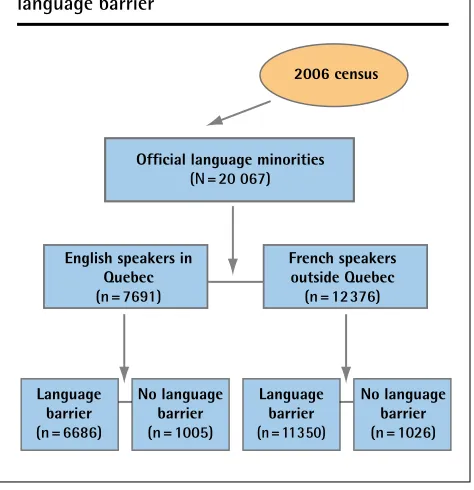
We defined language ability by grouping participants into language barrier or no language barrier groups based on responses to the question, “Which language(s), English or French, do you know well enough to conduct a conversation?” Given that French is the main language spoken in Quebec, “English only” respondents were categorized as having language barriers, and “French only” or “English and French” respondents were catego-rized as not having language barriers. Likewise, outside Quebec, where English is the main language spoken, “French only” respondents were categorized as having language barriers and “English only” or “English and French” respondents were categorized as having no language barriers (Figure 1). In this study, we used the terms English speakers to denote OLMs living in Quebec and French speakers to denote OLMs living in provinces and territories other than Quebec.
Independent predictor variables were defined, tak-ing into account Andersen’s health behaviour model,25
marital status, educational attainment, and immigra-tion status. Finally, enabling resources included personal income and employment status.
Statistical analysis
We analyzed the data separately for English speak-ers residing in Quebec and French speakspeak-ers outside of Quebec because demographic characteristics might not have been the same for the 2 populations, and health care delivery and planning occur largely at the pro-vincial or territorial level. We chose not to stratify the results by province and territory owing to small cell counts for some jurisdictions. Weighted proportions were used to describe HSU by language barrier group. We used sampling weights provided by Statistics Canada to account for the complex sampling procedure used in the SVOLM.23 A logistic regression model was fitted to
assess the association between HSU (having an RMD, use of services of an RMD, awareness of and use of tele-health services) and the predictive variables. Weighted values were used in the model. Significance was defined as P < .05. Analyses were performed using STATA, ver-sion 10. We obtained approval from Statistics Canada to access the public-use data file from which all personal identifying information had been removed.
RESuLTS
In total, our sample consisted of 7691 English speakers in Quebec (mean age 46.4 years) and 12 376 French
speakers outside of Quebec (mean age 46.5 years). Among English and French speakers, those with lan-guage barriers were primarily female, were married or in common-law relationships, and had less education and lower income (Table 1). In Quebec, English speakers with language barriers were more likely to be between 25 and 44 years of age, employed, and living in urban areas, and were more likely to report fair or poor health status, compared with those without language barriers. Outside Quebec, French speakers with language barriers were more likely to be between 45 and 64 years of age, not employed, and living in rural locations, and were more likely to report fair or poor health status, com-pared with those without language barriers.
Table 2 illustrates overall use of services of RMDs
and telephone health lines. In Quebec, English speak-ers with French language barrispeak-ers were less likely to have RMDs; among those with RMDs, use of the RMDs’ services was relatively low. Awareness and use of tele-health services were similar between those with lan-guage barriers and those without. Outside Quebec, French speakers with English language barriers were more likely to have RMDs compared with those with no language barriers. Use of RMD services and awareness and use of telehealth were similar in the populations with or without language barriers.
As outlined in Table 3, after adjusting for poten-tial confounders (age, sex, marital status, education, income, employment status, health status, immigra-tion status, and place of residence), English speakers in Quebec with language barriers were less likely to have RMDs and to use the services of RMDs, but were more likely to be aware of the existence of telephone health lines and to use these services. In contrast, French speakers outside Quebec had similar odds of having and using RMDs, being aware of telehealth, and using tele-health services, regardless of language barriers. Among those with language barriers who had no RMDs, English speakers in Quebec were less aware of the existence of telephone health lines or telehealth services than French speakers outside Quebec were (48.6% vs 61.9%).
Our logistic regression analysis showed that for both English speakers in Quebec and French speakers outside Quebec, age older than 45 years, male sex, being mar-ried or in common-law relationships, and higher income were factors associated with having an RMD. Being an immigrant in Quebec and living in a rural area outside of Quebec negatively influenced having an RMD (Table 4).
DIScuSSION
Our analysis of the SVOLM data demonstrated that the effects of language on HSU varied by geographic location and main language spoken. In Quebec, where French is
Figure 1.
Grouping of official language minorities by
language barrier
Official language minorities
(N = 20 067)
Language barrier
(n = 6686)
No language barrier
(n = 1005)
No language barrier
(n = 1026)
Language barrier (n=11350)
French speakers outside Quebec
(n = 12376)
English speakers in Quebec
(n = 7691)
Language barriers
|
Research
Table 2.
Weighted percentages illustrating overall use of health services by official language minorities
ENgLISH SPEAKERS IN QuEBEC (N = 7691) FRENCH SPEAKERS outSIDE QuEBEC (N = 12 376) HEALtH SERvICE
MEASuRE LANguAgE BARRIER, % yES BARRIER, % yESNo LANguAgE uNWEIgHtED P vALuE LANguAgE BARRIER, % yES BARRIER, % yESNo LANguAgE uNWEIgHtED P vALuE
Having regular medical doctor
60.7 70.7 .0001* 91.3 88.6 .029*
Using regular
medical doctor 45.6 57.4 .0001* 76.7 75.4 .214
Aware of
telehealth 55.4 49.8 .107 61.7 68.2 .672
Using telehealth 13.0 11.3 .097 13.3 13.7 .831
*Significant at P < .05.
Table 1.
Characteristics of study participants
ENgLISH SPEAKERS IN QuEBEC (N = 7691) FRENCH SPEAKERS outSIDE QuEBEC (N = 12 376)
vARIABLE
LANguAgE BARRIER, % (N = 6686)
No LANguAgE BARRIER, %
(N = 1005) uNWEIgHtED P vALuE
LANguAgE BARRIER, % (N = 11 350)
No LANguAgE BARRIER, %
(N = 1026) uNWEIgHtED P vALuE
Age, y .16 < .001
• 18-24 7.3 11.7 6.3 9.6
• 25-44 41.9 39.4 27.1 33.3
• 45-64 32.5 33.2 36.7 39.0
•≥ 65 18.4 16.7 29.9 18.1
Sex .027 < .001
• Male 47.7 51.4 38.0 45.6
• Female 52.3 48.6 61.9 54.4
Marital status .014 < .001
• Single 18.3 26.3 21.3 18.7
• Married or common law 64.8 59.8 54.9 67.2
• Divorced or separated 16.4 13.9 23.8 14.2
Immigration status < .001 .100
• Born in Canada 5.2 53.1 88.5 86.7
• Immigrant, in Canada < 10 y 26.3 7.1 3.4 2.8
• Immigrant, in Canada ≥ 10 y 68.5 39.8 8.1 10.5
Education < .001 < .001
• High school or less 49.8 38.6 78.3 46.8
• Some college or university 20.8 30.0 12.7 28.0
• Completed college or university 29.4 31.4 9.0 25.2
Income < .001 < .001
• Lowest (< $30 000) 39.5 19.9 32.9 16.0
• Middle ($30 000-$49 999) 22.8 21.6 28.2 18.7
• Upper middle ($50
000-$80 000)
21.3 23.9 24.8 24.5
• Highest (> $80 000) 16.5 34.6 14.1 40.8
Employed 62.2 49.3 < .001 33.6 61.4 < .001
Urban residence 99.3 89.7 < .001 45.6 73.4 < .001
the main language spoken, English speakers with French language bar-riers were less likely to have or to use the services of RMDs but were more likely to be aware of telehealth services. Outside of Quebec, where English is the main language spoken, there were no significant differences in HSU among French speakers. This contrasting result might reflect a number of factors. English speakers with French language barriers might have less need for the services of RMDs, as they might use other ser-vices such as walk-in clinics. The fact that English speakers in Quebec reported lower use of services sug-gests that there are factors beyond language barriers that hinder access to health care services for this pop-ulation. Current evidence points to acute shortages in the supply of GPs in Quebec,24,26 especially in Montreal,
which accounts for a third of the province’s population and where most of the English-speaking pop-ulation lives. Thus, English speak-ers, especially those with language barriers, are likely to face stiff com-petition for RMDs from the larger French-speaking population.
One could argue that the observed low rates of having and using RMDs in Quebec are the result of a rela-tively younger and healthy popula-tion compared with French speakers outside of Quebec. However, we con-trolled for age and health status in our analysis and the pattern of HSU remained unchanged between those inside and outside Quebec.
The difference in awareness and use of telephone health lines
Table 3.
Risk-adjusted oRs for 4 measures of health services utilization: ORs adjusted for age, sex, marital status,
education, income, employment status, health status, immigration status, and place of residence.
oR (95% CI), LANguAgE BARRIER vS No LANguAgE BARRIERHEALtH SERvICE MEASuRE ENgLISH SPEAKERS IN QuEBEC (N = 7691) FRENCH SPEAKERS outSIDE QuEBEC (N = 12 376)
Having regular medical doctor 0.66 (0.50-0.87) 1.22 (0.82-1.81)
Using regular medical doctor 0.65 (0.50-0.86) 0.94 (0.72-1.24)
Aware of telehealth 1.50 (1.16-1.93) 0.86 (0.67-1.09)
Using telehealth 1.43 (0.97-2.11) 1.05 (0.74-1.48)
OR—odds ratio.
Table 4.
Factors associated with having a regular medical doctor
vARIABLE
ENgLISH SPEAKERS IN QuEBEC (N = 7691), oR
(95% CI)
FRENCH SPEAKERS outSIDE QuEBEC
(N = 12 376), oR (95% CI)
Language barrier vs no barrier 0.66 (0.50-0.87)* 1.22 (0.82-1.81)
Age, y
• 18-24 Reference Reference
• 25-44 1.14 (0.89-1.47) 0.9 (0.71-1.32)
• 45-64 2.91 (2.19-3.84)* 1.76 (1.28-2.44)*
•≥ 65 6.49 (4.50-9.35)* 2.90 (1.84-4.56)*
Sex
• Female Reference Reference
• Male 1.93 (1.61-2.32)* 2.16 (1.74-2.67)*
Marital status
• Single Reference Reference
• Married or common law 1.84 (1.46-2.33)* 1.82 (1.36-2.43)*
• Divorced or separated 1.61 (1.10-2.34)* 1.45 (0.98-2.14)
Education
• High school or less Reference Reference
• Some college or university 1.02 (0.82-1.28) 1.05 (0.82-1.34)
• Completed college or university 0.80 (0.64-1.00) 1.07 (0.79-1.45)
Immigration status
• Nonimmigrant Reference Reference
• Immigrant 0.79 (0.65-0.97)* 0.88 (0.63-1.22)
Income
• Lowest (< $30 000) Reference Reference
• Middle ($30 000-$49 999) 1.29 (0.99-1.68) 1.21 (0.83-1.75)
• Upper middle ($50 000-$80 000) 1.43 (1.12-1.83)* 1.35 (0.92-2.00)
• Highest (> $80 000) 1.57 (1.23-2.01)* 1.90 (1.29-2.82)*
Employed
• Yes Reference Reference
• No 0.87 (0.71-1.07) 0.93 (0.72-1.20)
Place of residence
• Urban Reference Reference
• Rural 0.80 (0.63-1.01) 0.64 (0.50-0.82)*
Health status
• Good or excellent Reference Reference
• Fair or poor 1.15 (0.86-1.53) 0.83 (0.59-1.18)
Language barriers
|
Research
between English speakers and French speakers observed in our study is likely because in some urban areas (eg, Calgary or Edmonton in Alberta), telephone health lines were introduced to reduce the demand on emergency departments, or at least to ensure appropriate use of emergency services. In contrast, some provinces have used telehealth mainly for medical consultation to meet the health care needs of those in rural areas.
Overall, our findings concur with those from other studies that have shown that language barriers and socioeconomic disadvantage negatively influence access to health care services for linguistic minorities.7,8 In the
United States for example, linguistic minorities with limited proficiency in English are less likely to access and use preventive services27-29 and less likely to
estab-lish new or maintain existing patient-provider rela-tionships.30 Variations in HSU have been documented
among the Dutch-, French-, and German-speaking pop-ulations of Belgium. These linguistic groups (Flemish-Dutch, Walloon-French, German-German) differ from our sample in that they constitute the majority where they live. Thus, discrepancies in use of health services are mostly attributed to differences in socioeconomic gradients31 and are not necessarily owing to language
barriers. Groups with lower socioeconomic status use health services more often31 and more often report
poorer health.32
Improving health care for oLMs
Although language was not observed as a barrier to accessing health care among French speakers outside of Quebec, language remains a problem that needs to be addressed for some populations. This barrier can be addressed by providing language interpretation ser-vices for those with limited proficiency who are seeking medical care. This model of using interpreters has been implemented in some parts of Canada. Another way to reduce the effects of language barriers is by providing language training to health care providers.
Limitations
Our study has some limitations. First, the SVOLM is a cross-sectional survey; thus, data are subject to recall bias and causality cannot be established. Second, sam-pling for the SVOLM in Ontario, New Brunswick, and Quebec was limited to selected regions. Therefore, gen-eralizability of our findings to other regions might be limited. Third, our data lacked clinical information to properly define the need for services. Fourth, we defined our study population according to language barrier or no language barrier based on self-reported ability to hold conversations in English or French and could not deter-mine how inability to communicate in the main lan-guage influenced the decision to seek care. Nonetheless, the response rate for the SVOLM of 70% is relatively
high compared with many other large surveys involving racial and ethnic minorities.33
Conclusion
We found that English speakers in Quebec reported lower rates of having RMDs and using their services compared with French speakers outside of Quebec. Overall we found variations in HSU by language bar-rier, with lower use observed in Quebec. Our study is a snapshot of HSU by OLMs in Canada. More studies are needed to provide an understanding of the health care challenges faced by Canada’s linguistic minorities and to improve use of health services for this group.
Dr Ngwakongnwi is Health System Data Analyst with the Health Quality Council of Alberta. Dr Hemmelgarn is Associate Professor in the Department of Medicine and the Department of Community Health Sciences, Dr Musto is Clinical Associate Professor in the Department of Community Health Sciences, Dr King-Shier is Professor for the Faculty of Nursing and the Department of Community Health Sciences, and Dr Quan is Professor in the Department of Community Health Sciences, all at the University of Calgary in Alberta.
Acknowledgment
Dr Ngwakongnwi was supported by a Frederick Banting and Charles Best
Canadian Institute for Health Research Doctoral Student Award and a Prairie Regional Research Data Centre Student Incentive Grant. Dr Quan and Dr
Hemmelgarn are supported by an Alberta Innovate-Health Solutions Population
Health Scholar Award. Dr King-Shier is supported by an Alberta Innovate-Health Solutions Innovate-Health Scholar Award.
Contributors
Dr Ngwakongnwi and Dr Quan contributed to the concept and design of the study, analysis and interpretation of data, and drafting the article for submis-sion. Drs Hemmelgarn, Musto, and King contributed to the concept and design of the study and the interpretation of data. All authors revised, read, and approved the final manuscript to be published.
Competing interests
None declared
Correspondence
Dr Hude Quan, Department of Community Health Sciences, 3280 Hospital Dr
NW, Calgary, AB T2N 4Z6; telephone 403 210-8617; fax 403 210-3818; e-mail [email protected]
References
1. Official language act. Ottawa, ON: Ministry of Justice; 2010. Available from:
http://laws-lois.justice.gc.ca/eng/acts/O-3.01/index.html. Accessed
2012 Nov 13.
2. Gouvernement du Québec [website]. Portrait of Quebec. Quebec city, QC: Gouvernement du Québec; 2010. Available from: www.gouv.qc.ca/portail/
quebec/pgs/commun/portrait/demographie/?lang=en. Accessed 2012
Nov 13.
3. Statistics Canada. Population of French as the language spoken most often at home, Canada, provinces, territories and Canada less Quebec, 1996 to 2006.
Ottawa, ON: Statistics Canada; 2010.
4. Beaujot RP. The decline of official language minorities in Quebec and English Canada. Can J Sociol 1982;7(4):367-89.
5. Paille M. The English-speaking community in Quebec and the French-speaking minorities in English-French-speaking Canada: a demographic comparison.
Bull Hist Polit 1997;5(2):66-79.
6. Health Canada. Report to the Federal Minister of Health: Consultative Committee on French Speaking Minority Communities. Ottawa, ON: Health Canada; 2001. 7. Jacobs E, Chen AH, Karliner LS, Agger-Gupta N, Mutha S. The need for more
research on language barriers in health care: a proposed research agenda.
Milbank Q 2006;84(1):111-33.
8. Fiscella K, Franks P, Doescher MP, Saver BG. Disparities in health care by race, ethnicity, and language among the insured: findings from a national sample. Med Care 2002;40(1):52-9.
9. Quan H, Fong A, De Coster C, Wang J, Musto R, Noseworthy TW, et al. Variation in health services utilization among ethnic populations. CMAJ
2006;174(6):787-91.
10. Wu Z, Penning MJ, Schimmele CM. Immigrant status and unmet health care needs. Can J Public Health 2005;96(5):369-73.
11. Herbert CP. “Primary care” or “family practice.” Can Fam Physician
1987;33:15.
12. Becker MH, Drachman RH, Kirsscht JP. A field experiment to evalu-ate various outcomes of continuity of physician care. Am J Public Health
13. Chao J. Continuity of care incorporating patient perception. Fam Med
1988;20(5):333-7.
14. Dietrich AJ. Does continuous care from a medical doctor make a difference?
J Fam Pract 1982;15(5):929-37.
15. Weiss LJ, Blustein J. Faithful patients: the effect of long-term patient-physician relationships on the cost and use of health care by Americans. J Public Health 1996;86(12):1742-7.
16. Hayward RA, Bernard AM, Freeman HE, Corey CR. Regular source of ambu-latory care and access to health services. Am J Public Health 1991;81(4):434-8. Erratum in: Am J Public Health 1991;81(7):838.
17. Cornelius L, Beauregard K, Cohen J. Usual sources of medical care and their characteristics. National Medical Expenditure Survey research findings. Rockville, MD: Agency for Health Care Policy and Research, Public Health Services; 1991. No. 91-0042.
18. Carney P, Dietrich AJ, Freeman DH Jr. Improving future preventive care through educational efforts at a women’s community screening program.
J Community Health 1992;17(3):167-74.
19. Rakowski W, Rimer BK, Bryant SA. Integrating behaviour and inten-tion regarding mammography by respondents in the 1990 Nainten-tional Health Interview Survey of Health Promotion and Disease Prevention. Public Health Rep 1993;108(5):605-24.
20. Gagnon MP, Duplantie J, Fortin JP, Landry R. Implementing telehealth to support medical practice in rural/remote regions: what are the conditions for success? Implement Sci 2006;1:18.
21. Jennett P, Jackson A, Healy T, Ho K, Kazanijian A, Woollard R, et al. A study of a rural community’s readiness for telehealth. J Telemed Telecare
2003;9(5):259-63.
22. Rolland E, Moore MK, Victoria A, Robinson AV, McGuinness D. Using Ontario’s “Telehealth” health telephone helpline as an early-warning system: a study protocol. BMC Health Serv Res 2006;6:10.
23. Statistics Canada. Survey on the Vitality of Official Language Minorities (SVOLM). Ottawa, ON: Statistics Canada; 2007. Available from: www23. statcan.gc.ca/imdb/p2SV.pl?Function=getSurvey&SDDS=5099&lang=en &db=imdb&adm=8&dis=2. Accessed 2012 Nov 13.
24. Sibley LM, Glazier HR. Reasons for self-reported unmet healthcare needs in Canada: a population-based provincial comparison. Healthc Policy
2009;5(1):87-101.
25. Andersen RM. Revisiting the behavioral model and access to medical care: does it matter? J Health Soc Behav 1995;36(1):1-10.
26. Talbot Y, Fuller-Thomson E, Tudiver F, Habib Y, McIsaac WJ. Canadians without regular medical doctors. Who are they? Can Fam Physician
2001;47:58-64.
27. Makuc DM, Freid VM, Kleinman JC. National trends in the use of preventive health care by women. Am J Public Health 1989;79(1):21-6.
28. Stein JA, Fox X. Language preference as an indicator of mammography use among Hispanic women. J Natl Cancer Inst 1990;82(21):1715-6.
29. Woloshin S, Schartz ML, Katz JS, Welch HG. Is language a barrier to the use of preventive services? J Gen Intern Med 1997;12(8):472-7.
30. Ponce NA, Hays RD, Cunningham WE. Linguistic disparities in health care access and health status among older adults. J Gen Intern Med
2006;21(7):786-91.
31. Sykes LL, Walker LR, Ngwakongnwi E, Quan H. A systematic literature review on response rates across racial and ethnic populations. Can J Public Health 2010;101(3):213-9.
32. Van der Heyden JH, Demarest S, Tafforeau J, Van Oyen H. Socio-economic differences in the utilisation of health services in Belgium. Health Policy
2003;65(2):153-65.