I-HARPS: An Efficient Key Pre-distribution Scheme
Mahalingam Ramkumar
Department of Computer Science and Engineering
Mississippi State University
Abstract
We introduce an efficient random key pre-distribution scheme (RKPS) whose performance is 2 to 3 orders of magnitude better than schemes of comparable complexity in the literature. This dramatic improvement is achieved by increasing insecure storage complexity (for example us-ing external flash memory). The proposed scheme is a combination of the Kerberos-like key distribution scheme (KDS) proposed by Leighton and Micali, and random key pre-distribution schemes based on subset intersections.
We also investigate a simple security policy, DOWN (decrypt only when necessary) (which along with very reasonable assurances of tam-per resistance / read-proofness could ensures that no more than one se-cret an be exposed by tampering with a node), and its effect on the secu-rity of key pre-distribution schemes. The proposed scheme lends itself well for efficient implementation of the DOWN policy, and therefore in practice could be a secure and efficient alternative to more complex conventional key distribution schemes.
1
Introduction
A key distribution scheme (KDS) is a mechanism of distributing secrets to each node in a system, such that any two nodes1can authenticate each other. The process of authentication typically involves discovery of a shared secret, while simultaneously pro-viding verification of their claimed identities.
KDSs could be divided into two broad categories. For the first category, which includes most commonly used KDSs like Ker-beros (or any KDS based on the Needham-Schroeder symmetric key protocol [1]) and PKI, the secrets provided to each node are independent. In other words, secrets of a node do not provide any information regarding the secrets of other nodes.
For the second category or key pre-distribution schemes (KPS), secrets distributed to each node are not independent - they are all derived from a set of secrets chosen by a trusted authority (TA) (who deploys the network). With KPSs, a group of “colluding” nodes could pool their secrets together to compromise the entire system (or obtain secrets of all nodes). There is thus a concept ofn-secure KPSs. An-secure KPS can resist collusions of up tonnodes.
Any KPS is essentially a trade-off between security and com-plexity. A measure of the security isn- the number of colluding nodes that a KPS can resist. A primary measure of complexity of a KPS isk- the number of secrets that need to be stored in
1More generally, any group of nodes.
each node. The efficiency of a KPS then, is usually expressed as a ratio ofnvsk.
Since Blom et al [2] discovered that it is possible to trade-off security and complexity, many KPSs have been proposed in lit-erature - the primary difference between the KPSs being the nature of the trade-off employed. In this paper, we introduce a novel KPS, I-HARPS (Id-HAshed Random Preloaded Sub-sets). The trade-off employed by the proposed scheme involves achieving significant reduction in the size ofk(or size of secure storage) and computational complexity, by increasing insecure storage complexity.
The main motivation for the approach is the realization that insecure storage complexity may not be a crucial issue in many application scenarios. Flash based SD cards around the corner are expected have up to 8 GB of storage2. Thus for wireless
devices like hand held communication equipment with add-on flash memory capabilities, employing a few megabytes, or even tens of megabytes of that storage for the KDS is not impractical. By increasing insecure storage complexity, we show that a dra-matic reduction of secure storage complexity (k), and computa-tional complexity, is possible. Alternately, for the same secure storage complexity, a significant increase in security (orn- the number of colluding nodes that the KPS can resist) is possible. The proposed scheme is essentially a combination of a KDS proposed by Leighton3 et al in Ref. [3], and the idea of key pre-distribution schemes involving random allocation of subsets of keys to each node, that have been investigated by many re-searchers in the literature [4] - [12].
The rest of this paper is organized as follows. In Section 2 we provide a brief introduction to KPSs, and the KDS by Leighton et al [3]. In Section 3 we introduce I-HARPS, and an analysis of its security. We also compare the performance of I-HARPS with other KPSs. We shall see that I-HARPS could be over 300 times more efficient than other random KPSs of comparable complex-ity, and about 10 times more efficient than Blom’s KPS (which however is computationally very expensive), with some “reason-able” provisioning for additional insecure storage.
KPSs are typically expected to be employed in “trusted” de-vices with some hardware protection of stored secrets. In Sec-tion 4 we review problems and soluSec-tions involving protecting
2Even though SD stands for “secure” digital we do not intend to use the
security mechanism offered by SD cards for protecting information stored in the SD card. Other flash memory cards like CF (compact flash), SM (smart media), MS (memory stick), MMC (multimedia card) and xD-picture cards offer comparable storage at comparable prices.
secrets in trusted devices and indicate how a recently proposed security policy - DOWN (decrypt only when necessary) [13] can substantially improve the ability of trusted devices to protect their secrets. In Section 5 we compare different KPSs in con-junction with the DOWN policy - which provides an assurance that not more than one secret can be exposed by tampering with a device. When I-HARPS (of very reasonable complexity) is used in conjunction with DOWN, we show that an attacker may have to compromise secrets from many tens of millions of nodes in order to make any kind of dent in the security of the KPS.
2
Key Pre-distribution
A KPS consists of a trusted authority (TA), andN nodes with unique IDs (sayID1· · ·IDN). The TA chooses P secretsR
and two operators f()and g(). The operatorf(), is used to determine the secretsSithat are preloaded in nodei. Any two
nodesi andj, with preloaded secretsSi andSj can discover
a unique shared secretKij using a public operatorg()without
further involvement of the TA. The restrictions onf()andg()in order to satisfy these requirements can be mathematically stated as follows:
Si = f(R, IDi);
Kij = g(Si, IDj) =g(Sj, IDi)
= f(R, IDj, IDi) =f(R, IDi, IDj). (1)
Asg()is public, it possible for two nodes, just by exchanging their IDs, to executeg() and discover a unique shared secret. As the shared secret is a function of their IDs, their ability to arrive at the shared secret provides mutual assurances toiand jthat the other node possesses the necessary secretsSj andSi,
respectively. The secrets preloaded in each node is referred to as the node’s key-ring. We shall represent byk, the size of the key ring.
2.1
Why KPS?
The main disadvantage of Kerberos-like approaches [1] is the need for an online server for mediation of interaction between nodes, which is not satisfactory under scenarios where ad hoc mutual authentication is necessary. While PKI does not have this issue, there are three major issues that render PKI unsuitable for many application scenarios:
1. Large computational and bandwidth overheads due to the need for asymmetric cryptography.
2. Efficient dissemination of public keys in very large-scale deployments may not be possible as certificate chains [14] needed for mutual authentication could become very long. 3. For many applications4, the ability to escrow keys may
ac-tually be desirable.
4For example, smart cards with autonomous computational capabilities. As
such devices would be expected to self-destruct on sensing tampering attempts, false-alarms may result in locking away valuable encrypted data from genuine users, unless key escrow is possible.
KPSs cater for ad hoc mutual authentication by just exchang-ing IDs. Further, the problem of choosexchang-ing public IDs (for ef-ficient dissemination of public keys) is not an issue with KPS. Unlike asymmetric schemes where it is not possible in general to choose public keys (the choice of the private keys determine the choice of the public keys), with KPSs one can always choose their public ID - say by hashing a descriptive string like [“First-Name Last[“First-Name Affiliation”]). In other words, for any KPS, the private keys (theksecrets assigned to each node) are determined by the “public keys” (public ID). Also, KPSs by their very na-ture, cater for key escrow.
While the problems associated with efficient public key dis-semination and key escrow are simultaneously overcome by us-ing identity based cryptography (IBE) [15], they impose the need for ongoing involvement of a trusted third party (as in Kerberos-like models).
2.2
Deterministic KPS
KPSs themselves may be divided into two broad categories -deterministic and random KPS. Most KPSs based on finite field arithmetic [2], [16] - [18] belong to the former category. For example, in an-secure Blom’s scheme, the TA chooses n+12 secrets inZP ={0,1, . . . , P −1}(whereP is a large enough
prime), and generates a polynomial
f(x, y) =
n
X
i=0
n
X
j=0
aijxiyjmodP, x, y, aij ∈ZP. (2)
whereaij = ajiare n+12
independent secrets chosen by the TA. Every node is assigned a unique public ID5 from
ZP. A
node A (node with public ID A ∈ ZP) receives gA(x) =
f(x, A)securely (gA(x)hasn+ 1coefficients, corresponding to
k=n+ 1secrets of the nodeA) from the TA. Two nodesAand Bcan calculateKAB =KBA=f(A, B)=f(B, A)=gA(B)=
gB(A)independently.
An-secure deterministic KPS is unconditionally secure as long asnor less nodes have been compromised. If more thannnodes are compromised however, the entire KPS is compromised - or failure of the KPS occurs catastrophically. The most efficient of deterministic KPSs thus far (Blom’s scheme) requires only k=n+ 1keys in each node to ben-secure. However, Blom’s scheme is computationally expensive.
To overcome the two major limitations of KPSs based on finite-field arithmetic (computational complexity and catastrophic fail-ure) Gong et al [19] and Mitchell et al [20] investigated KPSs based on allocation of a subset of keys to each node from a pool of keys. The shared secret between any two nodes is then de-rived from all shared keys (say a one way function of all shared keys). While very naive approaches were used by Gong et al [19] for allocation of keys, Mitchell et al [20] were influenced by the seminal work of Erdos et al [21] on subset intersections. However the complexity involved in allocation of keys in such approaches, also makes it difficult for the nodes to determine the keys they share6in order to establish a shared secret.
5The size ofPlimits the possible network size.
2.3
Random KPSs
Dyer et al [4] were the first to point out that random allocation of subsets (instead of complex deterministic strategies) works “reasonably well.” More recently, this idea has been employed by various researchers [5] - [10] in the context of sensor net-works, and [11] - [12] for mobile ad hoc networks. In this paper, we refer to all KPSs based on random allocation of subsets as RPS (random preloaded subsets).
Leighton et [3] (in the same paper in which they proposed the simple and elegant KDS which will be discussed in the next section) also proposed the first random key pre-distribution scheme7(which we shall refer to as LM-KPS). Further unlike
RKPSs that followed, LM-KPS is not based on subset intersec-tions. LM-KPS is based on distributing keys with different “hash depths” to each node.
HARPS [12], perhaps the most efficient random KPS thus far8,
is a generalization of RPS and LM-KPS.
Formally, a(P, k)RPS employs a TA who chooses an indexed set ofP keysK1· · ·KP. Each node has a unique ID. The TA
chooses public random functionFRP S(), which when “seeded”
by a node ID, yields the allocation of keys for the node. Thus for a nodeA(node with unique IDA)
FRP S(A) = {A1, A2, . . . , Ak},
A = {KA1, . . . , KAk}. (3)
where1 ≤ Ai ≤ P, Ai =6 Ajfori 6= j. In other words
FRP S()generates a partial random permutation of {1· · ·P}.
The k-length sequence {A1, A2, . . . , Ak} is the index of the
keys preloaded in nodeA (or node with ID A). A is the set of secrets preloaded inA. Note that the indexes are public (as the node ID andFRP S()are public).
In the (k, L)LM scheme, the TA chooses an indexed set of ksecretsK1· · ·Kk, a cryptographic hash functionh(), and a
public random functionFLM(). For a nodeA,
FLM(A) = {a1, a2, . . . , ak},1≤ai≤L∀i.
A = {a1K1,a2K2, . . . ,akKk}. (4)
OrFLM()generates ak-sequence of uniformly distributed
ran-dom integer values between 1 andL. The nodeAis preloaded withkkeys. Theith preloaded key is nodeAis derived by
re-peatedly hashingithTAs keya
itimes. The parameterLis the
maximum hash depth. The notationiK
jrepresents the result of
repeatedly hashing ofKj,itimes, using a (public) cryptographic
hash functionh().
In(P, k, L)HARPS, the TA choosesP keysK1· · ·KP, and
each node is loaded with a hashed subset ofkkeys. The TA has an indexed set ofP secrets, a cryptographic hash functionh()
the indexes of the keys they share. However, this approach does not implicitly provide authentication of the node IDs.
7The authors refer to this scheme as “the second basic scheme” in [3]. 8Schemes proposed in [9] and [10] - which combine Blom’s scheme with
RPS schemes could be a little more efficient than HARPS. However, the perfor-mance of such schemes designed for a particularn, deteriorates very rapidly for n0> n[12].
and a public random functionFHARP S(). For a nodeA,
FHARP S(A) = {(A1, a1),(A2, a2), . . . ,(Ak, ak)},
A = {a1KA1,
a2K
A2, . . . ,
akK
Ak}. (5)
The first coordinate{A1, A2, . . . , Ak} represents the index of
the keys chosen to be preloaded in nodeA, and the second coor-dinate{a1, a2, . . . , ak}, the number of times each chosen key is
hashed (using cryptographic hash functionh()) before they are preloaded in the nodeA.
Note that LM-KPS and RPS are actually special cases of HARPS. LM-KPS is HARPS withP =k, and RPS is HARPS withL= 0(keys are not hashed before pre-loading) orL = 1
(all keys are hashed once before preloading)9.
The concept ofn-secureness is however, not an adequate de-scription of an RKPS. For any RKPS, an attacker, by exposing secrets fromnenodes could discover shared secrets between
ar-bitrary nodes with a some probabilitype. Thus a more
appropri-ate description of a RKPS could be(ne, pe)-secure KPS.
In general RKPSs are less efficient than the schemes based on finite field arithmetic - even though it is still k = O(n) (ex-cept for the LM-KPS scheme which needs k ≈ O(n3)). For
instance, to achieve(ne, pe)-security, HARPS [12] needsk ≈
ne
√
e log1
pe
keys, and schemes based on random preloaded
subsets [4] - [11] requirek≈nee log
1 pe
(or HARPS is more
efficient by a factor√e). RKPSs are also computationally in-expensive - they need only pure symmetric cryptography primi-tives like hash functions and / or block ciphers (multiplication is not needed unlike in Blom’s scheme).
Further, with a(ne, pe)-secure RKPS, exposing keys fromne
devices enables an attacker only to determine shared secrets be-tween nodes10. To actually determine all secrets in some node
by exposing secrets from other nodes, the attacker may have to expose keys from a significantly higher number of nodes. We refer to this type of attack - aimed at exposing all secrets from a node by exposing secrets from other nodes - as a syn-thesis attack11. Thus an even more appropriate characterization of an RKPS would be as{(ne, pe),(ns, ps)}-secure, where an
attacker needs to compromise secrets from
1. nenodes to discover shared secrets (between nodes other
than the compromised nodes) with a probabilitype, and
2. nsnodes to accomplish a synthesis attack with a probability
ps.
In general, forpe=psns>> ne. For RPS and LM-KPSnsis
an order of magnitude higher thanne. For HARPS,nsis more
than two orders of magnitude higher thanne[12].
9In practice choosingL= 1instead ofL= 0does not have any implication
on the security of shared secrets between nodes. The only advantage of choosing L= 1is that compromise of keys in nodes does not result in compromise of TA’s keys.
10With which an attacker can impersonate a node for purposes of “fooling”
other nodes. More specifically it is not possible to fool the TA.
2.4
Leighton - Micali KDS
The LM-KDS [3] (not to be confused with LM-KPS discussed earlier) is based on a master key, and a strong cryptographic hash function h(). The scheme consists of a trusted author-ity and a set of N nodes M. The trusted authority chooses a master key K. Node i ∈ M is provided with the secret Ki = h(K, i). For sending a message to nodej ∈ M(which
has secretKj =h(K, j)), nodeiperforms a look up in a public
repository (created by the TA, withN2entries) forPij (Pij is
not a secret), wherePij =h(Kj, i)⊕h(Ki, j), and calculates
KijasKij=Pij⊕h(Ki, j) =h(Kj, i). The messageM to be
sent tojmay be encrypted with a random session keyKS, and
sent tojas
Mij = [ikEKij(KS)kEKS(M)]. (6)
Nodejcan easily calculateKij = h(Kj, i)as it has access to
Kj.
However, in practice, it may not be feasible to maintain a pub-lic repository withN2keys. So the TA may actually need to be
on-line to calculatePijand provide it to the nodes “on demand”.
However, once a nodeiobtainsPij(to communicate with node
j), it does not have to getPijagain. Further, any nodeimay not
need to knowPijs for all possiblej ∈M. So the nodeicould
just store somePijs for some nodes (even in some insecure
stor-age location for easy access).
However, Pijs stored in insecure locations, could have been
modified - and therefore need to be authenticated. For this pur-pose, a second authentication key is used. The TA chooses an additional master key aK, and provides node i with aK
i =
h(aK, i). Additionally, one more public value A
ij is used
to authenticate each Pij, where Aij = h(aKi, h(Kj, i)) =
h(aKi, Kij). As the nodeihas aKi, it can check ifKij
ob-tained from aPij(provided by an untrusted source) is valid.
The main difference between the LM-KDS and schemes (like Kerberos) based on the symmetric Needham-Schroeder protocol [1] (which also require a trusted on-line server), is that the infor-mationPijthat the node gets from the server need not be secret
(nodes do not even need to authenticate themselves to the server to receivePijs). Further, the TA is not required to be on-line for
every communication attempt betweeniandj - nodes need to access the TA only once. It is also possible for nodeito getPijs
for a large number ofjs that nodeimay desire to communicate with in the future, in a single attempt.
The security of LM-KDS rests on the assumption that the mas-ter key cannot be compromised (while for Kerberos-like mod-els the assumption is that the trusted server cannot be compro-mised)12. The LM-KDS could however easily be extended to
using multiple master keys (sayt such systems used together, with master keys K1· · ·Kt). In this case an attacker would
have to compromise the master keys from alltsystems to break the system. The authentication secretKij in this case would be
Kij =Kij1 ⊕K
2
ij⊕ · · · ⊕K t ij.
12As it may be easier to unconditionally protect a single key in a device rather
than multiple keys, it could be argued that the LM-scheme is more secure than Kerberos-like models (if cryptanalytic attacks are considered impractical).
The primary disadvantage of LM-KDS is that it does not pro-vide a good solution for revocation of nodes - some alternate mechanism needs to be used for this purpose. For Kerberos like models this is not an issue as the TA would just refuse to honor requests from revoked nodes for authenticating itself to other nodes.
2.4.1 Basic KDS vs LM-KDS
In the basic KDS, for a system consisting ofN nodes, the TA chooses N2secrets (one for each pair) and assigns each node withN −1secrets. After the keys are assigned in each node, there is no need for the involvement of the TA for mutual au-thentication of nodes. Thus the basic KDS is a KPS scheme. In fact a very secure KPS scheme - no matter how many nodes are compromised, nodes that not compromised are not affected.
The LM-KDS can also be used to facilitate authentication of node without the involvement of the TA (or work like a KPS scheme). In this case, each node (say nodei) just needs to store N−1Pij values. While both approaches (basic KDS vs
LM-KDS) have the same storage complexity, there is one noteworthy difference. For the basic KDS,N−1secrets need to be stored. For LM-KDS theN−1Pijvalues need not be protected.
2.5
The Perfect KPS?
We can already see that if insecure storage complexity is not an issue the LM-KDS is indeed a very efficient KPS! Each node just needs to store one secret13! Further, no coalition of nodes
can compromise secrets of other nodes (as long as cryptanalytic attacks are infeasible). In fact for medium scale deployments involving say few tens of millions of nodes, LM KDS may be a feasible solution (even if the network size is 64 million, 1 GB of storage would be sufficient - which is perhaps not totally im-practical).
However, in order for a deployment to be highly scalable, and to fully utilize the advantages KPSs offer over other key distri-bution schemes, it may be necessary to choose a much larger “ID space.” For instance if we desire to assign public IDs based on a one-way function of “FirstName LastName Affiliation” the ID space should at least be 128 bits long to be useful (to ensure that collitions are highly improbable).
Under such a condition, it is still possible for nodes to store thePijvalues for each deployed node (which may be a few tens
of millions) However, it is not possible to predict the IDs of the nodes that “join the network” after the deployment. Thus when-ever new nodes join the network when-every node should be provided with the correspondingPijs - which may not be practical14.
In the next section we introduce a novel KPS scheme, I-HARPS, which overcomes this problem. With “more reason-able” requirement of insecure storage of a few megabytes or tens of megabytes, I-HARPS allows for very high scalability (practi-cally without bounds).
13We shall ignore the authentication keyaKfor the moment.
14Though this is much more practical than providing each node with an
3
I-HARPS
I-HARPS (like HARPS15) is also determined by three
parame-ters -P - the number of secrets the TA chooses,k- the number of secrets in each node, andL. However, unlike HARPS where Lis the maximum “hash depth,” in I-HARPS,Ldetermines the additional insecure storage complexity. More specifically, the insecure storage complexity isk(L−1).
The TA choosesP secrets{1K· · ·PK}(which we shall see
are actually the master keys ofPindependent LM-KDS), a cryp-tographically strong hash function h() and a public function F(). LetN represent the total number of nodes in the system. Each node has a unique ID. Like most KPSs, the network size is only limited by the number of bits chosen to represent the ID16.
A node with IDAgets a set ofksecretsA, andk(L−1)values Awhich are determined by the two one way functionsh()and F()as follows:
F(A) ={(A1, a1)· · ·(Ak, ak)}, (7)
for1≤Ai≤P, Ai6=Aj∀i6=j,1≤ai≤L, and
A = {A1Ka1· · ·
AkK
ak}, where
i
Kj = h(iK, j), (8)
and A=
A1P
a1,1· · ·
A1P
a1,a1−1
A1P
a1,a1+1· · ·
A1P
a1,L
A2P
a2,1· · ·
A2P
a2,a2−1
A1P
a2,a2+1· · ·
A2P
a2,L
.. .
AkP
ak,1· · ·
AkP
ak,ak−1
AkP
ak,ak+1· · ·
AkP
ak,L
(9) where
AiP
ai,j =h(
AiK
ai, j)⊕h(
AiK
j, ai). (10)
In other words, the TA choosesP LM-KDS master keys. Each system however is limited toL“users” (or onlyL2P
ij values
need to be generated by the TA). NodeAis provided with keys fromkof thePsystems. The specific choice ofkout ofP sys-tems for nodeAis determined byA1· · ·Ak(through the public
functionF(A)). In each of theksystems, the ID ofAis given by1 ≤ ai ≤ L(IDai in systemAi). Thus each node needs
to storeL−1values for each of theksystems - introducing an insecure storage requirement ofk(L−1).
In order to establish a shared secret withB, nodeAneeds to evaluateF(A)andF(B)to determine the shared indexes of the LM-KDS instances. Let us assume nodesAandBsharem sys-tems with master keysS1K· · ·SmK, and the ID (between 1 and
L) ofAandBin themsystems are(a1· · ·am)and(b1· · ·bm)
respectively. The shared secret betweenA andB, orKAB is
then
KAB =h(S1Kb1, a1)⊕h(
S2K
b2, a2)⊕ · · · ⊕h(
SmK
bm, am)
15HARPS employs a combination RPS and LM-KPS. I-HARPS employs a
combination of RPS and LM-KDS.
16In Blom’s KPS [2] it is limited toP- the number of elements in the finite
fieldZPover which the polynomials are evaluated.
Note that as in LM-KDS, node B can easily calculate h(SiK
bi, ai)as it has the necessary secrets
SiK
bi,1 ≤i≤m.
NodeAcan obtain eachh(SiK
bi, ai)as
h(SiK
bi, ai) =
SiP
ai,bi⊕h(
SiK
ai, bi), (11)
by looking up thePijvalues fromAin insecure storage.
3.1
Analysis of I-HARPS
Let
ξ= k
P. (12)
Now consider theithLM-KDS system where1 ≤ i ≤ P. In
order for two nodes (sayAandB) to utilize theithKDS, both
should have a secret for theithKDS - which occurs with a
prob-abilityξ2(or on an average two nodes shareP ξ2=kξsystems).
Let us assume that an attacker has compromised all secrets fromnnodes. In order to compromise the secret shared between AandBprovided by systemi(whereAhas an ID1 ≤a≤L andBhas ID1≤b≤Lin theithsystem), the attacker needs to find, in his ill-gotten collection of exposed secrets, eitheriKaor iK
b. The probability that the attacker finds exactlyuinstances
of systemikeys innnodes is
Bξ(n, u) =
n
u
ξu(1−ξ)n−u, (13)
and the probability that uinstances of the keys (of system i) correspond to eitheraor bis L2. Thus the probability that two nodes can use theithKDS safely is
ε=ξ2
n
X
u=0
Bξ(n, u)
1− 2
L
u
. (14)
In order to compromise the shared secret the attackers have to determine all elementary secrets which make up the final shared secretKAB. Thus the probabilitype that an attacker who has
compromisednnodes can compromise shared secrets of arbi-trary nodes is
pe= (1−ε)P. (15)
By similar reasoning the probability that an attacker can com-promise all secrets of a node by exposing secrets from other nodes is
ps= (1−εs)P, (16)
where
εs=ξ n
X
u=0
Bξ(n, u)
1− 1
L
u
. (17)
Note that there are two differences between Eqs (14) and (17). The first is the difference in the first term (ξinstead ofξ2) as each
node hask=P ξkeys - while onlyP ξ2keys are shared between
nodes. The second difference is in the last term which has 1
instead of L2. In the former case it is enough for the attacker to determine either the key ofAorBfor a system - which is not the case in the latter.
We have however, in Eq(14), ignored the fact that it is possible that the IDs of the two nodes (whose shared secret the attacker is trying to compromise) may have the same ID in theithsystem.
Under this condition (the probability of which is L12), the
at-tacker’s job is a little more difficult (he has to have that par-ticular key instead of one of two keys). Thus Eq (14), is more accurately written as
ε=ξ2
n
X
u=0
Bξ(n, u)
(L2−1)(1−2
L) + (1−
1
L)
L2
u
. (18)
3.2
Comparison With Other KPSs
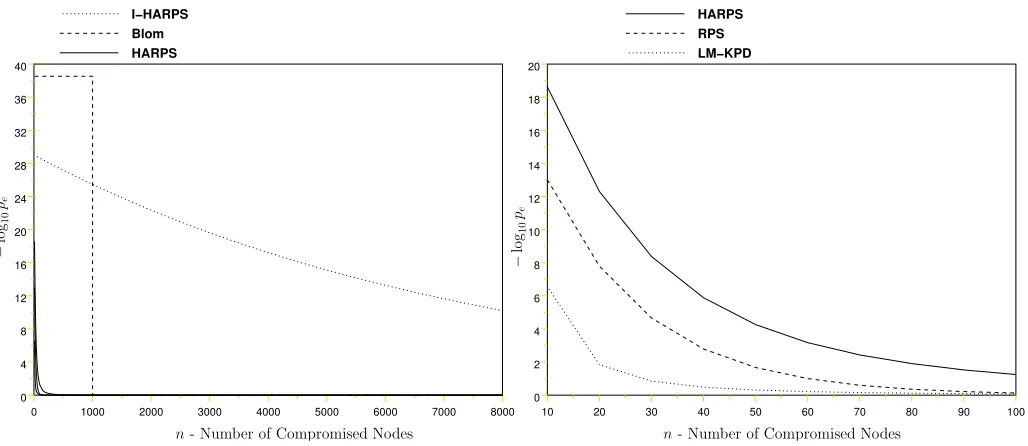
Figure 1 (left) provides a comparison of 5 KPSs in terms of the probability with which an attacker who has compromised n nodes, can discover shared secrets of other nodes (for the Y-axis we use −log10pe - so higher the better). For the
sake of comparison, all KPSs have the samek = 1000. For HARPS we have chosenP = 15000, L= 1024. For I-HARPS
P = 15000, L = 1024, for RPSP = 20000, for LM-KPS
P =k = 1000, L= 1024, andk = 1000for Blom’s scheme (or 999-secure Blom’s scheme). While the other KPSs do not re-quire any additional insecure storage for I-HARPS, ifk= 1000, L = 1024 and each key is of length 128-bits (16 bytes), the Pijs (which are also the same length as the keys) would require
16k(L−1)bytes or less than 16 MB of storage.
Note that even for deterministic KPSs like Blom’s scheme, there is always a probability that the attacker can “guess” the shared secret between two nodes. For instance, if the final shared secret is a 128-bit secret, the probability that the attacker can de-termine the secret17 isp
e = 21281 ≈ 3×10−39. For Blom’s
scheme the “probability of compromise” is therefore fixed at roughly10−39forn≤999. However forn≥1000the
proba-bility of compromise is unity (orlog10pe= 0).
Note that I-HARPS is very much usable even when 8000 nodes have been compromised! Beyondn= 8000(not shown in the plots), the probability of compromise is about
1. 1 in a billion(pe ≈ 10−9)when 9,000 nodes have been
compromised,
2. 1 in a million when 12,000 nodes have been compromised, 3. 1 in a thousand when 17,500 nodes are compromised. 4. andpe= 0.5forn= 27,500.
The trade-off is of course the need for additional insecure stor-age -1024×1000Pij values have to be stored in each node.
For example, if all keys (and hence thePijs) are 128-bits, an
additional 16 Megabytes of storage is required for I-HARPS. The three lines in the lower left corner of Fig 1 (left) corre-spond to HARPS, RPS and LM-KPS respectively18. A zoomed
view of the three lines are shown in Fig 1 (right).
17Which also goes to show that as long as the probability of compromise is
low, an RKPS is in no way inferior to a deterministic KPS.
18Which are literally “out of the chart”!
Blom
HARPS I−HARPS Blom HARPS I−HARPS
0 10000 20000 30000 40000 50000 60000 70000 80000 0
100 200 300 400 500
n- Number of Compromised Nodes
−
log
10
ps
Figure 2: Resistance of KPSs (Blom’s scheme, HARPS and I-HARPS) to node synthesis.
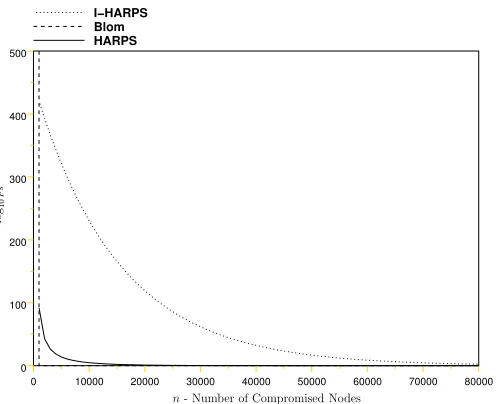
Figure 2 depicts the probability of node synthesisps - or the
probability with which an attacker can compromise all secrets from a node by exposing keys from other nodes. The figure has plots (log10psvsn) for I-HARPS, HARPS and Blom’s scheme.
For Blom’s scheme,pe=ps= 1forn=ne=ns≥k= 1000.
However RKPSs in general deteriorate more gracefully. With n= 9000compromised nodes, the attacker can expose all keys from roughly one in a million nodes for HARPS. For I-HARPS, the probabilitypsassociated with different number of nodes the
attacker compromises is
1. one in a trillion (ps= 10−12) -54,000nodes
2. one in a billion -59000nodes,
3. one in a million -66,000nodes (9000for HARPS).
3.2.1 Effect ofL(Insecure Storage Complexity)
Figure 3 depicts the effect of L on the performance of of I-HARPS. Obviously, asLincreases we expect the I-HARPS to improve substantially. After all, we already know that if there is no limit toLwe could just use the LM-KDS withN (network size) storedPij values which is secure against collusion of an
unlimited number of nodes!
With more practical restrictions onL, it can be seen that ifL is increased (and P, k are unchanged), ncan be increased by the same factor to keeppeconstant, by considering a first order
approximation of Eq (14),
ε=ξ2
n
X
u=0
Bξ(n, u)
1− 2
L
u
≈ξ2
1− 2
L
ξn
, (19)
and the fact that
I−HARPS Blom HARPS
HARPS RPS LM−KPD
0 1000 2000 3000 4000 5000 6000 7000 8000
0 4 8 12 16 20 24 28 32 36 40
10 20 30 40 50 60 70 80 90 100
0 2 4 6 8 10 12 14 16 18 20
n- Number of Compromised Nodes n- Number of Compromised Nodes
−
log
10
p
e
−
log
10
pe
Figure 1: Left: Comparison of 5 KPSs with the same value ofk= 1000, in terms of probability of compromise of shared secrets vs number of compromised nodes. Right: Zoomed in version of the lower left corner of the figure in the left to show performance of HARPS, RPS and LM-KPS.
0 5 10 15 20 25 30
1000 2000 3000 4000 5000 6000 7000 8000 9000 10000
L= 256
L= 512
L= 1024
L= 2048
L= 4192
n- Number of Compromised Nodes
−
log
10
pe
Figure 3: Performance of I-HARPS withP = 15000, k= 1000
for different values ofL. LargerLimplies larger insecure stor-age complexity.
3.2.2 Authentication Key
So far we have ignored the additional authentication key used by the LM-KDS. The main need for the additional authentica-tion key is to ensure that modificaauthentica-tions toPijs stored in insecure
locations could be detected. Thus in practice the authentication key is not needed if
1. thePij values are from a trusted source, and provided in
read-only storage device, or
2. some key based hash function (say using the user secret
iK
A for the ithLM-KDS) is used for authenticating all iP
Ajvalues for1≤j ≤L.
3.2.3 Hashing vs Storage Trade-offs
RKPSs exploit two fundamental “dimensions” - one provided by uniqueness of intersections of large subsets consisting of inde-pendent keys, and the other provided by generating many keys from each independent key. RPS schemes [4] - [11] make use of the former. LM-KPS [3] makes use of the latter. HARPS and I-HARPS use both. Specifically, HARPS achieves this without requiring extra storage, while I-HARPS calls for extra storage. It is very easy to see that a(P, k, L)I-HARPS (as does(P, k, L)
HARPS) reduces to(P, k)RPS whenL= 1(no storage needed for I-HARPS, and no hashing for HARPS)
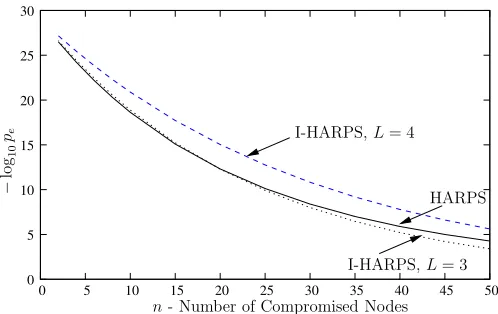
It is interesting therefore, to see how much storage, can be “em-ulated” by hashing. Figure 4 depicts plots comparing HARPS
with L = 1024 with I-HARPS (with the same P and k as
HARPS) forL = 3andL = 4. As HARPS withL = 1024
0 5 10 15 20 25 30
0 5 10 15 20 25 30 35 40 45 50
HARPS I-HARPS,L= 4
I-HARPS,L= 3
n- Number of Compromised Nodes
−
log
10
pe
Figure 4: Comparison of HARPS (L = 1024) with I-HARPS (3 ≤ L ≤ 4). Hashing in HARPS “emulates” a storage com-plexity between3−1 = 2 and4−1 = 3. For both KPSs P= 15000, k= 1000.
0 50 100 150 200 250 300 350 400 450 500
1 2 3 4 5 6 7 8 9 10
I-HARPS,P=k= 1000, L= 4 I-HARPS,P=k= 1000, L= 5 I-HARPS,P=k= 1000, L= 6
LM-KPD,P =k= 1000, L= 1024 I-HARPS,P =k= 1000, L= 3
n- Number of Compromised Nodes
−
log
10
pe
Figure 5: Comparison of LM-KPS (L= 1024) with I-HARPS (small3≤L≤6). For both KPSsP=k= 1000.
Figure 5 is a comparison of LM-KPS with a special case of I-HARPS with P = k. For LM-KPS L = 1024, and for I-HARPS we have plots forP = k = 1000withL = 3· · ·6. In both cases (HARPS vs I-HARPS in Figure 4 and LM-KPS vs I-HARPS in Figure 5) note that the storage emulation offered by hashing increases asnincreases. In other words, employing hashing instead of storage, while less efficient, deteriorates at a lower rate. It is not surprising that the LM scheme exploits the “second dimension” (the only dimension it exploits) better than HARPS - as HARPS can “exploit this dimension” only for shared keys. With LM allkkeys are shared (asP =k), while with HARPS onlyξkkeys are shared on an average.
That HARPS deteriorates more gracefully than I-HARPS is also readily apparent by considering that a 300-fold difference between HARPS and I-HARPS in terms of complexity of at-tacks for discovering shared secrets, reduces to a mere 7-fold difference between the two in terms of complexity of synthesis attack!
4
DOWN with Trusted Computers
Key pre-distribution schemes are more likely to be used in de-vices with some assurance of tamper resistance - for example, “trusted computers” with some ability to “protect” their secrets. In this section we investigate a simple security policy - DOWN (decrypt only when necessary) [13] and its ability to enhance the ability of trusted devices to protect its secrets. In particular we show that some KPSs - especially RKPSs are more “DOWN friendly.” We then proceed to analyze the effect of the DOWN policy on HARPS, I-HARPS and Blom’s KPS.
4.1
Protecting Secrets in Trusted Computers
Trusted computers [25] are expected to possess unflinching morals (the morality of the computers would be dictated by the software that runs on the computer). They will not, in general, trust the owners or controllers of devices (the human operators). They cannot be directed to do something that violates the rules they are trusted to obey. Just as human beings are trusted not to disclose their secrets in client-server applications, trusted com-puters are trusted not to disclose their secrets.
Therefore, practical realization of trusted devices calls for two fundamental assurances from technology - tamper-resistance and read-proofing. However both properties are not independent [26]. For instance, with the ability to tamper with the software, an attacker could direct the trusted computer to “spit-out” its se-crets. At the same time, the protected secrets could be used for authenticating the software (say using key based message au-thentication codes) - and thus prevent attackers from tampering with the software.
Trusted devices (for example a single chip computer in a smart card) can be at two fundamental states - in-use or at-rest. Obvi-ously, the secrets have to be protected during both states.
4.1.1 In-Use State
While the computer is in-use, it is possible to use many sen-sors that actively monitor for intrusions, and delete secrets under suspicion of tampering attempts. Attackers could monitor elec-tromagnetic radiations from chips for gaining clues about the secrets stored inside. But this could be prevented by employing proper shielding. Some attacks are also based on inducing faults in memory [28], [29] and employing differential power analysis [30]. Protection mechanisms against such attacks have also been investigated [31].
parts of the silicon (or some lines on the substrate) are protected by not providing a clear line of sight access (after all, it may not be possible to bend beams), it may be possible to build private circuits [34] to ensure that the attacker gains no knowledge (by tapping a few lines).
4.1.2 Protecting Secrets At-Rest
While rest encryption [35], is commonly used to protect databases at rest, the problem of rest encryption for trusted de-vices is very different. For the former, the secret used for en-crypting the contents of the database is typically stored outside the database. For the latter, this is not possible as trusted com-puters will not trust anyone else with their secrets. So, in trusted computers, even if the secrets are encrypted for rest, the secret used for encrypting the secrets should be stored in some non-volatile memory (NVM) inside the trusted computer, and should be protected. This calls for a continuous source of power sup-ply to the devices even when they are at rest, to monitor for potential intrusions and erase the secrets when an intrusion is sensed. However, it is not necessary that all bits be erased when tampering attempts are sensed. For instance, all-or-nothing [36] transforms could be used to ensure that even if very few of the encrypted bits are erased, there will be no way for the attacker to expose the secrets.
The evolving paradigm of physical unclonable functions (PUF) [22] however provides a very satisfactory solution to protect se-crets of a device while the device is at-rest. PUFs eliminate the need for any kind of monitoring of a device at rest. Silicon PUFs [37] exploit uncontrollable statistical delay variations of connections and transistors etched on substrates, in each manu-factured chip. Even though a manufacturer may fabricate many chips with identical masks, each chip would have a unique set of delays in its components, which even the manufacturer will not be able to measure with a high enough precision. In other words, each chip (or some components taken together in a chip) implements an “un-characterizable” (and therefore unclonable), unique, physical one-way function.
The unique PUF in each chip could be used along with challenge-response protocols for identification of devices. For instance, a chip with PUFH()generates responsesRi=H(Ci)
for different challengesCi. Or each device has a unique set of
challenge-response pairs (CRP)hCi, Rii. Thus, the key used for
encrypting the secrets at rest could beRX=H(X), whereXis
a randomly chosen “challenge” which is stored in the clear in the NVM in the device. When the device is at rest, there is no way for the attacker to determineRXfromX(as the only way to get
RXis by challenging the PUF which can be done only when the
device is on). Further, by definition, PUFs are unclonable (even the manufacturer cannot synthesize two identical PUFs and use one to determine responses of the other). When the device is powered on, the device could challenge the PUF withX and obtain the responseRX, and then proceed to decrypt the stored
secrets.
In practice PUFs may not be able to provide reliable CRPs asHmay drift with temperature and aging. Gassend et al [22] argue that it is possible to employ error correction codes [38] to
compensate for the drift of PUFs. The associated reduction in entropy of the hash function (due to error correction) could be addressed by increasing the complexity of PUFs.
4.1.3 Protecting Secrets During State-Transition
During the in-use state, the secrets may be decrypted and stored in RAM for use, but could be well protected by active monitors. During the rest state the secrets could be protected using rest-encryption (with PUFs). Perhaps the most vulnerable period of a trusted computer is during the transition from “in use” to “rest” state. The transition might typically involve 1) encryption of all keys for storage with a key and 2) clean erasure of all secrets stored in volatile memory.
While the second step may sound redundant at first sight (as the secrets in volatile storage will be lost when power supply is re-moved in any case), it is in fact required to ensure that the secrets temporarily stored in non-volatile memory do not leave a “foot-print.” Such footprints left behind in magnetic and solid state memories [39] could be used to decipher the previous contents of the memory, especially if they had been stored in a mem-ory location for long periods. Safe erasure [40] of contents in magnetic and solid state memory (or removing all traces of their footprints) may require many repeated overwriting operations. The ability of the attacker to scavenge bits is also significantly enhanced by cooling the device (say by immersing it in liquid nitrogen).
To render his attack more worthwhile, the strategy of the at-tacker may be to induce a glitch attack that causes the computer to hang. Even if some sensors (which work independent of the CPU) detect intrusion attempts, they may not be able to per-form the repeated overwriting operation needed for safe erasure. Thus immediate cooling following a glitch attack may be very productive for the attacker. The attacker may be able to extract all secrets from RAM. Another alternative to the glitch attack might be to use FIBs to suddenly cut off power supply to the CPU.
4.2
DOWN Policy
A simple security policy - decrypt only when necessary (DOWN) [13] could substantially reduce the susceptibility of trusted computers during the transition period. If contents of the RAM cannot be well protected following abnormal state transi-tions that may be induced by the attacker, a solution is to make sure that the RAM has very minimal information at any point in time. The DOWN policy recognizes the fact that most crypto-graphic operations have some inherent atomicity. At any point in time only one, or may be even a small part of a secret may be necessary for cryptographic computations.
For instance, if the secret to be protected is a RSA private expo-nentr(say of size 1024 bits), andnrepresent the RSA modulus, decryption of a some cipher textCinvolves modular exponenti-ation ofCwithr. OrP =Crmodn. However, to perform the
We could thus keeprencrypted at all times, and decrypt each bit as and when necessary.
4.2.1 Trusted Computers With DOWN
For trusted computer using DOWN, a single secretM could be used for encrypting all secrets stored in NVM. The secret M may be stored in some special volatile register in the CPU (which could be hidden even from the OS kernel) [23]. This register could be protected from scavenging attacks by repeated ones complementing of the register (say every few milliseconds are so) to ensure that it does not leave a discernible footprint. In addition toM the CPU may also have access to a hardware block cipherE(which is in fact commonly used in smart cards) which could generate many secretsSi =EM(i)which could be
used for encrypting the secretKistored in NVM.
At any point in time, the RAM can have utmost oneSi(andKi)
which the attacker may be able to scavenge from RAM (as RAM cannot possibly employ techniques like one-complementing to avoid footprints). With the DOWN policy, there is no explicit transition required for going from in-use to rest-state. Only the secretM needs to be protected at rest. With PUFs, even that need eliminated the secret could be encrypted withRXand
stored in the clear, in NVM - orRXitself could be used instead
ofM.
5
KPSs With DOWN
The use of DOWN policy is more natural for KPSs where only one secret is needed at any point in time. Further, a strict imple-mentation of the DOWN policy should ensure that at all times in the entire life-cycle of a device, only a part of the secret (or one of theksecrets for KPSs) is decrypted and stored in volatile RAM. This may not be feasible for even RSA19 for instance,
when the private and public key pairs are generated. However a strict implementation of the DOWN policy for KPSs does not pose any problems.
With the DOWN policy, the explicit transition is eliminated. The secrets stored in non-volatile memory are always encrypted. Thus the two main implications of the DOWN policy are
1. Non-volatile memory (NVM) used for storingkencrypted secrets does not need any protection.
2. By tampering with a device an attacker can expose no more than one KPS secret (in which process the device is ren-dered unusable). Thus an-secure KPS withkkeys is ren-derednk-secure!
5.1
DOWN Complexity of KPSs
Earlier, in Section 1, we argued that insecure storage complexity (needed for storingPijs for I-HARPS is not an issue. With the
DOWN policy, as even theksecrets are always stored encrypted in NVM, the secrets can also be stored in flash memory. So
19It is not clear now as to how the DOWN policy could be used for other
asymmetric ciphers that require operations other than modular exponentiation.
the size ofktoo is not an issue! Thus the DOWN policy hepls improve the security of any KPS in two ways
1. by allowing for largek, and
2. by rendering KPSnkorO(k2)-secure
However, the main disadvantage of increasing k is that, in general, the computational complexity increases withk. With the DOWN policy, whenever a secret is needed, it needs to be fetched from NVM, decrypted, used, and flushed out of mem-ory. Further, every time a secret is decrypted, the processor may need to switch to a secure kernel mode [23].
Thus with DOWN, the primary complexity is the number of DOWN operations needed to evaluate shared secrets (or estab-lish security associations likeKAB betweenA andB). Each
DOWN operation consists of 1) fetching from NVM, 2) switch-ing to secure kernel mode, decryption of secret, 3) usswitch-ing the se-cret in some cryptographic algorithm, and 4) flushing the RAM (where the secret was stored) clear.
While increasing k is typically accompanied by increase in computational complexity for most KPSs, this is not true for RKPSs. As a numerical illustration of the effect of DOWN pol-icy on KPSs, we shall compare three KPSs - Blom’s scheme [2] and HARPS [12] and I-HARPS.
For Blom’s scheme, allksecrets are needed for cryptographic computation involving discovery of shared secrets. However, for HARPS withP = 15000andk= 1000and I-HARPS with P = 15000, k = 1000, only aboutξk ≈67secrets are needed on an average! In other words, the following 6 systems have the same “DOWN complexity.”
1. Blom’s scheme withk= 67
2. HARPS withP = 15,000, k= 1000
3. I-HARPS withP = 15,000, k= 1000
4. HARPS withP = 60,000, k= 2000
5. I-HARPS withP = 60,000, k= 2000, L= 1024
6. I-HARPS withP = 60,000, k= 2000, L= 2048
All of them need 67 DOWN operations. In fact the crypto-graphic operation in each DOWN operation is actually signif-icantly less complex with I-HARPS - it just involves evaluation of two hash functions. For Blom’s scheme, each DOWN oper-ation involves an evaluoper-ation ofxymodP, where x ∈
ZP and
1≤y≤n.
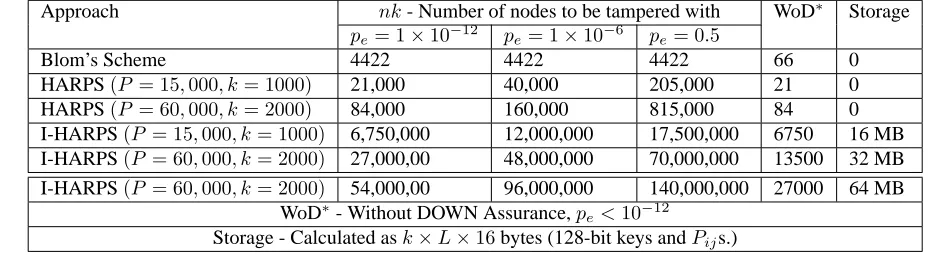
Table 1 provides a comparison of the 6 schemes. Also shown is the effect of increasing insecure storage on the security of I-HARPS (last row). For calculating the storage we have assumed that eachPij value is 128-bits or 16 bytes (all keys are 128-bits
long).
With DOWN, Blom’s scheme is renderednk = 66×67 = 4422-secure. For HARPS and I-HARPS, the table shows the number of nodes the attacker needs to tamper with (assuming the attacker can expose one secret from each node - thereby de-stroying the node in the process), fork= 1000andk= 2000, to discover shared secrets between nodes with some probabilitype.
Table 1: Comparison of 6 KPSs with the same “DOWN complexity.” All size - Blom’s scheme withk= 67,(P = 15,000, k = 1000)HARPS,(P = 60,000, k = 2000)HARPS,(P = 15,000, k = 1000)I-HARPS, and(P = 60,000, k = 2000)I-HARPS (withL= 1204andL= 2048) have DOWN complexity of 67.
Approach nk- Number of nodes to be tampered with WoD∗ Storage
pe= 1×10⁻¹² pe= 1×10⁻⁶ pe= 0.5
Blom’s Scheme 4422 4422 4422 66 0
HARPS(P = 15,000, k= 1000) 21,000 40,000 205,000 21 0
HARPS(P = 60,000, k= 2000) 84,000 160,000 815,000 84 0
I-HARPS(P = 15,000, k= 1000) 6,750,000 12,000,000 17,500,000 6750 16 MB I-HARPS(P = 60,000, k= 2000) 27,000,00 48,000,000 70,000,000 13500 32 MB
I-HARPS(P = 60,000, k= 2000) 54,000,00 96,000,000 140,000,000 27000 64 MB WoD∗- Without DOWN Assurance,pe<10−12
Storage - Calculated ask×L×16bytes (128-bit keys andPijs.)
With I-HARPS withk= 2000andL= 1024(or 32 MB inse-cure storage), the attacker has to destroy about 48 million chips to achieve the same goal!
Thus with RKPSs it is possible to take advantage20of the
prac-tical, large NVM storage without increasing the computational complexity (as comparison between the two cases withk= 1000
andk= 2000for HARPS and I-HARPS readily demonstrates). With KPSs, secrets would be renewed periodically. In order to take part in renewal, a node with authenticate itself to the TA with all itskkeys. So in order for the attacker to take part in key updates, the minimum requirement for an attacker is to discover allksecrets in a node21.
Taking the effect of DOWN policy into consideration,
1. For HARPS withk = 2000, an attacker needs to destroy over 20 million nodes to have one in a trillion chance of discovering all 2000 secrets of some node
2. For I-HARPS withk = 2000, L = 2048, to achieve the same goal, an attacker has to destroy over 520 million nodes (260,000 nodes without DOWN assurance).
While most recent works in the literature on random key pre-distribution schemes [5] - [10] (apart from [12] and [11]) are targeted towards their use in severely resource constrained sen-sor networks, with the DOWN policy, random KPSs, especially I-HARPS, become serious contenders even for scenarios where resource constraint is not an issue.
5.2
Practical Limits on
k
While for random KPSs like I-HARPS, HARPS and RPS we can afford to increasekwithout increasing the DOWN complexity, increasingk also increases the complexity of the public func-tionF()used to determine the indexes of the shared keys. The complexity of the public function could beO(klogk)orO(P)
depending on the implementation ofF().
However, the public functionF()is just a random sequence generator. It does not need to satisfy strong cryptographic
prop-20Only random KPSs employing the “dimension” of uniqueness of
intersec-tion of large subsets. The LM-KPS cannot take advantage of the DOWN policy.
21However, this may not be sufficient [24] for the attacker
erties. The only requirement is that the output of F()is rea-sonably close to a uniform distribution22. Even very low
com-plexity block ciphers, with reduced Fiestel rounds (for example TEA [27] with 4-5 rounds instead of 32) could be used for this purpose.
Implementations ofO(klogk)complexity would involve gen-eration of k-length uniformly distributed random variables to generate the partial permutation {A1· · ·Ak}. However,
com-parison of two sequences{A1· · ·Ak}and{B1· · ·Bk}to
deter-mine intersections would have a complexity ofO(klogk). Implementations ofO(P)complexity could actually be more straight-forward. For instance ifL = 1024andξ = 1/16, we could simply generateP uniformly distributed random integers F(A) =R1· · ·RP seeded by the node ID. The last four bits of
Riindicate if keyiis assigned to nodeA(for instance only if the
last 4 bits are all zeros - which will occur with a probability 1/16 - the desired probability for allocation of keys to each node). Similarly, 10 bits to the left of the 4 LSBs could indicate the ID of the node in systemi (between 1 and 1024 - which will of course be ignored if the keyi is not assigned to node A). Thus for HARPS or I-HARPS with k = 1024, P = 16k = 16384, we just need to generate 7168 32-bit random integers (16×14 = 224bits from seven such integers can be used for 16 14-bit valuesRi).
Note that the later approach does not guarantee that each node has exactlykkeys - some nodes may have more and some less. The average number of keys in each node would bek. How-ever, for our analysis we have actually assumed this model (we assume that each key is allocated to a node with probabilityξ).
5.3
HARPS vs I-HARPS
The significant improvement offered by I-HARPS over HARPS comes at a price. First is the need for extra storage, which may not be a crucial issue. In fact I-HARPS is rendered less compu-tationally expensive than HARPS as for each shared key HARPS needs an average ofL/4additional hashes to be performed.
However I-HARPS loses much of the versatility of HARPS.
22If the distribution of the output of F()is not uniform, it may result in
With HARPS, the same set of secrets which are used for pair-wise authentication, can also be used for broadcast authentica-tion [41], instantaneous discovery of shared group secrets (or conference secrets) and non-instantaneous discovery of group secrets (or broadcast encryption [42]). All these are not possible with I-HARPS. Further, HARPS caters for trivial extensions to a tree-hierarchical deployment [43], while protecting higher lev-els of hierarchy from compromise of secrets in the lower levlev-els of hierarchy.
6
Conclusions
We have presented a novel random key pre-distribution scheme which takes advantage of cheap and practically unrestricted in-secure storage like flash memory cards that wireless hand held devices are expected to have to yield dramatic gains in secu-rity and over other key pre-distribution without increasing secure storage complexity and computational complexity. Specifically, the proposed schemes was shown to be an order of magnitude more efficient than Blom’s scheme (which however cannot be implemented using pure symmetric cryptographic primitives), and over 300 times more efficient than other random key pre-distribution schemes of comparable complexity (which however do not need the additional insecure storage requirement).
We have also investigated the effect of a simple security policy, DOWN, on the security of the proposed scheme, and KPSs in general. In addition to being very efficient, the proposed scheme also lends itself well to efficient DOWN implementations.
Note that even with no assurance of read proofing or tamper resistance, I-HARPS with k = 2000 and a storage complex-ity of 64 MB can reasonably resist coalitions of up to 30,000 nodes (for resistance to attacks aimed at discovering shared se-crets) and more than 260,000 nodes for synthesis attacks. Thus with very little support from technology for tamper resistance / read-proofing I-HARPS could provide a a secure alternative to PKI for ad hoc mutual authentication. One of our current research effort involves extension of I-HARPS to hierarchical deployments.
References
[1] R. Needham and M. Schroeder, “Using encryption for au-thentication in large networks of computers,” Communica-tions of the ACM, 21(12), December 1978.
[2] R. Blom, “An Optimal Class of Symmetric Key Generation Systems,” Advances in Cryptology: Proc. of Eurocrypt 84, Lecture Notes in Computer Science, 209, Springer-Verlag, Berlin, pp. 335-338, 1984.
[3] T. Leighton, S. Micali, “Secret-key Agreement without PublicKey Cryptography,”Advances in Cryptology -CRYPTO 1993, pp 456-479, 1994.
[4] M. Dyer, T. Fenner, A. Frieze and A. Thomason, “On Key Storage in Secure Networks,” Journal of Cryptology, 8, 189–200, 1995.
[5] L. Eschenauer, V.D. Gligor, “A Key-Management Scheme for Distributed Sensor Networks,” Proceedings of the Ninth ACM Conference on Computer and Communica-tions Security, Washington DC, pp 41-47, Nov 2002.
[6] H. Chan, A. Perrig, D. Song, “Random Key Pre-distribution Schemes for Sensor Networks,” IEEE Sympo-sium on Security and Privacy, Berkeley, California, May 2003.
[7] R. Di Pietro, L. V. Mancini, A. Mei, “Random Key Assign-ment for Secure Wireless Sensor Networks,” 2003 ACM Workshop on Security of Ad Hoc and Sensor Networks, October 2003.
[8] S. Zhu, S. Xu, S. Setia S. Jajodia, “Establishing Pair-wise Keys For Secure Communication in Ad Hoc Networks: A Probabilistic Approach,” Proc. of the 11th IEEE Interna-tional Conference on Network Protocols (ICNP’03), At-lanta, Georgia, November 4-7, 2003.
[9] W. Du, J. Deng, Y.S. Han. P.K.Varshney, “A Pairwise Key Pre-distribution Scheme for Wireless Sensor Networks,” Proceedings of the 10th ACM Conference on Computer and Communication Security, pp 42–51, 2003.
[10] D. Liu, P.Ning, “Establishing Pairwise Keys in Distributed Sensor Networks,” Proceedings of the 10th ACM Confer-ence on Computer and Communication Security, Washing-ton DC, 2003.
[11] M. Ramkumar, N. Memon, R. Simha, “Pre-Loaded Key Based Multicast and Broadcast Authentication in Mobile Ad-Hoc Networks,” Globecom-2003.
[12] M. Ramkumar, N. Memon, “An Efficient Random Key Pre-distribution Scheme for MANET Security,” IEEE Journal on Selected Areas of Communication, March 2005.
[13] M. Ramkumar, “DOWN with Trusted Devices,” submitted to New Security Paradigms Workshop (NSPW) 2005.
[14] D. Clarke, J-E Elien, M. Fredette, A. Marcos, R.L.Rivest, “Certificate chain discovery in SPKI/SDSI,” Journal of Computer Security, vol. 9, no. 4, pp. 285 – 322(38), 2001.
[15] D. Boneh, M. Frankling, “Identity Based Encryption from the Weil Pairing,” Advances in Cryptology, Crypto 2001,, Berlin, 2001, LNCS vol 2139. Advances in Cryptology: Proc. of Eurocrypt 84, Lecture Notes in Computer Science,
209, Springer-Verlag, Berlin, pp. 335-338, 1984.
[17] T. Matsumoto, M.E.Hellman, “New Directions in Cryp-tography,” IEEE Transactions on Information Theory,
IT-22(6), Dec. 1976, pp.644-654.
[18] D. R. Stinson, T. van Trung, “Some New Results on Key Distribution Patterns and Broadcast Encryption,” Designs, Codes and Cryptography, 14 (3) pp 261–279, 1998.
[19] L. Gong, D.J. Wheeler, “A Matrix Key Distribution Scheme,” Journal of Cryptology, 2(2), pp 51-59, 1990.
[20] C.J. Mitchell, F.C. Piper, “Key Storage in Secure Net-works,” Discrete Applied Mathematics, 21 pp 215–228, 1995.
[21] P. Erdos, P. Frankl, Z. Furedi, “Families of Finite Sets in which no Set is Covered by the Union ofrOthers,” Isreal Journal of Mathematics, 51, pp 79–89, 1985.
[22] B. Gassend, D. Clarke, M. van Dijk, S. Devadas, “Silicon Physical Random Functions,” Proceedings of the 9th ACM conference on Computer and communications security, pp 148-160, 2002.
[23] J.P. McGregor, R. B. Lee, “Protecting Cryptographic Keys and Computations via Virtual Secure Coprocessing,” ACM SIGARCH Computer Architecture News archive, 33(1), March 2005.
[24] M. Ramkumar , “Safe Renewal of a Random Key Pre-distribution Scheme for Trusted Devices,” to be presented at the 6th IEEE Information Assurance Workshop (The West Point Workshop), United States Military Academy, West Point, New York, June 2005.
[25] A. Pfitzmann, B. Pfitzmann, M. Schunter, and M. Waid-ner, “Mobile User Devices and Security Modules: De-sign for Trustworthiness”; IBM Research Report RZ 2784 (#89262) 02/05/96, IBM Research Division, Zurich, Feb. 1996.
[26] R. Gennaro, A. Lysyanskaya, T. Malkin, S. Micali, T. Ra-bin, “Tamper Proof Security: Theoretical Foundations for Security Against Hardware Tampering,” Theory of Cryp-tography Conference, Cambridge, MA, February 2004.
[27] R. Needham, D. Wheeler, “TEA - A Tiny Encryption Al-gorithm,” Fast Software Encryption, 1994.
[28] R. Anderson, M. Kuhn, “Low Cost Attacks on Tamper Re-sistant Devices,” IWSP: International Workshop on Secu-rity Protocols, Paris, April 1997.
[29] S. Skorobogatov, R. Anderson, “Optical Fault Induction Attacks,” Cryptographic Hardware and Embedded Sys-tems Workshop (CHES-2002), LNCS 2523, Springer-Verlag, ISBN 3-540-00409-2, pp 2–12.
[30] P. Kocher, “Differential Power Analysis,” Advances in Cryptology, CRYPTO 1999, Springer LNCS series, Vol 1666, pp 388–397.
[31] M.G Karpovsky, K. Kulikowski, A. Taubin, ” Robust Pro-tection Against Fault-Injection Attacks of Smart Cards Im-plementing the Advanced Encryption Standard”. T Proc. Int. Conference on Dependable Systems and Networks (DNS 2004), July, 2004.
[32] O. Kommerling, M. Kuhn, “Design principles for tamper-resistant smart-card processors,” Proceedings of the Usenix Workshop on Smartcard Technology, pp. 9–20, 1999.
[33] P. Laackmann, B. Meier, H. Nguyen, Infineon Technolo-gies, “Revolution In The Smart Card Security,” available at http://www.epn-online.com/page/11955/revolution-in-the-smart-card-security-physical-attacks.html.
[34] Y. Ishai, A. Sahai, D. Wagner, “Private Circuits: Securing Hardware against Probing Attacks,” CRYPTO 2003, Santa Barbara, CA, Aug 2003.
[35] IEEE P1619 - Standard Architecture for Encrypted Shared Storage Media, available at http://siswg.org/docs/.
[36] R. Rivest, “All-or-nothing encryption and and the package transform,” Fast Software Encryption 1997, LNCS 1267, E. Biham Ed., Springer-Verlag, 1997.
[37] D. Lim, “Extracting Secret Keys from Integrated Circuits,” Masters Thesis, Department of Electrical Engineering and Computer Science, Massachusetts Institute of Technology, May 2004.
[38] F. M. Williams, N. Sloane, The Theory of Error-Correcting Codes, North-Holland Press, 1977.
[39] R. J. Anderson, Security Engineering: A Guide to Build-ing Dependable Distributed Systems, John Wiley and Sons, 2001.
[40] P. Gutman, “Secure Deletion of Data from Magnetic and Solid-State Memory,” Sixth USENIX Security Sympo-sium, San Jose, California, July 1996.
[41] M. Ramkumar, “Broadcast Authentication With Hashed Random Preloaded Subsets,” ePrint Archive, 2005/134, May 2005.
[42] M. Ramkumar, N. Memon, “A DRM Based on Renewable Broadcast Encryption,” to be presented at the Visual Com-munications and Image Processing (VCIP) Workshop, Bei-jing, China, July 2005.