Transactions, SMiRT-25 Charlotte, NC, USA, August 4-9, 2019
Division III
STRUCTURE-SOIL-STRUCTURE INTERACTION EFFECTS:
A CASE STUDY COMPARING TWO APPROACHES
Julio García1, Benjamin Kosbab2, Andrii Nykyforchyn3, Sunay Stäuble3 and Jens-Uwe Klügel3
1 Principal Engineer, SC Solutions, Marietta, GA, USA, [email protected] 2 Principal Engineer, SC Solutions, Marietta, GA, USA
3 Goesgen Nuclear Power Plant, Daeniken, Switzerland
ABSTRACT
The seismic SSSI effects in the nuclear island buildings for a representative plant are considered. The nuclear island consists of four buildings. The seismic SSSI effects on the lightest and smallest building (building of interest) are analyzed with two different approaches (ASCE 4-16, 2017). First, a model that includes all four buildings (explicit SSSI model) is constructed and used for the SSI analysis under a reference ground motion. This represents a rigorous approach that streamlines the steps necessary, but increases the complexity and size of the analysis model. However, taking advantage of high performance computing capabilities (HPC), the time and effort of the analysis remain within reasonable limits. Second, a two-step procedure is used for an approximate study of the SSSI effects on the building of interest: (1) a model that excludes the building of interest, but includes all other three buildings within the nuclear island (neighbor buildings model) is used for a seismic analysis with a reference ground motion to calculate the seismic response as acceleration time histories at various points on the soil at the footprint of the building of interest, which are used to create a modified input motion that includes the effects of the nearby buildings; and (2) the modified input motion is used for a seismic analysis of a stand-alone SSI model of the building of interest. This represents a simplified approach, which is computationally less intensive, but restricts the interaction only to the input motion and neglects to consider the mutual interaction between buildings during their seismic response. The SSSI effects are evaluated comparing the seismic response of the lightest and smallest building (building of interest) from the explicit SSSI model with the response of the same building of interest without SSSI effects, using a model with no other buildings included (stand-alone SSI model) both under a reference ground motion. The structural response from the rigorous approach is compared with the response from the simplified approach to assess the effectiveness and limitations of the simplified approach. It is found that the response spectra results from the simplified approach significantly overestimates the peak response amplitude compared to the response spectra results from the rigorous approach.
INTRODUCTION
CASE CONSIDERED
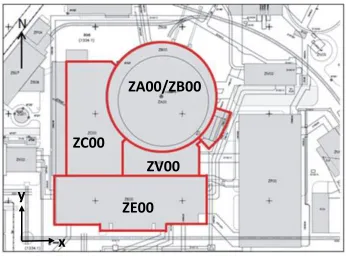
The seismic Structure-Soil-Structure Interaction (SSSI) effects in the nuclear island buildings for a representative plant are considered. The nuclear island consists of four buildings, including the reactor building (ZA00/ZB00), which is surrounded by the auxiliary building (ZC00) on the west side and the switchgear building (ZE00) and the emergency feed building (ZV00) on the south side, as it is shown in Figure 1.
Figure 1: Layout of Buildings Included in the Nuclear Island.
The site consists of well graded, highly compacted gravel on top of a relatively hard bedrock. The bottom of foundation elevation is generally located at similar elevation for all four buildings, with adjacent structures separated by gaps between buildings. Effective embedment is achieved along the perimeter of the nuclear island.
The emergency feed building (ZV00) is a reinforced concrete structure consisting basically of basement and two storeys, about 15 m tall and founded on a mat foundation of approximately 40 x 16 m. The bottom 9 m of the building is embedded, with effective embedment only along the east side, and no effective embedment on the north, south and west sides along the boundaries with the neighbor buildings. The neighbor buildings ZC00 and ZE00 have a mass of approximately 4 and 5 times the mass of the ZV00 building, respectively, while the more massive ZA00/ZB00 building has a mass of approximately 18 times the mass of the ZV00 building, and approximately 4 times the mass of the ZC00 and ZE00 buildings, respectively.
It is expected that the structural response of the ZV00 (the smallest and lightest of all four buildings) will be the most affected by SSSI effect, and is therefore selected for consideration in this case study. Specifically, the inclusion of the more massive ZA00/ZB00 building is expected to drive the response of all structures on the nuclear island, especially the lightweight ZV00. It is also expected that the structural response of the ZV00 building will be affected by the presence of the ZC00 and ZE00 buildings, but have a lesser effect than the ZA00/ZB00 building.
ZA00/ZB00
ZE00
ZC00
ZV00
APPROACH
The seismic SSSI effects are analyzed with two different approaches, which are considered acceptable by ASCE 4-16 (2017): For approach 1, a model that includes all four buildings (explicit SSSI model) is constructed and used for the SSI analysis in one step. This is considered a rigorous approach to evaluate the SSSI effects, which streamlines the steps necessary, but increases the complexity and size of the analysis model. However, taking advantage of high performance computing capabilities (HPC), the time and effort of the analysis remain within reasonable limits.
For approach 2, a two-step procedure is used for an approximate study of the SSSI effects on the ZV00. First, a model that excludes the ZV00 building, but includes all other buildings (neighbor buildings model) is subjected to a seismic analysis under a reference ground motion and used to calculate the seismic response as acceleration time histories at various points on the soil at the footprint of the ZV00 building. The spatial variation of the calculated acceleration time histories using the neighbour buildings model on the soil at locations on the footprint of the ZV00 at the elevation of bottom of foundation is analyzed. Further, the calculated acceleration time histories on the soil are used to generate a representative modified ground motion, which considers the effects of the neighbour buildings. In a second step, the modified ground motion is used as an input for a seismic analysis of a stand-alone SSI model of the ZV00 building. This is considered a simplified approach to evaluate the SSSI effects. Note that even though the simplified approach is basically postulated in ASCE 4-16 (2017) as an approximate approach to study the SSSI effects of two buildings: one light building and one heavy building, in this investigation the simplified approach is used to study the SSSI effects of multiple (four) buildings, according to the actual conditions at the plant.
This study concentrates on the response of the ZV00 building, further referred to as the building of interest, affected by the three neighbor structures, especially the heaviest ZA00/ZB00 building. Two objectives are sought: First, the SSSI effects on the ZV00 building are briefly discussed and assessed by comparing the response of the structure using the rigorous SSSI approach with the response of a stand-alone analysis: considering the building of interest with no other structures included. Second, the response of the building of interest using the simplified approach is compared with the response of the same building of interest using the rigorous approach to assess the effectiveness and limitations of the simplified approach.
MODELS CONSIDERED
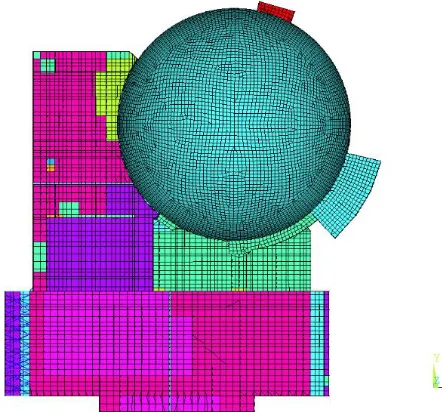
The rigorous approach considers an “explicit SSSI model”, while the simplified approach considers two models: a “neighbor buildings model” and a “stand-alone model”. Embedment conditions (considering full embedment along the perimeter of the nuclear island and no embedment elsewhere) are approximated during model development, where applicable. The rigorous approach uses an explicit SSSI model which consists of four buildings: ZA00/ZB00, ZC00, ZE00 and ZV00 and it is shown in Figure 2.
Figure 2: Explicit SSSI Model for Rigorous Approach
The simplified approach uses two models: a neighbor buildings model which consists of ZA00/ZB00, ZC00 and ZE00 buildings, and a stand-alone model which consists of ZV00 building; both models: neighbour buildings model and stand alone model, respectively, are shown in Figure 3.
RESULTS
The results from the rigorous approach are compared versus the results of a stand-alone model, both under a reference input motion, to assess the SSSI effects on the ZV00 building. For the simplified approach, a modified input motion is calculated first; then, a stand-alone model is subjected to a modified input motion and the results from the simplified approach are calculated and compared versus the results from the rigorous approach to assess the efficiency and limitations of the simplified approach.
Rigorous Approach and SSSI effects
The explicit SSSI model is subjected to the reference ground motion and the In-Structure Response Spectra (ISRS) at the monitoring location is calculated and normalized with respect to the peak ground acceleration (PGA) in the horizontal direction of the reference ground motion. The ISRS results from the explicit SSSI model are compared with the results from the stand-alone analysis in Figure 4. Comparison of the response of the ZV00 building at the same monitoring location for the explicit SSSI model, with the response for the stand-alone SSI model, indicates general differences in the spectral shapes, in the spectral amplitudes, and in the peak spectral amplitudes occurring at different frequencies for both the explicit SSSI model and the stand-alone SSI model (without any SSSI effects).
Figure 4: ISRS (normalized) for ZV00 building for Stand-Alone and Explicit SSSI Models
demands on typical equipment and components) the SSSI response agrees reasonably well with the stand-alone response
The differences in the spectral shape of the explicit SSSI results compared with the spectral shape of the stand-alone results indicate the nature of the SSSI effects for the case of the ZV00 building: the presence of the neighbour buildings produces an increase in the response for some frequencies and a decrease in the response for some other frequencies; additionally, the SSSI effects indicate an increase in the response in the vertical direction for certain frequencies, which is associated with rocking behaviour induced by the presence of the neighbour buildings.
Input Motion for Simplified Approach
The input motion for the simplified model is defined considering the response of the soil at the footprint location of the ZV00 building from the neighbor buildings model due to a reference ground motion, which accounts for the presence and influence of the neighbor buildings, but with no structural model at that location.
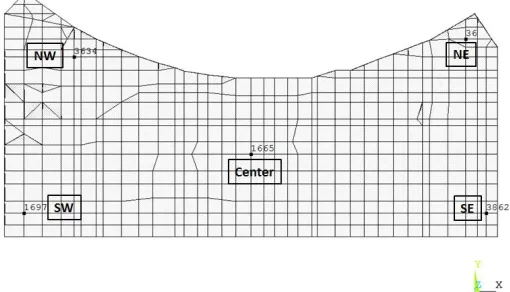
To understand the spatial distribution of the response from the neighbor buildings model, nodes on the soil are selected close to the four corners (NW, NE, SW and SE) of the footprint of the building of interest and at the elevation of the bottom of the foundation as shown in Figure 5.
Figure 5: Corner and Center locations for the Building of Interest for Soil Nodes in the Neighbor Structures Model – Simplified Approach
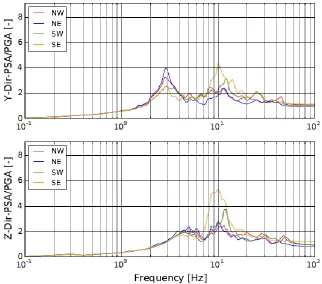
Figure 6: Response Spectra (normalized) at representative nodes close to corners for the Building of Interest in the Neighbor Structures Model – Simplified Approach
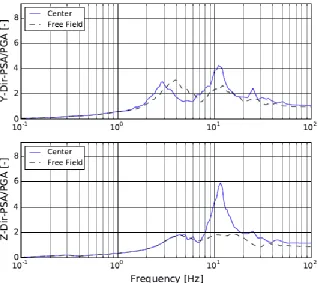
Each soil node is subjected to the influence of the three neighbour buildings, depending on the relative location to each building. However, the response of the soil nodes is relatively independent from each other, as there is no structural element that connects them. From the four corner nodes monitored, it is observed that the maximum response occurs along the east boundary of the ZV00 footprint, which corresponds to the less restrained line, compared with the other three boundaries that are restrained and driven by the response of each of the three neighbor buildings. The peak spectral amplification in low frequency, occurs at the NE corner, which is adjacent to the ZA00/ZB00 building on one side and to the free boundary on the other side. The peak spectral amplification in mid to high frequency, occurs at the SE corner, which is adjacent to the ZE00 building on one side and to the free boundary on the other side. If the foundation of the building of interest were subjected to this input motion, it would be expected that this non-uniform motion could partly be compensated by the stiffness of the foundation and partly could induce non-uniform structural response (rocking and/or torsion).
Figure 7: Response Spectra (normalized) Comparison of the Modified Input Motion with the Reference Input Motion.
In general, the differences in the spectral shapes, spectral amplitudes, and frequency content between the response spectra of the modified input motion and the response spectra of the reference input motion are generally similar to those observed in the SSSI response compared to the stand-alone response. This similarity suggests that this simplified approach can be expected to capture similar physically reasonable SSSI behavior as the more explicit treatment of SSSI effects, lending some confidence that the simplified approach is meaningful.
Note that the modified input motion, although it considers the effect of the neighbor buildings, deviates from the ASCE-4-16 (2017) guidelines on two conditions: (1) The modified input motion does not explicitly considers the torsion and/or rocking behavior observed in the spatial distribution; and (2) The modified input motion does not strictly envelope the reference input motion at all the frequencies of interest, as it is shown that in some frequency ranges the modified input motion has lower amplitudes in comparison with the reference input motion; in fact, if the modified input motion were forced to envelope the reference input motion, an artificial amplitude increase would be forced in those particular frequency ranges. Even though there are differences in the spectral shapes between the modified input motion and the reference motion (mostly in y-direction), the spectral amplitudes of the modified input motion are in general equal or higher than the spectral amplitudes of the reference input motion, and therefore the modified input motion could be understood as an increase of amplitude, frequency-dependent, of the reference input motion.
Assessment of Simplified Approach to Evaluate SSSI Effects
explicit SSSI approach in Figure 8, both normalized with respect to the peak ground acceleration (PGA) in horizontal direction of the reference ground motion, respectively.
Figure 8: ISRS (normalized) Comparison for the Simplified Approach versus Rigorous Approach
In general, the simplified approach reports relatively similar spectral shape but higher response amplitude in y- as well as in z- direction in comparison with the response from the rigorous approach. The response comparison in y-direction, which is parallel to the axis orientation crossing the two buildings: the heaviest building ZA00 and the lighter ZV00 indicates that the simplified approach overpredicts the response of the ZV00 on the order of 30%. The response comparison in z-direction, which also includes the coupling rocking response between the heaviest building ZA00/ZB00 and the lighter ZV00 building, indicates that the simplified approach overpredicts the response of the ZV00 from 30% to 100%.
The relatively similar spectral shape from the simplified approach in comparison with the spectral shape from rigorous approach indicates that the simplified approach does account for the important frequency sources of SSSI effects: the presence of the heaviest ZA00/ZB00 building, as well as the other neighbour buildings: ZC00 and ZE00. However, the overprediction of the spectral amplitudes reported by the simplified approach indicates that the net effect of the modified input motion on the stand-alone building simply overpredicts the spectral response amplitudes and falls short of capturing the effect of the non-uniform input motion that should induce rocking/torsion structural behavior.
ACKNOWLEDGMENTS
SUMMARY AND CONCLUSIONS
Two approaches for consideration of SSSI effects have been used and compared in a case study: an explicit approach and a simplified approach.
The SSSI effects for the building of interest are evaluated comparing the response from the explicit SSSI model with the response of a stand-alone SSI model (without any SSSI effects), both within the assumptions and constraints of the equivalent linear approach. It is found that the presence of the neighbour buildings produces an increase in the response for some frequencies and a decrease in the response for some other frequencies; besides, the SSSI effects indicate an increase in the response in the vertical direction for certain frequencies associated with rocking behavior induced by the presence of the neighbour buildings.
In general, the simplified approach for consideration of SSSI effects produces relatively similar spectral shape but significantly higher response amplitude in y- as well as in z- direction in comparison with the response from the rigorous approach. The simplified approach reports spectral amplitude that are in general on the order of 30% higher in horizontal direction, and up to 100% higher in vertical direction than those reported by the rigorous approach for certain frequency ranges
A single point translational motion for the simplified analysis is not capable of reproducing the potential non-uniform rocking and or torsion movement that would be expected by the strong spatial variation observed at the response of the soil for the neighbour building model. As a result, the simplified approach is found unable to capture significant effects like the spatial variation of the decoupled input motion on the footprint of the ZV00 building nor the coupling terms of the SSSI system.
The recommendation from ASCE 4-16 that the modified input motion for the simplified approach needs to envelope the reference input motion at the frequencies of interest could impose an artificial amplitude increase in some frequency ranges that would be reflected in additional overamplification of the response using the simplified approach for consideration of the SSSI effects.
Comparing the two approaches for consideration of SSSI effects, both the rigorous and simplified approaches have apparent benefits and drawbacks. The rigorous approach streamlines the steps necessary and more accurately captures complex SSSI behaviors, but increases the complexity and size of the analysis model. The simplified approach is less computationally intensive, but increases uncertainty with respect to certain SSSI behaviors, is potentially conservative and subject to possible artificial amplification, and requires additional intermediate steps. As high-performance computing (HPC) capabilities continue to improve, the primary drawback of the rigorous approach diminishes, making it the preferred approach. However, the balance of computational cost and complexity versus engineering effort and justifying simplifications should be assessed for each unique case.
REFERENCES
American Society of Civil Engineers, (2017). Seismic Analysis of Safety-Related Nuclear Structures, ASCE/SEI 4-16, Reston, VA, USA.