Utilization of Solid Waste Particles as
Aggregates in Concrete
K.Sathish Kumar
1, Mr.S.Dilli Babu*
21
Assistant Professor, Department of Civil Engineering, Bharath University, Chennai, India
2*
Assistant Professor, Department of Civil Engineering,Bharath University, Chennai, India
ABSTRACT: The river sand is one of the unavoidable ingredients in Civil Construction. The Construction activities
are increasing day by day. This usage of river sand is increasing its scarcity and its price in all parts of the co untry. Reducing the consumption of river sand in construction is a major issue while considering the Economic view. It also helps to save the environment by reducing the harmful impact of sand mining. The Discarded vehicle tyres which are historically been disposed of into landfills constitute an important part of the solid waste. Tyre disposal to landfills is problematic, as waste rubber is not easily biodegradable. An emerging field for the reuse of scrap tyres is in the production of concrete, where rubber tyres can be used as a partial replacement to natural aggregates. This has the additional advantage of saving in natural resources. In this study, an attempt has been made to control the environmental pollution and to save the natural resources by using the discarded rubber tyres for partial replacement for coarse aggregates and Copper slag for the partial replacement for fine aggregates.
KEYWORDS: Copper Slag; discarded rubber tyres; compression test; rebound hammer test; split tensile test
I. INTRODUCTION
Due to the rapid growth in population, the numbers of vehicles are increasing every day. The rubber tyres used in vehicles are thrown away after it is undergone to wear and tear. It is causing lot of environmental pollution. Discarded vehicle tyres constitute one important part of solid waste which has historically been disposed of into landfills. It is estimated that in India about 400 million tyres per year (i.e. more than 1,00,00,00 tyres per day) have been ending up as waste. This number is expected to increase by a further 63% by 2021, due to the forecasted growth in road traffic. This has become a major solid waste disposal problem. Tyre disposal to landfills is problematic, as waste rubber is not easily biodegradable. Stockpiled tyres also present many, health, environmental and economic risks through air, water and soil pollution, littering the landscape, and providing a breeding habitat for various pests. Moreover, tyres cause serious fire hazards: once set alight, they burn fiercely, producing a number of chemicals that are harmful to the environment. An emerging field for the reuse of scrap tyres is in the production of concrete, where tyre rubber can be used as a partial replacement to natural aggregates. This has the additional advantage of saving in natural resources. Shredded or ground tyres are different to other waste materials with a potential for re-use, because their production method is now well developed. Hence, the reuse of this material in concrete could have both environmental advantages and at the same time ensure economic viability.
Copyright to IJIRSET DOI: 10.15680/IJIRSET.2015.0403115 934 industries (India) ltd, Tuticorin, India produces 4 lakh tons of copper per year. For every ton of copper production, about 2.2 tons of copper slag is generated. Therefore, in India 8 lakh tons of copper slag is generated every year. It was obtained as a result of manufacturing of copper electrodes in Sterlite industry. Copper slag have been widely used for abrasive tools, roofing granules, cutting tools, abrasive, tiles, glass, road base construction, rail road ballast and cement and concrete industries. Several researchers have investigated the possible use of copper slag as fine and coarse aggregates in normal concrete and its effect on different mechanical properties of mortar and concrete.
II. EXPERIMENTAL PROGRAM
A. Materials required
1) Cement: Ordinary Portland Cement of grade 53 is used for the experiments [1-2]. The specific gravity of cement is 3.15.
2) Coarse and Fine Aggregates: Coarse aggregates are purchased from a nearby crusher in Chennai. Coarse aggregate with the size of 20mm were used. The fine aggregate was river sand which has the specific gravity of 2.55 and bulk density of 1.61
3) Copper slag: Copper slag is a by-product obtained during the production of copper in copper industries. Copper slag used in this work was brought from Sterlite industries (India) Ltd, Tuticorin.
4) Discarded rubber tyres: Rubber Tyres are obtained from a near work shop and is cut into pieces of 20 mm size. It is used to replace the coarse aggregates in some percentages [3-4].
III. LABORATORY TESTING MACHINE
A. Physical properties of Copper Slag
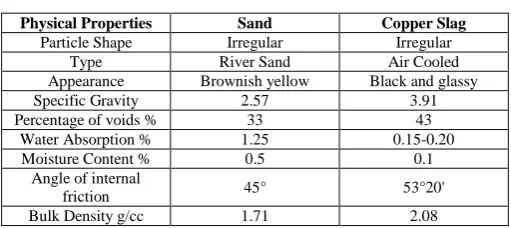
TABLE I. PHYSICAL PROPERTIES OF COPPER SLAG
Physical Properties Sand Copper Slag
Particle Shape Irregular Irregular
Type River Sand Air Cooled
Appearance Brownish yellow Black and glassy
Specific Gravity 2.57 3.91
Percentage of voids % 33 43
Water Absorption % 1.25 0.15-0.20
Moisture Content % 0.5 0.1
Angle of internal
friction 45° 53°20'
Bulk Density g/cc 1.71 2.08
B. Mix Design and Sample Preparation
TABLE II. CONCRETE MIXES WITH DIFFERENT PROPORTIONS OF CEMENT(C),COPPER SLAG(S) AND DISCARDED RUBBER TYRES (RT).ALL
VALUES IN KG/CU.M
Material C S W F.A C.A RT
S 0 14.06 0 7L 19.4 45.37 0
S 10 14.06 1.93 7L 17.4 45.37 0
S 20 14.06 3.88 7L 15.5 45.37 0
S 30 14.06 5.8 7L 13.6 45.37 0
S 40 14.06 7.75 7L 11.6 45.37 0
RT 5 14.06 9.69 7L 9.69 43.1 2.3
RT 10 14.06 0 7L 19.4 40.83 4.5
RT 15 14.06 0 7L 19.4 38.56 6.8
RT 20 14.06 0 7L 19.4 36.3 9.1
S 40 RT 15
14.06 7.75 7L 11.6 38.56 6.8
[S10 means Copper slag 10% replaced, RT5 means Rubber Tyres 5% Replaced]
IV. RESULTS
A. Compressive Strength of Cubes
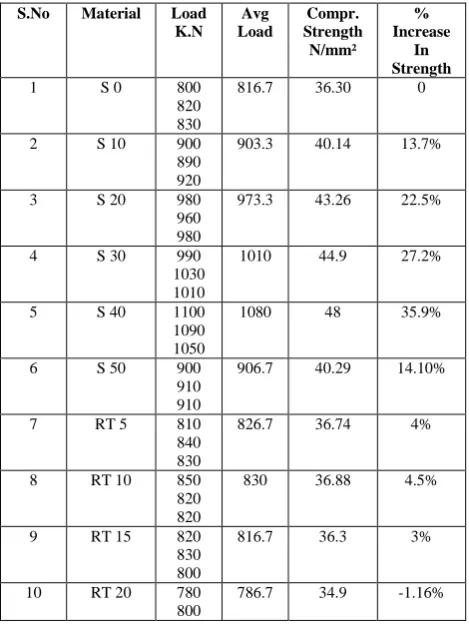
To determine the compressive strength, cube moulds of size 150x150x150 mm were used. 33 cubes were caste with different proportions of copper slag and rubber pieces. The moulds were cleaned thoroughly using a waste cloth and then properly oiled along its faces [9], [14]. Concrete was then filled in mould and then compacted using a standard tamping rod of 60 cm length having a cross sectional area of 225mm2. The table below shows the test results obtained on the compressive strength test on cubes.
TABLE III. COMPRESSIVE STRENGTH OF CUBE SPECIMENS AFTER 28 DAYS
S.No Material Load K.N
Avg Load
Compr. Strength N/mm²
% Increase
In Strength
1 S 0 800
820 830
816.7 36.30 0
2 S 10 900
890 920
903.3 40.14 13.7%
3 S 20 980
960 980
973.3 43.26 22.5%
4 S 30 990
1030 1010
1010 44.9 27.2%
5 S 40 1100
1090 1050
1080 48 35.9%
6 S 50 900
910 910
906.7 40.29 14.10%
7 RT 5 810
840 830
Copyright to IJIRSET DOI: 10.15680/IJIRSET.2015.0403115 936 780
11 S 40
RT 15
950 940 960
950 42.22 19.5%
B. Split tensile test on Cylinders
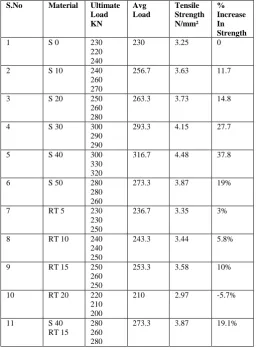
To determine the split tensile strength, cylinder moulds of diameter 150mm and length 300mm were casted. Totally, 33 cylindrical specimens were casted with different proportions of copper slag. The crude oil was applied along the inner surfaces of the mould for the easy removal of casted cylinder from the mould [10-11].
Split tensile strength=2P/Πld, P= Ultimate Load at failure, L=Length of specimen, D=Diameter of cylindrical specimen
TABLE IV. SPLIT TENSILE TEST ON CYLINDER SPECIMEN AFTER 28 DAYS
S.No Material Ultimate Load KN
Avg Load
Tensile Strength N/mm²
% Increase In Strength
1 S 0 230
220 240
230 3.25 0
2 S 10 240
260 270
256.7 3.63 11.7
3 S 20 250
260 280
263.3 3.73 14.8
4 S 30 300
290 290
293.3 4.15 27.7
5 S 40 300
330 320
316.7 4.48 37.8
6 S 50 280
280 260
273.3 3.87 19%
7 RT 5 230
230 250
236.7 3.35 3%
8 RT 10 240
240 250
243.3 3.44 5.8%
9 RT 15 250
260 250
253.3 3.58 10%
10 RT 20 220
210 200
210 2.97 -5.7%
11 S 40
RT 15
280 260 280
C. Flexural strength of Beams
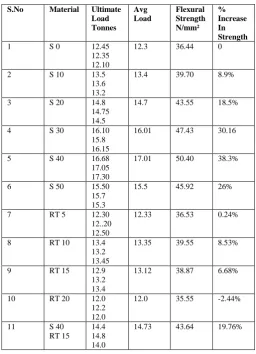
Beam specimens of size 1000 x150 x150mm are casted. To conduct the test the beam specimens were placed on the loading frame. Plumb bop was used to correct the centre of the beam [12]. Two distance pieces were kept at the one third distances from both the ends. Loading frame was placed upon the distance pieces and its centre was corrected using plumb bob. Two point loading system was adopted for the test [15].
Modulus of rupture= PL / BD2,P = ultimate load in KN, L = length of beam in m, B = Average width of specimen in m, D = Average depth of specimen in m.
TABLE V. FLEXURAL STRENGTH TEST ON BEAM SPECIMEN AFTER 28 DAYS
S.No Material Ultimate Load Tonnes
Avg Load
Flexural Strength N/mm²
% Increase In Strength
1 S 0 12.45
12.35 12.10
12.3 36.44 0
2 S 10 13.5
13.6 13.2
13.4 39.70 8.9%
3 S 20 14.8
14.75 14.5
14.7 43.55 18.5%
4 S 30 16.10
15.8 16.15
16.01 47.43 30.16
5 S 40 16.68
17.05 17.30
17.01 50.40 38.3%
6 S 50 15.50
15.7 15.3
15.5 45.92 26%
7 RT 5 12.30
12..20 12.50
12.33 36.53 0.24%
8 RT 10 13.4
13.2 13.45
13.35 39.55 8.53%
9 RT 15 12.9
13.2 13.4
13.12 38.87 6.68%
10 RT 20 12.0
12.2 12.0
12.0 35.55 -2.44%
11 S 40
RT 15
14.4 14.8 14.0
14.73 43.64 19.76%
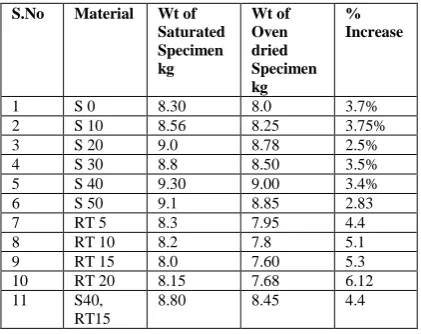
Copyright to IJIRSET DOI: 10.15680/IJIRSET.2015.0403115 938 S.No Material Wt of
Saturated Specimen kg
Wt of Oven dried Specimen kg
% Increase
1 S 0 8.30 8.0 3.7%
2 S 10 8.56 8.25 3.75%
3 S 20 9.0 8.78 2.5%
4 S 30 8.8 8.50 3.5%
5 S 40 9.30 9.00 3.4%
6 S 50 9.1 8.85 2.83
7 RT 5 8.3 7.95 4.4
8 RT 10 8.2 7.8 5.1
9 RT 15 8.0 7.60 5.3
10 RT 20 8.15 7.68 6.12
11 S40,
RT15
8.80 8.45 4.4
E. Ultrasonic Pulse wave velocity test
The Ultrasonic pulse velocity of concrete depends on the materials and the mix proportion used in making concrete and it is related to its density and modulus of elasticity.
TABLE VII. RESULTS FOR ULTRASONIC PULSE VELOCITY TEST
S.No Material Avge Transit Time µ sec
Distance mm
Avge Pulse Vel. Km/s
Concrete Quality
1 S 0 33.5 150 4.47 Excellent
2 S 10 32.2 150 4.65 Excellent
3 S 20 31.8 150 4.71 Excellent
4 S 30 31.5 150 4.76 Excellent
5 S 40 30.3 150 4.95 Excellent
6 S 50 31.8 150 4.71 Excellent
7 RT 5 33.6 150 4.46 Excellent
8 RT 10 33.4 150 4.49 Excellent
9 RT 15 34.0 150 4.41 Excellent
10 RT 20 35.3 150 4.2 Excellent
11 S 40
RT 15
31.2 150 4.80 Excellent
V. CONCLUSION
The following conclusions may be drawn from the study of the effect of copper slag and discarded rubber tyres replacement on the concrete properties
The addition of copper slag and rubber tyres has improved the compressive strength, split tensile strength and flexural strength of concrete.
The results from the ultrasonic pulse velocity tests prove that the copper slag and rubber tyre admixtured concrete have excellent quality.
The results revealed that addition of the copper slag in concrete increases the self–weight of the concrete.
The compressive strength increased by 36% in copper slag concrete. And when the rubber tyre and copper slag is mixed in definite percentage, the compressive strength increased by 20%
The flexural strength test on beams results show that the ultimate load carrying capacity of the beam increases by 30% for 38% replacement of copper slag.
Water absorption value of copper slag and rubber tyre concrete is lesser than normal concrete.
REFERENCES
[1] A.M. Arino, and B. Mobasher, Dept. of Civil & Environmental Engineering, Arizona State University, Tempe, Arizona, A paper on “The effect of ground copper slag on the strength, and Toughness of cementitious mixtures”M. Young, The Technical Writer's Handbook. Mill Valley, CA: University Science, 1989R. Nicole, “Title of paper with only first word capitalized,” J. Name Stand. Abbrev., in press.
[2] A. S. Alnuaimi, A paper on “The Use of copper slag as a replacement for fine aggregate in reinforced concrete slender columns” in WIT Transactions on Engineering Sciences, Vol 64, 2009, pages 125-133.
[3] Jaikumar S., Ramaswamy S., Asokan B.R., Mohan T., Gnanavel M., "Anti ulcer activity of methanolic extract of Jatropha curcas (Linn.) on Aspirin-induced gastric lesions in wistar strain rats", Research Journal of Pharmaceutical, Biological and Chemical Sciences, ISSN : 0975-8585, 1(4) (2010) PP.886-897.
[4] Brindha.D, Nagan.S, Dept. of Civil Engineering, A paper on “Durability Studies on Copper Slag Admixed Concrete” in Asian Journal Of Civil Engineering. (Building And Housing) VOL. 12, NO. 5, 2011.
[5] Kumar S.S., Rao M.R.K., Balasubramanian M.P., "Anticarcinogenic effects of indigofera aspalathoides on 20-methylcholanthrene induced fibrosarcoma in rats", Research Journal of Medicinal Plant, ISSN : 5(6) (2011) PP. 747-755.
[6] Bulent Yesilata, Yusuf Isiker, Paki Turgut , A paper on “Thermal insulation enhancement in concretes by adding waste PET and rubber pieces” in Construction and Building materials Journal, volume 23, 2009. Pages 1872-1888.
[7] D.Brindha, Baskaran.T, Nagan.S, In a paper on ”Assessment of Corrosion and Durability Characteristics of Copper Slag Admixed Concrete” International Journal of Civil and Structural Engineering, Volume 1, no 2, 2010, Pages 192-211.
[8] M. Mavroulidou & J.Figueiredo, A paper on “Discarded Tyre Rubber as concrete Aggregate: A Possible Outlet for used tires” in Global NEST Journal, 2010.
[9] Srinivasan V., "Analysis of static and dynamic load on hydrostatic bearing with variable viscosity and pressure", Indian Journal of Science and Technology, ISSN : 0974-6846, 6(S6) (2013) PP.4777-4782.
[10] Mukul Chandra Bora, Lecturer (Selection Grade), Department of Civil Engineering, Dibrugarh Polytechnic, Lahowal, Assam, A paper on “Sustainable Concrete with Scrap Tyre Aggregate”
[11] Prof. Osama A. Abaza, A paper on “The Utilization of Waste Tires in the Production of Non-Structural Portland Cement Concrete”
[12] Gopalakrishnan K., Prem Jeya Kumar M., Sundeep Aanand J., Udayakumar R., "Analysis of static and dynamic load on hydrostatic bearing with variable viscosity and pressure", Indian Journal of Science and Technology, ISSN : 0974-6846, 6(S6) (2013) PP.4783-4788.
[13] Teik-Thye Lim, Division of Environmental and Water Resources Engineering, Nanyang Technological University, Singapore; A study on “Assessment of the use of spent copper slag for land reclamation” in Waste Management & Research Journal, pages 67-73
[14] Yunping Xi, Yue Li, Zhaohui Xie, and Jae S. Lee; University of Colorado, Boulder, USA; A paper on “Utilization of Solid Wastes (Waste Glass and Rubber Particles) as aggregates in Concrete”, Pages 45-54.
[15] Subhashree A.R., Shanthi B., Parameaswari P.J., "The Red Cell Distribution Width as a sensitive biomarker for assessing the pulmonary function in automobile welders- a cross sectional study", Journal of Clinical and Diagnostic Research, ISSN : 0973 - 709X, 7(1) (2013) PP. 89-92.
[16] Dr. T.Nalini, Dr.K.Manivannan, Vaishnavi Moorthy, Efficient Remote Data Possession Checking In
Critical Information Infrastructures Ensuring
Data Storage Security In Cloud Computing, International Journal of Innovative Research in Computer and Communication Engineering, ISSN (Online): 2320 – 9801,pp 12-18, Vol. 1, Issue 1, March 2013
[17] Dr.K.P.Kaliyamurthie, Cervical Cancer Screening and Classification
Using Acoustic Shadowing, International Journal of Innovative Research in Computer and Communication Engineering, ISSN(Online): 2320-9801,pp 1659-1662, Volume 1, Issue 8, October 2013
[18] Dr.K.P.Kaliyamurthie, Automated Information Retrieval System
Using Correlation Based Multi- Document
Summarization Method, International Journal of Innovative Research in Computer and Communication Engineering, ISSN(Online): 2320-9801,pp 4328-4335, Vol. 1, Issue 7, September 2014
[19] Dr.K.P.Kaliyamurthie, D.Parameswari, Modelling Cloud Storage, International Journal of Innovative Research in Computer and Communication Engineering, ISSN: 2249-2651,pp 1-5, Volume1 Issue3 Number2–Dec2011
[20] Dr.K.P.Kaliyamurthie, D.Parameswari, Implementation of Customized Greencall
Algorithm for Energy-Efficient Of Wireless