Volume 3, No. 3, May-June 2012
International Journal of Advanced Research in Computer Science
RESEARCH PAPER
Available Online at www.ijarcs.info
ISSN No. 0976-5697
A Survey on Graph Domination Based Algorithms for Routing in Wireless Ad-Hoc
Network
Dr H B Walikar
Professor Dept of Computer Science Karnatak University
Dharwad, India [email protected]
Ishwar Baidari*
Asst. Professor Dept of Computer Science Karnatak University
Dharwad, India [email protected]
Shreedevi V Shindhe
Research Scholar Dept of Computer Science Karnatak University
Dharwad, India [email protected]
Abstract: During the last decade, wireless networks have been an interesting research in wireless computer networks with special attention focused on ad hoc networks (MANETs) in applications such as disaster management, battlefields communication, collaborative computing and any other situation requiring a net work built on demand. Routing protocol is one of the key technologies in MANETs. Efficient routing among a set of mobile hosts is one of the most challenging approach in wireless ad hoc networks. The task of constructions stable and efficient routing algorithm for ad hoc network represents a greater challenge composed to routing in networks based on a fixed and wired infrastructure. Routing based on dominating set (e.g. connected domination, k- domination, d-hop domination etc.,) is a right approach, where the searching technique for a route is reduced to node in the dominating set. We survey different dominating set based routing algorithm for (MANETs) highlighting their objective, features, and complexity.
Keywords: Mobile Ad-hoc Networks, Dominating algorithms, routing algorithms, Infrastructure less, CDS,
I. INTRODUCTION
Mobile Ad-hoc networks have been widely researched for many years. Research on Wireless Ad Hoc Networks has been ongoing for decades. The history of wireless ad hoc networks can be traced back to the Defense Advanced Research Project Agency (DAPRPA) packet radio networks (PRNet), which evolved into the survivable adaptive radio networks. Ad hoc networks have play an important role in military applications and related research efforts, for example, the global mobile information systems (GloMo) program [1] and the near-term digital radio (NTDR) program. Recent years have seen a new space of industrial and commercial applications for wireless ad hoc networks, as valuable communication equipment and portable computers become more compact and available.
Ad hoc networks are a new paradigm of wireless communication for mobile hosts (which we call nodes). In an ad hoc network, there is no fixed infrastructure such as base stations or mobile switching centers. Mobile nodes that are within each other's radio range can communicate directly via wireless links, while those that are far apart rely on other nodes to relay messages as routers. Node mobility in an ad hoc network causes frequent changes of the network topology. Military tactical operations are still the main application of ad hoc networks today. For example, military units (e.g., soldiers, tanks, or planes), equipped with wireless communication devices, could form an ad hoc network when they roam in a battlefield. Ad hoc networks can also be used for emergency,
law enforcement, and rescue missions. Since an ad hoc network can be deployed rapidly with relatively low cost, it becomes an attractive option for commercial uses such as sensor networks or virtual classrooms. Nodes, roaming in a hostile environment (e.g., a battlefield) with relatively poor physical protection, have non-negligible probability of being compromised. Therefore, we should not only consider malicious attacks from outside a network, but also take into account the attacks launched from within the network by compromised nodes. Therefore, to achieve high survivability, ad hoc networks should have a distributed architecture with no central entities. Introducing any central entity into our security solution could lead to significant vulnerability; that is, if this centralized entity is compromised, then the entire network is subverted. Thirdly, an ad hoc network is dynamic because of frequent changes in both its topology and its membership (i.e., nodes frequently join and leave the network). Trust relationship among nodes also changes, for example, when certain nodes are detected as being compromised. Unlike other wireless mobile networks, such as mobile IP, nodes in an ad hoc network may dynamically become affiliated with admin-istrative domains. Any security solution with a static configuration would not suffice. It is desirable for our security mechanisms to adapt on-the-fly to these changes.
The advantages [2] of an ad hoc network include the following:
i. Independence from central network administration
iii. Self-healing through continuous re-configuration
iv. Scalable—accommodates the addition of more nodes
v. Flexible—similar to being able to access the Internet
from many different locations
While ad hoc networks are typically used where they have the greatest emphasis on its advantages, there are some limitations:
vi. Each node must have full performance
vii. Throughput is affected by system loading
viii. Reliability requires a sufficient number of available
nodes. Sparse networks can have problems
ix. Large networks can have excessive latency (time delay),
which affects some applications
Some of these limitations also apply to conventional hub-and-spoke based networks, or cannot be addressed by alternate configurations. For example, all networks are affected by system loading, and networks with few nodes are difficult to justify in hard-wired solutions.
Figure.1Multi-hop Ad Hoc Network
Since, wireless ad-hoc networks are inherently different from the well-known wired networks; it is an absolutely new architecture. Thus some challenges raise from the two key
aspects: self-organization and wireless transport of
information .First of all, since the nodes in a Wireless Ad-hoc Network are free to move arbitrarily at any time. So the networks topology of MANET may change randomly and rapidly at unpredictable times. This makes routing difficult because the topology is constantly changing and nodes cannot be assumed to have persistent data storage. In the worst case, we do not even know whether the node will still remain next minute, because the node will leave the network at any minute. Bandwidth constrained is also a big challenge. Wireless links have significantly lower capacity than their hardwired counterparts. Also, due to multiple access, fading, noise, and interference conditions etc. the wireless links have low throughput.
Energy constrained operation. Some or all of the nodes in a MANET may rely on batteries. In this scenario, the most important system design criteria for optimization may be energy conservation. Limited physical security: Mobile networks are generally more prone to physical security threats than are fixed cable networks. There are increased
possibility eavesdropping, spoofing and denial-of-service attacks in these networks.
As mobile ad hoc networks are characterized by a multi-hop network topology that can change frequently due to mobility, efficient routing protocols are needed to establish communication paths between nodes, without causing excessive control traffic overhead or computational burden on the power constrained devices. A large number of solutions have already been proposed, some of them being subject to standardization within the IETF. A number of proposed solutions attempt to have an up-to-date route to all other nodes at all times. To this end, these protocols exchange routing control information periodically and on topological changes. These protocols, which are called proactive routing protocols, are typically modified versions of traditional link state or distance vector routing protocols encountered in wired networks, adapted to the specific requirements of the dynamic mobile ad hoc network environment. Most of the time, it is not necessary to have an up-to-date route to all other nodes. Therefore, reactive routing protocols only set up routes to nodes they communicate with and these routes are kept alive as long as they are needed. Combinations of proactive and reactive protocols, where nearby routes (for example, maximum two hops) are kept up-to-date proactively, while far-away routes are set up reactively, are also possible and fall in the category of hybrid routing protocols. A completely different approach is taken by the location-based routing protocols, where packet forwarding is based on the location of a node's communication partner. Location information services provide nodes with the location of the others.
In this paper, we opt to categorize routing algorithms based on graph domination proposed in the literature for Ad-hoc networks. We report on the state of the research and summarize a collection of published schemes stating their features and shortcomings. We also compare the different approaches and analyze their applicability. In the next section, we discuss the different classifications of graph domination based routing algorithms techniques and enumerate a set of attributes for categorizing a collection of published graph domination based routing algorithms.
II. TAXONOMY OF ROUTING ALGORITHMS
ATTRIBUTES
Routing techniques for MANETs proposed in the literature can be generally classified based on the overall network architectural and operation model. In this section we discuss the different classifications and present taxonomy of routing attributes. We later use such attributes to categorize and compare the surveyed graph domination based routing algorithms.
A. Classifying Routing Techniques:
protocols are ranging from a simple flooding scheme to state-based tree or mesh structures, as well as hierarchical and hy-brid approaches. Based on their operations, there exist different taxonomy schemes to classify these ad hoc multicast routing protocols, including connectivity among group members (tree-based vs mesh-based), route acquisition schemes (proactive vs reactive), connectivity initialization (sender-initiated vs receiver-initiated), dependency on unicast routing, and forwarding state maintenance schemes (source-based vs group-shared).
a) Taxonomy Based on Connectivity:
In this section, we classify ad hoc multicast protocols based on the methodologies used to maintain connectivity among group members.
(a) Tree-based Protocols: In static networks like traditional IP networks, tree-based multicast protocols [3] are efficient in terms of bandwidth consumption, and hence are often preferred. Some proposed techniques have adopted the traditional tree-based IP multicast scheme, while others employ different techniques to create and maintain tree structures for efficiency. However, with the dynamic nature of ad hoc networks, attempting to maintain a valid tree all the time might end up consuming significant amount of network bandwidth due to frequent topology changes.
AMRoute (Ad hoc Multicast Routing Protocol) is based on the IP multicast concept. To cope with dynamics in the network, the protocol only keeps track of the group members and lets member nodes communicate with each other via IP-in-IP tunnels in the same way as connecting multicast routers. Consequently, AMRoute relies on an underlying unicast routing protocol which is responsible for taking care of topology changes. Multicast states are only maintained by group members, as a group-shared tree is created and maintained among them. This also means that other non-member nodes are not required to support IP multicast. Since the protocol is not aware of nodal mobility (as it relies on a unicast routing protocol to connect member nodes), the multicast tree is suboptimal and may potentially cause temporary routing loops when nodes are moving.
Many tree-based protocols are designed to be tightly coupled with their base unicast routing protocols to provide multicast support with minimum additional overhead.
There are a number of tree-based multicast protocols that take into account mobility levels or stability of nodes or paths, and adapt their mechanisms accordingly. One of these protocols is the adaptive shared tree multicast. It is an integration of a source-based tree approach and a group-shared tree approach. With a two-level mobility model, nodes are classified into two categories, slow-moving nodes and fast-moving nodes. A multicast tree is initially created as a group-shared tree where the root is selected from the group of slow-moving nodes. A source may switch to use a source-based tree instead when the source observes that it is a slow node because a source-based tree would be more efficient in terms of delays and packet transmissions.
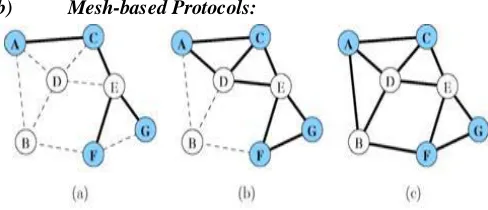
[image:3.612.326.570.56.161.2]b) Mesh-based Protocols:
Figure 2: Examples of multicast connectivity in tree-based and mesh-based approaches (solid lines denote paths on which multicast packets are forwarded
and nodes in shade denote multicast
Although a tree structure can support efficient multicast operations in general, it can be very fragile in dynamic environments where links can break due to node mobility or link failure since there is only one path connecting a source to a receiver. Furthermore, many tree-based protocols that are based on the reverse path forwarding technique or the core-based tree often require shortest path information from unicast routing tables to operate. Initialization and maintenance. Overhead will increase significantly in mobile ad hoc environments since they usually employ on-demand routing protocols, which normally do not maintain complete routing tables. Furthermore, using proactive routing protocols or trying to keep the routing tables updated all the time is not desirable due to an unacceptable amount of control traffic.
To provide path redundancy, several ad hoc multicast protocols [3] based on a mesh structure have been proposed. Unlike a tree, data packets are allowed to be forwarded to the same destination through more than one path, which increases chances of successful delivery. Figure 2 illustrates this situation. If the link between the receiver A and the source C is broken, with a tree-based approach in Figure 2.1(a), A will not be able to receive data from C. In contrast, the link breakage will not prevent A from receiving data with a mesh structure shown in Figure 2 (b), since D is serving as a backup path between A and C.FGMP (Forwarding Group Multicast Protocol) and ODMRP (On Demand Multicast Routing Protocol) maintain a mesh on top of a group of nodes known as a forwarding group. In FGMP, construction of a forwarding group is initiated by either a sender or a receiver flooding a request, depending on whether the sender advertising mode (FGMP-SA) or the receiver advertising mode (FGMP-RA) is used. In situations where the number of senders is less than the number of receivers, FGMP-SA is preferable. Each node in a forwarding group sets a forwarding flag which is associated with a soft-state timer and periodically refreshed by the sender (in FGMP-RA) or the receiver (in FGMP-SA).
b. Hierarchical, Hybrid and Adaptive Protocols: This section covers ad hoc multicast protocols that view the network as being hierarchical [3] rather than flat, including adaptive protocols that are not strict to one specific scheme (i.e., tree or mesh), but adapt their behaviors to different environment conditions. To achieve scalability, a hierarchical approach or a hybrid approach is often employed.
MZR (Multicast Zone Routing Protocol) adopts a hybrid approach using the same mechanism provided by the Zone Routing Protocol . A zone is defined for each node with a radius representing the number of hops from the node. A proactive, or table-driven, protocol is used inside each zone, while reactive route queries are carried on at the zone border nodes on demand, resulting in a much smaller number of nodes participating in the global flooding search. The zone size is fixed for every node and for the entire operation of the network. Previous study has shown that the optimal zone radius for the zone routing protocol is two.
Another approach to reducing the number of participants when a global flooding is needed is based on the notion of connected dominating sets. This approach is exploited by CGM (Clustered Group Multicast) , and MCEDAR (Multicast Core-Extraction Distributed Ad hoc Routing) which is an extension to the CEDAR unicast routing architecture. A set of nodes, called a dominating set, are extracted from the network through clustering, backbone construction, or minimum connected dominating set algorithms. Once a dominating set is obtained, any node must either belong to the set or be an immediate (one-hop) neighbor of a node in the set. These
nodes then form a virtual backbone which may be used to
carry both multicast data and control traffic as in CGM, or control traffic only as in MCEDAR.
c. Other Classifications for Multicast Protocols: The classification described in the previous section is based on how multicast connectivity is set up (i.e., a tree vs a mesh). In fact there are other many different aspects we can consider for protocol classification, which include, but are not limited to, the following:
a) Proactive vs Reactive:
Similar to unicast routing protocols [3], multicast routing protocols can also be classified as either proactive or reactive. A protocol is considered proactive if it continuously maintains multicast connectivity (i.e., tree/mesh) among group members, regardless of the availability of data traffic. This scheme is advantageous in that the multicast connectivity is readily available for data transfer. However, it may often end up using a large portion of valuable network bandwidth to keep the connectivity updated, especially when the network topology is dynamic. Therefore, a proactive scheme is usually suitable for networks with low mobility.
In contrast, reactive protocols attempt to establish connectivity among members on demand, i.e., only when a source has data to send. Therefore, no bandwidth is wasted even though the network topology keeps changing, given that nobody has data to send. A drawback of a reactive scheme is the longer multicast route acquisition time and frequent use of network-wide flooding.
b) Sender-initiated vs receiver-initiated:
This aspect concerns how multicast tree or mesh formation is initialized. The establishment of multicast connectivity [3] can be initiated by multicast sources, receivers, or both. In a sender-initiated protocol, each source is responsible for announcing its own existence to other nodes in the network so that nodes who are members can reply with join messages, resulting in establishment of group connectivity. The announcement can be done periodically or on demand. A receiver-initiated protocol, in contrast, requires each receiver to initiate a request to the group by searching for a point of attachment to the current tree/mesh, or sending a direct request to a special node such as the rendezvous point or the core. Source nodes, which may not be part of the group connectivity, then send data packets to the core so that data can be distributed to the group receivers.
c) Unicast-Dependent vs Unicast-Independent:
As stated earlier, certain multicast protocols rely on underlying unicast protocols to operate, while many others have been designed to operate independently. Since achieving certain tasks with unicast routing [3] may end up with unnecessary operations and waste of bandwidth, designing a multicast protocol to be independent of any unicast protocol allows the protocol to have complete knowledge about and better utilize the control overhead. On the contrary, tying a multicast protocol to unicast routing can also be beneficial. For instance, protocols that are tightly coupled with their base unicast routing protocols are able to exploit routing information and provide multicast capability with minimum additional overhead due to elimination of redundant tasks. Some protocols employ unicast routing functionality as a low-level mechanism to logically connect group members together, making the multicast mechanism itself independent to the network dynamics.
d) Source-based vs Group-shared Connectivity: A multicast tree [3] or mesh may be created and used to forward data packets generated by a particular source (source-based connectivity), or by any source within the group (group-shared connectivity). A source-based tree/mesh is often created as a combination of shortest paths from the receivers to the corresponding source, thus giving a major advantage in that end-to-end delays are minimum. In addition, having different sources employ different groups of nodes to forward data packets also helps in terms of traffic load balancing. However, having each source maintain its own connectivity separately can potentially yield more control overhead. For intermediate nodes, separate forwarding states are required for each source as well. Therefore, this scheme is suitable for networks with smaller number of sources, and for applications whose delays are critical.
III. GRAPH DOMINATION BASED ROUTING ALGORITHMS FOR MANETS
Keeping the routing tables up to date may consume a large part of the wireless traffic in the network. This traffic might sometimes be extremely dense which may possibly block the circulation of the messages between nodes. A virtually structured network such as a Connected Dominating Set (CDS) can be considered as a good solution to make message transfers more efficient
In this section we present a literature survey of published graph domination based routing algorithms for MANETs
A. A Dominating-Set-Based routing scheme in Ad-Hoc Wireless Networks:
In [4] Wu, Li focused some work on the formulation of a dominating set from an undirected graph and on routing scheme within the induced graph from the connected dominating Set. A marketing process marks every vertex in a constant number of rounds in a given connected and simple graph G= (V, E) that represent on ad-hoc warless network, m (v)is a marker for vertex u to v, which is either T (marked) or F (unmarked). The set if vertices that are marked T forms a connected dominating set. Assume that N (u) represents the neighbor set of vertex u and v has N (v) initially. The marking process consists of three steps
a. Initially assign marker F to every v in V
b. Every v exchanges its neighbor set N(v) with all its neighbors
c. Every V assigns its marker m(v) to T it there exist two unconnected neighbors
The problems of determining a minimum dominating set of a given unit graph is also € NP-complete. The connectivity requirement adds another dimension of difficulty. Therefore the connected dominating set derived from the marking process is not minimum two rules are given to enhance the marking process to reduce the size of the connected dominating set generated from the marking process. A distinct label id (v) is assign to each vertex V vertices are removed from the dominating set derived from the marking process by comparing the neighbor sets and vertex labels of adjacent vertices in the set.
The Wu-Li characterized algorithm as follows. For each node Z the following question is asked Does Z have neighbors x and y such that x and y are not adjacent? The vertex Z is then admitted to G set which we will call WuLi(G) if and only if the answer to the question is “yes”. It is then possible to show that WuLi (G) is a connected dominating set, unless G is complete Wu-Li then consider refining the above technique by assuming that each vertex has a unique integer identifier. There “Rule1” amounts to asking a further question for each Vertex Z in WuLi(G) as follows: Does Z have a neighbor Z’ in WuLi0(G) whose ID is higher than if Z and which is such that all if the neighbors if Z are also neighbors of Z’? If so, Z is deemed to be Superfluous. The set WuLi1(G) consider of all the vertices from WuLi0(G) for which the answer to the question is “no”. It too connected dominating set.
To further reduce the size of the set, Wu and Li also introduce “Rule2”. For each vertex Z in WuLi1(G). the following question is asked: Does Z have two neighbors from WuLi1(G). Which are themselves adjacent, and which have
ID’s larger than that of Z and which are such that their combined neighbors include all if the neighbors of z?
The set WuLi2(G) consists if all y=the vertices from WuLi1(G) for which the answer is “no”. This too can be a connected dominating set.
Wu-Li proposed algorithm calculates connected dominating set in O (∆2) time with distance-2 neighborhood information where ∆ is the maximum node degree in the graph. In addition, the proposed algorithm uses constant (1 or 2) rounds of message exchange, compared with O(γ) rounds of message exchanges in Das algorithm[5].
B. Approximation Algorithm for Connected
Dominating Sets:
In [6] Guha and Khuller originally addressed the connected dominating set problem. Authors proposed two approximation algorithms. Two algorithms are based on growing a tree. They defined the MCDS algorithm for general graphs which proposed a reduction from the set cover problem. This implies that for any fixed 0<ε<1, no polynomial time algorithm with
performance ratio (1- ε) H (∆) exists unless NP
⊂
DTIME[nO(loglog n)] where ∆ is the maximum degree and H is the harmonic function.
a. Growing a tree (1): Initially all vertices are unmarked (white) when we scan a vertex (color it black), We mark all its neighbors that are not in T and add them to T (color them gray). Thus marked nodes that have not been scanned are leaves in T (gray nodes). The algorithm continues scanning marked nodes until all the vertices are marked (gray or black). The set of scanned nodes (black nodes) will form the CDS in the end consider the following example.
Figure 3
vertex from N (v) and mark v at this point the algorithm has picked d+2 vertices.
b. Growing tree 2: An alternate approach to growing one connected tree is to grow separate components that from a dominating set and to then connect them together. The algorithm runs in two phases at the start of the
c. First phase: all nodes are colored white. Each time we include a vertex in dominating set, we color it black nodes that are dominated are colored gray. in the first phase the algorithm picks a node at each step and colors it black, coloring all adjacent white nodes gray. A piece is defined as a white node or a black connected component. At each step we pick a node to color black that gives the maximum (non-Zero) reduction in the number of pieces.
d. Phase II: Collection of black connected components that we need to connect. Recursively connect pairs of black components by choosing a chain of vertices, until there is no black connected component. Set of black vertices that form the connected component. The Algorithms have a performance ratio O (log n), where n is the number of vertices in the graph.
C. Dominating Sets and Neighbor Elimination-Based Broad casting Algorithm in Wireless Networks:
In[7] In the context of clustering and broadcasting. Stojmenovic, Seddigh, and Zunic presented three Synchronized distributed constructions of CDS. In each of the three constructions. The CDS consists of two types of nodes: the cluster-heads and the border-nodes. The cluster-heads from a maximal independent set (MIS) i.e. A domination set in which any pair nodes are non-adjacent. A node is a border-node if it is not a head and there at least two cluster-heads within its 2-hop neighborhood. The set of cluster-cluster-heads is induced by a ranking of nodes which give rise to a total ordering of all nodes. Three ranking are used: The ID only [8] [9]. An ordered pair of degree and ID [10] and an order pair of degree and location. The selection of the cluster-heads is given by a synchronized distributed algorithm which can be generalized to the following framework. Initially all nodes are colored white. In each stage of the synchronized distributed algorithm, all white nodes which have the lowest rank among all white neighbors are colored black. Then all white nodes adjacent to these blanks nodes are colored gray: Finally the ranks of the remaining white nodes are updated. The algorithm ends when all nodes are colored either blank of gray. All blank nodes then from the cluster-heads. Regardless of the choice of the ranking, The algorithms have a ∆(n) approximation factor. Such inefficiency stem from the non-selective inclusion of all border-nodes. In fact if the rank is ID only. The following fig shows.
Figure 4
A family of instances which would simply the approximation factor to be exactly n[11]. The Worst possible. In these instances the nodes with the largest ID is located at the center of a unit-disk and all other nodes are evenly distributed in the boundary of the unit disk. After the cluster heads are selected all other nodes become border-nodes. Thus the CDS would consist of all nodes[12]. On the other hand the node at the center dominates all other nodes. If the rank is an ordered pair of degree or an order pair of degree and location of the time complexity and message complexity is O (n2) and Ω (n) respectively.
D. A polynomial –Time approximation Scheme for the minimum connected dominating set in Ad Hoc wireless Networks :
In [13] cheng, Hunng Li-Wu and Du proposed the (1+1/s) – approximation for the minimum connected dominating set in unit-disk graphs running in n0((s log s)2). Here the authors focused on Unit-disk graphs. Algorithm works as follows: divide the space containing all vertices of the input unit-disk graphs, into to a grid of small cells, for each small cell take the points H distance away from the boundary then optimally compute a minimum union of connected dominating sets in each cell for connected components of the central area of the cell. The key lemma is to prove that the MCDS for the graph. Then for vertices not in central area, just use the distance h+1 away from the boundary, with some overlap with the centered areas to dominate them. This part together with above union, forms a connected dominating set for the whole input unit-disk graph.
Squares Q and Q’ Central Area and Boundary
Figure 5
There are many exiting protocols rely on flooding for the dissemination of topology update packets (proactive routing protocols [14] )or route request packets (proactive routing protocols[15,16]. To overcome these problems, a virtual backbone-based routing strategy has been introduced. The
h Central
arch
Boundary
Arc
most benefit of virtual backbone –based routing is the dramatic reduction of protocol overhead.
E. Distributed Rooting Algorithms for Wireless Ad Hoc Networks Using d-Hop Connected d-Hop Dominating Set :
In[17]. The authors generalized the Wu.Li algorithm so as to produce a d-hop connected d-dominating set that work as routors one of the important aspect of their routing scheme was that it also guaranteed shortest path routing through the network along a path that was guaranteed at any point along the way to encounter another router node within every k-steps. Later the authors modified this algorithm and proposed a number of variations on it. The authors said that “There is a trivial way to apply the Wu-Li algorithm” in order to produce a d-hop connected d-hop dominating set for G. To do so simply apply the Wu-Li algorithm to Gd instead of G. Then from the standpoint of G the resulting set is a d-hop connected d-hop dominating set However because the graph Gd obscures the sence of the distance in G. They felt that this is not a desirable approach Authors concluded that working directly with the graph G. rather than Gd and results in a set with this desirable “shortest path property”. Moreover they showed that this algorithm has a more efficient implementation.
Algorithm:
a. For each pair of vertices x and y satisfying
δ
(x. y) =d+1 consider all of the shortest paths from x to y. b. Consider the set of vertices that lie strictly between x andy along such a path. Let E (x .y) be the vertex in this set with the highest ID. Call this vertex E(x. y)
c. Construct the set Dd(G) by including all such E(x. y) and only these vertices.
This algorithm also has a “Shortest path property” as described in the following theorem.
Theorem: Assume that the connected graph G has radius at least d+1. Then the set Dd(G) is a d-hop connected d-hop dominations set. Moreover any two vertices u and v from G can be connected by a shortest path (in G) with the property that the set of vertices which are on this path and also in Dd(G) together with the vertices u and v, from a connected path between u and v in the d-closure Gd.
F. Extended Dominating –Set - Based routing in Ad-Hoc wireless Networks with unidirectional links:
In[18] Jie Wu extend the dominating - Set - Based routing to Ad-Hoc wireless Networks with unidirectional links Wu and Li [19] conducted some preliminary work on the formation of a dominating set for an undirected graph on a preliminary routing scheme within the induced graph from the connected dominating set. Specifically an efficient localized Algorithm for determining dominating and absorbent set of the vertices is given and this set can be easily updated when the Network Topology changes dynamically. A host v is called a dominating neighbor (absorbent neighbor) of another host u if there is a directed edge from v to u.
a. Extended Marking Process: To determine a set that is both dominating and absorbent, They propose and extended marking process see the below fig.
Figure 6
Where m( u) is a marker for vertex u
∈
v, which is either T (marked) or F (un marked) Basically, a node is marked whenever it is on the shortest path from neighbor to another. The following fig shows a four gateways (4,7,8 and 9)Figure 7
derived from the extended marking process. Arrow dashed lines correspond to unidirectional links and solid lines represent bidirectional links. A bidirectional links vu can be considered as two unidirectional links (v. u) and (u. v). The following fig shows three assignments of u, With one dominating neighbor w and are absorbent neighbor v.
Figure 8
b. Extensions: Author proposed two rules to reduces the size of connected dominating and absorbent set generated from the extended marking process. We first randomly assign a distinct label id(u) to each vertex u in V. Nd(n(Na(u)) represents the dominating (absorbent) neighbors sets; that is N(u)=Na(u)
Nd(u). Vertex u is called neighbor of vertex V if u is a dominating absorbent or dominating and absorbent neighbor of v Again V’ is the marked set after applying the extended marking process and D’ is the representing the topology of the ad hoc wireless network.G. On Calculating Power-Aware Connected
Dominating set :
While the energy level-based approach tries to prolong the average life span of each node.
a. Node-Degree-Based Rules: Author proposed two rules based on node degree(ND)[20] to reduce the size of G connected dominating set generated from the marking process. First of all, a distinct ID, id(v) is assigned to each vertex v in G. In addition nd(v) represent the node of u in G. i.e the cardinality of u’s open neighbor set N(u).
b. Rule 1: The rule indicates that when the closed neighbor set of v is covered by that of u, node v can be removed from G’if the ND to v is smaller that of u. Node ID’s are used to break a tie when the node degrees of two nodes are the same. Note that nd(v)<nd(u) implies that N[u]
⊄
N[v], and if v is marked and it is closed neighbor set is covered by that of u, it implies that node u is also marked. It is easy to prove that G’-{v} is still aconnected dominating set of G. The condition N[v]
⊆
N[u], implies v and u are connected in G’.
c. Rule2: The rule1 indicates that when the open neighbor set of v is covered by the open neighbor sets of two of its marked neighbors u and w
a) If neither u nor w is covered by the other two among u. v and w node v can be removed from G’.
b) If nodes v u are covered by u and w. v and w
respectively but w is not covered by u and v node u can be removed from G’ if the ND of v is small than that of u or the ID of v is smaller than that of U. When their ND’s are the same
c) When each of u, v and W is covered by the other two among u, v and w node u can be removed from G’ if one of the following conditions hold: U has the minimum NW among u, v and w the ND of v is the same as the ND of u but it is smaller than that of W and the ID of V is smaller than of that of u. or the ND’s of u, v and w are the same and v has the minimum LD among u. v and w, The condition N(u)
⊆
N(v)
N(w) in Rule 2 implies that u and W are connected. A gain it is easy to prove that G’-{u} is still a connected dominating set. Both u and w are marked because the fact that u is marked and N(v)⊆
N(u)
N(w) in G does not imply that u and Ware marked. Therefore if one of u and w is not marked u cannot be unmarked
d. Energy –Level: Author proposed two rules based on energy level (EL) to prolong average life span of a host and at the same time to reduce the size of a connected dominating set generated from the marking process. We first assign a distinct ID. Id (V) and an initial EL, Let e1 (u) to each vertex v in G’
v u
Figure 9
Since N[v](N[u], node v is removed from G’ if e1(v) < e1(u) and node u is the only dominating node in the graph. Therefore
Figure 10
N[v]=N[u]. either v and u can be removed as shown in the above figure. We pick that with a small EL.In a dynamic System such as an ad hoc wireless Network topology changes overtime. Therefore the connected dominating set also needs to change Assume that d’ and d are energy consumption in a given interval for a gateway host and a non-gateway host, respectively. That is each time applying both Rule 1 and Rule 2 EL of each gateway host will be decreased by d. When the energy level of u, d(v), reaches zero it is assumed that host u ceases to function In general, d’>d and d’ and d are variables dependent on the length of update interval and by pass traffic given an initial energy level of each host and values for d’ and d , the energy level associated with each host has multiple discrete levels.
H. Routing in Ad-Hoc Networks Using MCDS:
The centralized version of the distributed algorithm proposed by Das and Bharghavan consists of stages. The first stage finds an approximation to minimum dominating set which is essentially the well studied set covered problem [5] Let u denotes the Dominating set ouput in this stage. The second stage constructs a spanning Forrest F. each tree component in F is a union of stars centered at the nodes in u. The star s are generated by letting each Dominate node pickup an orbitery neighbor in u. The third stage expands the spanning forest F to a spanning tree T. all internal nodes in T form a CDS.The distributed implementation of the above greedy algorithm has very high time complexity and massage complexity, indeed, both time complexity and massage complexity can be as high as∆(n2).
I. Distributed construction of connected Dominating set in wireless Ad Hoc Networks:
In [23] Wan,Alzoubi and Frieder made a great improvement by proposing two-phase distributed algorithms. A Spanning tree is constructed first and then each node in the tree is labeled as either a dominator or a dominate
a. MIS:
Any pair of nodes in an MIS are separated by at least two hops however a subset of nodes in an MIS may be three hops away from the subset of the rest nodes in these MIS, MIS construction guarantees that the distance between any pair of its complementary subsets is exactly two hops. Auther1 chosen rank definition. The ranking is induced by an arbitrary rooted spanning tree T. Which can be constructed by the distributed leader- election algorithm in [24] with O(n) time complexity and O(nlogn) message complexity. Given a rooted spanning tree T. the (tree) level of a node is the number of hops in T between itself and root of T. The level of the root is O. The rank of a node is then given by ordered pair of its level and its ID. Such ranking gives rise to a total ordering of the nodes in the lexicographic order.
b. Dominating Tree Construction:
The second page constructs a dominating tree T whose internal nodes would become a CDS. Each node maintains a local Boolean variable Z which is initialized to 0 and set to 1 after the node joins the tree. Each node also maintains a local variable parent which stores the ID of its parent in T and is initially empty and a children list which records the ID’s of its children in T and is initially empty.
The root of T is gray neighbor of the root of T which has the largest number of blank neighbor. To select the root for T, the root of T also maintains a variable root and a variable degree which is initialized 0.Both MIS construction and dominating tree construction linear time, Wan Alzoubi and Frieder algorithm overall takes O (nlogn) message complexity and O(n) time complexity, But the algorithm in [17] used for the construction of T has O(nlogn) message complexity and O(n) time complexity. Authors compare the performance for algorithm listed in below table.
Table: 1
[3][5][6] [8] [13] [3] Approx. factor
θ
(log n) N n/2 ,n≤
8 Msg.Complexity
O(n2 ) O(m) O(n2) O(n log n)
Time complexity
O (n2 ) O(
∆
3 )Ω
(n) O(n)Nontrivial Yes No No Yes
The above table 1 shows that authors algorithm outperforms the existing algorithms.
J. Spine Routing in ad hoc Networks:
In [25] Shivakumar Das and Bhargvan present new Spine based routing infrastructure for fault tolerant unicast and multicast routing in ad hoc networks. Here authors addressed three main issues
a. How to build and maintain Spine
b. What network topology information to collect in the Spine
c. How to compute routes once the information is
gathered in the spine nodes.
Due to constant changes in the network topology[22], sharing resources and applications run on ad hoc network. The authors main goals are listed below.
a) Support efficient unicast routing by trading off
between shortest path routing and routing on demand algorithms
b) Support multicast routing using the spine structure as the multi cast backbone.
c) Compute alternate routes for long - lived connections and switched routes dynamically up on failure of the primary router in order to provide fault tolerant routing
To address and achieve above mentioned issues and goals respectively. They present two spine routing algorithms
i. Optional spine routing (OSR)
ii. Partial knowledge spine routing (PSR).
K. Optimal Spine Routing (OSR):
The main aim of the OSR is to provide optional up to date routes to sources in reply to route queries requests To determine routing with the spine. We gather globel knowledge of G in to all the spine nodes and compute shortest paths based on local copies of G in g( in to the link state approach restricted to spine nodes)To handle the movement of nodes OSR first updates the topology information in the spine nodes and then updates the routing table at non – spine nodes. The specific steps depend on which nodes and how many have moved. For finding routes between all pairs of nodes. OSR has the following time and message complexities. Let diam(c) be the diameter of c and ∆(c ) be the maximum degree of c. The time O ((n + | c | ) ∆) from the first step dominates the time complexity. And the message count O (n |c|+m +n logn) from the first step dominates the message complexity.
L. Partial – Knowledge Spine Routing ( PSR ):
optimality of the routes that PSR compute. Authors introduce the novel mechanism by which information about stable edges gets propagated on the spine. The mechanism uses two types of waves namely ad and delete waves to convey the stable edge information. Finally PSR uses a LMR like directed probing mechanism for route discovery.
M. Routing in Ad Hoc Networks Using a Spine:
Wireless ad hoc network has no physical backbone infrastructure a virtual back bone can be formed by nodes in connected dominating set of the corresponding unit – disk graph. Such virtual back bone also referred to as spine. In [26] Das Shivakumar and Bharghavan presented a two –level hierarchical routing or architecture for ad hoc networks. Within each cluster at the lower level, we use self- organizing, dynamic structure called a spine to help reduce the overhead. Between clusters they maintain link – state knowledge of the cluster graph topology in which each cluster is represented by one node.
N. Spine Routing:
To determine routes with the spine, authors gather global knowledge of G in to all the spine nodes and computers shortest path based on local copies of G . The algorithm to construct the spine and identity shortest path routes is largely the same as In [25][26] They used an approximation C to a minimum connected dominating set ( MCDS ) as their spine. Authors made one improvement compared to the algorithm in [18] for the route discovery step. The basic spine routing algorithm takes O (( n+|c|)Δ)=O(n Δ) time to initially determine routes using O ( (n+|c|+ m + n log n) messages.
O. Hierarchical Spine Routing Algorithm:
Authors characterize the clustering of G using several parameters. Each cluster has nc and Δc nodes and maximum degrees respectively. The roots in the cluster maintain upper-level topology and gives inter cluster routes. Some nodes considered as boundary nodes which are adjacent to other cluster nodes. The spine within each cluster is denoted by Sc and has at most |Sc| nodes.
P. Route discovery:
The spine routing algorithm establishes a spine within each node. For finding a routes in inter cluster the cluster head maintains the topology of Gc, membership table and list of local boundary nodes . The following algorithm describes this process.
a. S checks route cache for route to t b. S asks dom ( s ) for route:
If t € Cs then dom (s) replies with route c. (t
∈
Cs)Dom (s) asks root of Cs for route a) Root of Cs looks up Ct
b) Root replies to dom(s) with
i. Cluster route Cs = C1,C2………..Ck=Ct
ii. Boundary node b in Cs adjacent to Cn
c) Dom(s) forwards C1, C2…Ck and b to S.
When the nodes moves in the network the spine algorithm updates the routing tables in the spine nodes .Here authors extended basic spine routing algorithm to a two level
hierarchy. Hierarchical routing was identified as a necessary technique for large packet radio network. One drawback Hierarchical routing is an increase in the length of routes.
an exact algorithm for minimum cds with shortest-path constraint in wireless networks
In [27] Wing. Gav. Wu Lee, Zhu, and Du studied how to construct a shortest path connected dominating set (SPCDS) in a network which cannot be modeled as a complete graph. Authors introduce constructions of CDs from two aspects centralized construction and distributed constructions. They have categorized centralized CDS algorithm into two types-one is 1-stage and other is 2-stage. In 2-stage algorithms the first step is to select a minimum CDS using the technique of Steiner Tree [28]. In contrast 1-stage algorithm aim to select a CDS directly skipping the step of finding a DS.
Let P(u. v)={u, w1, w2, ………wk, v} be one shortest path between u and v in v, and all nodes on P(u, v) except u. v are called intermediate nodes. Every node pair may have more than one shortest paths and these shortest paths compose of a shortest path set P(u. v). For instance consider the following figure.
Figure 11
The shortest path between B ,D and C can be P1(B. D)={B, E, D} or P2(B, D)={B, A, D}. There for the shortest path set between node B and C should be PB.D= {P1 (B.D), P2 (B. D)}.
Here authors worked on SPCDS it is a port of CDS with shortest path constraint. Because of this constraint many problems can be reduce in the network such that transmission failure routing delay and energy cost and authors proved finding a minimum SPCDS is solvable in polynomial time. The provided exact algorithm with time complexity O(
δ
2 n ) In its route discovery mechanism. PSR takes a greedy approved to compute the shortest path from the source to the destinationQ. Iterative Local Solutions for Connected Dominating Sets in Ad Hoc Wireless Networks:
Here authors focus on using ILS to calculate a CDS with the objective of reducing the CDS size over a number of iterations
a. ILS in a Static Environment:
The following algorithm shows a K-round ILs. Where local topology information can be defined in different ways Algorithm K-round ILS (at each node U)
a) 1: Each node collects local topology information and applies a local solution to determine its states (marked or unmarked)
b) 2: The process completes if the number of iterations reaches K; otherwise each node selects a new priority and exchanges states,
c) 3: Apply the local solution again based on the new
node states and node priority GO to step 2 for the next iteration.
R. SILS in a Dynamic Environment :
After pointing out several drawbacks of CILS. We give a novel extension of the ILS called the seamless iterative local solution (SILS). The basic idea is that the CDS formation process continues beyond K rounds of iteration Node states (marked/unmarked) is adjusted in reaction to topology changes as the process iterates.
[image:11.612.42.283.468.646.2]a. At each round. Rule K is applied at all nodes. Marked or unmarked previously to determine their new states. b. Node states is no longer exchanged among neighbors. The main contributions of the authors are the seamless integration of the iterative process and handling of topology changes in Ad Hoc Wireless networks. They considered two extensions to the ILs to extend its use beyond static environment one is the natural extension that fails to obtain many desirable properties.
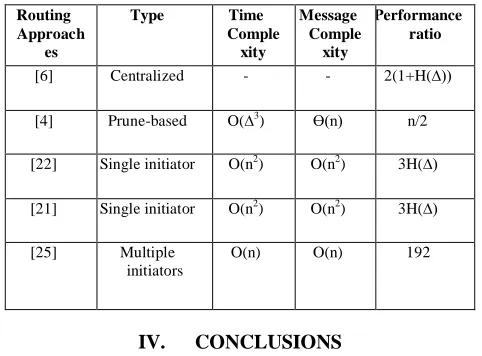
Table 2: Performance Comparison of the presented CDS based routing algorithm
Routing Approach
es
Type Time
Comple xity
Message Comple xity
Performance ratio
[6] Centralized - - 2(1+H(∆))
[4] Prune-based O(∆3) Ө(n) n/2
[22] Single initiator O(n2) O(n2) 3H(∆)
[21] Single initiator O(n2) O(n2) 3H(∆)
[25] Multiple initiators
O(n) O(n) 192
IV. CONCLUSIONS
Wireless Ad Hoc networks have attracted significant attention over the past few years. A growing list of civil and military applications can employ wireless Ad hoc networks for increased effectiveness. Significant attention has been paid to routing algorithms strategies and algorithms yielding a large number of publications. In this paper, we surveyed the state of the research and classified the different domination set based
routing algorithms. We highlighted the effect of the topology on the existing approaches and summarized a number of schemes stating their strength and limitations.
V. REFERENCES
[1]. B. Leiner, R. Ruth, and A. R. Sastry, "Goals and challenges of the DARPA GloMo program,"IEEE Personal Communications, vol. 3, no. 6, pp.34-43, December 1996. [2]. Deniz cokuslu. “a dominating set based communication
architecture for distributed applications in mobile ad hoc networks” A Thesis Submitted to the Graduate School of Engineering, July 2007,IZMIR. www.ube.ege. edu.tr/~erciyes/Deniz_Cokuslu_tez.pdf.
[3]. Chaiporn Jaikaeo. “Adaptive multicast routing for mobile wireless ad hoc networks”. A dissertation submitted to the Faculty of the University of Delaware, summer 2004. www.cpe.ku.ac.th/~cpj/publications/jaikaeo04adaptive.pdf [4]. J. Wu and H. Li, “A dominating-set-based routing scheme in
ad hoc wireless networks”. Telecommunication Systems, 18(1–3):13–36, 2001.
[5]. V Bhargavan and B Das, “Routing in Ad Hoc Networks Using Minimum Connected Dominating Sets”, International Confrence on Communications’97, Montreal, Canada, June1997.
[6]. S Guha and S Kuller, “Approximation algorithms for connected dominating sets’, Proc.of 4 th Annual Europen Symposium on Algoriths,(1996).
[7]. Ivan Stojmenovic,Mahtab Seddigh, and Jovisa Zunic “Dominating Sets and Neighbor Elimination- Based Broadcasting Algorithms in Wireless Networks”, IEEE TRANSACTIONS ON PARALLEL AND DISTRIBUTED SYSTEMS, VOL. 13, NO. 1, JANUARY 2002.
[8]. ITSI STC – RES10 Committee. “Radio Equipment and Systems: High Performance Radio Local Area Network type 1, Functional Specification,”June 1996.
[9]. A Ephermides, J E Wieselther, and D J Baker,” A Design Concept for Reliable Mobile Radio Networks with Frequency Hoping Signaling,”proc, IEEE vol 75, pp 56-73,1987. [10]. P.Bose, P Morin, I stojmenvoic, and J Urrutia, “Routing with
Guarnteed Deleviry in Ad hoc networks,”proc.Third Int’l Workshop Discrete Algorithm and methods for Mobile Comuting and Comm.(DIAL M),pp.48-55, Aug 1999. [11]. G Chen and I Stojmenovic, “Clustering and Routing in
routing m wireless ad hoc network“, Technical Report TR -99 -05, Computer Science, SITE, University of Ottawa, June 1999.
[12]. I. Stojmenovic, M. Seddigh, J. Zunic, “Dominating sets and neighbor elimination based broadcasting algorithms in wireless networks”, proc. IEEE Hawaii Int. Conf on System Sciences, January 2001.
Networks “ NETWORKS, Vol. 42(4),202-208 2003. Wiley Periodicals, Inc.
[14]. T. Clausen, P. Jacquet, A. Laouiti, P. Minet, P. Muhlethaler, and L. Viennot, Optimized link state routing protocol, IETF Internet Draft, draft.
[15]. D.B. Johnson and D.A. Maltz, “Dynamic source routing in ad hoc wireless networks,” Mobile computing, Tomasz Imi- elinski and Hank Korth (Editors), Kluwer, Boston, 1996, pp.153–181.
[16]. C.E. Perkins and E.M. Royer, Ad hoc on-demand distance
vector routing, Proc 2nd IEEE Workshop on Mobile Computing Systems and Applications, New Orleans, LA, February 1999, pp. 90–100.
[17].
“Distributed routing algorithms for multi-hop ad hoc networks using d-hop connected d-dominating sets”, Computer Networks and ISDN Systems Issue 6, 22 April 2005.
[18]. Jie Wu “Extended Dominating-Set-Based Routing in Ad Hoc Wireless Networks with Unidirectional Links”, IEEE TRANSACTIONS ON PARALLEL AND DISTRIBUTED SYSTEMS, VOL. 13, NO. 9, SEPTEMBER 2002.
[19]. J. Wu and H.L. Li, “On calculating connected dominating set for efficient routing in ad hoc wireless networks”, Proceedings of the 3rd ACM international workshop on Discrete algorithms and methods for mobile computing and communication, 1999, Pages 7-14.
[20]. Jie Wu, Fei Dai, Ming Gao, and Ivan Stojmenovic “On Calculating Power-Aware Connected Dominating Sets for Efficient Routing in Ad Hoc Wireless Networks “,JOURNAL OF COMMUNICATIONS AND NETWORKS, VOL.4, NO.1, MARCH 2002.
[21]. V Bhargavan and B Das, “Routing in Ad Hoc Networks Using Minimum Connected Dominating Sets”, International Confrence on Communications’97, Montreal, Canada, June1997.
[22]. R. Sivakumar, B. Das, and V. Bharghavan, “An Improved Spine-based Infrastructure for Routing in Ad Hoc Networks”, IEEE Symposium on Computers and Communication ‘98, Athens, Greece. June 1998.
[23]. P.-J. Wan, K. M. Alzoubi, and O. Frieder, Distributed construction of connected dominating set in wireless ad hoc networks. Mob. Netw. Appl., 9(2):141–149, 2004.
[24]. Mihaela Cardei, Xiaoyan Cheng, Xiuzhen Cheng and Ding-Zhu Du “Connected Domination in Multihop Ad Hoc Wireless Networks”
[25]. Sivakumar R. Das B,Bhargavan V. “Spine- Routing in Ad Hoc networks”. Clusters Computing 1(1998) 237-248 Baltzer Science publishers BV.
[26]. B. Das, R. Shivakumar, and V. Bhargavan, “Routmg in Ad Hoc Network Using a Spine”, International Conference on Computers and Communication Netwtorks ‘97, LasVega, NV. September 1997.
[27]. R. Sivakumar, B. Das, and V. Bharghavan, “An Improved Spine-based Infrastructure for Routing in Ad Hoc Networks”, IEEE Symposium on Computers and Communication ‘98, Athens, Greece. June 1998.
[28]. Ling Ding ⋅Xiaofeng Gao ⋅Weili Wu ⋅Wonjun Lee ⋅Xu Zhu
⋅Ding-Zhu Du “An Exact Algorithm for Minimum CDS with Shortest Path Constraint in Wireless Networks “.
[29]. D.-Z. Du, B. Lu, H. Ngo, and P. M. Pardalos. Steiner tree problems, 2000