pISSN 2320-1770 | eISSN 2320-1789
Original Research Article
Utility of second trimester beta HCG levels in prediction of gestational
hypertension: a prospective cohort study
Heena Chowdhary
1, Rabia Khurshid
1, Shameema Parveen
1, Shagufta Yousuf
2,
Showkat Hussain Tali
3*, Zafar Amin Shah
4INTRODUCTION
Gestational hypertension is a major pregnancy
complication associated with significant fetal risks and maternal morbidity and mortality.1,2,3 Although overt PIH
rarely appears until third trimester, there are many studies which show that the disease begins early in pregnancy.
The underlying patho-physiological mechanism
responsible for the disease process seems to appear between 8 to 18 weeks of gestation which makes it logical to search for predictive indicators.4 For years there
DOI: http://dx.doi.org/10.18203/2320-1770.ijrcog20170581
ABSTRACT
Background: Gestational hypertension is a significant threat both to maternal and fetal health. However, it is still a distant dream to predict accurately its occurrence in early pregnancy. Objective was to find out if β HCG levels determined between 13 to 20 weeks of gestation can be used as a predictor for gestational hypertension.
Methods: This prospective observational cohort study was conducted from August 2014 to January 2016. Serum β HCG levels were determined at 13 to 20 weeks of gestation of 190 normotensive pregnant women attending the antenatal clinics. They were followed for the development of gestational hypertension till 40 weeks of gestation or delivery.
Results: Out of the total 190 women, 25 (13.1%) developed gestation hypertension. Of those who developed gestational hypertension, 22 (88%) were having β HCG levels >2 MOM (p<0.001). Absolute β HCG levels (Mean±SD) were also significantly higher (54907±29509 V/S 41095±19103; p<0.001) in subjects who later developed gestational hypertension. Sensitivity, specificity, positive predictive value and the negative predictive value for β HCG at >2 MOM were 83.3, 96.9, 80.0 and 97.5 respectively (95% CI).
Conclusions: Pregnant women with high Beta HCG levels in early pregnancy have significantly higher risk for development of gestational hypertension.
Keywords: Early pregnancy, Gestational hypertension, HCG
1Department of Obstetrics and Gynecology, Sher-I-Kashmir Institute of Medical Sciences, Srinagar, Jammu and
Kashmir, India
2Department of Obstetrics and Gynaecology, Adesh Institute of Medical Sciences and Research, Bathinda, Punjab,
India
3Department of Paediatrics and Neonatology, Adesh Institute of Medical Sciences and Research, Bathinda, Punjab,
India
4Department of Immunology and Molecular Medicine, Sher-I-Kashmir Institute of Medical Sciences, Srinagar, Jammu
and Kashmir, India
Received: 30 January 2017
Accepted: 04 February 2017
*Correspondence:
Dr.Showkat Hussain Tali,
E-mail: [email protected]
has been a search for an early predictor of gestational hypertension so that special antenatal care can be given to these patients. However, none of the available tests till date has proved to be a gold standard.
Placenta is the known primary trigger of gestational hypertension. Recent placental transcriptome theory supports the view.5 Hsu et al hypothesized that during
mid trimester, immunological changes occur in the trophoblasts, resulting in secretory response, which is seen as a rise in the beta HCG levels.6 It may be
considered that early placental vascular damage in pre-eclamptic pregnancies leading to decreased oxygen supply may result in increased βHCG production by syncytiotrophoblastic cells.7 βHCG production has been
shown to increase when normal placental villi in organ culture were maintained under hypoxic conditions.8
Moreover, conditions like twins, molar pregnancies which are associated with elevated HCG levels also carry an increased risk of gestational hypertension. Therefore, high βHCG production in late first and early second trimester when definitive placental development occurs may be used as a predictive marker.9 Present study was
aimed to find out the utility of β HCG levels determined in early pregnancy to predict the occurrence of gestational hypertension.
METHODS
This prospective observational cohort study was conducted in the Department Gynecology and Obstetrics, Sher-I-Kashmir Institute of Medical Sciences, Srinagar, which is a tertiary care teaching institute in the state of Jammu and Kashmir, India. This study was conducted between August 2014 and January 2016 including complete follow-up of the last case registered for the study. Patients were enrolled in the study after taken approval from hospital ethical committee and written informed consent from the patients.
Inclusion criteria
Non-hypertensive pregnant women with gestational age between 13-20 weeks according to last menstrual period or first trimester USG.
Exclusion criteria
History suggestive of renal disease, diabetes, heart disease, collagen vascular disease, thyroid disorders or other endocrine disorders.
At the time of enrolment after a detailed history and physical examination, blood pressures were recorded by auscultator method in all the eligible pregnant women. Three ml venous blood was collected by venepuncture in vacutainers containing clot activator (red top). The blood was allowed to clot and later centrifuged at 3000 rpm for 5 minutes. The clear supernatant serum was aspirated and poured in 1.5ml microfuge tubes. The tubes were stored
at -20ºC until assayed. Serum beta HCG levels were estimated by chemi-luminescence technique in the Department of Immunology and Molecular Medicine, Sher-I-Kashmir Institute of Medical Sciences, Srinagar. Serum beta HCG levels were measured on DXI 200 chemi-luminescence analyser from Beckman coulter which is a fully automated random access analyser. The reagents and other accessories for conducting the test were also procured from Beckman coulter. All subjects were followed till 40 weeks of gestation or delivery for occurrence of gestational hypertension as per ACOG (American College of Obstetrics and Gynaecology) guidelines.10
Analysis
All the continuous variables were shown in terms of descriptive statistics and categorical variables with frequency and percentages. The standard statistical tests like chi-square test and Fischer’s exact test were used to see the association. All the results were discussed on 5% level of significance i.e. p value <0.05 was considered significant. The data was analyzed with the help of statistical software SPSS Version 20.
RESULTS
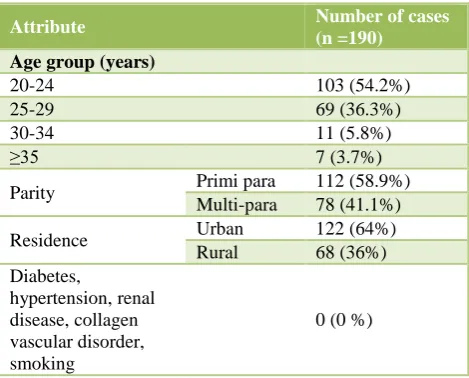
Baseline characteristics of the study population have been presented in Table 1. Table 2 depicts the pregnancy outcome after enrolment.
Table1: Baseline characteristics of enrolled subjects.
Attribute Number of cases
(n =190)
Parity Primi para 112 (58.9%)
Multi-para 78 (41.1%)
Table 2: Pregnancy outcome after enrolment.
Pregnancy outcome No. of
patients %
Missed abortion 2 0.95
Spontaneous abortion 11 5.24
Congenital malformations 3 1.43
Lost in follow up 4 1.91
No. of cases followed till delivery 190 90.47
Table 3: Relationship between beta HCG (MOM) levels and gestational hypertension.
Gestational age
(weeks) Beta HCG levels (MOM)
Total no. of subjects
With gestational hypertension
No gestational
hypertension P value
13-14 ≤2MOM 54 1 (1.9%) 53 (98.1%)
>2MOM 13 10 (76.9%) 3 (23.1%)
15-16 ≤2MOM 48 1 (2.1%) 47 (97.9%)
>2MOM 9 6 (66.7%) 3 (33.3%)
17-18 ≤2MOM 44 --- 44 (100%)
>2MOM 11 7 (63.6%) 4 (36.4%)
19-20 ≤2MOM 10 --- 10 (100%)
>2MOM --- --- ---
Overall (13-20)
≤2MOM 3 (1.9%) 154 (98.1%)
<0.001
>2MOM 22 (66.7%) 11 (33.3%)
Total 190 25 (13.2%) 165 (86.8%)
MOM: Multiples of medians.
Table 4: Relationship between beta HCG (absolute) levels and gestational hypertension.
Beta HCG levels (MIU/ml) No of cases Gestational
Hypertension
NO Gestational
Hypertension Mean±SD P value
<30,000 9 --- 9 (100%)
30,000-40,000 76 2 (2.6%) 74 (97.4%)
40,000-50,000 71 2 (2.8%) 69 (97.2%)
50,000-60,000 11 2 (18.2%) 9 (81.8%)
60,000-70,000 6 2 (33.3%) 4 (66.7%)
70,000-80,000 2 --- 2 (100%)
80,000-90,0’00 4 4 (100%) ---
90,000-1,00,000 5 5 (100%) ---
>1,00,000 6 6 (100%) ---
Total 190 25 (13.2%) 54907±29509 < 0.001
165 (86.8%) 41095±19103
Table 5: Beta HCG values (absolute) and severity of gestational hypertension.
Beta HCG level(mIU/ml) Gestational hypertension
severity
Total
P value
Mild Severe
≤80000 8 (80%) 1 (6.7%) 9 (36%)
<0.001
>80000 2 (20%) 14 (93.3%) 16 (64%)
Total 10 (40%) 15 (60%) 25 (100%)
mIU = Milli international units per day.
Table 6: Value of beta HCG (MOM) as a predictor of gestational hypertension.
Gestational hypertension
HCG >2 MOM
HCG ≤2
MOM Sensitivity (95% CI) Specificity (95% CI)
PPV (95% CI)
NPV (95% CI)
YES TP=20 FP=5 83.3
(62.6-95.3)
96.9 (92.9-99.0)
80.0 (59.3-93.2)
97.5 (93.8-99.3)
NO FN=4 TN=158
TP = True positive; FN = False negative; FP = False positive; TN = True negative.
Table 3 and 4 depict the relationship of Beta HCG levels and risk of development of gestational hypertension. Table 5 represents the relationship between the absolute levels of Beta HCG and severity of gestational hypertension. Table 6 shows sensitivity, specificity,
DISCUSSION
In present study, we observed that the subjects with relatively high beta HCG levels in early pregnancy have
higher chances of development of gestational
hypertension later in the pregnancy (p<0.001). Subjects with higher levels of beta HCG have significantly higher chances of development of severe disease (p<0.001). Values when determined in early pregnancy have a very good specificity and negative predictive value for the prediction of gestational hypertension (96.9 and 97.6 respectively). The strength of present study was that the majority of the enrolled subjects (190 out of 210; 90%) were available for final analysis with a dropout rate due to loss to follow up just under 2% (Table 2). The limitations of present study were that is an observation study and blinding was not performed. Although blinding was not feasible due to the nature of the study, it limits its generilasibility.
In present study, out of total 190 cases evaluated, 157 cases (82.6%) had Beta-HCG levels ≤2MOM, whereas 33 cases (17.4%) had Beta-HCG values >2MOM (Table 3). Out of 157 cases with Beta-HCG levels ≤2 MOM, only 3 cases (1.9%) developed pregnancy induced hypertension. And out of 33 cases with Beta- HCG values >2MOM, 22
cases (66.66%) developed pregnancy induced
hypertension (p<0.001). Sharma V et al in their study observed that out of 387 cases with beta-HCG levels <2MOM, only 6 cases (1.56%) developed pregnancy induced hypertension and out of 60 cases with beta-HCG values >2MOM, 49 cases (81.67%) developed pregnancy induced hypertension (p<0.001).11 Present findings are
also consistent with the findings of Kaur G et al who observed that 20 (83.33%) out of 24 cases with beta HCG levels >2MOM developed PIH against 2 (1.2%) cases out of 154 having beta HCG levels ≤2MOM (p value <0.001).12 Hernandez R et al and Soundararajan P et al
reported similar findings.13,14
In present study we observed that the higher absolute levels of beta HCG strongly correlate with occurrence of gestational hypertension (Table 4). Out of 190 Pregnant
women, 25 women who developed gestational
hypertension were having higher absolute levels of beta HCG as compared to 165 pregnant women who did not (Mean±SD; 54907±29509 vs 41095±19103; p<0.001). Zhonghua et al also concluded that there was a positive correlation between the absolute beta-HCG levels and the severity of pregnancy induced hypertension (p<0.001).15
Basirat Z et al reported that the maternal serum Beta
HCG levels in patients with preeclampsia
(39840±24630IU/L) was higher than in the control group (27460±25862; p=0.031).16 Our findings were also in
conformity with the findings of Gurbuz et al and Choudhury KM et al. 17,18
We observed that when beta HCG levels are more than 80,000 MIU/ml, not only the chances for occurrence of gestational hypertension increase but the severity as well
(p<0.001). Sixteen out of 25 patients (64%) who developed gestational hypertension, and 14 out of 15 (93.3%) who developed severe disease were having levels more than 80,000 MIU/ml. Zhonghua et al and Basirat Z et alalso reported similar findings.17,18
We observed that the sensitivity, specificity, positive predictive value and negative predictive value for Beta HCG levels >2MOM were 83.3, 96.9, 80.0 and 97.6 respectively. Kaur G et alalso reported that beta HCG levels obtained in early pregnancy have high sensitivity (90.91%), specificity (97.44%) and positive predictive value (83.33%) for the prediction of gestational hypertension.12 Hernandez R et al have reported similar
findings.13
CONCLUSION
Pregnant women with high beta HCG levels in early pregnancy have significantly higher risk for development of gestational hypertension as well as chances of having more severe gestational hypertensive disease.
Funding: No funding sources Conflict of interest: None declared
Ethical approval: The study was approved by the Institutional Ethics Committee
REFERENCES
1. Sharma P, Maheshwari S, Barala S. Correlation between second trimester beta human chorionic gonadotropin levels and pregnancy outcome in high risk group. Int J Reprod Contracept Obstet Gynecol. 2016;5(7):2358-61.
2. Anand S, Kirshnanand. Perinatal outcome in growth retarded babies born to normotensive and hypertensive mothers: a prospective study. BMC Cardiovasc Disord. 2015;15:111.
3. Ananth CV, Basso O. Impact of pregnancy-induced hypertension on stillbirth and neonatal mortality in first and higher order births: a population-based study. Epidemiology. 2010;21(1):118-23.
4. Chhabra S, Gandhi D. Prediction of pregnancy induced hypertension/pre-eclampsia by detecting microalbuminuria. J. Obstet Gynecol India. 2002;52:56-60.
5. Sober S, Reiman M, Kika T, Rull K, Inno R, Vaas P, et al. Extensive shift in placental transcriptome profile in preeclampsia and placental origin of
adverse pregnancy outcomes. Sci Rep.
2015;5:13336.
6. Hsu CD, Chan DW, Iriye B, Johnson TR, Hong SF, Repke JT. Elevated serum human chorionic gonadotropin as evidence of secretory response in severe preeclampsia. Am J Obstet Gynecol. 1994;170:1135-8.
nutrition and lactation. New York: John Wiley and Sons; 1973:203-220.
8. Fox H. Effect of hypoxia on trophoblast in organ culture: a morphologic and autoradiographic study. Am J Obstet Gynecol. 1970;107:1058-64.
9. Sorensen TK, Williams MA, Zingheim RW, Clement SJ, Hickak DE. Elevated second trimester human chorionic gonadotropin and subsequent pregnancy induced hypertension. Am J Obstet Gynecol. 1993;169:834-8.
10. Cunningham FG, Veno KJ, Bloom SL. Pregnancy hypertension. In: Williams Obstetrics. 23 ed. New York: McGraw-Hill Medical; 2010.
11. Sharma V, Sharma P, Firdous N. Beta HCG in mid trimester as a predictor of pregnancy induced hypertension. Int J Sci Res. 2016;5:303-5.
12. Dayal M, Gupta P, Varma M, Ghosh UK, Bhargava A. Role of second trimester maternal serum markers as predictor of preeclampsia. J Obstet Gynecol India. 2011;61(1): 38-41.
13. Roiz-Hernandez J, de J Cabello-Martinez J, Fernandez Mejia M. Human chorionic gonadotropin levels between 16 and 21 weeks of pregnancy and prediction of pre-eclampsia. Int J Gynaecol. 2006;92(2):101-5.
14. Soundararajan P, Muthuramu P, Veerapandi M, Mariyappan R. Serum beta human chorionic gonadotropin and lipid profile in early second
trimester (14-20 weeks) is a predictor of pregnancy-induced hypertension. Int J Reprod Contracept Obstet Gynecol. 2016;5(9):3011-6.
15. Feng Q, Cui S, Yang W. Clinical significance of beta HCG and human placental lactogen in serum of normal pregnancies and patient with pregnancy induced hypertension: Zhonghua Fu Chan Ke Za Zhi. 2000; 35(11):648-50.
16. Basirat Z, Barat S, Hajiahmadi M. Serum beta human chorionic gonadotropin levels and preeclampsia. Saudi Med. J. 2006;27(7):101-4. 17. Gurbuz A, Karateke A, Mengulluoglu M, Gedikbasi
A, Ozturkmen M, Kabaca C, et al. Can serum HCG values be used in the differential diagnosis of pregnancy complicated by hypertension? Hypertens Pregnancy. 2004;23(1):1-12.
18. Choudhury KM, Das M, Ghosh S, Bhattacharya D, Ghosh TK. Value of Serum β-hCG in pathogenesis of pre-eclampsia. J Clin Gynecol Obstet. 2012;1(4-5):71-5.