Article
1
Fabrication and Internal Functionalization of Highly
2
Macroporous WO
3
Thin Films
3
Maria Ojeda
1, Cale Gaster
1and Clifton Harris
1,*
4
1 Winthrop University, Department of Chemistry, Physics and Geology;
5
6
7
* Correspondence: [email protected]; Tel.: +1-803-323-4929
8
9
Abstract: Highly macroporous thin films of WO
3were fabricated on transparent conductive
10
substrates by application of a polymeric organic paste loaded with an amine/tungstate complex.
11
After spin-coating and annealing at 550
oC, the resulting yellow films are found to be comprised of
12
channeled array of clustered nanoparticles. These channels are confirmed by scanning electron
13
microscopy to extend through the entire length of the coating. The high porosity of the material
14
enables the insertion of a co-catalyst into the internal structure of the film. These internally
15
functionalized composites demonstrate good photosensitivity and stability in neutral electrolyte.
16
Keywords: Thin Films; WO
3; Photocatalysis
17
1. Introduction
18
Tungsten (VI) oxide is an n-type semiconductor that continues to spark the interests of research
19
groups.[1-62] This material boasts several favorable attributes, including advantageous band
20
potentials, a moderate band gap energy (2.6-2.7 eV) which allows for significant utilization of solar
21
irradiation, good photoactivity, and low toxicity. Much of the research focused on WO
3is regarding
22
its viability as a catalyst for the photoelectrolysis of water.[2, 4, 14, 20, 24, 28, 34, 63] The potential
23
of the valence band edge of WO
3is far positive of the oxidation potential of water, providing a
24
substantial thermodynamic driving force for oxygen evolution from the semiconductor surface under
25
solar illumination. Although the conduction band electrons of WO
3lack the necessary potential to
26
drive the reduction of H
+(aq), WO
3can be paired with a suitable hydrogen-evolving catalyst to enable
27
complete water splitting, either as part of a p/n tandem, or as a component of a z-scheme device.
28
The major drawbacks of WO
3include short diffusion lengths of the photogenerated holes, and low
29
absorption coefficients [4, 16]. Through tailoring and optimization of the structure of a WO
330
photoelectrode, the photocatalytic behavior of the material can be greatly enhanced.[4] 1D or
wire-31
like morphologies promote enhanced photocurrents by improving charge separation and
32
transport[64-68]. Porous morphologies boast high surface areas which extend the
catalyst-33
electrolyte interface and improve absorbance through increased light scattering.[37, 69, 70] In this
34
work, we report a simple route for the fabrication of thin films of WO
3comprised of a highly porous,
35
channeled array of clustered nanoparticles. These channels are confirmed by SEM to extend
36
through the entire length of the coating. After preparing the films, a co-catalyst, Co-Pi, was loaded
37
into the porous WO
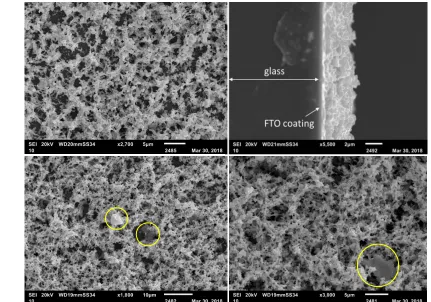
3network, and the physical and photoelectrochemical properties of the composite
38
coating were analyzed.
39
2. Materials and Methods
40
2.1. Reagents
41
Ammonium tungsten oxide hydrate ((NH
4)
6W
12O
39·xH2O, ATO), hydroxypropyl cellulose
42
(HPC, molar mass ≈ 100,000), triethanolamine (TEA), potassium phosphate monobasic,
alpha-43
terpineol and ethanol (200 proof) were purchased from VWR and used as received. Fluorine-doped
44
tin oxide transparent conductive substrates (FTO) were purchased from Hartford Glass company
45
(TEC-15). Prior to use, the FTO is sonicated in a solution of water, ethanol and detergent for 30
46
minutes, rinsed, heated briefly in dilute hydrogen peroxide, rinsed again, and dried at 100
oC.
47
2.2. Synthesis of the W(VI) Precursor Paste
48
To begin, 0.25g of ATO was dissolved in a mixture of 1g of deionized water and 3g of TEA using
49
an ultrasonic homogenizer. This leads to complexation of the W
6+center, indicated by the
50
appearance of a deep yellow color. The complexation of W
6+by TEA is an essential step, as it
51
dramatically enhances the solubility of the metal precursor in ethanol. The complexed solution is
52
then added to a separate solution of 0.75g of HPC dissolved in 5g of ethanol. Finally, 5g of
alpha-53
terpineol is blended into the mixture. Compressed air was passed through the solution while
54
vigorously stirring at room temperature for several hours to evaporate the ethanol, after which a
55
highly viscous white paste was obtained. The viscosity of the paste can be adjusted based on the
56
volume of alpha-terpineol added, corresponding to the particular needs of the reader.
57
2.3. Preparation Of Macroporous WO
3Thin Films
58
Paste was applied to a clean FTO surface by spin coating at 3000 rpm. A single application of
59
paste was used. The barrier height was set using 65 µm thick heat-resistant polyimide tape with
60
silicone adhesive (Micronova). Afterwards, the tape was removed and the films were annealed in
61
air at 550
oC for 4 hours. The resulting films are uniform, crack-free, strongly adherent,
semi-62
transparent, and bright yellow in appearance.
63
2.4 Functionalization of Macropores With Co-Catalyst
64
Co-Pi was a selected as a co-catalyst for this study due to its well-regarded ability to drive the
65
water oxidation reaction with high efficiency on metal oxide surfaces in neutral media.[6, 14, 16] The
66
synthesis of Co-Pi has been reported elsewhere.[71] In brief, a WO
3-coated electrode was used as
67
the working electrode and submerged into a solution of 0.5mM CoCl
2(aq) and 0.1M KH
2PO
4(aq)
68
buffered to a pH of 7. A constant voltage of 1V vs SCE was applied for a period of 15 minutes.
69
2.5 Methodology of Characterization
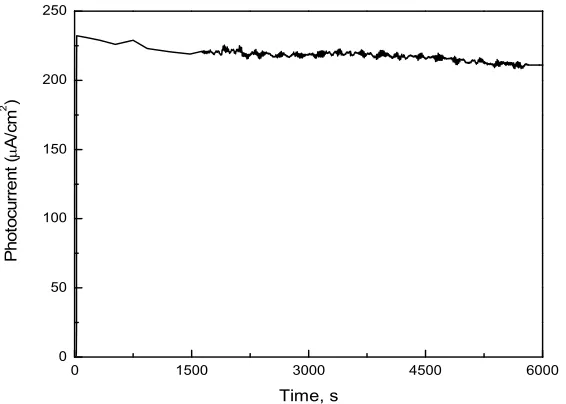
70
Formation of WO
3was confirmed by X-ray diffraction (Rigaku MiniFlex 600, Cu Kα radiation).
71
Surface and cross-sectional morphology of the film was analyzed using a JEOL JSM-6010PLUS/LA
72
SEM (20 kV AV). Samples were sputtered with carbon using a Polaron carbon evaporator to
73
minimize charging effects. For cross-sectional imaging, the FTO was cut and loaded vertically into a
74
double-slotted set screw vise holder (Ted Pella Inc., #16312, Ø32 × 10 mm). A Tauc plot was
75
produced using diffuse reflectance data obtained from an Ocean Optics USB-2000+
76
spectrophotometer coupled with a reflectance probe. Photocurrent analysis was performed using a
77
VersaSTAT 3 potentiostat with a three-electrode setup. A saturated calomel electrode was used as
78
the reference electrode, with platinum foil used as the counter electrode and WO
3-coated FTO
79
substrates with or without added Co-Pi were used as the working electrode. The electrolyte solution
80
was 0.1 M KH
2PO
4adjusted to pH 7. The working electrode was back-side illuminated using a solar
81
simulator from the Solar Light Company (AM 1.5, 100 mW/cm2).
82
3. Results
83
3.1. Structural and Optical Characterization
84
The deposited films show strong adhesion to the FTO surface, as well as good transparency. A
85
aggregated into an array of interconnected clusters which produce a network of micron-scale
87
channels that penetrate the full thickness of the coating. The cross-sectional image shown in figure
88
1b reveals a rough coating with non-uniform thickness. Under illumination, WO
3is well known to
89
suffer from hole-induced degradation due to the formation of peroxides at the surface.[28] Both
90
Seabold[14] and Zhong[16] have demonstrated that Co-Pi, when deposited on WO
3, eliminates the
91
peroxide-forming reaction by drastically enhancing the kinetics of the more thermodynamically
92
favorable oxygen-evolving reaction. Due to the extent of the porosity and the full permeation of the
93
micron-sized channels in our deposited films, the internal functionalization of the fiIm with Co-Pi
94
was demonstrated. Figures 1c and 1d reveal Co-Pi islands within the film, which are highlighted
95
with circles.
96
97
98
99
100
101
102
103
104
105
106
107
108
109
110
Figure 2 reveals photographic images of the porous film before and after addition of Co-Pi. As
111
shown, the Co-Pi deposition begins at the FTO surface, and the catalyst particles aggregate within
112
the channels. This is confirmed by the prominent appearance of the dark Co-Pi deposit which can
113
be seen when viewing the coated FTO through the backside, but much less so when viewing from
114
the front.
115
116
117
118
119
120
Figure 1a (top left): Top-down SEM image of WO3 film. Figure 1b (top right): Cross-sectional view. Figures 1c
and 1d (bottom left, bottom right): Images of WO3 films following addition of Co-Pi. Islands of Co-Pi can be seen
121
122
123
124
125
126
127
128
X-ray diffraction data is shown in the supporting information (S1). Characteristic peaks at 2θ =
129
24
o, 23.5
oand 23
osuggests that the material is in the monoclinic phase. The band gap of the material
130
was calculated as 2.62 eV from analysis of the Tauc plot, also provided in the supporting information
131
(S2). For materials having allowed, indirect transitions, extrapolation of the linear portion of the plot
132
of (αhv)
1/2vs hv yields the band gap energy in eV, where α is the absorption coefficient. The value
133
of α is directly proportional to the Kubelka-Munk function, (1-R)
2/2R, where R is the reflectance.
134
3.2. Photoelectrochemical Performance
135
The photoelectrochemical (PEC) performance of these films was measured in neutral electrolyte.
136
Although WO
3films do not exhibit long term stability at neutral pH, a neutral medium was chosen
137
for several reasons. First, any practical water-splitting catalyst intended for large-scale use must be
138
able to operate in neutral pH conditions. Second, the efficiencies of the hydrogen and oxygen
139
evolving reactions are affected inversely at extremes of pH. It has been demonstrated by numerous
140
groups that coating WO
3with a protecting layer of another material can prevent dissolution in neutral
141
electrolyte.[1,2,6,14] While we have not yet demonstrated this with our current system, the
142
photocurrent generation of bare and Co-Pi functionalized WO
3films has been analyzed and is
143
presented in figure 3. According to the current-voltage trace, the incorporation of Co-Pi into the
144
porous film results in a 302 mV cathodic shift in the onset potential of photocurrent, owing to the
145
decreased overpotential of water oxidation on Co-Pi relative to WO
3and improved hole transport
146
kinetics.[16,71,72] However, the maximum current is decreased relative to the bare WO
3. This is
147
likely the result of non-productive photon absorption by the dark Co-Pi material, as well as the
148
creation of new recombination sites.[14]
149
150
151
152
153
154
155
156
Figure 2. Front (left) and back (right) view of WO3 film with added Co-Pi. The edges
157
158
159
160
161
162
163
164
165
The stability and efficiency of the WO
3film is greatly extended when functionalized with Co-Pi,
166
as is reported in literature.[1,6,16,71-74] Figure 4 shows the photocurrent produced by the Co-Pi
167
loaded WO
3film in neutral electrolyte under continuous excitation with an applied bias of 0.3V vs
168
SCE. In the absence of the co-catalyst, the photocurrent decay is almost instant, with >90% loss in a matter
169
of minutes. With co-catalyst added, the duration of the current is extended, with a loss of ~8% over
170
the course of approximately 2 hours. The addition of a protecting layer to the WO
3catalyst would
171
minimize this decay.[16]
172
173
174
175
176
177
178
179
180
181
182
183
184
185
4. Discussion
186
We have presented a simple spin-coating route for the fabrication of thin films of WO
3comprised
187
of a highly macroporous array of clustered nanoparticles containing fully permeating channels.
188
During anodic electrodeposition of the co-catalyst, Co-Pi, nucleation initiates at the FTO interface,
189
then aggregation proceeds throughout the porous WO
3network to yield an internally functionalized
190
system. The system shows good photosensitivity, and the cathodic shift of the photocurrent onset
191
potential, along with the improved stability of the film under illumination indicate good electrical
192
contact between WO
3and Co-Pi. Future work in this area should include the addition of a protective
193
coating to the WO
3particles, or further loading of the porous network to improve charge separation
194
and transport.
195
Figure 3. i-V trace of bare and functionalized WO3 films under chopped illumination at pH 7 .
0 1500 3000 4500 6000
0 50 100 150 200 250
P
h
o
to
c
u
rr
e
n
t
(
A
/c
m
2 )
Time, s
Supplementary Materials: The following are available online at www.mdpi.com/xxx/s1, Figure S1: X-ray
196
Diffraction Pattern of WO3. Figure S2: Tauc Plot of WO3 Film.
197
Author Contributions: Conceptualization, M.O and C.H; methodology, M.O, C.G., C.H; software, M.O, C.G.;
198
validation, M.O, C.H.; formal analysis, C.H..; investigation, M.O, C.G., C.H.; resources, C.H.; data curation, M.O.,
199
C.H.; writing—original draft preparation, C.H.; writing—review and editing, M.O, C.G., C.H.; visualization,
200
M.O., C.G., C.H..; supervision, C.H..; project administration, C.H.; funding acquisition, C.H.
201
Funding: This research and the APC was funded by the NSF and South Carolina EPSCoR/IDeA program,
202
award# 17-RE06.
203
Acknowledgments: We would also like to thank Winthrop University’s SURE program and Dr. Julian Smith for
204
assistance with SEM.
205
Conflicts of Interest: The authors declare no conflict of interest.
206
References
207
1. Zhang, X.; Wang, X.; Wang, D.; Ye, J. Conformal BiVO4-Layer/WO3-Nanoplate-Array Heterojunction
208
Photoanode Modified with Cobalt Phosphate Cocatalyst for Significantly Enhanced Photoelectrochemical
209
Performances. ACS Applied Materials & Interfaces 2018, 10.1021/acsami.8b05477, doi:10.1021/acsami.8b05477.
210
2. Chae, S.Y.; Lee, C.S.; Jung, H.; Joo, O.-S.; Min, B.K.; Kim, J.H.; Hwang, Y.J. Insight into Charge Separation
211
in WO3/BiVO4 Heterojunction for Solar Water Splitting. ACS Applied Materials & Interfaces 2017, 9,
19780-212
19790, doi:10.1021/acsami.7b02486.
213
3. Yang, L., Zhu, X., Xiong, S., Wu, X., Shan, Y., Chu, P.K. Synergistic WO3·2H2O Nanoplates/WS2 Hybrid
214
Catalysts for HighEfficiency Hydrogen Evolution ACS Appl. Mater. Interfaces 2016, 8, 13966-13972.
215
4. Singh, T., Mueller, R., Singh, J., Mathur, S. Tailoring Surface States in WO3 Photoanodes for Efficient
216
Photoelectrochemical Water Splitting. Applied Surface Science 2015, 347, 448-453.
217
5. Krysa, J., Zlamal, M., Kment, S., Hubicka, Z. Photoelectrochemical Properties of WO3 and a-Fe2O3 Thin
218
Flims. Chem. Eng. Trans. 2014, 41.
219
6. Pilli, S.K., Janarthanan, R., Herring, A.M. Efficient Photoelectrochemical Water Oxidation of Co-Pi Catalyst
220
Modified BiVO4/WO3 Heterojunction Electrodes. Phys. Chem. Chem. Phys 2013, 15, 14723.
221
7. Liang, L., Zhang, J., Zhou, Y., Xie, J., Zhang, X., Guan, M., Pan, M., Xie, Y. High-performance flexible
222
electrochromic device based onfacile semiconductor-to-metal transition realized by WO3-2H2O ultrathin
223
nanosheets. Scientific Reports 2013, 3, 2-8.
224
8. Waller, M.T., T., Osterloh, F. Single Crystal WO3 Nanosheets: Photochemical Water Oxidation in the
225
Quantum Confinement Regime. Chemistry of Materials 2012, 24.
226
9. Enesca, A.A., L.; Duta, A. The Influence of Surfactants on the Crystalline Structure, Electrical and
227
Photocatalytic Properties of Hybrid Multi-Structured WO3 Thin Films. Applied Surface Science 2012, 258.
228
10. Hill, J.C., K. Effect of Electrolytes on The Selectivity and Stability of n-type WO3 Photoelectrodes For Use
229
in Solar Water Oxidation. The Journal of Physical Chemistry C 2012, 116.
230
11. Liu, Y.S., S.; Mustain, W. Synthesis of Nanosize WO3 And Its Evaluation as an Electrocatalyst Support for
231
Oxygen Reduction in Acid Media. ACS Catalysis 2012, 2.
232
12. Jeon, K., Youn, H., Kim, S., Shin, S., Yang, M. Fabrication and Characterization of WO3/Ag/WO3 Multilayer
233
Transparent Anode With Solution Processed WO3 For Polymer Light-Emitting Diodes. Nanoscale Research
234
Letters 2012, 7, 253-259.
235
13. Srinivasan, A.M., M. Chemically Stable WO3 Based Thin Film For Visible Light Induced Oxidation and
236
Superhydrophilicity. J. Phys. Chem. C 2012, 116, 15421-15426.
237
14. Seabold, J.C., K.S. Effect of a Cobal Based Oxygen Evolution Catalyst On The Stability and The Selectivity
238
of Photooxidation Reactions of a WO3 Photoanode. Chemistry of Materials 2011, 23.
239
15. Kim, H.K., J.;, Kim, W.; Choi, W. Enhanced Photocatalytic and Photoelectrochemical Activity in the Ternary
240
Hybrid of CdS/TiO2/WO3 Through Cascadal Electron Transfer. The Journal of Physical Chemistry C 2011, 115.
241
16. Zhong, D.K.; Choi, S.; Gamelin, D.R. Near-Complete Suppression of Surface Recombination in Solar
242
Photoelectrolysis by “Co-Pi” Catalyst-Modified W:BiVO4. Journal of the American Chemical Society 2011, 133,
243
18370-18377, doi:10.1021/ja207348x.
244
17. Gavrilyuk, A.I. Nanosized WO3 Thin Film As A Multifunctional Hydrogen Material For Acheiving
245
18. Hidayat, D.P., A.; Wang, W.; Okuyama, K. Preparation of Size Controlled WO3 Nanoparticles and
247
Evaluation of Their Adsorption Performance. Materials Research Bulletin 2010, 45.
248
19. Zhao, D.C., C.; Yu, C.; Ma, W.; Zhao, J. Photoinduced Electron Storage in WO3/TiO2 Nanohybrid Material.
249
Journal of Physical Chemistry C 2009, 113.
250
20. He, X.B., R. Direct Solar Water Splitting Cell Using Water, WO3, Pt and Polymer Electrolyte Membrane.
251
Energy 2009, 34.
252
21. Pak, J.B., M.; Paek, M.K. Synthesis and Reduction Behavior of Sol-Precipitated Fe2O3/WO3 Nanoparticles.
253
Journal of Alloys and Compounds 2009, 479.
254
22. Nah, Y.C.; Ghicov, A.; Kim, D.; Berger, S.; Schmuki, P. TiO2-WO3 Composite Nanotubes by Alloy
255
Anodization: Growth and Enhanced Electrochromic Properties. Journal of the American Chemical Society 2008,
256
130, 16154-+, doi:Doi 10.1021/Ja807106y.
257
23. Hamilton, J.W.J. Photooxidation of Water Using Nanocrystalline WO3 Under Visible Light. International
258
Journal of Photoenergy 2008.
259
24. Hu, C.C., Nian, J.N., Teng, H. Electrodeposited p-type Cu2O as Photocatalyst for H2 Evolution in the
260
Presence of WO3. Solar Energy Materials and Solar Cells 2008, 92, 1071-1076.
261
25. Luca, V., Blackford, M.G., Finnie, K.S., Evans, P.J., James, M., Lindsay, M.J., Skyllas-Kazacos, M., Barnes,
262
P.R.F. Sol-Gel Tungsten Oxide/Titanium Oxide Multilayer Nanoheterostructured Thin Films: Structural and
263
Photoelectrochemical Properties. J. Phys. Chem. C 2007, 111, 18479-18492.
264
26. Yang, B., Zhang, Y., Drabarek, E., Barnes, P.R.F., Luca. V. Enhanced Photoelectrochemical Activity of
Sol-265
Gel Tungsten Trioxide Films through Textural Control. Chem. Mater. 2007, 19, 5664-5672.
266
27. Krasnov, Y.S., Volkov, S.V., Kolbasov, G.Ya. Optical and Kinetic Properties of Cathodically Deposited
267
Amorphous WO3 Films. Journal of Non-Crystalline Solids 2006, 352.
268
28. Augustynski, J.S., R.; Hagemann, H.; Santoto, C.;. Nanostructured Thin Film Tungsten Trioxide
269
Photoanodes for Solar Water and Sea Water Splitting. Proc. SPIE 2006, 6340, Solar Hydrogen and
270
Nanotechnology, U140-U148.
271
29. Mills, A., Valenzuela, M.A. Photo-oxidation of water sensitized by TiO2 and WO3 in presence of different
272
electron acceptors. REVISTA MEXICANA DE F´ISICA 2004, 50, 287-296.
273
30. Pauporte, T. A Simplified Method for WO3 Electrodeposition. J. Electrochem. Soc 2002, 149.
274
31. Santato, C.; Ulmann, M.; Augustynski, J. Photoelectrochemical Properties of Nanostructured Tungsten
275
Trioxide Films. J. Phys. Chem. B 2001, 105, 936-940.
276
32. Santato, C.; Odziemkowski, M.; Ulmann, M.; Augustynski, J. Crystallographically oriented Mesoporous
277
WO3 films: Synthesis, characterization, and applications. J. Am. Chem. Soc. 2001, 123, 10639-10649.
278
33. Shim, J.; Lee, C.-R.; Lee, H.-K.; Lee, J.-S.; Cairns, E.J. Electrochemical characteristics of WO3/C and
Pt-279
TiO2/C electrocatalysts in a polymer electrolyte fuel cell. J. Power Sources 2001, 102, 172-177.
280
34. Sayama, K.M., K.; Abe., R.; Abe, Y.; Arakawa, H.;. Stoichiometric Water Splitting into H2 and O2 Using A
281
Mixture of Two Photocatalysts and an IO3-/I- Shuttle Redox Mediator Under Visible Light Irradiation. Chem.
282
Commun. 2001.
283
35. Tatsuma, T., Saitoh, S., Ohko, Y., Fujishima, A. TiO2-WO3 Photoelectrochemical Anticorrosion System with
284
an Energy Storage Ability. Chem. Mater. 2001, 13, 2838-2842.
285
36. Granqvist, C.G. Electrochromic tungsten oxide films: Review of progress. Solar Energy Mater. Solar Cells
286
2000, 60, 1993-1998.
287
37. Lee, W.J.; Fang, Y.K.; Ho, J.J.; Hsieh, W.T.; Ting, S.F.; Huang, D.Y.; Ho, F.C. Effects of surface porosity on
288
tungsten trioxide(WO3) films' electrochromic performance. J. Electron. Mater. 2000, 29, 183-187.
289
38. Shen, P.K.; Chi, N.; Chan, K.Y. Morphology of electrodeposited WO3 studied by atomic force microscopy.
290
J. Mater. Chem. 2000, 10, 697-700.
291
39. Sun, M. Nanocrystalline WO3 Thin Films: Preparation, Microstructure and Photochromic Behavior. 2000.
292
40. Wang, H.L., T.; He, J.; Hagfeldt, A.; Lindquist, S. Photoelectrochemistry of Nanostructured WO3 Thin Film
293
Electrodes for Water Oxidation. J. Phys. Chem. B 2000, 104.
294
41. Lee, S.H.; Cheong, H., M. ; Tracy, C.E.; Mascarenhas, A.; Czanderna, A.W.; Deb, S.K. Electrochromic
295
coloration efficiency of a-WO3-y thin films as a function of oxygen deficiency. Appl. Phys. Lett. 1999, 75,
1541-296
1543.
297
42. Bonhote, P.; Gogniat, E.; Graetzel, M.; Ashrit, P.V. Novel electrochromic devices based on complementary
298
43. Papaefthimiou, S.; Leftheriotis, G.; Yianoulis, P. Study of electrochromic cells incorporating WO3, MoO3,
300
WO3-MoO3 and V2O5 coatings. Thin Solid Films 1999, 344, 183-186.
301
44. Ozer, N.; Lampert, C.M. Electrochromic performance of sol-gel deposited WO3-V2O5 films. Thin Solid
302
Films 1999, 349, 205-211.
303
45. Lee, S.-H.; Cheong, H.M.; Zhang, J.-G.; Mascarenhas, A.; Benson, D.K.; K., S. Electrochromic Mechanism in
304
a-WO3-y Thin Films,., 74(2), 242. Appl. Phys. Lett 1999, 74, 242.
305
46. Kamat, P.V.; Vinodgopal, K. Sonochromic Effect in WO3 Colloidal Suspensions. Langmuir 1996, 12,
5739-306
5741.
307
47. Hotchandani, S.; Bedja, I.; Fessenden, R.W.; Kamat, P.V. Electrochromic and photoelectrochromic behavior
308
of thin WO3 films prepared from quantum size colloidal particles. Langmuir 1994, 10, 17-22.
309
48. Bechinger, C.; Herminghaus, S.; Leiderer, P. Photoinduced doping of thin amorphous WO3 films. Thin
310
Solid Films 1994, 239, 156-160.
311
49. Bedja, I.; Hotchandani, S.; Carpentier, R.; Vinodgopal, K.; Kamat, P.V. Electrochromic and
312
photoelectrochemical behavior of thin WO3 films prepared from quantized colloidal particles. Thin Solid Films
313
1994, 247, 195-200.
314
50. Shen, P.; Chen, K.; Tseung, A.C.C. Co-deposited Pt-WO3 electrodes. Part I.- Methanol oxidation and in situ
315
FTIR studies. Faraday Trans. 1994, 90, 3089-3096.
316
51. Vuillemin, B.B., O. Kinetics Study and Modeling of Electrochromic Phenomena in Amorphous WO3 Thin
317
Films in Acid and Lithium Electrolytes. Solid State Ionics 1994, 68.
318
52. Bedja, I.; Hotchandani, S.; Kamat, P.V. Photoelectrochemistry of quantized WO3 colloids. Electron storage,
319
electrochromic, and photoelectrochromic effects. J. Phys. Chem. 1993, 97, 11064-11070.
320
53. Tennakone, K.; Iieperuma, O.A.; Bandara, J.M.S.; Kiridena, W.C.B. TiO2 and WO3 semiconductor particles
321
in contact: Photochemical reduction of WO3 to the non-stoichiometric blue form. Semicond. Sci. Technol. 1992,
322
7, 423-424.
323
54. Ashokkumar, M. Factors Influencing The Photocatalytic Efficiency of WO3 Particles. Journal of
324
Photochemistry and Photobiology a-Chemistry 1989, 49.
325
55. Desilvestro, J.; Graetzel, M. Photoelectrochemistry of polycrystalline n-WO3. Electrochemical
326
characterization and photoassisted oxidation processes. J. Electroanal. Chem. Interfacial Electrochem 1987, 238,
327
129-150.
328
56. Desilvestro, J.; Graetzel, M.; Pajkossy, T. Electron transfer at the WO3-electrolyte interface under controlled
329
mass transfer conditions. J. Electrochem. Soc. 1986, 133, 331-336.
330
57. Erbs, W.; Desilvestro, J.; Borgarello, E.; Graetzel, M. Visible-light-induced O2 generation from aqueous
331
dispersions of WO3. J. Phys. Chem. 1984, 88, 4001-4006.
332
58. Nenadovic, M.T.; Rajh, T.; Micic, O.I.; Nozik, A.J. Electron transfer reactions and flat-band potentials of
333
WO3 colloids. J. Phys. Chem. 1984, 88, 5827-5830.
334
59. Desilvestro, J.; Graetzel, M. Photosynthesis of peroxodisulphate with visible light at polycrystalline WO3
335
anodes. J. Chem. Soc., Chem. Commun 1982, 9.
336
60. Kiwi, J.; Graetzel, M. Visible-light-driven generation of chlorine with powdered WO3 in aqueous solution
337
via redox catalysis. J. Chem. Soc., Faraday Trans 1982, 78, 931-939.
338
61. Mills, A. Photooxidation of Water Sensitized by WO3 Powder. J. Chem. Soc. Faraday Trans. 2 1982, 78.
339
62. Giraudeau, A.; Fan, F.R.; Bard, A.J. Semiconductor electrodes. 30. Spectral sensitization of the
340
semiconductors n-TiO2 and n-WO3 with metal phthalocyanines. J. Am. Chem. Soc. 1980, 102, 5137-5142.
341
63. Park, J.H.; Kim, S.; Bard, A.J. Novel Carbon-doped TiO2 Nanotube Arrays with High Aspect Ratios for
342
Efficient Solar Water Splitting. Nano Letters 2006, 6, 24-28.
343
64. Hwang, Y.J.; Boukai, A.; Yang, P.D. High Density n-Si/n-TiO2 Core/Shell Nanowire Arrays with Enhanced
344
Photoactivity. Nano Letters 2009, 9, 410-415, doi:Doi 10.1021/Nl8032763.
345
65. Kim, S.W.; Han, T.H.; Kim, J.; Gwon, H.; Moon, H.S.; Kang, S.W.; Kim, S.O.; Kang, K. Fabrication and
346
Electrochemical Characterization of TiO2 Three-Dimensional Nanonetwork Based on Peptide Assembly. ACS
347
Nano 2009, 3, 1085-1090, doi:Doi 10.1021/Nn900062q.
348
66. Wang, D.A.; Liu, Y.; Wang, C.W.; Zhou, F.; Liu, W.M. Highly Flexible Coaxial Nanohybrids Made from
349
Porous TiO2 Nanotubes. ACS Nano 2009, 3, 1249-1257, doi:Doi 10.1021/Nn900154z.
350
67. Lee, J.C.; Kim, T.G.; Choi, H.J.; Sung, Y.M. Enhanced photochemical response of TiO2/CdSe
351
heterostructured nanowires (vol 7, pg 2591, 2007). Crystal Growth & Design 2008, 8, 750-750, doi:Doi
352
68. Leschkies, K.S.; Divakar, R.; Basu, J.; Enache-Pommer, E.; Boercker, J.E.; Carter, C.B.; Kortshagen, U.R.;
354
Norris, D.J.; Aydil, E.S. Photosensitization of ZnO nanowires with CdSe quantum dots for photovoltaic devices.
355
Nano Letters 2007, 7, 1793-1798.
356
69. Dor, S.; Grinis, L.; Rühle, S.; Zaban, A. Electrochemistry in Mesoporous Electrodes: Influence of
357
Nanoporosity on the Chemical Potential of the Electrolyte in Dye Sensitized Solar Cells. The Journal of Physical
358
Chemistry C 2009, 113, 2022-2027, doi:doi:10.1021/jp808175d.
359
70. Baker, D.R.; Kamat, P.V. Disassembly, Reassembly and Photoelectrochemistry of Etched TiO2 Nanotubes.
360
J. Phys. Chem. C 2009, 113, submitted.
361
71. Kanan, M.W.; Nocera, D.G. In Situ Formation of an Oxygen-Evolving Catalyst in Neutral Water Containing
362
Phosphate and Co2+. 2008, 321, 1072-1075, doi:10.1126/science.1162018 %J Science.
363
72. Barroso, M., Cowan, A., Pendlebury, S., Gratzel, M., Klug, D., Durrant, J. The Role of Co-Pi in Enhancing
364
the Photocatalytic Activity of Fe2O3 Toward Water Oxidation. J. Am. Chem. Soc. 2011, 133, 4.
365
73. Zhong, D., Gamelin, D. Photoelectrochemical Water Oxidation by Cobalt Catalyst (Co-Pi)/ Fe2O3
366
Composite Photoanodes. J. Am. Chem. Soc. 2010, 132, 4202-4207.
367
74. Steinmiller, E., Choi, K. Photochemical deposition of Cobalt-based Oxygen Evolving Catalyst on a