Exclusive vector mesons at high energies:
from photon-proton to proton-proton and nucleus-nucleus
collisions
Wolfgang Sch¨afera
Institute of Nuclear Physics PAN, Cracow, Poland
Abstract. Photoproduction of vector mesons has been studied since the 1960’s and was instrumental in establishing the hadronic structure of the photon and the concept of vector-meson dominance. More recently our knowledge on vector vector-meson photoproduction has been furthered by experiments at the HERA accelerator. Total cross sections ans well as a number of kinematical distributions have been measured from light to heavy vector mesons. These experiments have been a testbed of ideas on the production mechanism, the QCD Pomeron exchange. In particular in varying the mass of the vector meson we can study the Pomeron exchange from the soft to the perturbatively hard regimes. The production mechanism also contains information on the quark-antiquark wave function of the produced meson. High energy protons or ions are the source of a flux of Weizs¨acker-Williams photons, which can be utilized to study the photoproduction of vector mesons also at the Tevatron and LHC colliders. We discuss how information on the small-x gluon distribution in protons in nuclei can be obtained. Besides this intrinsic interest in vector meson production, a precise knowledge thereof is also necessary for odderon searches. In this regard, we discuss also transverse momentum distributions including absorption effects.
1 Introduction
The earliest investigations of diffractive photoproduction established the hadronic structure of the pho-ton and were mainly based on the concept of vector-meson dominance. (For a review of these early developments, see e.g. [1].) More recently, the subject has been much advanced by experiments at the HERA accelerator. A wealth of physics information has been obtained from data: from transverse momentum distributions to total cross sections, to studies of s-channel helicity violation from the spin density matrix of vector mesons. Also the previously unexplored region of large photon virtuality Q2 was thoroughly investigated. We cannot do justice here to the impressive amount of data and the var-ious approaches proposed and conclusions reached by theorists. Instead we refer to the recent review [2]. The exclusive photoproduction of vector mesons at high energies is a typical diffractive process, which in the Regge theory is described by the t-channel exchange of a Pomeron (see e.g. the recent textbooks [3]). Consequently, these experiments have been important for testing ideas on the produc-tion mechanism, the QCD Pomeron exchange. In particular in varying the mass of the vector meson we can study the Pomeron exchange from the soft to the perturbatively hard regimes. The production mechanism also contains information on the quark-antiquark wave function of the produced meson. DOI: 10.1051/
C
Owned by the authors, published by EDP Sciences, 2012 epjconf 20123/ 701018
F
(
x, κ
) =
∂G
(
x, κ
)
/∂
log
κ
2p
p
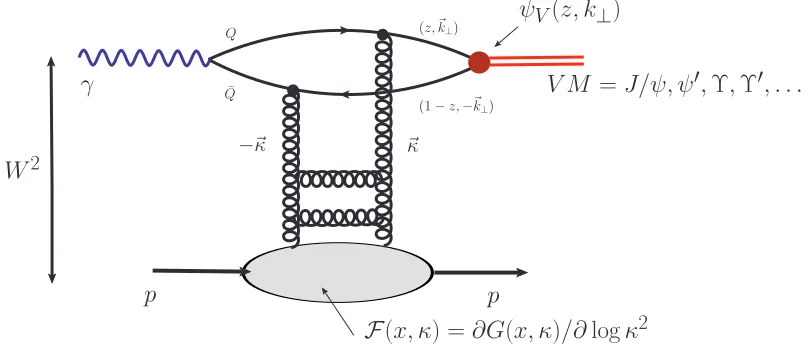
Fig. 1. A typical Feynman diagram for theγp→V p amplitude. Theγ→Q ¯Q vertex is calculated perturbatively.
Nonperturbative information is contained in the light cone wave function of the vector meson and the unintegrated gluon distribution.
2 Photoproduction
γ
p
→
V p
at high energies
One of the most striking findings of the diffractive vector meson studies at HERA concerns the system-atics of the energy-dependence of the various total vector-meson cross sections. Indeed, if, motivated by Regge theory, we parametrize the dependence onγp center-of-mass energy W, as
σtot(γp→V p)∝W 2
W2 0
δ
, (1)
the effective interceptδturns out do be a function of the hard scale Q2eff =Q2+MV2. Here Q2is the photon virtuality, MV the mass of the vector meson. For the case photoproduction, of most interest in this presentation, one finds the following: firstly, for light vector mesonsρ0, ω, and also forφ, we haveδ ∼ 0.11, close to the “soft Pomeron” intercept ofδ ∼ 0.08 that rules, e.g. the total photoab-sorption cross section. The intercept then significantly increases with meson mass: for J/ψ,δ ∼0.4, for ψ(2S ), we haveδ ∼ 0.55, and forΥ, the few available data points are consistent withδ ∼ 0.6. Given these process-dependent intercepts, do we have to give up the concept of a Pomeron? How can this behaviour be obtained in a “microscopic” approach? Indeed such a systematics of the energy dependence is qualitatively easily understood within the color-dipole approach [4, ?] to hard and soft diffractive processes. Within the color-dipole framework, the hadronic structure of the photon is ex-hausted by QCD degrees of freedom, at lowest order quark-antiquark pairs. The forward diffractive amplitude shown in Fig. 1 takes the form
ℑmA(γ∗(Q2)p→V p; W,t=0)= Z 1
0
dz
Z
d2rψV(z,r)ψγ∗(z,r,Q2)σ(x,r), (2)
where x =MV2/W2,ψV andψγ are the light-cone wave functions for the quark-antiquark Fock states of the vector meson and photon respectively. The q ¯q separation r is conserved during the interaction (and so are the longitudinal momentum fractions z,1−z carried by q and ¯q). Color dipoles of size r
are diagonal states of the S -matrix and interact with the proton with the cross section
σ(x,r)= 4π 3 αS
Z d2κ
κ4
∂xg(x,κ2)
∂log(κ2)
1−exp(iκr)
, (3)
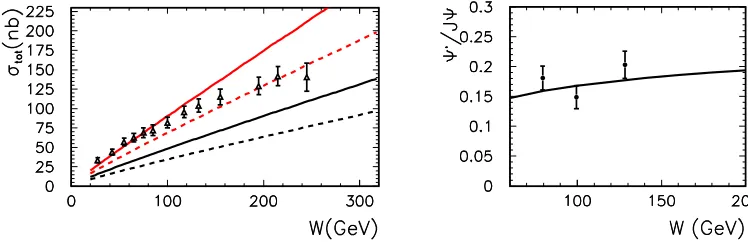
Fig. 2. Left panel: the total cross section forγp→J/ψp. Data from the ZEUS collaboration. Red lines are for a Gaussian, the black ones for a Coulomb-type wave function. Solid lines include an NLO treatment of the vector meson decay width, while the dashed lines a LO one. Right panel: The ratio of total cross sections ofψ(2S ) and J/ψphotoproduction. Here a Gaussian wave function was used.
which in turn is related to the transverse-momentum dependent (or unintegrated) gluon distribution (see e.g. [5] and references therein). Let us try to understand the behaviour of the amplitude (2) at large Q2
eff: firstly, the photon’s light cone wave function falls offas
ψγ∗(z,r,Q2)∝exp[−εr], ε=
q
m2f+z(1−z)Q2, (4)
which together with the fact that the distribution of dipoles in the meson is a smooth nonsingular function leads to the fact that the overlap (2) is dominated by dipoles of size [4]
r∼rS ≈ 6 q
Q2+M2 V
, (5)
which has become known as the “scanning radius”. For a quick estimate of the asymptotic behaviour, one can expand the exponential in eq.(3), so that for small dipoles:
σ(x,r)=π 2
3r 2α
S(q2)xg(x,q2),q2≈ 10
r2 , (6)
which, when inserted into (2) in conjunction with (4,5) leads to [4]:
ℑm A(γ∗p→V p)∝r2
Sσ(x,rS)∝ 1
Q2+M2 V
× 1
Q2+M2 V
xg(x,Q2+MV2). (7)
Notice the strong deviation from the (Q2+MV2)−1pole behaviour predicted by vector meson domi-nance. Hadronic degrees of freedom are not a good vantage point at all in this case. In fact, one of the factors r2
S ∝(Q 2+M2
V)
−1comes from the shrinking with Q2and m2
Qoverlap of the photon and meson dipole distributions, a second factor of rS2 originates from the interaction probability of a small dipole, which decreases∝ r2 (color transparency). Finally, there is the important dependence on Q2+M2 V through the argument of the gluon distribution. It gives us the sought-for correlation between energy dependence and Q2+M2
V. Indeed, empirically, from DGLAP fits we know that xg(x, µ
(GeV)
p γ
W
1 10 102
0
(GeV)
p γ
W
1 10 102
0 2
Fig. 3. Total cross sections for the production of light vector mesons. Left panel:ρ0 production. The diff er-ent curves show the variation with a change of the constituer-ent quark mass [9]. Below W ∼10 GeV secondary
Reggeons must be included. Right panel:ωproduction. Here the same quark mass that gives the best fit toρ0 production was used for the Pomeron exchange contribution. At low energies also the contribution from pion exchange via the anomalousγπω-vertex is included.
cancellations in the production amplitude, as it was long ago found within the color dipole models [4]. Reasonable agreement with HERA data is also obtained forΥproduction [6]. Notice, that for heavy vector mesons, the relevant dipole sizes are small (the scanning property!), and we are in the perturba-tive regime, where the gluon distribution is legitimately used. The dipole factorization (2) doesn’t in fact rely on perturbation theory, it is the relation between dipole cross section and gluon distribution that does. Color dipoles are good degrees of freedom also in the nonperturbative regime: following [4], just allowing for a constituent mass of quarks in the loop allows for a satisfactory description also ofφ[8], and evenρ0, ω[9] production (see Fig. 3).
3 Central exclusive photoproduction in proton-(anti)proton collisions
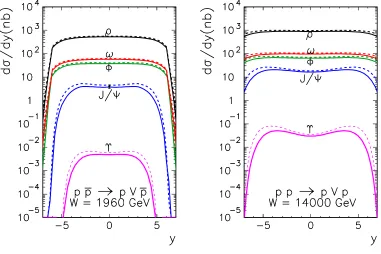
Fig. 4. Rapidity dependence of central exclusive vector meson production in proton-(anti)proton collisions. Left panel: proton-antiproton collisions at W=1960 GeV. Right panel: proton-proton collisions at W=14 TeV. In the left panel also shown is the data point from the CDF collaboration. Dashed lines are without absorptive corrections, while solid lines include them.
Odderon is required. In Fig. 5 we show results for two different unintegrated gluon distributions in a proton: the curves labeled IN use the glue from [5], whereas the ones labeled KS the one from [12]. The latter is obtained from a nonlinear evolution equation which accounts for the physics of gluon saturation at small x, while the former does not include explicit saturation effects. We observe that the shape of rapidity spectra is strongly affected, as well as the size of the cross section predicted at LHC energies.
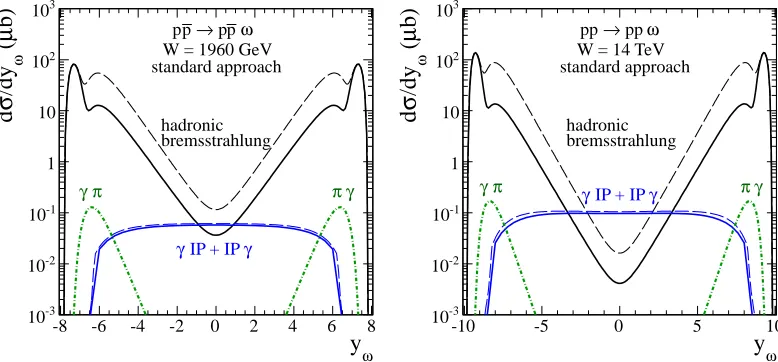
An interesting pattern was found in our calculations [9] of exclusiveωproduction, see Fig. 5. Here we deal with a purely soft process where there is no controlled access to the unintegrated gluon dis-tribution. Here, in addition to photoproduction we also included a number of purely strong interaction processes. TheωNN coupling is large, and there are “bremsstrahlung” type of contributions, where
theωis emitted offa nucleon line and which dominate in the respective beam and target fragmentation regions. They are the typical example of diffractive dissociation of a proton into a low-mass contin-uum state. In addition, there are contributions, which contain theωReggeon exchange in the crossed channel (the ω-Pomeron fusion). Although theω trajectory is subleading, they can be numerically surprisingly large.
4 From the free nucleon to the nuclear target:
γ
A
and
AA
collisions
Fig. 5. Rapidity dependence of central exclusive vector meson production in proton-(anti)proton collisions for different unintegrated gluon distributions in a proton (see text). Dashed lines do not include absorptive corrections, while solid ones do. Left panel: J/ψproduction at the Tevatron energy W=1960 GeV. Right panel:Υproduction at an LHC energy, W=7 TeV. In the left panel also shown is the data point from the CDF collaboration.
ω
y
-8 -6 -4 -2 0 2 4 6 8
b)
µ
(
ω/dy
σ
d
-3 10 -2 10 -1 10 1 10 2 10 3 10 ω p p → p pW = 1960 GeV standard approach
γ
IP + IP
γ π γ πγ hadronic bremsstrahlung ω
y
-10 -5 0 5 10
b)
µ
(
ω/dy
σ
d
-3 10 -2 10 -1 10 1 10 2 10 3 10 ω pp → pp W = 14 TeV standard approachγ
IP + IP
γ
π
γ πγ
hadronic bremsstrahlung
Fig. 6. Rapidity dependence of exclusiveωmeson production in proton-(anti)proton collisions. Left panel: p ¯p collisions at W=1960 GeV. Right panel: pp collisions at W=7 TeV. Shown are the contributions from hadronic “bremsstrahlung”, from photoproduction (γ-Pomeron fusion) as well as a contribution from the anomalousγπω vertex. From [9].
Fig. 7. Two Feynman diagrams for theγp→V p amplitude on the nuclear target. The left diagram represents a
rescattering of the Q ¯Q-Fock state and dominates at not too small values of x. The diagram on the right hand side can be viewed as a rescattering of a Q ¯Qg-Fock state. It is responsible for the x-dependence of the amplitude at small x.
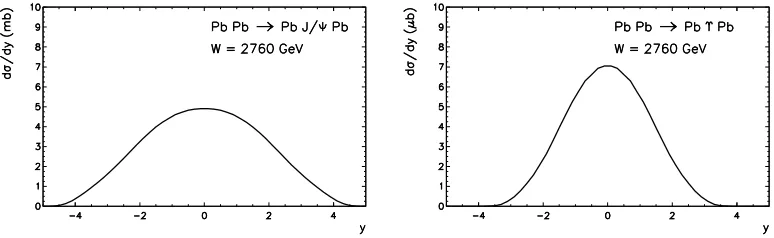
Fig. 8. Rapidity dependence of exclusive J/ψ-production (left) andΥproduction (right) in lead-lead collisions at the LHC energy WNN=2.76 TeV [14].
References
1. T. H. Bauer, R. D. Spital, D. R. Yennie and F. M. Pipkin, Rev. Mod. Phys. 50 (1978) 261 [Erratum-ibid. 51 (1979) 407].
2. I. P. Ivanov, N. N. Nikolaev and A. A. Savin, Phys. Part. Nucl. 37 (2006) 1.
3. V. Barone and E. Predazzi, High-energy particle diffraction (Springer, Berlin 2002); S. Donnachie,
H. G. Dosch, O. Nachtmann and P. Landshoff, Camb. Monogr. Part. Phys. Nucl. Phys. Cosmol. 19 (2002) 1.
4. N. N. Nikolaev, Comments Nucl. Part. Phys. 21 (1992) 41; J. Nemchik, N. N. Nikolaev, E. Predazzi and B. G. Zakharov, Z. Phys. C 75 (1997) 71 .
5. I. P. Ivanov and N. N. Nikolaev, Phys. Rev. D 65 (2002) 054004 [hep-ph/0004206]. 6. A. Rybarska, W. Sch¨afer and A. Szczurek, Phys. Lett. B 668 (2008) 126.
7. A. Cisek, Exclusive processes with large rapidity gaps in the formalism of unintegrated gluon
distributions, (PhD thesis, The Henryk Niewodnicza´nski Institute of Nuclear Physics, Polish
Academy of Sciences, Krak´ow, 2012)
8. A. Cisek, W. Sch¨afer and A. Szczurek, Phys. Lett. B 690 (2010) 168.
9. A. Cisek, P. Lebiedowicz, W. Sch¨afer and A. Szczurek, Phys. Rev. D 83 (2011) 114004. 10. W. Sch¨afer and A. Szczurek, Phys. Rev. D 76 (2007) 094014.
11. T. Aaltonen et al. [CDF Collaboration], Phys. Rev. Lett. 102 (2009) 242001 . 12. K. Kutak and A. M. Sta´sto, Eur. Phys. J. C 41 (2005) 343 .
13. G. Baur, K. Hencken, D. Trautmann, S. Sadovsky and Y. Kharlov, Phys. Rept. 364 (2002) 359. 14. A. Cisek, W. Sch¨afer and A. Szczurek, Phys. Rev. C 86 (2012) 014905.
15. N. N. Nikolaev, W. Sch¨afer and G. Schwiete, Phys. Rev. D 63 (2001) 014020.
![Fig. 3. Total cross sections for the production of light vector mesons. Left panel:ent curves show the variation with a change of the constituent quark mass [9]](https://thumb-us.123doks.com/thumbv2/123dok_us/8071048.1346146/4.482.45.436.58.244/total-sections-production-vector-mesons-curves-variation-constituent.webp)