ISSN (Print) : 2320 – 3765 ISSN (Online): 2278 – 8875
I
nternational
J
ournal of
A
dvanced
R
esearch in
E
lectrical,
E
lectronics and
I
nstrumentation
E
ngineering
(An ISO 3297: 2007 Certified Organization)
Website: www.ijareeie.com
Vol. 6, Issue 5, May 2017
Speed Control of BLDC Motor Using PID
Controller and Genetic Algorithm
Priyanka, M S Aspalli
Student, Department of EEE, PDA College of Engineering, Kalaburagi, Karnataka, India
Department of EEE, PDA College of Engineering, Kalaburagi, Karnataka, India
ABSTRACT: This paper discusses the progress of motor such as BLDC on efficiency and reliability. A DC motor brushless drive is characterized by greater efficiency, lower maintenance, higher cost, quiet operation and compact form. There are several techniques for controlling the BLDC motor as PI controller, PID controller, fuzzy logic, genetic algorithms, neural networks, PWM control and less sensor control, etc. The GA-based PID controller is used for the BLDC motor speed control. Due to its favorable electrical and mechanical properties, BLDC motors are used in applications such as automotive, aerospace, medical, instrumentation, machine tools, robotics and actuation, etc. The main advantage of the proposed method is that the mathematical model of the system under control is not necessary, so it is useful in many industrial processes that do not have an obvious or complicated model. In addition, this method allows determining the best values of the PID parameters for a specified overrun, a rise time, a settling time and a steady state error. The DC motor is modeled with the designed PID controller and the results of the simulation are obtained. The results obtained are compared with those of the conventional PID controller and the GA based algorithm, the comparison indicates the effectiveness of the proposed adjustment method, since it gives a better performance and satisfies the specified control characteristics.
I. INTRODUCTION
High-performance electric motor drives are very important in industrial applications as well as other purpose-built applications. In general, a better performance of an electric motor drive system has a better dynamic response. Among all motors, DC motors have been widely used in many variable speed applications that require high control requirements such as electric vehicles, steel rolling mills, electric cranes, high precision digital tools and robotics. This is due to its simple, precise and wide ranging control characteristics. The speed of DC motors is directly proportional to the armature voltage and inversely to the flux of the magnetic field. The control of the armature voltage and / or the field current will adjust the DC motor speed. One of the most popular controllers has been used for speed control of DC motors is the PID controller due to its simple structure and good performance. In addition, with technological advances, the parameters of the PID controller can be easily changed without the need to change any hardware. However, the performance of the PID controller depends on the accuracy of the model and the system parameters.
ISSN (Print) : 2320 – 3765 ISSN (Online): 2278 – 8875
I
nternational
J
ournal of
A
dvanced
R
esearch in
E
lectrical,
E
lectronics and
I
nstrumentation
E
ngineering
(An ISO 3297: 2007 Certified Organization)
Website: www.ijareeie.com
Vol. 6, Issue 5, May 2017
II. IMPLEMENTATION
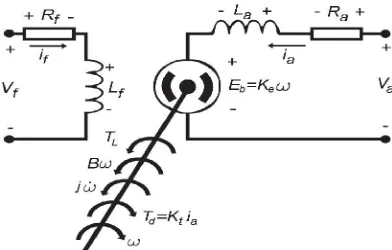
Although their maintenance costs are higher than othermotors, DC motors are most suitable motors for adjustablespeed control applications that need high control requirements.Fig. 1 shows the equivalent circuit of a separately excited DCmotor. The characteristics equations of the DC motor inLaplace form can be given as:
( ) = [ + ] ( ) + ( ) (1)
( ) = ( ) (2)
( ) = ( ) = ( ) + [ + ] ( ) (3)
Where , , are the armature voltages, current (A), resistance (Ω) and inductance (H) respectively.Eb is the
back EMF (V) and Ke is the back EMF constant(V.sec/rad). Td is the developed torque (N.m), Kt is the torqueconstant
(N.m/A), ω is the rotational speed of the motor(rad/sec), TL is the load torque (N.m), j is the inertia momentof the
motor (Kg.m2) and B is the viscous friction constant(N.m.sec/rad).
Fig 1: Equivalent circuit of a separately excited DC motor
Fig. 2 shows the block diagram of a separately excited DCmotor drive using armature voltage control. The transferfunction of the motor speed with respect to the armaturevoltage can be given as:
ω(s)
V (s)=
K
[L j]s + [R j + L B]s + [R B + K K ] (4)
Fig. 2 Block diagram of a separately excited DC motor drive using armaturevoltage control
PID CONTROLLER DESIGN:
ISSN (Print) : 2320 – 3765 ISSN (Online): 2278 – 8875
I
nternational
J
ournal of
A
dvanced
R
esearch in
E
lectrical,
E
lectronics and
I
nstrumentation
E
ngineering
(An ISO 3297: 2007 Certified Organization)
Website: www.ijareeie.com
Vol. 6, Issue 5, May 2017
controller. On its own, theResultant output temperature characteristictypically stabilized just below the desired reference temperature. This is because; as its gain increases, the system responds by applying more output power, and as a result the temperature rises rapidly and is approaching the set point. But as this happens, the system they react by decreasing the gain as the gap the reference is getting smaller and smaller. This makes the response be progressively converted into the exit temperature approaches the set point. This difference between stabilized production and Reference is called Steady State Error.
Integral Controller:To solve the steady state problem with Kp alone, the integral term, Ki, has to be used. The characteristic of integral control is that it performs an integration of the latest error values and applies a gain to minimize this error. The effect of this action is Changing Heater Powercontinuously based on previous performance up to the measured value of time of the temperature error is zero.
Derivative Controller:The term derivative comes into play when the Excess and oscillation. The error rate iscalculateddetermine the slope of the error in time y multiplying this rate of change by the derived gainKd. The term derivative of magnitude introducesDamping to the overall output of the system decreasing the rate of change of the output of the controller, can be reduced to excess and oscillation.But side effect is that damping can also slightly increase the climb time. Together with P and I terms of control, the term derivative may help the stability of the system process.
PID Controller: PID controller algorithm, the controller canControl action designed for specific process requirements. The controller response can be in terms of the response capacity of the Controller to an error, the degree to which the regulator exceeds the set point and the degree of System oscillation. Note that the use of the PID Algorithm for control does not guarantee optimum System control or system stability.
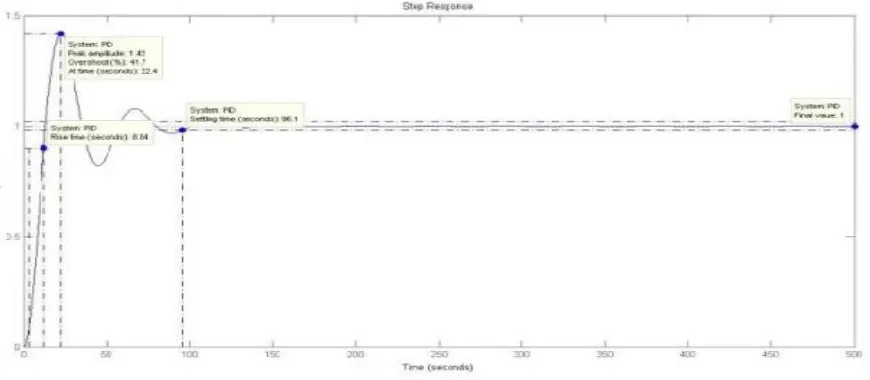
Fig 3:Output response of the Proportional Integral Derivativecontroller.
Table 1: Effects of PID controllers parameters kp, ki and kd on a closed loop system
Closed loop Response
Rise Time(sec) Maximum Overshoot(%)
Settling Time(sec)
Steady State Error As increase of KP Decrease Increase Small change Decrease
As increase of KI Decrease Increase Increase Eliminate
ISSN (Print) : 2320 – 3765 ISSN (Online): 2278 – 8875
I
nternational
J
ournal of
A
dvanced
R
esearch in
E
lectrical,
E
lectronics and
I
nstrumentation
E
ngineering
(An ISO 3297: 2007 Certified Organization)
Website: www.ijareeie.com
Vol. 6, Issue 5, May 2017
Genetic Algorithm:
Ineach generation, genetic operators are applied to individuals selected from the current population in order to create a new population. Generally, the three main genetic operators of reproduction, crossing and mutation are used. Using different probabilities to apply these operators, you can control the speed of convergence. The crossover and mutation operators must be carefully designed, as their choice contributes greatly to the execution of the entire genetic algorithm. Genetic algorithm (GA) is a search heuristic that mimics The process of natural evolution. This heuristic is routine Used to generate useful solutions to optimization and search problems. Genetic algorithms they belong to the largest class of evolutionary algorithms (EA) that generate solutions to optimization problems using techniques inspired by natural evolution, as inheritance, mutation, selection and crossing. In a Genetic algorithm, a population of strings (Called chromosomes or the genome genome), Encoding candidate solutions (called individuals, Creatures or phenotypes) to an optimization problem, Evolve towards better solutions. Traditionally, the solutions are represented in binary as strings of 0s and 1s, but others encodings are also possible. Evolution usually begins From a population of individuals generated at random and It happens in generations. In each generation, the each individual in the population is evaluated, multiple Individuals are stochastically selected from the Population (based on physical fitness) and (Recombined and possibly randomly mutated) to form a new population. The new population is then used in the next iteration of the algorithm. Commonly, the algorithm ends when either a maximum number of generations a satisfactory level of reached for the population. If the algorithm is finished due to a maximum number of generations, a solution may or may not have been reached.
Cross Over:
The crossover operator is the primary operator and is used to produce offspring who are different from their parents but who inherit a portion of the genetic material from their parents. Under this operator, a selected chromosome is divided into two parts and is recombined with another selected chromosome that has been divided at the same crossover point. Typically this operator is applied at a rate of 60% to 80% of the population, and the crossover point and each pair is randomly selected.
Mutation:
The mutation operator plays a secondary role in evolution. It helps maintain diversity in the population by discovering new or restoring lost genetic materials by looking for the space of the neighborhood solution. Although mutation may play a vital role in a genetic algorithm, it should be noted that it occurs with a small probability rate of 0.1% to 10% of the entire population.
ISSN (Print) : 2320 – 3765 ISSN (Online): 2278 – 8875
I
nternational
J
ournal of
A
dvanced
R
esearch in
E
lectrical,
E
lectronics and
I
nstrumentation
E
ngineering
(An ISO 3297: 2007 Certified Organization)
Website: www.ijareeie.com
Vol. 6, Issue 5, May 2017
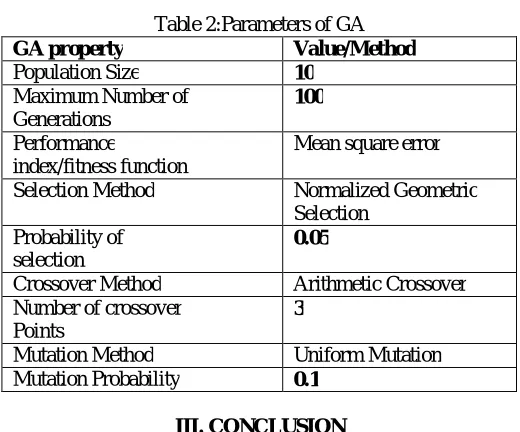
Table 2:Parameters of GA
GA property Value/Method
Population Size 10
Maximum Number of Generations
100
Performance
index/fitness function
Mean square error
Selection Method Normalized Geometric
Selection Probability of
selection
0.05
Crossover Method Arithmetic Crossover
Number of crossover Points
3
Mutation Method Uniform Mutation
Mutation Probability 0.1
III. CONCLUSION
Accurate performance of a motor is desired feature for any industrial application.As the age of motor increases its performance also deceases with aging, so it is desired to evaluate theperformance of motor from time to time for efficient operationThe conventional method for calculating output performance indices are quite time consuming.
The PID based approach algorithm worked satisfactory for the test system. The important observations made during the studies are
1) The solution time for proposed PID approach is only a fraction of time taken by conventional algorithm.
2) A proportional controller Kp will have the effect of reducing the rise time and reduce but never eliminatethe steady state error. 3) An internal controller Ki will have the effect of eliminate the steady state error but it may make thetransient response worse. 4) A derivative controller Kd will have the effect of increasing the stability of the system and reducing the overshoot and improve the transient response.
5) The output performance obtained by normalized value in PID is very close and near to accuracy.
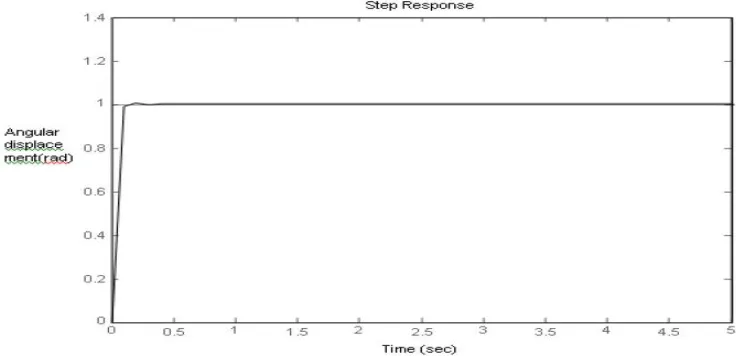
The simulation results showed that the introduction of the GA led to an improvement in the speed regulation of the IM, which leads us to say that optimization by GA gives us the possibility of designing a powerful PID controller by optimizing its parameters.
REFERENCES
[1] AdityaPratap Singh, Udit Narayan andAkashVerma,“Speed Control of DC Motor using PID Controller Based on Matlab”, IISTE, Vol.4, No.6,
2013.
[2] Pooja.Hanchate, Priyanka.Gadag, Prithvi.H, Sapna.U, Ramya.S, Priyaka.B, Swathi.I andRaghavendra.M.Shet,“Speed Control Of Dc Motor
Using PID Controller”, IRF International Conference,2016.
[3] TusharChouhan andArkajaAgrawal, “D.C. Motor Control by Genetic Algorithm”, International Journal of Digital Application &
Contemporary research, Vol. 1, No. 1, 2012.
[4] M’hamedChebre, AbdelkaderMeroufel andYessemaBendaha ,“Speed Control of Induction Motor Using Genetic Algorithm-based PI
Controller”, ActaPolytechnicaHungarica ,Vol. 8, No. 6, 2011.
[5] ThangavelVijayakumar, SubramaniamMuthukrishnan and GopalrajMurugananth, “Genetic Algorithm Based Speed Control ofPMDC Motor
Using Low Cost PIC 16F877A Microcontroller”, Authors and Scientific Research Publishing, 2016.
[6] PallaviShukla and AnkitKumar,“Different Types Of Speed Controllers For Brushless Dc Motor – A Review”, GJESR REVIEW PAPER,
VOL. 3, No. 3, 2016.
[7] S. A. Deraz,“Genetic Tuned PID Controller Based Speed Control of DC Motor Drive”, IJETT – Vol. 17, No. , 2014.
[8] NitishKatal and Sanjay Kr. Singh, “Optimal Tuning of PID Controller for DC Motor using Bio-Inspired Algorithms”, International Journal of
Computer Application, Vol. 56, No.2,2012.
[9] Pooja Sharma and Rajeev Gupta,“ Tuning of PID Controller for A Linear Brushless DC Motor using Swarm Intelligence Technique”Int.
Journal of Engineering Research and Applications, Vol. 4,No. 5, 2014.
[10] Neenu Thomas and Dr. P. Poongodi,“Position Control of DC Motor Using Genetic Algorithm Based PID Controller”, Proceedings of the