† Corresponding author
ISSN(e): 2224-4441/ISSN(p): 2226-5139 664
AN ANALYSIS ON THE IMPLEMENTATION OF INDUSTRIAL TRAINING
FOR MECHANICAL ENGINEERING STUDENTS IN UNITEN
Meenaloshini S
†Department of Mechanical Engineering, Universiti Tenaga Nasional (UNITEN), Kajang, Malaysia
Linda C
Department of Mechanical Engineering, Universiti Tenaga Nasional (UNITEN), Kajang, Malaysia
Zaimah H
Department of Mechanical Engineering, Universiti Tenaga Nasional (UNITEN), Kajang, Malaysia
Noor Zaimah M
Department of Mechanical Engineering, Universiti Tenaga Nasional (UNITEN), Kajang, Malaysia
ABSTRACT
This paper examines the implementation of industrial training programme for Bachelor of
Mechanical Engineering in Universiti Tenaga Nasional. The main objective of industrial training
is to expose students to the real working environment of an engineering profession. It is also
believed that through the industrial training programme, industries can contribute towards
enhancing the learning process of students. In addition, it helps the universities and industries to
develop stronger links and collaboration between them such as in research and development.
Our experience shows that about 40% of the students carried out their industrial training in the
manufacturing sector, 20% in power utilities, while the other 40% in other sectors such as oil and
gas, service and maintenance, engineering consultancy, and automotive industry. Feedbacks for
the host supervisors from the industries indicate that the students are very productive and efficient.
Our assessment also shows that at least 90% of the students are excellent in accomplishing the
industrial training programme. Feedbacks form faculty members who visited the students on site
were also gathered and analyzed. Finally, this paper will also highlight some pertinent views and
recommendations from the host companies for further improvement of the industrial training
programme.
© 2014 AESS Publications. All Rights Reserved.
Keywords
:Industrial training programme, Host company, Training schedule, Industry.1.
INTRODUCTION
The value of developing stronger links with industry in he current economic climate is being
International Journal of Asian Social Science
ISSN(e): 2224-4441/ISSN(p): 2226-5139
realized more and more by higher education institutions. Increase input by employers in course
development, placement and sandwich options in many degrees stems from increasing awareness
that it must be mutually beneficial to bring academic and industry closer together.Industry can
influence the learning of undergraduates to produce a potential workforce with the academic
knowledge and flexivbility they will require. (Mat et al., 2011) Students can learn first hand the
type of demands which will be made on them when they enter the world of work and hence will be
better prepared.
Industrial training is a form of “contested learning”.Contested learning means ambiguity and conflict between what is espoused and what is practiced in either the workplace and /or the
university or college classroom. Contested learning in industrial training reflects competing interest
(economic, educational and personal) that are found in the actions and values of students , teaching
staff or workplace supervisor. In the context of national reviews of vocational education and
training, industrial training also need to be reexamined in terms of contested findings on policy,
administration,workplace practice and evaluation of learning outcomes. (Norhazzah et al., 2012)
2. INDUSTRIAL TRAINING PROGRAMME IN UNITEN
Industrial training in UNITEN has been part of the Bachelor of Engineeirng programme since
the commencement of the university itself. The main objective of the industrial training as per
outlined by the board of the university is to expose students to various aspects of industrial training
practices and ethics, to apply the training knowledge for final year project,to allow students to
integrate theory with practises, to introduce students to industry and its work culture, to provide
oppurtunity for students to work with industrial practitioners, to expose students to potential
employers and to acquaint students with industry and its programme (Cannon and Arnold, 1998).
The programme is designed to exposed students to various types of experience, not just technical,
relating to their respective fields but also non-technical like administrative jobs as well.
3. INDUSTRIAL TRAINING PROCEDURE
Three months prior to the beginning of the new semester,students are required to apply on-line
in order to do industrial training in the following semester.The application goes through a vetting
process to determine if the student qualifies to enroll for industrial training. Once the qualified
names are announced, the students will be required to obtain five copies of the verification letter to
verify that they belong to UNITEN students. Together with the verification letter, the students
send out their resumes to various companies in order to be accepted in for industrial training. Once
they get accepted by a company, they go ahead and fill in the acceptance form to inform the
university of their offer. Prior to acceptance of students by the company, a briefing session would
be held to inform students on the etiquette at the host company, dress code and what is expected of
them at the host company. In the meantime, students are required to apply for the CIDB green card
which is to be carried along with them when they go into the industry. Students are required to
obtain a CIDB green card prior to going into the industry. CIDB Green Card programme is the
666 registration card known as the CIDB green card. This card must be kept while working at
construction sites. Without the Green Card, construction personnel’s are not allowed into the
construction sites.
4. AT THE HOST COMPANY
Once at the host company, students will be given a training schedule, well planned for 12
weeks, ranging from technical (on-site) to non – technical (administrative work). They are required
to record their everyday activities, knowledge gained for the day in their logbook on a weekly
basis. Their host supervisor will endorse the logbook from time to time. A visiting supervisor from
UNITEN would be assigned to visit the students, get feedback from them on their performance,
experience at the host company, to ensure valuable knowledge is obtained at the host company. The
visiting supervisor needs to submit a report on student performance after interacting with the
student.
5. COMPLETION OF THE INDUSTRIAL TRAINING
Upon completion of the industrial training programme, students are required to submit a report
to their respective visiting supervisors and also to carry out a presentation, which would then be
evaluated by a panel of lecturers. A grade of PASS or FAIL would be issued at the end of the
evaluation.
6. STUDENT DISTRIBUTION ACCORDING TO SECTORS AND REGION
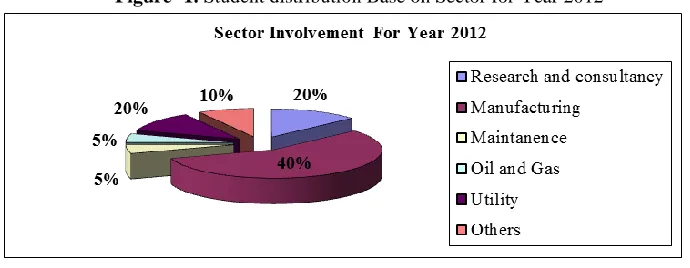
Our experience shows that about 40% of the students carried out their industrial training in the
manufacturing sector, 20% in power utilities, while the other 40% in other sectors such as oil and
gas, service and maintenance, engineering consultancy, and automotive industry as depicted in
Figure 1.
Figure- 1. Student distribution Base on Sector for Year 2012
Most students choose to do their industrial training in Klang valley as the prospects of getting a
Figure- 2. Student distribution Base on Location for Year 2012
7. PROBLEMS FACED DURING THE INDUSTRIAL TRAINING TENURE
Scheduling and organising an industrial training programme is a very difficult task. Full
cooperation is needed from various parties, the student, the coordinators of industrial training, and
the host company. Among the major problems faced include scheduling between university and
workplace, mismatch between work and students’ interest, lack of cooperation from employers and the issue of monitoring students’ progress especially in the workplace. (Ramli et al., 2001) Most of the time, keeping track of attendance of the trainee is the biggest issue.
At the University of North London, all students are given briefing at length on what to look out
for, and how to make the most use of their industrial training. But despite this, the younger students
often face difficulties. They have the double adjustments to make; both the realities of work in
general and the application of specific professional skills. Often the traditional solution to this
problem has been to give a student a project to do while on industrial training. This may cause the
supervisor to complain that the student does not do much work useful to the organization. (Ramli et
al., 2001). Another problem to tackle will be the grading and the evaluation. The problems of
assessing and grading industrial training performance are notorious due to disparate degrees of
supervision, experience offered, and cooperation by the hosts, and problems of access for teaching
staff. The solution should not be another theoretic essay divorced from the reality of the training
place. It may be in the form of analytical report on the host. This involves the students in describing
the activities that they are involved in on a day-to-day basis with the host. They should discuss on
the significance of the activities done or seen with regard to this purpose, relevance and actual
practice to the overall aims and objectives of the host organization and parent institutions. The
18%
59%
12%
3%
8%
Distribution Based on Location For Year 2012
Kuala Lumpur
Selangor
Northern (Perak,
Penang,Kedah)
East
668 emphasis is on the significant activities. (Gillian and Susanne, 1996)
8.
STUDENT EXPECTATIONS ON INDUSTRIAL TRAINING
A study carried out among UNITEN students found that overall students had moderate to high
expectations on their host organizations work environment. Specifically, students expected other
employees to be friendly and supportive of one another, to be concerned about and committed to
their job; emphasizing good planning efficiency and getting the job done; and expected their
physical environment to contribute to a pleasant work environment. On the other hand, the students
expected their supervisors to use rules and pressures to keep employees under control and to be less
supportive. They also expected their jobs to be low variety, change and new approaches, and
having less clarity as to daily routine and how explicitly rules and policies are communicated.
(Anthony, 1995)
9. HOST COMPANY EXPECTATIONS ON INDUSTRIAL TRAINING
In the perspective of a host company, they can actually benefit from the industrial training
student. It provides them an opportunity to test and analyze the practices, policies and objectives of
the organization through the critical but ultimately unhostile assessment by reasonable impartial
and informed students. This is a major benefit of taking such students on placement in the first
place. The industrial training experience well thought through and managed, should be symbiotic
one between student, institutions and host organization and not a parasitical one as it sometimes
appears to be (Paul et al., 1997)
10. CONCLUSION
The essence of industrial training is sorting out what constitutes the real world. Reflection on
what are real learning experiences involves students in socially reconstructing those elements that
are contested in various contexts and by creating new alignments of meanings. In practice, this
means personally resolving conflicts or by the identification of congruence among competing
priorities, plans, policies and people.
REFERENCES
Anthony, J.B., 1995. Problem of practical placement, library career development. 3(3): 10-14.
Cannon, J.A. and M.J. Arnold, 1998. Student expectations of college internship programs. Journal of
Education for Business, 73(4): 202.
Gillian, F. and T. Susanne, 1996. A competence approach to assessment of students placement. Education and
Training, 38(1): 30-36.
Mat, K., M.Z. Omar, A.O. Siti, O.K. Norhisham, N.A.R. Mohd, J. Maslina and J. Nordin, 2011. The
effectiveness of industrial training on UKM students. Procedia Social and Behavioral Sciences,
18(2011): 656–665.
Norhazzah, Y., M. Muhalim, A. Marina, M. Halina and M. Noorfa, 2012. Authentic assessment of industrial
training program: Experience of Universiti Teknologi Malaysia. Procedia - Social and Behavioral
Paul, H., G. Kate and M.I. Heather, 1997. Developing work based transferable skills in a university
environment. Journal of European Industrial Training, 21(2): 63-69.
Ramli, M.M., I. Sani and A. Abu, 2001. Tech _prep and school –to –work reforms in Malaysia: Meeting the
global challenges. IVETA Annual Conference 2001, Montego Bay, Jamaica, July 31 – 2 August
2001.