Article
Inverse Multiquadratic Functions as Basis for
Rectangular Collocation Method to Solve the
Vibrational Schrödinger Equation
Aditya Kamath 1 and Sergei Manzhos 1,*
1 Department of Mechanical Engineering, National University of Singapore, Block EA #07-08, 9 Engineering Drive 1, Singapore 117576; [email protected] (AK), [email protected] (SM)
* Correspondence: [email protected]; Tel.: +65-6516-4605
Abstract: We explore the use of inverse multiquadratic (IMQ) functions as basis functions when solving the vibrational Schrödinger equation with the rectangular collocation method. The quality of the vibrational spectrum of formaldehyde (in six dimensions) is compared to that obtained using Gaussian basis functions when using different numbers of width-optimized IMQ functions. The effects of the ratio of the number of collocation points to the number of basis functions and of the choice of the IMQ exponent are studied. We show that the IMQ basis can be used with parameters where the IMQ function is not integrable. We find that the quality of the spectrum with IMQ basis functions is somewhat lower that that with a Gaussian basis when the basis size is large and for a range of IMQ exponents. The IMQ functions are, however, advantageous when a small number of functions is used or with a small number of collocation points e.g. when using square collocation.
Keywords: Schrödinger equation; vibrational spectrum; collocation; inverse multiquadratic function; rectangular matrix
1. Introduction
Computational vibrational spectroscopy is important in the studies of vibrational phenomena in space, atmosphere, and in materials and at interfaces. It is necessary for the assignment of molecular species, including reactants, products, and intermediates and for the assignment of reaction pathways in many applications [1]. The Born-Oppenheimer approximation is a good approximation to compute the vibrational spectrum in most applications, in which case the vibrational dynamics is described by the Schrödinger equation (SE) for nuclei:
𝑇(𝒓) + 𝑉(𝒓) 𝜓(𝒓) = 𝐸𝜓(𝒓) (1)
where r denotes coordinates spanning the configuration space, 𝑉(𝒓) is the potential energy surface (PES), 𝑇(𝒓) is the kinetic energy operator (KEO), and 𝜓(𝒓) is the wavefunction. The values of the PES can be computed ab initio or sampled from an analytic function (which itself could be fitted to ab initio data or to empirical data) [2–8]. The KEO has a simple form in space-fixed Cartesian coordinates
rSF:
𝑇(𝒓 ) = − 1
2𝑀Δ (2)
where 𝑁 is the numbers of atoms, 𝑀 their masses, and Δ is the Laplacian operator in Cartesian coordinates of the ith atom: Δ = 𝜕 ⁄𝜕𝑥 + 𝜕 ⁄𝜕𝑦 + 𝜕 ⁄𝜕𝑧 (we use atomic units). As
space-fixed Cartesian coordinates are redundant for free molecules, typically, the KEO is expressed in internal coordinates in which it is much more complex [9]. Approximations are often used to simplify the expression for the KEO [10–13],which are a source of error.
The eigenvalues E are vibrational levels, and differences between them simulate observed spectra. Intensities of transitions are important for comparison with experimental spectra; however, the spectrum (of eigenvalues) itself is already useful for species assignment, and its calculation for polyatomic molecules is nontrivial. Eq. 1 can be relatively easily solved for a general PES for three- and four-atomic molecules, and the calculation becomes progressively more complex and CPU- and memory-costly for larger molecules. The commonly used method to solve Eq. 1 for a general potential 𝑉(𝒓) is the variational approach [14,15], in which one expands the wavefunction in a basis
𝜓(𝒓) = 𝑐 𝜃 (𝒓) (3)
Insertion of Eq. 3 into the SE Eq. 1, multiplication on the left by basis functions 𝜃 (𝒓) and integration over all configuration space leads to a matrix equation for the vector of coefficients c,
𝑯𝒄 = 𝐸𝑩𝒄
𝐻 = 𝜃 𝐻 𝜃
𝐵 = 𝜃 𝜃
(4)
with H the Hamiltonian and B the overlap matrix. Already with four atoms (a six dimensional configuration space), it is not unusual to use hundreds of thousands of basis functions (N), and the necessity to compute the integrals often requires PES values at millions of locations [16]. This practically requires availability of the PES as a continuous 𝑉(𝒓) function. Such functions are not trivial to construct with high accuracy even for a four-atomic system and become difficult to construct for larger systems [3,16–18]. For isolated molecules, it is relatively easy to compute sufficient amount of high quality ab initio data to which 𝑉(𝒓) can be fitted. For vibrations at interfaces and in materials, the cost of ab initio calculations is much higher, and for the vast majority of molecule-surface or aggregate state systems of practical importance, there are no, and there will never be, ab initio based PES functions, even though vibrational problems with a sufficiently small number of coupled degrees of freedom can be identified in such systems [12,19,20].
These difficulties in particular are responsible for the fact that harmonic spectra are still widely used in computational materials science. This is unfortunate, as in many applications anharmonicity is important. For example, the catalytic activity of surfaces is precisely due to their ability to weaken intramolecular bonds in adsorbed molecules, leading to more significant anharmonicity compared to free molecules. Popular methods which simplify the solution of Eq. 1 while allowing for anharmonicity and coupling also have not found much use in materials modeling [21]. For example, the vibrational self-consistent field approach (VSCF) [10] still requires the availability of the PES as it relies on integrals. The vibrational perturbation theory (VPT2) approach implemented in many ab initio codes [22] assumes a simple polynomial form of the PES which still requires many high-quality ab initio data points around the equilibrium, and fails for degenerate levels. Clearly, a direct solution of Eq. 1 for a general 𝑉(𝒓) is preferred.
A collocation approach is an alternative way to convert the SE (both the vibrational SE, Eq. 1 [13,17,23–27], and the electronic SE [28]) into a matrix form. In it, one use the expansion of Eq. 3 but only aims to satisfy the SE at a set of collocation points 𝒓𝒋, 𝑗 = 1, … , 𝑀:
𝑴𝒄 = 𝐸𝑺𝒄
𝑀 = 𝑇𝜃 (𝒓𝒊) + 𝑉(𝒓𝒊)𝜃 (𝒓𝒊)
𝑆 = 𝜃 (𝒓𝒊)
(5)
Although square collocation (M = N) was the type of collocation originally proposed for vibrational problems [24–26], in general, M > N. Eq. 5 can be solved using approaches developed for rectangular matrices [29] or by squaring it and using common eigensolvers:
There is no requirement that Eq. 3 reproduce the wavefunction in all space (although with a sufficiently dense set 𝒓𝒋 covering all regions of space where the wavefunction is not negligible this will be the case). The collocation points can be distributed in any desired way and do not have to form a quadrature grid (note that even though Eq. 6 has the form of a quadrature, the sums need not be equal to any integrals) [30]. This potentially allows computing the spectrum from a smaller number of 𝑉(𝒓) values which could be directly computed ab initio. The rectangular collocation (which is solved in the least squares sense) also can be used to tune the basis so that good accuracy can be achieved with small N [13,27]. Note that M can be smaller if the basis is better. The rectangular collocation approach has been applied to computations of anharmonic spectra of polyatomic molecules, including those on surfaces, directly from ab initio samples of 𝑉(𝒓) [11,12,19,20,31].
The KEO can in principle be applied to the basis functions analytically [11,12,32]; however, the complexity of KEO expressions in given internal coordinates 𝒓 can be avoided when applying the KEO numerically (using finite differences with an appropriate stencil achieving the desired accuracy) in space-fixed Cartesian coordinates 𝒓 [30,33,34]:
𝑇𝜃 = 𝜃 (𝒓 (𝒓 )) (7)
see Ref. [33] for details. In this way, it is easy to use the exact KEO with any coordinates in which the SE is solved and with any basis functions.
1.1 Problem statement and the aim of this work
Rectangular collocation can be used with any basis functions. The functions need not be integrable or even continuous, except at the collocation points. For example, Slater type functions (useful in full-potential electronic structure calculations) are easy to use with collocation even though they are not with the variational approach (which is why Gaussian-like functions are usually preferred in that application) [28]. Localized or delocalized functions can be used. For localized basis functions, only Gaussian functions have been used with rectangular collocation for the vibrational SE [20,30,33,34]. Gaussian functions are general and form a sufficiently small basis set (especially if their parameters are fitted) for the calculation to be doable on a personal computer for low-dimensional problems such as triatomic molecules and for a small number of states [13,20,27]. For larger molecules and large numbers of states, either other types of basis functions need to be used such as parameterized harmonic functions which allow for a small basis set size, as was tested in up to 15 dimensions [11–13,19,31], or a much larger Gaussian basis would be needed. For example, a sub-cm-1 accuracy has been achieved for the vibrational spectrum of formaldehyde (a six-dimensional
SE) with about 40,000 basis functions and with more than 100,000 collocation points[30,33,34]. While this kind of calculation is in principle doable on a modern workstation with a couple hundred GB of RAM, it is somewhat costly.
It is therefore useful to study other types of localized basis functions which might be advantageous in terms of accuracy or the required number of basis functions and collocation points to reach a given accuracy. In this work, we explore the generalized inverse multiquadratic (IMQ) function
𝜃 (𝒓) = (1 + 𝑐 |𝒓 − 𝒓𝒊| ) / (8)
The aim of this work is to explore the utility of the generalized IMQ basis function when solving a vibrational SE for a real molecule with the rectangular collocation method. We compare the performance of an IMQ basis to that of a Gaussian basis on the example of the spectrum of formaldehyde, i.e. solving a six-dimensional SE, for which results with Gaussian bases of different sizes are available [30,33,34]. Specifically, we explore the effect of different choices of including those which do not satisfy the integrability condition. We also explore the behavior of spectrum quality with the number of basis function and collocation points.
2. Methods
Eqs. 5-6 were solved using the IMQ basis functions. Calculations with Gaussian basis function
𝑔 (𝒙) = (2𝜎 𝜋) 𝑒
,
(9)
are performed for comparison as in Refs. [30,34]. The vibrational SE of formaldehyde, H2CO, was
solved for the lowest 100 levels in six bond coordinates including the CO bond length, the two CH bond lengths, the two HCO angles, and the dihedral angle between the two HCO planes. The six coordinates, in this order, form the vector r = rint. The KEO was applied in space-fixed Cartesian coordinates (Eq. 2) using Eq. 7 with a five-point finite difference stencil with all 𝑑𝑥 = 1 × 10 . See Ref. [33] for details. The values of 𝑉(𝒓) at the collocation points were sampled from the analytic PES of Ref. [36]. The collocation points {𝒓𝒋} are chosen within specific ranges of the six coordinates from a pseudo-random six-dimensional Sobol sequence [37] and accepted into the collocation point set if
𝑉 − 𝑉 + Δ
𝑉 + Δ > 𝑟𝑎𝑛𝑑 (10)
where rand is a (uniformly distributed) random number in [0, 1]. We use Vmax = 17,000 cm-1 and Δ = 500 cm-1. The coordinate ranges are rmin = (1.03, 0.84, 0.84, 83, 83, 105), rmax = (1.50, 1.69, 1.69, 162, 162,
255), where bond lengths are in Å and angles in degrees. The point selection is therefore similar to that used in Refs. [30,34] also allowing for comparison with results obtained with the Gaussian basis in those works.
The quality of the spectrum is evaluated as the MAE (mean absolute error) for 50 and 100 lowest vibrational levels vs a reference spectrum computed in Ref. [30] on the same PES with a highly accurate variational scheme. For each combination of the numbers of basis functions N, collocation points M, and the IMQ exponent , the basis width parameter c was optimized. To account for different ranges and types of internal coordinates, the following version of the IMQ function was used:
𝜃 (𝒓) = 1 + 𝑐 𝑟 − 𝑟, 𝑟 , − 𝑟 ,
/
(11)
This allows using a single parameter c for basis width optimization in a similar way as was done for Gaussian width parameters in Refs. [30,34]. The Gaussian width of Eq. 9 are optimized in the same way. The optimal width typically correspond to condition numbers of the overlap matrix STS on the
order of 1×10¹⁰.
3. Results
3.1. Effect of the IMQ exponent
outperforms the IMQ basis for the low-energy levels; however, for several values, the spectrum quality is practically the same as with the Gaussian basis. The IMQ basis slightly outperforms the Gaussian basis for the higher-energy levels, corroborating the conclusion of Rabitz et al. achieved based on model systems. The specific choice of seems to be non-critical as long as the width c is optimized. The best quality IMQ bases do satisfy the condition d = 6. (ii) The spectrum quality only marginally deteriorates for = 4-6 which do not satisfy the integrability condition d. This highlights the fact that nowhere in the collocation Eqs. 5-6 is it required that integrals over all space be finite. The use of non-integrable functions might be beneficial in some applications and remains little explored. Collocation is a way to harness any advantages associated with such functions.
Figure 1. The mean absolute error (MAE), in cm-1, over the lowest 50 and 100 vibrational levels of H2CO, computed with the inverse multiquadratic (IMQ50, IMQ100) basis with different (beta) parameters. The horizontal lines at 2 and 3.7 cm-1 are corresponding values obtained with a Gaussian basis (G50, G100, respectively), as in Ref. [30]. N = 20,000 basis functions and M = 80,000 collocation points are used.
3.2. Effect of the basis size
Next we test the performance of the IMQ basis with the basis size at a fixed M/N ratio of 3. Figure 2 shows the MAE of the lowest 50 and 100 vibrational levels obtained with the width-optimized IMQ functions with = 7 and with width-optimized Gaussian basis functions. For the lowest 50 level, the Gaussian basis outperforms, however modestly, the IMQ basis, except at the lowest number of basis functions N = 15,000 where IMQ basis is better. N = 15,000 is, however, too small to achieve spectroscopically relevant accuracy on the order of 1 cm-1 or better. A similar result is observed with
Figure 2. The mean absolute error (MAE), in cm-1, over the lowest 50 and 100 vibrational levels of H2CO, computed with a width-optimized inverse multiquadratic (IMQ50, IMQ100) basis with = 7 and a width-optimized multiquadratic Gaussian (G50, G100) basis, for different numbers of basis functions N and M = 3N collocation points. The insert shows part of the graph at the logarithmic scale.
3.3. Effect of the rectangularity of the collocation equation
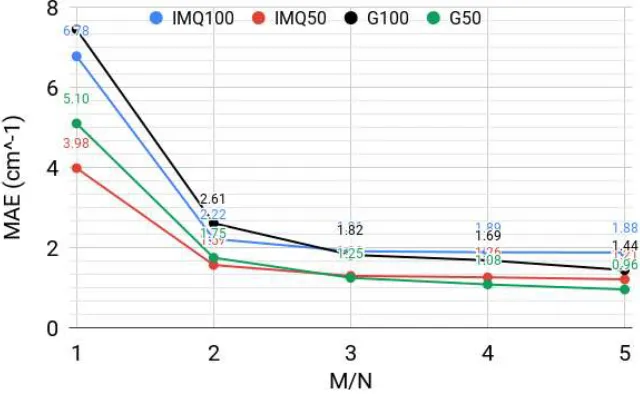
The IMQ basis functions were previously tested with the quadratic collocation (M = N) [35]. Here, we show that it is advantageous to use rectangular collocation, i.e. M > N. Figure 3 shows the behavior of the spectrum errors over the lowest 50 and 100 vibrational levels, computed with a width-optimized inverse multiquadratic basis with = 7 and a width-width-optimized Gaussian basis, for N = 30,000 basis functions and for different ratios of the number of collocation points to the number of basis functions M/N. There is a clear advantage of using M > N, which allows for a several-fold increase in level accuracy vs square collocation. This is a practically important advantage from the point of view of computational cost which is dominated by N: we have previously shown [33] that when using Eq. 6 to solve the rectangular collocation matrix equation, one only needs to store and manipulate matrices of size N×N for M > N as long as M/N is integer.
Figure 3. The mean absolute error (MAE), in cm-1, over the lowest 50 and 100 vibrational levels of H2CO, computed with a width-optimized inverse multiquadratic (IMQ50, IMQ100) basis with = 7 and a width-optimized multiquadratic Gaussian (G50, G100) basis, for N = 30,000 basis functions and different ratios of the number of collocation points to the number of basis functions M/N.
5. Conclusions
We have explored the use of inverse multiquadratic functions as basis functions in the rectangular collocation method to solve the vibrational Schrödinger equation. We computed the vibrational spectrum of formaldehyde (in d = 6 six dimensions) which allowed us to compare the behavior of the solution with respect to various calculation parameters (the IMQ exponent parameter , basis size N, collocation point set size M) to that previously observed with the Gaussian basis.
For the lowest basis set sizes we used (15,000 functions), the IMQ basis outperformed the Gaussian basis. However, to achieve the “spectroscopic accuracy” on the order of 1 cm-1 on the lowest
50 or 100 levels, more than N = 30,000 functions are needed and M > N is needed; for these values of N, the accuracy obtained with the IMQ basis is somewhat lower than that with the Gaussian basis.
The behavior with respect to the ratio of the numbers of the collocation points M and basis functions N is qualitatively similar to that observed with a Gaussian basis, both showing a significant improvement of errors for M > N up to about M = 3N. This highlight the advantage of the rectangular over square collocation, notably in the CPU cost which is dominated by N rather than M. When N = M i.e. when using square collocation, the IMQ basis outperformed the Gaussian basis, although in that regime the spectrum errors were much larger than 1 cm-1.
Perhaps the most important conclusion of this work is that with collocation, one can use basis functions which are not even integrable. In this case, this was shown when using IMQ functions with the exponent ≤ d. There is only a slight increase of error until becomes much smaller than d, although the best accuracy is obtained when > d. This is an important advantage over quadrature based variational methods, as basis functions can be chosen to satisfy requirements which make integrals more difficult to compute (an example being the cusp condition in electronic structure).
Author Contributions: Conceptualization, methodology and writing, S.M.; calculations and editing, A.K. Funding: The authors thank NUS Strategic India Initiative by the National University of Singapore. Acknowledgments: S.M. thanks Tucker Carrington for discussions.
References
1. Li, J.-T.; Zhou, Z.-Y.; Broadwell, I.; Sun, S.-G. In-situ infrared spectroscopic studies of electrochemical energy conversion and storage. Acc. Chem. Res.2012, 45, 485–494, doi:10.1021/ar200215t.
2. Cederbaum, L. S.; Hirst D. M.; Potential Energy Surfaces, Taylor + Francis, London, Philadelphia 1985. 3. Braams, B. J.; Bowman, J. M. Permutationally invariant potential energy surfaces in high dimensionality.
Int. Rev. Phys. Chem.2009, 28, 577–606, doi:10.1080/01442350903234923.
4. Manzhos, S.; Dawes, R.; Carrington, T. Neural network-based approaches for building high dimensional and quantum dynamics-friendly potential energy surfaces. Int. J. Quantum Chem.2015, 115, 1012–1020, doi:10.1002/qua.24795.
5. Peyerimhoff, S.; Murrell J. N.; Carter S.; Farantos S. C.; Huxley P.; Varandas A. J. C.; Molecular potential energy functions, Verlag John Wiley & Sons, Chichester, New York, Brisbane, Toronto, Singapore 1984. 197 Seiten, Preis: £ 19.95. Berichte der Bunsengesellschaft für Phys. Chemie 1985, 89, 1122–1122, doi:10.1002/bbpc.19850891027.
6. Hollebeek, T.; Ho, T. S.; Rabitz, H. Constructing multidimensional molecular potential energy surfaces from ab initio data. Annu. Rev. Phys. Chem.1999, 50, 537–70, doi:10.1146/annurev.physchem.50.1.537. 7. Collins, M. A. Molecular potential-energy surfaces for chemical reaction dynamics. Theor. Chem. Accounts
Theory, Comput. Model. (Theoretica Chim. Acta)2002, 108, 313–324, doi:10.1007/s00214-002-0383-5. 8. Handley, C. M.; Popelier, P. L. A. Potential energy surfaces fitted by artificial neural networks. J. Phys.
Chem. A2010, 114, 3371–3383, doi:10.1021/jp9105585.
9. Handy, N. C. The derivation of vibration-rotation kinetic energy operators, in internal coordinates. Mol. Phys.1987, 61, 207–223, doi:10.1080/00268978700101081.
10. Roy, T. K.; Gerber, R. B. Vibrational self-consistent field calculations for spectroscopy of biological molecules: New algorithmic developments and applications. Phys. Chem. Chem. Phys.2013, 15, 9468– 9492.
11. Manzhos, S.; Carrington, T.; Laverdure, L.; Mosey, N. Computing the anharmonic vibrational spectrum of UF6 in 15 dimensions with an optimized basis set and rectangular collocation. J. Phys. Chem. A2015, 119, 9557–9567, doi:10.1021/acs.jpca.5b07627.
12. Chan, M.; Carrington, T.; Manzhos, S. Anharmonic vibrations of the carboxyl group in acetic acid on TiO2: Implications for adsorption mode assignment in dye-sensitized solar cells. Phys. Chem. Chem. Phys. 2013, 15, 10028–10034, doi:10.1039/c3cp00065f.
13. Chan, M.; Manzhos, S.; Carrington, T.; Yamashita, K. Parameterized bases for calculating vibrational spectra directly from ab initio data using rectangular collocation. J. Chem. Theory Comput.2012, 8, 2053– 2061, doi:10.1021/ct300248n.
14. Bowman, J. M.; Carrington, T.; Meyer, H.-D. Variational quantum approaches for computing vibrational energies of polyatomic molecules. Mol. Phys.2008, 106, 2145–2182, doi:10.1080/00268970802258609. 15. Schleyer, P. von R. Encyclopedia of computational chemistry; New York, 1998; ISBN 9780471965886. 16. Manzhos, S.; Wang, X.; Dawes, R.; Carrington, T. A nested molecule-independent neural network
approach for high-quality potential fits. J. Phys. Chem. A2006, 110, 5295–5304, doi:10.1021/jp055253z. 17. Castro, E.; Avila, G.; Manzhos, S.; Agarwal, J.; Schaefer, H. F.; Carrington, T. Applying a smolyak
collocation method to Cl2CO. Mol. Phys.2017, 115, 1775–1785, doi:10.1080/00268976.2016.1271153. 18. Majumder, M.; Hegger, S. E.; Dawes, R.; Manzhos, S.; Wang, X.-G.; Tucker, C.; Li, J.; Guo, H. Explicitly
doi:10.1080/00268976.2015.1015642.
19. Manzhos, S.; Chan, M.; Carrington, T. Communication: Favorable dimensionality scaling of rectangular collocation with adaptable basis functions up to 7 dimensions. J. Chem. Phys. 2013, 139, 051101, doi:10.1063/1.4817182.
20. Manzhos, S.; Carrington, T.; Yamashita, K. Calculating anharmonic vibrational frequencies of molecules adsorbed on surfaces directly from ab initio energies with a molecule-independent method: H2O on Pt(111). Surf. Sci.2011, 605, 616–622, doi:10.1016/j.susc.2010.12.028.
21. Christiansen, O. Vibrational structure theory: new vibrational wave function methods for calculation of anharmonic vibrational energies and vibrational contributions to molecular properties. Phys. Chem. Chem. Phys.2007, 9, 2942, doi:10.1039/b618764a.
22. Barone, V. Anharmonic vibrational properties by a fully automated second-order perturbative approach. J. Chem. Phys.2005, 122, 014108, doi:10.1063/1.1824881.
23. Manzhos, S.; Carrington, T.; Yamashita, K. Nonspectral methods for solving the schrödinger equation for electronic and vibrational problems. J. Phys. Chem. Lett.2011, 2, 2193–2199, doi:10.1021/jz200513h. 24. Yang, W.; Peet, A. C. The collocation method for bound solutions of the Schrödinger equation. Chem.
Phys. Lett.1988, 153, 98–104, doi:10.1016/0009-2614(88)80139-8.
25. Peet, A. C.; Yang, W. The collocation method for calculating vibrational bound states of molecular systems—with application to Ar–HCl. J. Chem. Phys.1989, 90, 1746–1751, doi:10.1063/1.456068.
26. Yang, W.; Peet, A. C. A method for calculating vibrational bound states: Iterative solution of the collocation equations constructed from localized basis sets. J. Chem. Phys. 1990, 92, 522–526, doi:10.1063/1.458454.
27. Manzhos, S.; Yamashita, K.; Carrington, T. On the advantages of a rectangular matrix collocation equation for computing vibrational spectra from small basis sets. Chem. Phys. Lett.2011, 511, 434–439, doi:10.1016/J.CPLETT.2011.06.040.
28. Manzhos, S.; Carrington, T. Using rectangular collocation with finite difference derivatives to solve electronic Schrodinger equation. 2018.
29. Boutry, G.; Elad, M.; Golub, G. H.; Milanfar, P. The generalized eigenvalue problem for nonsquare pencils using a minimal perturbation approach. SIAM J. Matrix Anal. Appl. 2005, 27, 582–601, doi:10.1137/S0895479803428795.
30. Manzhos, S.; Wang, X.; Carrington, T. A multimode-like scheme for selecting the centers of Gaussian basis functions when computing vibrational spectra. Chem. Phys. 2018, 509, 139–144, doi:10.1016/j.chemphys.2017.10.006.
31. Chan, M.; Yamashita, K.; Carrington, T.; Manzhos, S. Towards accurate spectroscopic identification of species at catalytic surfaces: anharmonic vibrations of formate on AuPt. MRS Proc.2012, 1484, imrc12-1484-7a-0016, doi:10.1557/opl.2012.1623.
32. Manzhos, S.; Yamashita, K.; Carrington, T. Using a neural network based method to solve the vibrational Schrödinger equation for H2O. Chem. Phys. Lett.2009, 474, 217–221, doi:10.1016/J.CPLETT.2009.04.031. 33. Manzhos, S.; Carrington, T. Using an internal coordinate gaussian basis and a space-fixed cartesian
coordinate kinetic energy operator to compute a vibrational spectrum with rectangular collocation. J. Chem. Phys.2016, 145, 224110, doi:10.1063/1.4971295.
basis for bound-state problems. Comput. Phys. Commun. 1998, 113, 168–179, doi:10.1016/S0010-4655(98)00096-4.
36. Carter, S.; Handy, N. C.; Demaison, J. The rotational levels of the ground vibrational state of formaldehyde. Mol. Phys.1997, 90, 729–738, doi:10.1080/002689797172093.