<Heading Page>
1
Association between physical activity and self-rated health among pediatric patients with
2
type 1 diabetes mellitus who lack diabetes care
3
4
Author: Hyun Jin Kwona, Hyok Ju Maenga, Justin A. Haegeleb, Young Ah Leec,Choong Ho Shinc, 5
and Yeon Soo Kimd
6
aGeorgia State University, bOld Dominion University, cSeoul National University Children’s 7
Hospital, dSeoul National University 8
9
Author for correspondence
10
Corresponding Author: Hyun Jin Kwon, Ph.D.
11
Department of Kinesiology and Health, College of Education Human Development, Georgia State
12
University, Atlanta, GA
13
E-mail: [email protected]
14
15
Author Note
16
One of the authors has identified that he has a potential conflict of interest in this study.
17
The university hospital institutional review board has approved his written plan to manage his
18
conflict of interest and prevent it from influencing the results.
19
20
21
Abstract
22
Background: Even though a number of studies have verified the positive effect of physical
23
activity (PA) on self-related health (SRH) no previous research has examined this association
24
among pediatric patients with Type 1 diabetes mellitus (T1DM).
25
Objective: The purpose of this study was to investigate the association between regular physical
26
activity (PA) and self-rated health (SRH) in pediatric patients with Type 1 diabetes mellitus
27
(T1DM) who lacked diabetes care.
28
Methods: We conducted a retrospective study among pediatric patients with T1DM who lacked
29
diabetes care and were enrolled in a diabetes education program between January 2011 to
30
January 2015 at the endocrinology clinic of Seoul National University Children’s Hospital in
31
South Korea. The eligible participants for this study were 37 pediatric patients with T1DM aged
32
9 to 17 years. PA was divided into regular PA and muscle strength exercise to analyze the
33
relationship with SRH using binomial logistic regression analysis.
34
Results: The results showed SRH of pediatric patients with T1DM who did not engage in
35
regular PA was significantly lower than those who did (OR in regular PA = .199 [95%
36
CI: .040, .995]; OR in regular muscle strength exercise = .097 [95% CI: .023, .825]).
37
Conclusions: In conclusion, regular PA and muscle strength exercise in pediatric patients with
38
T1DM who lacked diabetes care were effective in improving their SRH. A systematic plan is
39
required to enhance regular PA for pediatric patients with T1DM.
40
41
42
Key words: pediatric patient with T1DM, physical activity, muscle strength exercise, self-rated
43
health
44
45
Interest in the health management of Type 1 diabetes mellitus (T1DM) patients has increased in
47
recent years. Research has revealed a three percent rise annually in pediatric patients around the
48
globe [1]. Although South Korea is known to have a relatively low incidence rate of T1DM, the
49
incidence rate is rapidly increasing according to recent data [2,3]. A number of complicating
50
issues tend to be experienced by those with T1DM diagnoses. For example, T1DM patients may
51
suffer psychologically through a long period of self-sugar management during childhood [4].
52
These psychological issues tend to be complicated further by the pressure of academic work
53
throughout one’s education [4,5]. Of additional concern, these issues can change with hormone
54
development during puberty [6–9]. T1DM patients may also have trouble managing their blood
55
sugar [10,11]. Concern about managing blood sugar can influence high levels of stress,
56
depression, and anxiety among pediatric patients with T1DM [12–16]. These concerns for
57
pediatric patients with T1DM might affect their quality of life. For example, research has
58
indicated that quality of life indices tend to be lower among this population when compared to
59
patients with Type 2 diabetes mellitus [10,17].
60
Among pediatric patients with T1DM, those who lack diabetes care could experience more
61
serious psychological problems and glycemic control in a vicious circle [18,19]. Therefore, it is
62
important to give attention to pediatric patients with T1DM who lack diabetes care. Self-rated
63
health (SRH) is regarded as one of the most important factors to pediatric patients with T1DM
64
because they have to self-manage their disease for their entire lifetime after being diagnosed.
65
SRH is considered a measure of overall health which considers biological, psychological, social,
66
and functional health levels [20]. Researchers have identified that poor SRH tends to be
67
associated with obesity [21]or low-grade inflammation [22]among this population. Even though
68
a number of studies have verified the positive effect of physical activity (PA) on SRH [23–26],
no previous research has examined this association among pediatric patients with T1DM.
70
Therefore, the purpose of this study was to investigate the association between regular PA and
71
SRH in pediatric patients with T1DM who lacked diabetes care.
72
73
Materials and Methods
74
Participants
75
The eligible participants of this study were 37 pediatric patients with T1DM that attended a
76
diabetes education program at the endocrinology clinic of Seoul National University Children’s
77
in South Korea. This study included children and adolescents aged 9-18 years who participated
78
in the program between January 2011 to January 2015. The specific selection criteria were
79
individuals who had: (a) received a T1DM diagnosis at least six months prior, (b) over 7.5% of
80
glycosylated hemoglobin (HbA1c), which is a biological value used when monitoring diabetes,
81
(c) consented to the study.
82
Data Collection and Instruments
83
This retrospective study involving a chart review of patients diagnosed with T1DM was
84
approved by the institutional review boards (IRB No. H-1606-046-769) of Seoul National
85
University Hospital. Data that were collected included demographic data, body fat (%), HbA1c
86
levels, PA, muscle strength exercise, and SRH of participants at the time of their enrollment in
87
the education program.
88
Regular PA. Regular PA was measured using two questions and responses. The question for
89
moderate PA was “Over the past 7 days, how many days did you engage in moderate physical
90
activity (for at least 30 minutes) that caused a slight increase in your breathing or heart rate (e.g.
tennis doubles, volleyball, badminton or table tennis, or any other activity)?”. The vigorous PA
92
question was, “over the past 7 days, how many days did you engage in vigorous physical activity
93
such as running, mountain climbing, soccer, basketball or any other activity (for at least 10
94
minutes) that caused a substantial increase in your breathing or heart rate?”. Using these two
95
questions, regular PA was defined as follows: vigorous PA ≥ 3days/week, moderate PA ≥5
96
days/week. Participants who did not meet the guidelines were classified as ‘nonregular PA’ group
97
[27].
98
Regular Muscle Strength Exercise. One question was used to measure regular muscle strength
99
exercise. This question read “over the past 7 days, how many days did you engage in muscle
100
strength exercise such as push-ups, sit-ups or weight lifting etc.?” Using the question, regular
101
muscle strength exercise was coded as a dichotomous variable of regular (≥3 days/week) or
not-102
regular muscle strength exercise.
103
SRH. SRH status was measured by one item, originally derived from SF-36 [28]: “In general,
104
how would you rate your current health?” and the response options were ① very good, ② good,
105
③ fair, ④ poor, and ⑤ very poor. According to the responses, the variable was classified to a
106
dichotomous variable of ‘optimal SRH’ and ‘poor SRH’. Scores 1–2 were coded as optimal SRH
107
[25,29].
108
Statistical Analysis
109
SPSS 21.0 version (SPSS Inc., Chicago, IL, USA) was used to analyze the data. Descriptive
110
statistics were conducted for the demographic characteristics of the participants, and we
111
performed Chi-square tests to examine the differences in SRH by regular PA and muscle strength
112
exercise. Odds ratio and 95% Confidence Interval (CI) through the logistic regression analysis
113
were calculated to analyze the relationship among regular PA, regular muscle strength exercise,
and self-rated health. The adjusting variables were gender and age in the analyzing process.
115
Statistical significance was accepted as p<.05.
116
117
Results
118
Characteristics of Participants
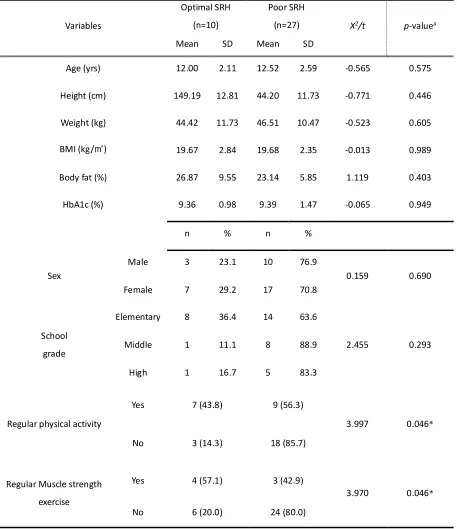
119
Participant demographics and descriptive PA and SRH statistics are shown in Table 1. The total
120
number of the participants was 37, which consisted of 13 (35.1%) and 24 females (64.9%), and
121
their mean age was 12.38±2.45. Though not statistically significant (p=0.690), the level of SRH
122
of female students was better than the male students. Further, the level of SRH of the elementary
123
school students was higher than the middle or high school students (p=0.293). Participants who
124
engaged in regular PA or in regular muscle strength exercise had significantly better SRH
125
(p=0.046).
126
Association between Physical Activity and Self-Rated Health
127
Table 2 showed the odds ratio with 95% CI of the SRH association with participating in regular
128
PA and regular muscle strength exercise, respectively. All odds ratio scores were calculated after
129
adjusting for age and gender. The SRH of the participants who did not have regular PA showed
130
0.199 times lower than those who had. The SRH of the participants who did not perform regular
131
muscle strength exercise was 0.097 times lower than those who did.
132
133
---
134
Insert Table 1 here
135
---
136
---
Insert Table 2 here
138
---
139
Discussion
140
Approximately 20% to 40% of people with diabetes in South Korea appropriately manage their
141
blood sugar [30]. However, an interest in the health management for pediatric patients with
142
T1DM is a pressing concern in South Korea because only about 13 to 15 percent of pediatric
143
patients with T1DM are in good management [31]. According to the results of this study,
144
pediatric patients with T1DM who did not perform regular PA or muscle strength exercise had
145
lower SRH than those who did. This result was synonymous with the many preceding studies
146
that showed that regular PA and muscle strength exercise positively affected the development of
147
SRH [26,32]. Although difficult to compare because of a lack of concrete guideline on PA for
148
maintaining health in pediatric patients with T1DM, the American Diabetes Association (ADA)
149
recommended that pediatric patients with diabetes perform moderate and vigorous PA over 60
150
minutes every day and muscle strength exercises more than 3 days a week [33].
151
The present study showed that moderate PA of more than 150 minutes per week or vigorous
152
aerobic excise of more than 75 minutes per week can have an effect on increasing SRH in
153
pediatric patient with lack of diabetes care. However, the amount of physical activity they
154
engaged in did not reach the recommended amount of PA per week by ADA. The results also
155
showed that pediatric patients who lacked diabetes care and engaged in muscle strength exercise
156
more than 3 days per week had higher SRH than those who did not meet these exercise
157
thresholds. This result is aligned with Copeland et al. [33], who presented the muscle strength
158
exercise guidelines for this population. Having higher SRH in pediatric patients who lack
diabetes care who got regular PA and muscle strength exercise than those who did less exercise
160
could be explained. First, gaining confidence may come from an improvement in body shape and
161
physical fitness through participating in regular PA or muscle strength exercise [34–36]. Second,
162
children and adolescents with plenty of PA are more likely to realize their health condition
163
positively because they tend to have low levels of negative mental health [37–39]. Furthermore,
164
this was regarded to influence the SRH of pediatric patients with T1DM positively by increasing
165
happiness [40] which came from social interaction effects in attending PA with peers [41].
166
The limitations in this study included the small sample size to analyze the data due to only
167
targeting patients in a diabetes education program with intensified treatment at a specific
168
location. Thus, a careful interpretation is necessary to generalize the result. A further limitation is
169
the inability to establish a causal connection between the independent and dependent variable
170
based on analyzing cross-sectional data. The present study did not adjust to use other variables to
171
explore effects on the SRH. In the future research, an advanced PA data analysis is needed to
172
consider gender or other demographic variables as well as colleting the data to use objective
173
instruments, such as accelerometers and pedometers.
174
References
177
1. Patterson, C. C.; Dahlquist, G. G.; Gyürüs, E.; Green, A.; Soltész, G. Incidence trends for
178
childhood type 1 diabetes in Europe during 1989–2003 and predicted new cases 2005–20: a
179
multicentre prospective registration study. The Lancet 2009, 373, 2027–2033,
180
doi:10.1016/S0140-6736(09)60568-7.
181
2. Kim, J. H.; Lee, C. G.; Lee, Y. A.; Yang, S. W.; Shin, C. H. Increasing incidence of type 1
182
diabetes among Korean children and adolescents: analysis of data from a nationwide registry
183
in Korea. Pediatr. Diabetes17, 519–524, doi:10.1111/pedi.12324.
184
3. Shin, C. H. Epidemiologic characteristics of type 1 diabetes in children aged 14 years or
185
under in Korea, 1985-2000. Korean J. Pediatr.2008, 51, 569–575, doi:2008.51.6.569.
186
4. Beacham, B. L.; Deatrick, J. A. Children With Chronic Conditions: Perspectives on Condition
187
Management. J. Pediatr. Nurs. Nurs. Care Child. Fam. 2015, 30, 25–35,
188
doi:10.1016/j.pedn.2014.10.011.
189
5. Delahanty, L. M.; Grant, R. W.; Wittenberg, E.; Bosch, J. L.; Wexler, D. J.; Cagliero, E.;
190
Meigs, J. B. Association of diabetes-related emotional distress with diabetes treatment in
191
primary care patients with Type 2 diabetes. Diabet. Med. 24, 48–54,
doi:10.1111/j.1464-192
5491.2007.02028.x.
193
6. Court, J. M.; Cameron, F. J.; Berg Kelly, K.; Swift, P. G. Diabetes in adolescence. Pediatr.
194
Diabetes10, 185–194, doi:10.1111/j.1399-5448.2009.00586.x.
195
7. Helgeson, V. S.; Escobar, O.; Siminerio, L.; Becker, D. Relation of Stressful Life Events to
196
Metabolic Control Among Adolescents with Diabetes: Five-Year Longitudinal Study. Health
197
Psychol. Off. J. Div. Health Psychol. Am. Psychol. Assoc. 2010, 29, 153–159,
198
doi:10.1037/a0018163.
199
8. Lee, M. S. Social Services Information for Children and Adolescents with Diabetes Mellitus.
200
J. Korean Diabetes2014, 15, 172–177, doi:10.4093/jkd.2014.15.3.172.
201
9. Silverstein, J.; Klingensmith, G.; Copeland, K.; Plotnick, L.; Kaufman, F.; Laffel, L.; Deeb,
202
L.; Grey, M.; Anderson, B.; Holzmeister, L. A.; Clark, N. Care of Children and Adolescents
203
With Type 1 Diabetes: A statement of the American Diabetes Association. Diabetes Care
204
2005, 28, 186–212, doi:10.2337/diacare.28.1.186.
205
10. Hood, K. K.; Beavers, D. P.; Yi-Frazier, J.; Bell, R.; Dabelea, D.; Mckeown, R. E.; Lawrence,
206
J. M. Psychosocial Burden and Glycemic Control During the First 6 Years of Diabetes:
207
Results From the SEARCH for Diabetes in Youth Study. J. Adolesc. Health2014, 55, 498–
208
504, doi:10.1016/j.jadohealth.2014.03.011.
209
11. Selvin, E.; Parrinello, C. M.; Sacks, D. B.; Coresh, J. Trends in Prevalence and Control of
210
Diabetes in the United States, 1988–1994 and 1999–2010. Ann. Intern. Med.2014, 160, 517,
211
doi:10.7326/M13-2411.
212
12. Compas, B. E.; Jaser, S. S.; Dunn, M. J.; Rodriguez, E. M. Coping with Chronic Illness in
213
Childhood and Adolescence. Annu. Rev. Clin. Psychol. 2012, 8, 455–480,
214
doi:10.1146/annurev-clinpsy-032511-143108.
215
13. Delamater, A. M.; Wit, M.; McDarby, V.; Malik, J.; Acerini, C. L. Psychological care of
216
children and adolescents with type 1 diabetes. Pediatr. Diabetes 2014,15(suppl 20), 232–
217
244, doi:10.1111/pedi.12191.
218
14. Diabetes Control and Complications Trial Research Group; Nathan, D. M.; Genuth, S.;
219
Lachin, J.; Cleary, P.; Crofford, O.; Davis, M.; Rand, L.; Siebert, C. The Effect of Intensive
220
Treatment of Diabetes on the Development and Progression of Long-Term Complications in
Insulin-Dependent Diabetes Mellitus. N. Engl. J. Med. 1993, 329, 977–986,
222
doi:10.1056/NEJM199309303291401.
223
15. Lawrence, J. M.; Standiford, D. A.; Loots, B.; Klingensmith, G. J.; Williams, D. E.; Ruggiero,
224
A.; Liese, A. D.; Bell, R. A.; Waitzfelder, B. E.; McKeown, R. E. Prevalence and Correlates
225
of Depressed Mood Among Youth With Diabetes: The SEARCH for Diabetes in Youth Study.
226
Pediatrics2006, 117, 1348–1358, doi:10.1542/peds.2005-1398.
227
16. Park, S. H.; Kang, H. S.; Hwang, S. Y.; Hwang, S. H.; Shin, Y.; Lee, J. E. Insulin Self-injection
228
in School by Children with Type 1 Diabetes Mellitus., Insulin Self-injection in School by
229
Children with Type 1 Diabetes Mellitus. Ann. Pediatr. Endocrinol. Metab. Ann. Pediatr.
230
Endocrinol. Metab.2012, 17, 224–229, doi:2012.17.4.224.
231
17. Kalyva, E.; Malakonaki, E.; Eiser, C.; Mamoulakis, D. Health-related quality of life (HRQoL)
232
of children with type 1 diabetes mellitus (T1DM): self and parental perceptions. Pediatr.
233
Diabetes 2012,12, 34–40, doi:10.1111/j.1399-5448.2010.00653.x.
234
18. Engum, A.; Mykletun, A.; Midthjell, K.; Holen, A.; Dahl, A. A. Depression and Diabetes: A
235
large population-based study of sociodemographic, lifestyle, and clinical factors associated
236
with depression in type 1 and type 2 diabetes. Diabetes Care 2005, 28, 1904–1909,
237
doi:10.2337/diacare.28.8.1904.
238
19. Nielsen, A. B. S.; Gannik, D.; Siersma, V.; Olivarius, N. de F. The relationship between
239
HbA1c level, symptoms and self-rated health in type 2 diabetic patients. Scand. J. Prim.
240
Health Care2011, 29, 157–164, doi:10.3109/02813432.2011.585542.
241
20. Reile, R.; Stickley, A.; Leinsalu, M. Large variation in predictors of mortality by levels of
242
self-rated health: Results from an 18-year follow-up study. Public Health2017, 145, 59–66,
243
doi:10.1016/j.puhe.2016.12.034.
244
21. Herman, K. M.; Sabiston, C. M.; Tremblay, A.; Paradis, G. Self-Rated Health in Children at
245
Risk for Obesity: Associations of Physical Activity, Sedentary Behavior, and BMI. J. Phys.
246
Act. Health2014, 11, 543–552.
247
22. Warnoff, C.; Lekander, M.; Hemmingsson, T.; Sorjonen, K.; Melin, B.; Andreasson, A. Is
248
poor self-rated health associated with low-grade inflammation in 43 110 late adolescent men
249
of the general population? A cross-sectional study. BMJ Open 2016, 6, e009440,
250
doi:10.1136/bmjopen-2015-009440.
251
23. Koo, K. M.; Kim, C. J Association Between Level of Physical Activity and Self-rated Health
252
in People with Spinal Cord Injury. Journal of Special Education & Rehabilitation Science
253
2016, 55, 155-168.
254
24. Kwon, H. J.; Cho, K. O.; Oh, J. W.; Lee, O.; Kim, Y. S. Association Between Levels of
255
Physical Activity and Self-rated Health in Korean Adolescents: the 2009 Korea Youth Risk
256
Behavior Web-based Survey. Korean J Phys Educ. 2012, 51, 253-261. Available online:
257
http://www.dbpia.co.kr (accessed on May 29, 2018).
258
25. Kwon, H. J.; Oh, J. W.; Yang, H. N. Associations of Physical Activity with Perception of
259
Stress and Self-rated Health in Korean Female Students with Early Menarche. Indian J. Sci.
260
Technol.2015, 8, doi:10.17485/ijst/2015/v8i35/88470.
261
26. Tsai, J.; Ford, E. S.; Li, C.; Zhao, G.; Balluz, L. S. Physical activity and optimal self-rated
262
health of adults with and without diabetes. BMC Public Health 2010, 10, 365,
263
doi:10.1186/1471-2458-10-365.
264
27. Sjostrom, M.; Ainsworth, B.; Bauman, A.; Bull, F.; Hamilton-Craig, C.; Sallis, J. Guidelines
265
for data processing analysis of the International Physical Activity Questionnaire (IPAQ) -
266
Short and long forms. 2005.
28. Bjorner, J. B.; Thunedborg, K.; Kristensen, T. S.; Modvig, J.; Bech, P. The Danish SF-36
268
Health Survey: Translation and Preliminary Validity Studies. J. Clin. Epidemiol.1998, 51,
269
991–999, doi:10.1016/S0895-4356(98)00091-2.
270
29. Eriksen, L.; Curtis, T.; Grønbæk, M.; Helge, J. W.; Tolstrup, J. S. The association between
271
physical activity, cardiorespiratory fitness and self-rated health. Prev. Med.2013, 57, 900–
272
902, doi:10.1016/j.ypmed.2013.09.024.
273
30. Choi, Y. J.; Kim, H. C.; Kim, H. M.; Park, S. W.; Kim, J.; Kim, D. J. Prevalence and
274
Management of Diabetes in Korean Adults: Korea National Health and Nutrition
275
Examination Surveys 1998–2005. Diabetes Care 2009, 32, 2016–2020,
doi:10.2337/dc08-276
2228.
277
31. Livingstone, S. J.; Looker, H. C.; Hothersall, E. J.; Wild, S. H.; Lindsay, R. S.; Chalmers, J.;
278
Cleland, S.; Leese, G. P.; McKnight, J.; Morris, A. D.; Pearson, D. W. M.; Peden, N. R.; Petrie,
279
J. R.; Philip, S.; Sattar, N.; Sullivan, F.; Colhoun, H. M. Risk of Cardiovascular Disease and
280
Total Mortality in Adults with Type 1 Diabetes: Scottish Registry Linkage Study. PLOS Med.
281
2012, 9, e1001321, doi:10.1371/journal.pmed.1001321.
282
32. Galán, I.; Boix, R.; Medrano, M. J.; Ramos, P.; Rivera, F.; Pastor-Barriuso, R.; Moreno, C.
283
Physical activity and self-reported health status among adolescents: a cross-sectional
284
population-based study. BMJ Open2013, 3, e002644, doi:10.1136/bmjopen-2013-002644.
285
33. Copeland, K. C.; Silverstein, J.; Moore, K. R.; Prazar, G. E.; Raymer, T.; Shiffman, R. N.;
286
Springer, S. C.; Thaker, V. V.; Anderson, M.; Spann, S. J.; Flinn, S. K. Management of Newly
287
Diagnosed Type 2 Diabetes Mellitus (T2DM) in Children and Adolescents. Pediatrics2013,
288
131, 364–382, doi:10.1542/peds.2012-3494.
289
34. Nguyen, T.; Obeid, J.; Walker, R. G.; Krause, M. P.; Hawke, T. J.; McAssey, K.;
290
Vandermeulen, J.; Timmons, B. W. Fitness and physical activity in youth with type 1 diabetes
291
mellitus in good or poor glycemic control. Pediatr. Diabetes 2015 16, 48–57,
292
doi:10.1111/pedi.12117.
293
35. Porter, A. K.; Matthews, K. J.; Salvo, D.; Kohl, H. W. Associations of Physical Activity,
294
Sedentary Time, and Screen Time With Cardiovascular Fitness in United States Adolescents:
295
Results From the NHANES National Youth Fitness Survey. J. Phys. Act. Health2017, 14,
296
506–512, doi:10.1123/jpah.2016-0165.
297
36. Rauner, A.; Mess, F.; Woll, A. The relationship between physical activity, physical fitness and
298
overweight in adolescents: a systematic review of studies published in or after 2000. BMC
299
Pediatr.2013, 13, 19, doi:10.1186/1471-2431-13-19.
300
37. Cowley, J.; Kiely, J.; Collins, D. Is there a link between self-perceived stress and physical
301
activity levels in Scottish adolescents? Int. J. Adolesc. Med. Health 2017, 1-7,
302
doi:10.1515/ijamh-2016-0104.
303
38. Gunnell, K. E.; Flament, M. F.; Buchholz, A.; Henderson, K. A.; Obeid, N.; Schubert, N.;
304
Goldfield, G. S. Examining the bidirectional relationship between physical activity, screen
305
time, and symptoms of anxiety and depression over time during adolescence. Prev. Med.2016,
306
88, 147–152, doi:10.1016/j.ypmed.2016.04.002.
307
39. McMahon, E. M.; Corcoran, P.; O’Regan, G.; Keeley, H.; Cannon, M.; Carli, V.; Wasserman,
308
C.; Hadlaczky, G.; Sarchiapone, M.; Apter, A.; Balazs, J.; Balint, M.; Bobes, J.; Brunner, R.;
309
Cozman, D.; Haring, C.; Iosue, M.; Kaess, M.; Kahn, J.-P.; Nemes, B.; Podlogar, T.; Poštuvan,
310
V.; Sáiz, P.; Sisask, M.; Tubiana, A.; Värnik, P.; Hoven, C. W.; Wasserman, D. Physical
311
activity in European adolescents and associations with anxiety, depression and well-being.
312
Eur. Child Adolesc. Psychiatry2017, 26, 111–122, doi:10.1007/s00787-016-0875-9.
40. Min, J. H.; Lee, E.-Y.; Spence, J. C.; Jeon, J. Y. Physical activity, weight status and
314
psychological well-being among a large national sample of South Korean adolescents. Ment.
315
Health Phys. Act.2017, 12, 44–49, doi:10.1016/j.mhpa.2017.02.004.
316
41. Price, M. S.; Weiss, M. R. Relationships among Coach Leadership, Peer Leadership, and
317
Adolescent Athletes’ Psychosocial and Team Outcomes: A Test of Transformational
318
Leadership Theory. J. Appl. Sport Psychol. 2013, 25, 265–279,
319
doi:10.1080/10413200.2012.725703.
Table 1. Characteristics of subjects by self-rated health status
Variables
Optimal SRH
(n=10)
Poor SRH
(n=27) X2/t p-valuea
Mean SD Mean SD
Age (yrs) 12.00 2.11 12.52 2.59 -0.565 0.575
Height (cm) 149.19 12.81 44.20 11.73 -0.771 0.446
Weight (kg) 44.42 11.73 46.51 10.47 -0.523 0.605
BMI (kg/㎡) 19.67 2.84 19.68 2.35 -0.013 0.989
Body fat (%) 26.87 9.55 23.14 5.85 1.119 0.403
HbA1c (%) 9.36 0.98 9.39 1.47 -0.065 0.949
n % n %
Sex
Male 3 23.1 10 76.9
0.159 0.690
Female 7 29.2 17 70.8
School
grade
Elementary 8 36.4 14 63.6
2.455 0.293
Middle 1 11.1 8 88.9
High 1 16.7 5 83.3
Regular physical activity
Yes 7 (43.8) 9 (56.3)
3.997 0.046*
No 3 (14.3) 18 (85.7)
Regular Muscle strength
exercise
Yes 4 (57.1) 3 (42.9)
3.970 0.046*
No 6 (20.0) 24 (80.0)
Table 2. Association between physical activity and self-rated health
Pediatric patients with Type 1 DM in lack of diabetes care OR (95% CI)
Regular physical activity
Yes Reference
No 0.199(0.040-0.995)*
Regular muscle strength exercise
Yes Reference
No 0.097(0.012-0.815)*