Evaluation of N-arylhydrazone derivatives of orotic acid as stimulators of human mesenchymal stem cell (hMSCs) differentiation.
Saeed Ali Syed1,2, Ahmed Bari1,2*Amer Mahmood3, Sarah Abuelreich3, Eric C. Hosten4, Richard
Betz4, Abdulrahman M. Al-Obaid1, Abdulrahman Ghadeer2.
1Department of Pharmaceutical Chemistry, College of Pharmacy, King Saud University, P.O.
Box: 2457, Riyadh, 11451, Saudi Arabia
2Research Center, College of Pharmacy, King Saud University, P.O. Box: 2457, Riyadh, 11451,
Saudi Arabia
3Stem Cell Unit, Department of Anatomy, King Saud University, P.O. Box: 2457, Riyadh,
11451, Saudi Arabia
4Nelson Mandela Metropolitan University, Department of Chemistry, PO Box 77000, Port
Elizabeth 6031, South Africa. *[email protected]
Key Words: Orotic hydrazide, Arylhydrazone, Mesenchymal Stem Cells, Proliferation *Address correspondence to this author at the Department of Pharmaceutical Chemistry, College of Pharmacy King Saud University, P.O. Box: 2457, Riyadh, 11451, Saudi Arabia, *[email protected]
Tel: +966533977946, Fax: +96614676220 Abstract:
Human mesenchymal stem cells (hMSCs) constitute of cells having potential of self-renewal and proliferation and are commonly isolated from bone marrow aspirates of large bones. The
osteogenic potential of these stem cells has been extensively exploited by scientists during the last many years for the biological evaluation of synthetic scaffolds with applications in tissue engineering. Current work aimed to synthesize N-arylhydrazone derivatives of orotic acid and
their evaluation as stimulators of human mesenchymal stem cells. Some of the analogs show
good to moderate proliferation rate.
Introduction:
HN N H O O OH O HN N H O O O O HN N H O O O O HN N H O O H N O NH2 Butanol Ethanol
NH2NH2OH. H2O EtOH, reflux, 67%
NH2NH2OH. H2O MeOH, reflux, 45%
1 2
3
4
HCl, reflux HCl, reflux
Scheme 1: Reaction scheme for the synthesis of compound 2,3and4.
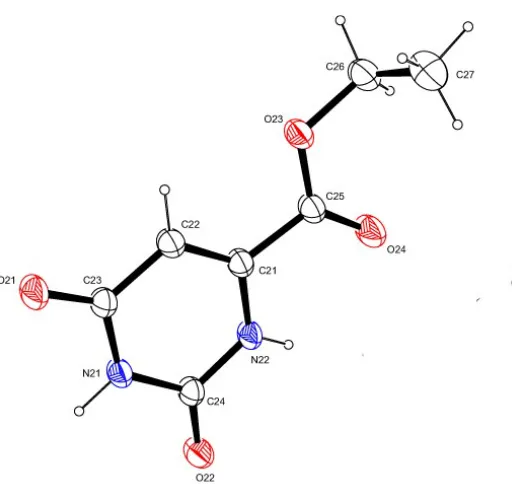
Fig 1. Crystal structure of compound 2
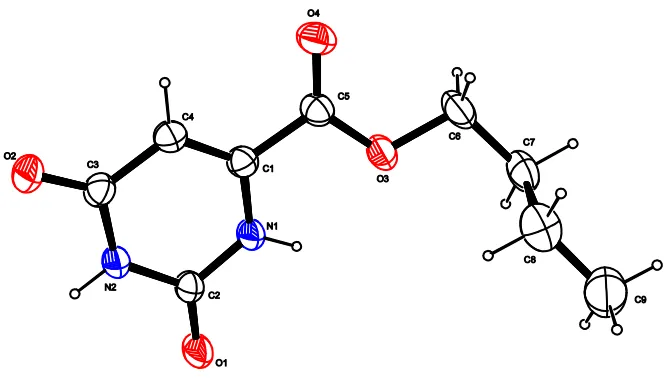
Fig 2.Crystal structure of compound 3
HN N H O O H N O NH2 4 HN N H O O H N O N O HN N H O O H N O N H N HN O O NH O N H N HN O O NH O N Cl Cl NH N H O O H N O N Br HN N H O O H N O N Cl Cl NH N H O O H N O N HO 5 6 7 8 9 10 11 HN N H O O H N O N Cl 12 NO2
Scheme 2. General synthesis of 5-12. Reagents and conditions: Ethanol, AcOH, reflux 5 h
Results:
Proliferation Method:
and 10,000 g of streptomycin/ml; Gibco, Cat No. 15140122) and 1% NEAA (X100; Gibco, Cat No. 11140035). After the cells reached 80–90% confluences in culture flasks, the cells were trypsinized and they were transferred in falcon tubes. Cells were counted using the Neubauer hemocytometer counting chamber (PAUL MARIENFELD GMBH & CO.KG.), the cells were seeded at a density of 0.01×10⁶ cells per well of a 96-well tissue culture plate. Following day the diluted compounds were added to the cells at the desired concentration in triplicate, after additional 2 days the media is changed to normal growth media. The next day is designated as day 1 of proliferation.
Alamar Blue Cell Viability Assay:
Cell viability was measured using alamar blue assay according to the manufacturer's recommendations (AbD Serotec, Raleigh, NC, USA). In brief, we cultured cells in 96-well plates in 100μl of the appropriate medium and at the indicated time point, and 10μl of Alamar Blue substrate was added and plates were incubated in the dark at 37°C for 1h. Reading was subsequently taken using fluorescent mode (Ex 530nm/Em 590nm) using BioTek Synergy II microplate reader (BioTek Inc., Winooski, VT, US.
Chemistry:
All solvents and reagents were purchased from AldrichChemical Co and were used as obtained. IR spectra were recorded with a Perkin-Elmer spectrum BX FT-IR spectrometer using KBr pellets. 1H and 13C NMR spectra were recorded on a Bruker instrument (500 and 125 MHz,
EtOH–H2SO4 (5:1) system. Merck silica gel 60 (230-400 mesh) was used for column
chromatography.
General procedure for the synthesis of compound 2 and 3 (19).
To a solution of orotic acid 1 (2 mmol) in ethanol/butanol (50 mL) was added catalytic amount of HCl. The resulting mixture was refluxed for 10 h with stirring followed by the evaporation of solvent in vacuo. The resulting solid obtained was washed with cold water several times, recrystallized with ethanol-water mixture afforded compounds 2 and 3.
Ethyl 2,6-dioxo-1,2,3,6-tetrahydropyrimidine-4-carboxylate (3)
Yield 71 %, m.p. 176. Brown crystals, IR (KBr): v = cm–1. IR (KBr): 1715, 1730 (C=O), 2990
(NH), 3335 (OH). 1HNMR (500.133 MHz, DMSO-d
6): δ = 1.30 (t, 3H, CH3), 4.31 (m, 2H, CH2),
6.05 (s, 1H, CH), 11.14 (br s, 1H, NH), 11.39 (br s, 1H, NH). 13C NMR (125.76 MHz,
DMSO-d6): δ = 15.21, 62.2, 103.50, 142.09, 151.20, 163.05, 164.55. MS (70 eV): m/z (Irel, %) 185 (71)
[M+H]+, 112 (100): calcd for C
7H8N2O4 (184.05): HRMS: 184.0499.
General procedure for the synthesis of arylhydrazones 5, 7, 8, 10, 11 and 12
A mixture containing the orotic hydrazide 4 (1 mmol) and appropriate aromatic aldehyde (1.1 mmol) with catalytic amount of acetic acid was heated under reflux and stirring for 3 h in ethanol. After completion of the reaction, as indicated by TLC, the reaction mixture was poured onto crushed ice and the solid separated was filtered under suction, washed with ice-cold water (50 mL), and subsequently dried to afford pure product.
Yield 64 %, m.p. 183 o C. white solid, IR (KBr): v = cm–1. IR (KBr): 1720, 1723 (C=O), 3019
(NH), 3310 (OH). 1HNMR (500.133 MHz, DMSO-d
6): δ = 3.82 (s, 3H, OCH3), 5.94 (s, 1H,
CH), 7.70 (d, 2H, j = 8.5 Hz, arom), 7.83 (d, 2H, j = 9.0 Hz, arom), 8.33 (s, 1H, CH), 10.20 (br s, 1H, NH), 10.77 (br s, 1H, NH), 11.26 (br s, 1H, NH). 13C NMR (125.76 MHz, DMSO-d
6): δ =
55.84, 100.79, 114.92, 125.37, 126.67, 129.57, 130.45, 150.38, 151.10, 151.30, 160.96, 164.51. MS (70 eV): m/z (Irel, %) 289 (39) [M+H]+, 267 (25), 133 (100): calcd for C13H12N4O4 (288.09):
HRMS: 288.0819.
(E)-N'-(2,6-dichlorobenzylidene)-2,6-dioxo-1,2,3,6-tetrahydropyrimidine-4-carbohydrazide (7)
Yield 69 %, m.p. 211 o C. light yellow solid, IR (KBr): v = cm–1. IR (KBr): 1718, 1723 (C=O),
3029 (NH), 3290 (OH). 1HNMR (500.133 MHz, DMSO-d
6): δ = 6.16 (s, 1H, CH), 7.49-7.63 (m,
3H, arom), 7.99 8.62 (s, 1H, CH), 11.03 (br s, 1H, NH), 11.37 (br s, 1H, NH), 12.38 (br s, 1H, NH). 13C NMR (125.76 MHz, DMSO-d
6): δ = 101.29, 129.71 (2×), 130.18, 132.78, 133.11,
134.64, 137.63, 148.91, 157.08, 164.46, 167.07. MS (70 eV): m/z (Irel, %) 327 (39) [M+H]+, 292
(25), 170 (100): calcd for C12H8Cl2N4O3 (326.00): HRMS: 326.0736.
(E)-N-(4-nitrobenzylidene)-2,6-dioxo-1,2,3,6-tetrahydropyrimidine-4-carbohydrazide (8)
Yield 69 %, m.p. 169 o C. white solid, IR (KBr): v = cm–1. IR (KBr): 1715, 1723 (C=O), 3039
(NH), 3290 (OH). 1HNMR (500.133 MHz, DMSO-d
6): δ = 5.94 (s, 1H, CH), 7.83 (s, 1H, arom),
8.34 (m, 3H, CH, 2 × arom), 8.74 (s, 1H, arom), 10.12 (br s, 1H, NH), 10.72 (br s, 1H, NH), 11.26 (br s, 1H, NH). 13C NMR (125.76 MHz, DMSO-d
6): δ = 103.0, 123.16, 131.16 (2×),
134.91 (2×), 144.20, 149.51, 151.33, 151.90, 164.16, 167.63. MS (70 eV): m/z (Irel, %) 304 (41)
[M+H]+, 298 (78), 176 (100): calcd for C
(E)-N-(3,4-dichlorobenzylidene)-2,6-dioxo-1,2,3,6-tetrahydropyrimidine-4-carbohydrazide (10)
Yield 55 %, m.p. 157 o C. white solid, IR (KBr): v = cm–1. IR (KBr): 1722, 1723 (C=O), 3031
(NH), 3290 (OH). 1HNMR (500.133 MHz, DMSO-d
6): δ = 5.99 (s, 1H, CH), 7.73 (m, 2H,
arom), 7.99 (s, 2H, arom), 8.38 (s, 1H, CH), 11.03 (br s, 1H, NH), 11.27 (br s, 1H, NH), 12.33 (br s, 1H, NH). 13C NMR (125.76 MHz, DMSO-d
6): δ = 101.17, 127.55, 129.44, 130.60, 132.27,
133.36, 134.74, 135.61, 147.78, 157.67, 164.48, 166.82. MS (70 eV): m/z (Irel, %) 289 (39)
[M-Cl]+, 267 (25), 133 (100): calcd for C
12H8Cl2N4O3 (326.00): HRMS: 326.0317.
(E)-N-(4-bromobenzylidene)-2,6-dioxo-1,2,3,6-tetrahydropyrimidine-4-carbohydrazide (11)
Yield 59 %, m.p. 177 o C. white solid, IR (KBr): v = cm–1. IR (KBr): 1717, 1725 (C=O), 3050
(NH), 3300 (OH). 1HNMR (500.133 MHz, DMSO-d
6): δ = 6.11 (s, 1H, CH), 7.65 (d, 2H, j = 8.5
Hz, arom), 7.83 (d, 2H, j = 8.5 Hz, arom), 8.37 (s, 1H, CH), 8.71 (br s, 1H, NH), 10.25 (br s, 1H, NH), 11.25 (br s, 1H, NH). 13C NMR (125.76 MHz, DMSO-d
6): δ = 99.83, 127.41, 129.73,
130.69, 131.86, 132.10 132.50, 145.33, 150.88, 151.20, 164.56, 162.07. MS (70 eV): m/z (Irel, %)
337 (30) [M+H]+, 211 (90), 157 (28): calcd for C
12H9BrN4O3 (335.99): HRMS: 335.9701.
(E)-N-(4-chlorobenzylidene)-2,6-dioxo-1,2,3,6-tetrahydropyrimidine-4-carbohydrazide (12) Yield 63 %, m.p. 141 o C. white solid, IR (KBr): v = cm–1. IR (KBr): 1715, 1730 (C=O), 2990
(NH), 3335 (OH). 1HNMR (500.133 MHz, DMSO-d
6): δ = 6.10 (s, 1H, CH), 7.77 (d, 2H, j = 8.5
Hz, arom), 7.90 (d, 2H, j = 8.2 Hz, arom), 8.38 (s, 1H, CH), 8.71 (br s, 1H, NH), 10.13 (br s, 1H, NH), 11.26 (br s, 1H, NH). 13C NMR (125.76 MHz, DMSO-d
6): δ = 101.04, 128.97 (2x), 129.53
(2x), 130.50, 133.09, 145.04, 149.20, 151.28, 161.05, 164.48. MS (70 eV): m/z (Irel, %) 276 (90)
[M-OH]+, 247 (45), 110 (100): calcd for C
X-ray Crystallographic Study of Compound 2. Crystals of compound 2 were obtained by crystallization from ethanol-water (3:1) by allowing slow solvent evaporation. Crystallographic data for the structure of compound 2 have been deposited at the Cambridge Crystallographic Data Center (deposit CCDC 1483501).
X-ray Crystallographic Study of Compound 3. Brown needles of compound 3 were obtained by crystallization from ethanol-water by allowing slow solvent evaporation. Crystallographic data for the structure of compound 3 have been deposited at the Cambridge Crystallographic Data Center (deposit CCDC 150815).
X-ray Crystallographic Study of Compound 4. Crystals of compound 4 were obtained by crystallization from hot ethanol and by allowing slow solvent evaporation. The compound was crystallized with two molecules of water in crystal lattice. Crystallographic data for the structure of compound 4 have been deposited at the Cambridge Crystallographic Data Center (deposit CCDC 1483500).
Discussion:
Stem cells are characterized by their extensive capability to self-renewal and differentiate into at least one, and usually more, mature cell types in presence of appropriate signals or small molecules which promote stem cells maintenance and specific differentiation 19, 20. The current
paper is focused on the synthesis of heterocyclic molecules specially modulated to enhance cell differentiation in mesenchymal stem cells.
reported procedure. The product obtained was recrystallized in ethanol-water (3:1) at room temperature to obtain crystals suitable for x-ray crystallography for compound 2 (fig 1). However, the cumbersome workup, low yield and toxicity restrict the wide application of this solvent. Considering the limitations of the reported methods, the need for the development of new and efficient method is strongly desirable. Therefore, ethanol is used along with catalytic amount of HCl afforded 3 in good yield. The solid obtained was recrystallized in ethanol-water mixture to afford the crystals suitable for x-ray crystallography for compound 3 (fig 2). The ethyl ester was reacted with hydrazine hydrate in refluxing ethanol yielding hydrazide 421 in 67%
yields. Comparing the result obtained, the same reaction was carried out with butyl ester of orotic acid but the yield was significantly low with longer reaction time. Yellow crystals of compound 4 (fig 3) suitable for X-ray crystallography were obtained by slow evaporation from ethanol at room temperature. Starting material 4 was than subjected through a series of acid catalyzed condensation reaction with various substituted aromatic aldehyde afforded target compounds in excellent yields. All the compounds 2-12 were isolated as (E)-isomers which was confirmed by gated-decoupling (GD) measurements. In the 1H NMR spectrum of synthesized
molecules, signal of pyrimidine CH appears at the characteristic position, moreover aromatic protons appeared in their respective regions. The IR spectra of all the synthesized compounds showed spectral bands in the regions 3050-3350 (NH), 1710-1723 (C=O) and 1600-1680 (C=O) typical of a uracil ring. The mass and HRMS data are also in accord with the proposed structures of compounds 2-12.
cells were investigated for additional three days to ensure the effect of these compounds on hMSCs. It was clearly observed that after day 1 at high concentration (500 μM) almost every compound including DMSO had slowed their proliferation completely except for sample 1, 6 and 9. This effect was more prominent at lower concentrations where the same compounds had significantly higher proliferation rate then the other compounds and DMSO (Graph 1). However at lower concentrations other compounds also showed significant up regulation such as, at 250 μM: 1 and 3, and at 10 μM sample 2 also showed significant difference, it was only 7 which did not have any effect on proliferation at day 1. Same pattern was followed on day 2 also, all the compounds at the highest concentration (500 μM) slowed the proliferation however 1, 6 and 9 still had significant higher proliferation rate. And at lower concentrations 50 and 10 μM beside 7 all compounds showed significant up regulation of proliferation (Graph 1). However, at day 5 only 1 was significantly higher at the highest concentration and 7 showed no change or lower proliferation at 50 μM (Graph 1). Other compounds exhibit less significant effect on proliferation which shows that substituent’s plays a role in stem cell proliferation.
Acknowledgement:
The authors thank Research Center, College of Pharmacy, and Deanship of Scientific Research, King Saud University for supporting this study.
Conflict of Interest:
The authors declare that they have no conflict of interest.
References:
2. Dogan H.N, Duran A, Rollas S, Sener G, Armutak Y, Keyer-Uysal M, Med. Sci. Res., 1998, 26, 755- 758.
3. A. Bari, Amer. Alanazi, S.A Syed, Azmat. Khan, A. A. Alobaid, J. Hetero. Chem, 2016 53, 2, 377-382.
4. D J.Brown, W B. Cowden Austral. J. Chem., 1983, 36, 1469-1474.
5. J M. Kane, B M. Baron, M W. Dudley, S M. Sorenson, F P. Miller, J. Med Chem, 1990, 33, 2772-2780.
6. R. Matunas, A J. Lai, C Lee, Tetrahedron, 2005, 61, 6298-6308.
7. A Bari, S.A Syed, I A. Hashmi, Chemistry of Heterocyclic Compounds, 2014, 49, 12, 1723-1730.
8. K Makino, J Kinoshita, K Saton, Nature, 1953, 172, 914-916.
9. C I. Hong, C Piantado, Journal of Medicinal Chemistry, 1968, 11, 6, 1182-1190.
10. E Laxminarayana, T Kumar, S K. Shivashankar, S Chary, M Thirumala, Der Pharma Chemica, 2011, 3, 3, 149-155.
11. S Gemma, G Kukreja, C Fattorusso, M Persico, M Romano, M Altarelli, L Savini, G Campiani, E Fattorusso, N Basilico , Bioorg. Med. Chem. Lett., 2006, 16, 5384-5388. 12. L Savini, L Chiasserini, V Travagli, C Pellerano, E Novellino, S Cosentino, M B. Pisano,
Eur. J. Med. Chem, 2004, 39, 113-122.
13. A G. Silva, G Zapata-Suto, A E. Kummerle, C A. Fraga, E J. Barreiro, R T. Sudo,
Bioorg. Med. Chem, 2005, 13, 3431-3437.
15. A Caroline, R Hubner, M Beller, M J. Frech, Current Pharmaceutical Biotechnology, 2013, 14, 36-45.
16. Q L. Ying, J Wray, J Nichols, L Batlle-Morera, B Doble, J Woodgett, P Cohen, A Smith,
Nature, 2008, 453, 519-523.
17. S Mae, S Shirasawa, S Yoshie, F Sato, Y Kanoh, H Ichikawa, T Yokoyama, F Yue, D Tomotsune, K Sasaki, Biochem. Biophys. Res. Commun., 2010, 393, 877-882.
18. A B. McLean, K A. D'Amour, K L. Jones, M Krishnamoorthy, M J. Kulik, D M. Reynolds, A M. Sheppard, H Liu, Y Xu, Stem Cells, 2007, 25, 29-33.
For synthesis of compounds 2, 4, 6 and 9, please check reference 21 and references cited therein.