© 2015, IJCSMC All Rights Reserved
408
Available Online atwww.ijcsmc.com
International Journal of Computer Science and Mobile Computing
A Monthly Journal of Computer Science and Information Technology
ISSN 2320–088X
IJCSMC, Vol. 4, Issue. 1, January 2015, pg.408 – 414
RESEARCH ARTICLE
Controlling Computer Music Player
Based On Human Hand Activity by
Using CAMSHIFT Algorithm
Malatesh M
1*, Parasappa Dali
2
¹*
PG scholar,Department of CS & E, UBDTCE, VTU, India²
PG scholar,Department of CS & E, UBDTCE, VTU, India1
[email protected]; 2 [email protected]
Abstract— The intent of the paper is to apply computer vision technique to control the music player by CAMSHIFT algorithm. Based on the human hand activity, gesture and posture recognition are used to communicate with computers. Gesture is the physical movement of a hand, expressive of an idea. Posture is the static morph of a hand. In this paper skin colour segmentation is used for hand detection, after hand detection CAMSHIFT algorithm is used for hand tracking stage. The algorithm first create the probability distribution image of the desired colour in the video sequence, then uses Hue Saturation colour system, finally CAMSHIFT algorithm is applied for hand tracking. MATLAB based simulation is used to obtain results.
Keywords— gesture, posture, skin colour segmentation, CAMSHIFT, HSV
I. INTRODUCTION
Virtual reality technologies, which can give humans the sensation of being involved in computer world, have been a popular research field for many years. Hand gesture play important role in the vision community, mainly for the purpose of Human-Computer Interaction (HCI). Gesture and posture recognition are application areas in HCI to communicate with computers. A gesture is spatiotemporal pattern which maybe static, dynamic or both. Static morphs of the hands are called postures and hand movements are called gestures.
In this paper, hand activity detection for motion recognition system is developed. In initial stage, a skin color segmentation method for the color image with complex background is presented, which is a mixed skin color segmentation model in both HSI and YCbCr color space constructed. After skin color segmentation, improved hand tracking algorithm is proposed. Through computation, the key points of hand can be received. Then we establish coordinate system for motion recognition and control music player on the basis of hand position in quadrants.
© 2015, IJCSMC All Rights Reserved
409
controller. Take advantage of webcam’s real time frame tracking function, a music player controller is implemented by Mat lab code.
Using computer vision systems to perform motion recognition is a complex and challenging task. We present an improved method for skin color area detection and segmentation based on YCbCr and HSI skin color space. We used CAMSHIFT Algorithm to track the gesture trajectory and estimate the center of hand, which used for controlling the Music Player. Using the algorithm we can exclude large numbers of interference and calculation, the complex data training and modeling is omitted.
Existing system: in existing system YCbCr/HSV is used for hand colour segmentation and then mean shift
algorithm is used to hand tracking. but there are certain disadvantages using these methods that is illumination and complex background similar to color effect, the method with YCbCr color space still may make skin-color region as non-skin skin-color, Under the influence of the environment, the method with HSI skin-color space still may make non-skin color as skin-color, Accuracy is low, as time changes distribution obtained from video image sequence also changes, so the mean shift algorithm should be adapted dynamically to the probability distribution when it is tracking.
II. RELATEDWORK
Many research fellows worked for gesture recognition, below illustrate some of the papers
“Hand gesture recognition using combined features of location, angle and velocity”, published by Ho-Sub Yoon, Jung Soh, Younglae J. Bae, Hyun Seung Yang [1].
“Evaluation of HMM training algorithm for letter hand gesture recognition” published by Nianjun Liu Brain C. lovell Peter J. Kootsookos[2]. This paper explains identification of letter hand gesture.
“Real-Time Capable System for Hand Gesture Recognition Using Hidden Markov Models in Stereo Color Image Sequences” published by Mahmoud Elmezain, Ayoub Al-Hamadi, Bernd Michaelis [3]
This paper explains identification of alphabets and numbers by the motion of single hand using Hidden Markov Models.
“The Hand Mouse: GMM Hand-color Classification and Mean Shift Tracking ”, published by Takeshi Kurata Takashi Okuma Masakatsu Kourogi Katsuhiko Sakaue [4]
The above paper explains an algorithm to identify and track a hand iv every image taken by a wearable camera.
III.PROPOSEDMETHOD
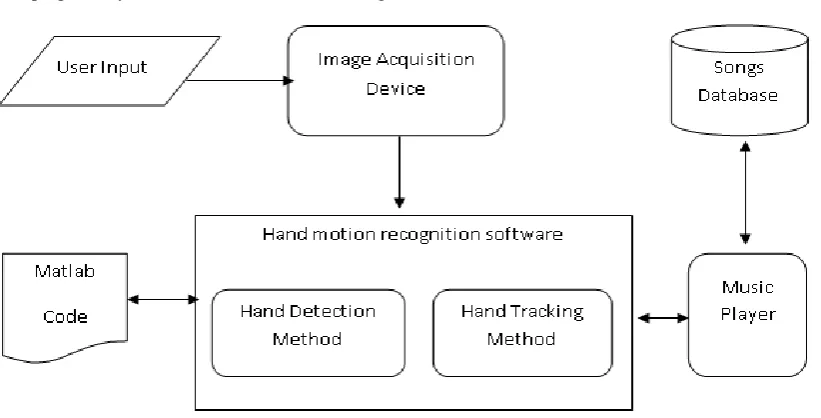
The proposed system architecture is shown in fig. 1
© 2015, IJCSMC All Rights Reserved
410
The Overview Design of the paper is presented as follows: 1) The user needs to give input as gesture through webcam.
2) The image acquisition device (Webcam) captures the video in the form of frame sequences.
3) By fusing the results receive from two methods i.e. from methods with YCbCr and HSI colour space, in other words, we perform every pixel “OR” operation on two binary images which get from two colour space in case of skin colour segmentation method to detect human hand and it provide frames to hand tracking method in hand motion recognition software
The proposed method consisting of skin colour segmentation, CAMSHIFT algorithm for hand tracking.
A. Skin Colour Segmentation Method
The steps of the proposed skin segmentation algorithm are described below. Steps 1-2 are for skin color
Detection, Step 3-4 are for skin segmentation using edge and color. Step 5-6 are post-processing.
Step 1:Generate the skin color score image S by computing the skin color likelihood ratios for all image pixels of the color input image I. apply an averaging filter (size 3×3) to smooth the skin color score image.
Step 2: Threshold the skin color score image as in (1) to obtain a binary map Bc for skin colored regions. A low threshold θ = 0.8 is used.
Step 3:Apply edge detectors (Sobel and Canny) on the color channels of the input image to find edge pixels. We find that the canny edge detector is suitable for detecting strong edges between homogenous regions whereas the Sobel edge detector is better at detecting non-homogenous blocks within a skin-colored region.
Step 4: For each region in Bc, raise the skin color threshold iteratively by a factor of 1.2 until the standard deviation (std) σ of the region intensity or the ratio of the edge count and the area of the region are below predefined thresholds. In addition, if the standard deviation measure σ of the region is higher than a threshold, all edges pixels (found in step 3) are removed from the region binary map.
Step 5: Remove regions that are smaller than 1% of the largest region, and regions whose area is reduced to less than 5% after a morphological erosion operation.
Step 6: Repeat the steps below for each remaining region, which is represented by binary map Bi: 1)Find the convex hull Bconv, i of the region.
2)Find the part of the skin color map Bc that corresponds to the convex hull. 3)Let Bcolor, i denote this part.
Obtain the final binary map for the skin region: Bi (final) = Bconv, i AND Bcolor, i.
Fig. 2 Skin colour segmentation method Flow chart. Read video frames
Convert frame from RGB to YCbCr
Convert to binary frame & differentiate it as skin
© 2015, IJCSMC All Rights Reserved
411
B. CAMSHIFT Algorithm
CAMSHIFT algorithm is a dynamic change in the distribution of the density function of the gradient estimate of non-parametric methods. The course of algorithm is as follows:
1. Choose an initial search window W1; 2. Run the MEANSHIFT algorithm;
3. Resize the search window according to the result of Step (2), and get a new window W2; 4. Use W2 as the initial search window for the next video frame and repeat the algorithm.
When CAMSHIFT algorithm track a specific colour object, the images do not have to calculate each frame all the pixels of the colour probability distribution, just calculate pixel colour probability distribution in the area that larger than the current search window. This can save a lot of computing.
However, this tracking algorithm is satisfying when it run under simple background or black-white colour background. When the colour of background is similar to the object, or there are some interference similar to the object’s colour, or tracking position between two consecutive frames in which velocity has changed abruptly, the CAMSHIFT algorithm will track them included, lead to tracking window enlarged automatically, or even lose the tracking window. So we propose an improved method to make it better.
Fig.3 Camshift method flowchart
CamShift algorithm is based on an adaptation of mean shift algorithm. And it is calculated as: 1). Select the starting location of the search window.
2). Store the zeroth movement by bean shifting.
3). Search window size has to be set, so that it must be equal to the function of the zeroth movement found in step 2
4).reiterate Steps 2 and 3 until convergence (mean location moves less than a present threshold).
To track the target using the Mean Shift algorithm, it iterates the following steps: 1) Choose a search window size and starting position of the search window. 2) Mean location is calculated in search window.
3) Centre the search window at the mean location computed in Step 2.
4) Reiterate Steps 2 and 3 until convergence (or until the mean location moves less than a present threshold).
IV.RESULTSANDTESTING
© 2015, IJCSMC All Rights Reserved
412
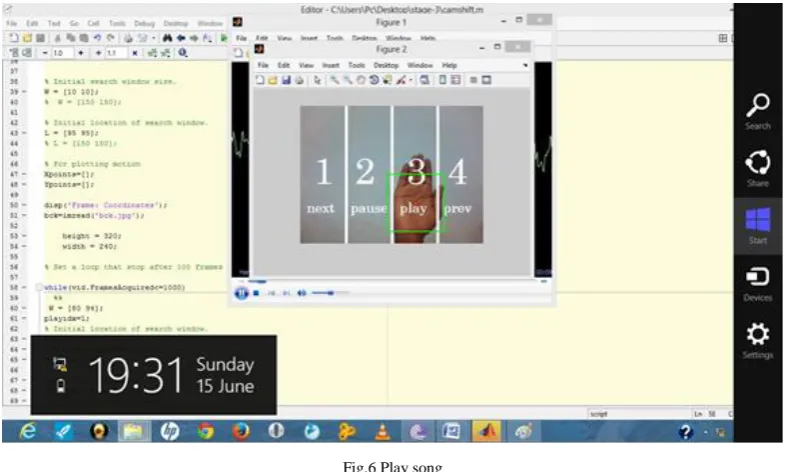
Fig. 4 Four type’s quadrants next, pause, play, previous We defined the first quadrant gesture as “Next song”, as shown in fig. 5
Fig.5 Play next song We defined the third quadrant gesture as “play song”, as shown in fig. 6
© 2015, IJCSMC All Rights Reserved
413
Test Case No. 1
Description Skin Color Segmentation Program
Sample Input Read video through webcam and run the program
Expected output Skin color as white and non-skin color as black
Actual output Output as expected
Results and Remarks Pass
Test Case No. 2
Description Hand Tracking Program
Sample Input Read video through webcam and run the program
Expected output Recognize hand motion as it moves
Actual output Output as expected
Results and Remarks Pass
Below tables show that the test cases for controlling music player system with different quadrants
Test Case No. 1
Description Controlling music player after track the hand.
Sample Input Keep hand in first quadrant
Expected output Play next song on the basis of hand present in first quadrant
Actual output Output as expected
Results and Remarks Pass
Test Case No. 3
Description Controlling music player after track the hand.
Sample Input Move hand to third quadrant
Expected output Play song on the basis of hand present in third quadrant
Actual output Output as expected
© 2015, IJCSMC All Rights Reserved
414
V. CONCLUSION
Using CAMSHIFT algorithms we can save large numbers of interference and calculation, the complex data training and modeling is omitted. According to large numbers of experiments, the intelligent music player system that we present provides robust performance in dynamic video sequence, and actual result is satisfactory.
Future work the paper can be enhanced further by improving the method to detect human hand accurately and also method to be improved to control music player very fast and effectively in a real time.
ACKNOWLEDGEMENT
The author would like to thank Smt. Kavitha G Assistant professor, UBDTCE VTU University for her valuable suggestion and support.
REFERENCES
[1] “Hand gesture recognition using combined features of location, angle and velocity”, published by Ho-Sub Yoon, Jung Soh, Younglae J. Bae, Hyun Seung Yang.
[2] “Evaluation of HMM training algorithm for letter hand gesture recognition” published by Nianjun Liu Brain C. lovell Peter J. Kootsookos
[3] “Real-Time Capable System for Hand Gesture Recognition Using Hidden Markov Models in Stereo Color Image Sequences” published by Mahmoud Elmezain, Ayoub Al-Hamadi, Bernd Michaelis
[4] “The Hand Mouse: GMM Hand-color Classification and Mean Shift Tracking ”, published by Takeshi Kurata Takashi Okuma Masakatsu Kourogi Katsuhiko Sakaue
[5] “Computer Music Controller Based on Hand Gestures Recognition Through Web-cam" published by Junhao Jiang, Junji Ma, Yiye Jin