Scholarship@Western
Scholarship@Western
Electronic Thesis and Dissertation Repository
8-23-2017 12:00 AM
Secure Integer Comparisons Using the Homomorphic Properties
Secure Integer Comparisons Using the Homomorphic Properties
of Prime Power Subgroups
of Prime Power Subgroups
Rhys A. Carlton
The University of Western Ontario Supervisor
Dr. Aleksander Essex
The University of Western Ontario
Graduate Program in Electrical and Computer Engineering
A thesis submitted in partial fulfillment of the requirements for the degree in Master of Engineering Science
© Rhys A. Carlton 2017
Follow this and additional works at: https://ir.lib.uwo.ca/etd
Part of the Information Security Commons, Other Electrical and Computer Engineering Commons, and the Software Engineering Commons
Recommended Citation Recommended Citation
Carlton, Rhys A., "Secure Integer Comparisons Using the Homomorphic Properties of Prime Power Subgroups" (2017). Electronic Thesis and Dissertation Repository. 4833.
https://ir.lib.uwo.ca/etd/4833
This Dissertation/Thesis is brought to you for free and open access by Scholarship@Western. It has been accepted for inclusion in Electronic Thesis and Dissertation Repository by an authorized administrator of
Abstract
Secure multi party computation allows two or more parties to jointly compute a function under encryption without leaking information about their private inputs. These secure computations are vital in many fields including law enforcement, secure voting and bioinformatics because the privacy of the information is of paramount importance.
One common reference problem for secure multi party computation is the Millionaires’ problem which was first introduced by Turing Award winner Yao in his paper "Protocols for secure computation". The Millionaires’ problem considers two millionaires who want to know who is richer without disclosing their actual worth. There are public-key cryptosystems that currently solve this problem, however they use bitwise decomposition and Boolean algebra on encrypted bits. This type of solution is costly as each bit requires its own encryption and decryption.
Our solution to the Millionaires’ problem and secure integer comparison looks at a new approach which doesn’t use the decomposition method and instead encrypts the full length of the message in one encryption (within scope). This method also extends in a linear fashion (with respect to the number of encryptions), so larger integers remain efficient to compare.
In this thesis, we present a new cryptosystem with a novel homomorphic property used for secure integer comparison, as well as a protocol implementing the cryptosystem and a simulation security proof for the protocol. Finally, we implemented the system and compared it to systems that are being used today.
Keywords: Prime Power Groups, Public Key Cryptosystem, Secure Integer Compar-ison, Cryptography, Homomorphic Encryption Properties
First, I would like to thank my supervisor, Dr. Aleksander Essex, for his unwavering support throughout the duration of my master’s program. There were a number of setbacks through the last two years, but his genuine enthusiasm and his ability to provide a nurturing learning environment were factors that I’ve found invaluable. Being the first person to open my eyes to the field of cryptography, Dr. Essex has allowed me to seek out my interests in the field and has fostered the curiosities that I have had. Without his guidance and upbeat attitude, the completion of this thesis would be impossible and I may have never delved into the field in the first place.
I would like to thank my parents who have provided me with continuous support and unfailing encouragement throughout my scholastic endeavours and through the process of researching and writing this thesis. This accomplishment would not have been possible without them.
To my friends who kept me sane through my thesis. Thank you for listening, offering me advice, and supporting me through this entire process. The nights spent playing trivia, watching Rick McGhee and the general help you have provided over the past two years were all greatly appreciated.
Finally thanks to Krzysztof Kapulkin, who I have co-written a publication (in sub-mission) with. Your help with the underlying mathematics behind our protocol was imperative and it was a pleasure working with you.
Contents
Certificate of Examination i
Abstract i
Acknowlegements ii
List of Figures v
List of Tables vi
1 Introduction 1
1.1 Motivation . . . 1
1.2 Contributions . . . 2
1.3 Organization of Thesis . . . 4
2 Background 5 2.1 Secure Computation . . . 5
2.2 Public Key Encryption . . . 6
2.2.1 Cryptosystem Breakdown . . . 7
2.2.2 Semantic Security . . . 9
2.2.3 IND-CPA Game . . . 9
2.2.4 Randomized Encryption . . . 10
2.2.5 Math Basics . . . 10
2.3 Homomorphic Encryption . . . 11
2.4 DGK Public Key Cryptosystem . . . 13
2.4.1 Modern Use . . . 15
2.5 Paillier Encryption . . . 15
2.6 ElGamal Encryption . . . 18
3 Our Protocol 21 3.1 Introduction . . . 21
3.2 Mathematical Principles . . . 21
3.3 Hardness Assumptions . . . 23
3.4 Working in Prime Power Groups . . . 24
3.5 Our Encryption Scheme . . . 25
3.5.1 Unique Homomorphic Properties . . . 27
3.5.2 Semantic Security . . . 28
3.7 Extension Techniques . . . 32
4 Protocol Security 35 4.1 Simulation Security Basics . . . 35
4.2 Our Simulation Environment . . . 36
4.3 Simulation Proof . . . 37
5 Implementation 42 5.1 Environment . . . 42
5.2 Coding Concepts . . . 43
5.3 Algorithms Used . . . 44
5.4 Analysis . . . 47
6 Extension to Geo-spatial Analysis 51 6.1 Overview . . . 51
6.2 Math Basics . . . 52
6.2.1 Euclidean Distance . . . 52
6.3 Geo-spatial Protocol . . . 53
6.3.1 Distance Calculation . . . 53
6.3.2 Shuffling . . . 53
6.3.3 Comparison Protocol . . . 53
6.3.4 Privacy Proof . . . 55
6.3.5 Correctness . . . 56
6.4 Future Work . . . 57
7 Conclusion and Future Work 60 7.1 Summary . . . 60
7.2 Discussion . . . 61
7.3 Future Work . . . 62
7.4 Conclusion . . . 62
Bibliography 63
Curriculum Vitae 69
List of Figures
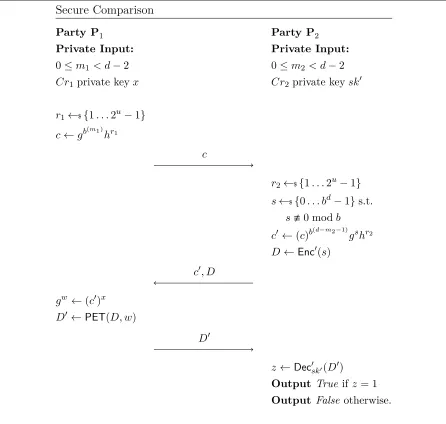
3.1 Secure integer comparison protocol evaluating (𝑚1 > 𝑚2) . . . 31
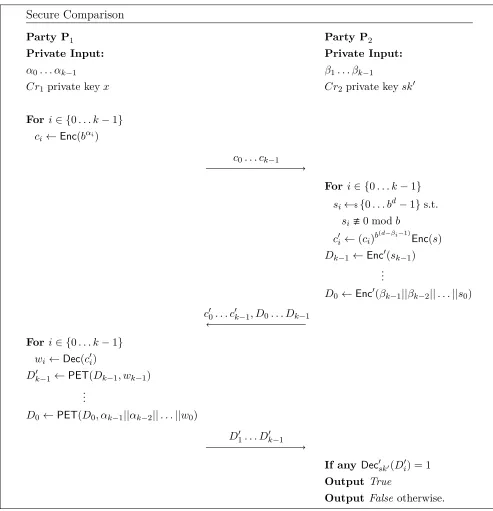
3.2 Secure integer comparison protocol for large ranges using blocking . . . . 34
4.1 Ideal functionality of our protocol for 𝑃𝐴 . . . 37
4.2 Ideal functionality of our protocol for 𝑃𝐵 . . . 37
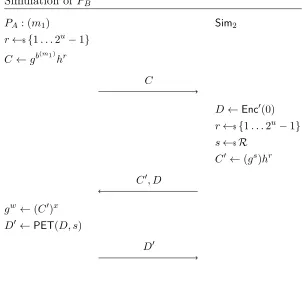
4.3 Simulation of 𝑃𝐵 . . . 40
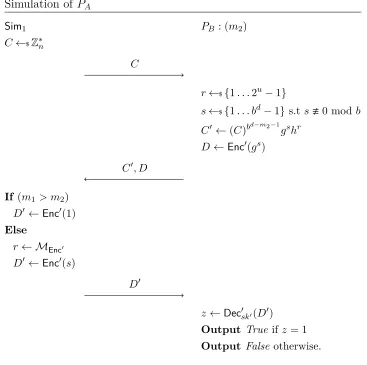
4.4 Simulation of 𝑃𝐴 . . . 41
6.1 Euclidean distance sub protocol . . . 54
6.2 Geo-spatial comparison protocol . . . 55
6.3 All variations described in geo-spatial correctness . . . 58
5.1 Table for extracting bits using squarings . . . 44 5.2 Comparison of DGK protocol performance vs. our performance . . . 50
6.1 Table for variations in geo-spatial correctness . . . 59
Chapter 1
Introduction
The internet has revolutionized the way that information is distributed on a day-to-day
basis. From health informatics to trustworthy voting, law records, Global Positioning
Systems, advertising and secure database linkage, personal information is more accessible
than ever before. With the availability of personal information there has been tension
between solving social problems and protecting individual privacy. This is where the foundation on which secure computation is based; to compute answers to questions
without disclosing unnecessary information. For this problem, protocols are put in place
to hide information while still allowing coordination and evaluation of the computation.
An example situation using secure computation is proving that an election was counted
correctly without revealing individual’s votes.
The development of protocols to ensure the security of information has steadily
improved over time, but with every step forward we make in the field of computation
there is a need to reassess the current standards that are being used. Within the scope of this thesis, we look at an arrangement of current public key cryptosystems and create a
new system that we believe can compete with the current systems in practice. To do this
we look at the field of homomorphic encryption, which allows for functions to be done
under encryption, and parties to work together without learning any excess information
about the other party. These concepts will be explained in detail in the following chapters.
1.1
Motivation
Secure multi party computation has been a cornerstone in the field of cryptography
since it was first brought in the early works of Goldwasser and Micali [31], and Micali
and Rogaway [45]. Fischlin [25] used these works to create the first definition of secure computation. Broadly speaking,this process allows a two or more parties to compute a
function involving the private inputs of the respective parties. This function is calculated
in a way that reveals no information about another party’s input beyond what can be
determined from the output of the function itself. For an adversary to learn anything
more than the inputs of the corrupted parties and the final output of the functions would
require every party to be corrupted.
Secure computation is essential for many efficient secure protocols. One example is its use in secure online voting. It ensures the discretionary nature of each individual
vote while also allowing a overall tally for the election to be computed. This acts as a
safeguard, affirming these results are not compromised. Without secure computation the
ability to perform the aggregation while ensuring the integrity and privacy of each vote
would not be feasible. The is just one case amongst many where secure computation
enables the integrity of the procedure, and one instance where the protocol within this
thesis could be implemented.
Within the set of secure multi party protocols, one of the largest growing areas is the
use of data analysis and aggregation. Over the last few years, the amount of data that has
been uploaded to the internet has increased drastically. This abundance of information
stretches from medical data to web access logs and its size transcends protocols used
previously. The distribution of such large amounts of information has forced developers
to create distributed protocols that are more efficient when dealing with large sets of data.
The boom in this area sparked an interest in the creation and implementation of a secure
protocol to use when dealing with comparing information using multi party computation.
In particular, within this thesis we are looking at secure integer comparison which entails comparing secret numbers from two parties and securely returning the result of which
integer was larger.
One example of this type of application is an application using geo-spatial analysis
to identify and order the distances of different locations from a user’s current location.
This specific example was looked at in depth and the options for secure comparison for
the ordering of locations was lacklustre. Secure integer comparisons currently require integers to be broken into their bitwise composition and evaluated using a large number
of encryptions and decryptions (one for each bit in the integer). The absence of a general
bulk comparison for integers left me unsatisfied, and it was from here that I began looking
into the creation of a new cryptosystem that allows for better secure integer comparison.
1.2
Contributions
1.2. Contributions 3
1. The creation of a novel public-key cryptosystem exploiting a homomorphic property
that can be used for efficient secure integer comparison,
2. The creation of an efficient protocol for the secure comparison of integers based on
this new cryptosystem,
3. A simulation based security proof for the protocol,
4. An implementation of both the cryptosystem and the protocol, which allows for
comparison with other public key cryptosystems.
These four contributions will be the main focus for the majority of the thesis, with
the final chapters discussing future applications for the contributions and fields that we
have looked at implementing the new protocol in.
Initially there will be discussion about the encryption scheme of the cryptosystem
that was developed throughout this masters degree. The research and use of prime power
subgroups allow for addition under encryption that exploits the new threshold function. This allows for the comparison of two encrypted values (𝑚1, 𝑚2) together to see if they
fit a certain mathematical criterion. The threshold discussed in this paper is denoted by 𝑡
and the function discussed is:
𝑓(𝑚1, 𝑚2) =
⎧ ⎪ ⎨
⎪ ⎩
0 𝑚1+𝑚2 ≥𝑡
𝑚1+𝑚2 otherwise.
Typically comparisons are done by splitting integers into individual bitwise encryptions
and computing secure Boolean operations on those encrypted bits. The approach to our
integer comparison differs from the standard approach as we are able to compare two
encrypted integers through the (nearly) direct application of the homomorphism on a
single encrypted value. Our approach avoids the need for binary decomposition which allows us to reduce the number of encryptions and decryptions that are needed to compare
these integers. This approach can also expands in a linear fashion, so the comparison for
larger values remains efficient.
Finally we will talk about the creation of our protocol, which utilizes this new
cryptosystem in a way designed to compute secure integer comparisons using the new
homomorphism that was stated above. The structure of this protocol differs from most
common protocols because the message space and all of the calculations exist within an
such a structure. This also differs from most homomorphic encryption schemes because
the groups used for our message space are not large primes or of semi-prime order.
1.3
Organization of Thesis
The remainder of this thesis is organized in the following manner:
Chapter 2 contains an introduction to the principles and mathematics behind
pub-lic key cryptography. It examines the core concepts of secure computation and looks
into three modern public key cryptosystems: DGK, Paillier and ElGamal. This section
also introduces the concept of homomorphic encryption and the partially homomorphic
properties that each of these cryptosystems posses.
Chapter 3examines the creation of a new public key cryptosystem (our cryptosystem)
that has a unique homomorphic property allowing for efficient secure integer comparison.
It explains the mathematical foundation of the cryptosystem and a protocol that was
developed to demonstrate the new homomorphic property that was discovered.
Chapter 4 looks at the security behind our protocol and introduces the concept of
simulation security. It details the environment that our protocol would be implemented
in and talks about the problems this environment causes. This chapter proves that our
protocol is secure against passive adversaries.
Chapter 5discusses the implementation of the protocol. It describes the Sage working
environment that was used for the implementation and looks at the performance of the
protocol in comparison to other commonly used public key cryptosystems.
Chapter 6 takes a look at the field of Geo-spatial analysis and the possibility of
using our cryptosystem within that field. This thesis originated as creating a protocol for
geo-spatial analysis but was pivoted when the lack of an efficient secure integer comparison method was noticed.
Chapter 7 talks about the implications of the work and what considerations should
be made when using or expanding upon our protocol. It also gives a synopsis of the work
Chapter 2
Background
This section will focus on important concepts that will be brought up throughout the
duration of this thesis. This includes encryption schemes that were looked at for a basis
for the secure integer comparison scheme that we created. The purpose of an encryption
scheme is primarily for preserving the confidentiality of information that is being sent
from one party to another. One of the main principles behind cryptography is Kerckhoff’s
principle (which can be found in many cryptography textbooks, for example Cryptography:
Fundamentals and applications [43], or Handbook of applied cryptography [44]).
Definition Kerckhoff’s Principle. A cryptosystem should maintain its security re-gardless of what information, except the secret key, is known to the public.
This principle states that security of information should not rely on the concealing of
the algorithm itself, and that it should instead rely on the secrecy of the decryption key. Within this section we will talk about the basis of sending a secure message through
an encryption and expand to talking about common day encryption schemes that were
studied for the creation of our custom encryption scheme.
2.1
Secure Computation
Secure computation is the idea that two or more parties can cooperate to compute a value
of mutual importance using their respective private inputs such that nothing other than
the output is revealed. This concept was first introduced in the form of the Millionaires’
problem by Yao [63], and expanded on by Blake and Kolesnikov [7]. Suppose there are
𝑚 parties who want to be able to compute a function 𝑓(𝑥1, 𝑥2, 𝑥3, ..., 𝑥𝑚) where𝑥𝑖 ≥0 is
the input for party𝑃𝑖 [4]. The goal is to be able to compute the function 𝑓 with all of
the other parties, without letting anyone else know their respective value of 𝑥 [56]. One
of the most well known instances of secure computation is the Millionaires’ problem.
Millionaires’ Problem: The Millionaires’ problem is based on the concept of two
millionaires wanting to know who is richer without revealing to each other how much
they are worth. In this instance of two party secure computation, the function is a secure
integer comparison. Given two integers 𝑥1, 𝑥2 the Millionaires’ problem is defined as:
𝑓(𝑥1, 𝑥2) =
⎧ ⎪ ⎨
⎪ ⎩
1 if 𝑥1 < 𝑥2
0 otherwise .
Definition Secure Computation. A two party protocol is considered a secure com-putation if no information other than the output 𝑓(𝑥1, 𝑥2) is learned where party’s 𝑃1,
𝑃2 only know their own respective inputs. The output should not give the receiver any
indication of what the other party’s initial input was into the function [24].
The millionaires problem is directly correlated to the work that we have done for
secure integer comparison. Though there are some efficient solutions already in practice
(such as the solution described in Lin et al. [40], or Ioannidis et al. [34]), we have developed
our own protocol that is able to give the resultant of the millionaire’s problem under
homomorphic encryption without leaking information about either party’s inputs. The
purpose of designing our own cryptosystem was to increase the efficiency by avoiding the bitwise decomposition method used by previous systems.
2.2
Public Key Encryption
The purpose of public key cryptography is to provide secure communication over a public
network. With public-key encryption two people are able to communicate privately
without ever having to have met to exchange a secret key. Public key cryptography
uses two separate keys: one for encrypting messages that is public, and one used to
decrypt messages that is private. For this type of encrpytion the public keys that are
exchanged are visible on the network without obfuscation. Security in this environment is
difficult because the information that is passed through the network can be intercepted by adversaries [60]. To be able to be truly secure over the network, a protocol using the
encryption must uphold the three key aspects of security: confidentiality, integrity and
authenticity. To do this, a protocol must preserve:
2.2. Public Key Encryption 7
∙ Integrity: Not allow the message to be modified while on the network
∙ Authenticity: Prove that the message comes from the original sender
With these three principles, an adversary who was able to intercept the information should
not be able to understand or modify the contents of any of the messages that were sent.
The purpose of a public key cryptosystem is to preserve the integrity of the messages.
For a public key cryptosystem, each party has their own set of cryptographic keys.
The public key is used for encryption and sending messages to other parties, while the
private key is used for decryption and deciphering the messages that others have sent. These keys are called asymmetric keys because the keys used by each party within the
exchange of a message are different (sender uses public key of recipient, receiver uses own
private key). Distribution of one’s public key is important as it is used by other parties
within the encryption of their messages. In contrast, private keys should be kept secret as
the decryption of a message should only be feasible for the owner of the private key. An
allegory for this system is the physical mail system, where anyone should be able to send
you mail, while only you should be able to read the mail addressed to you. The keys are
generated together, which means that they are related mathematically, however there are
certain principles that are upheld to make finding the private key from the public key impractical.
2.2.1
Cryptosystem Breakdown
Definition Public Key Cryptosystem: A public key cryptosystem (referred to from here as a cryptosystem for the sake of brevity) can be broken down into the three separate
functions that are required of it [13]. Firstly, a cryptosystem must be able to generate a set
of keys in order for secure communication across the public network. Next, a cryptosystem
must allow users to encrypt messages that are sent to others. Finally, a cryptosystem
must allow for the decryption of messages that are received. The algorithms for each of these functions are listed below.
Gen(𝜆) → (𝑝𝑘, 𝑠𝑘): Given the security parameter 𝜆 (the length of the keys that will
be created) [10],Gen returns a set of public and private keys, 𝑝𝑘, 𝑠𝑘 respectively. This is
the first action that takes place when first using a cryptosystem, as the keys are the basis
for the security.
key 𝑝𝑘 of the user that you would like to send the message to and creates a valid ciphertext
for the encryption 𝑐.
Dec(𝑐, 𝑠𝑘) → 𝑚: This function takes in a ciphertext 𝑐 and uses the private key 𝑠𝑘
to decrypt the message into its original form (the plaintext) 𝑚.
For a cryptosystem to maintain these properties, there must not be any overlapping of
ciphertexts. Every ciphertext must be able to be reverted into the original plaintext [54]
(i.e. no two separate plaintexts should produce the same ciphertext). Let 𝐾 be the set of all possible distinct key pairs that can be created by the cryptosystem. We say that a
cryptosystem’s encryption scheme is correct if:
∀{𝑝𝑘, 𝑠𝑘} ∈𝐾, 𝐷𝑒𝑐(𝐸𝑛𝑐(𝑚, 𝑝𝑘), 𝑠𝑘) = 𝑚.
Regardless of the key set that you have generated, the key pairing should allow for
encryption and decryption to work cooperatively.
We have stated that every key pair generated by the cryptosystem should work, but
we have not touched on the idea of the security of the messages themselves. The use
of a public network allows for adversaries to view the ciphertexts of the messages that
are being sent, yet they must not be able to decipher the plaintext of these messages.
Although each ciphertext has a 1:1 relationship with a plaintext, multiple re-encryptions of the same plaintext should result in different ciphertexts. This is done with randomization
which is described in Section 2.2.4. One way to provide this is through the use of perfect
secrecy.
Definition Perfect Secrecy. The ciphertexts of a cryptosystem should reveal nothing about the initial messages. This property is called perfect secrecy. For this property to be
maintained,
∀𝑐∈𝐶,∀𝑚0, 𝑚1 ∈𝑀, 𝑃 𝑟[𝐶 =𝑐|𝑚0] =𝑃 𝑟[𝐶 =𝑐|𝑚1].
Where 𝐶 is the set of all possible ciphertexts and 𝑀 is the set of all possible messages.
This means that given two messages 𝑚0, 𝑚1 and a ciphertext 𝑐, the probability of the
ciphertext coming from 𝑚0 or 𝑚1 should be the same. There should be no advantages to
guessing the message based on the ciphertext. Shannon’s theory emphasizes that for this
2.2. Public Key Encryption 9
2.2.2
Semantic Security
Definition Negligible Function. A function 𝑓 :N→N is called a negligible function
if for any positive polynomial 𝑝:N→N ⇐⇒ ∃𝑖0 ∈Z such that 𝑓(𝑖)<1/𝑝(𝑖) for 𝑖≥𝑖0
where 𝑖 is any integer greater than 0.
Definition Semantically Secure. A cryptosystem is considered semantically secure if there exists no probabilistic polynomial time algorithm (PPT), that can decipher the
plaintext from a given ciphertext. Given a ciphertext, it should be computationally infeasible
to gain information about the plaintext of the message. Given two plaintexts, 𝑚0, 𝑚1, and
ciphertext 𝑐, adversary 𝐴 should have no advantage of guessing the correct plaintext.
𝐴𝑑𝑣[𝐴, 𝑐] =|𝑃 𝑟(𝑚 =𝑚0|𝑐=𝑐)−𝑃 𝑟(𝑚=𝑚1|𝑐=𝑐)| is negligible
2.2.3
IND-CPA Game
Semantic security is equivalent to the Indistinguishable under Chosen-Plaintext Attack
(IND-CPA) setting. Security within this setting is often defined using the following
game-like structure. For the game, "Alice" will be the adversary looking to gain information about the scheme and "Bob" will be the oracle, who knows the keys for the encryption
scheme.
1. A set of keys is generated by Bob 𝐺𝑒𝑛(𝜆)→(𝑝𝑘, 𝑠𝑘).
2. Alice is given 𝑝𝑘 and asks Bob to encrypt plaintexts and return their corresponding
ciphertexts.
3. Alice creates 2 messages, 𝑚0, 𝑚1 and sends them with 𝑝𝑘 to Bob.
4. Bob chooses one of the messages 𝑏←${0,1} and chooses to encrypt 𝑚𝑏.
5. Bob computes 𝑐𝑏 =Encpk(mb) and returns 𝑐𝑏 Alice.
6. Alice outputs her guess 𝑔 ← {0,1} for which message was encrypted, and wins if
𝑔 =𝑏.
The system is considered semantically secure under IND-CPA if Alice is unable to
must be able to generate different ciphertexts for the same plaintext. Otherwise, in
a deterministic function, Alice can simply encrypt the messages herself before sending
them off as challenge messages. This means that the encryption of a ciphertext must be
probabilistic and change with each encryption (discussed in Section 2.2.4). The public key
cryptosystems DGK, Paillier and ElGamal, which we will talk about in further sections
are all semantically secure because gaining advantage in this game scenario would be
the equivalent of solving hard mathematical problems such as the residuousity problem
described later in this thesis.
2.2.4
Randomized Encryption
Randomized encryption is the use of randomness within an encryption algorithm so that the encryption of the same message over and over will result in different ciphertexts. This
property is needed in public key cryptosystems for semantic security. In the public key
setting randomized encryption can also be called probabilistic encryption because the
probability of a ciphertext relating to any two messages should be the same. Cryptosystems
usually deal with this randomization factor by splitting their total message space into two
distinct subsections. These are the message space and the randomiser space. An example
of this is shown below:
𝑀(𝑓𝑛)→𝑀(𝑔𝑟ℎ𝑠)
Where ℳ’s total message space of 𝑛-bits can be broken down into𝑟-bits for the message
space 𝑔 and 𝑠-bits for the randomiser space ℎ.
2.2.5
Math Basics
Below is a list of some of the key mathematical concepts that are used within public key encryption systems.
Group: A group is an algebraic structure that is made up of two components: a set of elements 𝒢 and a binary operation (·). A group works under closure, such that ∀𝑎, 𝑏∈ 𝒢,(𝑎·𝑏)∈ 𝒢. Along with the closure property, there are three main axioms that define the group (denoted as 𝒢):
1. Groups are Associative: ∀𝑎, 𝑏, 𝑐,∈ 𝒢,(𝑎·𝑏)·𝑐=𝑎·(𝑏·𝑐)
2. Groups have an Identity Element: ∃𝑖∈ 𝒢 | ∀𝑎 ∈ 𝒢, 𝑖·𝑎=𝑎. Here 𝑖 is the identity
2.3. Homomorphic Encryption 11
3. Elements have an Inverse: ∀𝑎∈ 𝒢,∃𝑏∈ 𝒢 |𝑎·𝑏 =𝑖. Here 𝑖 is the identity element.
Abelian Group: An abelian group is a group that also has the commutative property. This additional property states:
∀𝑎, 𝑏∈ 𝒢, 𝑎·𝑏=𝑏·𝑎.
Cyclic Group: A cyclic group, is an abelian group in group theory that can be generated from a single element. This element is called the generator for the cyclic group. These
generators are a key concept the field of public key cryptography. Let us say that 𝒢 is a
cyclic group that can be generated by a value 𝑥∈ 𝒢. This would mean that every element
in 𝒢 is equal to 𝑥𝑘 for a value 𝑘∈Z. This type of group structure can be divided into two different cases, infinite cyclic groups and finite cyclic groups [22]. If 𝒢 is infinite, then all of the 𝑥𝑘 are unique and 𝒢 is isomorphic to
Z. In the case where 𝒢 has a finite order 𝑛
every element in 𝒢 can be represented as𝑥𝑘 where 0< 𝑘 < 𝑛 or 𝑘 ∈ {0, ..., 𝑛−1}. Here
𝒢 is isomorphic to Z/𝑛Z Though it is stated that a single element can be used to generate a cyclic group, there is often more than just one element that can be used as the generator
for the cyclic group that was generated [1].
Computational Indistinguishability: The concept of computational indistinguisha-bility is based on comparing the two distributions of results based on a security parameter
𝑛 [30]. Let us take a look at two distribution ensembles {𝑅𝑛}𝑛∈N and {𝑆𝑛}𝑛∈N. We say that these sets are computationally indistinguishable for a probabalistic polynomial time
algorithm 𝐴 if:
𝛿(𝑛) =
⃒ ⃒ ⃒ ⃒
Pr
𝑥←𝑅𝑛
[𝐴(𝑥) = 1]− Pr
𝑥←𝑆𝑛
[𝐴(𝑥) = 1]
⃒ ⃒ ⃒ ⃒
is a negligible function in 𝑛 [9]. This means that given a specific value that has come from
one of these sets, the likelihood of the value coming from both sets should be the same and
therefore there should be no advantage in guessing which set it was chosen from [61].
2.3
Homomorphic Encryption
maintain properties and associations from the first set. While initially garbled circuits
were implemented to solve the millionaires problem, homomorphic encryption protocols
have taken over as the main was to do secure computation [33].
Definition Homomorphism. A Homomorphism is a transformation of one set into another that preserves in the second set the relations between elements of the first. This
means that there exists a function
𝑓 : 𝐴→𝐵
such that an operation · from within the 𝐴 domain, can be done in the 𝐵 domain using*.
This can be shown as
𝑓(𝑥 · 𝑦) = 𝑓(𝑥) * 𝑓(𝑦).
Homomorphic encryption is a form of encryption that allows for some computations to
be performed on the ciphertext without decrypting the ciphertext. The result of the
operations is returned as an encrypted result, which when decrypted is the same as if
some operation was performed on the plaintext [17].
Definition Homomorphic Encryption. Homomorphic encryption is a type of en-cryption where a set of operations performed on ciphertexts results in some other operation
being performed on the plaintexts [26]. This means that we can manipulate plaintexts
while they are under encryption. This can be shown as:
𝐸(𝑥)*𝐸(𝑦) = 𝐸(𝑥·𝑦).
Some applications for such a system are the implementation of secure bidding systems [8],
cloud computing [38] and data aggregation [36]. There are many partially homomorphic
cryptosystems that allow for some specific operations to be performed (namely addition and multiplication), but due to some major drawbacks of fully homomorphic encryption (such
as the intense amount of computational power needed) fully homomorphic encryption is not
very practical. Some examples of such drawbacks are processing time and implementation
complexity.
Many cryptosystems with homomorphic properties have been around for quite a while.
For example, DGK, Paillier, and ElGamal are partially homomorphic with Paillier
developed in 1999 [48]. While these systems are partially homomorphic, there are also
fully homomorphic cryptosystems that have been developed. An example of a fully
2.4. DGK Public Key Cryptosystem 13
2.4
DGK Public Key Cryptosystem
The DGK protocol was created by Damgard, Geisler and Kroigaard in 2007 [16], [18] as an efficient solution to solving the millionaire’s problem. For the creation of the
protocol, they were forced to form an entirely new homomorphic cryptosystem. The DGK
protocol is currently being used in many applications that deal with signal processing as
well as statistical analysis on sensitive data, k-means clustering on encrypted data and
bioinformatics (for example Franz et al.’s work on bioinformatics [27]). It is also often
improved upon (for example Garay et al.’s work [28]), as over time cryptographers get more
acquainted to it. This is the cryptosystem that we will be comparing our cryptosystem
with in future chapters, as it is the most commonly used secure integer comparison method.
Key Generation: Choose two 𝑡-bit primes 𝑣𝑝 and 𝑣𝑞 and two distinct primes 𝑝, 𝑞 of
equal bit length such that
𝑣𝑝|𝑝−1
𝑣𝑞|𝑞−1
then choose an ℓ-bit prime 𝑢 and a 𝑔 ∈Z* with order𝑢𝑣
𝑝𝑣𝑞 and choose ℎ to have order
𝑣𝑝𝑣𝑞. In this construction the 𝑔 generator is considered the message space, where the
input of the message will be present and the ℎ generator is of the randomiser space and
is used to obfuscate the numbers within 𝑔. The public (encryption) key is (𝑛, 𝑔, ℎ, 𝑢) and
the private (decryption) key is (𝑝, 𝑞, 𝑣𝑝, 𝑣𝑞). In addition to the key generation, an auxiliary
lookup table is made of tuples (𝑔𝑣𝑝𝑣𝑞)𝑖 for 0≤𝑖≤𝑢 which have corresponding values of 𝑖
Encryption: The encryption of a DGK message is not only tied to the message itself, but
also requires a random 𝑟 to be generated for the ciphertext (𝑟 is chosen 𝑟∈ {1, . . . , 𝑛}).
Let𝑚 be a message to be encrypted, the ciphertext for 𝑚 is
𝑐=𝑔𝑚ℎ𝑟 mod𝑛
Decryption: Let𝑐be the ciphertext chosen for decryption, where 𝑐∈Z*
𝑛, The plaintext
message can be found by computing
𝑚′ =𝑐𝑣𝑝𝑣𝑞 mod𝑛
𝑚′ = (𝑔𝑚ℎ𝑟)𝑣𝑝𝑣𝑞 mod𝑛
becomes 1, which leaves
𝑚′ = (𝑔𝑣𝑝𝑣𝑞)𝑚 mod𝑛.
𝑚′ can then be found within the auxiliary table that was created within the key generation.
Homomorphic Properties
The DGK is additively homomorphic and has the same homomorphic properties as the
Paillier cryptosystems as seen below.
∀𝑚1, 𝑚2 and 𝑘 ∈Z*𝑛
Dec(︁Enc(𝑚1)Enc(𝑚2) mod 𝑛
)︁
= (𝑚1+𝑚2)𝑣𝑝𝑣𝑞 mod𝑛
Dec(︁Enc(𝑚1)𝑔𝑚2 mod𝑛
)︁
= (𝑚1+𝑚2)𝑣𝑝𝑣𝑞 mod𝑛
Dec(︁Enc(𝑚1)𝑚2 mod𝑛
)︁
= (𝑚1𝑚2)𝑣𝑝𝑣𝑞
Dec(︁Enc(𝑚2)𝑚1 mod𝑛
)︁
= (𝑚1𝑚2)𝑣𝑝𝑣𝑞
Dec(︁Enc(𝑚)𝑘 mod𝑛)︁= (𝑘𝑚)𝑣𝑝𝑣𝑞
Secure Integer Comparison One of the large benefits of using the DGK system is
that the use of smaller primes reduces the size of the modulus and allow multiple rapid
encryptions and decryptions. This specific property was chosen for the approach that Damgard, Geisler and Kroigaard had towards secure integer comparison. When comparing
the bitwise decomposition of integers 𝑥 and 𝑦, their approach was to scan both bit rows
from left (the most significant part) to right searching for the first differing bit. The
outcome of the comparison of these differing bits will determine the comparison result of
both integers. Assume both integers contains ℓ bits denoted by 𝑥𝑖 and 𝑦𝑖 respectively,
this leads to a breakdown of
𝑥=𝑥ℓ−1. . . 𝑥2𝑥1𝑥0
where the most significant bit of 𝑥 is denoted as𝑥ℓ−1. Then the ciphertexts𝑐𝑖, 0≤𝑖 < ℓ
are computed which will only be zero when 𝑥𝑗 =𝑦𝑗 for each𝑗, 𝑖 < 𝑗 < ℓ and at the same
time 𝑥𝑖 ,𝑦𝑖.
A more intuitive way of looking at the value for 𝑐𝑖 is as follows,
𝑐𝑖 =𝑠+𝑥𝑖−𝑦𝑖+ 3 ℓ−1
∑︁ 𝑗=𝑖+1
*(𝑥𝑗 ⊕𝑦𝑗).
2.5. Paillier Encryption 15
𝑠 can be set to either −1 or 1 depending on the comparison that is performed (greater
than or less than). For example when𝑠= −1,𝑐𝑖 will only be zero when𝑥𝑖 = 1 and 𝑦𝑖 = 0
(and 𝑥𝑗 =𝑦𝑗 for each𝑗, 𝑖 < 𝑗 < ℓ) which means that 𝑥 > 𝑦. To avoid one of the parties
learning the comparison result, one party will set the parameter 𝑠 and the other party
will learn if 𝑐𝑖 = 0.
2.4.1
Modern Use
While the DGK scheme was first proposed in 2007, there have been few advancements in
the field of secure integer comparison. Recent work done using secure integer comparison
like Xiang et al.’s work in the field of secure facial recognition still use this protocol in
their studies in 2016 [62]. While the implementation of the protocol represents it’s use
in industry, it is also important to note that the DGK protocol is still the baseline for
which secure comparison protocols compare themselves to [15]. In Nateghizad et al.’s
work in trying to create a protocol specifically for metering systems [46] they compare their efficiency to the DGK protocol, stating that for their exact situation, the use of
their protocol is marginally better than DGK. Other examples of the DGK protocol being
mentioned as today’s standard include the works of Li et al. [39] and Couteau [15]. While
there have been a few advances in the efficiency of DGK itself such as Veugen’s work in
2011 [60], these advancements still have to deal with the drawback of using the binary
decomposition within DGK (the large number of encryptions and decryptions) and are
not as significant as our attempt to replace this process altogether.
2.5
Paillier Encryption
Pascal Paillier invented the Paillier encryption scheme in 1999 [48]. This scheme used a probabilistic public-key cryptosystem structure. The hardness assumption for this
cryptosystem was based on decisional composite residuousity, which deals with the
hardness of dedciding if a number is an 𝑛th residue modulo𝑛2 (which is computationally
difficult [19]). This cryptosystem was studied as it is often used in conjunction with the
DGK protocol for a second layer of security when making slight variations to the protocol
itself.
Paillier’s encryption scheme can be broken into it’s key generation, encryption, and
decryption algorithms [64]. They are listed as follows:
independent from one another. As long as the primes are of equal length, the property
𝑔𝑐𝑑(𝑝𝑞,(𝑝−1)(𝑞−1)) = 1
stands. Here𝑔𝑐𝑑 means the greatest common divisor (largest number that divides both
𝑝𝑞 and (𝑝−1)(𝑞−1)). From these two primes,𝑛 can be computed as
𝑛=𝑝𝑞
and 𝜆=𝑙𝑐𝑚(𝑝−1, 𝑞−1). Here 𝑙𝑐𝑚 means the least common multiple (smallest number
that is divisible by both 𝑝−1 and 𝑞−1). The next step in key generation is choosing a
random integer 𝑔 where 𝑔 ∈Z*
𝑛. To guarantee that 𝑛 divides the order of𝑔 we can check
to see if there is a modular inverse 𝜇. To do this, first we create a function 𝐿 where𝑢 is the security parameter and
𝐿(𝑢) = (𝑢−1)/𝑛.
Using this 𝐿we can generate the inverse as:
𝜇=𝐿(𝑔𝜆 mod𝑛2)−1 mod𝑛.
For the encryption scheme, the public key is (𝑛, 𝑔) and the private key is (𝜆, 𝜇).
Encryption: Let 𝑚 ∈ Z*
𝑛 represent a message that will be encrypted. Generate 𝑟
such that 𝑟 ∈ Z*
𝑛2. Using these two parameters, we can compute the ciphertext for a
Paillier encryption as:
𝑐=𝑔𝑚𝑟𝑛mod𝑛2.
Decryption: Given a valid ciphertext 𝑐where 𝑐∈Z*
𝑛, the plaintext of the ciphertext
can be computed as:
𝑚=𝐿
(︂
𝑐𝜆(𝑚𝑜𝑑𝑛2))·𝜇)︁mod𝑛
This decryption is "essentially one exponentiation modulo𝑛2" as pointed out by Paillier
in his original paper [48].
This encryption scheme harnesses certain discrete logarithms that can be easily com-puted to it’s advantage.
Homomorphic Properties: One of the key characteristics of Paillier’s encryption
2.5. Paillier Encryption 17
scheme, we have both homomorphic addition and homomorphic multiplication.
Homomorphic Addition of Plaintexts: Given 𝑟1, 𝑟2←$Z*𝑛, let the ciphertexts in this
section be represented as 𝐸(𝑚1, 𝑝𝑘) = 𝑔𝑚1𝑟𝑛1(𝑚𝑜𝑑𝑛2) and 𝐸(𝑚2, 𝑝𝑘) = 𝑔𝑚2𝑟2𝑛(𝑚𝑜𝑑𝑛2).
Here the multiplication of two ciphertexts under encryption is equivalent to the addition
of the plaintexts within the encryption, i.e.,
Dec
(︃
Enc(𝑚1, 𝑝𝑘)·Enc(𝑚2, 𝑝𝑘) mod𝑛2 )︃
= (𝑚1+𝑚2) mod𝑛.
This can be seen when inspecting what actually happens within the multiplication:
Enc(𝑚1, 𝑝𝑘)·Enc(𝑚2, 𝑝𝑘) = (𝑔𝑚1𝑟1𝑛)(𝑔
𝑚2𝑟𝑛
2) mod𝑛 2
=𝑔𝑚1+𝑚2(𝑟
1𝑟2)𝑛 mod𝑛2
=Enc(𝑚1+𝑚2, 𝑝𝑘).
This homomorphic addition also works if you multiply an encryption by a message within
the message space (in the form 𝑔𝑚). This can be shown as
Dec(︁Enc(𝑚1, 𝑝𝑘)·𝑔𝑚2 mod𝑛2 )︁
= (𝑚1+𝑚2) mod𝑛.
These multiplications reduce to the addition of the plaintexts by using the "product rule"
which allows exponents of the same base to be added when they are being multiplied.
The exponent found within the randomiser space does not effect the decryption because
the decryption key nullifies the space and deals only with the message space.
Homomorphic Multiplication of Plaintexts: Another property of Paillier’s
scheme is that raising a ciphertext to the power of a plaintext results in the product of
the two plaintexts under encryption:
Dec(︁Enc(𝑚1, 𝑝𝑘)𝑚2 mod𝑛2 )︁
=𝑚1𝑚2 mod𝑛.
This equation can be broken down further for easier analysis:
Enc(𝑚1, 𝑝𝑘)𝑚2 = (𝑔𝑚1𝑟𝑛1)
𝑚2 mod𝑛2
=𝑔𝑚1𝑚2(𝑟𝑚2
1 )
𝑛mod𝑛2
=Enc(𝑚1𝑚2, 𝑝𝑘).
encryption to a power 𝑝. This will multiply the encrypted plaintext by 𝑝.
𝐷(𝐸(𝑚1, 𝑝𝑘)𝑝 mod𝑛2) =𝑝𝑚1 mod𝑛
2.6
ElGamal Encryption
The ElGamal encryption scheme was invented by Taher ElGamal in 1985 [23] and uses the
Diffie-Helman key exchange as the foundation for it’s public-key algorithm. The security
of the system is based on Decisional Diffie-Helman assumption. This encrpytion scheme
is defined over a cyclic group 𝒢. ElGamal encryption is important to our protocol as we
can use it to extend the protocol, hiding the difference between the numbers within the secure comparison.
ElGamal’s encryption scheme can be broken into it’s key generation, encryption, and
decryption algorithms [64]. They are listed as follows:
Key Generation: Party 𝑃1 determines an efficient description of a cyclic group 𝒢 with
𝑞 elements and a generator 𝑔. Here an "efficient description" just means that not all of
the elements of the group are written out for the other party (𝑃2).
𝑃1 chooses 𝑥∈ {1, . . . , 𝑞−1}. and computes
𝑦=𝑔𝑥.
The public key for the cryptosystem is (𝐺, 𝑞, 𝑔, 𝑦) and the private key is (𝑥). This𝑥value
must be kept secret.
Encryption: For the encryption of a message 𝑚, Party 𝑃2 uses the public key given by
𝑃1 (𝐺, 𝑞, 𝑔, 𝑦) and a value 𝑟←${1, . . . , 𝑞−1}. 𝑃2 computes
𝑐1 =𝑔𝑟
and a shared secret
𝑠=𝑦𝑟.
𝑃2 then transforms it’s secret message 𝑚, into 𝑚′ ∈ 𝒢 and computes
2.6. ElGamal Encryption 19
𝑃2 then sends (𝑐1, 𝑐2) to 𝑃1.
If you know𝑚′, it is easy to determine the𝑦𝑟, because you can use𝑐
2 and divide out𝑚′.
This caveat means that to ensure security the value of 𝑟should be ephemeral. This means
a new𝑟should be chosen for each message causing it to change through the communication.
Decryption: For the decryption of a ciphertext (𝑐1, 𝑐2), party 𝑃1 computes the shared
secret using her private key 𝑥 as
𝑡 =𝑐𝑥1.
Recall that 𝑐1 =𝑔𝑟, which makes 𝑡=𝑔𝑟𝑥. 𝑃1 then computes
𝑚′ =𝑐2𝑡−1 =𝑐2(𝑔𝑟𝑥)−1
where 𝑡−1 is the inverse of 𝑡 in the group 𝒢 (as explained in Section 2.2.5). 𝑃 1 then
transforms 𝑚′ back into the original message 𝑚.
The equation below shows that the decryption results in the correct message:
𝑐2𝑡−1 = (𝑚′𝑠)𝑐−1𝑥
=𝑚′𝑦𝑟𝑔−𝑥𝑟
=𝑚′𝑔𝑥𝑟𝑔−𝑥𝑟
=𝑚′.
This scheme, much like Paillier is probabilistic in that plaintexts are not limited to just one
resulting ciphertext. The expansion of the size of plaintexts to ciphertexts is a 2:1 ratio [23].
For the encryption function, ElGamal requires 2 exponentiations (pre-computable as
independent from the message) and for the decryption function only 1 exponentiation is
needed.
Homomorphic Property: ElGamal has an multiplicative homomorphic property
where the multiplication of two ciphertexts results in the multiplication of the two
plaintexts. Given the encryptions for two messages 𝑚1, 𝑚2 ∈ 𝒢 using 𝑟1, 𝑟2 which are
randomly chosen from {1, . . . , 𝑞−1}. The encryptions can be shown as
(𝑐11, 𝑐12) = (𝑔𝑟1, 𝑚1𝑦𝑟1)
Using these encryptions it is possible to compute
(𝑐11, 𝑐12)(𝑐21, 𝑐22) = (𝑐11𝑐21, 𝑐12𝑐22)
=𝑔𝑟1𝑔𝑟2,(𝑚
1𝑦𝑟1)(𝑚2𝑦𝑟2)
=𝑔𝑟1+𝑟2,(𝑚
1𝑚2)𝑦𝑟1+𝑟2.
This ciphertext is the encryption of 𝑚1𝑚2.
ElGamal can also be implemented where the cyclic group 𝒢 is an elliptic curve. This
results in a faster computational time than exponential ElGamal, while being based on
the same principles. Elliptic curve ElGamal is used in the implementation section of the
thesis, but it was not studied in detail and the curve used was chosen from a set provided
by the National Institute of Standards and Technology (NIST) [47]. The particular curve
Chapter 3
Our Protocol
3.1
Introduction
Our approach in finding a more efficient scheme for the secure comparison of integers was
to try and create something brand new. When looking at possible options for the structure
of the encryption, it was clear to us that we wanted to incorporate homomorphic properties into the encryption so that all of our computations could be done under encryption. While
studying the different types of homomorphic properties that are used, we discovered a
new property wherein a threshold function could be used within an exponent to expose
information about the inputs. After discovering this new property (discussed further in
Section 3.5.1), we decided to base the new cryptosystem on showcasing this property
and the correct way to exploit the information learned from the threshold function. The
subsequent sections in this chapter explain the breakdown of the cryptosystem that was
developed and the protocol used for secure integer comparison using the cryptosystem.
These sections are an expansion on our paper [12].
3.2
Mathematical Principles
Within our encryption scheme we are working with an RSA modulus of 𝑛, where𝑛 =𝑝·𝑞
and 𝑝 and 𝑞 are relatively large primes. Each of these primes is comprised of a set of generators of different order. The three sections of𝑝 and 𝑞 are:
1. The message space 𝑏 where𝑏 is a small prime base (e.g. 3).
2. The randomiser space 𝑝𝑠, 𝑞𝑠 which is used for obfuscation.
3. The padding space 𝑝𝑡, 𝑞𝑡 which is used to extend the length of the message to fit
the parameters.
Put together, these parts make up 𝑝and 𝑞 as follows:
𝑝= 2𝑏𝑑𝑝𝑠𝑝𝑡+ 1
𝑞= 2𝑏𝑑𝑞𝑠𝑞𝑡+ 1
In this construction𝑝𝑠, 𝑝𝑡, 𝑞𝑠, 𝑞𝑡are pairwise distinct primes (meaning they are all different).
We note that we are also working in Z*
𝑛 ring which encompasses all non negative integers
from 0 to 𝑛−1. By deconstructing Z*𝑛, we can see that there are two cyclic subgroups within the the larger space. There is a cyclic subgroup G of order𝑏𝑑 and a unique cyclic
subgroup Hof order 𝑝𝑠𝑞𝑠. These subgroups define the message and randomiser spaces of
the encryption.
Z*𝑛 Z2𝑏𝑑𝑝
𝑠𝑝𝑡 ×Z2𝑏𝑑𝑞𝑠𝑞𝑡
(Z2)2×(Z𝑏𝑑)2×Z𝑝𝑠𝑞𝑠 ×Z𝑝𝑡𝑞𝑡
With 𝑔 ← G and ℎ ← H as random generators,the public key for the cryptosystem is 𝑝𝑘= (𝑛, 𝑏, 𝑑, 𝑔, ℎ, 𝑢). In this key, 𝑢 represents the bit-length of 𝑝𝑠 and 𝑞𝑠 and is a security
parameter for the protocol. Let the notation 𝑥←$𝑆 denote a value𝑥 sampled uniformly
at random from a set 𝑆. For the encryption of a message𝑚∈ {0, . . . 𝑏𝑑−1}, 𝑃1 creates
a random 𝑟←${1,2, . . . ,2𝑢−1}, and sends 𝑐=𝑔𝑚ℎ𝑟 mod𝑛. The decryption of 𝑐takes
the value of𝑝𝑠𝑞𝑠 (which is the order of ℎ) and computes 𝑐𝑝𝑠𝑞𝑠 = (𝑔𝑚)𝑝𝑠𝑞𝑠. By finding the
inverse of 𝑝𝑠𝑞𝑠 mod𝑛, which we call 𝑥, we can solve the discrete logarithm problem by
computing:
𝑔𝑚 = (𝑐𝑝𝑠𝑞𝑠)𝑥.
Since 𝑔 is an element of order𝑏𝑑this can be done in 𝑂(𝑑√𝑏) operations, which is efficient
in the size of 𝑏 and 𝑑.
The last aspect of the mathematical description of the scheme, is an explanation on
how to efficiently choose the generators 𝑔 and ℎ of the respective subgroups G and H. Generator ℎ is chosen in the same manner as the generators of the respective randomiser
spaces of the schemes of Groth and Damgård et al. [32], namely we find generator ℎ𝑝𝑠
(resp. ℎ𝑞𝑠) of the subgroup of Z *
𝑝 (resp. Z*𝑞) of order 𝑝𝑠 (resp. 𝑞𝑠). The procedure for
findingℎ𝑝𝑠 and ℎ𝑞𝑠 is straightforward, and is found in most software implementations of
3.3. Hardness Assumptions 23
etc) [23]. Next we use the Chinese remainder theorem to find ℎ such that
ℎ ≡ ℎ𝑝𝑠 mod𝑝
ℎ ≡ ℎ𝑞𝑠 mod𝑞.
𝑔 is chosen in the same manner, i.e., find a generator 𝑔𝑏𝑑 of a subgroup of order 𝑏𝑑
separately in Z*𝑝 and Z*𝑞 and use the Chinese remainder theorem to compute 𝑔 in the manner above.
3.3
Hardness Assumptions
Given the parameters as above, it should be infeasible to distinguish between a randomly
selected element ofZ*𝑛 and an element of order 𝑝𝑠𝑞𝑠, without factoring 𝑛 [59]. This should
be hard, even for an adaptive adversary [11]. To prove this, we begin by looking at the
structure of the public key that is created using our algorithm.
Definition An RSA quintuple is a quintuple (𝑛, 𝑏, 𝑑, 𝑔, 𝑢) where:
1. 𝑢 is an integer such that the Discrete Logarithm Problem is infeasible in a group
whose order is a prime of bit-length 𝑢;
2. 𝑏 is a prime of bit-length less than 𝑢;
3. 𝑑 is an integer greater than 1;
4. 𝑛 is an integer 𝑛 =𝑝𝑞, whose factorization is infeasible, where:
𝑝= 2𝑏𝑑𝑝𝑠𝑝𝑡+ 1 and 𝑞= 2𝑏𝑑𝑞𝑠𝑞𝑡+ 1;
and where𝑝𝑠and𝑞𝑠 are primes of bit-length𝑢, and𝑝𝑡,𝑞𝑡 are primes whose bit-length
is not 𝑢;
5. 𝑔 is an element of order 𝑏𝑑 in
Z*𝑛, which is the message space generator.
We point out that an RSA quintuple (𝑛, 𝑏, 𝑑, 𝑔, 𝑢) is only one number short of a public
key in our encryption scheme (Section 3.6). The final parameter is used to define the
problem and the corresponding hardness assumption.
Small RSA Subgroup Decision Problem Given an RSA quintuple (𝑛, 𝑏, 𝑑, 𝑔, 𝑢) and
𝑥∈Z*
𝑛, determine whether or not 𝑥has order 𝑝𝑠𝑞𝑠. From this decision, output ‘yes’ if 𝑥
Note that due to the requirements on the length of 𝑝𝑠, 𝑞𝑠, 𝑝𝑡, and 𝑞𝑡, this gives a
well-defined decision problem. Of course, if we could factor𝑛, then the problem would be easy
to solve. However, without the ability to factor 𝑛, it appears to be infeasible, which leads
us to the following definition:
Small RSA Subgroup Decision Assumption Given an RSA quintuple (𝑛, 𝑏, 𝑑, 𝑔, 𝑢)
and 𝑥∈Z*
𝑛, we say that 𝒢 satisfies the Small RSA Subgroup Decision Assumption if for
any polynomial time algorithm𝒜, the advantage of𝒜 in solving the Small RSA Subgroup
Decision Problem is negligible, i.e. the only way to determine if 𝑥 has order 𝑝𝑠𝑞𝑠 is to
factor 𝑛.
This assumption is very similar to an assumption presented by Groth [32], and an
assumption by Pointcheval [50]. Even though they are similar, to our knowledge our
assumption cannot be reduced to these assumptions.
3.4
Working in Prime Power Groups
Generator of a prime power subgroupIn Section 2.2.5 we talked about the concept of
generators and their role in cyclic groups and cryptography. One of the unique properties of our protocol is that we have chosen to work in what is called a ’prime power group’.
This differs from a typical cyclic subgroup as the order that we are using is power of a
small prime instead of the typical power of a large prime. To create a secure generator
of a prime power subgroup, one must find two numbers that are relatively prime to the
order of the group. Secondly, you need to make sure that the numbers chosen are also
relatively prime to the order of the group as well. Below is an algorithm for finding a
proper generator𝑔𝑏𝑑 of a subgroup of Z*𝑝 (for a prime 𝑝) of order𝑏𝑑 (finding Z*
𝑏𝑑 for prime
𝑝 in𝑛 =𝑝·𝑞):
while 𝑇 𝑟𝑢𝑒:
𝑥 ←$ {2. . . 𝑝−2}
𝑦 = 𝑥(𝑝−1)/𝑏 mod𝑝
if 𝑦 , 1 :
return 𝑥(𝑝−1)/𝑏𝑑.
This procedure is repeated to find a generator 𝑔𝑏𝑑 of a subgroup of Z*𝑞 (for prime 𝑞),
3.5. Our Encryption Scheme 25
3.5
Our Encryption Scheme
This section discusses the algorithms that form the basis of the cryptosystem that we have created. The composition of our protocol is similar to the composition found in
Section 2.2.1, as we have structured our protocol to be a public key cryptosystem. Below
we list the three functions that comprise our system.
𝐺𝑒𝑛(𝜆): For our generator𝒢 we take the input𝜆 ∈Z+ as the security parameter, which
in this case is the length of the keys that are to be generated. This Gen function
produces a pair (ℓ, 𝑢) where ℓ is the length where factoring the product of two random ℓ bit primes is infeasible for a PPT-bounded machine, and where 𝑢 is
the length where solving a discrete log in a group of 𝑢 order is infeasible for a
PPT-bounded machine. After the generator obtains (ℓ, 𝑢), a small prime base 𝑏 and
message space with an upper bound of𝑑∈Z+ are chosen. Next we need to find a
modulus for the message space. This modulus𝑛, will be generated from two primes
𝑝and 𝑞 where𝑛 =𝑝𝑞. The construction of𝑝 and 𝑞 are as follows:
𝑝 = 2𝑏𝑑𝑝𝑠𝑝𝑡+ 1
𝑞 = 2𝑏𝑑𝑞𝑠𝑞𝑡+ 1,
In this example, the composition of the primes are as follows: 2𝑏𝑑is within the message
space, 𝑝𝑠 is the within the randomiser space, and 𝑝𝑡 is within the padding space. Let the
length of𝑝𝑠, 𝑞𝑠 be𝑢bits so that solving the discrete logarithm of the randomiser generator
is computationally infeasible. Next we need to decide on the length of the padding space.
For this we need to look at ℓ and see if the length of ⌈log2(𝑏𝑑)⌉+𝑢 > ℓ. We need the
primes that we are using to be have sufficient length such that factorization is infeasible.
If this is the case, we can simply set 𝑝𝑡 = 𝑞𝑡 = 1 and ignore the padding space of the
message. If ⌈log2(𝑏𝑑)⌉+𝑢 < ℓ, we need to choose a value 𝑣 to pad the encryption so
that it is sufficiently secure. To do this we can choose 𝑣 where𝑣 =ℓ−(⌈log2(𝑏𝑑)⌉+𝑢).
Since we now can account for both the ℓ and 𝑢 parameters to be fulfilled, we can create
generators for the groups. Let G be a subgroup of Z*𝑛 of order or 𝑏𝑑 modulo both 𝑝 and
𝑞. This subgroup will be what we use for the message space of our encryption. Next
we can create a subgroup for the randomiser space by finding a subgroup G𝑟 of Z*𝑛 of
order 𝑝𝑠𝑞𝑠. We are able to pick random generators𝑔←$G(cf. Section 2.2.5) and ℎ←$G𝑠.
Ultimately, find 𝑥 where 𝑥′ = (𝑝𝑠𝑞𝑠)−1 mod𝑏𝑑 and 𝑥 = 𝑝𝑠𝑞𝑠𝑥′. This x value is used to
For our protocol, the public key is𝑝𝑘= (𝑛, 𝑏, 𝑑, 𝑔, ℎ, 𝑢), and the private key is𝑠𝑘= (𝑥).
Enc(𝑝𝑘, 𝑚): The message space for the comparison consists of integers in the range
(0. . . 𝑏𝑑−1). Any number greater than 𝑏𝑑−1 will fill a spot in the generator that
is already occupied, which ruins the 1:1 ciphertext to plaintext relation mentioned
in Section 2.2.1. For the encryption of message 𝑚, a party uses the values from
the public key 𝑝𝑘 and picks a random 𝑟 within the constraints of the protocol,
𝑟←${1, . . . ,2𝑢−1}. With these values, a party is able to create ciphertext 𝑐 by
computing
𝑐=𝑔𝑚ℎ𝑟.
The random 𝑟 provides the probabilistic distribution required for perfect secrecy
and semantic security as referenced in Section 2.2.1 and Section 2.2.2.
Dec(𝑠𝑘, 𝑐): To decrypt a ciphertext𝑐 using private key 𝑠𝑘, compute
𝑐𝑥 =𝑐𝑝𝑠𝑞𝑠𝑥′ = (𝑔𝑚ℎ𝑟)𝑝𝑠𝑞𝑠𝑥′ = (𝑔𝑚)𝑝𝑠𝑞𝑠𝑥′ℎ𝑟𝑝𝑠𝑞𝑠𝑥′ =𝑔𝑚𝑝𝑠𝑞𝑠𝑥′.
Because the order of the randomiser group is𝑝𝑠𝑞𝑠, raising the generatorℎto𝑝𝑠𝑞𝑠makes the
output of the generator 1. This isolates the message space and allows for the decryptor to view the message without obfuscation. Since𝑥′ was chosen such that𝑥′ = (𝑝𝑠𝑞𝑠)−1 mod𝑏𝑑
and we know that𝑥′ exists becausegcd(𝑏, 𝑝𝑠𝑞𝑠) = 1,𝑝𝑠𝑞𝑠𝑥′ ≡1 mod 𝑏𝑑, it will cancel itself
out within generator 𝑔.
𝑐𝑥′ = (𝑔𝑚𝑝𝑠𝑞𝑠)𝑥′ =𝑔𝑚.
Last of all, we can recover the original message 𝑚 from 𝑔𝑚 by computing the discrete
logarithm. Since we have chosen a small prime base 𝑏, we will only have to do 𝑑
computations of the discrete logarithm of order 𝑏. This is efficiently computable due to
the size of 𝑏.
Remark Throughout this section we have been constructing our message space using
2𝑏𝑑. In the case where we want 𝑏= 2, we can reduce the complexity of the creation for
the primes by creating 𝑝and 𝑞 in the following manner:
𝑝 = 2𝑑𝑝𝑠𝑝𝑡+ 1,
𝑞 = 2𝑑𝑞𝑠𝑞𝑡+ 1.