Scholarship@Western
Scholarship@Western
Electronic Thesis and Dissertation Repository
12-8-2017 10:00 AM
Stable Cu, Fe, and Ni Isotopic Systematics of the Sudbury Offset
Stable Cu, Fe, and Ni Isotopic Systematics of the Sudbury Offset
Dikes and Associated Rocks
Dikes and Associated Rocks
Peter Christoffersen
The University of Western Ontario
Supervisor Bouvier, Audrey
The University of Western Ontario Co-Supervisor Osinski, Gordon
The University of Western Ontario Graduate Program in Geology
A thesis submitted in partial fulfillment of the requirements for the degree in Master of Science © Peter Christoffersen 2017
Follow this and additional works at: https://ir.lib.uwo.ca/etd
Part of the Geochemistry Commons
Recommended Citation Recommended Citation
Christoffersen, Peter, "Stable Cu, Fe, and Ni Isotopic Systematics of the Sudbury Offset Dikes and Associated Rocks" (2017). Electronic Thesis and Dissertation Repository. 5179.
https://ir.lib.uwo.ca/etd/5179
This Dissertation/Thesis is brought to you for free and open access by Scholarship@Western. It has been accepted for inclusion in Electronic Thesis and Dissertation Repository by an authorized administrator of
i
The stable isotope ratio compositions of Fe, Ni, and Cu (δ56Fe, δ60Ni, and δ65Cu) are reported
for the first time in rocks from the Sudbury Igneous Complex (SIC). Massive sulfide ores,
Quartz Diorite (QD), Inclusion bearing Quartz Diorite (IQD), and rocks from members of the
Main Mass of the SIC were analyzed. The objective was to better understand the origin(s)
and source(s) of the Offset Dikes and the associated sulfide mineralization. Based on stable
isotope ratios and petrographic observations, two distinct types of sulfide mineralization
hosted within the Offset Dikes are identified. Massive sulfide mineralization hosted within
the Offset Dikes was identified to be different than the disseminated blebby sulfide
mineralization found within the QD and IQD, based on coordinated isotopic and petrographic
analyses. Comparisons of the stable isotope ratios of Fe, Ni, and Cu between rock samples
from different Offset Dikes established a homogeneity in Fe, Ni, and Cu compositions.
Including between the QD and IQD, and their disseminated sulfides. A correlation between
δ60Ni, and δ65Cu values, with lighter compositions for the massive sulfides compared to the
residual main mass, indicates an early magmatic origin for the massive sulfides compared to
the disseminated sulfides contained in the Offset Dikes.
Keywords
Sudbury Igneous Complex, Fe isotopes, Ni isotopes, Cu isotopes, Sulfides, Economic
ii
Co-Authorship Statement (where applicable)
The collaborative nature of project analyses resulted in co-authorship on the integrated
articles presented. Specifically, Dr. Bastian Georg and Dr. Karla Newman are staff scientists
at the Trent Water Quality Centre who aided in the measurement of Cu and Fe isotopic ratios
presented in this project and the two manuscripts herein. Dr. Laura Wasylenki is an associate
professor, and Dr. Shui-jiong Wang a post-doctoral researcher under her supervision at
Indiana University. Both aided in the measurement of Ni isotopic ratios presented in this
project and the two manuscripts herein. Drs. Audrey Bouvier and Gordon Osinski supervised
iii
Acknowledgments
First and foremost, I would like to thank my advisors Dr. Audrey Bouvier and Dr. Gordon
“Oz” Osinski for giving me the amazing opportunity to study the best impact crater on Earth
with the greatest isotopes.
This project was made possible thanks to Wallbridge Mining Company Limited, and its
personnel are thanked for their cooperation, interest in the study and providing core samples,
information, and access to their property.
I would like to thank Dr. Bastian Georg and Dr. Karla Newman for their assistance with the
mass spectrometers at the Trent University Water Quality Centre. On the same note, I would
like to thank Dr. Laura Wasylenki and Dr. Shui-jiong Wang at the Indiana University
SESAME Lab for their assistance and provision of the double spike. Additional thanks goes
to Dr. Blair Gibson for assistance in the GEOMETRIC Lab at Western.
Dad, Mom, and Anna, Thank You for your love and support during the highs and lows of
grad school and life.
I would like to thank my geology friends during this journey whether late nights in the lab,
late nights running a rover in “Martah”, or late nights at the pub. Jon O’, Jess, Matt, Lindsay,
Sarah, Zach, Andrea, Kienan, everyone I’m forgetting, and the SpaceRocks, and
GEOMETRIC groups, Thank You for making the curveballs of grad school hittable.
I would like to thank the Saint Lawrence University Geology department. First, for giving me
a solid foundation in Geology, and for putting up with my questions. Jeff Chiarenzelli, Mark
Erickson, and David Kratzmann, Thank You.
I’d like to thank my defense committee Elizabeth Webb, Peter Brown, and Peter Lightfoot
Finally, and most importantly I would like to acknowledge Levi Keszey, Tom Callahan,
James Wrigley, Dave Kruger, Whitney Brown, Grace Pezzella, Erica Lehner, and the rest of
my AMC Hut Croo family. You helped me pick myself after failure in life, and taught me the
iv
Table of Contents
Abstract ... i
Co-Authorship Statement (where applicable) ... ii
Acknowledgments... iii
List of Tables ... vii
List of Figures ... viii
Chapter 1 ... 1
1 Introduction ... 1
1.1 Stable Isotope Geochemistry ... 1
1.1.1 Stable Cu Isotopes and their Fractionation Processes ... 5
1.1.2 Stable Fe Isotopes and their Fractionation Processes ... 8
1.1.3 Stable Ni Isotopes and their Fractionation Processes ... 11
1.2 A Multi-Isotopic Approach to Sulfide Petrogenesis at Sudbury ... 14
1.3 Impact Cratering ... 15
1.3.1 Impact melting and impact melt rocks ... 18
1.4 Sudbury Geology ... 19
1.4.1 Sudbury Igneous Complex ... 22
1.4.2 Offset Dikes ... 22
1.5 Introduction to the Thesis ... 25
1.6 References ... 25
Chapter 2 ... 38
2 Chemical Extraction and Measurement of Stable Fe, Cu, and Ni isotopes ... 38
2.1 Introduction ... 38
2.2 Evaluation of Analytical Methods ... 38
2.2.1 Sample Dissolution ... 39
v
2.2.3 Cu Mass Spectrometry ... 41
2.2.4 Fe Mass Spectrometry... 42
2.2.5 Ni Purification ... 43
2.2.6 Ni Mass Spectrometry... 46
2.2.7 Double Spiking ... 46
2.3 Conclusions ... 47
2.4 References ... 48
Chapter 3 ... 50
3 Stable Cu, Fe, and Ni Isotopic Systematics of the Sudbury Offset Dikes and Associated Rocks ... 50
3.1 Introduction ... 50
3.2 Geologic Background ... 51
3.3 Samples ... 55
3.4 Analytical Methods ... 57
3.4.1 Mass Spectroscopy... 58
3.4.2 Optical and Electron Microscopy Methods ... 61
3.5 Results ... 61
3.5.1 Petrographic, EDS, and WDS Data ... 62
3.5.2 Isotopic Results ... 66
3.6 Discussion ... 73
3.6.1 Isotopic Variations in Offset Dikes, Main Mass, and Country Rocks ... 73
3.6.2 Isotopic Variations in Massive Sulfide Mineralization ... 75
3.6.3 Origin of Sulfide Mineralization within the Offset Dikes ... 78
3.7 Conclusions ... 79
3.8 References ... 80
vi
4 Conclusions and Future work ... 91
4.1 Fe, Ni, and Cu Method Improvements... 91
4.2 Significance... 92
4.3 Recommendations for future measurement ... 93
4.4 References ... 94
Appendices ... 96
vii
List of Tables
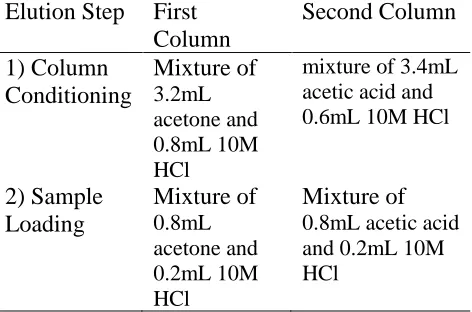
Table 3-1: Column chemistry procedure for the separation of Cu and Fe from sample
matrices on 2ml of AG-MP1 100-200 mesh in Biorad® poly-prep columns. ... 60
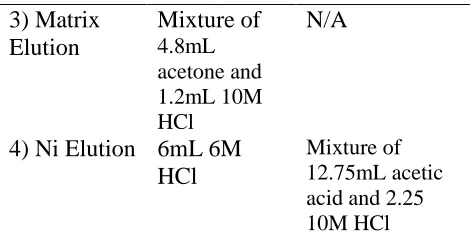
Table 3-2: Column chemistry procedure for the separation of Ni from sample matrices on
2ml of AG50W-X8, 200-400 mesh in Biorad® poly-prep columns. ... 61
Table 3-3: Table of δ65Cu values, Cu concentrations, and number of analyses of Offset Dikes,
Sulfide Ores, SIC Main Mass, and Target Rocks from the Sudbury impact structure. ... 67
Table 3-4: Table of δ54Fe values, Fe concentrations, and number of analyses of Offset Dikes,
Sulfide Ores, SIC Main Mass, and Target Rocks from the Sudbury impact structure. ... 68
Table 3-5: Table of δ60Ni values, Ni concentrations, and number of analyses of Offset Dikes,
Sulfide Ores, SIC Main Mass, and Target Rocks from the Sudbury impact structure. ... 69
Table 3-6: Table of R2 and P-values obtained from performing a simple linear regression of
the listed elements abundance against the isotopic ratio of a given sample (e.g. δ54Fe against
Fe elemental abundance). The given P-values indicate that the only statistically significant
results are the moderate correlations between the concentration of Fe and Cu within the
sulfides and their corresponding isotopic compositions. All simple linear regressions
viii
List of Figures
Figure 1-1: Conceptual diagram of crater formation. The right hand side displays simple
crater formation, while complex crater formation is displayed on the left. Modified from
Osinski and Pierazzo, 2013. ... 16
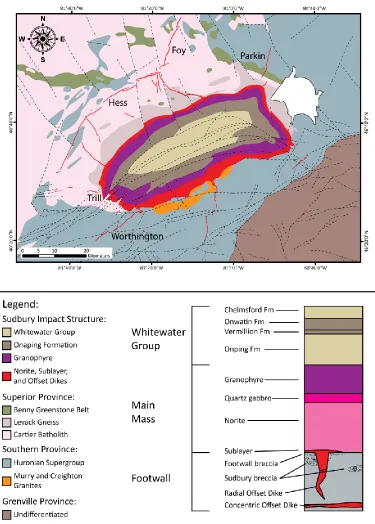
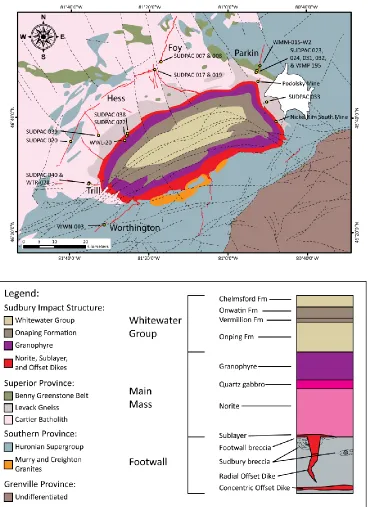
Figure 1-2: Geologic map of the Sudbury impact structure and the surrounding region with
schematic diagram of the stratigraphy of the Sudbury Igneous Complex, Whitewater Group,
and some Footwall units. Based on data from OGS bedrock regional 1:250,000 scale and
internal Wallbridge Mining Company Limited maps. Stratigraphic column after Ames et al.
(2008), with unit thickness approximated relative to one another. ... 21
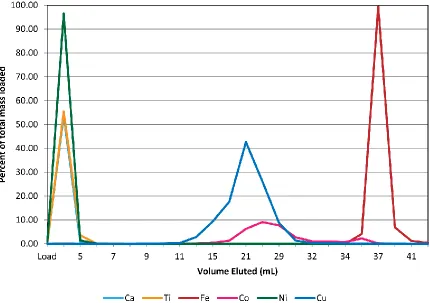
Figure 2-1: Elution Curve for SUDPAC 017, a sulfide containing QD sample from the
intersection of the Foy and Hess offsets. ... 40
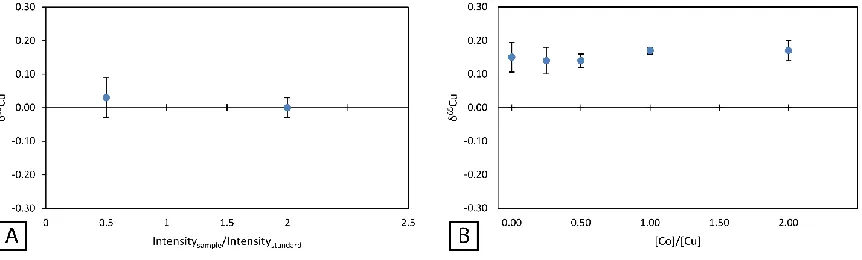
Figure 2-2: A) δ65Cu of ICP Cu solution at twice concentration and half concentration
relative to the bracketing standard. B) δ65Cu of ICP Cu solution doped with common matrix
elements K (28%), Mg (7%), Co (65%), 50ppb Zn and variable amounts of Cu. A shift can
be seen from 0‰ (A) to ~0.15‰ (B) δ65Cu likely due to the presence of Zn. Zn doping was
tested as an internal standard, but failed to yield reproducible standard values. ... 42
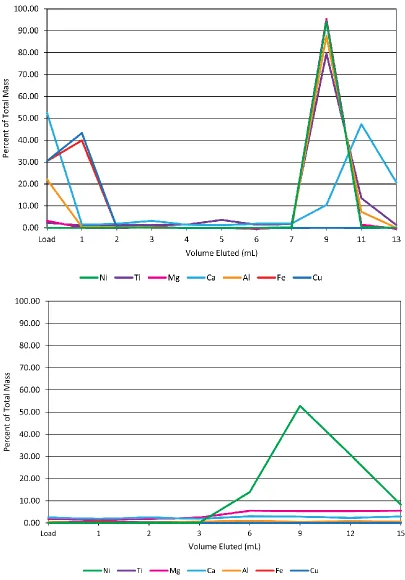
Figure 2-3: Elution curves for the first column of the Ni separation protocol separating metals
such as Fe and Cu (top), and the second column protocol separating Ni from cations such as
Ca, Al, Ti, and Mg (bottom). ... 45
Figure 3-1: Geologic map of the Sudbury Igneous Complex and surrounding Superior
Province and Huronian footwall rocks along with the post-impact Whitewater Group. From
OGS bedrock regional 1:250,000 scale and internal Wallbridge Mining Company Limited
maps. Sample numbers and locations are displayed as yellow dots. Also displayed is a
schematic cross section of the rock units associated with the Sudbury impact structure after
Ames et al. (2008). ... 54
Figure 3-2: A) Outcrop of IQD from the Foy Offset containing clasts of felsic and mafic
gneiss hammer for scale. B) Outcrop of IQD from the Foy Offset containing felsic and mafic
ix
of QD from the Hess Offset in contact with granite of the Cartier Batholith hammer for scale.
D) Outcrop of QD from the Foy Offset with grease pencil for scale. Outcrops shown in A, B,
and D are from a section of the Foy Offset north of the intersection between the Foy and
Hess Offset Dikes. Outcrop shown in C is from the western section of the Hess Offset Dike
where SUDPAC 020 was collected. ... 56
Figure 3-3: Photomicrographs showing the two styles of sulfide mineralization seen within
the Offset Dikes. A,B, and C) massive sulfide mineralization consisting of pyrrhotite, pyrite,
chalcopyrite, pentlandite, and magnetite from the Trill Offset (SUD 040 [A,B]) and Parkin
Offset (WMM-015-W2 [C]). D) disseminated blebby sulfide mineralization from the
intersection of the Foy and Hess Offsets (SUD 017). Abbreviations are as follows: Cpy –
chalcopyrite, Mag – magnetite, Pn – pentlandite, Po – pyrrhotite, and Py – pyrite. ... 63
Figure 3-4: A) Composition maps of CoNiCu (RGB) of massive sulfide ore from the Trill
Offset (WTR-028). Enlarged area highlighted in red. B) Enlargement displaying oscillatory
zonation of Co within pyrite grains in red. ... 64
Figure 3-5: A,B) Composition map of CoNiCu (RGB) of a bleb of disseminated sulfide from
sample SUD 017 displaying a lack of Co zonation or enrichment. Optical photomicrograph
of the sample shown in Fig. 3-5D. C) Composition map of CoNiCu (RGB) of massive sulfide
ore from the Trill Offset (SUD 040). Co enrichment is displayed within the pyrites in red.
Optical photomicrograph of the sample shown in Fig. 3-5A,B. ... 65
Figure 3-6: Graphs displaying the distribution of δ65Cu, δ56Fe, and δ60Ni values measured for
each lithology sampled. Error bars given as 2SD. ... 71
Figure 3-7: Plot of δ65Cu values against δ56Fe values (top) and δ65Cu values against δ60Ni
values (bottom) measured for each sample along with basic sample description with some
specific samples labelled. Gray bars correspond to Bulk Silicate Earth (BSE) values for
δ65Cu and δ60Ni, and MORB values for δ56Fe. The black line is a linear regression of
Sublayer, QD, IQD, and massive sulfide isotopic compositions, and defined as δ65Cu =
x
List of Appendices
Appendix A: Silicate Geochemistry measured by ICP-MS, average error of 5-10% ... 96
Chapter 1
1
Introduction
Recent advances in stable isotope geochemistry have greatly improved the ability to
accurately and precisely measure non-traditional stable “heavy” isotopes (e.g., Ca, Cr,
Cu, Fe, Ni, Se, Sr, Zn, Hg, U) (Teng et al., 2017). This improvement in techniques and
instrumentation has opened new doors of inquiry into geologic processes and the origins
of enigmatic geologic bodies. These improved techniques and instrumentation will be
leveraged to measure the Fe, Ni, and Cu stable isotopic composition of the Sudbury
Igneous Complex (SIC) Offset Dikes, and their associated rocks. The objectives of these
measurements and this research are: evaluate the origin(s) and source(s) of the Offset
Dikes and the sulfides they contain; and investigate the evolution and differentiation of
the SIC as the impact melt sheet of a large diameter crater. This chapter introduces
concepts of stable isotope geochemistry, previous work on Cu, Fe, and Ni stable isotopes,
and important questions posed by the Sudbury Igneous Complex.
1.1
Stable Isotope Geochemistry
Isotopic fractionation is a process whereby two or more isotopes become unevenly
distributed between reservoirs. In the context of geology, includes rocks, magmas, fluid,
and/or minerals. Isotopic fractionation effects can arise due to chemical and physical
processes and fall under two main types, mass-dependent and mass-independent (Teng et
al., 2017). Mass-dependent fractionation is any fractionation process whereby the mass of
the isotopes being fractionated control the distribution (fractionation) of the isotopes
between the isotopes being fractionated, the larger the fractionation which can occur.
During mass-independent fractionation, the mass of the isotopes in question does not
control the fractionation of those isotopes. Mass-independent fractionation is a relatively
rare phenomenon, with only a few mass-independent fractionation processes identified.
Mass independent fractionation naturally occurs mainly in O and S isotopes by
photodissociation reactions, or are identified for many elements due to nucleosynthetic
anomalies preserved in primitive meteoritic materials.
There are two main types of mass-dependent fractionation, equilibrium fractionation and
kinetic fractionation. Equilibrium fractionation is dependent on the zero point energy of a
molecule where heavier isotopes have lower zero-point energies and vibrational
frequencies. Thus as a reaction goes to completion, isotopes are fractionated based on
their mass. An example of equilibrium fractionation would be any physical and/or
chemical reaction which reacts to completion e.g. vinegar and baking soda. In contrast,
during kinetic fractionation it is the velocity of molecules and atoms which drives
fractionation. Lighter molecules containing lighter isotopes are faster than molecules
containing heavier isotopes in order to keep kinetic energy constant. Kinetic fractionation
processes include evaporation, incomplete reactions, unidirectional processes, some
biological processes, and reactions taking place at a very rapid rate.
Several concepts are essential to the measurement of stable isotopes, and understanding
how they fractionate. These equations and principles are detailed below using the two
isotopes of Cu, 65Cu and 63Cu as an example. Processes specific to stable Cu, Fe, and Ni
Isotopic ratio (R): The ratio of the abundance of two isotopes,
𝑅65⁄63= 𝐶𝑢 65
𝐶𝑢
63 Eq. 1-1
Fractionation factor (α): the ratio between two of the same isotopic ratios (R) from two
different substances A and B,
𝛼𝐴−𝐵65⁄63=𝑅𝐴 65
63 ⁄
𝑅𝐵65⁄63
Eq. 1-2
Delta value (δ): The deviation of a measured isotopic ratio from an isotopic standard of
known composition represents the isotopic offset of an unknown sample. This notation is
used because of the difficultly in measuring the absolute abundance of isotopes by
magnetic sector mass spectrometry. Also, fractionation effects are usually small in
magnitude. The units used for Fe, Cu and Ni are usually given in per mil (‰), or parts
per thousand, but could also be given in epsilon notation which corresponds to deviation
per 10,000. All isotopic ratios reported in this thesis are expressed as delta values given
in per mil (‰).
𝛿65𝐶𝑢 = [𝑅𝑈𝑛𝑘𝑛𝑜𝑤𝑛 65 63 ⁄ − 𝑅𝑆𝑡𝑎𝑛𝑑𝑎𝑟𝑑 65 63 ⁄
𝑅𝑆𝑡𝑎𝑛𝑑𝑎𝑟𝑑65⁄63
− 1] × 1000 Eq. 1-3
Which expanded becomes:
𝛿65𝐶𝑢 = [
𝐶𝑢𝑈𝑛𝑘𝑛𝑜𝑤𝑛 65
𝐶𝑢𝑈𝑛𝑘𝑛𝑜𝑤𝑛
63 − 𝐶𝑢𝑆𝑡𝑎𝑛𝑑𝑎𝑟𝑑 65 𝐶𝑢𝑆𝑡𝑎𝑛𝑑𝑎𝑟𝑑 63 𝐶𝑢𝑆𝑡𝑎𝑛𝑑𝑎𝑟𝑑 65 𝐶𝑢𝑆𝑡𝑎𝑛𝑑𝑎𝑟𝑑 63
Big delta (Δ): Big delta is the difference between the delta values (δ) measured in two
materials A and B. This value can also be used to linearly approximate the fractionation
factor between two reservoirs (Eq. 6). This approximation is accurate at high
temperatures, but is much less accurate in lower temperature systems. If the difference
between the sample and standard (Eq. 3) is too large however, the error from
approximating exponential fractionation laws as a linear function becomes too great.
∆𝑎−𝑏 = 𝛿𝑎− 𝛿𝑏 Eq. 1-5
∆𝑎−𝑏 ≈ 1000𝑙𝑛𝛼𝑎−𝑏 Eq. 1-6
In addition to these equations, there are several important qualitative principles of
isotopic research. 1) The magnitude of an isotopic fractionation, α, will decrease as
temperature increases (Urey, 1947). This occurs as a result of the overall system
becoming more energetic, as this happens, the relative difference in vibrational energy
potential between two given isotopes decreases. 2) Heavy isotopes become enriched in
materials where the bonds are stronger (i.e., solids over liquids, liquids over gases, and
phases with the highest oxidation state). 3) Light isotopes are more reactive and during
kinetic fractionation will become enriched in the product of that reaction. This is a result
of the lower amount of energy required to move or react lighter molecules due to their
lower mass. Because isotopic fractionations are dependent on physical and chemical
conditions; isotopic fractionation can be used to evaluate the conditions and processes a
1.1.1
Stable Cu Isotopes and their Fractionation Processes
Cu is a first row transition metal with two stable isotopes 63Cu and 65Cu, with an
abundance of 69.2% and 30.8% respectively. The mass difference between the two
isotopes of Cu is 2 atomic mass units (amu), a 1.5% mass difference. This is a relatively
low difference in mass compared to O, S, and C isotopes. As a result of the small relative
difference in mass of Cu stable isotopes, during high temperature equilibrium
fractionation processes it is expected that the resulting fractionations will be small. Cu
can transition between two oxidation states Cu (I) and Cu (II) under temperature and
pressure conditions commonly found on the Earth’s surface and in geologic materials.
The fractionation between these two oxidation states was first characterized by Zhu et al.
(2002) who found Δ65Cu Cu(II)-Cu(I) = 4‰ during the reduction of aqueous Cu(II) to Cu(I)
during iodide precipitation at 20 °C. Subsequent studies concluded that the change in
oxidation state, not the change in phase, caused the large fractionation observed between
the redox states (Maréchal and Sheppard, 2002; Ehrlich et al., 2004; Mathur et al., 2005).
Kinetic fractionation processes are more likely than equilibrium processes to create large
observed fractionations. Such processes include phase transformations which do not
achieve equilibrium such as evaporation, and reactions which occur rapidly such as the
separation of immiscible melts like sulfide melt from silicate melt. Reactions which occur
very rapidly are often unable to achieve equilibrium, which can result in unbalanced
reactions and large fractionations. The process of sulfur segregation in a melt is
potentially quite important for Cu given its abundance in magmatic sulfide ores. A
terrestrial example of Cu fractionation due to kinetic processes is the relatively extreme
al., 2010). A process thought to form tektites is the rapid quenching of vapor and melt
following hypervelocity meteorite impacts. As Cu is a moderately volatile element, loss
of 63Cu through evaporation of Cu likely causes this observed enrichment of 65Cu in
tektites.
1.1.1.1
Igneous processes
Due to the fact that most igneous processes on Earth take place at high temperature, the
isotopic fractionations that occur in igneous settings are generally very low with a
measured range of δ65Cu in silicate igneous rocks falling between -0.3 to 0.5‰ (Othman
et al., 2006; Kehata and Irata, 2013; Liu et al., 2014; Savage et al., 2015). This varies
little from the composition of the Bulk Silicate Earth (BSE) measured by Savage et al.
(2015) of δ65Cu
BSE = 0.07 ± 0.10‰.
When a melt reaches sulfur saturation, the separation of sulfide melt from silicate melt is
a process of interest due to the possibility of creating significant isotopic fractionations.
Savage et al. (2015) carried out experiments to measure Δ65Cu
sulfide-silicate. Despite an
inability to fully separate sulfide which was disseminated within the silicate fraction,
Savage et al. (2015) performed mass-balance calculations to estimate Δ65Cu sulfide-silicate
based on δ65Cu
sulfide. The authors found a wide range of values (~ -0.5‰ to -20‰) which
they attribute to error propagation from incomplete separation of silicate and sulfide
phases from the sample capsules. However, some important conclusions can still be
drawn from their experiments. First, their experiments suggest that the sign of Δ65Cu
sulfide-silicate is negative, second despite their wide range of values; the magnitude of the
values is much higher than that observed between suites of silicate lithologies generated
and differentiation processes of silicate melts, which generally occur at high
temperatures, will have little effect on the δ65Cu composition of their crystalized
products. In fact, these processes are likely an order of magnitude lower than separating
sulfides from siliceous melt.
1.1.1.2
Sulfide Ores
Larson et al. (2003) was the first study to note a wide range of δ65Cu values (-3 to
+2.5‰) in ore minerals. Additional studies have broadened the range of values observed
for sulfide minerals considerably; with secondary sulfide minerals displaying values
ranging from -16.5 to +12 ‰ (Mathur et al., 2005). In contrast to secondary sulfide ores,
primary sulfide ores have been found to display a narrower range of values than
secondary ore minerals (0 ± 0.5‰). These observations have led to the systematic study
of Cu isotopes within sulfide ores to evaluate the relative roles of hydrothermal processes
(Graham et al., 2004; Maher and Larson, 2007; Li et al., 2010; Mathur et al., 2012), redox
processes within ore deposits (Mathur et al., 2005; Markl, Lahaye, et al., 2006; Asael et
al., 2007, 2009), and sources of metals (Graham et al., 2004; Malitch et al., 2014; Ripley
et al., 2015). Mathur et al. (2009) also evaluated the use of Cu isotopes as exploration and
vectoring tool for Cu porphyry deposits. This was achieved by comparing values from
hypogene and supergene environments, and evaluating what conditions and processes
caused the isotopic fractionations observed.
Redox changes were first invoked to explain the large variation in δ65Cu values observed
in secondary supergene ore deposits (Larson et al., 2003). Further studies agreed that
redox changes were the primary explanation for isotopic fractionation (Larson et al.,
fractionation factors of redox changes cannot account for observed natural variability, as
they are too low to create the observed fractionations on their own (Sherman, 2013).
Some possible mechanisms to explain the variability seen in natural systems are, multiple
episodes of hydrothermal activity resulting in multiple episodes of fractionation. Or, that
phase changes, Rayleigh distillation, and/or open system behavior mechanisms are
working in concert with redox changes to create the large variations seen in natural
systems (Moynier et al. 2017). Rayleigh distillation is an exponential relationship which
would create much larger observed fractionations. While the removal or addition of
material and energy via an open system; this might allow for the preferential removal of
isotopes and the generation of large observed fractionations.
Although many of the studies summarized above focused on secondary sulfides, Ripley
et al. (2015) studied the Cu isotopic composition of magmatic Ni-Cu-PGE sulfide ore
deposits from the Midcontinent Rift System in North America. The authors were able to
measure a difference in the Cu isotopic composition between the sheet and conduit style
intrusions of the Midcontinent Rift. Along with host rock data, the authors investigated
the source of Cu within the deposits, and whether crustal Cu was incorporated into the
deposits. The authors concluded that the incorporation of crustal Cu could not fully
explain the values measured at the Duluth Complex. While crustal contamination of
sheet-style mineralization, was only likely if the mantle source of the magma had a light
δ65Cu value.
1.1.2
Stable Fe Isotopes and their Fractionation Processes
Iron is a first row transition metal with four stable isotopes, and the fourth most abundant
variety of minerals. Fe has four stable isotopes, 54Fe, 56Fe, 57Fe, and 58Fe with abundances
of 5.845, 91.754, 2.1191, and 0.2919 atom% respectively (Berglund and Wieser 2011).
The mass difference between the most commonly measured isotopes, 54Fe and 56Fe is 2
(amu) for a 1.8% mass difference. As a result, Fe commonly exhibits much smaller mass
fractionations than lighter elements such as O, S, and C. Fe has three redox states which
are commonly found in geologic settings as metallic iron (Fe0), ferrous iron (Fe2+), and
ferric iron (Fe3+). Metallic Fe0 is not naturally found at the Earth’s surface. However, as a
result of the oxidation state of the crust and mantle; Fe2+, and Fe3+ are commonly
distributed in different geological systems. Redox changes between Fe2+ and Fe3+ are
thought to be a mechanism that allows large fractionations of Fe isotopes to occur. This is
a mechanism that has been invoked to explain an observed systematic increase in δ56Fe
values in igneous rocks with increasing SiO2 content (Dauphas et al., 2014).
1.1.2.1
Igneous processes
Due to the relatively small difference in mass between the isotopes of Fe coupled with
the high temperature that igneous processes operate at, it was initially thought that Fe
isotopes in igneous rocks would display a small variation in the their isotopic signatures.
However, this has been proven to not always be the case. For instance, evolved igneous
rocks such as granites have been observed to have a significantly heavier Fe isotopic
composition than less evolved igneous rocks (Poitrasson and Freydier, 2005; Heimann et
al., 2008; Dauphas et al., 2009; Schuessler et al., 2009; Sossi et al., 2012; Zambardi et al.,
2014; Foden et al., 2015; He et al., 2017). In short, as SiO2 content of silicic rocks
increases, the Fe composition of the rock becomes heavier. Although exotic processes
2015), and fluid exsolution (Poitrasson and Freydier, 2005) have been invoked to explain
this phenomena, Dauphas et al. (2014) and Foden et al. (2015) argue that fractional
crystallization alone can explain the variation. Additional support of this argument can be
found in the observation that crystallization of olivine can produce a significant
fractionation of Fe isotopes (Teng et al., 2008).
Another process producing significant fractionation of Fe isotopes is the interaction
between sulfide and silicate melts. Schuessler et al. (2007) experimentally determined the
average fractionation between pyrrhotite and silicate melt (Δ56Fe
pyrrhotite-silicate melt)for a
temperature range of 840-1000 °C was -0.35 ± 0.04‰, the pyrrhotite was found to
preferentially incorporate the lighter isotope of Fe. In their experiments the silicate melt
consisted of a hydrated peralkaline rhyolitic melt. The authors also suggested that for
basaltic systems or systems with a higher amount of Fe2+ as part of the total amount of Fe
the fractionation observed would be lower in magnitude.
1.1.2.2
Sulfide Ores
Within sulfide ore systems, there are several processes that can potentially fractionate Fe
isotopes, making sulfide ore systems an attractive system to study. One of the key
processes which affects Fe isotopic ratios in magmatic sulfide systems is the interaction
of sulfide and silicate melt (Schuessler et al., 2007; Hiebert et al., 2013). Another
important process is the deposition and interaction of sulfide minerals within
hydrothermal systems (Rouxel et al., 2004; Rouxel et al., 2008; Polyakov and Soultanov,
2011). As a result, Fe isotopes in conjunction with petrographic and other isotopic
techniques, have been investigated as a tool to distinguish between hydrothermal and
al., 2006; Markl, von Blanckenburg, et al., 2006; Wang et al., 2015), different sources of
mineralization (Zhu et al., 2016), contamination of mineral systems (Hiebert et al., 2013),
and as a geo-thermometer (Wawryk and Foden, 2015).
Hiebert et al. (2013) used Fe isotopes along with S isotopes at the Voisey’s Bay deposit
to evaluate the level of crustal contamination and the specific crustal contaminates within
the deposit. The authors reported a small range of δ56Fe values for mineralized samples,
but the measured values were centered on mantle values for δ56Fe estimated from
periodtites (–0.02 ± 0.026‰) (Dauphas et al. 2017). Analysis of the δ56Fe values revealed
a sulfide and silicate melt in equilibrium with each other which the authors conclude was
a result of the greater amount of Fe in the silicate melt in comparison to the sulfide melt.
Syverson et al. (2017) experimentally investigated the fractionation between chalcopyrite
and Fe-bearing hydrothermal fluids at 350 °C and 500 bars to better understand Fe
behavior at undersea vents. A Δ56Fe
chalcopyrite-Fe2+(aq) of 0.09± 0.17‰ was measured and
found consistent with theoretical predictions. They subsequently argue that δ56Fe
compositions of chalcopyrite can be used as a proxy for δ56Fe content of hydrothermal
fluids.
It has been noted that Komatiite Fe-Ni sulfide deposits display a small range of negative
δ56Fe values; this is consistent with high-temperature fractionations in melts with a high
silicate magma to sulfide magma ratio (Dauphas et al., 2017).
1.1.3
Stable Ni Isotopes and their Fractionation Processes
Nickel is a first row transition metal with five stable isotopes 58Ni, 60Ni, 61Ni, 62Ni, and
respectively (Gramlich et al. 1989). Commonly found in sulfide ores, as a minor
component in most silicate minerals, and within the Earth’s core based on geophysical
evidence. Ni is an important industrial metal for the creation of metal alloys such as
stainless steel, and high strength alloys used in jet engines. Compared to Cu and Fe, the
study of the stable isotopes of Ni in terrestrial materials is a new field. Most studies of Ni
isotopes have been conducted on meteoritic, peridotitic, and mantle derived materials.
This is a result of the difficulty in measuring Ni stable isotopes and the complex column
separation procedures required to separate Ni from geologic materials. Low yields during
Ni extraction and purification can result in isotopic fractionation during extraction
procedures, and inaccurate measurement of the isotopic ratio. Chemically, Ni can exist in
multiple oxidation states, but in geological material Ni is most commonly found as Ni2+.
As a result, redox changes thought to be a major driver of transition metal isotope
fractionation (Dauphas et al., 2014), likely play little role in the fractionation of Ni
isotopes in shallow geologic settings. However, Ni does change its redox state from +2 to
0 as it partitions into the metal fraction of a melt, an important process during planetary
core formation. There have been attempts to measure Ni isotopic fractionation between
metal and silicate material. Lazar et al. (2012) reported ∆62/58Nimetal-silicate=0.25±0.02 ×
106⁄T2 between metal and talc from isotope partitioning experiments; Chernonozhkin et
al. (2016) also reported analyses of metal and silicate material from pallasites and
mesosiderites. While yet to be measured, Δ62/58Ni
sulfide-silicate is likely a large enough value
to produce significant isotopic fractionations (Elliott and Steele, 2017). There is likely a
significant isotopic fractionation due to the partitioning of Ni between silicate and sulfide
1.1.3.1
Igneous processes
Investigations of Ni isotopic fractionation during igneous processes has not received
much attention. The lack of Ni redox state changes between different common sulfide
and silicate phases, eliminates redox changes as a possible driver of large fractionations
of Ni isotopes. Most studies of igneous material have focused on defining the δ60Ni
values of the bulk silicate Earth, mostly by analyzing mantle and mantle derived material.
With the δ60Ni value of the bulk silicate Earth (BSE) having been measured as 0.18 ±
0.04‰ (Steele et al., 2011), 0.15 ± 0.24‰ (Cameron et al., 2009), 0.05 ± 0.05‰
(Gueguen et al., 2013), and 0.23 ± 0.06‰ (Gall et al., 2017). The Bulk Silicate Earth
(BSE) is the original composition of the silicate part of the Earth prior to the
differentiation of the first crustal material. Recently however, measurements of mantle
rocks and their minerals (olivine, pyroxene and garnet) showed resolvable differences in
δ60Ni between mineral phases explaining small differences measured among ultramafic
mantle rocks (Gall et al., 2017).
1.1.3.2
Sulfide Ores
Ni isotopes within sulfides display a wide range in values compared to silicate igneous
rocks, and have begun to be studied in greater depth during the previous decade. This
makes sulfide ores an exciting area of study, and likely to expand in scope in the coming
years due to improved methods for extracting and purifying Ni from geologic materials
(e.g. those detailed in Chapter 2). A wide range of δ60/58Ni values (-1 to -0.3) have been
measured in Ni-bearing sulfides from komatiites (Gueguen et al., 2013; Hofmann et al.,
2014; Steele et al., 2011) and sulfide ore from the Thompson Ni belt (Tanimizu and
δ60/58Ni value of ~0.5‰ measured from a Sudbury pentlandite sample (Tanimizu and
Hirata, 2006).
Hofmann et al. (2014) used Ni isotopes along with Fe and S isotopes to examine the
magmatic and hydrothermal history of the Trojan and Shangani nickel sulfide deposits in
Zimbabwe. The authors were able to argue against a sedimentary source for Ni based on
the isotopic composition measured at the deposit. Used in conjunction with petrographic
analysis, Fe, and S isotopes; the authors determined that the generally low grade deposits
had a magmatic origin with subsequent hydrothermal reworking. They further suggest
that post-magmatic hydrothermal processes played an important role in the upgrading of
what were initially, low grade deposits.
1.2
A Multi-Isotopic Approach to Sulfide Petrogenesis at
Sudbury
This project aims to use the intergrated analyses of stable Fe, Ni, and Cu isotopes to
understand sulfide and host-rock petrogenesis at Sudbury. Based on the afore-mentioned
knowledge of how Fe, Ni, and Cu isotopes behave during magmatic and hydrothermal
proccesses, it is hoped that an analysis of stable Fe, Ni, and Cu isotopes will allow the
evaluatation of sulfide genesis and evolution. Such as, the hydrothermal history of the
sulfides, metal sources of the sulfides, and the identification of sulfide segregation within
magma(s). Coupled with petrographic analysis, stable Fe, Ni, and Cu isotopes offer
powerful tools to identifty and examine sulfide petrogenesis and development. The
identification and refinement of sulfide petrogenesis and evolution models at Sudbury
will provide valuable information towards improving Ni-Cu-PGE ore deposit exploration
1.3
Impact Cratering
Impact cratering is a ubiquitous geologic process occurring on every solid body in the
solar system. Driven by the physical processes arising from the collision of solid bodies;
hypervelocity impacts, where the striking projectile is large enough to pass through the
atmosphere with little deceleration and strike its target at its original cosmic velocity
(French, 1998), form high-pressure shock waves that result in the creation of craters
larger than several meters. While the impact cratering process is a continuum, in order to
better evaluate the cratering process it has been divided into three stages, contact and
compression, excavation, and modification (Fig. 1-1) (Gault et al., 1968).
First, the contact and compression stage begins when the projectile first makes contact
with the surface it is impacting and begins to compress the target material. The projectile
penetrates the target material creating a shock wave; moves through and compresses the
target material and the impactor. Eventually the shock wave moving through the impactor
reaches the top of the impactor, and is reflected back down into the impactor and target as
a rarefaction wave (Ahrens and O’Keefe, 1972). This unloads, or releases the pressure
created by the initial shock wave, and causes the melting and vaporization of the
projectile and target material (Gault et al., 1968; Melosh, 1989). When this rarefaction
wave reaches the interface of the target and projectile, the contact and compression stage
Figure 1-1: Conceptual diagram of crater formation. The right hand side displays simple
crater formation, while complex crater formation is displayed on the left. Modified from
The excavation stage is characterized by the development of the transient cavity of the
impact crater, it is during this phase the crater is opened (Melosh, 1989). It is important to
note that by this point the projectile has unloaded, melted, and/or vaporized. As the initial
shock wave moves through the target, it sets into motion the target material with an
outward radial trajectory. This initial shock wave, combined with rarefaction waves from
shock waves which initially travelled upward generates an excavation flow-field
removing material; creating the transient cavity (Dence, 1968; Grieve and Cintala, 1982).
The ejected material from the excavation flow field is ballistically ejected beyond the rim
of the transient cavity, generating deposits of ejected material (Oberbeck, 1975). Once
the transient cavity formed during the excavation stage reaches its maximum lateral
extent, the modification stage begins.
The modification stage is considered the final stage of impact cratering, and ends once
any major movement within the target material ends. The end result of the modification
stage is dependent on the force of the impact, gravitational pull of the impacted body, and
the strength of the impacted material (Melosh and Ivanov, 1999). There are several
morphologies that can result from impact cratering formed during the modification stage,
simple craters, complex craters, peak-ring craters, and multi-ring craters. Simple craters
are craters that display only a bowl shaped depression in the target surface. Complex
craters in addition to having a bowl-shaped depression, also contain a central uplifted
area known as a central peak or central uplift in eroded structures. Multi-ring basins are
very large craters that display multiple rings of uplifted and slumped material in
Central peaks and peak rings are formed when the target surface moves upward in
response to its unloading after the downward force of the impactor is no longer pressing
down on the surface during the excavation stage. The target surface moves upward, and
produces a central uplift. Peak ring craters are a variation on this morphology whereby
the central uplift grows so rapidly it “overshoots” its equilibrium height (Kenkmann et
al., 2013). This causes the central uplift to be gravitationally unstable and collapses
downward and outward to form a circular ring of uplifted material in the middle of the
crater (Melosh and Ivanov, 1999).
1.3.1
Impact melting and impact melt rocks
During impact, a rarefaction, or release wave is generated when the initial shock wave is
reflected downward after reaching the upper limit of the projectile (Ahrens and O’Keefe,
1972). This release wave move through and unloads both the impactor, and target rocks.
This unloading causes shock melting as the pressure-volume work generated by the
compression shock wave is not fully recovered and the remaining pressure-volume work
becomes waste heat (Grieve et al., 1977).
This waste heat causes melting of the target material, a thermodynamically irreversible
process. While dependent on several factors, the amount of melt generated by shock
melting during hypervelocity impact is primarily driven by the size of the impactor, while
variables such as composition and velocity are second order (Cintala and Grieve, 1998).
It is important to note, that shock melting is a fundamentally different process than
endogenic igneous systems. Shock melting is dependent on the shock pressure generated
by the compressing shock wave, and compressibility of the target material. Impact melt
these are important impact melt products, the focus of this thesis are the melts generated
from the impact melt sheet of the Sudbury Impact structure. These products fall outside
that purview, and a focus is given to impact melt sheets and related processes and
products.
As crater size increases eventually, impact melt will pond at the base of the crater and
begin to form a coherent sheet of impact melt, also known as an impact melt sheet. Some
large impact melt sheets have been noted to undergo igneous differentiation, the Main
Mass of the Sudbury Igneous Complex (SIC) being a prime terrestrial example (Grieve et
al., 1991b; Therriault et al., 2002). However, there are conflicting observations of the
presence (Vaughan et al., 2013), or absence (Spudis et al., 2014) of a differentiated
impact melt sheet at the lunar Orientale impact basin. Along with observations suggesting
the South Pole Akin Basin contains a differentiated impact melt sheet (Vaughan and
Head, 2014), have triggered debate as to whether large impact melt sheets always
undergo igneous differentiation. Or, if igneous differentiation of impact melt sheet is the
exception rather than the rule of large impact melt sheets.
1.4
Sudbury Geology
Located within central Ontario, Canada, along the boundary between the Southern and
Superior Provinces, the Sudbury impact structure is recognized as the eroded remains of a
200-250 km wide multi-ring impact basin (Grieve et al., 1991). From U-Pb dating of
zircon the age of the Sudbury impact has been identified as 1.85 Ga, during the Penokean
orogeny (Davis, 2008). The resulting crater and impact melt sheet was subsequently
modified by the Penokean (1.89-1.83 Ga) (Schulz and Cannon, 2007), Yavapai
1993; Rivers, 1997), and Grenville (1.235-0.945 Ga) Orogenies (Bethune and Ty, 1997).
As a result syn-orogenic timing of the Sudbury impact event, and the subsequent
orogenic events the original impact structure was deformed into an elliptical shape.
The Sudbury impact structure consists of the Whitewater Group, the Sudbury Igneous
Complex (SIC), and the shocked and brecciated target rocks of the crater floor (Fig. 1-2).
The Whitewater Group is a series post-impact breccias and sediments consisting of four
formations, in ascending order, the Onaping, Vermilion, Onwatin, and Chelmsford
Formations (Grieve et al., 2010). In contrast to the Vermilion, Onwatin, and Chelmsford
Formations, the Onaping Formation is not sedimentary in origin, and has been the subject
of vigorous debate as to its origin (Grieve et al., 2010).
Several attempts have been made to measure the diameter of the transient cavity of the
Sudbury crater, with the diameter estimates range from 100-130 km (Grieve et al., 1991a;
Deutsch et al., 1995; Spray et al., 2004). Estimates of the total amount of impact melt
generated at Sudbury range from ~30,000 km3 (Zieg and Marsh, 2005) to ~31,000 km3
(Pope et al., 2004). These estimates are rather consistent with the scaling relationships of
Grieve and Cintala, (1997). Considering the amount of melt and the size of the transient
crater diameter, the initial crater formed at Sudbury was likely a peak-ring or possibly a
multi-ring impact structure. There is also additional evidence to support this conclusion
Figure 1-2: Geologic map of the Sudbury impact structure and the surrounding region
with schematic diagram of the stratigraphy of the Sudbury Igneous Complex, Whitewater
Group, and some Footwall units. Based on data from OGS bedrock regional 1:250,000
scale and internal Wallbridge Mining Company Limited maps. Stratigraphic column after
1.4.1
Sudbury Igneous Complex
The Sudbury Igneous Complex (SIC) consists of the differentiated Main Mass, Sublayer,
and Offset Dikes created from the melt sheet of the Sudbury impact crater. The Main
Mass is the differentiated melt sheet generated from the impact event and is broadly
divided from top to bottom into the Upper Contact Unit, Granophyre, Quartz Gabbro,
Norite, and Sublayer units (Dickin et al., 1996; Lightfoot et al., 1997; Anders et al.,
2015). Several mechanisms have historically been proposed for the differentiation of the
Sudbury melt sheet. At the present however, there are three main models for the
differentiation of the Sudbury melt sheet, with the first the most widely accepted:
• Crystal-liquid differentiation where the settling and accumulation of cumulus
minerals created the Norite and Quartz Gabbro units (Lightfoot et al., 1997; Lightfoot et
al., 2001; Therriault et al., 2002).
• Melting of the country rock generated felsic melt and mafic melt. As a result of
density differences, the felsic melts rose and the mafic melts sank. This produced a
density stratified magmatic system from which the melt sheet was differentiated
(Golightly, 1994).
• In the initial melt sheet, two immiscible melts formed which then coalesced and
separated due to immiscibility into two melts. These two separate melts crystalized to
form the Norite and Granophyre (Zieg and Marsh, 2005).
1.4.2
Offset Dikes
The radial and concentric Offset Dikes of the SIC were derived from the melt sheet of the
experienced syn- and post- emplacement faulting (Lightfoot et al., 1997). The name
Offset Dike is derived from observed offsets in the dikes on the metre to kilometre scale
perpendicular to strike. They are considered by some to be similar to the granophyre
dikes seen at the Vredefort impact structure in South Africa (Dietz, 1961). Radiometric
U-Pb zircon ages from the Hess Offset Dike of 1849.1 ± 0.9 Ma (Bleeker et al., 2014),
Copper Cliff Offset Dike of 1849.8 ± 2 Ma (Corfu and Lightfoot, 1996), and zircon and
baddelyite ages from Foy of 1852 +4/-3 Ma (Osterman et al., 1996) are identical with the
1.85 Ga age of the impact event (Krogh et al., 1982; Davis, 2008). Geochemical analyses,
such as major and trace element multivariate analyses from the offset dikes (Pilles et al.,
2017) support emplacement shortly after impact (Tuchscherer and Spray, 2002).
Differing arguments have been made as to specifically when the Offset Dikes were
emplaced, whether during the excavation stage of the Sudbury impact (Murphy and
Spray, 2002), the modification stage (Wood and Spray, 1998; Murphy and Spray, 2002)
or between 1-10 Ka post-impact (Hecht et al., 2008). Several mechanisms have been
proposed for the emplacement of the Offset Dikes; broadly stated, multiple injections
(Morris and Pay, 1981; Murphy and Spray, 2002; Klimesch et al., 2015) versus a single
injection of material.
The Offset Dikes have historically been termed “quartz diorite”; although the rock types
range from quartz monzodioritic through granodioritic and tonalitic, herein the Offset
Dikes will be referred to as quartz diorite for historical consistency (Wood and Spray,
1998; Murphy and Spray, 2002; Lightfoot et al., 2001). Broadly, the offset dikes are
divided into two main lithologies, an inclusion-rich quartz diorite phase (IQD), and an
footwall material of the Levack Gneiss Complex, Cartier Granitoid, Huronian
Supergroup, to clasts of QD. The offset dikes are considered to have been derived from
the undifferentiated impact melt sheet of the Sudbury Impact structure (Lightfoot et al.,
1997a).
Discontinuous segmented bodies of QD enveloped in SUBX also exist, however their
physical link to the SIC is not clear due to erosion, and their presence in SUBX raises
questions about whether they were generated in situ, or emplaced. The nature of the
contact between the Offset Dikes and the footwall varies with distance from the SIC, and
composition of the host rock. In general, the greater the distance of the Offset Dike from
the SIC, the sharper the contact will be between footwall and dike (Lightfoot, 2016). The
radial offset dikes are usually connected to the Main Mass through embayments, and
extend out through the footwall for hundreds of meters to tens of km from the base of the
SIC. The concentric offset dikes run roughly parallel the structure of the Main Mass, and
are found at surface up to ~20 km away from the present erosional base of the Main
Mass. There is no known connection between the Main Mass and the concentric dikes; a
prime example of this type of offset dike is the Hess Dike in the North Range (Wood and
Spray, 1998). The 7km long Manchester Dike in the South Range is comparable.
Both the QD and IQD contain varying amounts of sulfide mineralization, ranging from
barren to economic amounts of sulfide. Generally the QD has very low sulfide content,
and the IQD very high sulfide content. However most known deposits are associated with
IQD of the Frood-Stobie, Copper Cliff, and Worthington-Victoria Offset Dikes
(Lightfoot, 2016). Sulfide mineralization within the Offset Dikes consists mainly of
study, the Parkin, Foy, and Worthington Offsets have contained or contain deposits
which have been mined (Lightfoot and Farrow, 2002; Murphy and Spray, 2002;
Tuchscherer and Spray, 2002).
1.5
Introduction to the Thesis
The goal of this thesis is to use Cu, Fe, and Ni stable isotopes to investigate the SIC, its
Offset Dikes, and sulfides contained therein. To this goal the thesis is organized as
follows. In chapter 2 we evaluate the effectiveness of methods used for the separation of
Fe, Cu, and Ni from geologic materials, and the measurement of Fe, Cu, and Ni stable
isotopic ratios from those geologic materials. In chapter 3 we present and discuss δ56Fe,
δ60Ni, and δ65Cu values measured from the SIC, the Offset Dikes, and sulfides. Finally,
chapter 4 is devoted to a discussion of improvements to the method used to extract Fe,
Cu, and Ni from geologic materials, the significance of our conclusions, and avenues for
future research.
1.6
References
Ahrens, T.J., and O’Keefe, J.D., 1972, Shock melting and vaporization of lunar rocks and
minerals: The Moon, v. 4, p. 214–249.
Ames, D.E., Davidson, A., and Wodicka, N., 2008, Geology of the giant Sudbury
polymetallic mining camp, Ontario, Canda: Economic Geology, v. 103, p. 1057–
1077.
Anders, D.A., Osinski, G.R., Grieve, R.A.F., and Brillinger, D.T.M., 2015, The Basal
Onaping Intrusion in the North Range: Roof rocks of the Sudbury Igneous
Asael, D., Matthews, A., Bar-Matthews, M., and Halicz, L., 2007, Copper isotope
fractionation in sedimentary copper mineralization (Timna Valley, Israel):
Chemical Geology, v. 243, p. 238–254.
Asael, D., Matthews, A., Oszczepalski, S., Bar-Matthews, M., and Halicz, L., 2009, Fluid
speciation controls of low temperature copper isotope fractionation applied to the
Kupferschiefer and Timna ore deposits: Chemical Geology, v. 262, p. 147–158.
Bethune, K.R., and Ty, A., 1997, Metamorphism of the Sudbury diabase dyke-swarm:
From Protolith to two-pyroxene-garnet coronite: Canadian Mineralogist, v. 35, p.
1191–1220.
Bleeker, W., Kamo, S.L., Ames, D.E., and Smith, D., 2014, New U-Pb ages for some key
events in the Sudbury area, including the Creighton Granite and Joe Lake
metagabbro, in Geological Association of Canada - Mineralogical Association of
Canada Annual Meeting, Program with Abstracts, p. 33.
Cameron, V., Vance, D., Archer, C., and House, C.H., 2009, A biomarker based on the
stable isotopes of nickel: Proceedings of the National Academy of Sciences, v.
106, p. 10944–10948.
Chernonozhkin, S.M., Goderis, S., Costas-Rodríguez, M., Claeys, P., and Vanhaecke, F.,
2016, Effect of parent body evolution on equilibrium and kinetic isotope
fractionation: A combined Ni and Fe isotope study of iron and stony-iron
meteorites: Geochimica et Cosmochimica Acta, v. 186, p. 168–188.
Cintala, M.J., and Grieve, R. a. F., 1998, Scaling impact melting and crater dimensions:
Implications for the lunar cratering record: Meteoritics & Planetary Science, v.
33, p. 889–912.
Corfu, F., and Lightfoot, P.C., 1996, U-Pb Geochronology of the Sublayer Environment,
Sudbury Igneous Complex, Ontario: Economic Geology, v. 91, p. 1263–1269.
Dauphas, N., Craddock, P.R., Asimow, P.D., Bennett, V.C., Nutman, A.P., and
melting from Archean to Present: Earth and Planetary Science Letters, v. 288, p.
255–267.
Dauphas, N., John, S.G., and Rouxel, O., 2017, Iron Isotope Systematics: Reviews in
Mineralogy and Geochemistry, v. 82, p. 415–510.
Dauphas, N., Roskosz, M., Alp, E.E., Neuville, D.R., Hu, M.Y., Sio, C.K., Tissot, F.L.H.,
Zhao, J., Tissandier, L., Médard, E., and Cordier, C., 2014, Magma redox and
structural controls on iron isotope variations in Earth ’ s mantle and crust: v. 398,
p. 127–140.
Davis, D.W., 2008, Sub-million-year age resolution of Precambrian igneous events by
thermal extraction-thermal ionization mass spectrometer Pb dating of zircon:
Application to crystallization of the Sudbury impact melt sheet: Geology, v. 36, p.
383–386.
Dence, M.R., 1968, Shock zoning at Canadian craters: Petrography and structural
implications.: Contributions from the Dominion Astrophysical Observatory in
Victoria, v. 8.
Deutsch, A., Grieve, R.A.F., Avermann, M.E., Bischoff, L., Brockmeyer, P., Buhl, D.,
Lakomy, R., Müller-Mohr, V., Ostermann, M., and Stoffler, D., 1995, The
Sudbury Structure (Ontario, Canada): a tectonically deformed multi-ring impact
basin: Geologische Rundschau, v. 84, p. 697–709.
Dickin, A.P., Artan, M.A., and Crocket, J.H., 1996, Isotopic evidence for distinct crustal
sources of North and South Range ores, Sudbury Igneous Complex: Geochimica
et Cosmochimica Acta, v. 60, p. 1605–1613.
Dietz, R.S., 1961, Vredefort Ring Structure : Meteorite Impact Scar ? The Journal of
Geology, v. 69, p. 499–516.
Ehrlich, S., Butler, I., Halicz, L., Rickard, D., Oldroyd, A., and Matthews, A., 2004,
Experimental study of the copper isotope fractionation between aqueous Cu(II)
Elliott, T., and Steele, R.C.J., 2017, The Isotope Geochemistry of Ni: Reviews in
Mineralogy and Geochemistry, v. 82, p. 511–542.
Foden, J., Sossi, P.A., and Wawryk, C.M., 2015, Lithos Fe isotopes and the contrasting
petrogenesis of A- , I- and S-type granite: LITHOS, v. 212–215, p. 32–44.
French, B.M., 1998, Traces of catastrophe: A handbook of shock-metamorphic effects in
terrestrial meteorite impact structures, in LPI Contributions 954,.
Gall, L., Williams, H.M., Halliday, A.N., and Kerr, A.C., 2017, Nickel isotopic
composition of the mantle: Geochimica et Cosmochimica Acta, v. 199, p. 196–
209.
Gault, D. E., Quaide, W.. L., and Oberbeck, V.. R., 1968, Impact cratering mechanics and
structures: Shock Metamorphism of Natural Materials, p. 87–99.
Golightly, J.P., 1994, The Sudbury Igneous Complex as an impact melt; evolution and
ore genesis: Proceedings of the Sudbury-Noril’sk Symposium, p. 105–117.
Graham, S., Pearson, N., Jackson, S., Griffin, W., and O’Reilly, S.Y., 2004, Tracing Cu
and Fe from source to porphyry: In situ determination of Cu and Fe isotope ratios
in sulfides from the Grasberg Cu-Au deposit: Chemical Geology, v. 207, p. 147–
169.
Grieve, R.A.F., Ames, D.E., Morgan, J. V., and Artemieva, N., 2010, The evolution of
the Onaping Formation at the Sudbury impact structure: Meteoritics and Planetary
Science, v. 45, p. 759–782.
Grieve, R.A.F., and Cintala, M.J., 1982, A method for estimating the initial impact
conditions of terrestrial cratering events, exemplified by its application to Brent
crater, Ontario, in Lunar and Planetary Science Conference Proceedings, p. 1607–
1621.
Grieve, R.A.F., and Cintala, M.., 1997, Planetary differences in impact melting:
Grieve, R.A.F., Dence, M.R., and Robertson, P.B., 1977, Cratering processes-As
interpreted from the occurrence of impact melts: Impact and explosion cratering:
Planetary and terrestrial implications, v. 1, p. 791–814.
Grieve, R.A.F., Stoffler, D., and Deutsch, A., 1991, The Sudbury Structure -
controversial or misunderstood? Journal of Geophysical Research-Planets, v. 96,
p. 22753–22764.
Gueguen, B., Rouxel, O., Ponzevera, E., Bekker, A., and Fouquet, Y., 2013, Nickel
isotope variations in terrestrial silicate rocks and geological reference materials
measured by MC-ICP-MS: Geostandards and Geoanalytical Research, v. 37, p.
297–317.
He, Y., Wu, H., Ke, S., Liu, S.-A., and Wang, Q., 2017, Iron isotopic compositions of
adakitic and non-adakitic granitic magmas: Magma compositional control and
subtle residual garnet effect: Geochimica et Cosmochimica Acta, v. 203, p. 89–
102.
Hecht, L., Wittek, A., Riller, U., Mohr, T., Schmitt, R.T., and Grieve, R.A.F., 2008,
Differentiation and emplacement of the Worthington Offset Dike of the Sudbury
impact structure, Ontario: Meteoritics & Planetary Science, v. 43, p. 1659–1679.
Heimann, A., Beard, B.L., and Johnson, C.M., 2008, The role of volatile exsolution and
sub-solidus fluid/rock interactions in producing high 56Fe/54Fe ratios in siliceous
igneous rocks: Geochimica et Cosmochimica Acta, v. 72, p. 4379–4396.
Hiebert, R.S., Bekker, A., Wing, B.A., and Rouxel, O.J., 2013, The role of paragneiss
assimilation in the origin of the Voisey’s Bay Ni-Cu sulfide deposit, Labrador:
Multiple S and Fe isotope evidence: Economic Geology, v. 108, p. 1459–1469.
Hofmann, A., Bekker, A., Dirks, P., Gueguen, B., Rumble, D., and Rouxel, O.J., 2014,
Comparing orthomagmatic and hydrothermal mineralization models for
komatiite-hosted nickel deposits in Zimbabwe using multiple-sulfur, iron, and
Horn, I., von Blanckenburg, F., Schoenberg, R., Steinhoefel, G., and Markl, G., 2006, In
situ iron isotope ratio determination using UV-femtosecond laser ablation with
application to hydrothermal ore formation processes: Geochimica et
Cosmochimica Acta, v. 70, p. 3677–3688.
Kehata, K.I., and Irata, T.H., 2013, Evaluation of UV-fs-LA-MC-ICP-MS for Precise in
situ Copper Isotopic Microanalysis of Cubanite: Analytical Sciences, v. 29, p.
1213–1217.
Kenkmann, T., Collins, G.S., and Kunnemann, K., 2013, The modification stage of crater
formation, in Osinski G.R. and Pierazzo E. eds., Impact Cratering: Processes and
Products, John Wiley & Sons, p. 60.
Klimesch, L.M., Hecht, L., and Riller, U., 2015, Emplacement, Differentiation and
Mineralisation of the Trill Offset Dike, Sudbury, Canada.: Economic Geology,.
Krogh, T.E., McNutt, R.H., and Davis, G.L., 1982, Two high precision U–Pb zircon ages
for the Sudbury Nickel Irruptive: Canadian Journal of Earth Sciences, v. 19, p.
723–728.
Larson, P.B., Maher, K., Ramos, F.C., Chang, Z., Gaspar, M., and Meinert, L.D., 2003,
Copper isotope ratios in magmatic and hydrothermal ore-forming environments:
Chemical Geology, v. 201, p. 337–350.
Lazar, C., Young, E.D., and Manning, C.E., 2012, Experimental determination of
equilibrium nickel isotope fractionation between metal and silicate from 500??C
to 950??C: Geochimica et Cosmochimica Acta, v. 86, p. 276–295.
Li, W., Jackson, S.E., Pearson, N.J., and Graham, S., 2010, Copper isotopic zonation in
the Northparkes porphyry Cu-Au deposit, SE Australia: Geochimica et
Cosmochimica Acta, v. 74, p. 4078–4096.
Lightfoot, P.C., 2016, Nickel Sulfide Ores and Impact Melts: Origin of the Sudbury
Lightfoot, P.C., and Farrow, C.E.G., 2002, Geology, Geochemistry, and Mineralogy of
the Worthington offset dike: A genetic model for offset dike mineralization in the
Sudbury Igneous Complex: Economic Geology, v. 97, p. 1419–1446.
Lightfoot, P.C., Keays, R.R., and Doherty, W., 2001, Chemical Evolution and Origin of
Nickel Sulfide Mineralization in the Sudbury Igneous Complex, Ontario, Canada:
Economic Geology, v. 96, p. 1855–1875.
Lightfoot, P.G., Keays, R.R., Morrison, G.G., Bite, A., and Farrell, K.P., 1997,
Geochemical relationships in the Sudbury Igneous Complex: Origin of the main
mass and offset dikes: Economic Geology, v. 92, p. 289–307.
Liu, S.-A., Li, D., Li, S., Teng, F.-Z., Ke, S., He, Y., and Lu, Y., 2014, High-precision
copper and iron isotope analysis of igneous rock standards by MC-ICP-MS: J.
Anal. At. Spectrom., v. 29, p. 122–133.
Maher, K.C., and Larson, P.B., 2007, Variation in Copper Isotope Ratios and Controls on
Fractionation in Hypogene Skarn Mineralization at Coroccohuayco and Tintaya ,
Perú: Economic Geology, v. 102, p. 225–237.
Malitch, K.N., Latypov, R.M., Badanina, I.Y., and Sluzhenikin, S.F., 2014, Insights into
ore genesis of Ni-Cu-PGE sulfide deposits of the Noril’sk Province (Russia):
Evidence from copper and sulfur isotopes: Lithos, v. 204, p. 172–187.
Maréchal, C.N., and Sheppard, S.M.F., 2002, Isotopic fractionation of Cu and Zn
between chloride and nitrate solutions and malachite or smithsonite at 30 degrees
and 50 degrees C, in Geochimica et Cosmochimica Acta, p. A484--A484.
Markl, G., von Blanckenburg, F., and Wagner, T., 2006, Iron isotope fractionation during
hydrothermal ore deposition and alteration: Geochimica et Cosmochimica Acta,
v. 70, p. 3011–3030..
Markl, G., Lahaye, Y., and Schwinn, G., 2006, Copper isotopes as monitors of redox
processes in hydrothermal mineralization: Geochimica et Cosmochimica Acta, v.
Mathur, R., Ruiz, J., Casselman, M.J., Megaw, P., and van Egmond, R., 2012, Use of Cu
isotopes to distinguish primary and secondary Cu mineralization in the Cañariaco
Norte porphyry copper deposit, Northern Peru: Mineralium Deposita, v. 47, p.
755–762.
Mathur, R., Ruiz, J., Titley, S., Liermann, L., Buss, H., and Brantley, S., 2005, Cu
isotopic fractionation in the supergene environment with and without bacteria:
Geochimica et Cosmochimica Acta, v. 69, p. 5233–5246.
Mathur, R., Titley, S., Barra, F., Brantley, S., Wilson, M., Phillips, A., Munizaga, F.,
Maksaev, V., Vervoort, J., and Hart, G., 2009, Exploration potential of Cu isotope
fractionation in porphyry copper deposits: Journal of Geochemical Exploration, v.
102, p. 1–6.
Melosh, H.J., 1989, Impact cratering: A geologic process: Research supported by NASA.
New York, Oxford University Press (Oxford Monographs on Geology and
Geophysics, No. 11), 1989, 253 p., v. 11.
Melosh, H.J., and Ivanov, B.A., 1999, Impact Crater Collapse: Annual Review of Earth
and Planetary Sciences, v. 27, p. 385–415.
Morris, A., and Pay, R., 1981, Genesis of the Foy (?) Offset and Its Sulfide Ores : The
Paleomagnetic Evidence from a Study in Hess Township , Sudbury , Ontario:
Economic Geology, v. 76, p. 1895–1905.
Moynier, F., Koeberl, C., Beck, P., Jourdan, F., and Telouk, P., 2010, Isotopic
fractionation of Cu in tektites: Geochimica et Cosmochimica Acta, v. 74, p. 799–
807.
Moynier, F., Vance, D., Fujii, T., and Savage, P., 2017, The Isotope Geochemistry of
Zinc and Copper: Reviews in Mineralogy and Geochemistry, v. 82, p. 543–600.
Murphy, A.J., and Spray, J.G., 2002, Geology, mineralization, and emplacement of the