Available Online atwww.ijcsmc.com
International Journal of Computer Science and Mobile Computing
A Monthly Journal of Computer Science and Information Technology
ISSN 2320–088X
IJCSMC, Vol. 4, Issue. 6, June 2015, pg.1023 – 1028
RESEARCH ARTICLE
A Constraint Analysis Based Approach for
QoS Optimization using Network Coverage
Meenakshi
Student, M.Tech (CSE), Rohtak Institute of Engineering and Management, Rohtak
[email protected]
Sarul
Asstt. Prof., CSE dept, Rohtak Institute of Engineering and Management, Rohtak
[email protected]
Abstract— A sensor network communication capabilities are restricted because of architectural formation. It is required to achieve the effective network coverage and localization. In this work, a fuzzy adaptive constraint analysis model is defined to provide the optimization in the network formation. In earlier stage of this model, the network density and area based analysis is performed. Later on the load, energy and criticality parameters are taken to obtain the controller nodes over the network. These controllers are then defined with area specification to provide controlled communication. The simulation results show that the presented work model has optimized the network coverage and improved the network life. Keywords: Coverage, Optimization, QoS, Fault Criticality, Density
I. INTRODUCTION
Coverage is having its significance to improve the communication reliability in constraint specific sensor network. The network is defined with the restricted specification in terms of energy constraints, sensing range etc.
Coverage is a fundamental issue in a WSN, which determines how well a phenomenon of interest (area or target) is monitored or tracked by sensors[4]. Effectiveness of coverage system in a sensor network will improve the QoS for different network operations so that the improvement to network localization and clustering will be achieved. The core phenomenon defined with coverage is to identify the existence of some node in the sensing range so that effective communication and monitoring will be performed. It is also effective to improve the network reliability because of high connectivity ratio. Additionally the coverage formulations try to find the weak points i.e. the points which are least covered by the sensors in a sensor field and suggest future deployment and reconfiguration schemes for improving the coverage performance. Generally the coverage involves the two basic ideas [5]:
The evaluation of coverage performance when the sensor nodes are deployed in the monitoring region.
The improvement of the coverage performance when the sensor network cannot effectively satisfy the application requirements.
under different deficiencies. The requirement vectors for the network are also changed because of these parameters. The coverage requirement may also change after a network has been deployed, for instance, due to changes in application modes or environmental conditions. Each sensor node is able to sense the phenomenon in a definite sensing area. Any point in the sensing area of a sensor is said to be covered by the sensor. The sensing area of a sensor is normally assumed to be a disk with the sensor located at the center. The radius of the disk is called the sensing range of the sensor. Considering the coverage concept, the formulation of network can be improved so that network life will be improved and the energy consumption over the network will be reduced[1][5][6].
Coverage Problems are fundamental and crucial in designing a wireless sensor network. The coverage Problem of the WSN are to cover the whole area or set of specific targets within where we would like to scrutiny in an unremitting period by deploying abundant sensors randomly. It is caused by three main reasons: not enough sensors to cover the whole Region of Interest (ROI), limited sensing range and random deployment. As sensors are operated using limited power supply some of them die out resulting in inadequate sensors to fully cover the ROI.A sensor’s sensing range is confined to a certain radius due to which sensor cannot cover the region outside its sensing range which results to the coverage problem. All aspects of network coverage includes area coverage, target coverage and barrier coverage are affected through various associated factors including the energy, failure rate and connectivity vectors. Depended on the coverage objectives and applications, they can be roughly classified [6] on the basis of what is to be covered, namely area coverage, Target coverage and Barrier coverage.
Target Coverage Problems: there exists a set of predetermined targets which need to be monitored (covered) in a fixed deployed area. Due to limited battery energy of deployed sensors, target coverage problem are focusing on designing effective scheduling algorithms to prolong the time for monitoring these targets.
Area Coverage Problems: In an interested area we have to ensure that every point of the whole area can be monitored by at least one sensor. The coverage problem is to maximize the time for monitoring the whole area.
Barrier Coverage Problems: Given a barrier we want to guarantee that every object moves across the barrier will be detected by the deployed sensors.
Among these problems, area coverage problem have already received extensive attention in past years. On the other hand other two problems begin to draw attention recently. Our work focuses on target coverage problem in a sensor network. Coverage is in general associated with energy-efficiency and network connectivity, two important properties of WSN. Various algorithms has been proposed to solve the above coverage problems. Our research focus on the following considerations: evaluating and improving coverage performance for target coverage, while maximizing the network lifetime.
II. LITERATURE SURVEY
Lot of work is already done, in the area of area coverage by different researchers in the form of localization algorithms. Some of the work defined by earlier researchers is defined here under
Author [1] discussed the types of coverage problem according to different standards. They studied the types of the coverage problem according to the deployment of the networks, the characters of monitored areas or targets, the sensing models of sensor nodes and so on. To improve the coverage performance an algorithm is also proposed in this paper. Using the mobility of nodes, the algorithm can move redundant nodes to uncovered area. Although there are some limits of energy and node hardware, the algorithm is still effective in practice. Author[2] review the common strategies used in solving coverage problem in WSN. They reviewed the researches done in maximizing coverage of WSN by sensors positioning. The approaches covered for the analysis includes the grid based approach, physical position estimation approach and the stress analysis approach. Theory and concepts along with the examples of the algorithms proposed using these approaches were presented. The reviewed strategies each have their own benefits or costs.
Author [3] also explored the coverage concept under different parameters so that effective network deployment will be done. Author has identify the parameters involved in the coverage including the connectivity analysis and energy level comparison. Once the parameters will be collected, these properties will be combined under classification methods to obtain the coverage level analysis. These properties includes point level coverage estimation, block level estimation and the barrier point identification approach. Author has explored all these methods under different algorithmic approaches. Author [4] defined a work on static estimation to the network deployment under location uncertainity. Author has analyze the network for random positioning of nodes as well as targets and perform the energy level estimation with different resource constraints. These constraints include the resource restriction so that network life will be improved. Author identified the vectors based on which reliable and energy effective coverage can be obtained over the network. Author[5] presented a study based work on coverage estimation under different design problems of sensor network. Author analyzed the core constraints for network generation so that the long term challenges will be covered. These constraints include the connectivity analysis, load analysis, energy effectiveness analysis and coverage range analysis. Author presented the work in the form of study as well as comparative analysis so that effective area coverage will be obtained over the network.
coverage problem by organizing the sensors into maximum disjoint set covers and these are activated successively. Author[8] focused on one of the major issues of target coverage problem of sensor network that is maximize the network lifetime, which can be solved by selecting minimum working nodes that will cover all the targets. The main objective is to determine the coverage ratio of all targets which have been significantly improved in comparison with the basic ant colony algorithm. The target coverage problem has been optimized by making it energy efficient using modified ant colony algorithm.
Author[9] proposed an energy-balance heuristic distributed algorithm based on energy utility of sensors. The target coverage problem with adjustable sensing ranges is transformed into the h-hop local target coverage problem with adjustable sensing ranges. Secondly, he considered the key constraint of network lifetime by introducing the definition of key target, design the energy utility function based on the ratio of target coverage contribution to energy consumption cost and establish the adaptive adjustment mechanism of waiting time. The simulation shows that the proposed algorithm can prolong greatly the network lifetime and has lower computational complexity and communication complexity, good scalability and stability. Author [10] investigated lifetime optimization for target coverage in wireless sensor network with QoS requirements in this approach a column corresponding to feasible solution is generated. Author[11] proposed a heuristic greedy optimum coverage algorithm to maximize network lifetime for target coverage. Firstly they analyzed the energy model for target coverage and presented the definition of key target and the coverage priority of key target. Then a strategy for sensor selection in which the sensor with more energy utility is prior chosen as active sensor is designed. Then the algorithm is proposed based on minimizing the energy consumption of key target and maximizing energy efficiency of sensor node. The algorithm is highly effective and good scalable[12][13].
III. RESEARCH METHODOLOGY
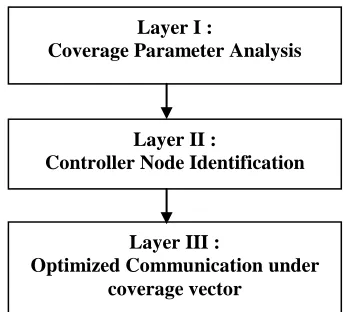
In this present work an optimization to the network architecture is obtained based on the localization and coverage vectors. The work is defined to provide the communication optimization model based on three main stages shown in figure 1. In first stage of this model, the network analysis is done in terms of area size and node density parameters. Based on this, the coverage range and area capabilities analysis is obtained from the work. In second stage of this model, controller node identification over the network areas is done to provide the area level analysis. The analysis is here done under the energy, load and fault criticality parameters. The fuzzy adaptive model is applied in this stage to provide the coverage level optimization. In final stage of this model, the network capabilities are analyzed and the optimized communication under coverage parameters.
Figure 1 : Layered Communication Model
A) Layer 1 :
In this layer, the network analysis is done under the area and the density parameters. The coverage and the localization is here obtained on different network scenarios. The work is here applied on two different network scenarios and with different density vectors. This stage provided the analysis on network nodes in terms of requirement of localization and the coverage. The stage also performed the distance adaptive analysis on the network to obtain the location adaptive characteristics.
Layer I :
Coverage Parameter Analysis
Layer II :
Controller Node Identification
Layer III :
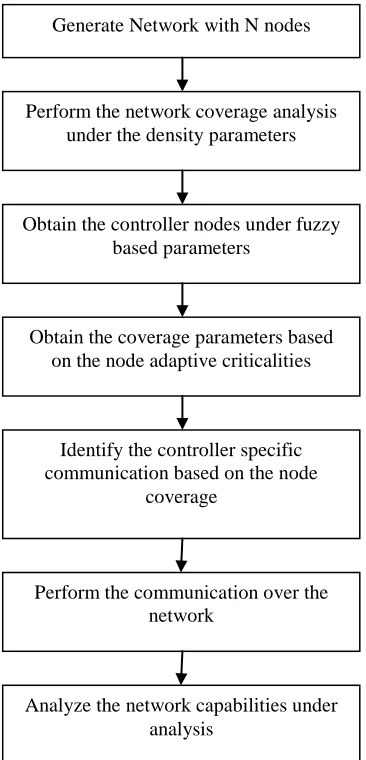
Figure 2 : Adaptive Algorithmic Model
IV. CONCLUSION
B) Layer II
Once the coverage and localization analysis is done, the next work is to define the controllers over the network that can boost up the communication by providing the coverage to the range node. The critical and the controller node selection is here done based on fuzzy adaptive analysis. This analysis is done under the energy, distance, load and criticality parameters.
C) Layer III
In final stage of this work, the communication is performed over the network. The communication is performed via the controller nodes. The sensor nodes performs the communication with controller node and based on the controller specific coverage analysis the communication is performed over the network.
V. RESULTS
The presented work is simulated in matlab environment with random scenario. In this scenario, the nodes are placed randomly with random specification of energy. The communication constraints are also defined in terms of energy consumption associated with different communication operations. The communication is performed for 2000 rounds and the
Generate Network with N nodes
Perform the network coverage analysis under the density parameters
Obtain the controller nodes under fuzzy based parameters
Obtain the coverage parameters based on the node adaptive criticalities
Identify the controller specific communication based on the node
coverage
Perform the communication over the network
analysis of work is done in terms of network energy and life parameters. The work is defined to optimize the network coverage and localization so that the optimized communication will be performed and network life will be improved
Figure 3 : Dead Node Analysis
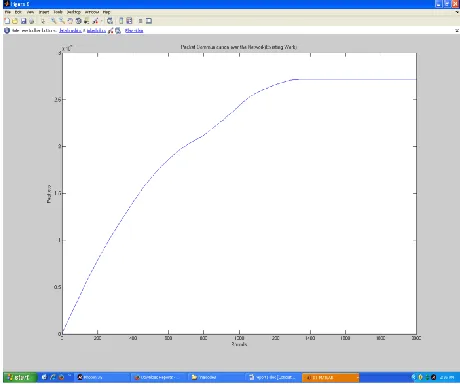
Here figure 3 is showing the analysis of this presented work under dead node analysis. The figure is showing the analysis in terms of dead nodes over the network. Here x axis is showing the communication rounds and y axis is showing the dead nodes. The figure shows that the dead nodes in case of existing approach are higher than proposed work. It shows that the overall network life in case of proposed work is improved. Another parameter considered relative to life is energy consumption in the network. The analysis in terms of communication over the network is shown in figure 4
Figure 4: Network Communication Analysis
VI. CONCLUSION
In this paper, an optimization model is presented for coverage level and localization level improvement over the network. The work provided the improvement in the connectivity vector so that the overall communication strength is improved.
REFERENCES
[1] GholamAli Yaghoubi," Connectivity Issue in Wireless Sensor Networks by Using Depth-First Search and Genetic Algorithm", 2010 International Conference on Computational Intelligence and Communication Systems 978-0-7695-4254-6/10 © 2010 IEEE (pp 377-381)
[2] Nauman Aslam," Distributed Coverage and Connectivity in Three Dimensional Wireless Sensor Networks", "IWCMC’10, June 28– July 2, 2010, Caen, France. Copyright © 2010 ACM 978-1-4503-0062 - 9/10/06 (pp 1141-1145)
[3] Yinian Mao," Coordinated Sensor Deployment for Improving Secure Communications and Sensing Coverage", SASN’05, November 7, 2005, Alexandria, Virginia, USA. ACM 1595932275/05/0011 (pp 117-128)
[4] Chi-Fu Huang," The Coverage Problem in a Wireless Sensor Network", WSNA’03, September 19, 2003, San Diego, California, USA. Copyright 2003 ACM 1-58113-764-8/03/0009 (pp 115-121)
[5] Ashwinkumar Badanidiyuru," Approximating Low-Dimensional Coverage Problems", SCG’12, June 17–20, 2012, Chapel Hill, North Carolina, USA. ACM 978-1-4503-1299-8/12/06 (pp 161-170)
[6] Vikram P. Munishwar," Coverage Management for Mobile Targets in Visual Sensor Networks", MSWiM’12, October 21–25, 2012, Paphos, Cyprus. ACM 978-1-4503-1628-6/12/10 (pp 107-115)
[7] Vijay Chandrasekhar," Localization in Underwater Sensor Networks — Survey and Challenges", WUWNet’06, September 25, 2006, Los Angeles, California, USA. ACM 1-59593-484-7/06/0009 (pp 33-40)
[8] Muzammil Hussain," Distributed Localization in Cluttered Underwater environments", WUWNet’10, Sept. 30 - Oct. 1, 2010, Woods Hole, Massachusetts, USA ACM 978-1-4503-0402-3
[9] Melike Erol," Localization with Dive’N’Rise (DNR) Beacons for Underwater Acoustic Sensor Networks", WUWNet’07, September 14, 2007, Montréal, Québec, Canada. ACM 978-1-59593-736-0/07/0009 (pp 97-100)
[10] M Bala Krishna," Computing Methodologies for Localization Techniques in Wireless Sensor Networks", International Conference and Workshop on Emerging Trends in Technology (ICWET 2011) – TCET, Mumbai, India ICWET’11, February 25–26, 2011, Mumbai, Maharashtra, India. ACM 978-1-4503-0449-8/11/02 (pp 1024-1028)
[11] Diba Mirza," Real-time Collaborative Tracking for Underwater Networked Systems", WUWNet’12, Nov. 5 - 6, 2012 Los Angeles, California, USA. ACM 978-1-4503-1773-3/12/11
[12] Sangbo Seo ," A New Energy Efficient Data Transmission Method for Underwater Wireless Sensor Networks",CSTST 2008, October 27-31, 2008, Cergy-Pontoise, France. ACM 978-1-60558-046-3/08/0003 (pp 675-681)
[13] Liangjie He," Implementation and Emulation of Distributed Clustering Protocols for Wireless Sensor Networks", IWCMC’07, August 12-16, 2007, Honolulu, Hawaii, USA. ACM 978-1-59593-695-0/07/0008 (pp 266-271)