Electronic Thesis and Dissertation Repository
8-17-2016 12:00 AM
The Acute Effects of Nicotine and Exercise on Working Memory
The Acute Effects of Nicotine and Exercise on Working Memory
Steven Guirguis
The University of Western Ontario Supervisor
Harry Prapavessis
The University of Western Ontario Graduate Program in Kinesiology
A thesis submitted in partial fulfillment of the requirements for the degree in Master of Arts © Steven Guirguis 2016
Follow this and additional works at: https://ir.lib.uwo.ca/etd
Part of the Cognitive Psychology Commons, and the Health Psychology Commons
Recommended Citation Recommended Citation
Guirguis, Steven, "The Acute Effects of Nicotine and Exercise on Working Memory" (2016). Electronic Thesis and Dissertation Repository. 4081.
https://ir.lib.uwo.ca/etd/4081
This Dissertation/Thesis is brought to you for free and open access by Scholarship@Western. It has been accepted for inclusion in Electronic Thesis and Dissertation Repository by an authorized administrator of
psychoactive properties for centuries. Specifically, nicotine has been consistently shown
to improve cognitive performance (Heishman, Kleykamp, & Singleton, 2010). Similar
effects also have been shown with exercise (Chang, Labban, Gapin, & Etnier, 2012). The
purpose of the present study was to examine whether a 20 min bout of moderate-intensity
exercise enhances cognitive performance (working memory) as effectively as 4 mg of
NICORETTE® gum in a non-smoker population. Twenty-three non-smokers (M age =
25.87; 13 female) underwent a three-week randomized counterbalanced procedure. The
N-Back Task was used to measure working memory after administration of nicotine or
exercise. Findings showed significant improvements in reaction time after both
treatments. However, accuracy significantly improved only for exercise. The author
recommends exercise over nicotine as a safe and effective strategy for non-smokers to
enhance cognitive performance. Implications for future studies are discussed.
Keywords
ii
Acknowledgments
I would like to express my very great appreciation to my supervisor, Harry Prapavessis,
for this experience in the Exercise and Health Psychology Laboratory and all the
opportunities that came with. My grateful thanks are also extended to all current and past
EHPL members I’ve had the chances to work with. I would also like to thank my family
for all their support and unconditional love. Finally, I wish to thank my mother for her
patience and encouragement since I was young and for pushing me when I thought I
iii
Table of Contents
Abstract ... ii
Acknowledgments ... iii
Table of Contents ... iv
List of Tables ... v
List of Figures ... vi
List of Appendices ... vii
Chapter One: Literature Review ... 1
1 Introduction ... 1
1.1 Nicotine Dependence ... 2
1.2 Neurological factors. ... 2
1.3 Behavioural factors. ... 3
1.4 Genetic factors. ... 4
1.5 Cognitive factors ... 5
1.6 Quitting aids/treatments ... 5
1.7 A closer examination of nicotine and cognition ... 6
1.8 Exercise and cognition ... 8
1.9 Working Memory ... 11
1.10 Nicotine vs Exercise on Cognitive Performance (Working Memory) ... 12
1.11 Purpose and Hypothesis ... 13
1.12 Implications of this study ... 13
Chapter Two: The Current Study ... 14
2.1 Methods ... 14
2.2 Primary Outcome Measure ... 14
2.3 Other Measures ... 16
2.4 Intervention ... 17
2.5 Procedure ... 18
2.6 Statistical Analyses ... 20
2.7 Results ... 20
Chapter Three: Discussion ... 26
3.1 Strengths and Limitations ... 28
3.2 Future directions ... 29
3.3 Implications ... 32
3.4 Conclusion ... 32
References ... 34
Appendices ... 53
iv
List of Tables
Table 1: Percent Abstinent at Six Months for Smoking Cessation Strategies ... 6
Table 2: Demographic Variables ... 20
v
List of Figures
Figure 1. Diagram of the four N-back conditions. ... 16
Figure 2. Flow diagram of participants moving through the study ... 19
Figure 3. Accuracy score at each time point. Error bars represent standard error. .... 24
vi
List of Appendices
Appendix A ... 53
Recruitment Poster ... 54
Ethics Approval ... 55
Ethics Renewal ... 56
Letter of Information ... 57
Appendix B ... 64
Sociodemopraphic Questionnaire ... 65
Physical Activity Readiness Questionnaire (PARQ) ... 66
Smoking History/Godin Leisure-time Exercise Questionnaire ... 67
Nicotine ... 68
Exercise ... 69
Chapter One: Literature Review
1 Introduction
In the past couple years, Canadians have seen the amount of smokers aged 12 and older
drop from 19.3% to 18.1% (Statistics Canada, 2014). This decline represented the lowest
smoking rate reported since 2001. Smoking, however, remains a problem for 5.4 million
Canadians and is the leading cause of preventable death (Why tobacco control is
important, 2016). Furthermore, smoking is a risk factor for many diseases including lung
cancer, heart disease, strokes and respiratory diseases (Surgeon General, 2014).
Fortunately, smoking cessation can reduce the risk of these diseases and quitting has
immediate and long-term health benefits. Within 12 hours of quitting one experiences
improved lung function, blood circulation, and removal of carbon monoxide from the
blood (Health Canada, 2012). Those who remain smoke-free for 15 years reduce their
risk of coronary heart disease, and strokes to that of a non-smoker and reduce the risk of
dying in half compared to those continuing to smoke. The problem does not lie in
smokers’ desire to quit as 75% said they would quit when asked ‘If you could quit painlessly would you quit smoking or would you continue to smoke?’ (Mullins &
Borland, 1996). Despite this, most quitters end up relapsing in the first eight days
(Hughes, Keely, & Naud, 2004), while only 3-5% of unassisted quitters reach the
one-year mark (CDCP, 2011). Disturbingly, almost half of lung cancer patients continue to
smoke post surgery (Davison & Duffy, 1982; Walker et al., 2006), forty percent continue
after undergoing laryngectomy (Himbury & West, 1985), and amongst those suffering a
heart attack, forty percent relapse before leaving the hospital (Bigelow, Rand, Gross,
Burling, & Gottlieb, 1986). These numbers indicate how challenging quitting is. This
difficulty is not surprising as smoking has been known for its highly addictive nature
since its introduction to the western world (Ferrence, Slade, Room, & Pope, 2000).
1.1 Nicotine Dependence
Nicotine acts as the principal psychoactive component in tobacco (Karan, Dani, &
Benowitz, 2003). Cigarettes transport nicotine to the brain more efficiently than any other
tobacco product as it delivers it to the brain within seven seconds of inhalation (Maisto,
Galizio, & Connors, 2004). The average dose of nicotine each cigarette delivers is 1 to 2
mg of nicotine (Karan et al., 2003). Each smoker takes around 11 puffs per cigarette
(USDHHS, 1988) and the average Canadian smoker smokes 13.9 cigarettes per day
(Tobacco Use in Canada: Patterns and Trends, 2015) as the body metabolizes nicotine
fairly quickly. Nicotine blood concentration levels can drop to half within two to three
hours after smoking (Lynch & Bonnie, 1994).
Upon quitting, smokers experience a barrage of unpleasant signs and symptoms
(Stolerman & Jarvis, 1995). Just after 12 hours of abstaining, smokers report cravings for
tobacco, being irritable, cognitive impairments, restless, anxious, depressed mood,
difficulty concentrating and increased hunger (Carruthers & Feyerabend, 1984; Bell,
Taylor, Singleton, Henningfield, & Heishman, 1999; Gross, Javik & Rosenblatt, 1993;
Hughes 1992; Hughes & Hatsukami 1986; Hughes, Hatsukami, Pickens, Krahn, Malin, &
Luknic, 1984; Lyvers, Maltzman, & Miyata, 1994; West, Jarvis, Russell). These
withdrawal effects manifest even after abstaining from nicotine chewing gum (West &
Russell 1985; Hughes et al., 1986) further incriminating nicotine. Although it does not
carry the same stigma, nicotine is as addictive as other drugs such as cocaine and heroin
(USDHHS, 1988; SCOTH 1998; RCP 2000). Furthermore, nicotine meets the criteria for
dependence (WHO, 1992) as it leads to tolerance, withdrawal, impaired control, neglect
of activities, time spent in substance-related activity, continued use despite problems, and
compulsion. The neurological effect of nicotine serves as a powerful driving force of this
disorder; however, behavioural, genetic, and cognitive performance factors contribute as
well. These are discussed in detail below.
1.2 Neurological factors
Nicotine’s substantial impact is partially due to its ability to imitate the role of the natural
receptors (nAChRs) in the brain (Di Matteo, Pierucci, Di Giovanni, Benigno, & Esposito,
2007). Upon binding, it releases many neurotransmitters including: glutamate (learning
and memory enhancement), norepinephrine (arousal and appetite suppression) dopamine
(reward-motivated behaviour), serotonin (mood and appetite modulation), and GABA
(reduction in anxiety and tension Benowitz, 2008). Similar to other drugs and naturally
rewarding stimuli like food, nicotine increases dopamine release in the nucleus
accumbens (Brazell Mitchell, Joseph, & Gray, 1990; Benwell & Balfour 1992; Imperato,
Mulas, & Di Chiara 1986; Rose & Corrigall 1997; Rowell Carr, & Garner, 1987; Salgado
& Kaplitt, 2015). There is a substantial body of evidence indicating dopamine in the
accumbens plays a prominent role in our reward system as it elicits euphoric feelings and
reinforces future smoking behaviour (Benowitz, 2010; Wonnacott, Sidhpura, & Balfour,
2005). Alternating this pathway leads to abuse and addiction by causing an increase in
sensitivity of the drug and decreased interest in non-drug stimuli (Melis, Spiga, & Diana,
2005). Moreover, lesions of the mesolimbic dopamine system weaken self-administration
of nicotine (Corrigall et al., 1992). The role of nicotine in the accumbens is just one
reason smoking is addictive.
1.3 Behavioural factors
The perceived cognitive benefits attained from smoking helps maintain the habit in many
(West, 1993). Therefore, smokers might partake during stressful situations or whenever
undergoing a lull. The intensity of one’s cravings and withdrawal symptoms can predict
their relapse rate (Swan, Ward, & Jack, 1996). These cravings and withdrawal symptoms
act analogous to an electric shock one receives as a form of punishment upon quitting and
negatively reinforces the act of quitting (Eissenberg, 2004). The best way to
alleviate/prevent this electric shock-cravings and withdrawal symptoms is to relapse and
smoke. As the smoker learns these consequences they become conditioned to smoke, this
type of learning is similar to operant conditioning (Skinner, 1963). As nicotine
deprivation can negatively reinforce the habit; nicotine administration can positively
reinforce smoking (Glautier, 2004). Six different species (rats, rhesus monkeys, squirrel
monkeys, baboons, dogs and humans), have demonstrated that pure nicotine can serve as
Henningfield, & Goldberg, 1990). Upon administration in humans, smoking is the
unconditioned stimulus and cigarette cravings/withdrawal symptoms act as the
unconditioned response, while neutral stimulus becomes drug-related cues (conditioned
stimuli) and is parried with the drug and the hedonic drug effects it delivers (Pavlov,
1927). These conditioned stimuli can be situational cues like smoking while drinking
coffee, cigarette smell and sight, and ashtrays or lighters. They can trigger cravings and
withdrawal post pairing (Bevins & Palmatier, 2004; Niaura, 2000). Smokers quickly
associate the act of smoking with pleasure and are motivated to perform this act anytime
they are stressed or exposed to drug-related cues (Benowitz 2008; Gilbert 1995; Kassel,
Stroud & Paronis 2003).
1.4 Genetic factors
The Cytochrome P450 2A6 (CYP2A6) encodes for an enzyme involved in the metabolic
inactivation from nicotine to cotinine (Nakajima et al., 1996) and is a known candidate
gene for smoking (Tobacco and Genetics Consortium, 2010). Different types of CYP2A6
metabolize nicotine at different speeds (Mwenifumbo & Tyndale, 2009). A slower
metabolism is associated with lower prevalence of smoking and reduced cigarette use
(Mwenifumbo & Tyndale, 2009; Ray, Tyndale, & Lerman, 2009). Smokers with the fast
metabolism version of the gene smoke more and have their first cigarette earlier during
the day. Furthermore, they report more intense withdrawal symptoms than those with
slower nicotine metabolism (Kubota et al., 2006). Eight single nucleotide polymorphism
around brain-derived neurotrophic factor (BDNF) are associated with smoking initiation
(Tobacco and Genetics Consortium, 2010) and BDNF helps regulate synaptic plasticity
and survival of cholinergic-dopaminergic neurons (Zhang, & Poo, 2001). Moreover, the
prefrontal cortex and hippocampus have high levels of BDNF; these areas have
implication in the cognitive enhancing effects of nicotine (Levin, McClernon, & Rezvani,
2006). Different genetic variations at BDNF might be altering the rewarding effects of
nicotine by modifying the dopamine reward circuits and allowing the creation of
drug-related memories that promote nicotine use after exposure. One single nucleotide
polymorphism is associated with smoking cessations. Located 23 kb 5’ of DBH on
Genetics Consortium, 2010). Three different loci have been associated with number of
cigarettes per day; the SNP rs1051730 in CHRNA3 has the strongest association
accounting for 0.5 of the variance. The SNP rs16969968 in CHRNA3, rs684513[G] in
CHRNA5, and re9788682[G] and rs7163730[G] in LOC123688 also influence cigarettes
per day independently.
1.5 Cognitive factors
Difficulty concentrating-due to nicotine deprivation-is a recognized symptom of nicotine
withdrawal (Hughes, 2007) that leads to relapse and maintains smoking habits (American
Psychiatric Association, 2000; Heishman, Taylor, & Henningfield, 1994). Furthermore,
smoking eliminates these withdrawal-induced deficits (Heishman et al., 1994), and
nicotine exposure increases alertness, vigor, and arousal (Gilbert, Dibb, Plath, & Hiyane,
2000; Perkins et al., 1994; Perkins, Grobe, Weiss, Fonte, & Caggiula, 1996). Abstaining
from smoking negatively impacts working memory, sustained attention and response
inhibition (Ashare, Falcone, & Lerman, 2014; Snyder & Henningfield 1989), while
cognitive impairs are detected just 4 hours of abstaining and could last more than nine
days after the initial deprivation (Snyder & Henningfield, 1989). Hence, people that wish
to quit face an uphill battle. Quitters deal with cravings, cognitive deficits, and
withdrawal symptoms, which are all relapse factors, and the more intense, the faster the
relapse (Swan et al., 1996). Expectedly, two-quarters of unaided quit attempts relapse
within the first week (Hughes, 1992). Consequently, different smoking aids have been
generated to aid quit attempts.
1.6 Quitting aids/treatments
Several quit-smoking aids are available for smokers to pick from (Lancaster, Stead,
Silgay, & Swoden, 2000) such as: behavioural and psychological interventions (e.g.
Cognitive-Behavioural Therapy, Exercise), Nicotine Replacement Therapy (NRT)
(Lancaster et al., 2000), e-cigarettes (Brown, Beard, Kotz, Michie, & West, 2014)
computer and other electronic aids (Chen et al., 2012), Exercise (Roberts et al., 2012) and
pharmacological interventions (Antidepressants- nortriptyline, non-tricyclic
The effectiveness of the different cessation strategies is shown in Table 1.
Table 1: Percent Abstinent at Six Months for Smoking Cessation Strategies
(USDHHS, 2008)
Cessation strategies % abstinent [95% CI]
Physician advise to quit 10.2 [8.5, 12.0]
Behavioural interventions
Proactive telephone counseling 13.1 [11.4, 14.8]
Group counseling 13.9 [11.6, 16.1]
Individual counseling
Exercise-aided counseling
16.8 [14.7, 19.1]
24.6 [15. 78]*b
Pharmacotherapy interventions
Nicotine patch (6 – 14 weeks) 23.4 (21.3, 25.8)
Nicotine gum (6 – 14 weeks) 19.0 (16.5, 21.9)
Nicotine lozenge (2 mg) 24.2a
Nicotine inhaler 24.8 [19.1, 31.6]
Bupropion SR 24.2 [22.2, 26.4]
Varenicline (2 mg/day)
Vaccine
Exercise aided nicotine
33.2 [28.9, 37.8]
15.0 [20, 67]**
26.7***a
Note. CI = Confidence Interval a95% CI not reported. bThree months for smoking
cessation. * Marcus et al., 1999. ** Hartmann-Boyce, Cahill, Hatsukami, & Cornuz,
2012. *** Abrantes et al., 2014; Prapavessis, Cameron, Baldi, Robinson, Borrie, Harper,
& Grove, 2007; Prapavessis, De Jesus, Fitzgeorge, Faulkner, Maddison, & Batten, 2016
1.7 A closer examination of nicotine and cognition
A plethora of research has demonstrated nicotine’s ability to protect smokers from
cognitive deficits during a quit attempt (Atzori Lemmonds, Kotler, Durcan, & Boyle
2008; Heishman, Kleykamp, & Singleton, 2010; Heishman, et al., 1994; Wesnes,
whether nicotine only reverses cognitive deficits or improves cognitive performances
(Heishman, Snyder, & Henningfield, 1993). Furthermore, smokers abstaining overnight
might not be nicotine free as their plasma nicotine levels are as high as 5-10 ng/ml
(Benowitz, Jacob, Jones, & Rosenberg 1982). This occurrence could explain why some
studies failed to demonstrate nicotine’s benefits on cognitive performances (Grundey,
Amu, Ambrus, Batsikadze, Paulus, & Nitsche, 2015; Kleykamp, Jennings, Blank, &
Eissenberg, 2005; Myers, Taylor, Moolchan, & Heishman, 2008). There are three
populations of interest worth examining to clarify this issue: not deprived smokers,
minimally deprived smokers and non-smokers. In a 2010 meta-analysis conducted by
Heishman and colleagues, the effects of nicotine on cognitive domains were assessed.
The purpose of that study was to examine whether nicotine can improve cognitive
performances and included studies with adult nonsmokers, smokers who were minimally
deprived (less than 2 h), or smokers who were not deprived. The study included nine
performance domains and out of those nine, six domains showed significant positive
effects after administering nicotine: fine motor, alerting attention-accuracy and reaction
time, orienting attention reaction time, short-term episodic memory-accuracy and
working memory reaction time. These findings show that nicotine does not merely
relieve cravings and related withdrawal symptoms in smokers; it also enhances cognitive
performance in nonsmokers and not deprived smokers. These findings have been
replicated in patients with schizophrenia, Alzheimer’s, ADHD, Parkinson’s diseases and
other age-related cognitive declines (Evans & Drobes 2009; Levin et al., 2006; Newhouse,
Potter, & Singh, 2004).
Nicotine may improve cognition via its ability to interact with the presynaptic nAChR
receptors in the brain and aid the release of ACh, dopamine, serotonin, glutamate, and
γ-aminobutryic acid (Heishman et al., 2010; Samuels & Davis 1998; Wonnacott 1997).
These neurotransmitters are associated with learning and memory (Martin & Aceto,
1981). Specifically, the α7 and α4β2 nicotinic receptors found in the hippocampus of rats play a fundamental role in nicotine’s effect on cognitive functioning (Rezvani & Levin,
2001) and these receptors in the hippocampus and basolateral amygdala mediate
nicotine’s role in memory (Levin et al., 2006; Mansvelder et al., 2006). Nicotine also
and facilitates hippocampal synaptic activity (Gray, Rajan, Radcliffe, Yakehiro, & Dani,
1996) causing the hippocampus to play an important role in nicotine’s effects on memory.
Nicotine activates several other brain regions involved in attention and memory
including: the prefrontal cortex, partietal cortex, and thalamus (Azizian, Monterosso,
O'Neill, & London, 2009; Brody 2006; Levin et al., 2006). Like the hippocampus, these
areas are known to contain high densities of nAChRs. Levels of ACh increases in rats
prefrontal cortex (PFC) in tasks that require attention (Himmelheber, Sarter, & Bruno,
2000; Passetti, Dalley, O'connell, Everitt, & Robbins, 2000). Nicotine administration
activates the PFC in a similar manner as nAChr receptors are involved in PFC functions
(Brody 2006; Levin et al., 2006; Azizian et al., 2009).
Nonsmokers receiving nicotine enjoy enhanced cortical facilitation as they experience
cortical excitability (Grundey et al., 2015). Cortical excitability and plasticity are possible
biomarkers for cognitive functioning (Miniussi & Ruzzoli 2013). Nicotine also alters
norepinephrine and neural activity in the locus coeruleus, which is known to be part of
the alerting/arousal network (Fan, McCandliss, Fossella, Flombaum, & Posner, 2005;
Posner & Rothbart 2007). Improvement in working memory performance in non-smokers
is due to the enhancement of cortical excitability they enjoy post nicotine (Grundey,
Freznosa, Klinker, Lang, Paulus, & Nitsche, 2013). Chronic nicotine administration leads
to withdrawal upon cessation, which in turn leads to a down-regulation of the glutamate
receptor function (Li, Semenova, D'Souza, Stoker, & Markou, 2014). The glutamate
system is critically involved in working memory performances. Consequently, any
down-regulation leads to performance deterioration in nicotine-deprived smokers (Driesen et
al., 2013). Lastly, the glutamatergic system controls intracortical facilitation. Upon
quitting, deprived smokers experience decreased intracortical facilitation (Grundey et al.,
2013; Lang et al., 2008). Nicotine administration, however, restores compromised
cortical facilitation returning it to baseline levels.
1.8 Exercise and cognition
Similar to nicotine, exercise enhances cognitive performances (Chang et al., 2012;
exercise play a role in determining the effects exercise will have on cognitive
performances (Chang et al., 2012). Short exercise sessions (< 10 min) show a negligible
effect while exercise bouts over 11 min show significant effects on cognitive
performances. In general, it seems that 20 min of exercise is necessary to see
enhancement. If the test is performed immediately after exercise, lighter intensity
exercise will show these positive effects, however, if the delay is greater than 1 min
between exercising and testing, very light exercise no longer shows any improvement
while harder intensities (moderate or vigorous) show the most improvement. While the
best cognitive improvements occur with moderate intensity (Kamijo, Nishihira,
Higashiura, & Kuroiwa, 2007), the effects of exercise on cognitive performances might
be an inverted-U as exercising until exhaustion leads to impairment on cognitive
performance (Brown & Bray, 2014; Chang et al., 2012; Lambourne & Tomporowski,
2010; McMorris & Hale, 2012). Moderate-intensity exercise is known to show the best
cognitive improvements (Kamijo et al., 2007; Gondola, 1987; Heckler & Croce, 1992;
Sibley, Etnier, & Le Masurier, 2006; Tomporowski, 2003) and is easy enough to be done
by untrained individuals.
Despite plenty of research being conducted on exercises and its effects on cognitive
performances, studies examining its effects on smokers undergoing a quit attempt is
limited. Self-reported evidence suggests poor concentration is reduced after engaging in 5
min (Daniel, Cropley, Ussher, & West, 2004) and 10 min (Ussher, Nunziata, Cropley, &
West, 2001) of cycling or a 15 min brisk walk (Taylor & Katomeri, 2007). Only one
study, however, has used objective measures in this population examining exercises
effects on cognitive performance (Van Rensburg & Taylor, 2008). Van Rensburg &
Taylor tested the effect of a 15 min self-paced walk on an attention task (Stroop
colour-word interference task). Although participants in the exercise condition showed a
reduction in desire to smoke, they did not see any improvement in cognitive functioning
relative to passive controls. As no baseline measure of cognitive performance was taken
while participants were still smoking, it cannot be deduced whether smokers performance
declined as a function of abstinence and returned to baseline levels after exercise.
Furthermore, participants were instructed to go on a brisk walk but were allowed to set
participants chose to walk at. This pace could be insufficiently intense to impact
cognitive functioning.
Increase in catecholamines (norepinephrine and dopamine) concentration due to exercise
has been proposed to lead to faster processing (McMorris, Sproule, Turner, & Hale,
2011). Catecholamines activate the reticular formation and increase arousal. More
specifically, P3 latency which measures the speed of stimulus classification and stimulus
evaluation time (Kamijo et al., 2007), shows a decreased latency post exercise (Gerin &
Privat, 1998; Travlos & Marisi, 1995). Deceased P3 latency plays a role in working
memory RT partly explaining how exercise improves it.
Moderate-intensity exercise improves blood flow and oxygen to the brain (Ide & Secher,
2000) causing improvements in various cognitive tasks (Meeusen & De Meirleir, 1995;
Polich & Kok, 1995). Exercise also improves cortical activation, which as
aforementioned, is an important part of cognitive functioning. Exercise activates key
brain areas associated with attention and memory performances. It was revealed that
exercise activates dorsolateral prefrontal cortices in both hemispheres and the left
dorsolateral prefrontal cortex during Stroop Test performances (Yanagisawa, Dan,
Tsuzuki, Kato, Okamoto, Kyutoku & Soya, 2010). This activity correlated with improved
performances on the test indicating exercises effect on cognition is partly mediated via
enhanced prefrontal cortex activation. A study looking at brain activity during the N-back
task post exercise showed increased brain activation in several brain regions (Li, Men,
Chang, Fan, Ji, & Wei, 2014). Functional MRI showed increased activation in the right
middle prefrontal gyrus, the right lingual gyrus, and the left fusiform gyrus and decreased
activation in the anterior cingulate cortexes, the left inferior frontal gyrus, and the right
paracentral lobule during the harder task (2-back). Although there was a difference in
brain firing post exercise, n-back scores were not significantly different. This could be
attributed the study having a small sample size (n = 15). Furthermore, this study might
have experienced a ceiling effect, as the 2-back task might not be hard enough. Lastly,
there was greater activation in the brain during the 2-back condition compared to the
0-back condition. These brain regions are thought to be responsible for solving complex
Brain-derived neurotrophic factor (BDNF) plays an important role in neural development,
functioning, neurogenesis and affects learning and memory performances (Szuhany,
Bugatti, & Otto, 2015). This protein is found in high concentration throughout the central
nervous system, including brain regions such as the hippocampus, cerebral cortex,
hypothalamus and cerebellum (Murer Yan, & Raisman-Vozari, 2001). BDNF activity has
been suggested to mediate the effects of exercise on cognition as it increases post
exercise (Zoladz, Pilc, Majerczak, Grandys, Zapart-Bukowska, & Duda, 2008). Higher
levels of BDNF have also been associated with improved cognitive task performances
(Szuhany et al., 2015) while lower levels in older adults may contribute to memory
impairments. Exercise-induced BDNF also reduces the threshold for encoding and
memory (Intlekofer et al., 2013) putting the brain in a state of readiness for plasticity
(Cotman, Berchtold, & Christie, 2007).
1.9 Working Memory
Working memory is an aspect of cognition worth focusing on as it plays a key role in
goal-oriented behaviour and complex decision making (Baddeley, 1998; Bryan & Luszcz,
2001; Park, Smith, Lautenschlager, Earles, Frieske, Zwahr, & Gaines 1996). By
interacting with the central executive mechanism, the phonological loop, and the
visuospatial sketchpad (Baddeley, 1998), working memory provides temporary memorial
representations. The phonological loop encodes verbal and acoustic info while the
visuospatial sketchpad encodes visual and visuospatial information. The central executive
is responsible for overseeing the whole process and ensuring information held in the
short-term memory, and long-term memory is integrated. This study focuses on working
memory as it plays a prominent role in everyday functioning (Heaton et al., 2004). For
instance, working memory is needed for military, sport, and academic performance
(Alloway, & Alloway, 2010; McMorris et al., 2011) and training working memory can
improve fluid intelligence (Jaeggi, Studer-Luethi, Buschkuehl, Su, Jonides, & Perrig,
2010). Furthermore, exercise and nicotine are more likely to affect performances on
Several brain regions are consistently activated during n-back tasks including: the lateral
premotor cortex, dorsal cingulate and medial premotor cortex, dorsolateral and
ventrolateral prefrontal cortex, frontal pole and bilateral and medial posterior parital
cortex (Owen, McMillan, Laird, & Bullmore, 2005). These regions in general, implicate
executive processes and performance in working memory tasks. Furthermore, the
prefrontal cortex seems to have the biggest impact on working memory as several regions
within the prefrontal cortex plays a prominent role in working memory performances.
Working memory is impacted negatively during a quit attempt (Jacobsen et al., 2007;
Ashare et al., 2014; Snyder & Henningfield 1989) and nicotine can reverse the harmful
effects of nicotine deprivation (Atzori et al., 2008; Ashare & McKee 2012). Nicotine
administration and working memory research has produced equivocal findings. Some
studies have shown positive effects in smokers (Ernst, Heishman, Spurgeon, & London,
2001; Grundey et al., 2015; Grobe, Perkins, Goettler-Good, & Wilson, 1998; McClernon,
Gilbert, & Radtke, 2003; Myers et al., 2008) and non-smokers (Heishman et al., 2010;
Kumari et al., 2003; McClernon et al., 2003; Mumenthaler, Taylor, O’Hara, & Yesavage,
1998), while others have shown no effects (Ernst et al., 2001; Foulds, Stapleton,
Swettenham, Bell, McSorley, & Russell, 1996; Heishman et al., 1993; Hindmarch, Kerr,
Sherwood, 1990; Kleykamp et al., 2005), and few have shown negative effects (Foulds et
al., 1996; Grundey et al., 2015). There are currently no (a) standard nicotine dosages or
form of administration and (b) uniformly accepted ways to assess working memory,
which likely contribute to these inconsistent findings (Ernst et al., 2001). With respect to
exercise, many studies have shown the positive effects of a single bout of exercise on
working memory tasks (Churchill et al., 2002; McMorris et al., 2011; Williams & Lord,
1997); however, there is also no standard exercise dose (intensity and duration).
1.10 Nicotine vs. Exercise on Cognitive Performance
(Working Memory)
As discussed above, nicotine has been shown to have a positive effect on cognitive
performance in both smoking and non-smoking models, whereas exercise has been
shown to have the same positive effect in non-smoking models only. There is no
working memory) in either smoking or non-smoking model.
1.11 Purpose and Hypothesis
PurposeThe purpose of the present study was to examine whether a 20 min bout of
moderate-intensity exercise enhances cognitive performance (working memory) as effectively as 4
mg of NICORETTE® gum in a non-smoker population.
Hypothesis 1
All participants will improve working memory performance after nicotine and exercise
treatment.
Hypothesis 2
There will be no significant difference in working memory performance between nicotine
and exercise treatments.
1.12 Implications of this study
Nicotine’s effect on humans is undeniable. Aside from being an addictive psychoactive
drug, it can also improve cognition. This cognitive boost could play a role in introducing
non-smokers to smoking and even maintain this habit down the road. The cognitive
effects of nicotine also impact special populations. Nicotine has been used to aid
unhealthy populations to attenuate attention and cognitive deficits found in schizophrenia,
Alzheimer’s, ADHD, Parkinsons’s diseases and other age-related cognitive decline
(Evans & Drobes 2009; Levin et al., 2006; Newhouse et al., 2004). If exercise improves
cognitive performance similarly to nicotine, it will gain support and credibility as a
possible treatment aid for special populations while providing healthy non-smokers with
Chapter Two: The Current Study
Ethics StatementThe experimental procedure was approved by the Western University Health Science
Research Ethics Board (HSREB) and met the standards of the Declaration of Helsinki.
Each participant was informed of the discomfort associated with acute exercise and
nicotine before providing written informed consent.
2.1 Methods
ParticipantsThe sample group for this study consisted of healthy male and female non-smokers
(N=36). Participants were students from Western University and were recruited through
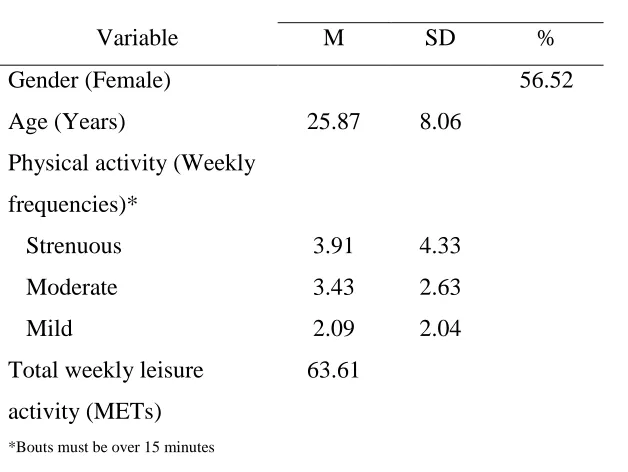
posters placed across campus. Demographic data can be found in Table 2. Upon
completion, participants received a $10 gift card to a local store. Inclusion criteria
required participants be: (a) non-smoker; (b) aged 18-45 years; (c) right-handed; (d) have
no contraindications to physical activity; and (e) no contraindications to nicotine.
Exclusion criteria included: (a) dealing with a mental illness; (b) females who were
pregnant or breastfeeding; (c) currently or recently smoked cigarettes; and (d) having
major health complication. The 18-45 age range ensured this sample included the group
with highest potential tobacco use (20-34 years) (Statistics Canada, 2014), Participants
were removed from the dataset due to: dropouts (n=9), uncomfortable with nicotine
(n=2), outside age criteria (n=1), and dealing with mental illness (n=1). The final sample
size included twenty-three participants (Mage = 25.87, SD = 8.058. 13 female). Five
reported smoking a cigarette at one point in their life, and only one was a previous
smoker.
Design
This study employed a randomized, within-subjects counterbalanced procedure trial
design. The sample was stratified by gender and was randomly assigned to conditions
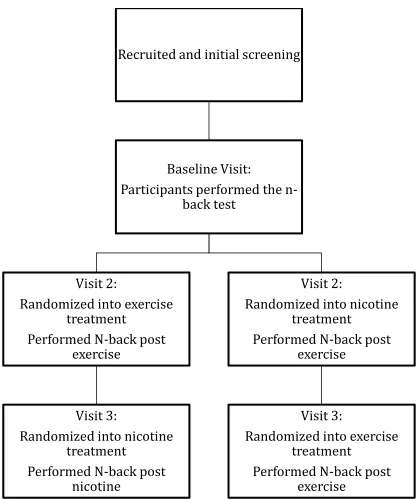
using a random number generator (www.randomizer.org). A graphic illustration of the
study design can be found in Figure 2.
2.2 Primary Outcome Measure
Working memory was measured using the N-back task (Jonides, Schumacher, Smith,
Lauber, Awh, Minoshima, & Koeppe, 1997). The N-back task is a measure of working
memory as it requires the use of both the phonological loop and the visuospatial
sketchpad (Jonides et al., 1997). The N-back was performed on a laptop in an isolated
room using INQUISIT By Millisecond Software (version 4.0.8.0). There were four
different cognitive loads 0, 1, 2, and 3-back each increasing in difficulty. These loads
occur in a random order. Each trial takes approximately 5 min to complete and involves a
letter stimulus that appears on a computer screen for an interval of 500 ms, followed by a
1000 ms blank screen interstimulus. Participants see a total of 200 letters in the 5 minute
task (0-back = 48 letters, 1-back = 48 letters, 2-back = 50 letters, 3-back = 54 letters).
Participants had to determine if the stimuli matched the stimuli that appeared “N” items
back and were instructed to press the response key (‘A’ key) using their right hand as
soon as a target appears while keeping in mind both the speed and accuracy components
of the task. In the 1-back condition, the target is defined as the letter stimulus that is the
same as the one preceding it. For example, “x, interstimulus, x” would be the target. In
the 2-back condition, the target is defined as a letter appearing that is the same as what
preceded it two letters before. For example, “a, interstimulus, b, interstimulus, a”, would
be the target (see Figure 1 for N-back illustration). The 3-back letter condition was
treated as the primary outcome measure as it is most sensitive to behaviour and
medication effects (Loughead et al., 2009). Performances on the N-back were assessed by
recording the number of errors committed (Accuracy) and mean reaction time (RT) in
milliseconds for each N-back condition. As previously mentioned, cognitive performance
(working memory) was the focus of this study because it is affected by nicotine in both
smokers and non-smokers (Kumari et al., 2003; Heishman et al., 2010) and exercise in
non-smokers (McMorris et al., 2011). Furthermore, performances on the 3-back are
Figure 1. Diagram of the four N-back conditions (Braver, Cohen, Nystrom,
Jonides, Smith, & Noll, 1997).
2.3 Other Measures
Vital signs
Heart rate and systolic/diastolic blood pressure were recorded to monitor the effect of
nicotine gum and exercise. There were three measure points: before treatment, right after
treatment, and after the N-back task. Heart rate was monitored using the Polar RS100
heart rate device and systolic/diastolic blood pressure was measured manually.
Sociodemographic Questionnaire
Information, including: age, gender, and contact information was collected.
Physical activity readiness questionnaire
The standard seven-item questionnaire was used to assess if participants required medical
clearance to engage in physical activity (PAR-Q; Canadian Society for Exercise
Physiology [CSEP], 2012). Participants were required to response yes or no to the
questions; if they responded yes to any items they were ineligible to participate.
Smoking History & Current Practices
Exercise Behaviour
The Godin Leisure-Time Exercise Questionnaire was used to assess leisure-time physical
activity (Godin, & Shephard, 1997). This brief four-item questionnaire breaks down the
amount of mild, moderate and strenuous exercise participants engaged in during their free
time and how often their heart beats rapidly.
2.4 Intervention
Moderate-intensity exercise
Moderate intensity was defined as 45 to 68% of heart rate. Moderate-intensity was
calculated using the formula: (220 – age) x 60~70% of heart rate, as this intensity
improves multiple aspects of cognitive function (Chang, Tsai, Hung, So, Chen, Etnier,
2011; Hillman, Snook, & Jerome, 2003). Participants completed a 20 min bout of
moderate-intensity exercise on a Woodway PPS treadmill (Woodway, Waukesh, WI).
This bout entailed a 5 min warm up to start and 3 min cool-down to end. Participants’
heart rate was monitored closely using the Polar RS100 heart rate device. The researcher
controlled the incline and speed corresponding to participants’ heart rate ensuring they
were exercising at a moderate-intensity while allowing participants to decide whether
they would rather have the speed or incline manipulated when needed. As previously
mentioned this intensity of exercise has been shown to have the best results on cognitive
performance including working memory (Kamijo et al., 2007 Gondola, 1987; Heckler &
Croce, 1992; Sibley et al., 2006; Tomporowski, 2003). Moderate-intensity exercise is
also easy enough to be done by untrained individuals.
Nicotine gum
Participants received two pieces of nicotine polacrilex (Nicorette®) gum. Each piece
contained 2 mg of nicotine. Nicotine polacrilex was chosen due to ease of administration
and controlled mean of delivery when administrated under the standardized chewing
protocol (Henningfield, Radzius, Cooper, & Clayton, 1990). This protocol reduces
individual response variability and plasma nicotine levels directly relate to the dose. Thus
participants were instructed to chew once every 3 seconds for 20 min as almost 50% of
1987). Lastly, nicotine gum was picked as it has low dependence potential and toxicity
(USDHHS, 1988)
2.5 Procedure
Individuals who expressed interest and contacted investigators were screened for
eligibility criteria by telephone or e-mail. Screening questions concerned smoking status,
age, contraindications to nicotine or exercise, dominant hand, mental illness and for
females current pregnancy or breastfeeding. If eligible, the researcher then scheduled the
first lab visit. The study required participants to come to the Exercise and Health
Psychology Laboratory (EHPL, ww.ehpl.uwo.ca) at the University of Western (London,
Ontario) for three sessions, baseline, first treatment, and second treatment.
Upon arriving at the lab, participants read the letter of information and offered signed
consent followed by the sociodemographic questionnaire, PAR-Q, and Godin
Leisure-Time Exercise Questionnaire. Participants were restricted to half a cup of coffee on each
day of testing and instructed to abstain from alcohol and drugs for at least 24 hours before
testing. Participants were then randomized into two equal treatment groups of either
nicotine administration, or exercise participation, and then switch to counterbalance
treatments. During baseline (Visit 1), participants were familiarized with the N-back task
until they could consistently score 75% or higher in each N-back trial to eliminate any
learning effect. Participants were instructed to perform the task as accurately as they can
while keeping reaction time in mind. Once competency was established, a baseline
cognitive measure was obtained from each participant utilizing the N-back test. Each visit
was scheduled at seven days intervals, and participants were notified the night before
testing as a reminder of instructions and protocol for the given task. Time of day that
subjects participated in was kept constant. For the second visit, participants were
randomized into one of two treatments (nicotine or exercise) and began the N-back
immediately after treatment (within 2 min). Participants then returned for a third visit one
week later and underwent the treatment condition (i.e. exercise or nicotine) they had not
done yet. After completion of the third visit, participants were thanked and received their
Figure 2. Flow diagram of participants moving through the study.
Recruited and initial screening
Baseline Visit:
Participants performed the
n-back test
Visit 2:
Randomized into exercise
treatment
Performed N-back post
exercise
Visit 3:
Randomized into nicotine
treatment
Performed N-back post
nicotine
Visit 2:
Randomized into nicotine
treatment
Performed N-back post
exercise
Visit 3:
Randomized into exercise
treatment
2.6 Statistical Analyses
Manipulation check (treatment)
Paired samples t-test was conducted to compare baseline heart rate and systolic/diastolic
blood pressure to post-treatment heart rate and systolic/diastolic blood pressure.
Primary outcome analyses
Separate repeated measure MANOVAs (3 treatment conditions: baseline, nicotine,
exercise) were conducted to examine the effects of treatment on N-back accuracy and
RT. Significant main effects were followed by all possible pairways comparisons sample
t-tests. MANOVA was chosen over ANOVA as the latter is susceptible to violations of
sphericity (variances of the differences between all possible pairs of groups or conditions
are equal) as indicated by Mauchly’s Test of Sphericity (Stevens, 1996).
The level of significance was accepted at p < .05 for all tests (Tabachnick & Fidell,
1996). Effect sizes (η 2) accompany all reported findings. In accordance with Cohen
(1988), 0.02 is a small effect size, 0.13 is a moderate effect size, and 0.26 is a large effect
size. Data was analyzed using IBM SPSS Statistics (Version 24).
Table 2: Demographic Variables at Baseline
Variable M SD %
Gender (Female)
Age (Years)
Physical activity (Weekly
frequencies)*
Strenuous
Moderate
Mild
Total weekly leisure
activity (METs)
25.87
3.91
3.43
2.09
63.61
8.06
4.33
2.63
2.04
56.52
2.7 Results
Manipulation Check
Exercise
Paired t-test showed that there was significant increase in heart rate t(22) = -13.855, p
< .001, η2=0.90 and systolic blood pressure t(21) = -6.074, p < .001, η2=0.64 after
engaging in moderate intensity from baseline to post-exercise. Diastolic blood pressure,
however, was not significantly different t(21) = 1.125, p = .273, η2=0.06.
Nicotine
Paired t-test showed that there was significant increase in heart rate t(20) = -5.545, p
< .001, η2=0.60 and diastolic blood pressure t(20) = -2.946, p = .008, η2 = 0.30 after
nicotine administration from baseline to post-exercise. Systolic blood pressure, however,
was not significantly different t(20) = .169, p = .868, η2 = 0.001.
Primary Outcome
3-Back Accuracy
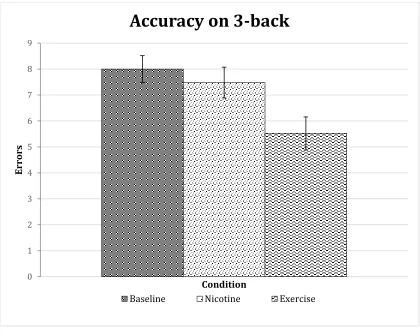
Repeated measure MANOVA revealed a significant treatment effect on accuracy Wilks’
Lambda = .536, F (2, 21) = 9.104, p = .001, partial eta square η2 = .464. These findings
suggest that there was as a change in accuracy across the 3 treatment conditions. Post-hoc
comparison revealed a significant difference in the scores for baseline (M = 8.00, SD =
2.468) and exercise (M = 5.52, SD = 3.043) conditions—t(22) = 4.357, p < .001, η2=0.46;
no significant difference in the scores for baseline (M = 8.00, SD = 2.468) and nicotine
(M = 7.48, SD = 2.842) conditions—t(22) = .866, p = .396, η2=0.03 and; a significant
difference in the scores for exercise (M = 5.52, SD = 3.043) and nicotine (M = 7.48, SD =
2.842) conditions—t(22) = 2. 567, p = .012, η2= .25.(see Figure 3).
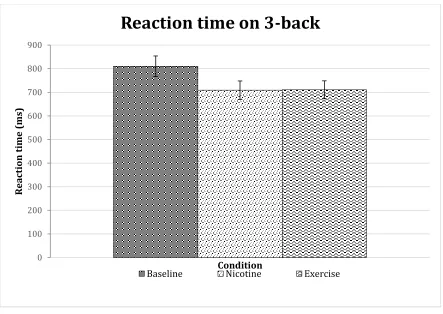
3-Back RT
Repeated measure MANOVA revealed a significant treatment effect on reaction time
Wilks’ Lambda = .667, F (2, 21) = 5.232, p = .014, partial eta square η2 = .333. These
Post-hoc paired sample t-tests indicated that there was a significant difference in the scores for
baseline (M=810.27, SD=209.801) and exercise (M = 710.64, SD = 181.948)
conditions—t(22) = 3.204, p = .004, η2=0.31; for baseline (M = 810.27, SD = 209.801)
and nicotine (M = 708.99, SD = 187.469) conditions—t(22) = 3.099, p = .005, η2=0.30;
but not for exercise (M = 710.64, SD = 181.948) and nicotine (M = 810.27, SD =
209.801) conditions—t(22) = 0.087, p = .931, η2= .00034.(see Figure 4).
Secondary Outcome
0-2 back
0-back accuracy. Repeated measures MANOVA revealed a non-significant treatment
effect on reaction time Wilks’ Lambda = .937, F (2, 21) = .704, p = .506, partial eta
square η2 = .063.
1-back accuracy. Repeated measures MANOVA revealed a non-significant treatment
effect on reaction time Wilks’ Lambda = .933, F (2, 21) = .755, p = .482, partial eta
square η2 = .067.
2-back accuracy. Repeated measures MANOVA revealed a non-significant treatment
effect on reaction time Wilks’ Lambda = .785, F (2, 21) = 2.871, p = .079, partial eta
square η2 = .215.
0-back RT. Repeated measures MANOVA revealed a non-significant treatment effect on
reaction time Wilks’ Lambda = .942, F (2, 21) = .647, p = .534, partial eta square η2 =
.058.
1-back RT. Repeated measures MANOVA revealed a non-significant treatment effect on
reaction time Wilks’ Lambda = .800, F (2, 21) = 2.631, p = .096, partial eta square η2 =
.200.
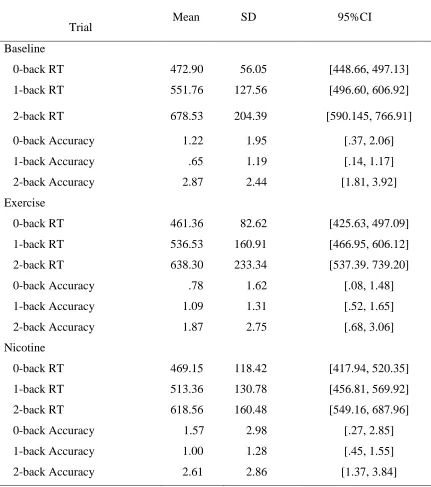
2-back RT. Repeated measures MANOVA revealed a significant treatment effect on
reaction time Wilks’ Lambda = .719, F (2, 21) = 4.105, p = .031, partial eta square η2 =
.281. These findings suggest that there was a change in RT across the 3 treatment
in the scores for baseline (M=678.53, SD=204.390) and nicotine (M=618.56,
SD=160.477) conditions— t(22)=2.932, p = .008, η2=0.28; but not for baseline (M =
678.53, SD = 204.390) and exercise (M = 638.30, SD = 233.344) conditions—
t(22)=1.032, p = .313, η2=0.046; or for exercise (M = 638.30, SD = 233.344) and nicotine
(M=618.56, SD = 160.477) conditions— t(22)=0.539, p = .596, η2= .015.
Table 3: Means, Standard Deviations, and 95% Confidence Intervals for 0-2 N-back
Trial Mean SD 95%CI
Baseline
0-back RT 472.90 56.05 [448.66, 497.13]
1-back RT 551.76 127.56 [496.60, 606.92]
2-back RT 678.53 204.39 [590.145, 766.91]
0-back Accuracy 1.22 1.95 [.37, 2.06]
Figure 3. Mean accuracy scores at each time point. Error bars represent
standard error. Each condition included 54 letter stimuli.
0 1 2 3 4 5 6 7 8 9
Err
or
s
Condition
Accuracy on 3-back
Figure 4. RT score at each time point. Error bars represent standard error.
0 100 200 300 400 500 600 700 800 900
Rea
cti
on
t
ime
(m
s)
Condition
Reaction time on 3-back
Chapter Three: Discussion
To the author’s knowledge, this is the first study to investigate the effectiveness of an
acute bout of moderate-intensity exercise versus 4 mg nicotine polacrilex gum on
cognitive performance (i.e., working memory) in a non-smoking population. Participants
underwent both treatments in a randomized counterbalanced fashion. Our main finding
showed significant improvement in RT after both treatments. Accuracy significantly
improved only for exercise. Beyond theses general findings a number of specific issues
warrant commentary.
Accuracy in the exercise condition improved by 31.25% but only 6.5% in the nicotine
condition. This 26.4% net difference indicates that exercise was superior to nicotine in
enhancing cognitive performance (i.e., working memory). Although previous literature
supports exercise facilitating cognitive performance (Chang et al., 2012; Lambourne &
Tomporowski, 2010; McMorris & Hale, 2012), the effects reported were smaller to the
ones reported here. This raises the question why? One plausible reason is that the dose
(i.e., duration = 20 minutes and intensity = 45-68% of heart rate) of exercise was optimal
for enhancing cognitive performance in the present study. As previously mentioned, short
exercise sessions (< 10 min) show negligible cognitive performance effects while
exercise bouts over 11 min show significant effects (Chang et al., 2012). Superior
cognitive improvements also have been shown with moderate intensity exercise (Kamijo
et al., 2007). Fitness level seems to play a major role in exercises’ effect on cognitive
performance (Chang et al., 2012) as highly fit participants appear to benefit the most
while less-fit participants might suffer adverse effects. This is because unfit participants
are more likely to reach exhaustion faster, which is associated with impaired cognitive
performance (Brown & Bray, 2014). It is important to acknowledge that participants in
this study were self-selected opening the possibility they exercise regularly or enjoy
exercise. Finally, the N-back task that was selected to capture working memory accuracy
may, in part, help explain these findings. Although past research has shown that the entire
N-back protocol is sensitive to accuracy change by both acute exercise (Audiffren, 2009;
Tomporowski, 2003) and nicotine (Heishman et al., 2010), the focus of the present study
confirmed that 0-2 back conditions would be too easy for participants creating a ceiling
effect, and thus negating treatment effects. The 3-back was also selected as it is sensitive
to behavior and medication effects (Loughead et al., 2009), It should also be mentioned
that the modest accuracy improvement found for nicotine is not consistent with effects
reported for memory type tasks in the Heishman et al. (2010) meta-analysis.
RT improved by 12.34% in the exercise condition and 12.59% in the nicotine condition.
This 0.25% net difference indicates that both treatments were equally effective in
enhancing working memory RT. This finding is in line with previous literature. Past
studies have typically reported large effect sizes for both exercise (Chang et al., 2012)
and nicotine (Heishman et al., 2010). Furthermore, arousal has been shown to decrease
RT (Eason, Harter, & White, 1969). Both treatments in this study are known to increase
arousal (Fan et al., 2005; Gilbert et al., 2000; McMorris et al., 2011; Perkins et al., 1994;
Perkins et al., 1996; Posner & Rothbart, 2007). Therefore, shorter RT is expected
post-treatment.
Working memory tasks like the N-back provide accuracy and reaction time (RT) scores.
Although there is a well-known speed-accuracy trade-off effect (performing a task faster
jeopardizes its accuracy (Reed, 1973), this was not the case in either treatment as both
showed decreased RT (12.34% for exercise and 12.59% for nicotine) while improving
accuracy (31.25% for exercise and 6.5% for nicotine). The author argues accuracy data
are more important in these types of tasks. Performing a cognitive task faster has little
implication if accuracy is jeopardized. For example, it is more important to get the correct
answer on an exam than to finish quickly.
Nicotine-induced enhancement might have been jeopardized as a consequence of
dysphoria non-smokers experience (Heishman, et al., 1993; Hindmarch et al., 1990).
Heishman and Henningfield (2000) sought to explore this idea by developing tolerance to
the initial dysphoric effects of nicotine in non-smoker participants. Participants received
ascending doses of nicotine (0, 2, 4, 8 mg) for eight consecutive days. At the end of the
eight days, participants showed tolerance to the initial dysphoric effects of nicotine.
measure that improved while working memory accuracy, gross motor coordination,
recognition, and visual scanning and attention were impaired. The findings from the
present study suggests, any dysphoria non-smokers experience post nicotine is not
adversely affecting cognitive task performances (i.e., accuracy). Furthermore, impairment
seen in the Heishman and Henningfield study might have been due to the nicotine dose
itself. Participants received 0, 2, 4, and 8 mg of nicotine gum causing plasma nicotine
concentration levels to be as high as 6.9-11.5 ng/ml. Even after building tolerance, a 14
mg dose might be too high for non-smokers and could negatively impact cognitive
performance.
3.1 Strengths and Limitations
There are several strengths that must be highlighted with the present study. First, a
randomized counterbalanced trial design allowed every participant to undergo both
treatments and serve as their own control. Using a randomized counterbalanced
procedure guarded against practice or order of treatment effects. Furthermore, this design
protected against any loss of motivation participants might experience causing them to try
less in later visits. As this was a within-subject design, it had greater power and reduced
error variance associated with individual difference (Pollatsek & Well, 1995). This in
turn allowed the author to use a smaller number of participants to explore the
effectiveness of the two treatments compared to a between subject design. Second,
participants’ level of caffeine and alcohol consummation was controlled. Caffeine is
known to increase feelings of concentration and alertness (Peeling & Dawson, 2007) and
has been shown to enhance N-back performance depending on personality
type-extraversion (Smillie & Gökçen, 2010). Alcohol is known to impair many types of
cognitive function including working memory (Dry, Burns, Nettelbeck, Farquharson, &
White, 2012). Additionally, coffee consumption can limit nicotine absorption
(Henningfield et al., 1990). Ensuring these two were not consumed the day of testing
(caffeine) and within 24 hours of testing (alcohol) played an instrumental role in assuring
changes in performances were due to treatment rather than uncontrolled substance factors.
Third, there was a manipulation check using HR and blood pressure data to ensure the
increases diastolic blood pressure and heart rate (Ernst et al., 2001; Foulds et al., 1997;
Hughes, Rose, & Callas, 2000; Ragueneau, Michaud, Démolis, Moryusef, Jaillon, &
Funck‐Brentano, 1999) while systolic blood pressure and heart rate increases due to exercise (Shahraki, Mirshekari, Shahraki, Shahraki, & Naroi, 2012). Lastly, the dose of 4
mg was picked, as 2 mg is not intense enough to produce all the physical symptoms of
nicotine while stronger doses lead to higher reports of dysphoria (Kleykamp et al., 2005).
Despite the strengths highlighted, the present study is not without limitations. First, only
one domain of cognitive performance (i.e., working memory) was examined. Thus it is
unclear whether the effect is universal or only specific to working memory assessed
through the N-back. Furthermore, although the N-back has strong face validity it has
been shown to have weak convergent validity with other measures of working memory
(Kirchner, 1958; Kane, Conway, Miura, & Colflesh, 2007). Second, with only
twenty-three participants, these findings may not be generalizable to other non-smoking
populations. Third, although participants were given specific chewing instructions, there
is no way of knowing whether they followed instructions as they sat in a room alone for
the 20 min. This is problematic as almost 50% of the nicotine remains in the gum with
improper chewing (Benowitz, Jacob, & Savanapridi, 1987). However, although plasma
nicotine levels were not recorded in this study, heart rate and diastolic blood pressure
manipulation check indicate the nicotine treatment worked. N-back performances were
enhanced post-nicotine further supporting this treatment. The question remains whether
nicotine-induced improvements were maximized using the current procedure. If
participants failed to follow the chewing procedure, they might have received enough
nicotine to show a partial effect only. RT improved by 12.59% while accuracy only
improved by 6.5%. These effects might underrepresent the effect of 4mg nicotine gum
and further cognitive benefits could have resulted from the full dose. Fourth, neither the
researcher nor the participant was blinded to the treatment. Fifth, this study did not
measure the typical dysphoria or negative mood nicotine typically produces in
non-smokers (Heishman et al., 1993). Sixth and finally, participants’ prior knowledge
regarding treatment was also not measured. Hence, the author cannot rule out whether
3.2 Future Directions
The results obtained in this study needs to be replicated with a larger non-smoking
sample. An important future direction is conducting this study with a smoking
population. Since abstinent smokers experience cognitive deficits, it would be interesting
to see whether exercise-induced improvement is robust enough to reverse this impairment
and show additional improvement.
As aforementioned, only one cognitive domain was examined. Future studies need to
discover if exercise improves other domains more effectively than nicotine gum can. In
the 2010 meta-analysis regarding nicotine’s effect on cognitive performances, thirteen
domains were classified, and only six of those domains showed significant positive
effects post administration (Heishman et al., 2010). Performances in all thirteen domains
need to be examined post exercise. More importantly, the other five domains that
improved post nicotine administration need to be tested post exercise to see which
treatment is more effective on different types of cognition. Tasks like short-term episodic
memory accuracy and alerting attention show the greatest improvement post nicotine
administration making them potential candidates for future studies to examine.
Cognitive testing occurred immediately after treatment (approximately 2 min). This study
did not examine whether treatment effects are present after a delay. Exercise has been
shown to demonstrate its biggest effects on cognition 11-20 min after exercise, but these
effects wane after delays longer than 20 min (Chang et al., 2012). Nicotine’s delayed
enhancement effect has been observed in animal models and can last 24 h after
administration (Buccafusco, & Jackson, 1991; Buccafusco, Jackson, Jonnala, & Terry,
1999). Nicotine’s delayed effect on human cognition, however, has yet to be examined.
Future work needs to evaluate the effect of these two treatments in delayed testing
models.
Another worthwhile line of inquiry is to clarify whether acute exercise and nicotine gum
function through distinct mechanistic pathways. Imaging (brain scans) procedures may
prove useful in identifying how exercise and nicotine exert their effect on cognitive
in both treatments as one possible mechanism behind this effect (Grundey et al., 2013; Li
et al., 2014; Yanagisawa et al., 2010). Correspondingly, enhanced intracortical
facilitation in the prefrontal cortex is associated with improved working memory
performance (Brunoni & Vanderhasselt, 2014), and there is a substantial amount of
nicotinic receptors in the prefrontal functions. (Poorthuis & Mansvelder 2013). An
advantage exercise has over nicotine is the ability to provide the brain with BDNF
proteins which plays an essential role in learning and memory performances (Szuhany et
al., 2015). This protein is released after exercise bouts and helps improve cognitive
performances (Szuhany et al., 2015; Zoladz et al., 2008). There has been some evidence
that nicotine administration leads to increases in BDNF mRMA expression in the dorsal
hippocampus (Wei, Liu, Li, Zheng, Zhou, & Li, 2015). Evidence, however, remain
minimal and more studies need to explore the role of nicotine and BDNF in human
cognition.
Although the two treatments rely on the same brain region-prefrontal cortex-they could
use different pathways allowing possible additive effect. With respect to additive effects,
two studies have investigated the possibility of using acute exercise and NRT to alleviate
cravings and withdrawal symptoms in a smoking model (Harper et al., 2012; Tritter,
Fitzgeorge, & Prapavessis, 2015). Harper et al. found that combining acute exercise and
the NRT patch led to extra cravings relief throughout the duration of the study (9 weeks
post-quit). Withdrawal symptoms benefited from an additive effect up to the 7-week
mark. This study, however, did not employ a control group leaving it open to criticism.
The second study sought to validate this by adding a control group in an acute model.
Smokers abstained for 15 h and were randomized into their conditions and receiving a 2
mg nicotine lozenge (Tritter et al., 2015). Those in the experimental condition partook in
a 20 min moderate-intensity exercise bout while the control condition sat passively. The
experimental group (which received both treatments) had lower craving scores at each
time point. Withdrawal symptoms were reduced in both groups, but there was no
evidence of any additive effect. This study did include a subjective assessment of
concentration. Although this measure did improve, there was no visible additive effect of
the two treatments. Future studies need to examine the possibility of any additive
concentration levels might experience a ceiling effect. Hence, a more sophisticated
cognitive task is essential in exploring additive effects in future studies.
3.3 Implications
Nicotine has been suggested as medication in unhealthy populations dealing with
cognitive deficits (Barr et al., 2008; White & Levin 1999; Wilson et al., 1995). This
research indicates that exercise is a more effective and efficient treatment regarding
cognitive functioning. Benefits of using a treatment like exercise include avoiding
exposing these populations to an addictive drug like nicotine while exposing them to the
countless health benefits exercise delivers (Clark & Uraina, 2011). Exercise enhances
weight control, reduces the risk of cardiovascular disease, red type 2 diabetes,
osteoporosis, as well as breast and colon cancers.
Young adult stress is associated with the decision to commence smoking (Byrne, Byrne,
& Reinhart, 1995). This stress typically arises from school performance and future
uncertainty, as academic success can determine future occupation. Consequently,
adolescents turn towards smoking to help them cope. Alongside nicotine’s addictive
effect, the cognitive boost it provides could reinforce this behaviour and help relief
academic related stress if it translates to better grades. Moderate-intensity exercise can
reduce stress (Hansmann, Hug, & Seeland, 2007; Jin, 1992) and has been shown to
enhance cognitive performance (Chang et al., 2012). The findings from the present study
can be used to convince the non-smoking population to look to healthy behaviours like
exercise when facing stressful situations or cognitive lulls. Furthermore, smoking and
exercising are incompatible behaviours as reported high leisure-time exercise levels are
inversely related to smoking in self-reported surveys (Boutelle, Murray, Jeffery,
Hennrikus & Lando, 2000). Therefore, exercising could further protect young adults from
taking up smoking.
Eighty-five percent of Canadians do not meet the current Canadian Physical Activity
Guidelines (Colley, Garriguet, Janssen, Craig, Clarke, & Tremblay, 2011) meaning most
people are missing out on exercises-induced benefits in cognition and health in general.
exercising to receive cognitive benefits. If regular exercise becomes habitual at a younger
age, it could carry on into adulthood helping with the lack of exercise epidemic.
3.4 Conclusion
This is the first study directly examining the effectiveness of exercise and nicotine on
cognitive performance (i.e., working memory) in non-smokers. Findings showed
significant improvements in RT after both treatments. However, accuracy significantly
improved only for exercise. The author recommends exercise over nicotine as a safe and