Western University Western University
Scholarship@Western
Scholarship@Western
Electronic Thesis and Dissertation Repository
11-8-2016 12:00 AM
Towards Comprehensive Parametric Code Generation Targeting
Towards Comprehensive Parametric Code Generation Targeting
Graphics Processing Units in Support of Scientific Computation
Graphics Processing Units in Support of Scientific Computation
Ning Xie
The University of Western Ontario
Supervisor
Marc Moreno Maza
The University of Western Ontario
Graduate Program in Computer Science
A thesis submitted in partial fulfillment of the requirements for the degree in Doctor of Philosophy
© Ning Xie 2016
Follow this and additional works at: https://ir.lib.uwo.ca/etd
Part of the Numerical Analysis and Scientific Computing Commons, and the Programming Languages and Compilers Commons
Recommended Citation Recommended Citation
Xie, Ning, "Towards Comprehensive Parametric Code Generation Targeting Graphics Processing Units in Support of Scientific Computation" (2016). Electronic Thesis and Dissertation Repository. 4257.
https://ir.lib.uwo.ca/etd/4257
This Dissertation/Thesis is brought to you for free and open access by Scholarship@Western. It has been accepted for inclusion in Electronic Thesis and Dissertation Repository by an authorized administrator of
The most popular multithreaded languages based on the fork-join concurrency model ( Cilk-Plus,OpenMP) are currently being extended to support other forms of parallelism (vectoriza-tion, pipelining and single-instruction-multiple-data (SIMD)). In the SIMD case, the objective is to execute the corresponding code on a many-core device, like a GPGPU, for which theCUDA language is a natural choice. Since the programming concepts of CilkPlus andOpenMP are very different from those ofCUDA, it is desirable to automatically generate optimizedCUDA-like code fromCilkPlusorOpenMP.
In this thesis, we propose an accelerator model for annotated C/C++code together with an implementation that allows the automatic generation ofCUDAcode. One of the key features of thisCUDAcode generator is that it supports the generation ofCUDAkernel code where program parameters (like number of threads per block) and machine parameters (like shared memory size) are treated as unknown symbols. Hence, these parameters need not to be known at code-generation-time: machine parameters and program parameters can be respectively determined when the generated code is installed on the target machine.
In addition, we show how these parametric CUDAprograms can be optimized at compile-time in the form of a case discussion, where cases depend on the values of machine parame-ters (e.g. hardware resource limits) and program parameparame-ters (e.g. dimension sizes of thread-blocks).
This generation of parametric CUDA kernels requires to deal with non-linear polynomial expressions during the dependence analysis and tiling phase of the input code. To achieve these algebraic calculations, we take advantage of techniques from computer algebra, in particular in the RegularChains library of Maple. Various illustrative examples are provided together with performance evaluation. Our preliminary implementation uses LLVM,MapleandPPCG; moreover, it successfully processes a variety of standard test-examples.
Keywords: Many-core machine model; Parametric CUDA code generation; Polynomial arithmetic; Compiler optimization
Acknowledgements
With your greatest help, I become who I am today. With your enlightenment, I achieve what I have today.
Special thanks sincerely for the insightful guidance from Prof. Marc Moreno Maza and the great collaboration with Prof. Robert M. Corless, Dr. Changbo Chen, Dr. Yuzhen Xie, Dr. Sardar A. Haque, Svyatoslav Covanov, Farnam Mansouri, Robert H.C. Moir and Xiaohui Chen. Many thanks to industry partners: Dr. J¨urgen Gerhard from Maplesoft R&D department, and Wang Chen, Abdoul-Kader Keita and Jeeva Paudel from IBM compiler group for making this research work have practical uses.
Big thanks to the supervisory committees: Prof. Mark Daley and Prof. Yuri Boykov for advices and comments. It is my honor to have Dr. Matteo Frigo, Prof. Robert M. Corless, Prof. Michael Bauer and Prof. Roberto Solis-Oba as the examiners. I would like to express my gratitude for their comments and questions. With all my heart, I appreciate the continued support of my parents, colleagues, friends, the ORCCA laboratory and the Computer Science Department of The University of Western Ontario.
The work was supported by NSERC of Canada, MITACS, Maplesoft Inc. and IBM Corp..
Dream my life, live my dream. To a better self.
Abstract i
Acknowledgements ii
List of Figures vi
List of Tables x
List of Algorithms xii
List of Appendices xiii
1 Introduction 1
1.1 Contributions of this thesis . . . 5
1.2 Outline of this thesis . . . 6
2 Background 10 2.1 Models of computation . . . 10
2.1.1 Fork-join model . . . 10
2.1.2 PRAM model . . . 11
2.2 General-purpose GPU computing . . . 13
2.2.1 TheCompute Unified Device Architecture(CUDA) . . . 14
2.2.2 Modern GPU architectures . . . 15
2.3 Dense arithmetic over finite fields with theCUMODPlibrary . . . 16
2.4 TheMetaForklanguage . . . 17
2.5 Automatic parallelization in the polyhedral model . . . 19
2.5.1 Z-polyhedron . . . 20
2.5.2 Polyhedral iteration domain . . . 21
2.5.3 Data dependence graph . . . 21
2.5.4 Dependence polyhedron . . . 22
2.5.5 Affine transformation . . . 23
2.5.6 Farkas multipliers . . . 24
2.5.7 Feautrier’s algorithm . . . 24
2.5.8 PLUTO’s algorithm . . . 25
2.6 Solving systems of polynomial equations and inequalities . . . 26
3 The Basic Polynomial Algebra Subprograms 30
3.1 Design and specification . . . 30
3.2 User interface . . . 31
3.3 Implementation techniques . . . 34
3.4 Experimental evaluation . . . 35
3.5 Application . . . 37
4 A Many-Core Machine Model 41 4.1 Introduction . . . 41
4.2 A many-core machine model . . . 43
4.2.1 Characteristics of the abstract many-core machines . . . 43
4.2.2 Many-core machine programs . . . 46
4.2.3 Complexity measures for the many-core machine model . . . 46
4.2.4 A Graham-Brent theorem with parallelism overhead . . . 47
4.3 The Euclidean algorithm . . . 48
4.4 Fast Fourier Transform . . . 52
4.4.1 Cooley & Tukey algorithm . . . 52
4.4.2 Stockham algorithm . . . 53
4.4.3 Comparison of running time estimates . . . 54
4.5 Polynomial multiplication . . . 55
4.5.1 Plain multiplication . . . 55
4.5.2 FFT-based multiplication . . . 58
4.5.3 Comparison of running time estimates . . . 59
4.6 Radix sort . . . 60
4.7 Conclusion . . . 62
5 MetaFork-to-CUDA: Generation of ParametricCUDAKernels 63 5.1 OptimizingCUDAkernels depending on program parameters . . . 64
5.2 Automatic parametricCUDAkernel generation . . . 65
5.3 TheMetaFork-to-CUDAcode generator . . . 67
5.4 Experimentation . . . 73
5.5 Conclusion . . . 80
6 Generation of OptimizedCUDAKernel Code 84 6.1 Case study: matrix multiplication . . . 84
6.2 Experimentation . . . 90
6.3 Conclusion . . . 94
7 Towards Comprehensive ParametricCUDAKernel Generation 96 7.1 Comprehensive optimization . . . 99
7.1.1 Hypotheses on the input code fragment . . . 100
7.1.2 Hardware resource limits and performance measures . . . 100
7.1.3 Evaluation of resource and performance counters . . . 102
7.1.4 Optimization strategies . . . 102
7.1.5 Comprehensive optimization . . . 103
7.1.6 Data-structures . . . 104
7.2.1 InputMetaForkcode fragment . . . 110
7.2.2 Comprehensive translation into parametricCUDAkernels . . . 111
7.3 Implementation details . . . 111
7.4 Experimentation . . . 113
7.5 Conclusion . . . 121
8 Conclusion and Future Work 123 Bibliography 125 A Sample Code in theBPASLibrary 135 A.1 Adaptive algorithms . . . 135
A.2 User interfaces . . . 136
B Theoretical Analysis of Fundamental Algorithms Using the MCM Model 139 C Documentation forMetaFork-to-CUDACode Generator 181 C.1 Assumptions on the sytax ofMetaForkstatements . . . 181
C.2 Schedule tree forMetaForkand parametricCUDAcode . . . 183
D Examples Generated byPPCG 188
E The Implementation for Generating ComprehensiveMetaForkPrograms 193
Curriculum Vitae 196
List of Figures
1.1 A C program for reversing a one-dimensional array . . . 2
1.2 TheCUDAprogram for reversing a one-dimensional array . . . 3
1.3 ParametricCUDAkernel for reversing a one-dimensional array . . . 4
1.4 TwoCUDAkernels based on possible values of machine and program parame-ters for reversing a one-dimensional array, where Z is the maximum number of shared memory words per processor supported by the hardware architec-ture and R is the maximum number of registers per thread supported by the hardware architecture . . . 6
1.5 Overview of the thesis . . . 8
2.1 An example of computation DAG: Fourth Fibonacci . . . 11
2.2 Matrix multiplication written inCilkPlus . . . 12
2.3 Overview of a hybrid CPU-GPU system . . . 13
2.4 Execution of aCUDAprogram . . . 14
2.5 UsingMetaForkto translate a givenCilkPlusprogram into aOpenMPprogram 18 2.6 UsingMetaForkto translate a givenOpenMPprogram into aCilkPlusprogram 18 2.7 UsingMetaForkto translate a givenOpenMPprogram into aCilkPlusprogram 19 2.8 For-loop nest in the polyhedral model . . . 20
2.9 An example of the data dependence graph of the source program . . . 22
2.10 The transformed code based on time and processor coordinates . . . 24
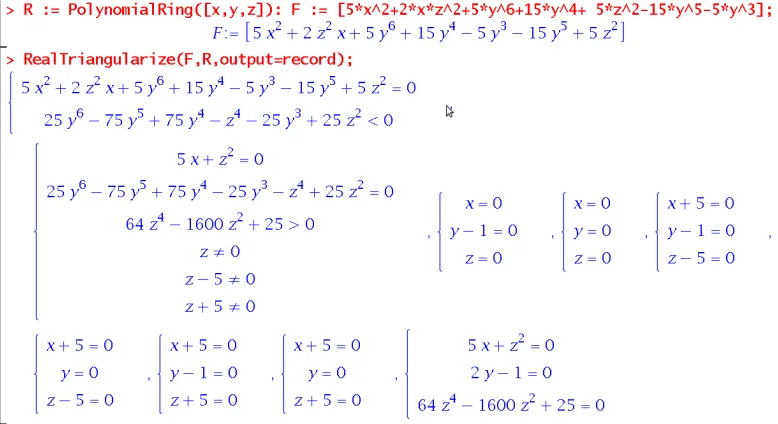
2.11 A triangular decomposition into semi-algebraic systems computed with the RealTriangularizecommand . . . 28
2.12 Output of theRealTriangularizecommand for theEVEsurface . . . 28
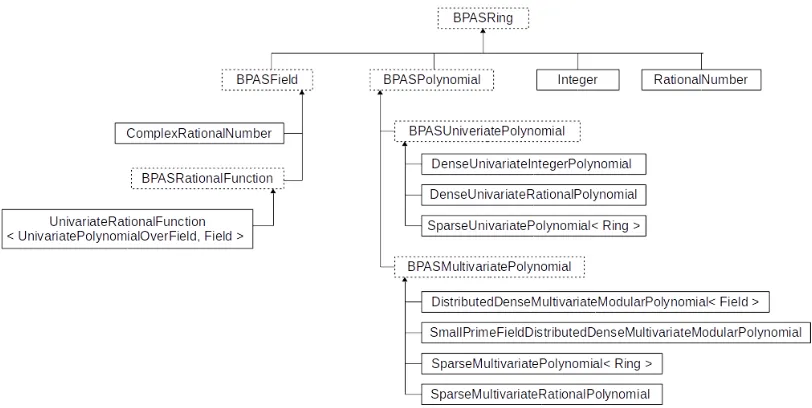
3.1 A subset ofBPASalgebraic data structures . . . 32
3.2 Another subset ofBPASalgebraic data structures . . . 33
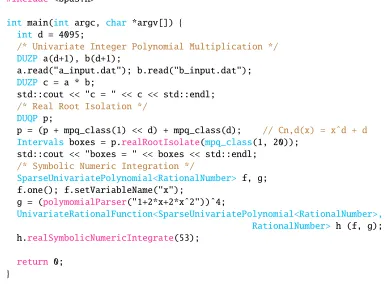
3.3 A snapshot ofBPAScode . . . 33
3.4 Multiplication scheme for dense univariate integer polynomials . . . 35
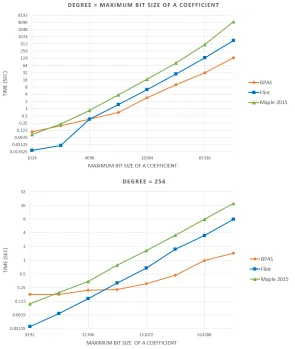
3.5 Dense integer polynomial multiplication:BPASvs FLINT vsMaple . . . 36
3.6 Thehtopscreenshot of multiplying two large integer polynomials inBPAS . . . 37
3.7 An example of matchable interval lists . . . 39
3.8 A sample output ofrealSymbolicNumericIntegrate . . . 40
4.1 Overview of an abstract many-core machine . . . 44
4.2 Overview of a many-core machine program . . . 44
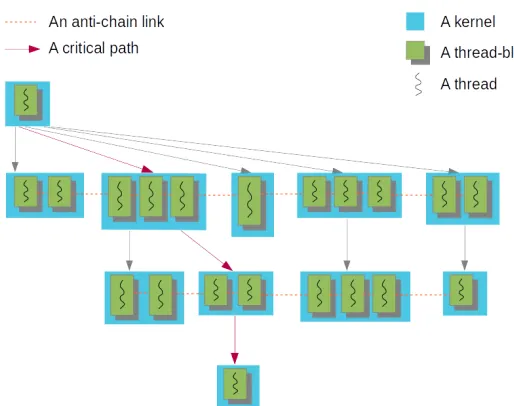
4.3 An example of a thread-block DAG . . . 48
4.5 Running time on GeForce GTX 670 of our multithreaded Euclidean algorithm for univariate polynomials of sizes n and m over Z/pZ, where p is a 30-bit
prime, whereas the program parameter takes valuess= 1 and s=256 . . . 52
4.6 Multiplication phase: illustration of a thread-block reading coefficients froma, band writing to the auxiliary arrayM . . . 57
4.7 Addition phase: illustration of a thread-block reading and writing to the auxil-iary arrayM . . . 57
4.8 Running time of the plain polynomial multiplication algorithm with polynomi-alsa(deg(a)= n−1) andb(deg(b)= m−1) and the parameter son GeForce GTX 670 . . . 59
4.9 Running time of the plain and FFT-based multiplication algorithms with the input sizenon GeForce GTX 670 . . . 60
5.1 Overview of the implementation of theMetaFork-to-CUDAcode generator . . . 69
5.2 One-dimensional stencil computation, namely Jacobi, written in C . . . 70
5.3 1D Jacobi written inMetaFork . . . 70
5.4 Generated parametricCUDAkernel for 1D Jacobi . . . 71
5.5 Generated host code for 1D Jacobi . . . 72
5.6 Serial code, MetaFork code and generated parametric CUDA kernel for array reversal . . . 74
5.7 Serial code,MetaForkcode and generated parametricCUDAkernel for 2D Jacobi 76 5.8 Serial code,MetaForkcode and generated parametricCUDAkernel for LU de-composition . . . 78
5.9 Serial code,MetaFork code and generated parametricCUDAkernel for matrix transpose . . . 79
5.10 Serial code,MetaFork code and generated parametricCUDAkernel for matrix addition . . . 80
5.11 Serial code,MetaFork code and generated parametricCUDAkernel for matrix vector multiplication . . . 81
5.12 Post-processing CUDAkernel with coalesced accesses for matrix vector multi-plication . . . 82
5.13 Serial code,MetaFork code and generated parametricCUDAkernel for matrix matrix multiplication . . . 83
6.1 Multiplication of two matrices . . . 84
6.2 The MetaFork code with the granularity loop and good data alignment for matrix multiplication . . . 85
6.3 Post-processing the generatedCUDAkernel code for matrix multiplication with the granularity loop . . . 87
6.4 CUDAkernel with unrolling the granularity loop for matrix multiplication . . . . 89
6.5 The serial C code with good data locality for matrix multiplication . . . 90
6.6 TheMetaForkcode and its kernel code with the granularity loop for reversing a one-dimensional array . . . 92
6.7 TheMetaForkcode and its kernel code with the granularity loop for 1D Jacobi 93 6.8 The MetaFork code and its kernel code with the granularity loop for matrix
addition . . . 93
6.9 The MetaFork code and its kernel code with the granularity loop for matrix transpose . . . 94
6.10 The MetaFork code and its kernel code with the granularity loop for matrix vector multiplication . . . 95
7.1 Matrix addition written in C (the left-hand portion) and inMetaFork(the right-hand portion) with ameta forloop nest, respectively . . . 97
7.2 Comprehensive translation ofMetaForkcode to two kernels for matrix addition 98 7.3 The decision tree for comprehensive parametricCUDAkernels of matrix addition 99 7.4 Matrix vector multiplication written in C (the left-hand portion) and in Meta-Fork(the right-hand portion), respectively . . . 102
7.5 The decision subtree for resource or performance counters . . . 108
7.6 The serial elision of theMetaForkprogram for matrix vector multiplication . . 111
7.7 The software tools involved for the implementation . . . 112
7.8 Computing the amount of words required per thread-block for reversing a 1D array . . . 113
7.9 The first case of the optimizedMetaForkcode for array reversal . . . 114
7.10 The second case of the optimizedMetaForkcode for array reversal . . . 115
7.11 The third case of the optimizedMetaForkcode for array reversal . . . 115
7.12 The first case of the optimizedMetaForkcode for matrix vector multiplication 115 7.13 The second case of the optimizedMetaForkcode for matrix vector multiplication116 7.14 The third case of the optimizedMetaForkcode for matrix vector multiplication 116 7.15 TheMetaForksource code for 1D Jacobi . . . 117
7.16 The first case of the optimizedMetaForkcode for 1D Jacobi . . . 117
7.17 The second case of the optimizedMetaForkcode for 1D Jacobi . . . 118
7.18 The third case of the optimizedMetaForkcode for 1D Jacobi . . . 118
7.19 The first case of the optimizedMetaForkcode for matrix addition . . . 119
7.20 The second case of the optimizedMetaForkcode for matrix addition . . . 119
7.21 The third case of the optimizedMetaForkcode for matrix addition . . . 119
7.22 The first case of the optimizedMetaForkcode for matrix transpose . . . 120
7.23 The second case of the optimizedMetaForkcode for matrix transpose . . . 120
7.24 The third case of the optimizedMetaForkcode for matrix transpose . . . 120
7.25 The first case of the optimizedMetaForkcode for matrix matrix multiplication 121 7.26 The second case of the optimizedMetaForkcode for matrix matrix multiplication121 7.27 The third case of the optimizedMetaForkcode for matrix matrix multiplication 122 C.1 An example of themeta schedulestatement . . . 182
D.1 PPCGcode and generatedCUDAkernel for array reversal . . . 188
D.2 PPCGcode and generatedCUDAkernel for matrix addition . . . 188
D.3 PPCGcode and generatedCUDAkernel for 1D Jacobi . . . 189
D.4 PPCGcode and generatedCUDAkernel for 2D Jacobi . . . 189
D.7 PPCGcode and generatedCUDAkernel for matrix transpose . . . 191 D.8 PPCGcode and generatedCUDAkernel for matrix matrix multiplication . . . 192
List of Tables
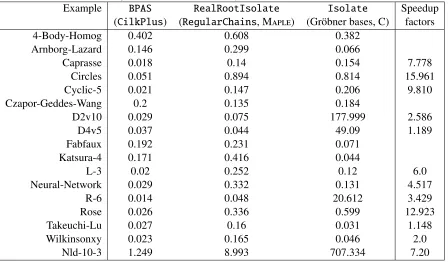
3.1 One-dimensional modular FFTs: ModpnvsBPAS . . . 34 3.2 Cilkviewanalysis ofBPASand KS (∗shows the number of instructions) . . . . 37 3.3 Univariate real root isolation running times (in secs.) for four examples . . . 38 3.4 Running times (in secs.) of multivariate real root isolation: BPASvsMaple17
RealRootIsolatevs C (withMaple17 interface)Isolate . . . 40
4.1 Running time (in secs) of the Cooley & Tukey and Stockham FFT algorithms with the input sizenon GeForce GTX 670 . . . 55
5.1 Speedup comparison of reversing a one-dimensional array betweenPPCGand MetaForkkernel code . . . 74 5.2 Speedup comparison of 1D Jacobi betweenPPCGandMetaForkkernel code . . 75 5.3 Speedup comparison of 2D Jacobi betweenPPCGandMetaForkkernel code . . 75 5.4 Speedup comparison of LU decomposition betweenPPCGandMetaFork
ker-nel code . . . 77 5.5 Speedup comparison of matrix transpose betweenPPCGandMetaFork kernel
code . . . 77 5.6 Speedup comparison of matrix addition between PPCG andMetaFork kernel
code . . . 79 5.7 Speedup comparison of matrix vector multiplication amongPPCGkernel code,
MetaForkkernel code andMetaForkkernel code with post-processing . . . . 80 5.8 Speedup comparison of matrix multiplication between PPCG and MetaFork
kernel code . . . 81 5.9 Timings (in sec.) of quantifier elimination for eight examples . . . 82
6.1 Experimental results of matrix multiplication for the CUDA kernel with the shared memory for the output matrix and the granularity of threads . . . 86 6.2 Experimental results of matrix multiplication for theCUDAkernel with the local
memory for the output matrix and the granularity of threads . . . 88 6.3 For input matrices of order 210, speedup factors of the matrix multiplication
kernel unrolling the computation . . . 88 6.4 For input matrices of order 210, speedup factors of the matrix multiplication
kernel unrolling the copy-in, computation and copy-out phases with a compi-lation flag--maxrregcount=40 . . . 90 6.5 Speedup factors obtained with kernels generated byPPCGandMetaForkwith
post-processing, respectively, w.r.t. the serial C code with good data locality for matrix multiplicationm . . . 91
6.7 Speedup factors of 1D Jacobi for time iteration 4 and input vector of length 215+2 92
6.8 Speedup factors of matrix addition for input matrix of order 212 . . . 92 6.9 Speedup factors of matrix transpose for input matrix of order 214 . . . 94 6.10 Speedup factors of matrix vector multiplication for input matrix of order 213
and input vector of length 213 (An error indicates that the total amount of re-quired shared memory exceeds the hardware limit.) . . . 94
7.1 Optimization strategies with their codes . . . 114
List of Algorithms
1 OptGcdKer(a,b,s,da, db) . . . 49
2 PlainMultiplicationGPU(a,b,s) . . . 56
3 MulKer(a,b,M,n,m,s) . . . 56
4 AddKer(M, f,y,s,x,i) . . . 57
5 ComprehensiveOptimization(Q(S)) . . . 105
6 Optimize . . . 106
7 MultiParametricCodeOptimizer(f ileName) . . . 193
8 Optimize(plan,task) . . . 194
9 Optimize(plan,task) . . . 195
Appendix A Sample Code in theBPASLibrary . . . 135 Appendix B Theoretical Analysis of Fundamental Algorithms Using the MCM Model . . 139 Appendix C Documentation forMetaFork-to-CUDACode Generator . . . 181 Appendix D Examples Generated byPPCG . . . 188 Appendix E The Implementation for Generating ComprehensiveMetaForkPrograms . . 193
Chapter 1
Introduction
It is well known that the impact of the high-performance software for both numerical and ex-act linear algebra on engineering and scientific computing is tremendous, worthy of the great efforts that have been put for more than thirty years. The most significant results are software projects like BLAS [76], LAPACK [3], ATLAS [121] and LinBox [43]. The same remark should be extended to the processing of linear transforms, in particular, Fast Fourier Trans-forms, where notable works are the SPIRAL [98] and FFTW [48] projects, as well as to com-puter algebra, see the recent proceedings of the international workshop on parallel symbolic computation (PASCO) [44, 88, 89].
The successful techniques employed in those software projects include implementation of highly efficient algorithms for basic routines, block-based algorithms for better exploiting the memory hierarchies, parallel and distributed processing, as well as automatically optimiz-ing and tunoptimiz-ing code on different platforms. This trend has been stimulated by the advent of hardware acceleration technologies (multicore processors, cell processors, general-purpose graphics processing units (GPGPUs), field programmable gate arrays (FPGAs)) provide vast opportunities for innovation in computing. In particular, GPGPUs combined with low-level heterogeneous programming models, such asCUDA(theCompute Unified Device Architecture, see [95, 73]), brought super-computing to the level of the desktop computer.
However, these low-level programming models carry notable challenges, even to expert programmers. Indeed, fully exploiting the power of hardware accelerators by writing CUDA code often requires significant code optimization efforts. While such efforts can yield high performance, it is desirable for many programmers to avoid the explicit management of the hardware accelerator, e.g. data transfer between the host (or CPU) and the device (or GPGPU) or between memory levels of the device. For this reason, the most popular multithreaded languages, in particularCilkPlus[10, 79] andOpenMP[41, 13, 9], are based on the fork-join concurrency model targeting multi-core architectures rather than GPGPUs. Currently, these multithreaded languages are being extended to support other forms of parallelism, such as vectorization, pipe-lining and single-instruction-multiple-data (SIMD). In the SIMD case, the case we are interested in this thesis, the objective is to execute the corresponding code on a many-core GPGPU, for which theCUDAlanguage is a natural choice.
To overcome the challenge of developing software targeting many-core GPGPUs,
high-levelmodels for accelerator programming, notablyOpenMP andOpenACC[113, 56], have
be-come an important research direction. With these models, programmers only need to annotate
their C/C++(or FORTRAN) code to indicate which portion of code is to be executed on the device, and how data is mapped between the host and the device.
In OpenMPand OpenACC, the work distributed among the processors of the device can be expressed in a loose manner or even ignored. This implies that code optimization techniques must be applied in order to derive efficientCUDAcode. Moreover, existing software packages (e.g. PPCG[115], C-to-CUDA[6], hiCUDA[57], CUDA-CHiLL[101]) for generatingCUDAcode from annotated C/C++programs, either let the user choose, or make assumptions on the char-acteristics of the targeted hardware and on how the work is divided among the processors of that device. These choices and assumptions limitcode portabilityas well as opportunities for
code optimization. This latter fact will be illustrated with the following example for reversing a one-dimensional array.
Example 1 Consider the C program on Figure 1.1 for reversing a one-dimensional array, where each element of the input vector In is moved to the appropriate position of the out-put vectorOut. Figure 1.2 gives a corresponding CUDAprogram, where the host code, shown on Figure 1.2(a), launches a kernel on the device, shown on Figure 1.2(b). Note that the kernel code makes a few assumptions:
(1) The array lengthNis less than the maximum number of threads that the hardware archi-tecture supports.
(2) 32dividesN.
In order to launch a kernel function, one must specify the grid and thread-block formats (in-troduced in Section 2.2). In our example of Figure 1.232threads per thread-block andN/32 thread-blocks per grid are specified forkernel0. Observe also that the program explicitly han-dles the data placement on the device, for instance, on Figure 1.2, allocating shared memory for arrayInand using the global memory for arrayOut.
int N, In[N], Out[N];
// Initializing
for (int i = 0; i < N; i++) In[i] = i+1;
// Reversing the array In for(int i = 0; i < N; i++)
Out[N-1-i] = In[i];
Figure 1.1: A C program for reversing a one-dimensional array
The C-to-CUDAcode generation introduced in [6] is known to be the first source-to-source polyhedral framework (see Section 2.5 for the term polyhedral) that translates serial C pro-grams intoCUDAprograms. However, manual post-processing, such as placing synchronization statements in the kernel code, is required for generating a compilableCUDAkernel.
3
int N, In[N], Out[N];
// Initializing
for (int i = 0; i < N; i++) In[i] = i+1;
int *dev_In, *dev_Out;
// Allocating memory spaces on the device cudaMalloc((void **) &dev_In, (N)*sizeof(int)); cudaMalloc((void **) &dev_Out, (N)*sizeof(int));
// Copying the data from host to device
cudaMemcpy(dev_In, In, (N)*sizeof(int), cudaMemcpyHostToDevice); cudaMemcpy(dev_Out, Out, (N)*sizeof(int), cudaMemcpyHostToDevice);
// Launching the kernel dim3 dimBlock(32); dim3 dimGrid(N/32);
kernel0 <<<dimGrid, dimBlock>>> (dev_In, dev_Out, N);
// Copying the data from device to host
cudaMemcpy(Out, dev_Out, (N)*sizeof(int), cudaMemcpyDeviceToHost);
// Freeing the memory spaces on the device cudaFree(dev_In);
cudaFree(dev_Out);
(a) The host code
__global__ void kernel0(int *In, int *Out, int N) { int idx = blockIdx.x * 32 + threadIdx.x;
__shared__ int shared_In[32];
if (idx < N) {
shared_In[threadIdx.x] = In[idx]; __syncthreads();
Out[N-1-idx] = shared_In[threadIdx.x]; }
}
(b) The device code
Figure 1.2: TheCUDAprogram for reversing a one-dimensional array
However, by default,PPCGuses 32 (resp. 16×32) as the thread-block format in the gener-ated one-dimensional (resp. two-dimensional) kernels; meanwhile, PPCGalso allows the user to pass a numerical value as the thread-block format.
threads and how the data is mapped on the device. However, the grid and thread-block formats of a kernel must be specified as integer expressions.
CUDA-CHiLL[101] presents a script-based compiler framework for transforming annotated C programs toCUDAprograms. Moreover, in [72], a transformation strategy generator is intro-duced with CUDA-CHiLL, such that several candidateCUDAkernels are generated, by varying data placement (shared memory or register) and numerical values of parameters (like thread-block sizes). Then, empirical evaluation of those candidateCUDAkernels is performed so as to select theCUDAkernel with the best performance by the end.
In summary, for thoseCUDAkernels generated byPPCG, C-to-CUDA,hiCUDAandCUDA-CHiLL, the program parameters (e.g. the number of threads per thread-block) and the machine param-eters (e.g. the shared memory size) are numerical values instead of unknown symbols.
In this thesis, we propose an accelerator model for annotated C/C++code, together with an implementation, that allows the automatic generation ofCUDAcode. One of the key features of thisCUDAcode generator is that it supports the generation ofCUDAkernel code where program parameters (like number of threads per block) and machine parameters (like shared memory size) are treated as unknown symbols. Thus, machine parameters can be specialized to actual values when the generatedCUDAcode is compiled on the targeted hardware. The program pa-rameters can be either optimized by techniques developed in this thesis or automatically tuned at run-time. As an illustration, following up on Example 1, aCUDAkernel code depending on one program parameter, along with a kernel function call from the host, is shown in Figure 1.3 where the variable B specifies the thread-block format. Observe thatkernel1takes the pro-gram parameter B as an argument, whereas thekernel0 in Figure 1.2 takes data parameters In,OutandNonly.
__global__ void kernel1(int *In, int *Out, int N, int B) { int idx = blockIdx.x * B + threadIdx.x;
// BLOCK_0 should be pre-defined as a constant // and be equal to B
__shared__ int shared_In[BLOCK_0];
if (idx < N) {
shared_In[threadIdx.x] = In[idx]; __syncthreads();
Out[N-1-idx] = shared_In[threadIdx.x]; }
}
// The kernel function call from the host dim3 dimBlock(B);
dim3 dimGrid(N/B);
kernel1 <<<dimGrid, dimBlock>>> (dev_In, dev_Out, N, B);
Figure 1.3: ParametricCUDAkernel for reversing a one-dimensional array
1.1. Contributions of this thesis 5
parameters, we provide a correspondingly optimal CUDA kernel. Of course, the meaning of
optimalhas to be clearly defined, which will be done in Chapter 7.
To continue with our example, consider two machine parameters for the targeted GPGPU device:
Z: the maximum number of shared memory words per processor supported by the hardware architecture,
R: the maximum number of registers per thread supported by the hardware architecture. For the C program in Example 1, we generate twoCUDAkernels based on the possible values of the machine and program parameters, see Figure 1.4.
Observe that each thread inkernel2moves two elements of arrayInto the corresponding positions of arrayOut, whereaskernel1is identical to the kernel in Figure 1.3. By doing so, kernel2increases arithmetic intensity so as to hide the data transfer time between the global and shared memories for arrayIn; however, this increases both register usage (from 6 to 8) and shared memory usage (from B to 2*B) machine words. Therefore,kernel2 works correctly and is optimal under the system of the constraintsC2but not under the system of the constraints
C1.
1.1
Contributions of this thesis
One of main objectives of this thesis is to generate CUDAkernels with program and machine parameters represented by unknown symbols. We call such kernelsparametric. These param-eters need not be known at code-generation time. Machine paramparam-eters (e.g. shared memory size) and program parameters (e.g. number of threads per thread-block) can be, respectively, determined when the generatedCUDAcode is installed on the targeted hardware. The challenge here is that any manipulation of non-linear expressions to be generated in the CUDA kernel requires specific code generation techniques relying on algebraic computation.
A second objective is to optimize parametricCUDAprograms at compile-time, in the form of a case discussion, where cases depend on the possible values of machine parameters and program parameters. This leads us to the concept ofcomprehensive parametricCUDAkernels. To be more precise, given an input annotated C code., this is a decision tree, where each edge holds a Boolean expression (given by polynomial constraints) and each leaf is either aCUDA program such that for each leafKwe have:
1. Kworks correctly under the conjunction of the Boolean expressions located between the root node and the leaf, and
2. K is semantically equivalent toC.
In each Boolean expression, the unknown variables represent machine parameters and program parameters. This case discussion can be handled by techniques from symbolic computation. Automatic parametric kernel code generation can, then, be achieved by means of combining an optimizing compiler and a computer algebra system.
C1 :
n
B≤Z<2B ∪ n 6≤R<8
__global__ void kernel1(int *In, int *Out, int N, int B) {
int idx = blockIdx.x * B + threadIdx.x;
// BLOCK_0 should be pre-defined as a constant // and be equal to B
__shared__ int shared_In[BLOCK_0]; if (idx < N) {
shared_In[threadIdx.x] = In[idx]; __syncthreads();
Out[N-1-idx] = shared_In[threadIdx.x]; }
}
dim3 dimBlock(B); dim3 dimGrid(N/B);
kernel1 <<<dimGrid, dimBlock>>> (dev_In, dev_Out, N, B);
C2 : (
2B≤Z 8≤R
__global__ void kernel2(int *In, int *Out, int N, int B) {
int even_idx = blockIdx.x * 2 * B + 2 * threadIdx.x; int odd_idx = blockIdx.x * 2 * B + 2 * threadIdx.x + 1; // BLOCK_0 should be pre-defined as a constant
// and be equal to B
__shared__ int shared_In[2*BLOCK_0]; if (even_idx < N && odd_idx < N) {
shared_In[2*threadIdx.x] = In[even_idx]; shared_In[2*threadIdx.x+1] = In[odd_idx]; __syncthreads();
Out[N-1-even_idx] = shared_In[2*threadIdx.x]; Out[N-1-odd_idx] = shared_In[2*threadIdx.x+1]; }
}
dim3 dimBlock(B); dim3 dimGrid(N/(2*B));
kernel2 <<<dimGrid, dimBlock>>> (dev_In, dev_Out, N, B);
Figure 1.4: Two CUDAkernels based on possible values of machine and program parameters for reversing a one-dimensional array, where Z is the maximum number of shared memory words per processor supported by the hardware architecture andRis the maximum number of registers per thread supported by the hardware architecture
We observe that classical models of parallel computation, namely the fork-join concurrency model [11] and the parallel random access machine (PRAM) model [110, 51], do not distin-guish between the task-based and data-based parallelism. Thus, those models are too simplistic for analyzing algorithms targeting GPGPUs.
1.2
Outline of this thesis
1.2. Outline of this thesis 7
review theMetaForklanguage [29], which is a linguistic extension of C/C++with high-level parallel programming constructs. Similarly toOpenMPandOpenACC, theMetaForklanguage offers ahigh-level model for accelerator programming. We stress the fact that this thesis does not deal with dependence analysis and the computation of schedules in automatic paralleliza-tion; this can be done via the polyhedral model [46, 15] that we briefly review in Chapter 2. Fi-nally, in that same chapter, we give an overview of the algorithmic tools [4, 25, 23, 24, 112, 22] for dealing with systems of non-linear polynomial equations and inequalities.
In Chapter 3, we present the Basic Polynomial Algebra Subprograms (BPAS) library for arithmetic operations with univariate and multivariate polynomials, dense or sparse. TheBPAS library is written inCilkPlustargeting multi-core architectures. The original goal of this the-sis was to investigate how to integrate code targeting GPGPUs (for instance, from theCUMODP library) within theBPASlibrary. These two libraries,BPASandCUMODP, are developed in our research group; moreover, this leads us to the idea of developing frameworks, such as Meta-Fork, for translating programs between different concurrency platforms. We also note that, the BPASlibrary, as a computer algebra library targeting high-performance, could also be used, in the future, for improving the efficiency of our algebraic tools for generating parametricCUDA kernels. The work reported in Chapter 3 is an extended version of [20] as well as a joint project with Changbo Chen, Svyatoslav Covanov, Farnam Mansouri, Robert Moir, Marc Moreno Maza and Yuzhen Xie. Appendix A lists sample codes from theBPASlibrary.
Chapter 4 presents a model of multithreaded computation with an emphasis on estimating the parallelism overheads of programs targeting many-core machines. To evaluate the perfor-mance of a givenCUDA-like program, we consider three complexity measures, namely work,
spanand parallelism overhead. We also extend the Graham-Brent theorem so as to estimate
the running time of aCUDA-like program on a given number of streaming multiprocessors. We evaluate the benefits of our model on six fundamental algorithms, including the Euclidean al-gorithm for univariate polynomial GCDs, two fast Fourier transform alal-gorithms, the plain and FFT-based univariate polynomial multiplication algorithms, and radix sort [103]. Each studied algorithm is either implemented in theCUMODP library or reported in [103]. We observe that experimentation is coherent with the theoretical analysis based on our model. The work in Chapter 4 is an extended version of [61] as well as a joint project with Sardar Anisul Haque and Marc Moreno Maza.
Chapter 5 reports on a preliminary implementation of the C-to-CUDA code generator dis-cussed above. Generating parametricCUDAkernels implies dealing with non-linear polynomial expressions, particularly during the tiling phase. To achieve these algebraic calculations, we take advantage of quantifier elimination (QE) and its implementation of the RegularChains library ofMaple[27]. In order to illustrate the merits of parametricCUDAkernels, we use our code generator on eight test cases: array reversal, 1D Jacobi, 2D Jacobi, LU decomposition, matrix transposition, matrix addition, matrix vector multiplication and matrix matrix multipli-cation. The performance evaluation of the generatedCUDAprograms of each test case is pro-vided as well. Chapter 5 is related to [19] and is joint work with Changbo Chen, Xiaohui Chen and Marc Moreno Maza. Appendix C provides documentation of ourMetaFork-to-CUDAcode generator, while Appendix D collects the generated CUDA programs byPPCG for those same eight test cases.
use six test cases so as to verify whether these techniques can, in general, further improve the performance of parametricCUDAkernels. For each test case, since we use the MetaFork lan-guage as the high-level accelerator programming model, the portion of the code that should be translated into CUDA kernels is annotated manually. Along with the previous chapter, ex-perimentation shows that the generation of parametric CUDA kernels can lead to significant performance improvement w.r.t. approaches based on the generation of CUDAkernels that are not parametric. Moreover, for certain test cases, our experimental results show that the optimal choices for program parameters may depend on the problem size.
In Chapter 7, we propose an algorithm for comprehensive optimizationof an annotated C program, depending on parameters treated as symbols at compile-time. We use this algorithm to generate optimized parametricCUDAkernelsin the form of a case discussion based on the possible values of the machine and program parameters. In our preliminary implementation of the comprehensive optimization algorithm, we consider two machine parameters: register usage per thread and required shared memory per thread-block; meanwhile, we apply four code optimization strategies: caching data in local or shared memory, reducing register usage per thread, controlling thread granularity and eliminating common sub-expressions. This isa proof-of-conceptimplementation written inMaple and dedicated to the comprehensive gener-ation of optimized MetaFork programs from an input MetaFork program. For each of the six test cases: array reversal, matrix vector multiplication, 1D Jacobi, matrix addition, matrix transpose and matrix matrix multiplication, three optimizedMetaForkprograms are generated with systems of constraints. Chapter 7 is joint work with Xiaohui Chen and Marc Moreno Maza. Appendix E provides the pseudo-codes of the implemented algorithms.
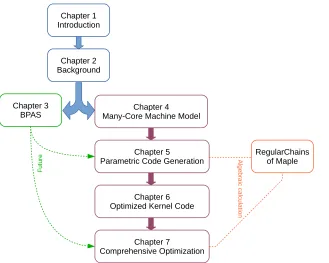
Chapter 1 Introduction
Chapter 3 BPAS
Chapter 2 Background
Chapter 4 Many-Core Machine Model
Chapter 5
Parametric Code Generation
Chapter 6 Optimized Kernel Code
Chapter 7
Comprehensive Optimization
RegularChains of Maple
A
lg
eb
ra
ic
c
alc
ula
tio
n
F
ut
ur
e
Figure 1.5: Overview of the thesis
1.2. Outline of this thesis 9
available in source athttp://www.bpaslib.org, and theMetaFork-to-CUDAcode generator is freely available in source athttp://www.metafork.org.
Background
In this chapter, we review background materials related to our work. Section 2.1 is dedicated to classical models of parallel computation. Section 2.2 discusses briefly the features of modern GPU architectures and the programming model CUDA. Section 2.3 gives an overview of the CUMODPlibrary, which is used in the experimentation reported in Chapter 4. In Section 2.4, we present theMetaForklanguage, which serves as a high-level parallel programming model for automaticCUDAcode generation in Chapters 5, 6 and 7. In Section 2.5, we study Feautrier’s and PLUTO’s algorithms in the so-calledpolyhedral model. Finally, Section 2.6 is an overview of the algorithmic tools used for dealing with systems of polynomial equations and inequalities.
2.1
Models of computation
Based on Flynn’s taxonomy [47],single instruction multiple data(SIMD) is defined as one of the categories of parallel computers, where multiple processing units execute the same instruc-tions on multiple data sets. In this scheme, data is distributed across different processing units so as to achievedata parallelism. In contrast, task parallelismdistributes tasks (or functions) to different processing units.
As mentioned before, with the pervasive ubiquity of many-core processors, in particular GPUs, models of computation must take into account both task-based and data-based paral-lelism. In fact, popular concurrency platforms (such asCilkPlus[10, 79],CUDA[95, 73] and OpenCL[111]) offer both forms of parallelism, with parallel constructs specific to each case.
Hereafter, we review two classical models of parallel computation, the fork-join model in Section 2.1.1 and the parallel RAM (PRAM) model in Section 2.1.2. Those models do not distinguish between task-based parallelism and data-based parallelism; thus, those models are too simplistic for analyzing algorithms targeting many-cores.
2.1.1
Fork-join model
In the fork-join model [11], one can consider a multithreaded program (see Chapter 27 in [34]) as a directed acyclic graphG= (V,E), calledcomputation DAG. Figure 2.1 shows the compu-tation DAG for calculating the 5-th Fibonacci number, namelyF4, where Fn = Fn−1+Fn−2 if
2.1. Models of computation 11
n≥ 2 andF0 = F1 = 1 otherwise. In a multithreaded program, we call astranda sequence of
consecutive instructions without parallel constructs.
Figure 2.1: An example of computation DAG: Fourth Fibonacci
This model defines two complexity measures:
1. thework T1 of a multithreaded computation is the total time to execute the entire
com-putation on one processor, and
2. thespan T∞ is the longest time to execute the strands along any path in the DAG.
Assuming that each strand executes in unit time, the work is the number of vertices, and the span equals the number of vertices on a longest path orcritical pathin the computation DAG.
Those two measures, work and span, and one machine parameter, the number P of pro-cessors, can be combined in results like the Graham-Brent theorem ([11, 53]) or the Blumofe-Leiserson theorem (Theorems 13 & 14 in [12]) in order to give running time estimates. We recall that the Graham-Brent theorem states that the running timeTP onPprocessors satisfies
TP ≤T1/P+T∞. A refinement of this latter theorem actually supports the implementation (on
multi-core architectures) of the parallel performance analyzer, called Cilkview [63]. In this context, the running timeTP is bounded in expectation byT1/P+2δTc∞, whereδis a constant
(called thespan coefficient) andTc∞is the so-calledburdened span.
The fork-join model has become popular with the development of the concurrency plat-form CilkPlus [10, 79] targeting multi-core architectures. An example of code written in CilkPlus is given in Figure 2.2 for computing matrix multiplication. This CilkPlus code is implemented with a divide & conquer method and the blocking strategy reported in [49] by Frigo, Leiserson, Prokop and Ramachandran.
2.1.2
PRAM model
The PRAM model [110, 51] is defined as a synchronous model of parallel computation. The PRAM machine consists of a number of processors, each of which is a RAM with a private local memory, and a shared memory that processors communicate with. Since the amount of shared memory is limited, it restricts the amount of data that can be communicated between processors in one step.
/**
* Square matrices A, B, C of order N * The base case size is set to X
* Call to parallel_dandc(0, N, 0, N, 0, N, A, B, C, N, X); **/
void parallel_dandc(int i0, int i1, int j0, int j1, int k0, int k1, int* A, int* B, int* C, int N, int X) { int di = i1 - i0;
int dj = j1 - j0; int dk = k1 - k0;
if (di >= dj && di >= dk && di >= X) { int mi = i0 + di / 2;
cilk_spawn parallel_dandc(i0, mi, j0, j1, k0, k1, A, B, C, N, X); parallel_dandc(mi, i1, j0, j1, k0, k1, A, B, C, N, X);
cilk_sync; }
else if (dj >= dk && dj >= X) { int mj = j0 + dj / 2;
cilk_spawn parallel_dandc(i0, i1, j0, mj, k0, k1, A, B, C, N, X); parallel_dandc(i0, i1, mj, j1, k0, k1, A, B, C, N, X);
cilk_sync; }
else if (dk >= X) { int mk = k0 + dk / 2;
parallel_dandc(i0, i1, j0, j1, k0, mk, A, B, C, N, X); parallel_dandc(i0, i1, j0, j1, mk, k1, A, B, C, N, X); }
else {
// The base case using the serial, naive matrix multiplication for (int i = i0; i < i1; ++i)
for (int j = j0; j < j1; ++j) for (int k = k0; k < k1; ++k)
C[i * N + j] += A[i * N + k] * B[k * N + j]; }
}
Figure 2.2: Matrix multiplication written inCilkPlus
(EREW),concurrent read exclusive write(CREW),exclusive read concurrent write(ERCW) andconcurrent read concurrent write(CRCW). At one step, “exclusive” indicates that at most one processor can read from or write to the same memory cell, while “concurrent” indicates that processors can simultaneously read from or write to the same memory cell. The advantage of the PRAM model is that it focuses on designing efficient parallel algorithms in terms of arithmetic operations while ignoring communication issues. In addition, all memory accesses are assumed to take place in constant time. Unfortunately, concrete machines cannot currently scale to large numbers of processors while preserving uniformly fast access time to the shared memory.
An attempt to integrate memory contention into the PRAM model has been made with the
queue read queue write(QRQW) PRAM, defined in [52]. This model enhances the
2.2. General-purposeGPUcomputing 13
and time spent in read/write accesses are conflated in a single quantity. We believe that this unification is not appropriate for recent many-core processors, such as NVIDIA GPUs, for which the ratio between one global memory read/write access and one floating point operation can be in the 100’s.
A more practical PRAM model is proposed in [51] called asynchronous PRAM. Unlike the PRAM model, the processors of an asynchronous PRAM run asynchronously, that is, each processor executing its instructions independently without interrupting others. It considers subset independent synchronization and fixed communication delays for global reads/writes. However, this family of PRAM is not suitable to modern GPUs, since it is trivial to consider a machine parameter for synchronization, which is not an issue for modern GPUs.
2.2
General-purpose GPU computing
Figure 2.3: Overview of a hybrid CPU-GPU system
2.2.1
The
Compute Unified Device Architecture
(
CUDA
)
CUDAis the programming model introduced to implement parallel algorithms on NVIDIA GPU devices [95, 73]. ACUDAprogram consists of one or more blocks of code that are executed on either the host (CPU) or the device (GPU). On the host, the code is implemented with little or no parallelism, while on the device, the code is designed to exhibit a rich amount of task or data parallelism, in particular, in a SIMD fashion.
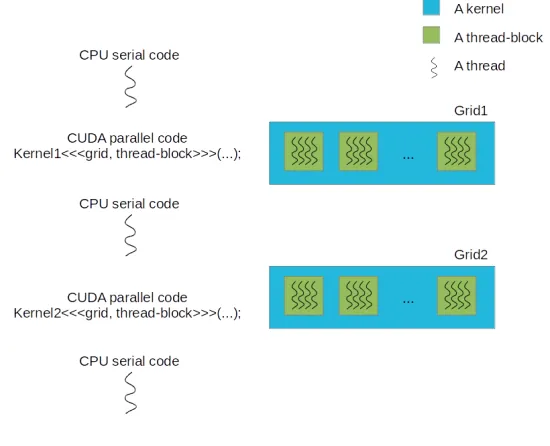
Figure 2.4: Execution of aCUDAprogram
The execution of a typical CUDA program is shown in Figure 2.4. It starts with the se-rial C/C++code and then launches a kernel on the device to execute the parallel code. Upon the completion of the kernel, the process resumes to the execution of serial code on the host. When a kernel function is invoked, the number of thread-blocks and the number of threads per thread-block are specified, according to the problem size, by the programmer. The syntax for launching a kernel from the host code extends that of a C function call with kernel execution configuration parameters surrounded by<<<and>>>, where the execution configuration pa-rameters define the dimensions of the grid and the dimensions of each thread-block. All the threads comprising a kernel during an invocation are collectively called agrid.
In addition, the programmer needs to allocate the problem size on the device memory using the keyword cudaMalloc and free the device memory after computation using the keyword cudaFree. To transfer pertinent data between the host and allocated device memories, one can use the keywordcudaMemcpy, withcudaMemcpyHostToDeviceand cudaMemcpyDeviceTo-Hostspecifying where the data is copied from and to. The function type qualifier global 1,
written prior to a function declaration, indicates that the function is a kernel; meanwhile, on the host, this kernel is called to generate a grid of threads on the device. Moreover, threadIdx,
2.2. General-purposeGPUcomputing 15
blockIdx andblockDim are built-in variables to identify the thread index, the thread-block index and the thread-block dimension, respectively.
2.2.2
Modern GPU architectures
Unlike CPUs optimized for low latency access to memory systems, modern GPUs are designed for data-parallel, throughput computation and tolerance of memory latency. A GPU typically consists of a global memory (dynamic random-access memory(DRAM)), a number of
stream-ing multiprocessors (SMs) and a global scheduler. Each SM contains a number of cores, a
shared memory and a thread scheduler.
Apart from the evolution of graphic techniques on GPUs, we summarize key features of modern GPU architectures with respect to general-purpose GPU computing as below.
1. Hardware thread scheduling. Based on the documentation of NVIDIA Fermi [36] and
Kepler [37] architectures, there is a two-level, distributed thread scheduler, such that thread-blocks from the same or different kernels are scheduled to various SMs and warps of 32 threads of a thread-block are distributed to execute concurrently.
2. Memory hierarchy. This hierarchy offers the benefits of the on-chip local memory for each thread, theon-chipshared memory shared among threads in an SM with low latency, and the global memory for sharing across the GPU with high throughput. In order to declare an array allocated in the shared memory of the SM, one shall use the shared qualifier prior to the declaration of the array (see Figure 1.3 for an example). Moreover, when a warp of threads accesses consecutive memory locations to the global memory, the hardwarecoalescesits memory accesses into a consolidated access.
3. Data parallelism. This is implemented as SIMD processors or in a single instruction
multiple thread(SIMT) fashion.
4. Task parallelism. This type of parallelism, also calleddynamic parallelism, can launch a new kernel from a thread, synchronize on the results and control the scheduling via the hardware paths; moreover, these operations are done independently of the CPU. This allows data-dependent and recursive code to execute in parallel on GPUs.
5. Latency hidden. This is done via computation by SIMT (instead of cache). Based on the concept offast context switching, active warps of threads that wait for memory accesses are switched to those whose data are available. Typically, 128 threads per SM occupy an SM during the computation to hide the global memory access latency.
6. Synchronization. Threads are independent of each other, such that there are no synchro-nization issues among thread-blocks per grid, while threads with a thread-block can be synchronized by issuing syncthreads(). Additionally, synchronization of task par-allelism is explicitly managed prior to launching a (child) kernel to ensure that all data is ready. If thread divergence occurs, both sides of the branch execute within a warp, and idle threads in a warp wait for others to complete.
2.3
Dense arithmetic over finite fields with the
CUMODP
li-brary
CUMODP [59] is a CUDAlibrary for exact computations with dense polynomials over finite fields. A variety of operations, like multiplication, division, computation of subresultants, multi-point evaluation, interpolation and many others, are provided. These routines are pri-marily designed to offer GPU support to polynomial system solvers and a bivariate system solver is part of the library. Algorithms combine FFT-based and plain arithmetic, while the implementation strategy emphasizes reducing parallelism overheads and optimizing hardware usage.
Polynomial multiplication and matrix multiplication are at the core of many algorithms in symbolic computation. Expressing, in terms of multiplication time, the algebraic complex-ity of an operation like univariate polynomial division or the computation of a characteristic polynomial is a standard practice, see for instance the landmark book [120]. At the software level, the motto “reducing everything to multiplication”2 is also common, see for instance the
computer algebra systems Magma [16], NTL [108] or FLINT [62].
With the advent of hardware accelerator technologies, multi-core processors and Graph-ics Processing Units (GPUs), this reduction to multiplication is, of course, still desirable, but becomes more complex since both algebraic complexity and parallelism need to be consid-ered when selecting and implementing a multiplication algorithm. In fact, other performance factors, such as cache usage or CPU pipeline optimization, should be taken into account on modern computers, even on single-core processors. These observations guide the developers of projects like SPIRAL [98] or FFTW [48].
TheCUMODPlibrary provides arithmetic operations for matrices and polynomials (in a dense representation) primarily with modular integer coefficients, targeting many-core GPUs. Some operations are available for integer or floating point coefficients as well. A large portion of the CUMODP library code is devoted to polynomial multiplication and the integration of that operation into higher-level algorithms.
Typical CUMODP operations are matrix determinant computation, polynomial multiplica-tion (both plain and FFT-based), univariate polynomial division, the Euclidean algorithm for univariate polynomial GCDs, subproduct tree techniques for multi-point evaluation and in-terpolation, subresultant chain computation for multivariate polynomials and bivariate system solving. TheCUMODPlibrary is written inCUDA[95, 73] and its source code is publicly available atwww.cumodp.org.
This work is reported in [59] and is a joint project with Sardar Anisul Haque, Xin Li, Farnam Mansouri, Marc Moreno Maza and Wei Pan.
2.4. TheMetaForklanguage 17
2.4
The
MetaFork
language
MetaFork [29] is a high-level programming language extending C/C++, which combines several models of concurrency, including fork-join and pipelining parallelisms. MetaFork is also a compilation framework, which aims at facilitating the design and implementation of concurrent programs through three key features:
1. Perform automatic code translation between concurrency platforms targeting both multi-core and many-multi-core GPU architectures.
2. Provide a high-level language for expressing concurrency as in the fork-join model, the SIMD (single instruction multiple data) paradigm and the pipelining parallelism. 3. Generate parallel code from serial code with an emphasis on code depending on machine
or program parameters (e.g. cache size, number of processors, number of threads per thread-block).
As of today, the publicly available and latest release of MetaFork, see www.metafork. org, offers the second feature stated above, a preliminary implementation of the third feature as well as the multi-core and many-core portions of the first one. To be more specific, Meta-Forkis a meta-language for concurrency platforms based on the fork-join model, pipelining parallelism and the SIMD paradigm. This meta-language forms a bridge between actual multi-threaded programming languages, and we use it to perform automatic code translation between those languages.
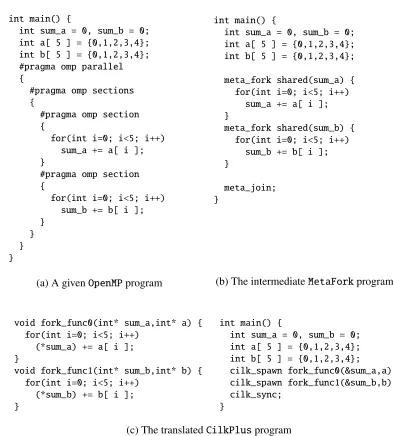
In an earlier work [29], MetaForkwas introduced as an extension of both the C and C++ languages into a multithreaded language based on the fork-join concurrency model [11]. Thus, concurrent execution is obtained by a parent thread creating and launching one or more children threads, so that the parent and its children execute a so-calledparallel region. An important ex-ample of parallel regions arefor-loop bodies.MetaForkhas four parallel constructs dedicated to the fork-join model: function call spawn, block spawn, parallelfor-loop and synchroniza-tion barrier. The first two use the keywordmeta fork, while the other two use, respectively, the keywords meta for and meta join. Similar to the CilkPlus specifications, the paral-lel constructs ofMetaForkgrant permission for concurrent execution but do not command it. Hence, aMetaForkprogram can execute on a single core machine. We emphasize the fact that meta fork allows the programmer to spawn a function call (like in CilkPlus [10, 79, 35]) as well as a block (like in OpenMP [41, 13, 9]). Using the same examples from [29], Fig-ures 2.5, 2.6 and 2.7 illustrate automatic code translation between theOpenMPprogram and the CilkPlusprogram via theMetaForklanguage.
long fib(long n) { long x, y;
if (n<2) { return n; } else if (n<BASE)
return fib_serial(n); else {
x = cilk_spawn fib(n-1); y = fib(n-2);
cilk_sync; return (x+y); }
}
(a) A givenCilkPlusprogram
long fib(long n) { long x, y;
if (n<2) { return n; } else if (n<BASE)
return fib_serial(n); else {
x = meta_fork fib(n-1); y = fib(n-2);
meta_join; return (x+y); }
}
(b) The intermediateMetaFork program
long fib(long n) { long x, y;
if (n<2) { return n; } else if (n<BASE)
return fib_serial(n); else {
#pragma omp task shared(x) x = fib(n-1);
y = fib(n-2);
#pragma omp taskwait return (x+y);
} }
(c) The translatedOpenMPprogram Figure 2.5: UsingMetaForkto translate a givenCilkPlusprogram into aOpenMPprogram
int main() { int a[N]; int b = 0;
#pragma omp parallel #pragma omp for private(b) for (int i=0;i<N;i++) {
b = i ; a[i] = b; }
}
(a) A givenOpenMPprogram
int main() { int a[N]; int b = 0;
meta_for (int i=0;i<N;i++) {
int b; b = i ; a[i] = b; }
}
(b) The intermediateMetaFork program
int main() { int a[N]; int b = 0;
cilk_for (int i=0;i<N;i++) {
int b; b = i ; a[i] = b; }
}
(c) The translatedCilkPlus program
Figure 2.6: UsingMetaForkto translate a givenOpenMPprogram into aCilkPlusprogram
parallelism overheads. This problem is studied by Shirako, Unnikrishnan, Chatterjee, Li and Sarkar [107] together with a solution in the context ofOpenMPby proposing new synchroniza-tion constructs to enabledo-across parallelism. These observations have motivated a first ex-tension of the MetaFork language with three constructs to expresspipeliningparallelism: meta pipe, meta wait andmeta continue. Recall that a pipeline is a linear sequence of processing stages through which data items flow from the first stage to the last stage. If each stage can process only one data item at a time, then the pipeline is said to beserialand can be depicted by a (directed) path in the sense of graph theory. If a stage can process more than one data item at a time, then the pipeline is said to be paralleland can be depicted by a directed acyclic graph (DAG), where each parallel stage is represented by an independent set, that is, a set of vertices of which no pair is adjacent.
2.5. Automatic parallelization in the polyhedral model 19
int main() {
int sum_a = 0, sum_b = 0; int a[ 5 ] = {0,1,2,3,4}; int b[ 5 ] = {0,1,2,3,4}; #pragma omp parallel {
#pragma omp sections {
#pragma omp section {
for(int i=0; i<5; i++) sum_a += a[ i ]; }
#pragma omp section {
for(int i=0; i<5; i++) sum_b += b[ i ]; }
} } }
(a) A givenOpenMPprogram
int main() {
int sum_a = 0, sum_b = 0; int a[ 5 ] = {0,1,2,3,4}; int b[ 5 ] = {0,1,2,3,4};
meta_fork shared(sum_a) { for(int i=0; i<5; i++)
sum_a += a[ i ]; }
meta_fork shared(sum_b) { for(int i=0; i<5; i++)
sum_b += b[ i ]; }
meta_join; }
(b) The intermediateMetaForkprogram
void fork_func0(int* sum_a,int* a) { for(int i=0; i<5; i++)
(*sum_a) += a[ i ]; }
void fork_func1(int* sum_b,int* b) { for(int i=0; i<5; i++)
(*sum_b) += b[ i ]; }
int main() {
int sum_a = 0, sum_b = 0; int a[ 5 ] = {0,1,2,3,4}; int b[ 5 ] = {0,1,2,3,4};
cilk_spawn fork_func0(&sum_a,a); cilk_spawn fork_func1(&sum_b,b); cilk_sync;
}
(c) The translatedCilkPlusprogram
Figure 2.7: UsingMetaForkto translate a givenOpenMPprogram into aCilkPlusprogram
automatically generating compilable CUDA programs with program parameters (like number of threads per thread-block) and machine parameters (like shared memory size) allowed at code-generation-time.
This work is summarized in [19].
2.5
Automatic parallelization in the polyhedral model
Hypothesis 1 We considerfor-loop nests having the format shown on Figure 2.8. Note that
for (i_1 = 0; i_1 < N_1; i_1++) .
. .
for (i_e = 0; i_e < N_e; i_e++) {
// for-loop nest body
}
Figure 2.8:For-loop nest in the polyhedral model
Figure 2.8 suggests that thefor-loop nest isperfect, that is, only the innermost loop may have statements other than afor-loop.
In fact, imperfectfor-loop nests can be reduced to perfectfor-loop nests [71] without change of semantics but with possible loss of efficiency in terms of consumption of computer resources (time and space).
Paul Feautrier’s [46] andPLUTO’s [15] algorithms are two procedures for generating parallel code from serial C code automatically. The two procedures focus on parallelizing for-loop nests (including imperfect ones) under the following assumption.
Hypothesis 2 Referring to the notations introduced in Figure 2.8, in every array reference (e.g. i 1 * N 1 + i 2ina[i 1 * N 1 + i 2]) in thefor-loop nest body,
(i) the index is an arithmetic expression linear in the vector(i 1, ..., i e, N 1, ..., N e), where
(ii) each ofN 1, ..., N eis an arithmetic expression linear in all the variables occurring in that expression.
Note thati 1 * N 1 + i 2 is linear in each of the variables i 1, N 1, i 2, but not in the vector(i 1, i 2, N 1).
Hypothesis 2 implies that the iterations of thefor-loop nest can be represented by the in-teger points of a polyhedron. For that reason, Feautrier’s andPLUTO’s algorithms are said to be based on thepolyhedral model. Before giving a sketch of those algorithms in Sections 2.5.7 and 2.5.8, we review the concepts of aZ-polyhedron in Section 2.5.1, a polyhedral iteration do-main in Section 2.5.2, a data dependence graph in Section 2.5.3, the dependence polyhedron in Section 2.5.4, an affine transformation in Section 2.5.5 and Farkas multipliers in Section 2.5.6.
2.5.1
Z
-polyhedron
Let Z be the ring of the integer numbers and m be a positive integer. The set of all vectors
~x ∈Zm
whereh.~x = kwithh∈ Zm
andk ∈Zis anaffineZ-hyperplane. The set of all vectors
~x ∈ Zm where A~x+~c ≥ 0 with an p×minteger matrix A (for p > 0) and~c ∈
2.5. Automatic parallelization in the polyhedral model 21
2.5.2
Polyhedral iteration domain
We observe that every for-loop nest in the format shown on Figure 2.8 naturally defines a Z-polytopeD inZe, callediteration domainof the for-loop nest; moreover, the points of D are callediteration vectors. Let~I = (I1, . . . ,Ie) andJ~= (J1, . . . ,Je) be two iteration vectors in
D. We writeJ~≺lex ~I whenever~I is lexicographically greater thanJ~. We writeJ~lex ~Iif either
~
J ≺lex ~IorJ~= ~Iholds. We calldefining systemofDthe system of linear inequalities:
0≤ i1< N1 ...
0≤ie < Ne
Let~I = (I1, . . . ,Ie) andS be respectively an iteration vector ofDand a statement of the body of our perfect loop nest. We denote byS(~I) the execution ofS during the~I-th iteration of the for-loop nest.
2.5.3
Data dependence graph
The following definition is restricted to our context of a perfectfor-loop nest, while it could be stated for an arbitrary program. Let~Iand J~be two iteration vectors inD. LetSsandSt be two statements of the for-loop nest body. We say that there is adata dependencefromSs(~I) to St(J~) (alternatively, we say that St(J~) depends on Ss(~I)), and we write Ss(~I) =⇒ St(J~), whenever the following conditions hold simultaneously:
(1) both Ss(~I) andSt(J~) access the same memory location and at least one of them stores data into this memory location, and
(2) we have~I ≺lex J~.
Thedata dependence graph(DDG)G= (V,E) is a labelled directed-graph, where (1) the setV of the vertices is the set of the statements of thefor-loop nest body,
(2) (Ss,St) is an edge if there exist two iteration vectors~IandJ~such that we haveSs(~I) =⇒
St(J~),
(3) each edge (Ss,St) is labelled with the set of the pairs (~I, ~J) of iteration vectors such that we haveSs(~I) =⇒ St(J~).
We classify the data dependence from statementSs(~I) to statementSt(J~) into three categories, based on the sequences of read and write operations to the same memory locationX:
- True dependence(also known as aflowdependence): Xis written inSsbefore it is read inSt.
Ss: X = . . .
St : . . . = X - Anti-dependence: X is read inSsbefore it is written inSt.
Ss: . . . = X
St : X = . . .
- Output dependence: Xis written inSsbefore it is written inSt.
Ss: X = . . .
Example 2 Consider the source program given below:
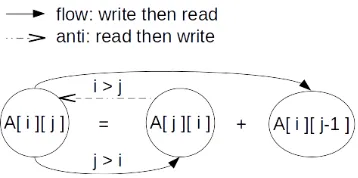
for (int i = 0; i < N; ++i) for (int j = 1; j < N; ++j) S: A[i][j] = A[j][i] + A[i][j-1];
Figure 2.9 shows the data dependence graph of the source program in Example 2. Observe that data dependence occurs for each of the following:
- fromA[i][j-1]in statementS toA[i’][j’]in statementS wheni’ = i, j’ = j - 1(flow dependence),
- fromA[j][i]in statementStoA[i’][j’]in statementSwheni’ = j, j’ = i, i < j(flow dependence),
- fromA[i][j]in statementStoA[j’][i’]in statementSwhenj’ = i, i’ = j, j < i(anti-dependence),
where(i, j)and(i’, j’)are two iteration vectors of thefor-loop nest; thus,i, j, i’, j’ are non-negative integers satisfying i < N, 0 < j, j < N, i’ < N, 0 < j’, j’ < N.
Figure 2.9: An example of the data dependence graph of the source program
2.5.4
Dependence polyhedron
Lete:= (Ss,St) be an edge of the data dependence graph. Let~IandJ~be two iteration vectors such that we have Ss(~I) =⇒ St(J~). We call dependence polyhedronassociated with e the
Z-polyhedron defined by the conjunction of the inequalities on~I, ~Jexpressing the fact that the following conditions hold simultaneously:
(i) ~I ∈ D, (ii) J~∈ D,
2.5. Automatic parallelization in the polyhedral model 23
In Example 2, for the flow dependence from A[i][j-1] to A[i’][j’] in Figure 2.9, we observe that the dependence polyhedron is
1 0 0 0 0 0
−1 0 0 0 1 −1
0 1 0 0 0 −1
0 −1 0 0 1 −1
0 0 1 0 0 0
0 0 −1 0 1 −1
0 0 0 1 0 −1
0 0 0 −1 1 −1
1 0 −1 0 0 0
0 1 0 −1 0 −1
i j i0 j0 N 1 ≥ 0 = 0 (2.1)
2.5.5
A
ffi
ne transformation
Consider a for-loop nest and a statementS in the body of this loop nest. Let x1, . . . ,xms be
the loop iteration counters occurring in the indices of the array references in the statementS; we write ~x = [x1 · · · xms]. By definition, a one-dimensional affine transformation for the
statementS maps~xtoφS(~x) defined by
φS(~x)=t1 · · · tms
~
x+ t0,
wheret0 ∈Zandt1 · · · tms
is a row-vector overZ. In the literature, the mapφS is sometimes referred as an affine hyperplane. An n-dimensional affine transformation for statement S is given by
φS(~x)= T ~x+~t,
whereT is a constant matrix with nrows (and mS columns) and~t is a constant vector of size
n, the coefficients of bothT and~tbelonging toZ. In the literature, the mapφs is also called a
scattering function.
In the polyhedral model, the notions of one-dimensional affine transformations and n -dimensional affine transformation are used to perform an affine change of coordinate system for the loop iteration counters so as to exhibit for-loop nests whose iterations can be executed concurrently. Note that, because of the inequality constraints that appear in the polyhedron, this cannot simply be done via linear algebra and requires polyhedral operations, like projection, which can be done by the Fourier-Motzkin elimination algorithm3[122].
To be more precise, one-dimensional affine transformations andn-dimensional affine trans-formations are meant to be used as time coordinates and any other other coordinates are re-garded asspace coordinates. A tuple of space coordinates can be interpreted as a processor and the transformedfor-loop can be interpreted as a schedule for each processor. Therefore, if such one-dimensional affine transformations exist, it can be understood as a way of executing the original for-loop in a parallel manner. In the sequel, we will call parallelization such a one-dimensional affine transformation.