3567 R. Sai Chandana, Dr. K. Bhavya Sri, Dr. M. Sumakanth, R. Swethasri
Abstract: A simple, precise and rapid RP-HPLC method was developed and validated for the estimation of pioglitazone hydrochloride. Separation was achieved by using Phenomenex Luna C18 column (250x4.6mm, 5μm) using a mixture of methanol and water in the ratio 75:25 with a flow rate of 1ml/min. The analyte was monitored out using UV detector at 268nm. The retention time was found to be 3.28mins. The proposed method showed linearity for concentration range of 10-18μg/ml with correlation coefficient r2-0.999. The proposed method showed good recovery. This method is accurate, precise, linear and can be used for routine analysis of Pioglitazone Hydrochloride.
Keywords: Pioglitazone hydrochloride, RP-HPLC, validation, method development.
————————————————————
INTRODUCTION:
Pioglitazone is an oral antidiabetic agent belonging to the class of thiazolidinedione that acts primarily by decreasing insulin resistance. It is used in the management of type 2 diabetes mellitus. It improves sensitivity to insulin in muscle and adipose tissue and inhibits hepatic gluconeogenesis also improves glycemic control while reducing circulating insulin levels. Pioglitazone [(±) - 5- [[4- [2- (5- ethyl- 2- pyridinyl) ethoxy] phenyl] methyl] -2, 4-] thiazolidinedione monohydrochloride belongs to a different chemical class and has a different pharmacological action than the Sulfonylureas, metformin, or α glucosidase inhibitors. The aim of the present study is to develop a simple RP-HPLC method with UV detection for the quantitative determination of Pioglitazone hydrochloride. This analytical method can be used for the estimation of Pioglitazone hydrochloride in regular analysis.[1]
Fig.1: Structure of Pioglitazone hydrochloride
MATERIALS AND METHODS:
Instrumentation:
Analysis was performed using Waters HPLC equipped with waters 2476 dual λ absorbance UV detector, Phenomenex Luna C18 column (250X4.6mm,5μm) and an waters 717 plus auto sampler. The output signal was monitored and processed using Empower 3 software.[2]
Chemicals:
Pioglitazone hydrochloride drug sample was procured from MSN Organics Private Limited, Hyderabad , methanol HPLC grade and double distilled water HPLC grade were procured from s d fine-chem. limited. Tablets were procured from local market (pioglar 30mg – sun pharmaceutical India, Ltd).
Chromatographic conditions:
The chromatographic determination of pioglitazone hydrochloride was achieved by using Phenomenex Luna C18 column (250X4.6mm,5μm).A mixture of methanol: water in the ratio of 75:25 was used as mobile phase. The mobile phase is filtered through a 0.45μm filter and then degassed by ultrasonicator. The flow rate of 1ml/min was maintained and detection was carried out 268nm.[3]
Diluent: Methanol HPLC grade.
Preparation of stock and working standard solutions:
10mg of pioglitazone was accurately weighed and transferred into a 10ml volumetric flask containing methanol and made upto mark (1000μg/ml). From stock solution 1 ml was pipetted and transferred into another 10ml volumetric flask and upto mark the volume with methanol (100μg/ml).From the working standard 1ml solution was pipetted into another 10ml volumetric flask and made upto mark (10μg/ml).[4]
METHOD VALIDATION:
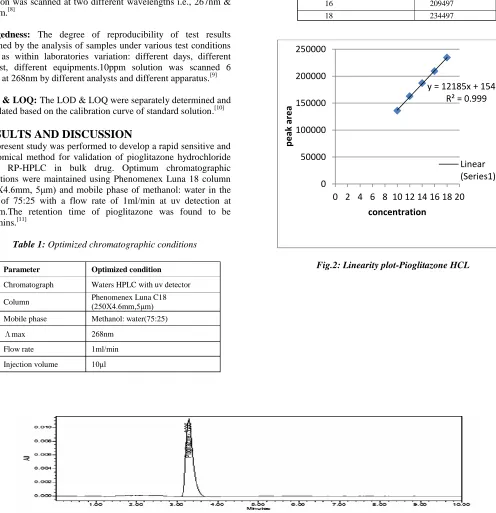
Linearity: The linearity of detector response is determined by plotting a graph with series of standard concentration range of 10-18μg/ml with concentration on X-axis and absorbance on Y-axis at 268nm. The correlation coefficient for pioglitazone hydrochloride was found to be 0.999. This data demonstrates that the method developed showed adequate sensitivity to the series of concentrations of analyte in sample.[5]
Precision: The precision of the analytical method was determined by analysis of multiple sampling of the same homogenous sample at 268nm.[6]
Accuracy: Accuracy for pioglitazone hydrochloride is determined by spiking triplicate concentrations of standard solution at different levels (50%, 100% & 150%) with a known ____________________________
R.Sai Chandana, Dr.K.Bhavya sri, Dr.M.Sumakanth, R.Swethasri RBVRR WOMEN’S COLLEGE OF PHARMACY, BARKATPURA,
HYDERABAD-500078
concentration of a sample and absorbance was measured at 268nm.[7]
Robustness: The robustness of an analytical procedure is a measure of its capacity to remain unaffected by small, but deliberate variations in method parameters and provides an indication of its reliability during normal usage. Standard 10ppm solution was scanned at two different wavelengths i.e., 267nm & 269nm.[8]
Ruggedness: The degree of reproducibility of test results obtained by the analysis of samples under various test conditions such as within laboratories variation: different days, different analyst, different equipments.10ppm solution was scanned 6 times at 268nm by different analysts and different apparatus.[9]
LOD & LOQ: The LOD & LOQ were separately determined and calculated based on the calibration curve of standard solution.[10]
RESULTS AND DISCUSSION
The present study was performed to develop a rapid sensitive and economical method for validation of pioglitazone hydrochloride using RP-HPLC in bulk drug. Optimum chromatographic conditions were maintained using Phenomenex Luna 18 column (250X4.6mm, 5μm) and mobile phase of methanol: water in the ratio of 75:25 with a flow rate of 1ml/min at uv detection at 268nm.The retention time of pioglitazone was found to be 3.28mins.[11]
Table 1: Optimized chromatographic conditions
Table 2: Linearity results
Fig.2: Linearity plot-Pioglitazone HCL
Fig.3: Linearity chromatogram of 10μg/ml of Pioglitazone HCL solution
y = 12185x + 15412 R² = 0.999
0 50000 100000 150000 200000 250000
0 2 4 6 8 10 12 14 16 18 20
p e ak ar e a concentration Linear (Series1)
Parameter Optimized condition
Chromatograph Waters HPLC with uv detector
Column Phenomenex Luna C18 (250X4.6mm,5μm)
Mobile phase Methanol: water(75:25)
Λmax 268nm
Flow rate 1ml/min
Injection volume 10μl
Concentration (μg/ml) Peak area
10 135898 12 162991
14 187143
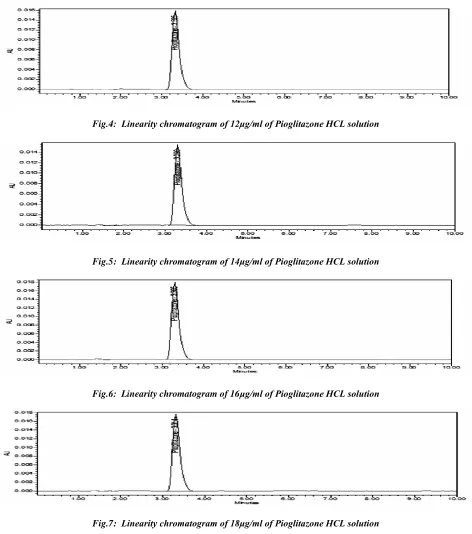
3569 Fig.4: Linearity chromatogram of 12μg/ml of Pioglitazone HCL solution
Fig.5: Linearity chromatogram of 14μg/ml of Pioglitazone HCL solution
Fig.6: Linearity chromatogram of 16μg/ml of Pioglitazone HCL solution
Fig.7: Linearity chromatogram of 18μg/ml of Pioglitazone HCL solution
Table 3. Accuracy results
Concentration
(μg/ml) Standard+ Sample Peak area % Recovery %RSD
50
4+6 4+6 4+6
136898 136798 136698
99.65 99.53
99.41 0.07
100
8+6 8+6 8+6
196143 196243 196343
100.07 100.19
100.31 0.05
150
12+6 12+6 12+6
243497 243397 243597
98.78 98.66
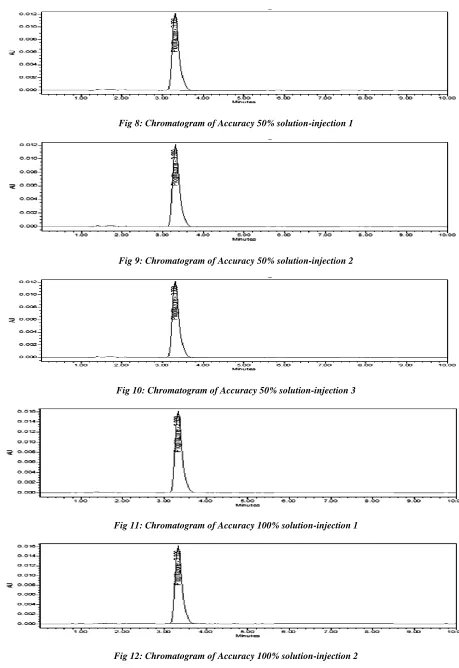
Fig 8: Chromatogram of Accuracy 50% solution-injection 1
Fig 9: Chromatogram of Accuracy 50% solution-injection 2
Fig 10: Chromatogram of Accuracy 50% solution-injection 3
Fig 11: Chromatogram of Accuracy 100% solution-injection 1
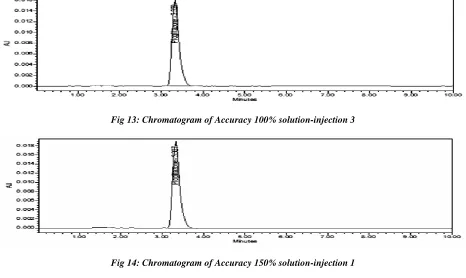
3571 Fig 13: Chromatogram of Accuracy 100% solution-injection 3
Fig 14: Chromatogram of Accuracy 150% solution-injection 1
Fig 15: Chromatogram of Accuracy 150% solution-injection 2
Fig 16: Chromatogram of Accuracy 150% solution-injection 3
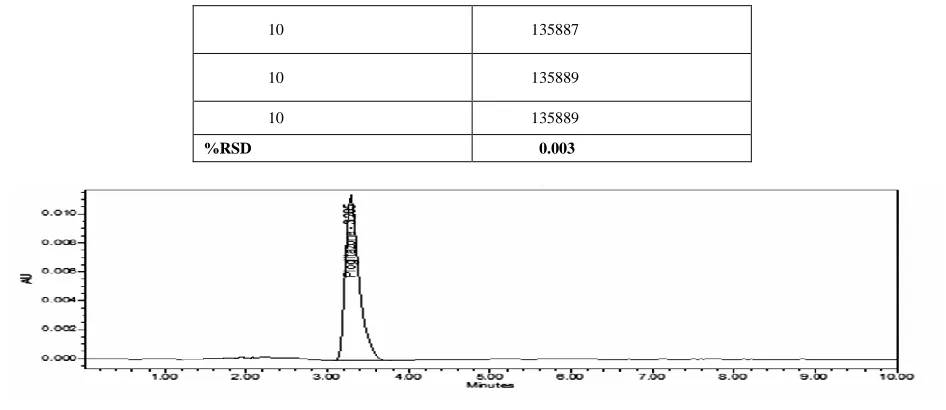
Table 4: Results of Intraday precision
Concentration (μg/ml) Peak area
10 135898
10 135898
10 135887
10 135889
10 135889
%RSD 0.003
Fig 17. Intraday precision chromatogram (10μg/ml)-injection 1
Fig 18: Intraday precision chromatogram (10μg/ml)-injection 2
Fig 19: Intraday precision chromatogram (10μg/ml)-injection 3
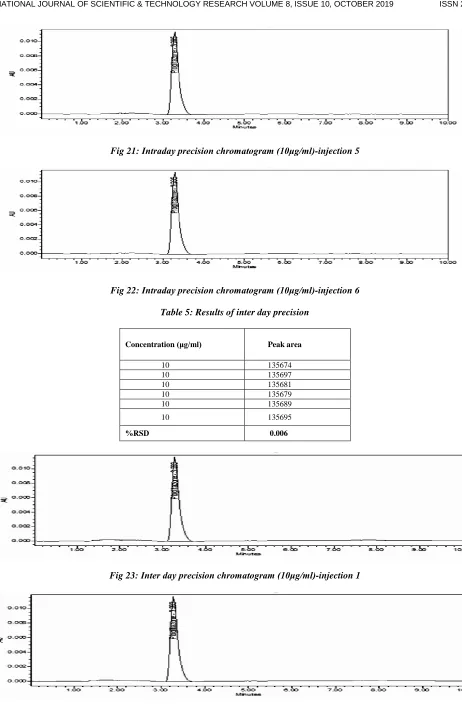
3573 Fig 21: Intraday precision chromatogram (10μg/ml)-injection 5
Fig 22: Intraday precision chromatogram (10μg/ml)-injection 6
Table 5: Results of inter day precision
Concentration (μg/ml) Peak area
10 135674
10 135697
10 135681
10 135679
10 135689
10 135695
%RSD 0.006
Fig 23: Inter day precision chromatogram (10μg/ml)-injection 1
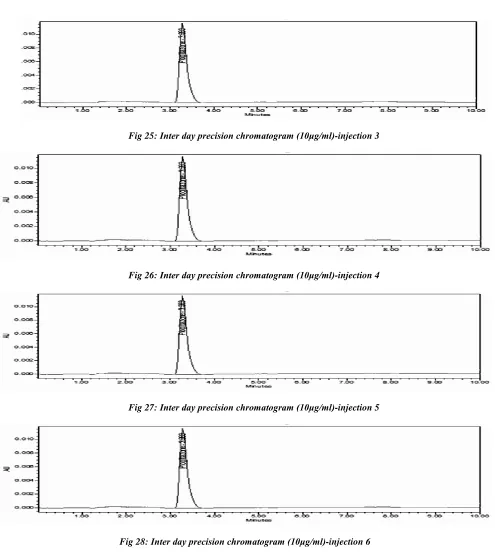
Fig 25: Inter day precision chromatogram (10μg/ml)-injection 3
Fig 26: Inter day precision chromatogram (10μg/ml)-injection 4
Fig 27: Inter day precision chromatogram (10μg/ml)-injection 5
Fig 28: Inter day precision chromatogram (10μg/ml)-injection 6
Table 6: Results of robustness (change in flow rate)
Concentration(μg/ml) Flow rate
0.9ml/min 1.1ml/min
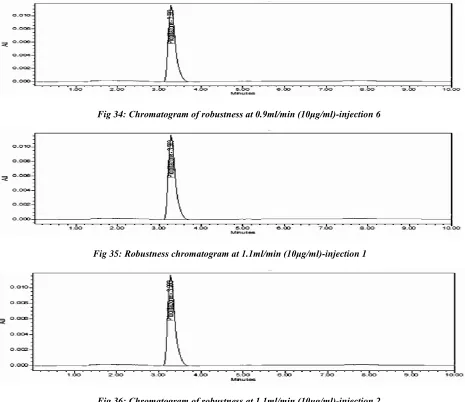
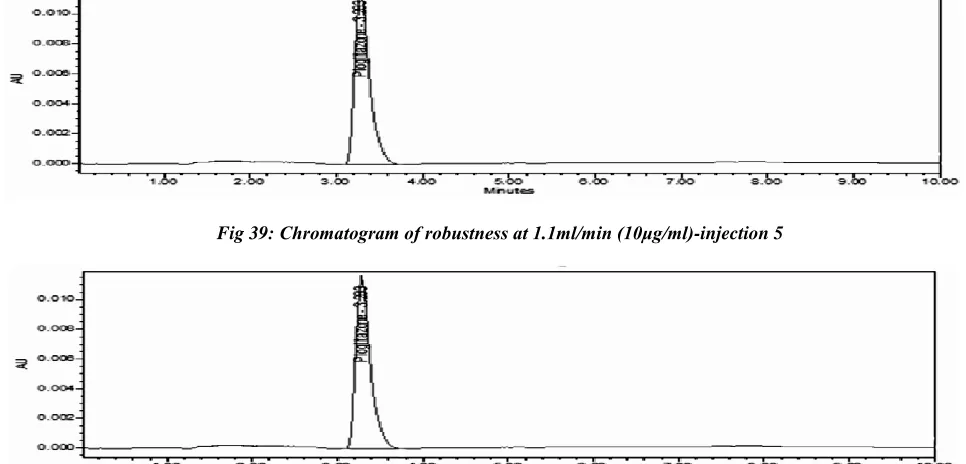
10 134417 138987
10 134411 138988
10 134419 138987
10 134415 138984
10 134417 138985
10 134419 138986
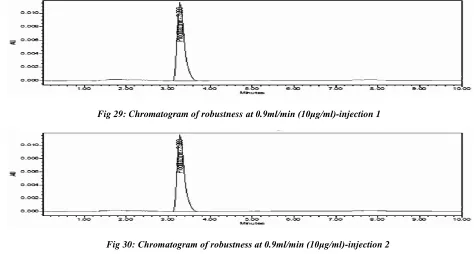
3575 Fig 29: Chromatogram of robustness at 0.9ml/min (10μg/ml)-injection 1
Fig 30: Chromatogram of robustness at 0.9ml/min (10μg/ml)-injection 2
Fig 31: Chromatogram of robustness at 0.9ml/min (10μg/ml)-injection 3
Fig 32: Chromatogram of robustness at 0.9ml/min (10μg/ml)-injection 4
Fig 34: Chromatogram of robustness at 0.9ml/min (10μg/ml)-injection 6
Fig 35: Robustness chromatogram at 1.1ml/min (10μg/ml)-injection 1
Fig 36: Chromatogram of robustness at 1.1ml/min (10μg/ml)-injection 2
Fig 37: Chromatogram of robustness at 1.1ml/min (10μg/ml)-injection 3
3577 Fig 39: Chromatogram of robustness at 1.1ml/min (10μg/ml)-injection 5
Fig 40: Chromatogram of robustness at 1.1ml/min (10μg/ml)-injection 6
Table 7: Results
Validation parameters Results
Linearity range (μg/ml) 10-18 Correlation coefficient (r2) 0.999
Precision (%RSD) Intraday -0.003 Inter day-0.006
Accuracy (recovery)
50%:-99.41-99.65 100%:-100.07-100.31 150%:-98.66-98.90
Robustness (%RSD) Flow rate:-0.9ml/min-0.002 1.1ml/min-0.001
LOD 0.005
LOQ 0.001
CONCLUSION
The estimation of Pioglitazone hydrochloride was done by RP-HPLC. The mobile phase was composed of methanol and water in the ratio of 75:25 with flow rate of 1ml/min. The detection vas carried out by using UV detector at 268nm. The retention time of pioglitazone hydrochloride was 3.28mins.The results of validation parameters are within the limits. Therefore this method can be employed for routine laboratory analysis.
Acknowledgment:
I would like to express my deep gratitude to Prof.M.Sumakanth, Ph.D, Principal, RBVRR Womens College of Pharmacy, Hyderabad, India. I would like to extend my thanks to Dr.K.Bhavya sri and R.Swetha sri, RBVRR Womens College of Pharmacy, Hyderabad, India.
REFERENCES:
[1] Sharmila begum shaik (2014) Analytical method development and validation of pioglitazone hydrochloride by RP-HPLC (Journal of chemical and pharmaceutical research) sssvolume 6(6), pg.no:16-21 [2] Madhukar (2011) Rapid and sensitive RP-HPLC
analytical method development and validation of
pioglitazone hydrochloride (Scholars research library) volume 3(3), Pg.no:128-132.
[3] Rama Krishna kommanna (2013) Development and validation of HPLC and UV spectrophotometric methods for determination of pioglitazone hydrochloride in bulk and its formulation (Scholars research library) volume 5(1), pg.no:269-278
[4] D.Srinivasulu (2010) Development and validation f new RP-HPLC method for determination of pioglitazone hydrochloride in pharmaceutical dosage forms,(International journal of chemistry research) volume 1(1), Pg.no 18-20.
[5] Dhirender singh (2011) Development and validation of a HPTLC method for estimation of Pioglitazone in bulk and tablet dosage form (Journal of pharmacy research) volume 4(11), Pg.no 3919-3921.
[6] N.Satheesh kumar (2014) Pioglitazone: A review of analytical methods (Journal of pharmaceutical analysis) volume 4(5), Pg.no:295-302
[8] Safwan ashour (2015) Development and validation of stability indicting HPLC method for quality control of Pioglitazone hydrochloride (Canadian chemical transactions) volume 3(1), Pg.no: 1-11.
[9] Smita Sharma (2010) Study of stressed degradation behavior of Pioglitazone hydrochloride in bulk and pharmaceutical formulation by HPLC assay method (Journal of optoelectronics and biomedical materials) volume 1(1), Pg.no: 17-24.
[10] Dr. Amit kumar Sharma (2016) A review on analytical methods of Pioglitazone drug (World journal of pharmaceutical research) volume 5(11), Pg.no:517-537. [11] Agha zeeshan (2017), HPLC method development,
validation and its application to investigate in vitro effect of pioglitazone on the availability of H1 receptor antagonists (Journal of the association of arab universities for basic and applied sciences) volume-22, Pg.no: 70-75.
[12] G .Om reddy (2002), Determination of pioglitazone hydrochloride in bulk and pharmaceutical formulations by HPLC and MEKC methods (Journal of pharmaceutical and biomedical analysis) volume-23, Pg.no: 593-607.
[13] J.B.Meeker (2003), Quantitative determination of pioglitazone in human serum by direct injection high performance liquid chromatography mass spectrometry and its application to a bioequivalence study (Journal of chromatography bioanalytical technologies in the biomedical and life sciences) volume-795, Pg.no: 215-226.
[14] K.Ramulu (2010), Identification, isolation and characterization of potential degradation products in pioglitazone hydrochloride drug substance (Pharmazie) volume-65, Pg.no: 162-168.
[15] N.Rashmitha (2010), A validated stability indicating HPLC method for the determination of impurities in pioglitazone hydrochloride (Journal of pharmaceutical chemistry) volume-2, Pg.no: 426-433.
[16] N.Mahesh (2011), Enhancement of dissolution rate and formulation development of pioglitazone-a BCS class II drug (Journal of Pharma research) volume-4, Pg.no: 3862-3863.
[17] K.Yamashita (1996), High performance liquid chromatographic determination of pioglitazone and its metabolites in human serum and urine (Journal of chromatography bioanalytical technologies in the biomedical and life sciences) volume-677, Pg.no: 141-146.
[18] P.D Sethi (2007), High performance liquid chromatography, quantitative analysis of pharmaceutical formulations, volume-1
[19] Galen W. Ewing (1970), Instrumental methods of chemical analysis, Indian edition